Which Japanese cherry trees to choose depending on the size of your garden?
A selection of Japanese cherry trees suited to the space available in your garden or on your balcony
Contents
For a small garden or terrace, choose a compact flowering cherry such as Prunus incisa ‘Kojo-no-mai’. In a medium-sized garden, Prunus serrulata ‘Amanogawa’, with its narrow and columnar habit, allows you to enjoy beautiful spring flowering without taking up too much width. Large gardens can accommodate more substantial varieties, such as ‘Kanzan’, which has a spreading crown and produces a profusion of pink flowers. The choice of a sakura depends mainly on its width at maturity, its habit and the space available around it.
Key points to remember
|
Which flowering cherry habit suits your space?
To best integrate a flowering cherry, known as sakura in Japan, into your garden, on your patio or balcony, it is essential to anticipate its shape at maturity. Its habit determines the space it occupies and the tree’s visual impact in the landscape:
- Compact, bushy habit: growth remains limited (under 2.50 m). This habit is suitable for small urban gardens, rockeries or growing in a container on a patio.
- Upright, fastigiate or columnar habit: the branches grow vertically along the trunk. This habit is recommended for narrow spaces in the open ground, for example between a path and a boundary wall.
- Spreading or flared habit: the branches gradually widen with age, eventually forming a dome or fan. The spread often equals or exceeds the height of the tree, requiring an open position.
- Weeping habit: its flexible main branches trail towards the ground. Highly attractive, this shape requires an open circular space around the trunk to showcase the cascade of flowers.
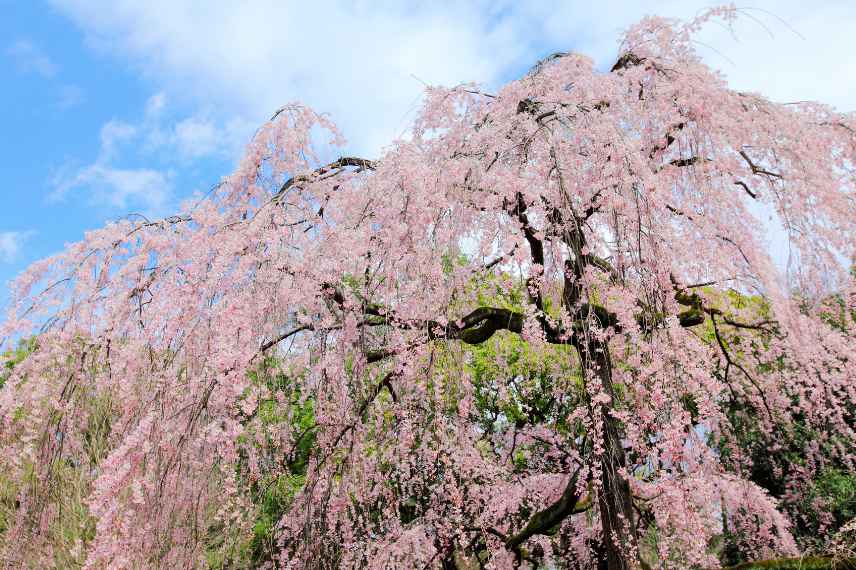
Some Sakura varieties have a weeping habit.
Growing reminder: growth rate varies according to the species and cultivars. Japanese cherry trees do not tolerate late transplanting or severe pruning well. It is therefore best to choose the right variety when planting rather than relying on repeated pruning to control its size.
Which flowering cherry should you choose for the size of your garden?
| Variety | Silhouette and habit | Dimensions | Flowering period and colour | Recommended setting |
| Prunus incisa ‘Kojo-no-mai | Compact, bushy and twisted | 2.50 m x 2 m | Small single flowers, pinkish white with a red centre (March-April) | Balcony, terrace, pocket garden of less than 10 m² |
| Prunus serrulata ‘Amanogawa’ | Columnar | 4 to 5 m x 1 to 1.50 m | Semi-double, fragrant soft pink flowers (April-May) | Small garden, informal hedge, avenue planting |
| Prunus ‘Kanzan’ | Spreading, then forming a broad dome | 6 m x 4 m | Large double pompom flowers, vivid magenta pink (April-May) | Medium to large garden, specimen tree |
| Prunus yedoensis | Rounded and spreading crown | 8 to 10 m x 6 to 8 m | Single pinkish white, fragrant flowers (March-April) | Large garden, park |
| Prunus ‘Tai-Haku’ | Spreading with a broad fan-shaped habit | 5 to 7 m x 7 m | Large single, pure white flowers (April) | Large garden, park |
| Prunus yedoensis ‘Ivensii’ | Weeping | 3 to 4 m in all directions | Highly fragrant single white flowers (March-April) | Small to medium-sized garden |
| Prunus ‘Royal Burgundy’ | Spreading | 4 to 5 m x 3 to 4 m | Double dark pink flowers (April-May) | Medium to large garden. Specimen tree on a lawn |
| Prunus incisa ‘Paean’ | Compact | 2 m in all directions | Small flowers in two shades of pink (March-April) | Small garden, container growing |
Our advice : do not choose a tree solely according to the size of your garden today. Also picture its silhouette in ten or twenty years, when its crown has grown larger. For a small plot, it is better to choose a naturally compact cultivar rather than to rely on repeated pruning.
Read also
Growing a Japanese cherry tree in a potWhich sakura should you choose for a small garden, patio or balcony?
In small gardens, on balconies or terraces, you must first consider the size of the branches as well as the root system. Choose dwarf cultivars or ones that do not exceed 2.50 metres in height and spread, with slow growth. They must also have excellent hardiness, especially when grown in pots:
- Prunus incisa ‘Kojo-no-mai’: this dwarf cherry tree, with a compact, rounded and bushy habit, reaches a height of just 2.50 m and a spread of around 2 m. It is appealing for its compact habit, as well as its highly attractive twisted appearance in winter. From the beginning of spring, it is covered with a multitude of single, pale pink flowers that become lighter as they open, before revealing flamboyant red autumn foliage.
- Prunus incisa ‘Paean’: this is a very compact cultivar, distinguished by its particularly generous and early flowering, displaying two shades of pink. Its foliage turns orange-red in autumn. With growth limited to around 2 m in all directions, ‘Paean’ is an alternative to ‘Kojo-no-mai’ for a small garden or growing in a large container.
- Prunus glandulosa ‘Rosea Plena’ and ‘Alba Plena’: these small shrubs measure around 1.20 to 1.50 m in all directions. They produce an abundance of very double pompom-like flowers, pink or pure white respectively. They are perfect for growing in pots where space is limited.
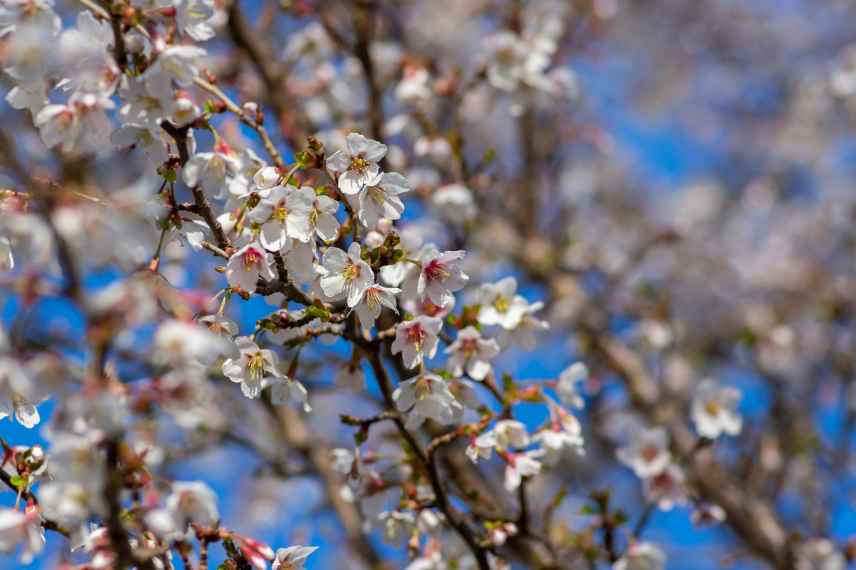
The ‘Kojo-no-mai’ variety is appealing for its compact habit and slightly twisted branches.
Planting advice: to keep a dwarf cherry tree on a balcony or terrace, use a container with drainage holes that is at least 40 to 50 cm in diameter and depth. Add a layer of clay pebbles at the bottom to ensure drainage, use quality potting compost enriched with compost, and water regularly, as the growing medium dries out quickly in a pot.
Which Japanese cherry trees should you choose for a medium-sized garden?
In a medium-sized garden, the aim is to add height without casting excessive shade over the garden. Choose trees measuring between 3 and 6 metres tall, with a spread that is more or less equivalent, and a columnar or compact weeping habit. A narrow cultivar allows you to enjoy beautiful flowering in a position where a spreading crown would be difficult to accommodate.
- Prunus serrulata ‘Amanogawa’: thanks to its strictly fastigiate habit, this Japanese cherry reaches 4 to 6 m in height, with a spread of just 1 to 1.50 m. It is the ideal solution for planting close to a boundary or along a path. In April, its upright branches become completely covered in delicately fragrant, pale pink semi-double flowers.
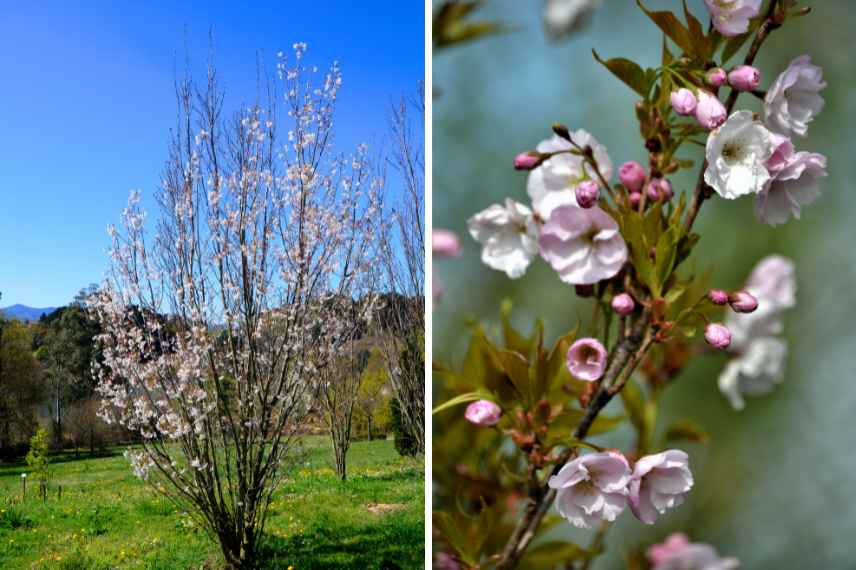
The variety ‘Amanogawa’ has a columnar habit that is ideal for small gardens
- Prunus ‘Accolade’: this horticultural hybrid has a semi-spreading, bushy silhouette (4 to 5 m in all directions). Unlike ‘Amanogawa’, it needs space to spread sideways. It is prized for its very early flowering, from the end of March.
- Prunus serrulata ‘Royal Burgundy’: reaching 4 to 5 m in height with a spread of 3 to 4 m, this cultivar is characterised by dark purple foliage throughout the season, creating a striking contrast with its dark pink double flowers in spring.
- Prunus serrulata ‘Kanzan’: this is the most widely grown Japanese cherry. Its habit is initially spreading, forming a dome 6 m tall and 4 to 5 m wide. Its abundant double magenta-pink flowers open in April-May.
- Prunus serrulata ‘Tai-Haku’: this large white-flowered cherry is a legendary cultivar that forms a vigorous tree with a spreading habit and a very broad, fan-shaped crown (5 to 7 m tall and 7 m wide). It is characterised by single, brilliantly white flowers up to 6 cm in diameter, opening at the same time as young copper-coloured shoots.
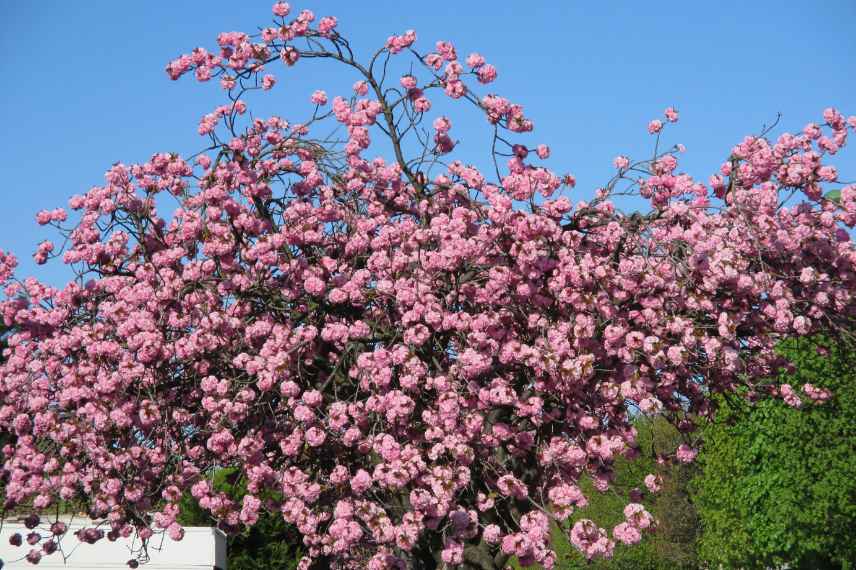
The Japanese cherry variety ‘Kanzan’ has an upright habit before spreading with age.
Which flowering cherries should you choose for a large garden or park?
In large spaces, it becomes possible to plant arborescent cultivars with broad crowns, requiring more than 6 metres of spread.
- Prunus serrulata ‘Tai-Haku’ (the large white-flowered cherry): this cultivar forms a vigorous tree 5 to 7 m tall and 7 m wide. Its fan-shaped, spreading crown requires a wide-open position. Its very large, pure white single flowers open at the same time as the young bronze leaves.
- Prunus yedoensis (Yoshino cherry): an iconic tree in Japanese parks, it develops a broad, rounded crown reaching 8 to 10 m in height and 6 to 8 m in spread. Before the leaves appear, its branches become covered in a profusion of delicately almond-scented, white-pink flowers.
- Prunus sargentii : reaching 7 to 8 m in all directions, this cherry is distinguished by its bright pink single flowers and, above all, by its autumn foliage, which turns a striking orangey red.
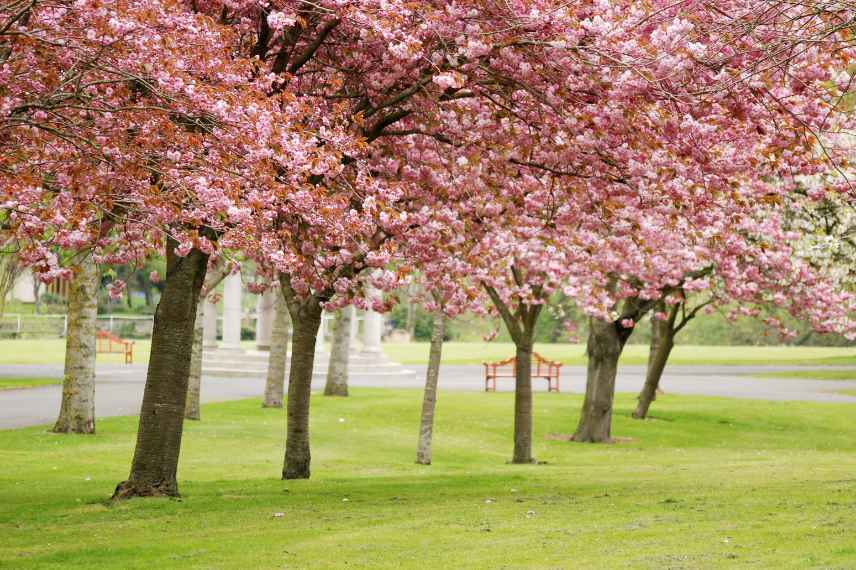
Prunus yedoensis is the iconic tree of Japanese parks.
FAQ
Can you grow a sakura in a pot on a balcony?
Yes, provided you choose a dwarf or slow-growing variety such as Prunus incisa ‘Kojo-no-mai’, Prunus incisa ‘Paean’ or Prunus glandulosa. A columnar flowering cherry such as ‘Amanogawa’ should not be grown in a container long term because of its height (more than 4 metres) and its root system. In a pot, make sure you use a well-drained container, fertile potting compost and maintain regular watering, as the potting compost must not dry out completely in summer.
Which flowering cherry stays the smallest?
There is not just one miniature flowering cherry, but several very compact cultivars:
-
Prunus glandulosa (‘Rosea Plena’ and ‘Alba Plena’) remains the smallest, reaching only 1.20–1.50 m.
-
Prunus incisa ‘Paean’ reaches around 2 m in all directions.
-
Prunus incisa ‘Kojo-no-mai’ generally settles at between 2 m and 2.50 m at maturity.
How long does a sakura flower for?
Flowering on a Japanese cherry usually lasts one to three weeks. This varies according to the variety, but also depends on the weather: strong winds, rain or high temperatures hasten petal drop.
Does a Japanese cherry need pruning?
No, routine pruning is not recommended. Japanese cherry (Prunus) naturally develops a balanced, harmonious shape without human intervention. In addition, like all stone-fruit trees in the genus Prunus, it responds very poorly to severe pruning. If pruning is necessary to remove dead wood or a broken branch, carry out light pruning just after flowering, applying a tree wound dressing to any sizeable wounds.
- Subscribe!
- Contents
This form is protected by reCAPTCHA - the Google Privacy Policy and Terms of Service apply.

































Comments