
Climate zones and USDA zones in France
Choosing the right plants with confidence
Contents
France is well known for the extraordinary diversity of its landscapes, but also of its climates. Indeed, although our country generally enjoys a temperate climate, there are significant differences in temperature and rainfall from one region to another… In nature, this results in fairly specific flora and, in gardens, in the need to choose suitable plants: particularly hardy plants that can withstand the cold, or that grow better in a mild, damp climate…
This information appears in all our plant descriptions, but understanding it is not always easy because we use USDA hardiness zones.
I would therefore like to take a closer look at the climate zones in France, as well as how they correspond to USDA hardiness zones, so that you can choose plants suited to your garden’s climate!
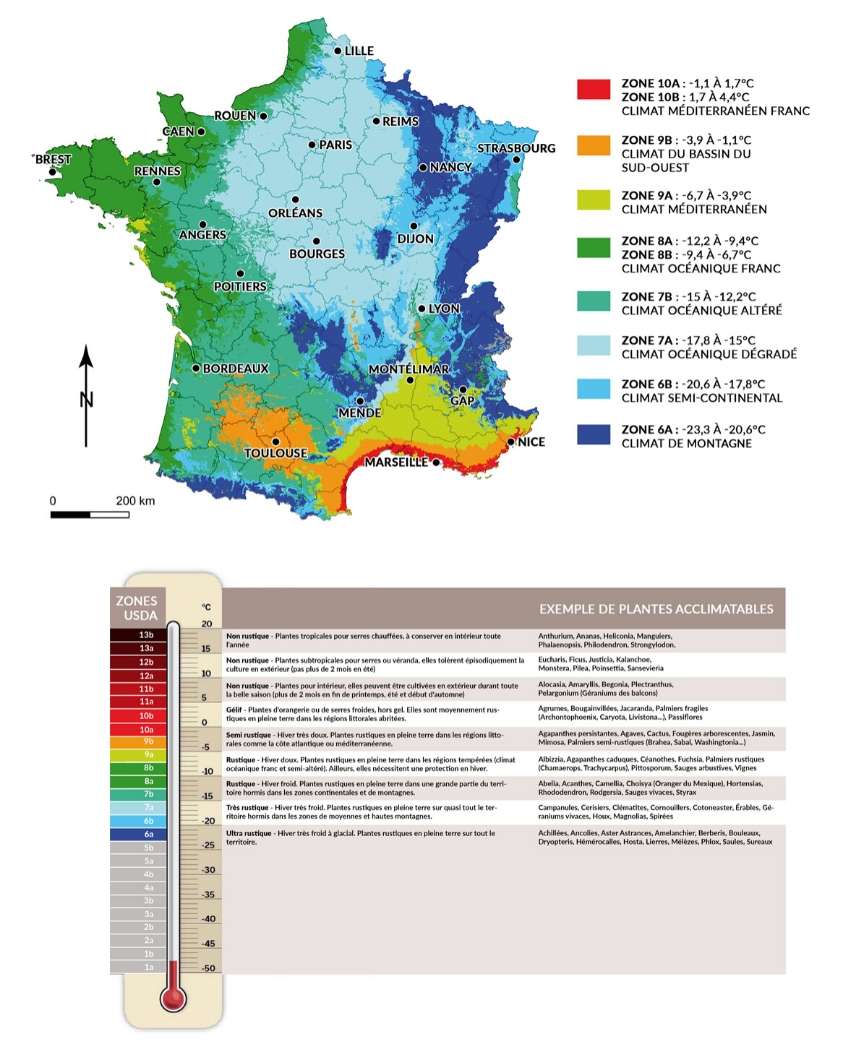
Climate Map of France + USDA Zones
Read also
Hardy plants and hardinessUSDA hardiness zones
The concept of USDA zones is American; it was created by the United States Department of Agriculture (U.S. Department of Agriculture, hence the name USDA). It is a geographical division into 26 isothermal zones based on the average minimum temperatures recorded over the last 20 years. In practical terms, these indicators show the “likely minimum temperature” that your region will experience in winter, which is fundamental when discussing hardiness!
This approach to hardiness zones is used in many countries, including France. USDA zones have the advantage of being fairly precise and are widely used throughout the world. The scale comprises 26 levels, but in France only 10 are used, from zone 6a to zone 10b.
Summary table:
| Climate type | USDA zone |
| Type 1 Mountain climate | Zone 6a: -23.3 to -20.6 °C |
| Type 2 Semi-continental climate and mountain-margin climate | Zone 6b: -20.6 to -17.8 °C |
| Type 3 Degraded oceanic climate of the central and northern plains | Zone 7a: -17.8 to -15 °C |
| Type 4 Modified oceanic climate | Zone 7b: -15 to -12.2 °C |
| Type 5 True oceanic climate | Zone 8a: -12.2 to -9.4 °C |
| Zone 8b: -9.4 to -6.7 °C | |
| Type 6 Modified Mediterranean climate | Zone 9a: -6.7 to -3.9 °C |
| Type 7 South-West Basin climate | Zone 9b: -3.9 to -1.1 °C |
| Type 8 True Mediterranean climate | Zone 10a: -1.1 to 1.7 °C |
| Zone 10b: 1.7 to 4.4 °C |
Discover other Climbers
View all →
Available in 0 sizes

Available in 0 sizes
Available in 0 sizes
Available in 0 sizes

Available in 0 sizes
Available in 0 sizes
Available in 0 sizes

Available in 1 sizes

Available in 2 sizes
Available in 1 sizes
Type 1: Mountain climates – USDA Zone 6a
Mountain climates are fairly diverse and are found throughout almost all of France: the Pyrenees, Massif Central, Alps, Jura, Morvan and Ardennes, as well as, at lower altitudes, the uplands to the east of Champagne and parts of Lorraine and Franche-Comté…
In these geographical areas, there is:
- a high number of days with precipitation and a high total amount of precipitation (rain, snow…)
- an average temperature below 9.4°C, with more than 25 days when the minimum temperature fell below -5°C, and fewer than 4 days when the maximum temperature exceeded 30°C.
- Maximum year-on-year variability in July rainfall and winter and summer temperatures.
→ This climate corresponds to USDA Zone 6a (recorded minimum temperatures: -23.3 to -20.6°C)
Read also
10 very hardy, frost-resistant treesType 2: the semi-continental climate and the climate of montane margins – USDA Zone 6b
Climate type 2 is an intermediate climate between mountain climates and climate types 3, 4 and 8. The area affected by this climate includes the foothills and extends across large areas of Burgundy, Lorraine and Alsace.
In these areas:
- temperatures are less cold than in the mountains (but, at the same altitude, colder than anywhere else),
- rainfall is slightly lower and less frequent,
- there is a low ratio between autumn and summer rainfall
→ This climate corresponds to USDA zone 6b (recorded minimum temperatures: -20.6 to -17.8°C)

Type 3: the modified oceanic climate of the plains of central and northern France – USDA Zone 7a
Climate type 3 covers the whole of the Paris Basin, extending southwards (the middle Loire Valley, the northern Massif Central and the Saône Valley).
The climate remains oceanic, but with marked variations:
- temperatures are intermediate (around 11 °C on average annually, with between 8 and 14 days when temperatures fall below -5 °C).
- Rainfall is low (less than 700 mm annually), particularly in summer, but rain falls on an average of 12 days in January and 8 days in July, with these figures averaged across France.
- Interannual variability in rainfall is minimal, whereas temperature variability is high.
→ This climate corresponds to USDA Zone 7a (recorded minimum temperatures: -17.8 to -15 °C)
Type 4: Altered oceanic climate – USDA Zone 7b
Climate type 4, altered oceanic climate, appears as a transition between fully oceanic climate (type 5) and degraded oceanic climate (type 3). Between Nord-Pas-de-Calais and Normandy, it forms a narrow band, while in the west this transition widens to more than 150 km. This climate also affects the south-western Massif Central, from Dordogne to Aveyron, and the northern Pyrenees.
The characteristics:
- the mean annual temperature is fairly high (12.5 °C), with few cold days (between 4 and 8 per year) and a high number of hot days (between 15 and 23 per year).
- The annual temperature range (July-January) is close to the minimum, and interannual variability is average.
- Rainfall, average in terms of annual totals (800-900 mm), occurs mainly in winter, while summer is fairly dry.
→ This climate corresponds to USDA zone 7b (recorded minimum temperatures: -15 to -12.2 °C)
Type 5: The true oceanic climate – USDA Zones 8a and 8b
Oceanic climate occupies a narrow strip along the North Sea coast and covers Normandy, Brittany, Vendée and the Charentes. A limited oceanic area extends across the west of the heathland and Pyrénées-Atlantiques.
In these areas:
- temperatures are moderate and very even: the annual range (less than 13°C difference between July and January), the number of cold days (fewer than 4) and hot days (fewer than 4), and interannual variability are all minimal.
- Rainfall is abundant annually (just over 1,000 mm) and frequent in winter (more than 13 days in January).
- summer is also rainy (8–9 days in July), but total rainfall is lower.
- oceanic climate is also characterised by considerable interannual variation in winter rainfall.
→ This climate corresponds to USDA zones 8a and 8b (recorded minimum temperatures: -12.2 °C to -6.7 °C)

Type 6: Modified Mediterranean climate – USDA Zone 9a
The altered Mediterranean climate extends mainly across the southern Alps and Pre-Alps, encompassing most of the two départements of Alpes-de-Haute-Provence and Drôme. It can also be found in a few pockets on the left bank of the Rhône, around Ardèche, and in the form of a narrow strip to the west, between Pyrénées-Orientales and Hérault.
The characteristics:
- high average annual temperatures, with few cold days and between 15 and 23 hot days per year.
- minimal year-to-year variability in July temperatures: summer is consistently hot from one year to the next.
- medium total annual rainfall (800-950 mm), but it is not evenly distributed.
- autumn and winter are wet and highly variable from one year to the next, unlike summer, which is dry and stable according to the 1971-2000 climate normal.
→ This climate corresponds to USDA zone 9a (recorded minimum temperatures: -6.7 to -3.9 °C)
Type 7: The Climate of the South-West Basin – USDA Zone 9b
This type of climate concerns a geographically disparate area spanning several regions (Aquitaine, Languedoc) and centred on the middle Garonne basin, referred to for convenience as the “South-West Basin”.
It is characterised by:
- a high annual average temperature (above 13 °C) and a high number (> 23) of hot days, while days with frost below -5 °C are rare.
- a high annual temperature range (15 to 16 °C) and low interannual variability in winter and summer temperatures.
- Rainfall is low in terms of the annual total (less than 800 mm) and in winter, but is slightly higher during the summer. It is more frequent in winter (9–11 days) than in summer (fewer than 6 days). This distribution indicates that rainfall intensity is low in winter (oceanic rainfall) and higher in summer (thunderstorms coming from Spain or the Bay of Biscay). Interannual rainfall variability is medium.
→ This climate corresponds to USDA zone 9b (recorded minimum temperatures: -3.9 to -1.1 °C)
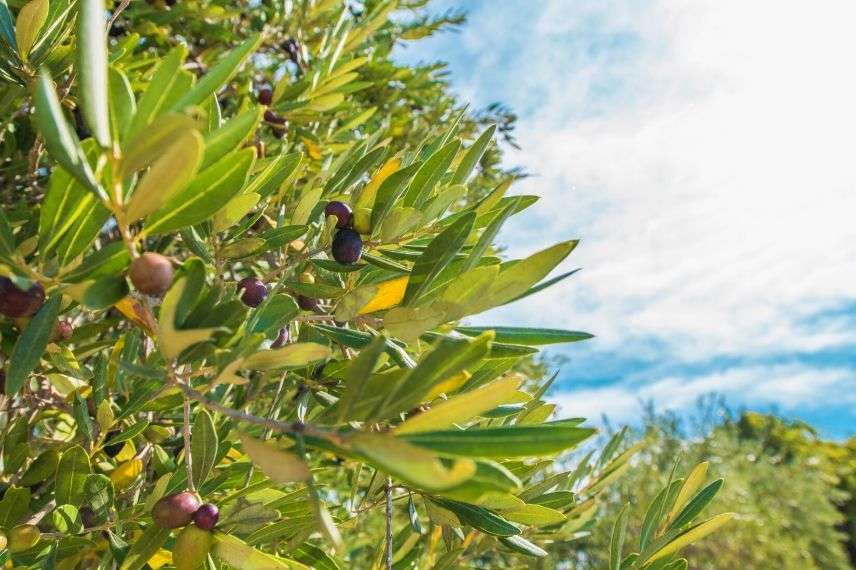
Type 8: Clear Mediterranean climate – USDA Zones 10a and 10b
This climate occupies a strip just under one hundred kilometres wide around the Mediterranean Sea, from the Pyrenees to the Var. Beyond this, in the Alpes-Maritimes, the Mediterranean climate becomes so narrow that it eventually appears only sporadically within the Alpine valleys.
The climatic characteristics are very pronounced, more so than in each of the seven previous climates.
- annual temperatures are high, cold days are extremely rare and hot days are frequent.
- The annual temperature range is high (more than 17 °C between July and January), while these characteristics are very stable from one year to the next.
- The very high ratio between autumn rainfall and summer rainfall (> 6) is the main characteristic of this climate. Annual rainfall totals are low, with a dry summer but a rather wet winter despite the low number of rainy days. These characteristics are also stable from one year to the next.
→ This climate corresponds to USDA zones 10a and 10b(recorded minimum temperatures: -1 °C to +4.4 °C)
Find out more
Discover our advice sheet: Hardy plants and hardiness.
- Subscribe!
- Contents
This form is protected by reCAPTCHA - the Google Privacy Policy and Terms of Service apply.


































Comments