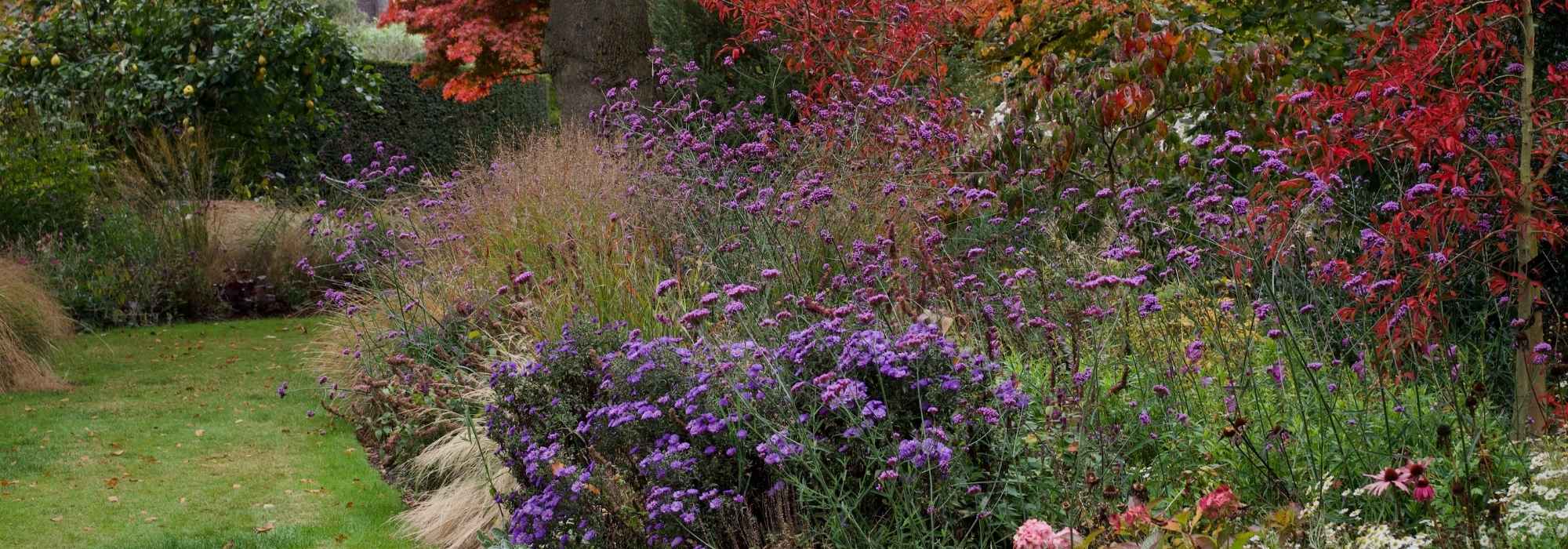
How to prepare a garden in autumn to make it more drought-resistant the following summer?
4 priorities for preparing your garden for heatwaves and increasingly dry summers
Contents
Preparing for increasingly scorching summers is set to become one of our concerns, and it starts in autumn! This season, which is ideal for planting, is becoming the key time to get the garden ready to face the hot months a few months later. From preparing the soil and planting to choosing the best drought-tolerant plant species, here’s our autumn programme to help your garden thrive next year.
How to water your garden less next summer
|
How can you help your soil retain moisture from autumn onwards to combat drought?
1- Work the soil to help it retain moisture
Giving the plants in a garden the best possible chance all comes down to the soil and how it is prepared. We should not forget that too quickly. This applies in “ordinary” times, if you can call them that, and even more so with climate change.
Because, if water is life, soil, the fixed support for plants rooted in place, is what determines their growth and resilience, beyond the differences between plants that thrive in dry soil and others (I’ll come back to this a little later in the article). In the wake of the repeated heatwaves of summer 2026, gardeners are rethinking things: well-drained soil, often recommended for many common plants in France, will need to be reconsidered. The soil must still be sufficiently free-draining, but it must not let water run off too quickly! On sandy soil that does not retain water, for example, we can try adding more organic matter than before. On clay soil, which has the advantage of retaining moisture, we can improve the surface structure. In spring, only work organic matter into the surface layer.
Organic amendments are more than useful here: they can help us. In this respect, we will increasingly take inspiration from permaculture gardening techniques, which are simply age-old ways of working with the soil. Applied in autumn and breaking down over winter, a layer of organic matter will improve the soil structure and encourage soils that are too free-draining to retain water better and allow it to penetrate. After all, soil rich in humus absorbs water better and stores it for longer. Compost, a layer of fallen leaves and manure for the vegetable garden are all easy-to-make treasures, which you can produce in your garden or collect nearby. The aim is to slow drainage around shrubs, trees and perennials that thrive in deep, humus-rich soil. Earthworms also work the soil, aerating it so it can absorb rainfall more readily, even though less rain now falls during the warmer months.
It is clear that this addition of organic matter is not suitable for so-called Mediterranean plants such as lavender or rockrose. Follow our specific advice in this article: How to enrich your soil naturally with organic amendments?
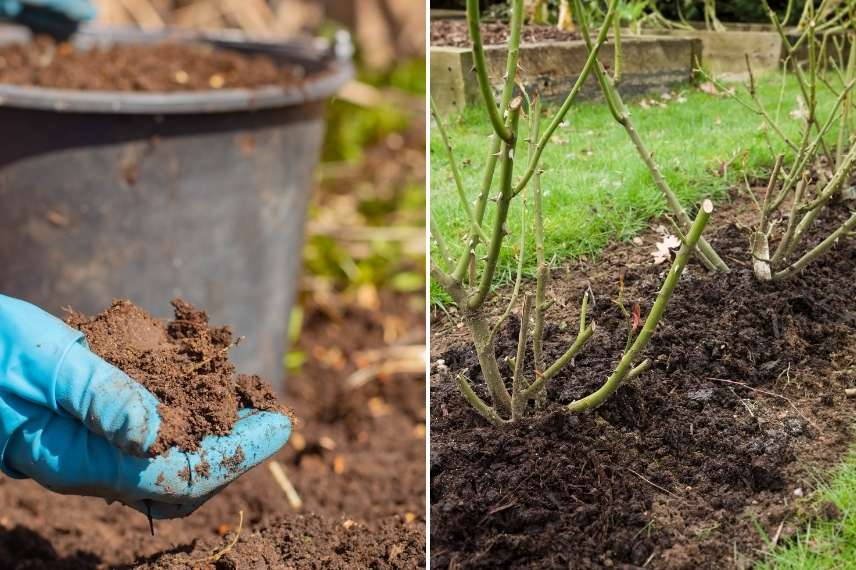
Adding compost is a valuable way to help the soil retain moisture
2- Mulching
We’re not done talking about mulching, because in these turbulent times in the garden, it is proving to be much more than an ally.
Covering the soil with fallen leaves, ramial chipped wood, any decomposed or dry organic matter, either on its own or in a mix, should be part of every gardener’s routine. Do this when planting or, from now on, in autumn to protect the soil. The aim is still to protect it from the cold, but above all to get ahead of spring and keep the soil moist for several months.
So, forget bare soil in beds. This means planning your gardening tasks so you can make your own mulch (buying enough for even a medium-sized garden is already too expensive).
Many of us do this, but some do not apply a thick enough layer, which is essential if you want to reap the benefits.
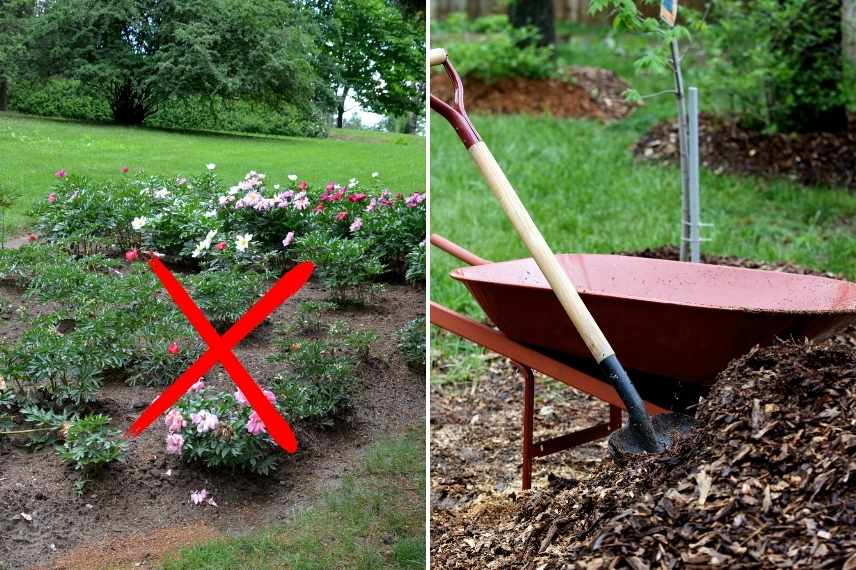
Bare soil, even in a bed of roses that cope rather well with drought… no!
Why has autumn become the norm for planting?
Rethinking the planting calendar is one of the other lessons we have learnt from repeated heatwaves. Autumn has already been the main planting season in our gardens for several years, for the simple reason that springs are becoming less and less wet and are now a borderline season for planting, except for very tender plants that are sensitive to the cold.
In most regions, and now for the vast majority of plants, autumn is THE planting season. For several months, during this dormant period, roots develop a better root system, especially in deciduous species, thanks to winter moisture and, above all, because the plant has no sap and nothing else to do! It will be better equipped to face its first spring or a very dry summer.
Planting must be done properly: this is the secret to success. Container-grown and bare-root plants each have their advantages. Autumn is the prime season for bare-root plants, which establish exceptionally well when planted correctly. Planting container-grown plants takes a little more effort. We explain everything in detail in How to plant a tree, How to plant a shrub in the garden? and For your planting, choose bare-root plants. In either case, do not neglect the planting hole or generous watering (even when it rains!). Create a watering basin, and apply a generous layer of mulch. These three steps are essential to anchor the plant in the ground and give it every chance to establish well.
Transplanting can also be beneficial for some plants that have proved particularly unable to cope with these heatwaves. They may be newly planted, or plants that prefer partial shade and will never thrive in their current position, which is too hot or lacks sufficient shade. Transplanting is a shock, but doing it in autumn allows some plants to flourish elsewhere in the garden, often in a more shaded spot (although you may find that flowering shrubs and perennials produce fewer flowers).
→ Find out more in our articles: The best times to plant; Transplanting perennials and grasses: how to move your plants successfully; How to transplant trees and shrubs successfully; and Mulching: how to protect young plants in the garden
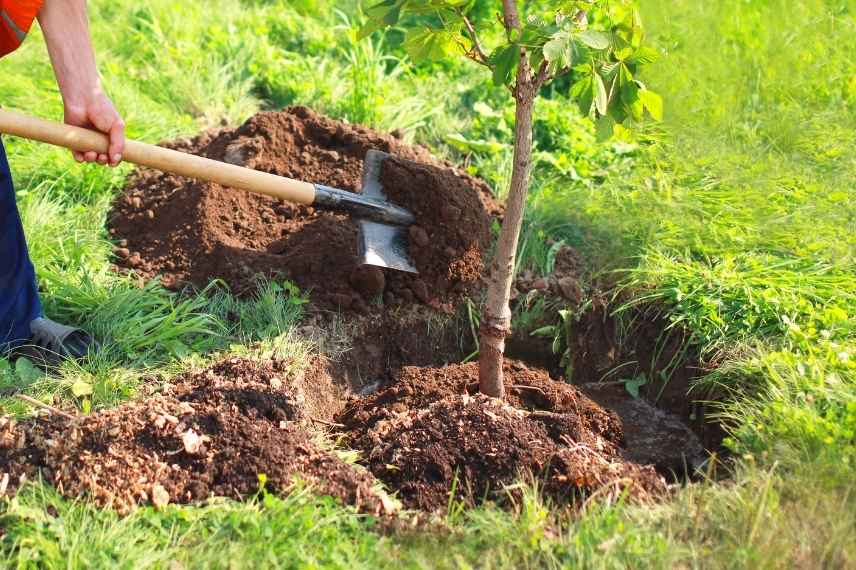
Autumn is becoming the norm for planting and preventing the devastating effects of dry summers
How can you create more shade in a garden to make it less vulnerable to drought?
The evidence is clear: shading gardens with few trees is becoming essential in the face of climate change. More specifically, we need to establish an upper or middle layer quickly, using trees and shrubs to create natural cast shade while increasing humidity, which benefits plants and shrubs growing below.
This protective layer must therefore be able to withstand high temperatures itself. The trees and shrubs to prioritise are those that grow quickly, as they can become established despite years of heatwaves. Depending on the site, climbing plants such as Virginia creeper, common hop or wisteria are another option. These are essential for shading pergolas over paved terraces, or covering walls that radiate a great deal of heat. In the vegetable garden, consider putting up a tall structure on at least one side in autumn, ideally the side most exposed to the heat. You can then plant a productive climber against it, for example.
Let’s not forget to create or extend windbreaks and hedges to limit wind-driven evaporation and desiccation. More broadly, creating green rooms enclosed by plants is one solution to consider in medium-sized to large gardens.
The downside of very fast-growing trees such as willows and poplars is that they are often thirsty and fragile, which is the opposite of what we want. The best strategy is to combine two trees: a long-lived but slow-growing tree, such as Mediterranean hackberry, downy oak or olive, for the next twenty years, alongside a faster-growing tree, such as a plane-leaved mulberry or a pollarded paulownia, to provide shade in the meantime.
For fast-growing trees and shrubs, look no further than Paulownia, plane-leaved mulberry (Morus kagayamae), Mediterranean hackberry (Celtis australis), tamarisk, scorpion vetch and butterfly bush. In all cases, choose plants with broad, dense canopies, and, above all, species that need little water once established. At this stage, it is worth planting in combinations that benefit one another, following the principles of a permaculture plant guild.
→ Read also: Fast-growing hedges: 10 shrubs that grow quickly; Light in the garden: aspect, sunshine, shade and brightness.

Creating or re-establishing an upper layer is a priority in the fight against drought
Which plants and vegetation should you choose that are resistant to both cold and drought?
In most regions of the country, we must now turn to plants from the garrigue, as well as pioneer plants and deep-rooting plants, which suffer less during heatwaves. Only regions with winters that are too wet will be unable to grow them.
When choosing new plants to replace those that have not survived the heatwave summers, or to add to your garden:
- Choose Mediterranean plants that are drought-tolerant but also hardy, as climate change is also bringing increasingly frequent cold snaps in midwinter: lavender, sage, rosemary, oregano, gaura, stonecrop, rock rose, yarrow, olive tree, strawberry tree… These are all so-called garrigue plants that are characteristically resistant to both heat and cold.
- Choose a few pioneer plants with deep roots (such as burdock), which break up the soil at depth and withstand dry conditions well.
- Group plants with similar water needs into zones (known as hydrozoning), so you can target watering where it is needed, limiting it to certain beds and borders and adjusting it as effectively as possible.
Our articles offer examples of some exceptionally resilient plants: 7 trees that withstand cold and drought; 7 shrubs that withstand cold and drought; 9 perennials that withstand cold and drought; Drought-resistant hedge shrubs; 5 hedge shrubs that withstand cold and drought; and Albizia and dry soils: an ornamental tree adapted to climate change.
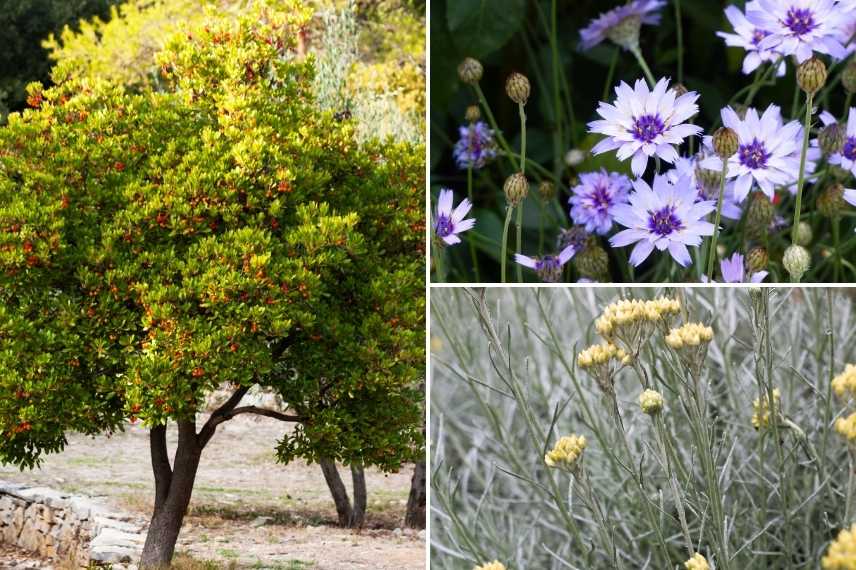
Strawberry tree, Catananche and Helichrysum italicum: three plants among the most resistant to heatwaves
Can you really get by without watering the following summer?
Is a garden without watering a fantasy or a possibility? In the context of climate change, as droughts and heatwaves become more intense and water restrictions become the norm in summer, it has become far more than a mere gardening curiosity: it is the way forward. Gardeners who began this transition ten years ago – with systematic mulching, Mediterranean plants and lawns replaced by ground-covering perennials – now have gardens that come through summer unscathed, while more traditional gardens burn up as early as June.
Storing water is still essential, and autumn is the time to think about it. You can buy rainwater collectors or water tanks and install them before the autumn and winter rains. Creating raised beds or retention pits is also worth considering in gardens with enough space.
Of course, one autumn is not enough to make a garden 100% drought-proof. But adopting these good habits will make it more resilient year after year, leaving us less at a loss at the end of catastrophic summers…
Find our detailed advice in How to design a garden with little or no watering; 10 drought-resistant perennial plants for a garden without watering; I visited… Jardin de la Grille, a garden without watering, and in our section dedicated to climate change.
Frequently asked questions about autumn gardening after a heatwave
Is it too late to save dry, cracked soil in autumn after a dry summer?
No, in fact, this is the only time when soil really repairs itself: dried-out soil becomes water-repellent, so water beads on the surface instead of soaking in. Lightly rake the surface, add compost and sow a green manure crop such as phacelia or oats. Frost and earthworms will do the rest, and the soil will absorb water much better from the following spring.
Do I still need to water if I choose drought-tolerant plants?
Yes, because a plant is only truly drought-tolerant once it is well established, which takes 2 to 3 years. In the first year, always water deeply once a week rather than a little every day. This encourages the plant to seek out water more independently. From the third year onwards, most of these plants need no watering at all.
What can I actually do in autumn if I have little time to spend in my garden?
If you can only do one thing, spend a weekend mulching. A 10–15 cm layer of wood chips or ramial chipped wood over the beds and around the base of trees is the garden task with the best effort-to-benefit ratio: it protects the soil from being compacted by winter rain, feeds soil life and already provides a reserve of moisture for June and July. If you have a little more time, plant shade trees and shrubs. And if you still have a little time to spare, buy and install a water butt before the autumn rains: it’s the piece of equipment everyone regrets not having put in place before summer.
- Subscribe!
- Contents
This form is protected by reCAPTCHA - the Google Privacy Policy and Terms of Service apply.

































Comments