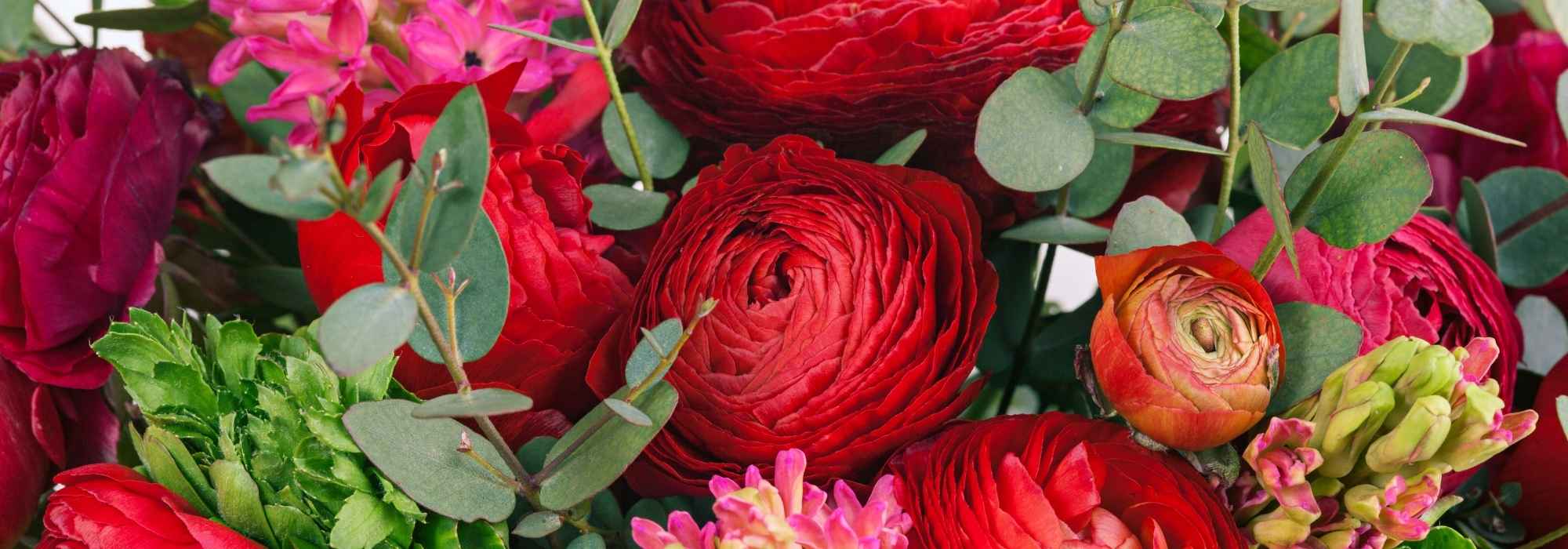
Which ranunculus to choose for creating beautiful bouquets at home?
Our favourite varieties to plant for creating your spring bouquets
Contents
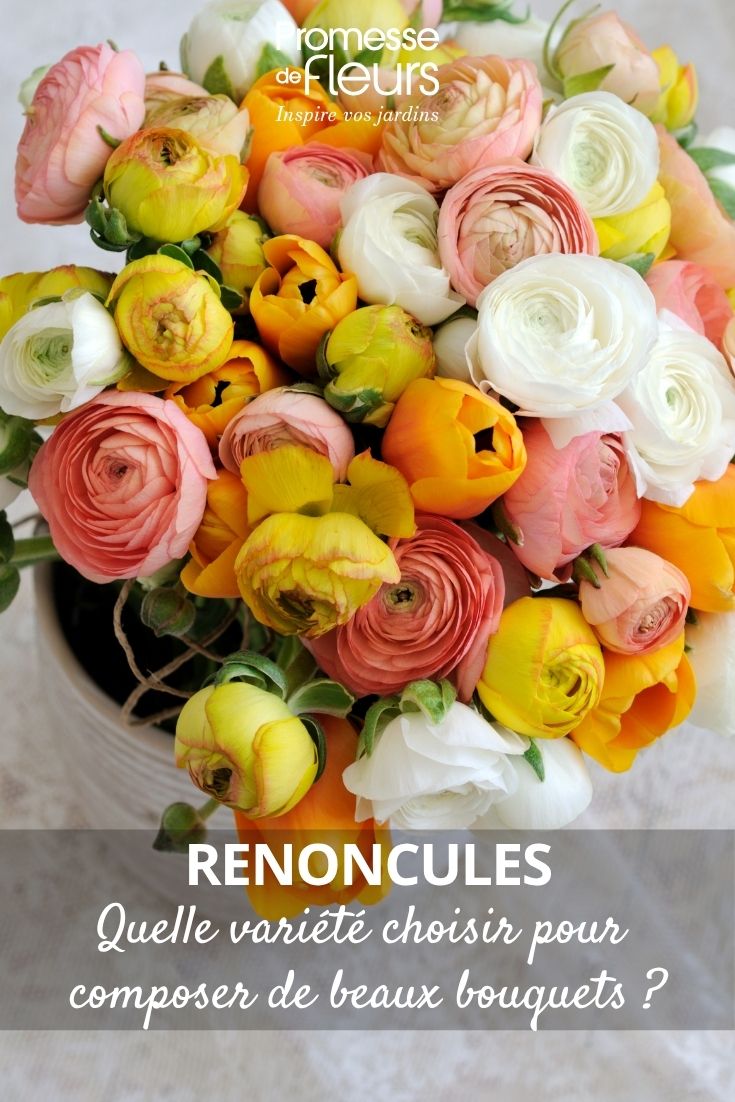
If there is one charming flower for bouquets, it is certainly the ranunculus! With dozens of petals and its soft or bright colours, it heralds the return of spring and allows you to create lovely bouquets. It is often planted in the garden for this very reason. Here are the most beautiful ranunculuses to consider for making your own spring bouquets. Arranged together or combined with other flowers, ranunculuses look stunning in spring bouquets!

For a pink bouquet
Many ranunculus are pink. They are perfect for creating the base of wonderfully feminine bouquets. To make yours, choose a few Persian buttercups from the “Romance” series, such as Ranunculus ‘Romance Seine’, a beauty in very fresh, rather pale pink shades, accompanied by a ranunculus in a deeper pink such as ‘Supreme Pink‘ or ‘Romance Orleans‘, edged with pink.
Add a few white or pink lisianthus to bulk out this bouquet for a June arrangement, or freesias, which flower at the same time as ranunculus, to add a fragrant note. No bouquet is complete without foliage! Here, the silvery foliage of eucalyptus is a great classic, which you can easily replace with ivy, mugwort or stems of weeping ornamental pear.
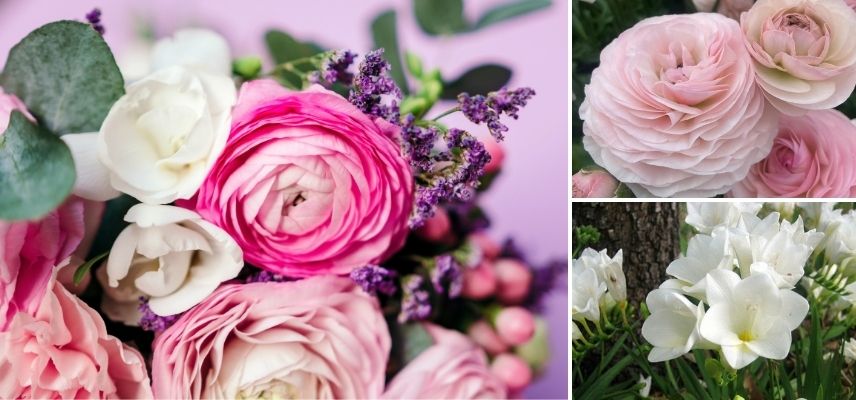
Ranunculus ‘Seine’ and white freesia
♥ Other options for a pink bouquet: mix in a few tulips ‘Angélique’ for a fuller bouquet, and add a few slender sprigs of statice.
For a romantic bouquet
Between pastel colours and delightfully powdery shades, romanticism really suits ranunculus. They can easily replace or blend with the first roses, sometimes even stealing the limelight. All pink ranunculus, as well as salmon-coloured ranunculus, are perfect for a bouquet with a romantic theme. A bride could choose this style if the big day falls between April and May, as most ranunculus will then be in flower.
For powdery and mauve combinations, pair Persian buttercup ‘Romance Nohant‘, in a highly refined pale coral shade, or Persian buttercup ‘Romance Orleans’ with a few masterwort, skimmias still in bud and a white or pink Leptospermum, as in the bouquet shown below.
A simpler, lighter arrangement will bring together a few other particularly graceful ranunculus, such as the pink Persian buttercup, or the unusual ranunculus ‘Brushmark Cesar’, intriguingly variegated with purplish pink.
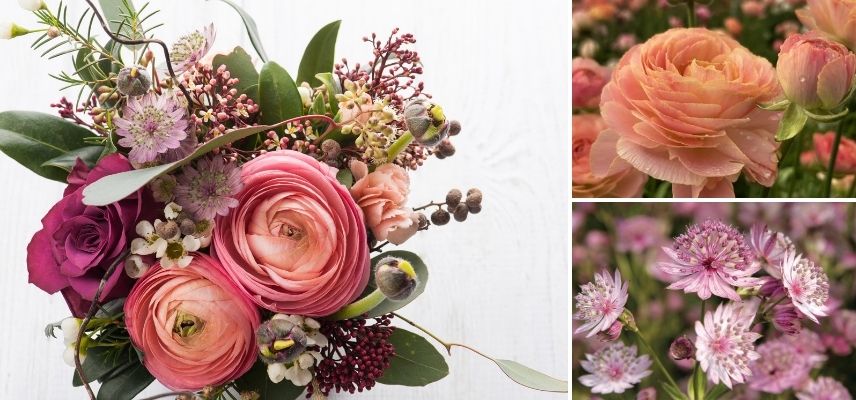
On the right, Ranunculus ‘Romance Nohant’ and masterwort ‘Buckland’
♥ Other options for a romantic bouquet: eucalyptus flowers, baby’s breath, (almost) all roses, with a preference for centifolia roses, and peonies, as well as the largest ranunculus flowers (from the Romance series).
For a monochromatic white bouquet
White bouquets have an elegance that is both understated and very contemporary.
They can be made solely from white ranunculus, choosing double-flowered varieties for a fuller effect, such as the double white Persian buttercup, with its adorable, very full flower, gradually revealing a golden yellow centre as the flower opens.
Another little marvel of delicacy, barely tinged with green, the Persian buttercup ‘Suprême Light Green’ also lends its freshness to deceptively simple bouquets. You can always add a few other equally charming white flowers to this type of bouquet, such as Narcissus ‘Petrel’ or beautiful, fragrant tuberose flowers late in the season. A few white-green snowball tree flowers will also look wonderful in this striking bouquet.
This bouquet is a beautiful option for an original and delicate bridal bouquet.
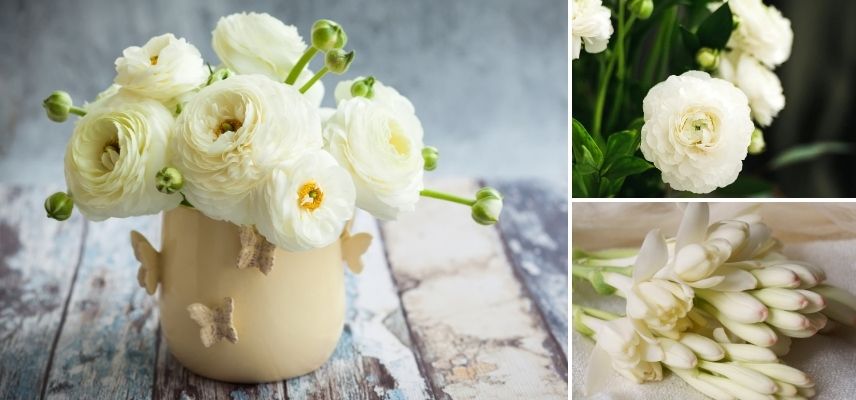
On the right, double white Persian buttercup and tuberose
♥ Other options for a white bouquet based on ranunculus: white will also look wonderfully chic in a pairing of ranunculus and De Caen anemones (‘The Bride’), or if you have a few white kalmias such as ‘Elf’ or ‘Zebulon’, flowering in May.
Spotlight on ranunculus
Why not simply arrange a few ranunculuses together? A bouquet made up of ranunculuses in a harmonious, tone-on-tone colour palette is a safe bet if you want to avoid getting it wrong! But you can also dare to use stronger contrasts and dark-coloured ranunculuses, ranging from purple-red to violet. The diversity and elegant simplicity of ranunculuses mean that they always work well together.
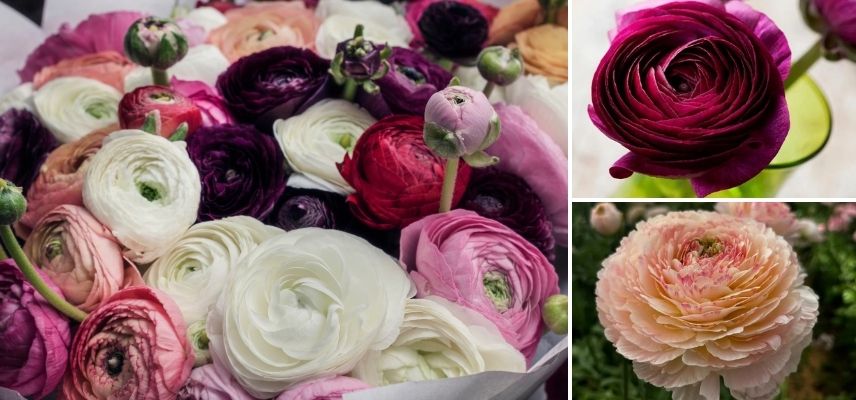
On the right, ranunculuses ‘Pauline Violet’ and ‘Romance Maritime’
Read also: How to choose a ranunculus and our complete guide to ranunculuses.
For a cheerful bouquet
Yellow and orange ranunculuses will be the stars of a brighter bouquet in spring, bringing a burst of energy into the home. They are often paired with tulips that are just as vibrant.
For this sunnier bouquet, rely on the speckled ranunculus ‘Café au Lait’, with its unique burnt-orange colour, as well as the wonderfully ruffled ranunculus ‘Poodle Mudassar‘, in a very bright orange, or the more classic ‘Romance Quimper‘ with its beautiful lemon-yellow flowers.
A predominantly red bouquet, almost baroque in style, will bring together ranunculuses ‘Romance Perigord’ and a few stems of more carmine ranunculuses, such as the double red ranunculus. It will be perfect in a pared-back interior, where it will attract every eye, or, on the contrary, in a country house.
♥ Combinations with a brightly coloured ranunculus bouquet: fringed or parrot tulips are ideal, as are a few fairly tall species tulips, such as the entirely yellow Tulipa greigii ‘Lemon Giant’. Green flowers will provide the essential neutral colour for this type of bouquet.
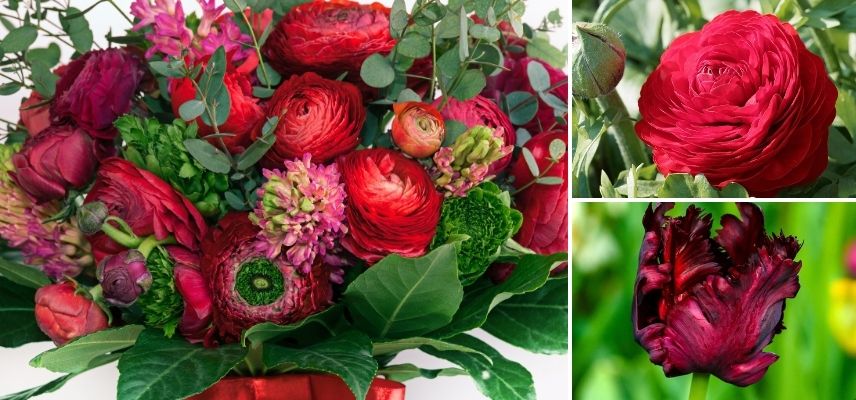
On the right, double red ranunculus and parrot tulip ‘Black Parrot’
For a bohemian bouquet
With their faded colours, certain Persian buttercups make their way into retro bouquets.
The Persian buttercup ‘Brushmark Verona’ will be the centrepiece of a wonderfully vintage bouquet, with its tightly packed petals that look crumpled, and its pinkish beige colour streaked with burgundy. As its flowers are large, it can afford to form a duo with a few peony flowers, such as the herbaceous peony ‘Nymphe‘ or ‘Madame Calot‘, which is paler. As in our example, surround these two floral beauties with a few heads of ornamental alliums or botanical roses such as Rosa rugosa ‘Jam-a-licious’.
This bouquet is also perfect for a bride who has chosen a bohemian theme for her special day.
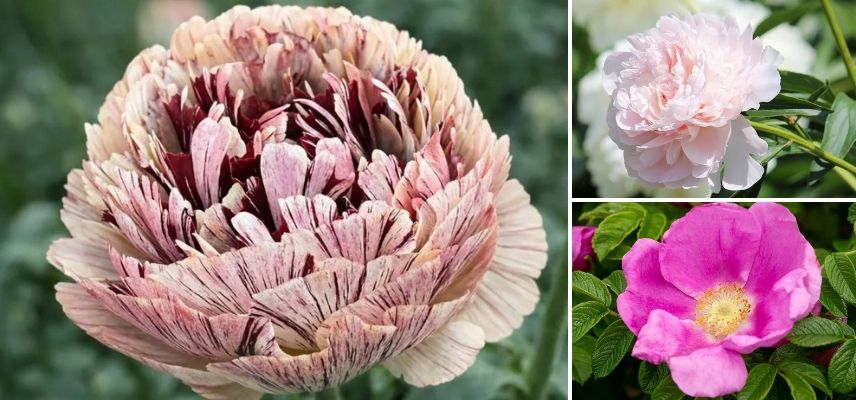
On the left, ‘Brushmark Verona’ Persian buttercup, and on the right, ‘Madame Calot’ peony and ‘Jam-a-licious’ rugosa rose
For a country-style bouquet
Do you prefer less formal bouquets? Ranunculuses are very versatile and can also work well in country-style bouquets. All colours and forms (single or double) of ranunculuses are suitable here, but single-flowered varieties will give the bouquet a more natural look.
Choose the Butterfly series, including ‘Butterfly Minerva‘, with its vibrant apricot-orange flowers, ‘Butterfly Ninos‘, with its very soft pearly white flowers, always single-flowered, or ‘Butterfly Hera‘, a demure pink.
For example, pair them with lilac, which flowers at the same time, and a few early perennials of interest such as lady’s mantle, which also adds its beautiful foliage, Campanula glomerata, and honesty. This bouquet will be even more interesting with the addition of flowers gathered during a walk: carrot flowers, cow parsley, etc. Don’t forget a few taller or twisted branches to break up the bouquet and give it a slightly wild look (Pittosporum, willow, privet, etc.).
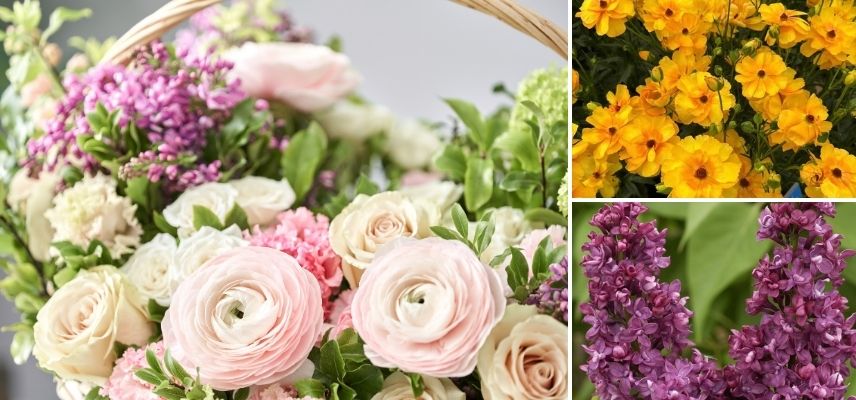
On the right, ranunculus ‘Butterfly Minerva’ and lilac ‘Charles Joly’
Some practical tips for your ranunculus bouquets
- Most ranunculuses are of medium height (around 50 cm), ideal for creating round bouquets or more generous arrangements;
- Ranunculus have slender stems: place them in a grid made for the vase (using chicken wire), or support them with floral wire to keep them in place;
- They last 10 to 15 days in fresh water, depending on their stage of flowering;
- Change the bouquet water every two days for optimum vase life;
- Cut the stems at an angle and remove the leaves below the waterline.
- Subscribe!
- Contents
This form is protected by reCAPTCHA - the Google Privacy Policy and Terms of Service apply.

































Comments