
































Left neglected all winter, terraces and balconies look sorry for themselves under spring's renewing sun. But many enthusiasts don't have a garden, and these small spaces are for them the only places to pamper if they want to enjoy a little time outdoors. If you read the article: Ten landscapers' tips for garden design, you now know the basics to steer your creativity. But arranging a terrace remains fairly specific: dulled, dirty floor, frost-damaged plants and broken pots?
Here are some tips to restore sparkle to this special space in a few hours or a weekend!
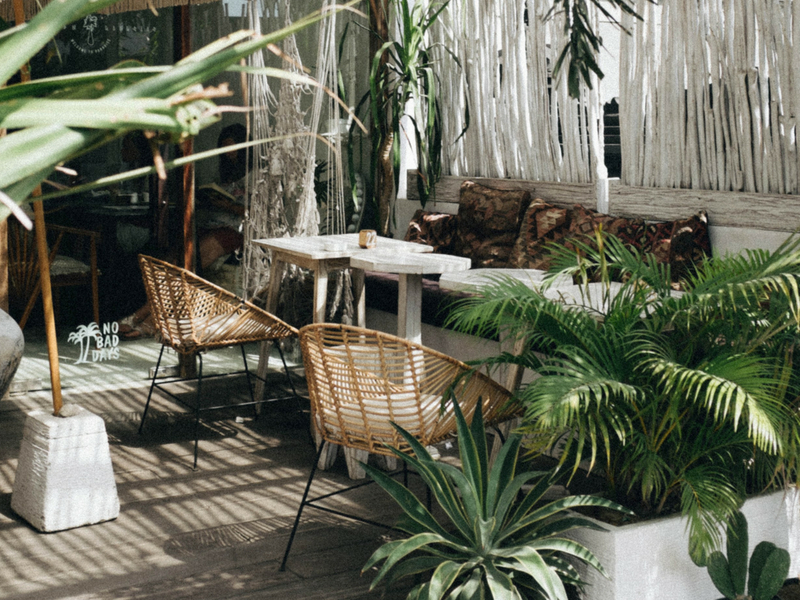
1- Clear the clutter
Because spring cleaning includes the terrace, it is essential to start by getting rid of anything that clutters the view (and so stifles your creativity). Don't hesitate to throw away cracked, unsightly pots, annuals that didn't survive winter cold, and any accumulated rubbish on the floor. A final sweep will make things clearer and make the space seem a little larger than you imagined...
Note: some plants may still be dormant: put your shrubs and perennials aside for now, even if they look very poorly. Give them a chance: they may simply take a little longer to wake up than others...
2- Refresh terrace flooring
A terrace that has aged badly is obvious from its surface: either too worn or simply out of date, the floor alone can affect the whole feel of the layout. Today there are very simple solutions to give it a new lease of life. For example, wooden decking tiles are very easy to lay and dress the outdoor space on their own. They now come in various formats, more adaptable (square, rectangular), and with a wide range of wood species.
Another, more recent solution: interlocking tiles. They are also very easy to install and cuts are not hard to make. Above all, they allow endless combinations. For example, for a client's terrace I chose to replace the floor (gravel-effect slabs with a look a little too "standard" for my taste...) with a mix of wood/slate/grass. These tiles come in a wide choice of materials and allow you to dare all sorts of fantasies: natural wood, composite wood, stone, and even artificial grass (some of which have a truly striking visual effect).
Note: check headroom under openings (doors and French doors): there must be enough space to install a new covering. Although many materials are offered in different thicknesses today (sometimes very slim for interlocking tiles), this is a detail not to overlook when buying. Most importantly: any raising of the floor must comply with current standards regarding balustrade height to avoid risk of falls.
3- Play with views
It's important to place a terrace or balcony within its surrounding environment: an intrusive neighbour's view or a splendid outlook will be handled very differently in a layout. Thus, some terraces will benefit from being screened from neighbours' sight; in that case opt for a play of screens and strategically placed climbers.
The terrace then becomes an intimate, secret space, enclosed by vegetation. Conversely, if overlooking neighbours isn't an issue and the view is breathtaking, it's important to make the most of that environmental asset and highlight it. In a terrace layout with a view over the Angoulême plateau, for example, I chose to install a pergola oriented directly towards that view so the eye is naturally drawn to the landscape whenever one steps outside. Seating can also be positioned with this in mind.
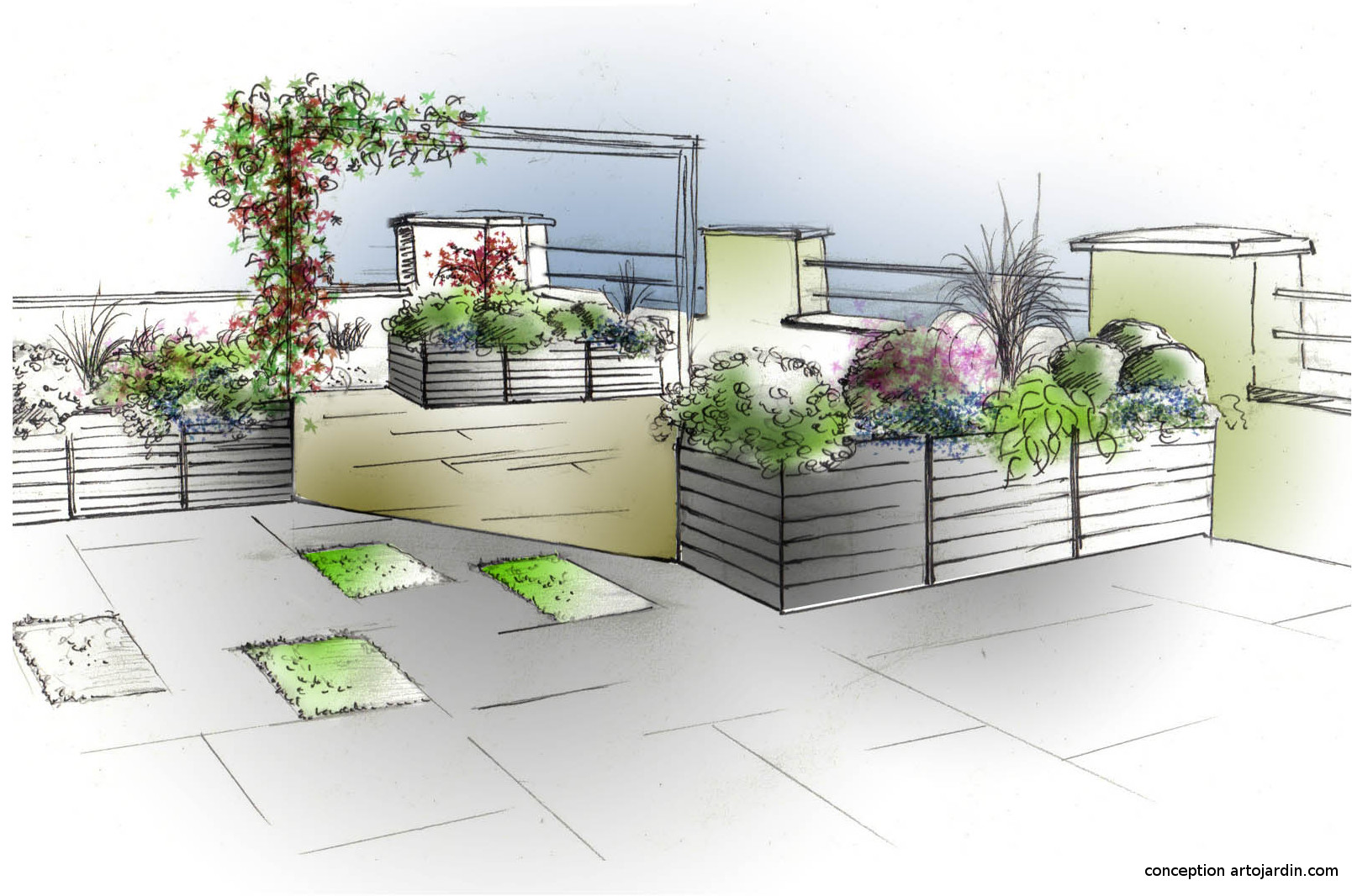
Note: there are regulations on installing screens and pergolas, so check before undertaking any remodelling.
4- Choose a standout colour
Small spaces have the advantage of being easy to arrange and allowing more freedom than large projects. It's the perfect time to opt for colour! A bright red for a contemporary scheme, a pastel blue for a romantic balcony... anything is possible, the important thing is to find coherence and harmony. Colour can appear on furniture cushions, pergola curtains, pottery...
Note: one colour is fine; two can work if well thought out. Beyond that, you risk visual overload. And so might your neighbours.
5- Choose plants suited to terraces and balconies
Plants should be chosen by affinity first, but also in coherence with the proposed layout. Grasses are perfect, for example, for a contemporary scheme, such as Pennisetum 'Karley Rose' or Imperata 'Red Baron'; also alliums, eremurus, and clipped boxwood. Others lend themselves better to a Mediterranean feel: lavender, rosemary or heathers — choice is wide.


Note: the difficulty lies in the container, as a plant will be more stressed in a planter than in the ground. Choose plants better suited to container culture, and select sufficiently large containers and an appropriate substrate.
6- Use décor as an extension of the house
A terrace or balcony is fundamentally an extension of the home, a vital living space, especially for those without a garden. The aim is to make the most of this space. So give free rein to your creativity: pictures, ornaments, candlesticks... the idea is to reinforce the mood you have chosen.
Thus, for a bohemian scheme, and if the balcony is covered, you can lay rugs on the floor, install ethnic-style tables, seating made from recycled materials, or strings of colourful bunting. Also select suitable lighting: designer globe lights, fairy lights, Asian lanterns... Finally, choice of materials (for pots, tables, benches...) is important: terracotta, coloured resin, zinc, natural wood, Corten... materials alone dictate the atmosphere of the place.
Note: the golden rule is moderation once again. Choose a style and stick to it. Lighting should remain restrained: the aim is to create a cosy and welcoming atmosphere.

Comments