
Aster novi-belgii Audrey

Aster novi-belgii Audrey

Aster novi-belgii Audrey
Aster novi-belgii Audrey
Aster novi-belgii Audrey
New York Aster, Michaelmas Daisy
The young plant arrived two weeks ago in a dormant state, so only a few leaves are visible. I planted it quickly; I won’t be able to judge whether it has established until spring.
Isabelle 06, 18/12/2025
Back-to-school special offer!
Get €10 off for every €50 you spend! And get up to €40 off on a single order.
How does it work?
1. Shop your favourites
Add your favourite plants to your basket. For every €50 you spend (excluding delivery charges, store credit and the plastic-free option), you’ll receive a €10 voucher.
€50 spent = €10 voucher
€100 spent = €20 voucher
€150 spent = €30 voucher
€200 spent = €40 voucher
2. Place your order
Once your basket reaches one of the spending thresholds, place your order. You can even choose your delivery date!
3. Receive your voucher
As soon as your order has been shipped, you’ll receive an email containing your personal voucher code and its value.
4. Use it on your next order
Your voucher is valid for 90 days from the date you receive it. It can be used once only, on a new order worth at least the value of the voucher, excluding delivery charges.
Please note: Vouchers can be combined with other offers, but cannot be split or refunded.
Home or relay delivery (depending on size and destination)
Important: You may be charged customs duties by your country’s customs authorities upon delivery.
Schedule delivery date,
and select date in basket
This plant carries a 12 months recovery warranty
More information
We guarantee the quality of our plants for a full growing cycle, and will replace at our expense any plant that fails to recover under normal climatic and planting conditions.
Would this plant suit my garden?
Set up your Plantfit profile →
Description
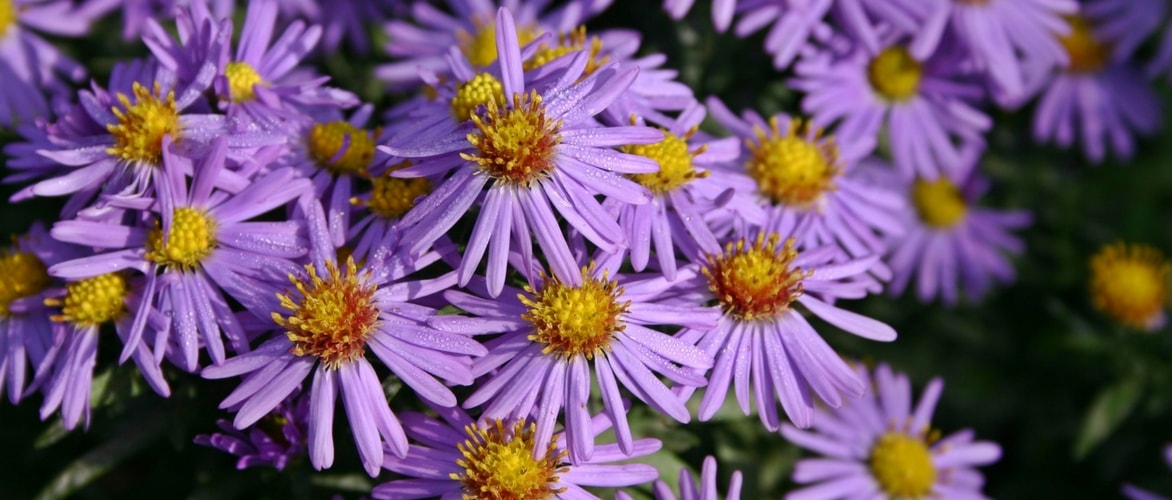
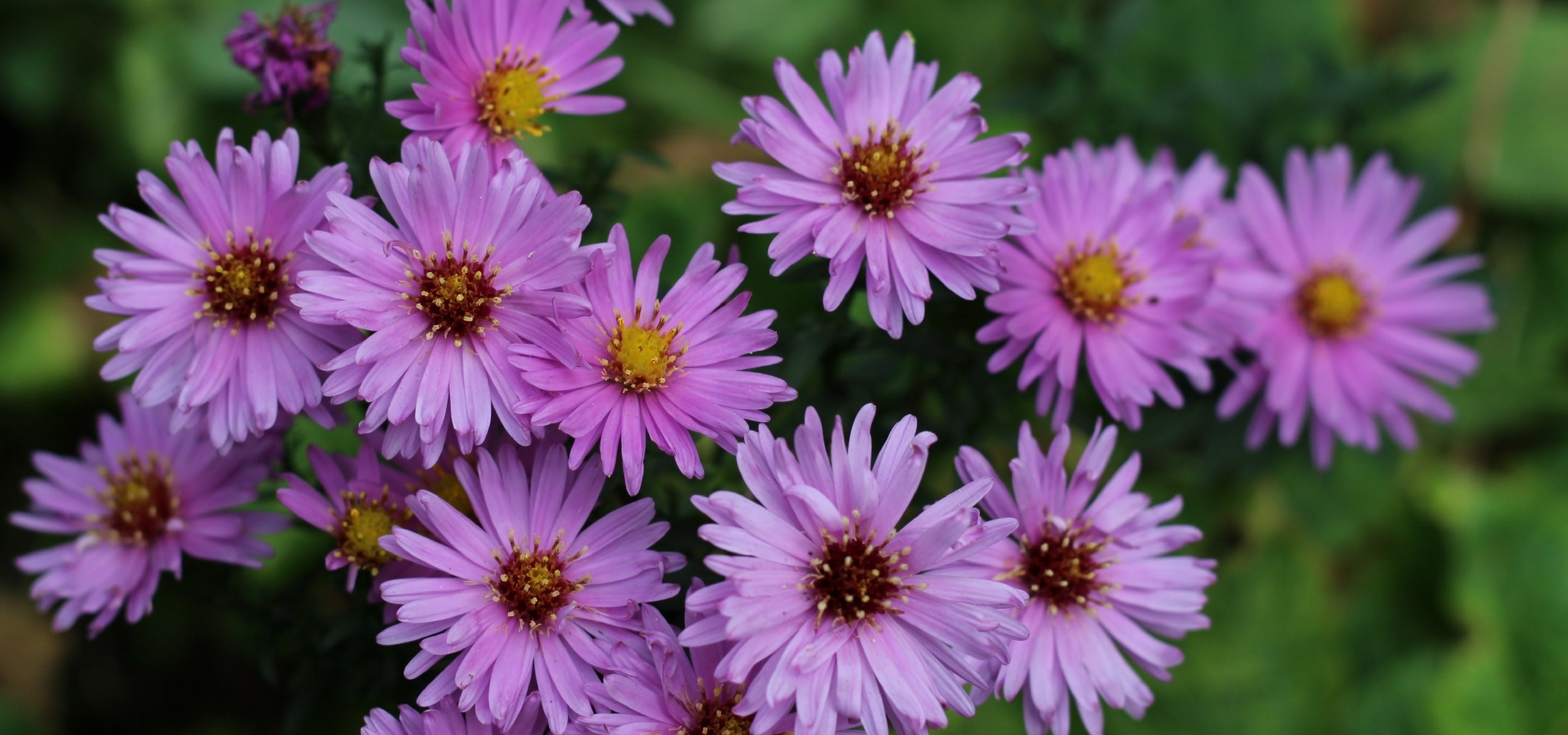
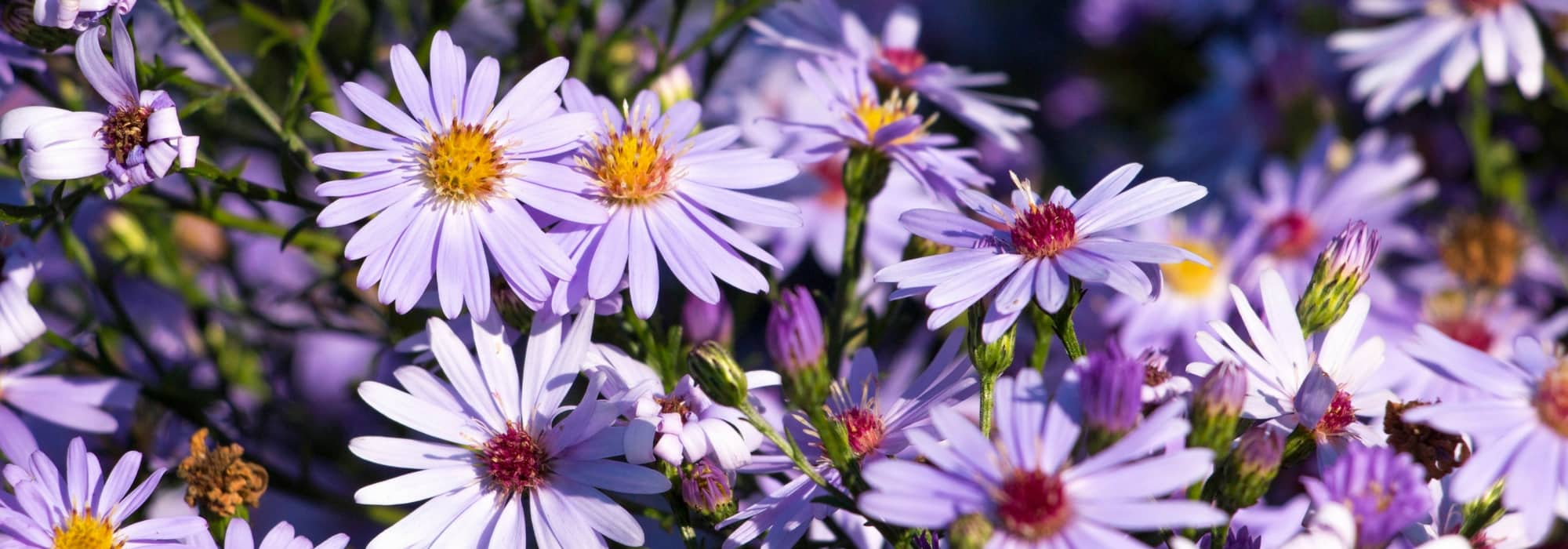
L'Aster novi-belgii ‘Audrey’ est un aster d’automne nain qui dépasse rarement la hauteur d’une bordure. Ses tiges courtes et très ramifiées disparaissent sous de nombreuses petites marguerites mauve lilacé à cœur jaune en fin de saison. Cette variété compacte permet de fleurir le premier plan d’un grand massif de vivaces ou une potée à une période où les floraisons estivales déclinent, même sur un balcon ou dans un petit jardin.
Cet aster appartient à la famille des Astéracées. C’est une vivace herbacée : toute sa végétation aérienne sèche en hiver, puis de nouvelles pousses sortent de la souche au printemps. Son nom botanique accepté, Symphyotrichum novi-belgii, a remplacé Aster novi-belgii, toujours très employé dans les jardins et le commerce horticole. L’espèce dont le cultivar ‘Audrey’ est issu pousse naturellement dans l’est du Canada et le nord-est des États-Unis, dans des prairies humides, des terrains ouverts et sur certains secteurs proches du littoral. L’épithète novi-belgii ne désigne pas la Belgique actuelle : elle renvoie à la Nouvelle-Néerlande, un ancien territoire qui comprenait la région de New York.
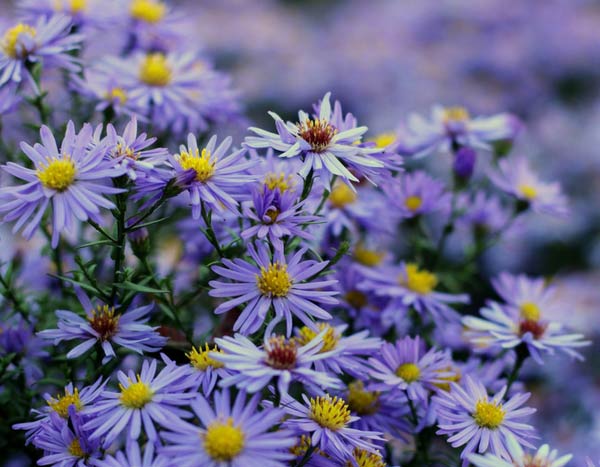
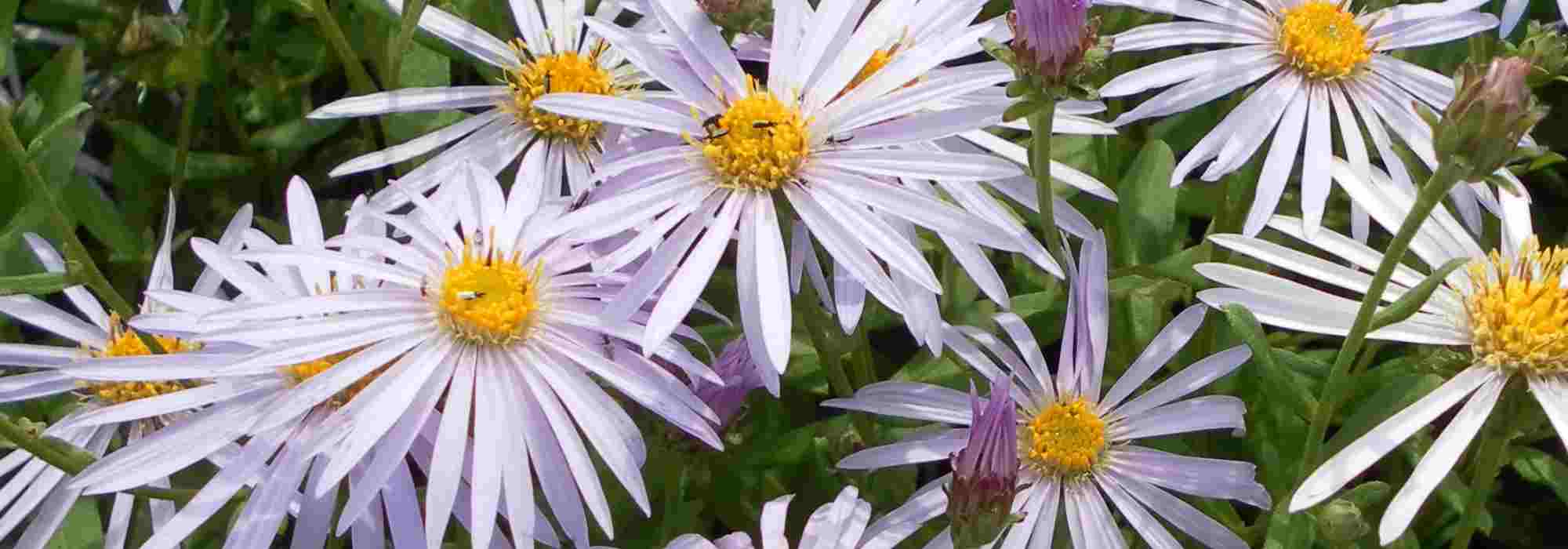
'Audrey' forme une touffe compacte et arrondie, haute de 30 cm et large de 40 à 50 cm. Ses tiges dressées se ramifient près de la base, ce qui explique son aspect fourni et trapu. Elles portent des feuilles étroites, lancéolées, d’un vert moyen à foncé, disposées le long des rameaux. En septembre et octobre, leur extrémité se divise pour produire des bouquets serrés composés d'inflorescences en capitules de 3 cm de diamètre. Les ligules ou "pétales" périphériques, d'un mauve lilacé avec des nuances roses ou bleutées selon la lumière, entourent un disque central jaune doré. Les abeilles, les syrphes et les papillons y trouvent du pollen et du nectar. Après la floraison, les disques brunissent et produisent de petits fruits secs munis d’aigrettes. La souche de cet aster s’élargit par le biais de courts rhizomes, mais son développement reste compatible avec une bordure ou un grand pot. Cette variété est rustique au moins jusqu’à −20 °C et elle n'a pas besoin d'être tuteurée. Comme les autres asters de Nouvelle-Belgique, elle peut être atteinte par l’oïdium en cas de sécheresse.
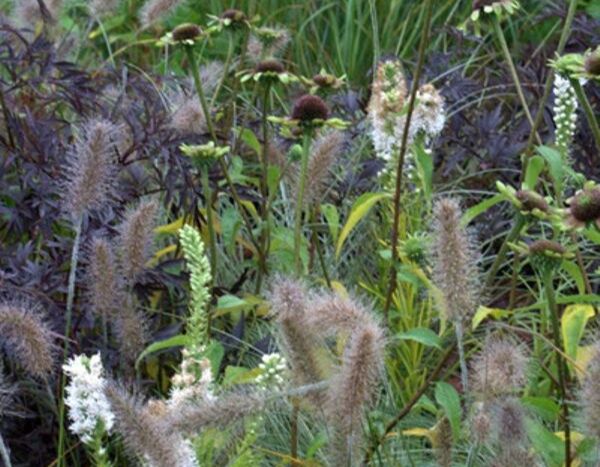
Cet aster ‘Audrey’ trouve facilement sa place dans une bordure de vivaces ou le long d’une allée. Il remplira aussi une belle potée sur une terrasse ensoleillée, seul ou accompagné d’une plante retombante peu vigoureuse comme un Bacopa blanc 'Gulliver Dynamic White'. Au jardin, on peut l’associer à la Sanguisorba ‘Little Angel’, à la Persicaria affinis ‘Darjeeling Red’, à la Sesleria autumnalis et au Stachys ‘Hummelo’. Ces plantes apprécient toutes le soleil et une terre riche, fraîche et drainée. Le mauve de l’aster s’harmonise avec les tons bordeaux, le rose et les différents verts, dans une composition dont les floraisons s’échelonnent de l’été à l’automne.
Aster novi-belgii Audrey in pictures


Flowering
Foliage
Plant habit
Botanical data
Aster
novi-belgii
Audrey
Asteraceae
New York Aster, Michaelmas Daisy
Aster novi-belgii 'Audrey', Symphyotrichum novi-belgii ‘Audrey’
Cultivar or hybrid
Planting and care
Aster novi-belgii ‘Audrey’ should be planted from February to April or from September to November in a fertile, friable, moist soil, in full sun. Clay and chalky soils are tolerated. In this case, incorporate well-rotted compost to improve drainage. Water during the first summer so that the stump can take root. An established plant withstands short dry spells, but these encourage powdery mildew and reduce flowering. An organic mulch helps to keep the soil cool and moist. Division, carried out every three or four years in spring, rejuvenates the clump and prevents it from becoming bare in the centre. In a pot, use a wide, deep container whose base allows water to drain away freely.
Planting period
Intended location
Care
Planting & care advice
-
-
-
-
-

-

-
-

-
, onOrder confirmed
Reply from on Promesse de fleurs
Recently viewed products
Haven't found what you were looking for?
Hardiness is the lowest winter temperature a plant can endure without suffering serious damage or even dying. However, hardiness is affected by location (a sheltered area, such as a patio), protection (winter cover) and soil type (hardiness is improved by well-drained soil).

The flowering period indicated on our website applies to countries and regions located in USDA zone 8 (France, the United Kingdom, Ireland, the Netherlands, etc.)
It will vary according to where you live:- In zones 9 to 10 (Italy, Spain, Greece, etc.), flowering will occur about 2 to 4 weeks earlier.
- In zones 6 to 7 (Germany, Poland, Slovenia, and lower mountainous regions), flowering will be delayed by 2 to 3 weeks.
- In zone 5 (Central Europe, Scandinavia), blooming will be delayed by 3 to 5 weeks.
In temperate climates, pruning of spring-flowering shrubs (forsythia, spireas, etc.) should be done just after flowering.
Pruning of summer-flowering shrubs (Indian Lilac, Perovskia, etc.) can be done in winter or spring.
In cold regions as well as with frost-sensitive plants, avoid pruning too early when severe frosts may still occur.
The planting period indicated on our website applies to countries and regions located in USDA zone 8 (France, United Kingdom, Ireland, Netherlands).
It will vary according to where you live:
- In Mediterranean zones (Marseille, Madrid, Milan, etc.), autumn and winter are the best planting periods.
- In continental zones (Strasbourg, Munich, Vienna, etc.), delay planting by 2 to 3 weeks in spring and bring it forward by 2 to 4 weeks in autumn.
- In mountainous regions (the Alps, Pyrenees, Carpathians, etc.), it is best to plant in late spring (May-June) or late summer (August-September).
The harvesting period indicated on our website applies to countries and regions in USDA zone 8 (France, England, Ireland, the Netherlands).
In colder areas (Scandinavia, Poland, Austria...) fruit and vegetable harvests are likely to be delayed by 3-4 weeks.
In warmer areas (Italy, Spain, Greece, etc.), harvesting will probably take place earlier, depending on weather conditions.
The sowing periods indicated on our website apply to countries and regions within USDA Zone 8 (France, UK, Ireland, Netherlands).
In colder areas (Scandinavia, Poland, Austria...), delay any outdoor sowing by 3-4 weeks, or sow under glass.
In warmer climes (Italy, Spain, Greece, etc.), bring outdoor sowing forward by a few weeks.
Shipping country and language
Your country of residence may be:
Your country of residence is:
For a better user experience on our website, you can select:
Your shipping country:
-
 Austria
-
 Belgium
-
 Bosnia & Herzegovina
-
 Bulgaria
-
 Croatia
-
 Cyprus
-
 Czechia
-
 Denmark
-
 Estonia
-
 Finland
-
 France
-
 Germany
-
 Greece
-
 Hungary
-
 Iceland
-
 Ireland
-
 Italy
-
 Latvia
-
 Liechtenstein
-
 Lithuania
-
 Luxembourg
-
 Malta
-
 Netherlands
-
 Poland
-
 Portugal
-
 Romania
-
 Serbia
-
 Slovakia
-
 Slovenia
-
 Spain
-
 Sweden
-
 Switzerland
Language:
-
French
-
 English
-
Spanish
-
Italian
-
German
-
Portuguese
-
Dutch
-
Finnish
My Account
Hello
My wish lists
My cart
Log in / Register
Existing customer?
This form is protected by reCAPTCHA - the Google Privacy Policy and Terms of Service apply.
New customer?
Create an account to track your orders, access our customer service and, if you wish, make the most of our upcoming offers.