Wild Roses Collection
Wild Roses Collection
Rosa canina, pimpinellifolia, glauca (rubrifolia)
Back-to-school special offer!
Get €10 off for every €50 you spend! And get up to €40 off on a single order.
How does it work?
1. Shop your favourites
Add your favourite plants to your basket. For every €50 you spend (excluding delivery charges, store credit and the plastic-free option), you’ll receive a €10 voucher.
€50 spent = €10 voucher
€100 spent = €20 voucher
€150 spent = €30 voucher
€200 spent = €40 voucher
2. Place your order
Once your basket reaches one of the spending thresholds, place your order. You can even choose your delivery date!
3. Receive your voucher
As soon as your order has been shipped, you’ll receive an email containing your personal voucher code and its value.
4. Use it on your next order
Your voucher is valid for 90 days from the date you receive it. It can be used once only, on a new order worth at least the value of the voucher, excluding delivery charges.
Please note: Vouchers can be combined with other offers, but cannot be split or refunded.
Home or relay delivery (depending on size and destination)
Important: You may be charged customs duties by your country’s customs authorities upon delivery.
Schedule delivery date
and select date in basket
This plant carries a 24 months recovery warranty
More information
We guarantee the quality of our plants for a full growing cycle, and will replace at our expense any plant that fails to recover under normal climatic and planting conditions.
Description
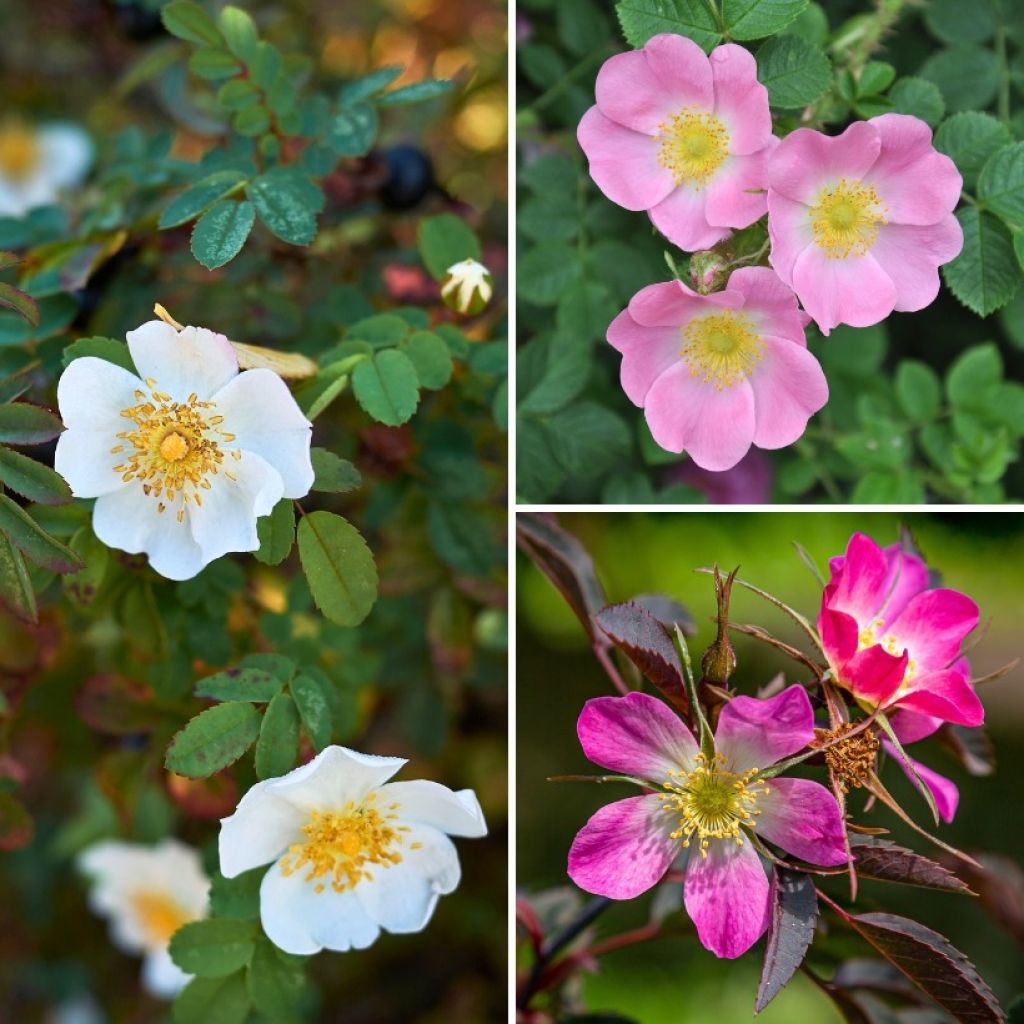
We offer a collection of three wild roses, hardy and robust deciduous shrubs that will bring nature into your garden. Their light and decorative foliage accompanies a flowering of dog roses, ranging from white to pink, from May to July depending on the varieties. These plants adapt to a wide range of soils and tolerate both cold and drought. Ideal for creating informal hedges or countryside borders, these wild roses require little maintenance and attract beneficial wildlife with their nectar-bearing flowers and colourful fruits in autumn.
Collection details:
1 x Dog Rose - Rosa canina: a vigorous bush reaching 2 to 3 m in height. Its thorny stems bear light green foliage and simple flowers, pale pink with yellow centres, in June. Its orange-red hips persist throughout winter, nourishing birds and small animals. It thrives in dry, chalky soils.
1 x Burnet Rose - Rosa pimpinellifolia: a compact bush about 1 to 1.5 m tall, this rose features finely cut dark green foliage. Its white flowers with golden centres bloom from May onwards. Very hardy and wind-resistant, it adapts to poor, sandy soils.
1 x Red-leaved Rose - Rosa glauca (Rosa rubrifolia): distinguished by its blue-green foliage with purplish reflections, the Red-leaved Rose reaches 1.5 to 2 m in height. Its simple flowers, soft pink with golden stamens, appear in June. Its prominent red hips provide a decorative touch in autumn. It prefers well-draining soils and sunny locations.
These wild roses, offered as bare roots, should be planted in autumn and winter, from November to March, when the plants are dormant. This period ensures good root development before the return of warmer days. Choose a sunny or semi-shaded location, in well-drained soil, even poor or chalky.
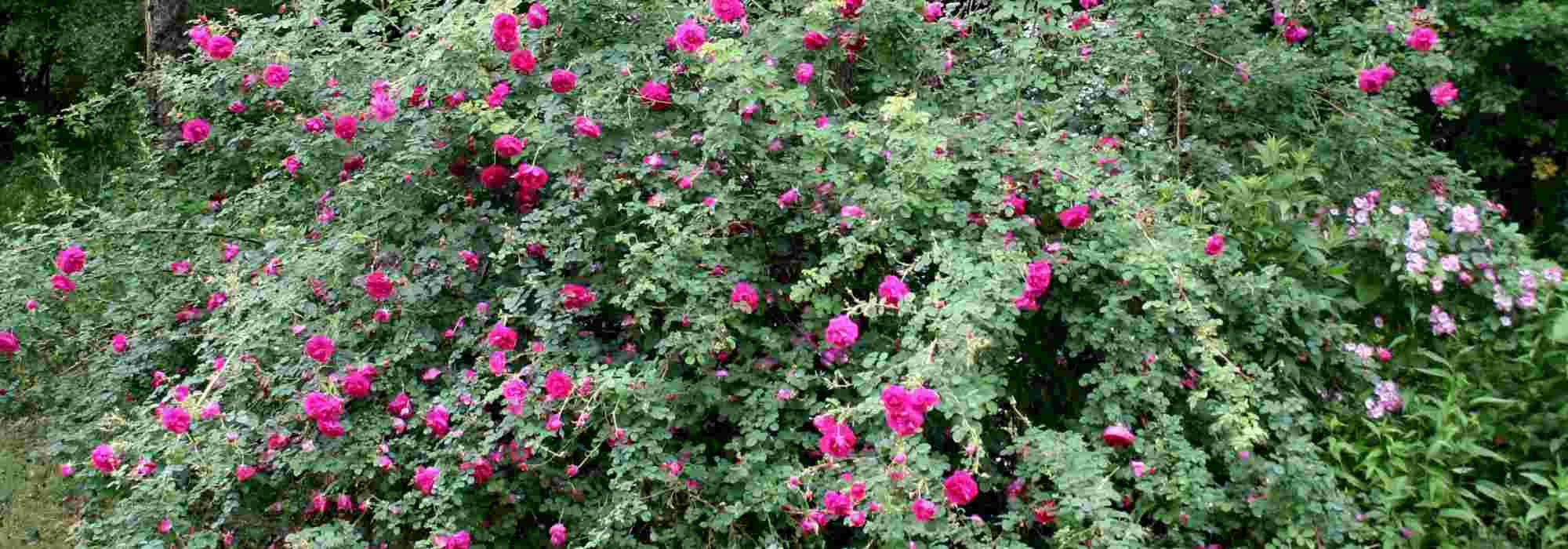
To create a countryside hedge or a natural border, arrange the roses according to their height. The Dog Rose, the tallest (up to 3 m), should be placed at the back. The Red-leaved Rose, with purplish highlights, in the middle, and the Burnet Rose, more compact (1 to 1.5 m), at the front. Maintain a distance of 80 cm to 1 m between each plant to allow for harmonious growth.
For a loose hedge, plant 2 to 3 shrubs per linear metre to create a dense plant screen. After planting, water generously to ensure good root-to-soil contact. Natural mulching will help retain moisture and limit weeds during the initial months.
To accompany the wild roses in this collection, plant two Common Dogwoods (Cornus sanguinea), whose bright red branches will illuminate the garden in winter. Their foliage turning purple in autumn will harmonise with the purplish foliage of the Red-leaved Rose. Also, add three European Spindle Trees (Euonymus europaeus). Their bright pink capsules with orange seeds provide a unique decorative touch in autumn, extending visual interest after the summer flowering of the roses. Their flexible growth and bright green foliage perfectly complement the natural feel of the scene. To structure the foreground, place five Birchleaf Spiraeas (Spiraea betulifolia 'Pink Sparkler'). Their summer pink blooms prolong the floral display, and their rounded silhouette (1 to 1.5 m) balances the composition.
With a spacing of 80 cm to 1 m between each plant, the collection will cover approximately 10 to 12 m². This informal, natural hedge will offer changing colours throughout the year.

Plant habit
Flowering
Foliage
Botanical data
Rosa
canina, pimpinellifolia, glauca (rubrifolia)
Rosaceae
Planting and care
Wild roses prefer a sunny location (at least 4 to 5 hours of sun per day) but sheltered from the scorching rays of midday and strong winds. Roses appreciate loose, permeable, and humus-rich soils. They will adapt to any garden provided that the soil is well-worked and drained. To plant your bare-root rose, work the soil to a depth of 40 cm by crumbing the soil well and placing a base dressing such as dried blood or dehydrated horn at the bottom of the planting hole, position your young plant by covering the top of the root ball with 3 cm of soil, backfill and water generously to eliminate air pockets. In dry weather, water regularly for a few weeks to facilitate root development. Also, remember to provide your rose with special rose fertiliser that enhances flowering.
Planting period
Intended location
Care
Planting & care advice
-

-
-

-

-
-

-
-

This item has not been reviewed yet - be the first to leave a review about it.
Recently viewed products
Haven't found what you were looking for?
Hardiness is the lowest winter temperature a plant can endure without suffering serious damage or even dying. However, hardiness is affected by location (a sheltered area, such as a patio), protection (winter cover) and soil type (hardiness is improved by well-drained soil).

The flowering period indicated on our website applies to countries and regions located in USDA zone 8 (France, the United Kingdom, Ireland, the Netherlands, etc.)
It will vary according to where you live:- In zones 9 to 10 (Italy, Spain, Greece, etc.), flowering will occur about 2 to 4 weeks earlier.
- In zones 6 to 7 (Germany, Poland, Slovenia, and lower mountainous regions), flowering will be delayed by 2 to 3 weeks.
- In zone 5 (Central Europe, Scandinavia), blooming will be delayed by 3 to 5 weeks.
In temperate climates, pruning of spring-flowering shrubs (forsythia, spireas, etc.) should be done just after flowering.
Pruning of summer-flowering shrubs (Indian Lilac, Perovskia, etc.) can be done in winter or spring.
In cold regions as well as with frost-sensitive plants, avoid pruning too early when severe frosts may still occur.
The planting period indicated on our website applies to countries and regions located in USDA zone 8 (France, United Kingdom, Ireland, Netherlands).
It will vary according to where you live:
- In Mediterranean zones (Marseille, Madrid, Milan, etc.), autumn and winter are the best planting periods.
- In continental zones (Strasbourg, Munich, Vienna, etc.), delay planting by 2 to 3 weeks in spring and bring it forward by 2 to 4 weeks in autumn.
- In mountainous regions (the Alps, Pyrenees, Carpathians, etc.), it is best to plant in late spring (May-June) or late summer (August-September).
The harvesting period indicated on our website applies to countries and regions in USDA zone 8 (France, England, Ireland, the Netherlands).
In colder areas (Scandinavia, Poland, Austria...) fruit and vegetable harvests are likely to be delayed by 3-4 weeks.
In warmer areas (Italy, Spain, Greece, etc.), harvesting will probably take place earlier, depending on weather conditions.
The sowing periods indicated on our website apply to countries and regions within USDA Zone 8 (France, UK, Ireland, Netherlands).
In colder areas (Scandinavia, Poland, Austria...), delay any outdoor sowing by 3-4 weeks, or sow under glass.
In warmer climes (Italy, Spain, Greece, etc.), bring outdoor sowing forward by a few weeks.
Shipping country and language
Your country of residence may be:
Your country of residence is:
For a better user experience on our website, you can select:
Your shipping country:
-
 Austria
-
 Belgium
-
 Bosnia & Herzegovina
-
 Bulgaria
-
 Croatia
-
 Cyprus
-
 Czechia
-
 Denmark
-
 Estonia
-
 Finland
-
 France
-
 Germany
-
 Greece
-
 Hungary
-
 Iceland
-
 Ireland
-
 Italy
Italy
-
 Latvia
-
 Liechtenstein
-
 Lithuania
-
 Luxembourg
-
 Malta
Malta
-
 Netherlands
-
 Poland
-
 Portugal
-
 Romania
-
 Serbia
-
 Slovakia
-
 Slovenia
-
 Spain
Spain
-
 Sweden
-
 Switzerland
Language:
-
French
-
 English
-
Spanish
-
Italian
-
German
-
Portuguese
-
Dutch
-
Finnish
My Account
Hello
My wish lists
My cart
Log in / Register
Existing customer?
This form is protected by reCAPTCHA - the Google Privacy Policy and Terms of Service apply.
New customer?
Create an account to track your orders, access our customer service and, if you wish, make the most of our upcoming offers.