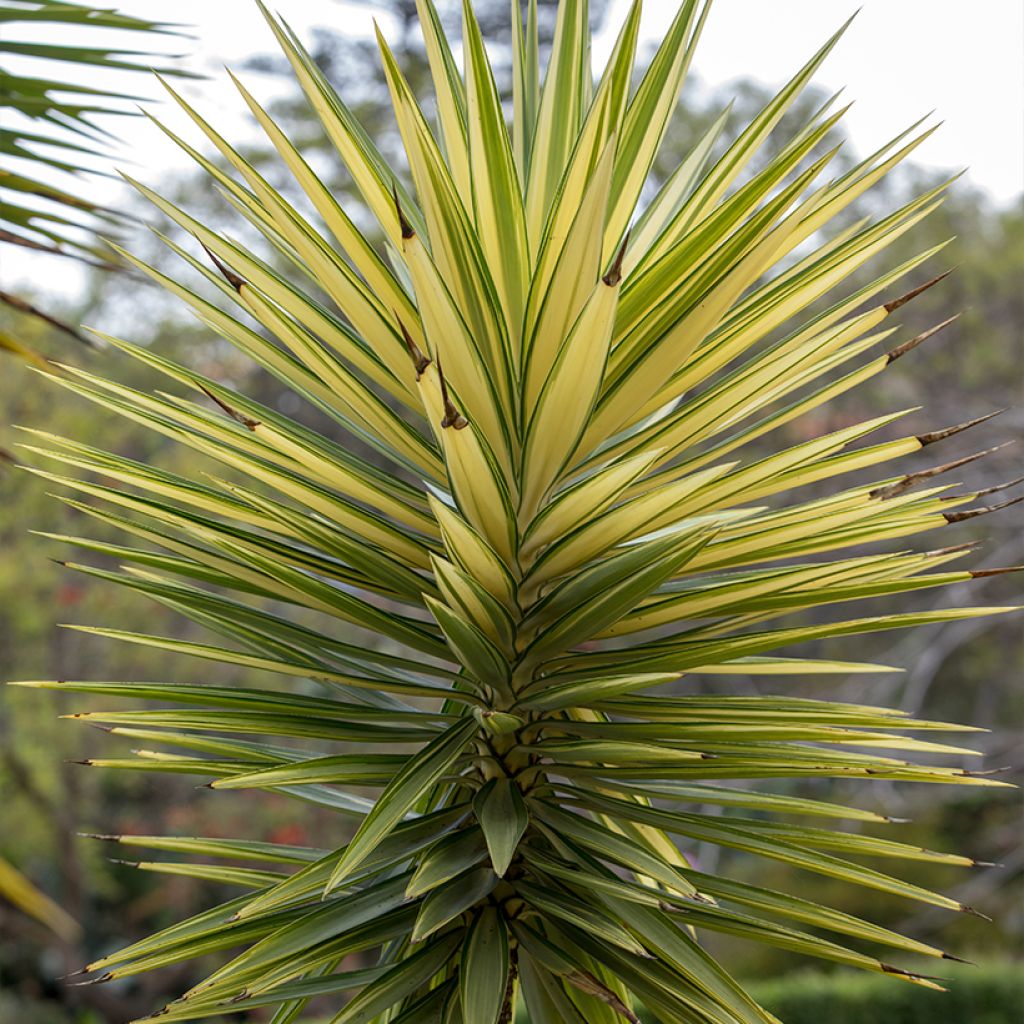
Yucca aloifolia Variegata - Spanish bayonet
Yucca aloifolia Variegata - Spanish bayonet
Yucca aloifolia Variegata
Spanish bayonet, dagger plant
Back-to-school special offer!
Get €10 off for every €50 you spend! And get up to €40 off on a single order.
How does it work?
1. Shop your favourites
Add your favourite plants to your basket. For every €50 you spend (excluding delivery charges, store credit and the plastic-free option), you’ll receive a €10 voucher.
€50 spent = €10 voucher
€100 spent = €20 voucher
€150 spent = €30 voucher
€200 spent = €40 voucher
2. Place your order
Once your basket reaches one of the spending thresholds, place your order. You can even choose your delivery date!
3. Receive your voucher
As soon as your order has been shipped, you’ll receive an email containing your personal voucher code and its value.
4. Use it on your next order
Your voucher is valid for 90 days from the date you receive it. It can be used once only, on a new order worth at least the value of the voucher, excluding delivery charges.
Please note: Vouchers can be combined with other offers, but cannot be split or refunded.
Home or relay delivery (depending on size and destination)
Important: You may be charged customs duties by your country’s customs authorities upon delivery.
Schedule delivery date
and select date in basket
This plant carries a 24 months recovery warranty
More information
We guarantee the quality of our plants for a full growing cycle, and will replace at our expense any plant that fails to recover under normal climatic and planting conditions.
Would this plant suit my garden?
Set up your Plantfit profile →
Description
Yucca aloifolia 'Variegata' is a Yucca with aloe-like leaves, also known as the variegated Spanish bayonet due to its stiff leaves with a rather dangerous pointed tip. The species is native to the coasts bordering the Gulf of Mexico, where a hot, humid climate prevails, and frost can occur further north. This is why, despite its very exotic appearance, it manages to withstand our average winters quite well. Fairly fast-growing, it quickly forms a short trunk that supports a decorative rosette of slender, green leaves, edged with yellow. It also produces a spectacular summer bloom that lasts for many weeks. It will thrive in most well-drained soils, grows in full sun or even in light shade, and its exotic, architectural form adds character to a border.
Formerly classified in the Agavaceae family, alongside visually similar genera such as Agave, the Yucca genus is now curiously assigned to Asparagaceae, the family of Asparagus. There are about forty species of wild Yuccas, mainly native to North America, where they grow in arid zones. Yucca aloifolia differs slightly from this archetype as it is found in regions with a humid climate, from the south coasts of the United States (from Louisiana to Virginia), to western Mexico (as far as the Yucatan), and even in some Caribbean islands. It is capable of withstanding a wide range of climatic conditions, from tropical to warm temperate, and even regions subject to frost. More accommodating than many other species concerning atmospheric humidity it will grow naturally in dunes and sandy areas and needs well-drained soil without stagnant moisture, especially in winter. This versatility explains why this Yucca is one of the earliest cultivated in Europe, since the beginning of the 17th century.
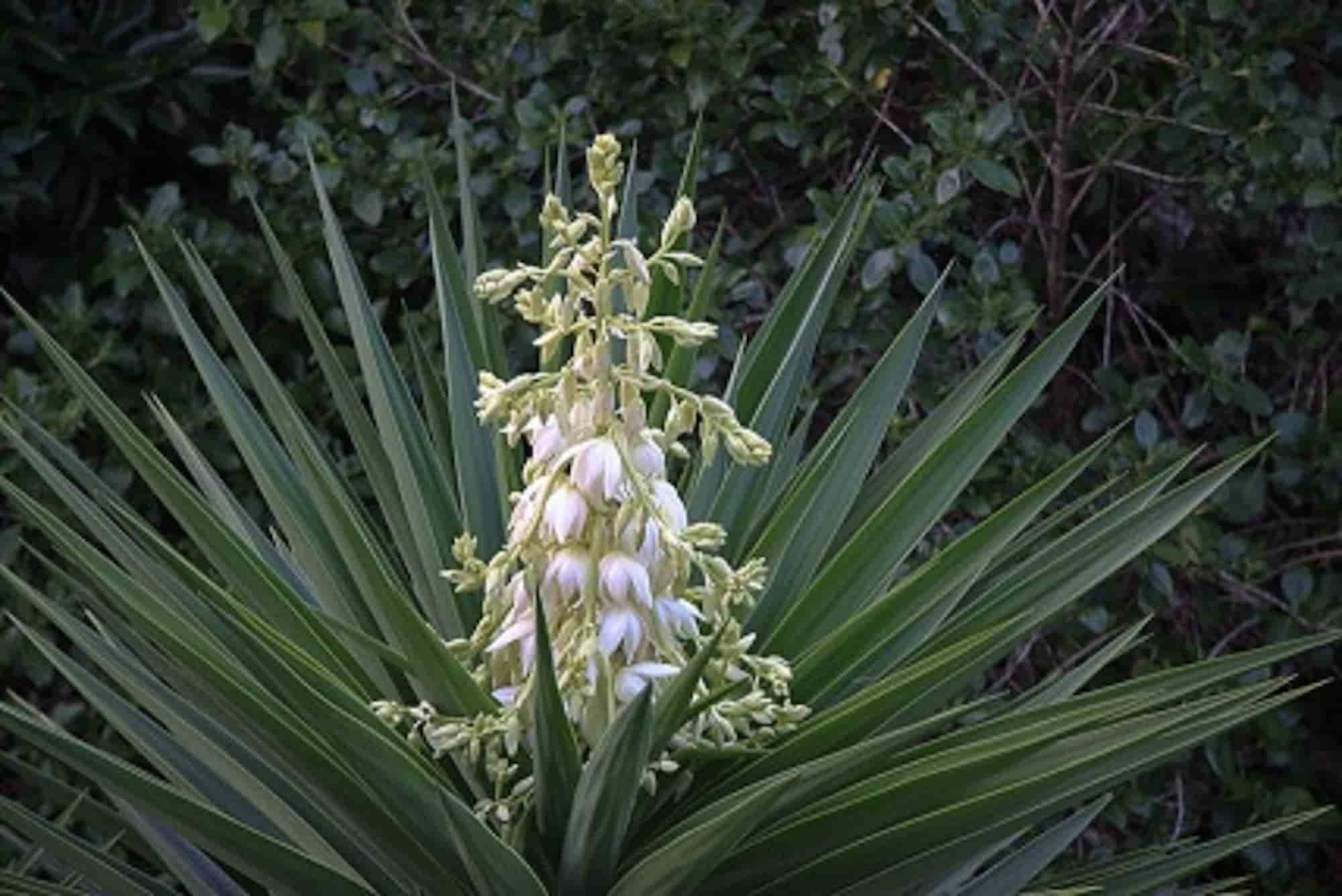
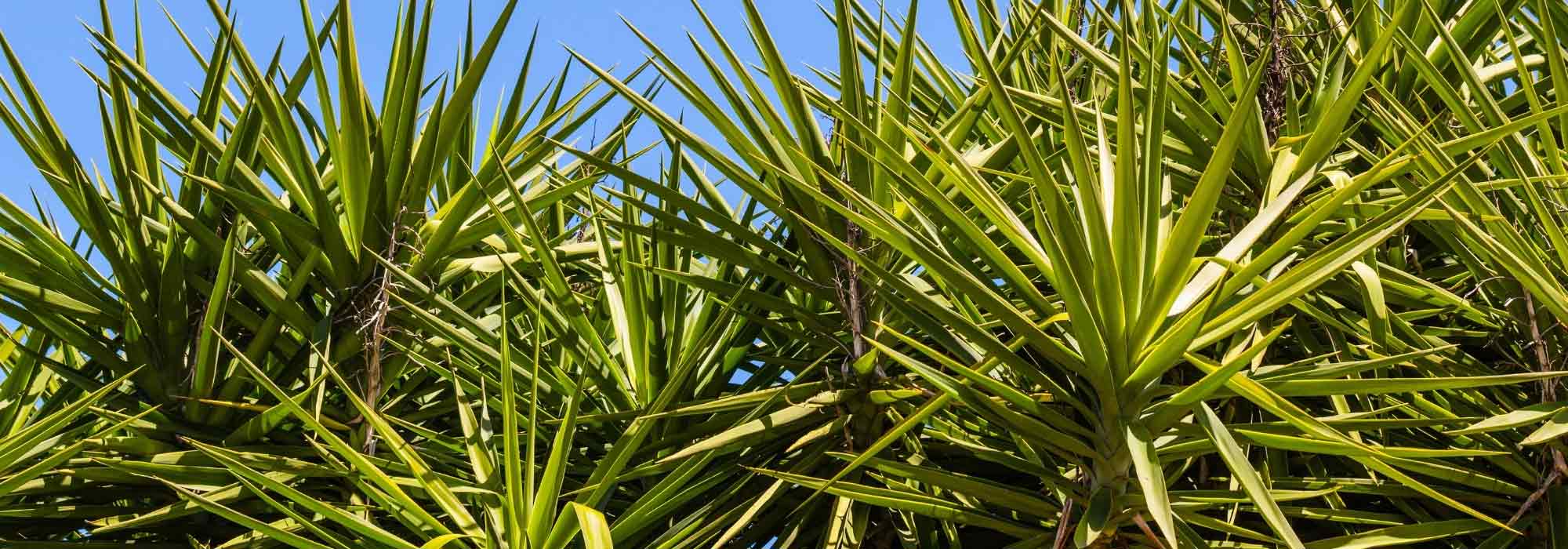
In humid climates, or if watered regularly in summer, it shows rapid growth, developing a short trunk within 3 years of cultivation that lifts the rosette of leaves above the ground. These very stiff leaves measure 30 to 50 cm long by 3 cm wide. The pointed tip is dangerous for the eyes, so the planting location should be chosen carefully. Upright at the top of the rosette, the leaves spread horizontally downwards, giving the shrub a very distinctive silhouette. In Yucca aloifolia 'Variegata', the most common variegated variety, the medium green leaves are adorned with a cream-yellow band around the edge, giving the foliage a bright appearance. The slightly succulent leaves are very finely toothed on the margin and have a sharp point at the tip. Due to the faster growth of the axis (stem) than in other species, the leaves are slightly less crowded at the base. As the rosette rises, the old leaves at the base dry and hang downwards, while remaining attached to the trunk for a long time. They thus form a kind of skirt that provides slight protection from cold in winter, and gives the plant a somewhat wild look. This Yucca has the peculiarity of suckering quite easily, thus forming a clump after a few years, as wide as it is tall, reaching a maximum of 2.50 m to 3 m. The evergreen leaves are decorative all year round, adding interest to the plant's very geometric shape. In summer, it is even more appealing with its abundant flowering. A flower spike rises from the centre of the rosette. Measuring about fifty centimetres tall, it is adorned with dozens of white flowers in the shape of large bells, 5 cm in diameter, slightly pink at the base. It blooms in summer for 2 months or more, eye-catching in the garden. Another peculiarity: this Yucca species is the only one that can produce fruit in our gardens, as it is not dependent on a single insect species, not present in our regions, to ensure pollination. Our local pollinators perform this task very well, and the flowers then develop into something similar to small bananas, 5 to 10 cm long, which turn black when mature.
Yucca aloifolia 'Variegata' will thrive in any well-drained soil in the south. It is a perfect plant for adding an exotic touch to a border or large rock garden with other strong-character plants. Puya coerulea 'Violacéea' is a little-known Bromeliad hardy to -10°C in dry soil, forming a beautiful clump of fine leaves, above which flower spikes 2 m tall bearing flowers of intense violet-blue rise in summer. Opuntia, or prickly pear cactus, is another plant evoking hot, desert climates, which is recognisable at first glance and will reward you with a superb ephemeral bloom. Many species prove to be much more cold-hardy than they appear, provided, like your Yucca, they are planted in well-drained soil (ideally on a rock garden slope).

Yucca aloifolia Variegata - Spanish bayonet in pictures

Plant habit
Flowering
Foliage
Botanical data
Yucca
aloifolia
Variegata
Asparagaceae
Spanish bayonet, dagger plant
Yucca aloifolia Marginata, Yucca aloifolia f. marginata
North America, Central America
Planting and care
Plant Yucca aloifolia 'Variegata' in spring, in a very sunny and sheltered position if your garden is in a borderline hardiness zone. A mature specimen will withstand brief frosts down to -12°C. It grows around 15 to 20 cm per year in our climate. In mild climates, plant in autumn, especially in hot, dry summer climates; this will allow the plant to benefit from autumn rainfall. This species tolerates humid Atlantic-type climates quite well. However, it doesn't like soil moisture, especially when combined with cold: plant it in very well-drained soil, ideally in a large rock garden, a raised bed enriched with gravel, or a rocky slope. It is not fussy about pH or soil type, which may be slightly acidic, sandy, stony, or even slightly calcareous. It adapts to poor soil, but its growth will be slightly faster in more fertile soil. Water during the first two years, especially in hot and dry periods. Remove spent flower stems.
You have a magnificent Yucca, but it doesn't flower? Perhaps it is too young, or only established for 3 or 4 years in your garden. This plant takes time to settle and only flowers after 8 years. Then, depending on sunlight and climate, it will flower every year, or maybe every two or three years.
Propagation:
Yucca aloifolia is easily propagated by sections of trunk. It should be noted that plants from cuttings produce fewer roots than those from seed, making them susceptible to strong winds and less drought-resistant in hot climates.
Fertilisation in yuccas:
In their native countries, Yucca flowers are pollinated only by a few species of tiny primitive moths without a proboscis that live in symbiosis with the plant, Prodoxus, for example. The female of these moths carries pollen grains from one flower to the pistil of another. She lays a few eggs at the base of the flower. The young caterpillars feed on some of the seeds. Since Prodoxus is not part of our fauna, most yuccas grown in our gardens never produce fruit. Only Yucca aloifolia is capable of this, because its pollination does not depend exclusively on the presence of these micro-moths and can be carried out by our native insects.
Planting period
Intended location
Care
Planting & care advice






This item has not been reviewed yet - be the first to leave a review about it.
Recently viewed products
Haven't found what you were looking for?
Hardiness is the lowest winter temperature a plant can endure without suffering serious damage or even dying. However, hardiness is affected by location (a sheltered area, such as a patio), protection (winter cover) and soil type (hardiness is improved by well-drained soil).

The flowering period indicated on our website applies to countries and regions located in USDA zone 8 (France, the United Kingdom, Ireland, the Netherlands, etc.)
It will vary according to where you live:- In zones 9 to 10 (Italy, Spain, Greece, etc.), flowering will occur about 2 to 4 weeks earlier.
- In zones 6 to 7 (Germany, Poland, Slovenia, and lower mountainous regions), flowering will be delayed by 2 to 3 weeks.
- In zone 5 (Central Europe, Scandinavia), blooming will be delayed by 3 to 5 weeks.
In temperate climates, pruning of spring-flowering shrubs (forsythia, spireas, etc.) should be done just after flowering.
Pruning of summer-flowering shrubs (Indian Lilac, Perovskia, etc.) can be done in winter or spring.
In cold regions as well as with frost-sensitive plants, avoid pruning too early when severe frosts may still occur.
The planting period indicated on our website applies to countries and regions located in USDA zone 8 (France, United Kingdom, Ireland, Netherlands).
It will vary according to where you live:
- In Mediterranean zones (Marseille, Madrid, Milan, etc.), autumn and winter are the best planting periods.
- In continental zones (Strasbourg, Munich, Vienna, etc.), delay planting by 2 to 3 weeks in spring and bring it forward by 2 to 4 weeks in autumn.
- In mountainous regions (the Alps, Pyrenees, Carpathians, etc.), it is best to plant in late spring (May-June) or late summer (August-September).
The harvesting period indicated on our website applies to countries and regions in USDA zone 8 (France, England, Ireland, the Netherlands).
In colder areas (Scandinavia, Poland, Austria...) fruit and vegetable harvests are likely to be delayed by 3-4 weeks.
In warmer areas (Italy, Spain, Greece, etc.), harvesting will probably take place earlier, depending on weather conditions.
The sowing periods indicated on our website apply to countries and regions within USDA Zone 8 (France, UK, Ireland, Netherlands).
In colder areas (Scandinavia, Poland, Austria...), delay any outdoor sowing by 3-4 weeks, or sow under glass.
In warmer climes (Italy, Spain, Greece, etc.), bring outdoor sowing forward by a few weeks.
Shipping country and language
Your country of residence may be:
Your country of residence is:
For a better user experience on our website, you can select:
Your shipping country:
-
 Austria
-
 Belgium
-
 Bosnia & Herzegovina
-
 Bulgaria
-
 Croatia
-
 Cyprus
-
 Czechia
-
 Denmark
-
 Estonia
-
 Finland
-
 France
-
 Germany
-
 Greece
-
 Hungary
-
 Iceland
-
 Ireland
-
 Italy
Italy
-
 Latvia
-
 Liechtenstein
-
 Lithuania
-
 Luxembourg
-
 Malta
Malta
-
 Netherlands
-
 Poland
-
 Portugal
-
 Romania
-
 Serbia
-
 Slovakia
-
 Slovenia
-
 Spain
Spain
-
 Sweden
-
 Switzerland
Language:
-
French
-
 English
-
Spanish
-
Italian
-
German
-
Portuguese
-
Dutch
-
Finnish
My Account
Hello
My wish lists
My cart
Log in / Register
Existing customer?
This form is protected by reCAPTCHA - the Google Privacy Policy and Terms of Service apply.
New customer?
Create an account to track your orders, access our customer service and, if you wish, make the most of our upcoming offers.