Calendula officinalis Double Lemon seeds - Pot marigold
Calendula officinalis Double Lemon seeds - Pot marigold
Calendula officinalis Double Lemon
Pot Marigold, Common Marigold, Garden Marigold, English Marigold
Back-to-school special offer!
Get €10 off for every €50 you spend! And get up to €40 off on a single order.
How does it work?
1. Shop your favourites
Add your favourite plants to your basket. For every €50 you spend (excluding delivery charges, store credit and the plastic-free option), you’ll receive a €10 voucher.
€50 spent = €10 voucher
€100 spent = €20 voucher
€150 spent = €30 voucher
€200 spent = €40 voucher
2. Place your order
Once your basket reaches one of the spending thresholds, place your order. You can even choose your delivery date!
3. Receive your voucher
As soon as your order has been shipped, you’ll receive an email containing your personal voucher code and its value.
4. Use it on your next order
Your voucher is valid for 90 days from the date you receive it. It can be used once only, on a new order worth at least the value of the voucher, excluding delivery charges.
Please note: Vouchers can be combined with other offers, but cannot be split or refunded.
Home or relay delivery (depending on size and destination)
Important: You may be charged customs duties by your country’s customs authorities upon delivery.
Schedule delivery date
and select date in basket
This plant carries a 6 months recovery warranty
More information
We guarantee the quality of our plants for a full growing cycle, and will replace at our expense any plant that fails to recover under normal climatic and planting conditions.
Would this plant suit my garden?
Set up your Plantfit profile →
Description
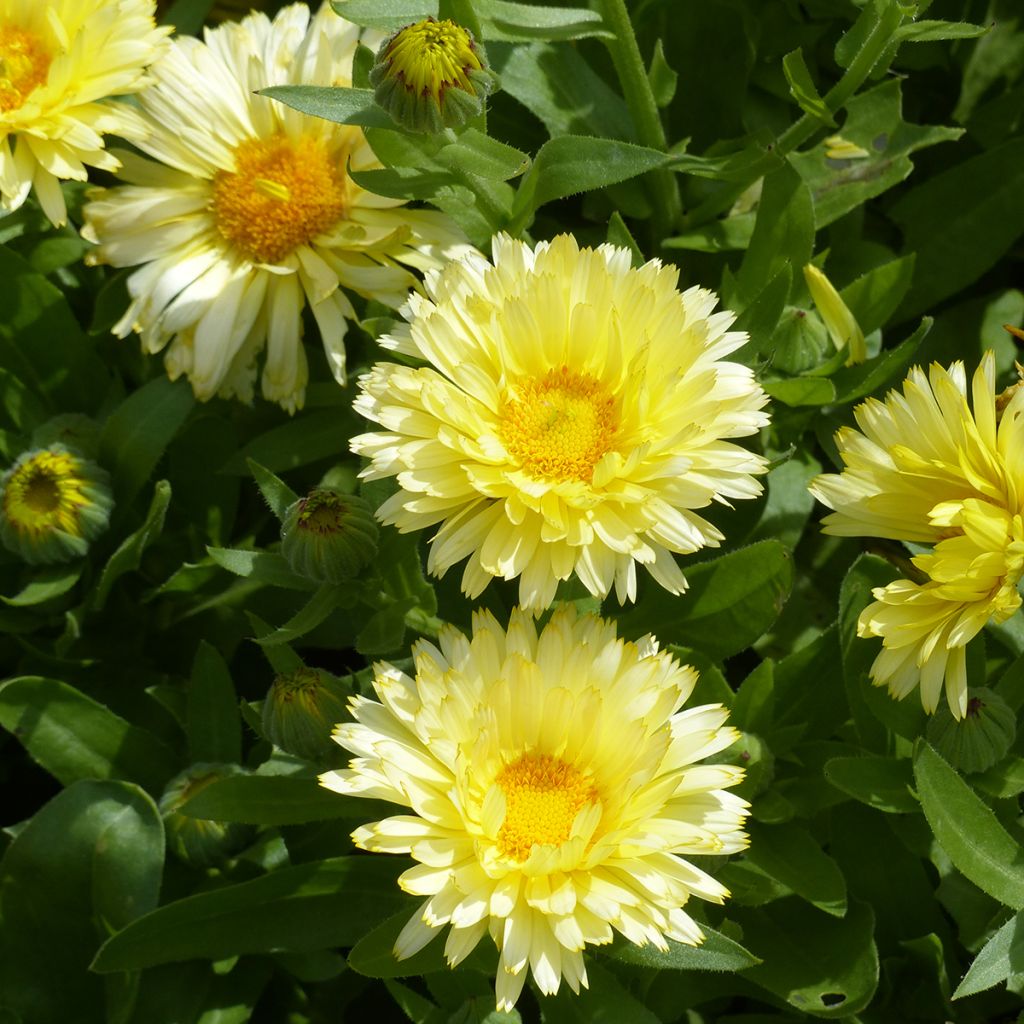
Calendula officinalis 'Pacific Beauty Lemon' is a Pot Marigold that combines numerous ornamental qualities. This very compact variety remains dense and proves extremely floriferous. Despite its small size, it produces large semi-double and double flowers abundantly throughout the summer. Its flower heads have lemon-yellow edges and an intense yellow centre. Ideal for borders and containers, this annual is also well-suited to the vegetable garden, as its petals are edible. Its cycle is rapid; sow it in March-April and it will flower approximately 10 weeks later.
Calendula belongs to the vast Asteraceae family, which, after Orchids, is the most prolific in the vegetable kingdom with approximately 23,500 species and 1,600 genera. This family was formerly called Compositae because the "flower heads" are actually inflorescences composed of numerous small flowers. The family includes many aromatic plants, some countryside wildflowers (Dandelion, Cornflower, Daisy...) and numerous ornamental plants, such as Mouse-ear Hawkweed or the popular Zinnia.
There are about twenty species of Calendula, including the Pot Marigold, C. officinalis, which easily spreads to grow wild in Mediterranean regions, as the seed withstands cold well. The species name comes from the fact that the plant has long been known for its herbal properties, to the extent that the great Charlemagne recommended its cultivation in royal estates in his famous work "Capitulare de villis vel curtis imperii". Today, breeders work to produce ever more floriferous varieties for ornamental use.
This is the case for the particularly attractive Pot Marigold 'Double Lemon' for garden flowering. It is very compact, forming dense clumps 40 cm high by 20 cm wide, which remain well-grouped throughout the growing season. The medium green foliage is quickly adorned with large flowers that can reach up to 7 cm in diameter from June, sometimes May. Composed of dozens of florets, the large flowering heads are lemon-yellow on the periphery, turning to intense yellow at the centre. The contrast with the green leaves is particularly harmonious, and the plant forms magnificent borders. It is also perfect for filling containers in which it will flower until September, with regular applications of liquid fertiliser. Easy to grow in most soils, this superb variety also shows good resistance to powdery mildew, that fungus which can mark foliage with white, weakening the plant and harming flowering. The flowering is not only very pretty, but also useful for pollinating insects. Opening and closing with to sunlight, the flowers are also edible. Add petals to your salads to give them a colourful note and a slight spicy taste, as Pot Marigold is a good substitute for saffron!
Very easy to grow from seed, Pot Marigold 'Double Lemon' can be grown in the vegetable garden, between rows of vegetables to add colour, as well as to repel soil nematodes and attract pollinators. Plant Basil 'Dark Opal' with purple leaves next to it for a lively display! It will also be valuable in the ornamental garden, where its generous flowering will continue throughout summer. You can combine it in beds with Dahlias and thus create very contrasting colourful scenes. All foliage plants will also be good companions, such as Artemisias with greyish vegetation.

Flowering
Foliage
Plant habit
Botanical data
Calendula
officinalis
Double Lemon
Asteraceae
Pot Marigold, Common Marigold, Garden Marigold, English Marigold
Cultivar or hybrid
Planting and care
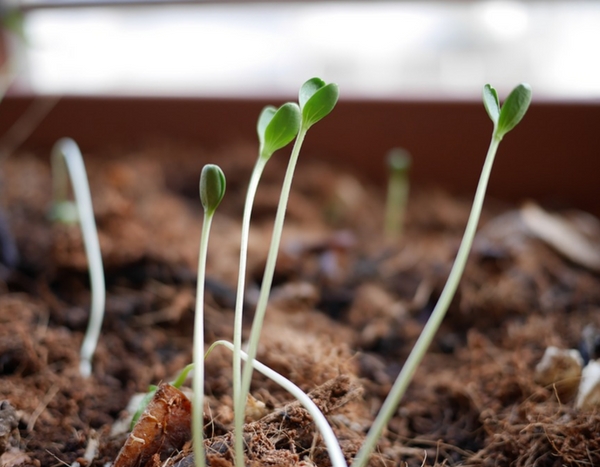
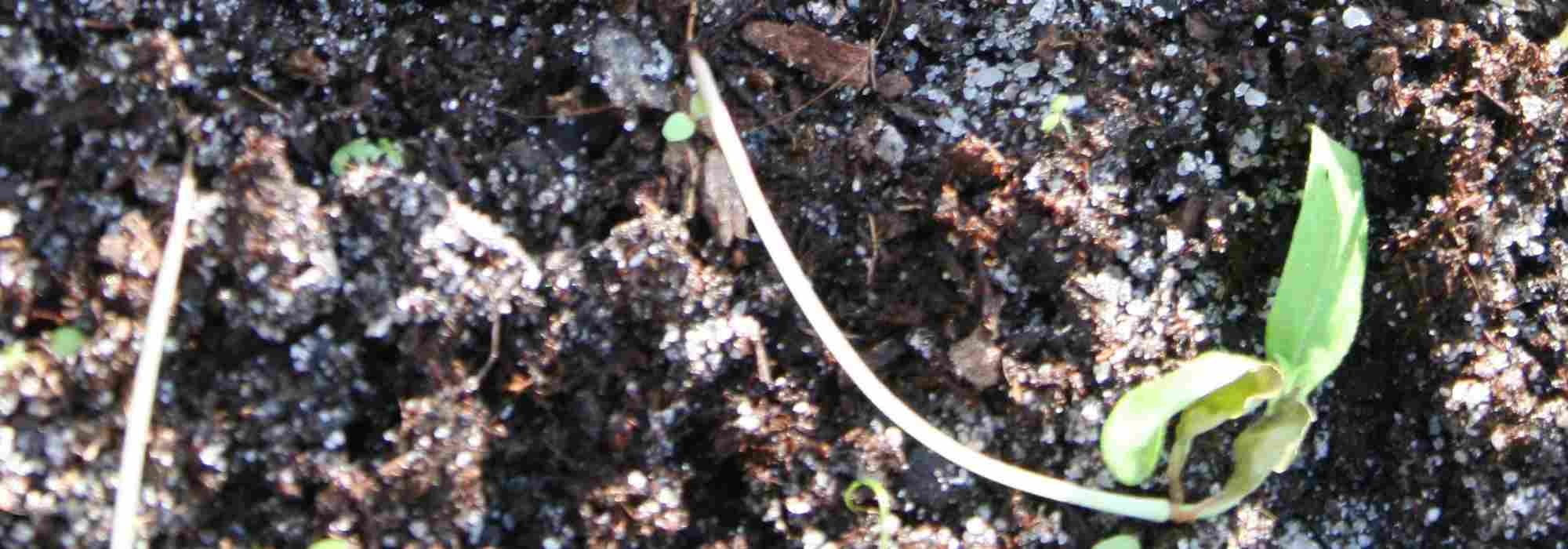
The Double Lemon Marigold can be sown directly in place from March in mild regions, and between April and May elsewhere. If you live in a cold area, wait until the end of heavy frosts, as the seeds prefer temperatures around 20°C. Loosen the soil a little and choose a sunny spot. Sow the seeds in furrows spaced 30 cm apart, then cover with a few millimetres up to 1.3 cm of soil and water lightly. They will germinate within 5 to 10 days, and you can thin them if necessary, spacing them 30 cm apart in the rank.
In colder regions, it is also possible to sow indoors in March-April by keeping the trays at a temperature of 18 to 23°C. This allows you to get ahead in the development cycle; simply transplant the young plants outdoors from May onwards.
Another option is to sow in late summer/early autumn, in a cool greenhouse, in pots that remain sheltered until spring. You can then transplant the shoots from March onwards into containers or open ground to benefit from an earlier start.
Growing:
Marigolds are fast-growing plants that thrive in sun or partial shade in warm climates and in sheltered positions. They are undemanding, provided they are planted in well-drained, fairly fertile, light soil. Protect the plants from slugs and snails, which are fond of them.
Sowing period
Intended location
Planting & care advice
-

-
-
-

-

-

-

-

This item has not been reviewed yet - be the first to leave a review about it.
Recently viewed products
Haven't found what you were looking for?
Hardiness is the lowest winter temperature a plant can endure without suffering serious damage or even dying. However, hardiness is affected by location (a sheltered area, such as a patio), protection (winter cover) and soil type (hardiness is improved by well-drained soil).

The flowering period indicated on our website applies to countries and regions located in USDA zone 8 (France, the United Kingdom, Ireland, the Netherlands, etc.)
It will vary according to where you live:- In zones 9 to 10 (Italy, Spain, Greece, etc.), flowering will occur about 2 to 4 weeks earlier.
- In zones 6 to 7 (Germany, Poland, Slovenia, and lower mountainous regions), flowering will be delayed by 2 to 3 weeks.
- In zone 5 (Central Europe, Scandinavia), blooming will be delayed by 3 to 5 weeks.
In temperate climates, pruning of spring-flowering shrubs (forsythia, spireas, etc.) should be done just after flowering.
Pruning of summer-flowering shrubs (Indian Lilac, Perovskia, etc.) can be done in winter or spring.
In cold regions as well as with frost-sensitive plants, avoid pruning too early when severe frosts may still occur.
The planting period indicated on our website applies to countries and regions located in USDA zone 8 (France, United Kingdom, Ireland, Netherlands).
It will vary according to where you live:
- In Mediterranean zones (Marseille, Madrid, Milan, etc.), autumn and winter are the best planting periods.
- In continental zones (Strasbourg, Munich, Vienna, etc.), delay planting by 2 to 3 weeks in spring and bring it forward by 2 to 4 weeks in autumn.
- In mountainous regions (the Alps, Pyrenees, Carpathians, etc.), it is best to plant in late spring (May-June) or late summer (August-September).
The harvesting period indicated on our website applies to countries and regions in USDA zone 8 (France, England, Ireland, the Netherlands).
In colder areas (Scandinavia, Poland, Austria...) fruit and vegetable harvests are likely to be delayed by 3-4 weeks.
In warmer areas (Italy, Spain, Greece, etc.), harvesting will probably take place earlier, depending on weather conditions.
The sowing periods indicated on our website apply to countries and regions within USDA Zone 8 (France, UK, Ireland, Netherlands).
In colder areas (Scandinavia, Poland, Austria...), delay any outdoor sowing by 3-4 weeks, or sow under glass.
In warmer climes (Italy, Spain, Greece, etc.), bring outdoor sowing forward by a few weeks.
Shipping country and language
Your country of residence may be:
Your country of residence is:
For a better user experience on our website, you can select:
Your shipping country:
-
 Austria
-
 Belgium
-
 Bosnia & Herzegovina
-
 Bulgaria
-
 Croatia
-
 Cyprus
-
 Czechia
-
 Denmark
-
 Estonia
-
 Finland
-
 France
-
 Germany
-
 Greece
-
 Hungary
-
 Iceland
-
 Ireland
-
 Italy
Italy
-
 Latvia
-
 Liechtenstein
-
 Lithuania
-
 Luxembourg
-
 Malta
Malta
-
 Netherlands
-
 Poland
-
 Portugal
-
 Romania
-
 Serbia
-
 Slovakia
-
 Slovenia
-
 Spain
Spain
-
 Sweden
-
 Switzerland
Language:
-
French
-
 English
-
Spanish
-
Italian
-
German
-
Portuguese
-
Dutch
-
Finnish
My Account
Hello
My wish lists
My cart
Log in / Register
Existing customer?
This form is protected by reCAPTCHA - the Google Privacy Policy and Terms of Service apply.
New customer?
Create an account to track your orders, access our customer service and, if you wish, make the most of our upcoming offers.