Further reading…
Making a garden resilient, stronger in the face of the repeated heatwaves our countries now suffer, is one of the challenges of the Chaparral garden, which draws on flora from extreme climates, such as those found in New Mexico or California. The multiple heatwaves of summer 2026 confirm this reality and will certainly steer us towards undemanding plants that are also hardy in our winters. Discover this new type of garden, inherently waterwise, low-maintenance and very promising.
What is a chaparral?
Chaparro is a Spanish word referring to several oak species (Quercus ilex, holm oak, but also Quercus coccifera and sometimes cork oak). The term also covers less well-known species such as Castela tortuosa, a shrub native to arid areas of Mexico and southern United States.
Chaparral is nothing more than an area of scrub and shrubs, forming a specific ecosystem in Mediterranean climates. It generally resembles a stand of holm oaks, in other words a garrigue or maquis, terms and landscapes more familiar to us. The name in Spanish denotes a biome found mainly from Mexico to California, and in Europe around the Mediterranean such as Andalusia or Sardinia. These areas are wooded, populated by shrubs and undershrubs able to withstand very hot conditions.
Plants able to grow in chaparral are often sclerophyllous (small, leathery leaves covered by a protective cuticle), sharing unique adaptations to this dry environment: deep roots, grey-green leaves that reflect light, and essential oils that limit evaporation.

We imagined three scenes to reproduce, in spirit, this ultra-resilient type of landscape. You can create a single area of the garden that receives particularly strong summer sun, or treat the whole garden in this style, provided you live in temperate valleys or mild zones of the country.
Adapting the chaparral to a dry exotic garden
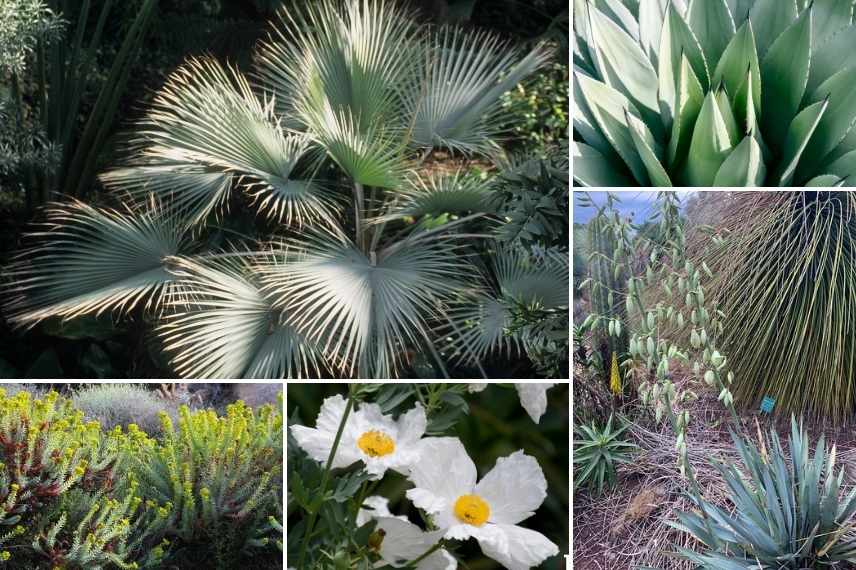
A dry garden can create a sublime scene with exceptional plants.
Here we play with a palette of blue-tinged foliage using plants surprisingly resistant to short frosts in winter, not exceeding −10°C. The tree poppy, a Californian and Mexican plant with wonderful white flowers, and the Mexican blue palm for an original backdrop, have proven able to withstand very dry summers. Once well established, Romneya poses no real hardiness issues. A Yucca pallida joins them to form that superb silvery-blue base, accompanied by an agave hardy enough such as Agave parryi or Agave montana.
A Mediterranean perennial, Euphorbia pithyusa, a Balearic spurge that stays low, and a Mexican-origin plant, Mathiasella bupleuroides 'Green Dream' with jade-green flowers, naturally fit among these plants. We bring in chartreuse and blue-green tones for a duet of colours evoking Mediterranean aridity.
NB: this blue planting can easily be part of a blue garden, located in the sunniest, driest part of the garden!
Transport yourself to Lanzarote
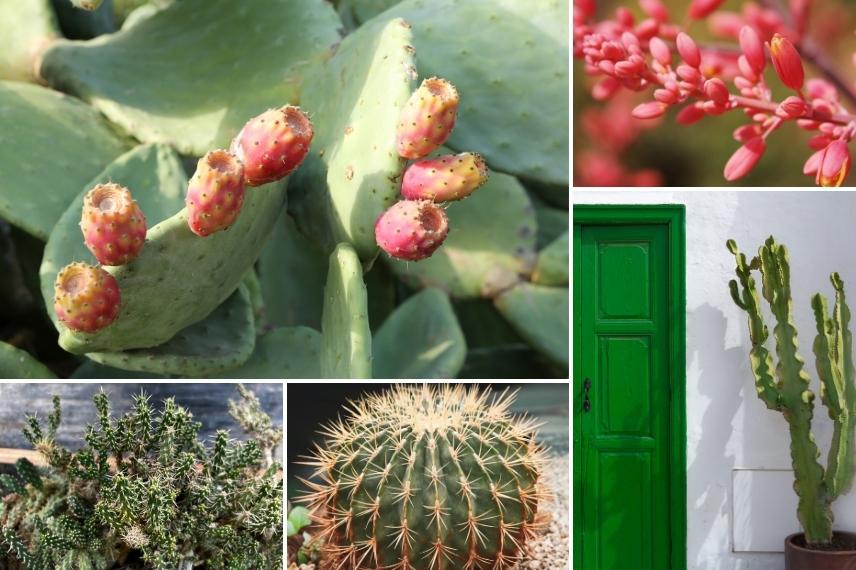
Lanzarote's cactus gardens are exceptionally photogenic. On this volcanic archipelago grow sclerophyllous plants with small leathery leaves adapted to drought, and spiny cacti. Drawing inspiration from them, while carefully selecting cacti cold-hardy enough for our winters, allows creation of a unique area within a dry garden, ready to face repeated summer heat spikes. Ensure perfect drainage, as this type of garden cannot tolerate any standing moisture in winter.
A prickly pear, well adapted to sea spray, is interesting for its slightly greater hardiness (down to around −15°C for some) and its unique habit with large spiny pads. Plant them liberally; choices include Opuntia scheeri or Opuntia engelmannii var. rastrera, among many others. In this distinctive setting, succumb to oddity of Cylindropuntia kleiniae, a cousin of opuntias, quite cold-hardy and producing a beautiful magenta summer bloom. Complement the area with a Hesperaloe parviflora and an Echinocactus grusonii, the golden barrel cactus often seen on the island.
This type of garden is intended for warm, mild regions of the country with less severe winters and dry summers.
Use pumice or black volcanic stones to simulate island soils and to ensure drainage. Finishing touch? a whitewashed house with green shutters to reproduce another characteristic of this island close to African coasts.
... or to landscape a poor, unproductive slope
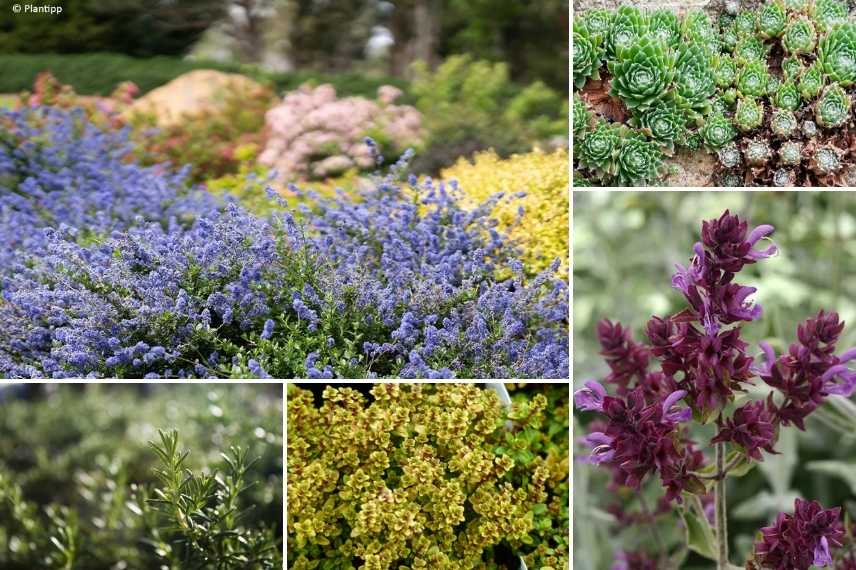
A south-facing, dry and unproductive slope can also be transformed into a resilient space by imitating the chaparral, an ecosystem adapted to extreme conditions.
To turn poor soil into a semi-desert rockery, favour low, hardy shrubs such as cistus (Cistus), a California lilac like the ceanothus ' Pacific Wave' or its groundcover form (C. thyrsiflorus 'Repens'), a prostrate rosemary and some sempervivums. These plants, with deep roots and leathery or fleshy leaves, tolerate drought and poor soils perfectly. Add a golden thyme, and some sages (such as Canary Island sage 'Lancelot'), aromatic plants that will scent the garden while attracting pollinators.
Once established, these plants require little watering and maintenance. Their dense foliage will protect soil from erosion and limit growth of weeds that are unwanted on the slope. A mineral mulch will help conserve moisture and enhance the slope's natural appearance. A few ochre or orange boulders placed here and there will also help evoke Californian or Andalusian maquis while enhancing the area.
Discover our selection of succulents and perennials on our "Dry garden" page online, and our inspiration in the trend booklet 2026!
Since Beth Chatto, the dry garden movement has increasingly been seen among landscapers and in gardening magazines and books. We cover it in detail in Designing a dry exotic garden, Laying out a gravel garden, the Californian-style garden and the garrigue garden, as well as strong trends recently seen at the Chelsea Flower Show in London, such as the antipodal garden and the sand garden.
Find all garden trends for 2026 in: What are the five major trends for 2026?
Making a garden resilient, stronger in the face of the repeated heatwaves our countries now suffer, is one of the challenges of the Chaparral garden, which draws on flora from extreme climates, such as those found in New Mexico or California. The multiple heatwaves of summer 2026 confirm this reality and will certainly steer us […]
There are materials that do us good. Cork, from the tree that bears its name, is one of them, and it has been making a notable comeback in our lives for several years now. A renewable, 100% natural, ecological material, cork is not used only to seal our best vintages.
The possibilities offered by this natural material are many and its recycling concerns us all.

Cork: a bio-based, ancestral and innovative material
Cork comes from the bark of the cork oak (Quercus suber), a tree growing around the Mediterranean, mainly in Portugal, and also in Spain, Italy, France, Algeria and Morocco. It has been exploited primarily in Europe since the 17th century, but its qualities were known to the Romans and Greeks, who began making cork stoppers to better preserve wine or oil in amphorae (clay or resin stoppers having proved limited). It was Dom Pierre Pérignon, a Benedictine monk well known in the Champagne world, who is said to have popularised the use of cork.
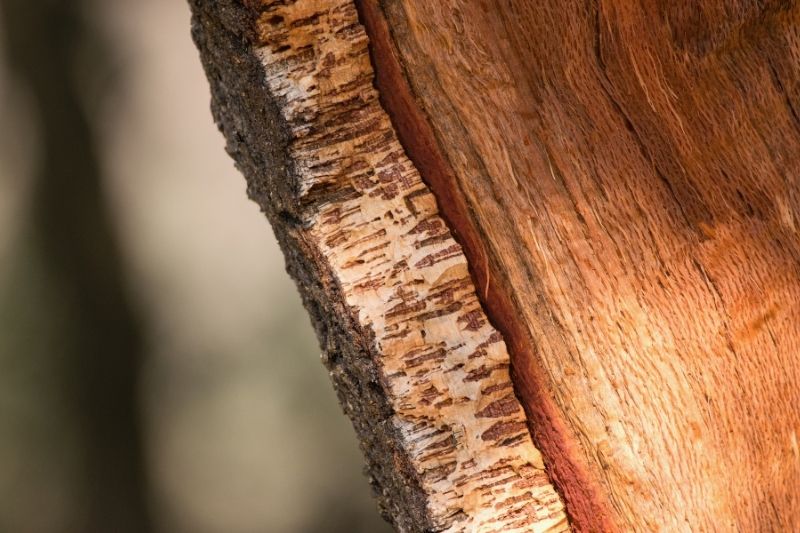
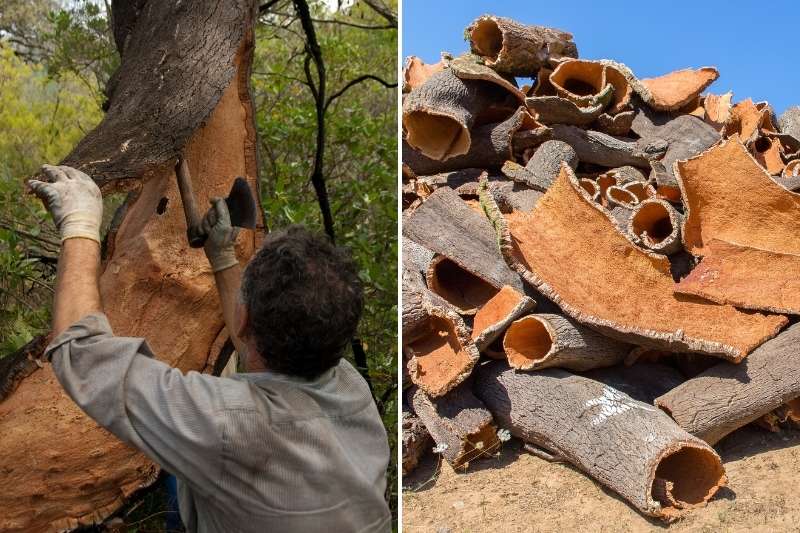
Only the bark – referred to as suberified bark – is harvested. The tree is not cut down; only its very thick cork bark, up to 25 cm thick, is removed using a special axe, without damaging the cambium (living tissue beneath the cork).
The tree therefore remains alive. The cork oak is able to regenerate its bark after each harvest, allowing sustainable exploitation over decades. It is also fire-resistant: after each fire, frequent in these Mediterranean regions, it reconstitutes its bark… like a vegetal phoenix or a Terminator of the forests!
Properties and uses of cork
Given all its qualities, cork has many uses beyond making stoppers. It is a technical material widely used in the marine sector for boat decks because of its rot-resistant properties, in leather goods to make soles, shoes and small items, and as an accessory for numerous decorative items, jewellery and furniture. Light yet flexible, impermeable and insulating, attractive and watertight, it has also become a material of choice for thermal and acoustic insulation. The construction industry also uses it as an effective moisture barrier, accounting for 14% of its use. The wine industry remains its main outlet, representing 69% of consumption. It uses the protective and breathable qualities of cork as well as its density to produce high-quality stoppers.

Production and extraction
Portugal, the world’s leading cork exporter, is the undisputed leader in production (50% of the total). Suberaies, the name given to cork oak forests, account for nearly a quarter of the country’s woodlands, with a strong concentration in the Alentejo region. Portuguese cork represents 50% of world production. Portugal and Spain alone cover more than half of the exploited areas.
France produces a smaller but high-quality quantity, in specific areas (Corsica, Pyrénées-Orientales, Var and Landes). The cork sector in France produces 3 billion cork stoppers per year, out of 14 billion worldwide.
It must be understood that cork forests and plantations in Portugal and other Mediterranean countries are ecosystems in their own right. Cork cultivation relies on patient, extensive management of natural areas.
Furthermore, knowing that one tonne of cork absorbs 2 tonnes of CO2, and that global production is 300,000 tonnes per year, there is no need to do the maths to grasp the ecological value of this resource.
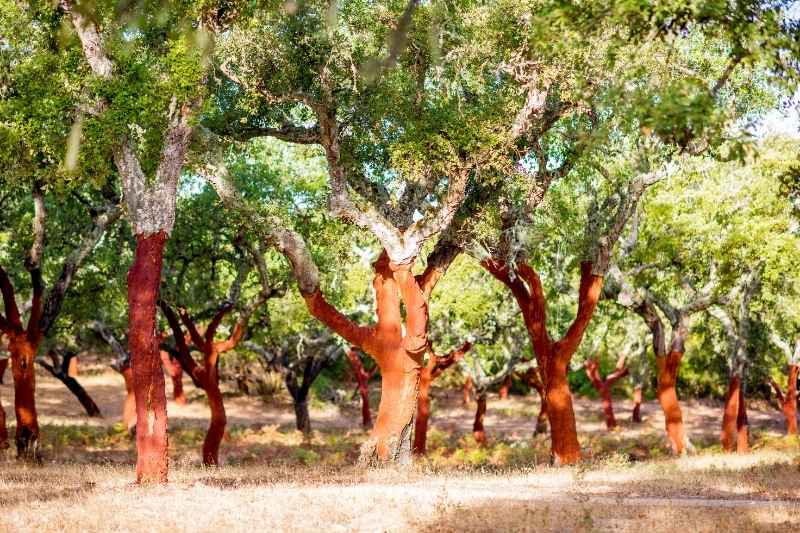
Extraction is done manually on the trunk when the tree is mature, at least 25 years old, by cutting or "lifting" the bark in large slabs. This is known as the debarking or lifting operation, carried out during the sap-rise period, from May to August. The first harvest produces so-called "male" cork, of lower quality, very thick and too hard, which will be sent for grinding. The bark renews naturally every 12 years approximately, on trees living on average 200 years. Each cork oak can thus be "scalped" around fifteen times in its life, producing so-called "female" cork, a noble, excellent-quality material. The cork slabs are air-dried for six months. Harvested cork has a very long shelf life, close to 100 years!
Cork recycling: an eco-friendly civic act within everyone's reach
France, as the world’s second-largest wine consumer, has a role to play.
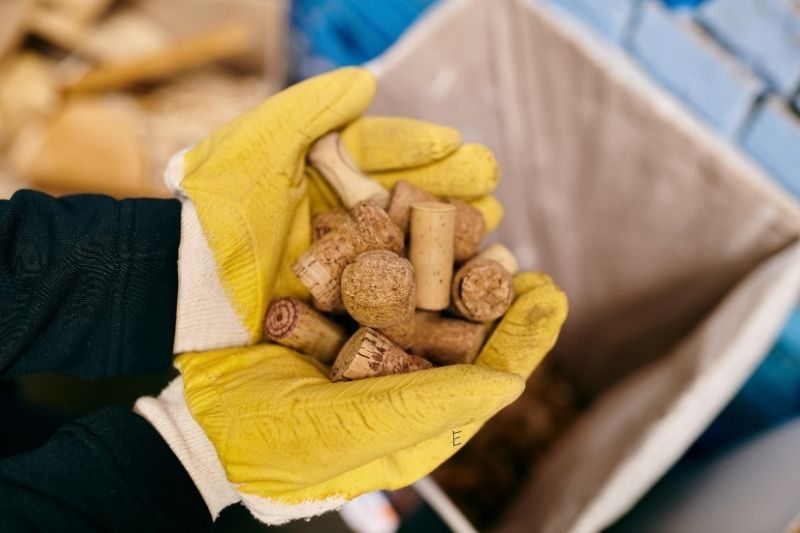
A 100% plant-based product, cork stoppers can be recycled, but they are not classed as packaging. They therefore cannot be put in the yellow recycling bin. They must be dropped off at a local collection point. Household waste centres, town halls, supermarkets, organic shops, wine merchants and sometimes schools are all places where precious stoppers can be returned.
Fewer people know that many local, regional and national associations take part in collections to support charitable causes.
Options in France include Recycliege France, Planetliege (site of the French Cork Federation), and regional waste management organisations such as Smitcom.
Once collected, stoppers are sent to specialised recycling plants where they receive specific treatment. Ground, they become granules, which are then turned into boards or blocks to make other objects, including new stoppers, or used for energy recovery.
Avoid putting cork stoppers in the compost. Although biodegradable, they decompose rather slowly and, in that case, should not be bonded with glue or plastic, as some new commercial stoppers are. These must be thrown in the household refuse bin.
Sorting cork: a well-established process
Each year more than 60 million cork stoppers are recycled in France out of a consumption of 3 billion cork-sealed bottles.
In this area, prevention and information are major issues for this circular economy in order to promote a reflex in our daily habits: collect cork stoppers together at home rather than throwing them one by one in the bin.
At European level, there is a recycling code for cork, FOR51. It identifies products made from natural cork without any agglomerate or synthetic substitute.
Be careful not to confuse 100% cork stoppers with cork-look stoppers, which are agglomerates of synthetic materials and glue: these must not go in the yellow recycling bin!
Cork in the garden: why not consider it?
An insulating material in summer and winter, therefore thermoregulating… Now, doesn't that sound good for our plants? Cork stoppers are indeed one of the original but proven recycling options for our potted plants. For drainage or insulation against the cold, once cut into small pieces (yes, you have to get your hands a little dirty), 100% cork stoppers prove to be precious and economical allies, replacing clay pebbles. Placed under pots, they protect those left on terraces and balconies in winter.
Our cork stoppers can also find a second life and be upcycled very prettily and easily for Christmas. The natural material and colour of cork pair perfectly with pine cones and wood to decorate the home for the festive season. Keep it in mind!

Further reading…
Cork is venturing into the space industry! Discover this surprising article on the aeronautical potential of cork from a small French company.
Two websites to consult: Planète Liège and the Mediterranean Cork Institute (IML), which provide much more information on their comprehensive sites.
This video shows the cork stopper manufacturing process in a Portuguese factory.
There are materials that do us good. Cork, from the tree that bears its name, is one of them, and it has been making a notable comeback in our lives for several years now. A renewable, 100% natural, ecological material, cork is not used only to seal our best vintages.The possibilities offered by this natural […]
Some trees and plants from far‑flung lands, from the baobab to our venerable oak, have been regarded as sacred for millennia. Peoples from different regions have chosen certain members of the world’s flora for their spiritual significance or the legends they tell. To this day they continue to attach powerful symbolism to them.
Why? Which trees and plants are these mythical specimens adored by so many cultures? I suggest discovering a few on each continent, among the most emblematic on our planet.
Le Ginkgo biloba
This tree with its unique, bilobed foliage, like thousands of tiny fans, and its sublime golden autumn colours, is one of Asia’s emblematic sacred trees. Long before Hiroshima — which made it famous worldwide for surviving the blast — this symbol of resilience was known in Japan for its exceptional longevity, even its apparent immortality. It is said that Ginkgo biloba can live for more than 1,000 years. Some ginkgos in Asia have even been dated to nearly 800 years, a record for this “fossil” tree and sole representative of its botanical family, the Ginkgoaceae.
It is one of those venerated trees planted in front of Buddhist, Taoist and Shinto temples. It is said that Confucius once taught his philosophy beneath one of the planet’s oldest specimens, at Sungkyunkwan in South Korea. In Japanese tradition, the ginkgo wards off evil spirits, and it is also known for medicinal virtues and its natural fire‑resistant quality, a symbol of protection.
Rediscovered for landscaping about thirty years ago because of its ease of cultivation and rapid growth, it is increasingly seen in gardens, both as the typical form, Ginkgo biloba, and in dwarf varieties suitable for containers. It also lends itself well to bonsai training.
Today it is also widely planted for another reason: science is closely studying its interesting properties in research into cognitive disorders.
Read more at: Ginkgo biloba: why does this tree fascinate so many gardeners? and 5 great ideas for pairing ginkgo.

African and Indian ficus
Let us now travel to the African continent. Ficus sycomorus, which I saw myself at the Botanical Garden of Palermo, is one of Africa’s majestic trees, a classic “palaver tree”, alongside the baobab and the banyan, which are also sacred.
An African fig tree, remarkable for its stemless flowering and fruiting, arising directly from trunk and old branches. Once fertilised by wasps, the flowers (sycones, another botanical peculiarity) become small round figs, grey‑green to pinkish‑orange. As with our Mediterranean fig, it is not strictly a fruit but a pseudocarp.
Often simply called sycamore, Egyptian fig or Pharaoh’s fig in ancient Egypt, it belongs to family Moraceae. Found in Africa, it is also widespread in Near and Middle East, notably in Israel and Yemen, where it is still cultivated for its figs.
Mentioned in Old and New Testaments (Zacchaeus story), associated with Egyptian female deities (Hathor, Nut or Isis), Ficus sycomorus is one of the world’s oldest trees, venerated as a tree of life. Numerous representations have been found in tombs and on papyri; the Egyptians used its rot‑resistant wood to make sarcophagi and many everyday objects.
This age‑old sycamore also represents a tree of benefits, providing vital shade in hot countries, beneficial through abundance of fruit, and above all indicating presence of water, source of life.
Planted near graves, sycamores are still attributed a link between heaven and earth, true connections between the two worlds.

Another sacred Ficus is the banyan or banian (Ficus benghalensis), native to India, where it grows wild across the subcontinent. Remarkable for its vast spread, it is recognisable by spectacular aerial roots that descend from the crown to reach the ground, take root and proliferate. Its gigantism makes it hard to photograph; it is Bali’s cosmic sacred tree and a symbol of wisdom throughout Asia, its roots creating an immutable link between earth, people and the divine. Offerings are often left around banyans in Asia. Different religious traditions (Hinduism, Buddhism, Jainism) ascribe varied attributes to it, but it remains a powerful symbol for communities, serving as refuge, landmark, spiritual anchor and meeting place.

Holly
Common holly (Ilex aquifolium), with evergreen leaves and bright red berries, holds a sacred place in many traditions worldwide. Often relegated to defensive hedging, holly has symbolised eternal life, protection and rebirth since antiquity, thanks to its evergreen foliage in winter. Celtic pagan culture revered it as a protective tree, able to drive away evil spirits and to purify places. It was often associated with the winter solstice, a time when its berries, symbols of fertility, shone in the sleeping landscape.
In Christian tradition, holly is linked to Christ’s crown of thorns, its red berries evoking shed blood. At Christmas it decorates homes with its reddened berries during dark season. The Romans presented holly branches at the Saturnalia, festivals marking renewal of the year. In folk magic holly is used for protection against spells and to attract luck. Its wood, reputedly rot‑resistant, was also used to make sacred objects.
Note: holly in English (“holly”) does not share etymological origin with “holy” (sacred), but their similar sounds and holly’s role in pagan then Christian traditions have strengthened its symbolic association with the sacred. Thus this plant, already protective in European cultures, became a “holy” emblem of winter festivities, notably at Christmas.

Cordyline and taro
Oceania is no stranger to sacred legends about its plants, found across the Pacific islands. According to an ancient Polynesian origin myth of plants, the taro (Colocasia esculenta) was born from a man’s feet and his lungs became the leaves. The plant called elephant’s ear is therefore more than an edible root to island inhabitants.
Cordyline fruticosa, a tropical, very colourful plant ubiquitous in hedges and villages, is also sacred: it was planted before houses and principal priests’ dwellings to drive away evil spirits; it was taken aboard canoes to bless sailors and long Pacific crossings. Its leaves had many practical uses — making waistcloths, roofing houses, cooking food — and its roots are edible. Called Ti in Hawai‘i and Auti in Tahitian, this plant with magical powers is consecrated to Lono, god of the fields, and widely used in religious ceremonies. It is still regarded as protective, judging by its presence around houses, and is much used in leaf crowns and necklaces that beautify Polynesian culture, adorning heads and bodies and welcoming visitors.

The lotus
Another plant with strong sacred connotations is the Asian species Nelumbo nucifera, the sacred lotus, which transports us to Asia.
Growing in full sun with roots in muddy water, the lotus symbolises purity arising from chaos and filth. Legend has it that the muddier the water it grows in, the purer and more beautiful its flowers. This purity is linked in Buddhist culture to purity of body and soul, and also to rebirth and spiritual elevation, like the flower rising above the water well above the leaves.
Its aura is not confined to India, its native land where it holds true sacred status. Vietnam has adopted it as national emblem, Macao even depicts it floating on water on its flag, and Egypt considers it a national flower.
Although the Egyptian lotus — actually a water lily — belongs to two other species (Nymphea lotus and Nymphea caerulea), it is likewise an aquatic plant and regarded as one of the oldest revered plants in the world: adored in pharaonic Egypt, the “sesen” was painted on tomb frescoes and bas‑reliefs, on papyri and used as a capital motif on “lotiform” temple columns. Opening with the sun and closing in the evening as it sinks beneath the water, it was associated with god Ra, symbolising creation, rebirth, the sun and therefore life. The blue lotus (Nymphaea caerulea), very fragrant, was used to perfume temples and as offerings to the gods.
Asian Nelumbo nucifera and the Egyptian lotus water lily are among the most deeply rooted sacred symbols worldwide, spanning distinct cultures and religions. The lotus’s many representations, and its symbolism of beauty, purity, fertility and divinity, make it a sacred flower in Buddhism and Taoism. In Asia, Buddha is often depicted seated on a lotus. Hatha yoga even borrowed from this plant the famous lotus posture used in Buddhist meditation. Among Hindus, creator god Brahma is said to have been born from a Nelumbo nucifera flower. Oriental temples are still preceded by lotus ponds, and the lotus throne is a common pedestal in Asian art.

The pawpaw (Asiminier)
We finish this sacred selection on the American continent. This tree with an oddly exotic common name (Pawpaw) is entirely hardy and has been cultivated for centuries in the northern and eastern United States and in Canada, in fact long before colonists arrived on the New World. The Anishinaabeg, Indigenous Algonquin peoples of Quebec and Ontario, gave the plant its Latin name Asimina triloba, probably derived from an Indigenous name.
Endemic to the whole eastern United States, the pawpaw was deeply rooted in Native American culture, serving not only as food but being closely associated with medicine, myths and spiritual meaning, notably as a symbol of patience and connection with nature.
For the Shawnee of Ohio, as for many Indigenous peoples, nature is inseparable from spirituality. Pawpaws, as nourishing and medicinal plants found at many sacred sites, were naturally integrated into rituals. The trees’ growth cycle symbolised renewal, connection to ancestors and balance between the physical and spiritual worlds. Pawpaw fruits likely featured in prayer and offering rites and were used as trade goods.
The Shawnee still see in these trees a symbol of connection between generations and their lands, even after forced displacement in the 19th century. The pawpaw remained a living reminder of cultural heritage.
This “poor man’s banana” or “northern mango”, as Québeckers call it, has a distinctive flavour that cannot easily be compared to familiar European fruits —
Belonging to family Annonaceae, which includes several tropical forest trees such as ylang‑ylang, custard apple and sugar‑apple, the pawpaw is unique in growing in temperate regions.

Go (much) further...
Many other plants and trees are considered sacred, often associated with immortality by peoples. They come from the oldest civilisations and traditions: the yew, the olive and the asphodel in the Mediterranean, the kapok tree (Ceiba) in South America, Commiphora myrrha (the myrrh of the Magi) in the Near East, the baobab, Cyperus papyrus in Egypt, sacred bamboo, the ash or the oak closer to home… They are all still linked to pagan or religious rites around the world.
For further reading for enthusiasts of botany and history like me: learn much more about the mythical sycamore in this fascinating Tela Botanica paper; there is much to say about the lotus, a millennia‑old plant with multiple sacred connotations… This article on the symbols of ancient Egypt should enthral you.
To conclude, publisher Eyrolles released in 2024 a beautiful book, "Arbres sacrés du monde - Science, légendes et usages autour de 25 essences, A marvellous anthropological exploration for connecting with the wisdom of trees" by Aurélie Valtat, which inspired me to buy it while researching this topic. I highly recommend it if you wish to continue this fascinating journey through the world’s trees.
At Delachaux et Niestlé you can find Histoires d'arbres - Des sciences aux contes by Philippe Domont, forest engineer, published in 2014. And, to write this article, I joyfully revisited one of my old favourites (the best!), Mythologies of the World by Roy Willis, original English edition 1993. It contains rich material and insights into the connections between humans and plants since time immemorial.
Some trees and plants from far‑flung lands, from the baobab to our venerable oak, have been regarded as sacred for millennia. Peoples from different regions have chosen certain members of the world’s flora for their spiritual significance or the legends they tell. To this day they continue to attach powerful symbolism to them.Why? Which trees […]
Terraces, courtyards, patios and small bohemian balconies are the new stars of summer! This very colourful "boho" trend that has invaded our interiors and wardrobes also appears in our summer green retreats. It matches the sunny cheerfulness of a season when we spend a lot of time outdoors.
Let’s take inspiration from the gypsy world to prepare bright alcoves on balconies, terraces and inner courtyards from the first fine days, with planting ideas and decorative elements. We explore this Boho Patio in three scenes easy to recreate at home!
Boho Patio codes
The bohemian atmosphere dresses itself in vivid, deep and variegated colours that answer one another, but also in associations of warm tones in the blooms: intense reds, deep violets, Indian pinks and spicy oranges, not forgetting bicoloured flowers. Bluish, golden or purplish foliage helps to reinforce this playful mood, bringing red or variegated splashes.
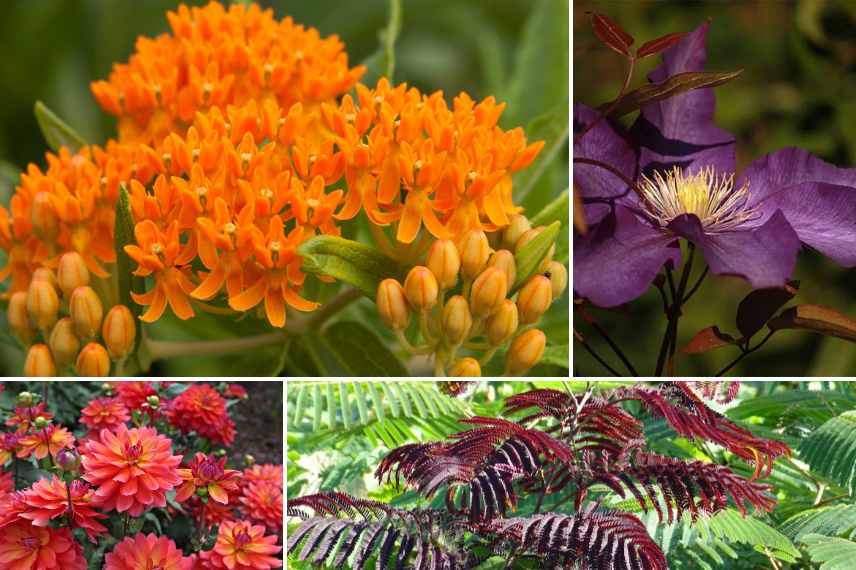
This mixed-up planting borrows from gypsy culture a festive, hybrid universe that laughs at convention and pairs a whole spectrum of colours, provided they are warm and bright.
This style is also based on improvisation, like manouche music, and on bold accents. This temperament appears in the garden in temporary scenes created especially for the summer months, and in the accumulation of mismatched small objects (side tables, stools, small cushions, etc.).
On the décor side, important for dining and relaxation areas, have fun with mismatched pairings: rustic furniture repainted turquoise or green, rattan chairs, fabric pouffes, Provençal floral and ethnic patterns juxtaposed with strong colours: turquoise, pink, orange and bright yellow. The advantage of this bohemian décor is that you can mix disparate objects and accessories, using what you already have at home or stored in the attic, to give them a second life: bring out granny’s lace and embroidery for the summer, macramé and trimmings, old rattan armchairs, baskets and fruit crates, airy curtains. In a joyful mix of materials, the décor is done!

On a sun-drenched terrace
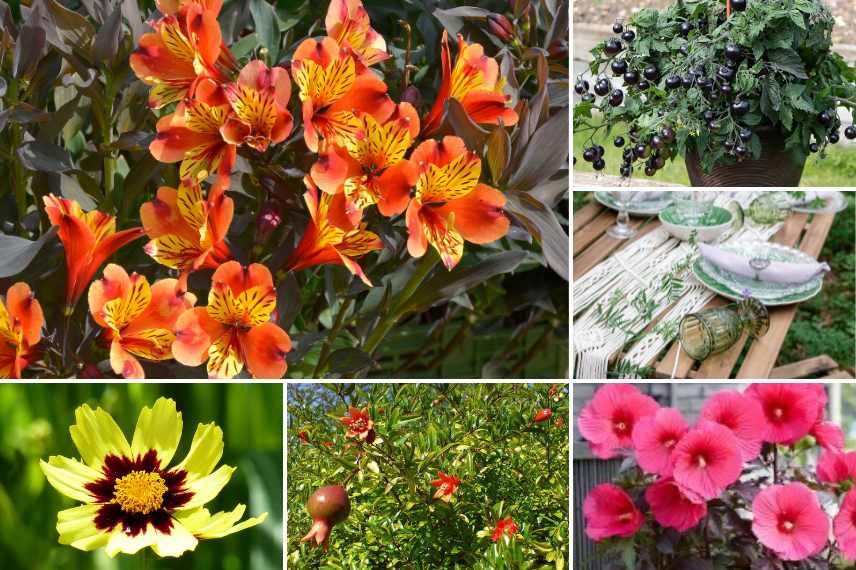
Terrace or balcony are often west- or south-facing. They can be radically transformed into an ultra-cheerful cocoon with sun-tolerant plants that do well in pots. Explore a plant colour palette ranging from saffron yellow to violet for a truly bohemian vibe.
Alstroemerias 'Indian Summer', orange and yellow contrasting against bronze foliage, will look stunning alongside Coreopsis 'Cosmic Eye', a bright yellow spotted with purple, or the pretty all-yellow 'Full Moon Madness'. Add other long-flowering plants such as a common Rose mallow 'Pink Passion' with giant flowers and dark purple foliage, and provide more foliage interest with a pomegranate that can be grown in a pot, such as Punica granatum 'Nana', whose brilliant flowers will pair beautifully with the other perennials. For snacking at aperitif time, invite, for example, the surprising cherry tomatoes 'Akoya', whose fruits turn almost black.
In a semi-shaded urban patio
Small city courtyards benefit from focusing on colour and variegated or golden foliage to lift them out of the shade. In a semi-shaded patio receiving enough light and warmth in summer, opt for sunny flowers and a few "indestructibles":
Hosta 'The King', Hakonechloa macra and an Aucuba japonica 'Crotonifolia' for their golden and variegated foliage (Aucuba will reward you with pretty red berries a little earlier) together with the bold flowers of Hibiscus syriacus 'Hibisa rosada', and the Peruvian lily 'Duc d'Anjou'.
The bohemian spirit will also be present in accessories, essential in less bright areas and in smaller spaces.
Beyond plants, bring colour without fearing the boldest mixes. Dare genre-mixing: antique rug + Italian ceramics + small disparate or oversized objects and a cosy bench, etc. Here, the evening atmosphere will be especially worked on: lanterns, paper lanterns and candles, and don’t forget a crochet throw in these patios that are often cooler at night.

Garden refuge as an improvised alcove
This bohemian trend can also be expressed in a corner of the garden used as an improvised summer retreat.
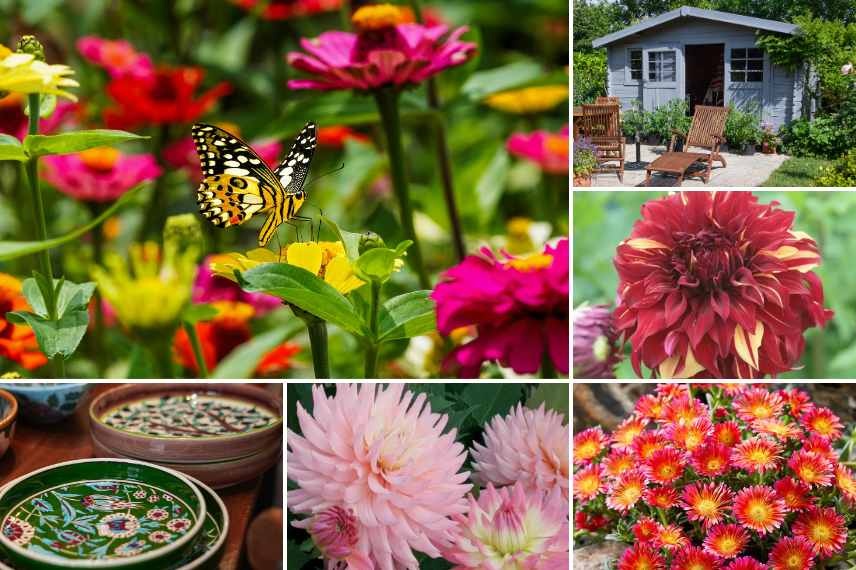
In front of a shed, garden shelter or at the foot of a fine tree from which a rattan chair is hung, set up a summer hideaway using bohemian codes. A temporary terrace, improvised with clip-together wooden decking tiles readily available from DIY stores, is easy to install. In summer it becomes a true green cocoon perfect for relaxing on a garden sofa made of a few stacked pallets or large pouffes, in a fairground style.
Here, a few colourful annuals join the party: multicoloured zinnias and orange calendulas (marigolds) sown in pots in spring, or beds of African marigold 'Mango Tango' around the area, as well as sun-loving perennials such as the charming Delosperma 'Ocean Sunset Orange Glow'. Count on two striking pots of dahlias with evocative names, the fiery 'Bohemian Spartacus' and the more restrained compact 'Melody Gipsy', for a long and remarkable display. Sunflowers 'Mongolian Giant' will bring pep and height, while a pot of basil 'Everleaf Emerald Tower' will be handy for salads at barbecues or sunny lunches.
Gather your most colourful pots, bring in lace, hangings, vintage crockery and cushions: job done!
Discover other plants ideal for composing this bohemian green décor on a terrace in our "Boho Patio" selection online and in our trend booklet!
Feeling the bohemian spirit? Find our advice on creating a bohemian garden, and our inspirational sequences: Catalane and Peach Raspberry.
This Boho Patio trend also draws on recycling second‑hand objects. Explore our topics to let your creativity run free: Decor idea: plants in unusual containers; How to make a planter from a pallet?; Recycling in the garden and How to use and properly integrate terracotta pots in the garden?
Terraces, courtyards, patios and small bohemian balconies are the new stars of summer! This very colourful “boho” trend that has invaded our interiors and wardrobes also appears in our summer green retreats. It matches the sunny cheerfulness of a season when we spend a lot of time outdoors. Let’s take inspiration from the gypsy world […]
At the end of each year, it's an opportunity to reflect on the favourite plants of the editorial team, those that have marked our gardens, terraces, and interiors with their beauty, originality, or ease of cultivation. Behind each favourite, there is a gardener's story, a meeting with a plant that has found its place and transformed a patch of greenery into a true source of inspiration.
In this article, the editorial team shares its top plant picks for 2025, from characterful trees and shrubs to floriferous perennials, not forgetting the graphic houseplants and lesser-known species that deserve to be recognised. This selection is guided by a passion for gardening, a desire to share useful tips, and to help you find the plant that will make your heart race.
Ingrid: the Cercis canadensis 'Ruby Falls'
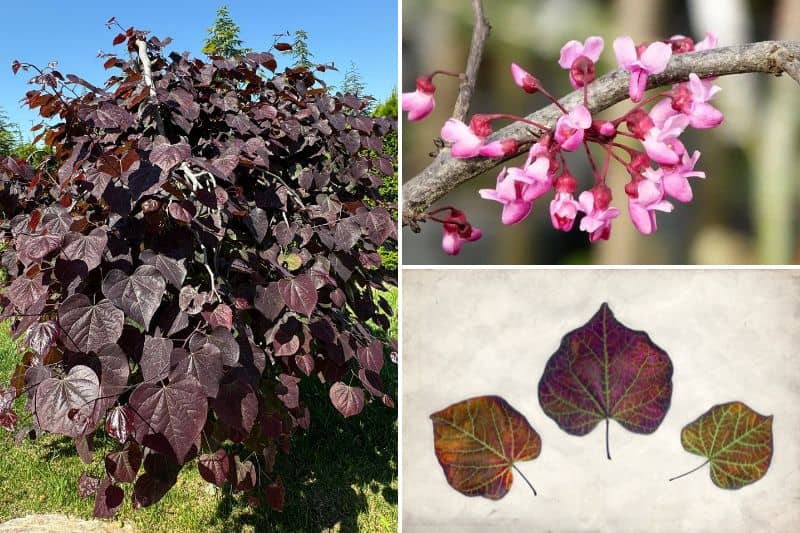
This year, my choice is the Cercis canadensis 'Ruby Falls', a dwarf weeping redbud that offers a poetic presence in my bordering terrace bed. Planted in partial shade, it boasts heart-shaped leaves of a deep purple mixed with green, which seem to cascade along its drooping branches. In spring, its violet-pink flowers emerge on the still bare wood, bringing unexpected colour before the young red leaves unfurl. In autumn, this foliage takes on bronze and copper hues before falling.
I particularly love the contrast of its purple foliage with that of the surrounding plants, especially the bright green and violet-blue flowers of a nearby Hardy geranium 'Rozanne'. Alongside them, my Greater celandine, more spontaneous, naturally brightens the base of the shrub with its light green foliage. A little further away, a Acer palmatum ‘Bloodgood’, with its reddish-brown foliage, echoes the Ruby Falls. This chromatic continuity, from the purple of the Cercis to the darker hue of the maple, gives a gentle coherence to the bed and creates a visual depth where the light catches differently depending on the seasons.
This little Canadian redbud easily finds its place in a garden, thanks to its weeping habit and compact size. Its good hardiness makes it simple to cultivate, as long as the soil retains some moisture in summer. At my place, it quickly integrated into the bed, bringing softness to this part of the garden without ever overshadowing the neighbouring perennials.
Virginie: the Begonia 'Rex Escargot'
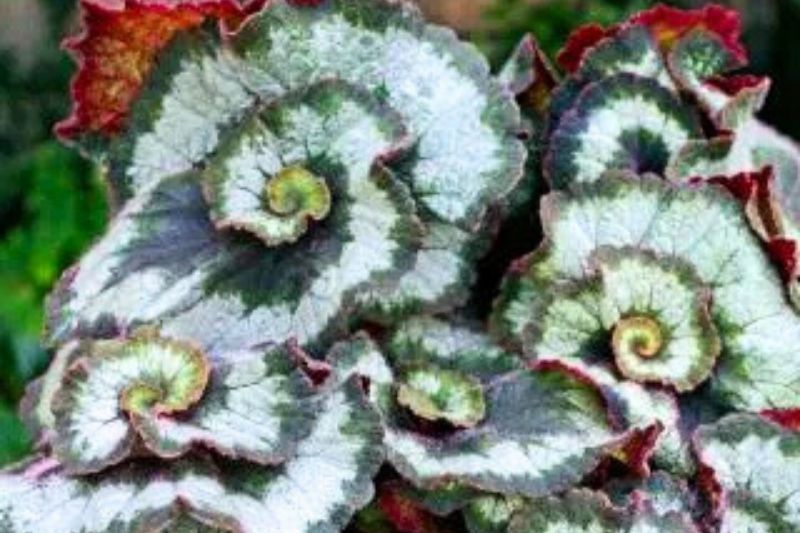
My heart undoubtedly leans towards the Begonia 'Rex Escargot'. What makes it truly special? This variety lives up to its name: each leaf spirals and seems to form a small snail shell, hypnotic and wildly graphic. We love its artistic touch with its unique colour contrasts: a blend of greens, silver, and chocolate.
With its velvety foliage, spiralled patterns, and unprecedented colours, it marks the strong return of indoor begonias, which are increasingly appealing due to their original aesthetics and diverse foliage. Long relegated to grandmothers' balconies or forgotten greenhouses, begonias now rank among the top 5 most sought-after plants for our interiors. Right in line with the major trend of decorative begonias, this variety stands out as a vintage icon brought back to life. Easy to cultivate (as long as you respect its preference for ambient humidity and filtered light), it adapts perfectly to all our interiors.
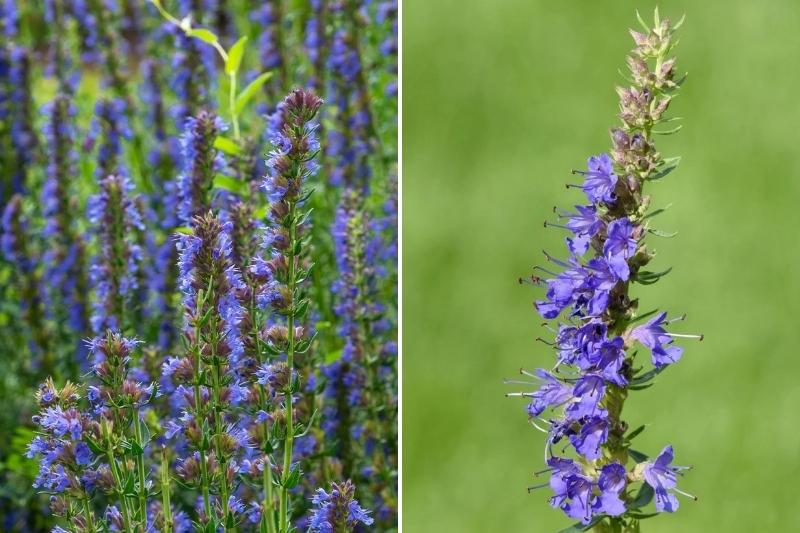
Olivier: the Hyssopus officinalis
"You, who are very sentimental, will surely appreciate this plant!" And bam! I was handed, without further ado, a clump of earth, from which only a few meagre green shoots emerged. Of course, I knew a bit about hyssop, as I have been passionate about medicinal plants since my studies. Moreover, it held a prominent place in medieval herb gardens. However, in my heavy soil, I remained… sceptical about its future. So, I decided to try it in a large container alongside my other Mediterranean plants, botanical cousins: thyme, sage, rosemary, and lavender.
Hyssopus officinalis is a dwarf undershrub (you can use that as a somewhat original insult), ideal for very sunny spots and dry or calcareous soils. And, in just one season, mine has thrived. I particularly love its flowers, a lovely violet-blue, which bloom from July to September and are highly appreciated by pollinating insects, including butterflies. Known as "sacred herb" by the ancient Greeks, this aromatic plant can reach up to 50 cm in height and has very fragrant leaves. It is cultivated for its medicinal properties (infusion for bronchial issues and digestion) and to flavour various dishes such as salads and soups. In short, if you have a spot left in your herb garden: give hyssop a try!
Sophie: the Westringia fruticosa
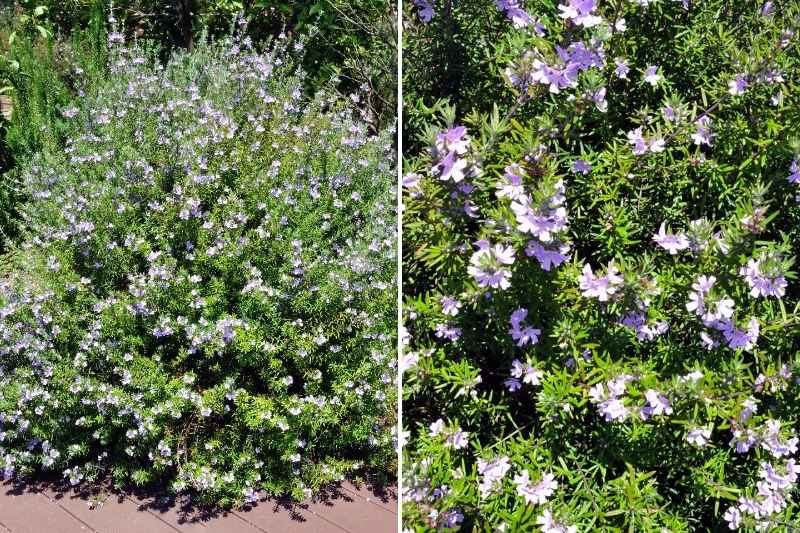
I have chosen the Westringia fruticosa, also known as Australian rosemary, as my plant pick for 2025, because it embodies the perfect companion plant, one that simplifies gardening! With its slight resemblance to rosemary, it has that familiar and sunny charm that immediately sets the tone. In my southern garden, amidst gauras, agapanthus, Leucophyllums, and lavender, it has settled in as if it has always belonged there. Its evergreen and silvery foliage captures the light, its naturally well-defined silhouette adds elegance, and its impressive resistance to heat, wind, and drought makes it a reliable choice, as I know it can thrive without any care. It tempers the exuberance of the blooms, highlights the volumes, and its light and delicate flowering brings just the right amount of freshness. What I love is its easy-going nature and its clean and bright appearance all year round.
With its 1 to 1.5 m in height and the same in spread, the Westringia fruticosa easily finds its place in the garden. Its delicate flowering extends from spring to autumn, returning in waves. It withstands light frosts down to -5 °C without flinching, sometimes even more in well-drained soil, making it perfectly suited for southern gardens, sheltered areas, and coastal climates. To thrive sustainably, it primarily requires a well-drained soil, preferably light, poor, and stony, where water never stagnates, an essential condition to preserve its longevity and natural vigour.
Gwenaëlle: the Protea 'Pink Ice'
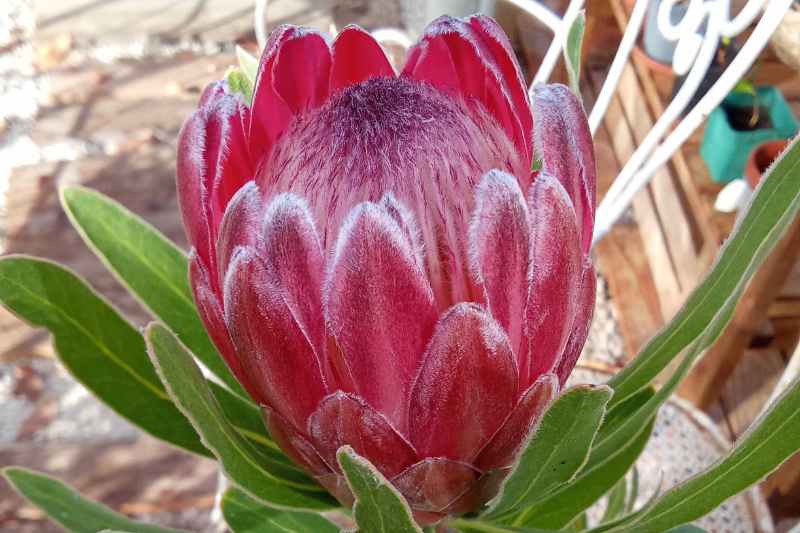
Every year, when we choose our plant of the year to share with you, I always hesitate, as several plants in my garden could claim a spot on this podium. This year, there’s no hesitation… Drumroll… It’s my Protea 'Pink Ice', brought back from Madeira in 2022, that wins all the votes! The tiny plant I bought at the flower market in Funchal and lovingly planted has seen it all, and it’s the only one of the three plants to have survived. Growing it in a greenhouse and repotting it as it grew, it suffered, two years ago, from my carelessness as a gardener when, in the middle of summer, I forgot to ventilate the greenhouse. As a result, one of the two main branches completely cooked, throwing it somewhat off balance. But, with care, it continued to grow, forming new branches to my great satisfaction. What a surprise it was in September to see three buds appear, slowly but surely transforming into those sublime pink inflorescences I had been patiently waiting for in early November.
Proteas, native to South Africa, are considered delicate plants due to their very low hardiness. Of course, I protect it in winter, wrapping it up and watching it like a hawk. I also only water it with room temperature rainwater and have provided it with an acidic and light substrate. I’m not sure I’ll plant it in the garden for a few more years, in which case I’ll need to find it a particularly sheltered spot. The arrival of these large fluffy flowers is such a spectacle that I recommend it to all gardeners who love exotic plants, as this plant literally transports me elsewhere!
Pascale: the Sedum ‘Thunderhead’
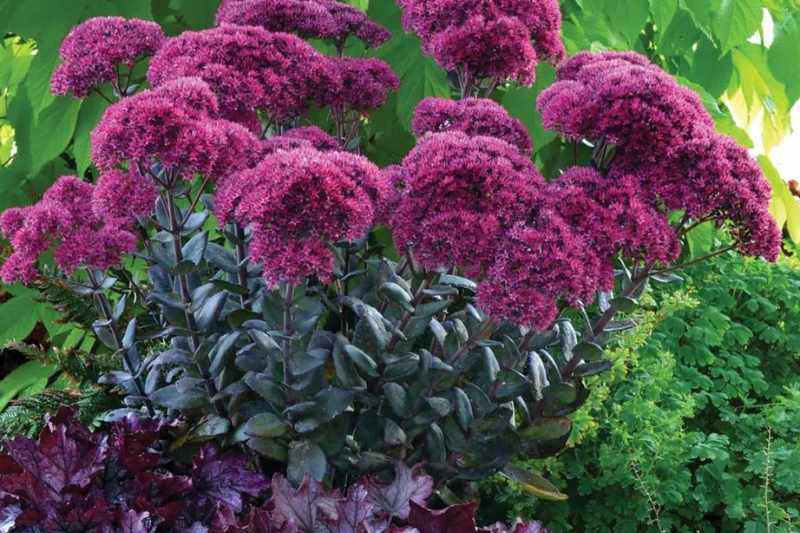
I admit, I was long among the detractors of sedums. Perhaps because these plants always seemed a bit dull and unremarkable in the beds. And then, what’s the point of growing these succulent plants at home, in a region where drought was hardly an issue? Climate change has decided otherwise, and the heatwave has taken its toll on other plants I cherished… Not to mention the numerous cultivars of stonecrop that offer new cultivation perspectives.
The Sedum ‘Thunderhead’ is one of the pleasant surprises. This variety has literally swept away my prejudices about sedums, thanks to its presence and vigour. From spring, its robust dark stems stand proudly, bearing very fleshy bluish-green foliage. But it’s at the end of summer that the magic happens: the dense and enormous flower heads bloom in a deep purplish-red, lasting until early winter. As these flowers, perched on purple stems, are highly melliferous and nectariferous, they attract swarms of pollinators.
And in winter, this sedum continues to put on a show with its dry inflorescences. I’ve even taken a few to enhance a bouquet of dried flowers and herbs. And already, the next spring shoots are emerging from the ground.
Paired with my beloved heucheras, this stonecrop has found its place in my semi-shaded bed. But elsewhere, it could bask in the sun all summer long.
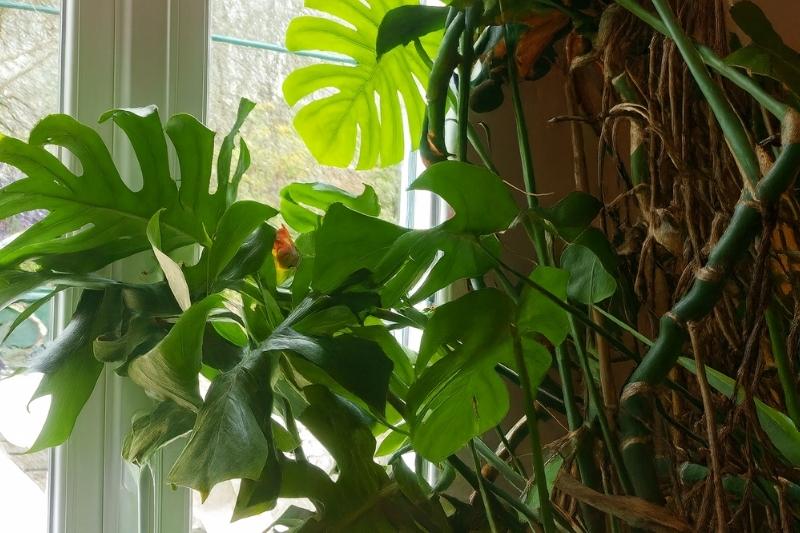
Elisabeth: the Monstera deliciosa, 25 years of cohabitation with my "philo"
Some stories last, enduring through moves, neglect, and trends. The one I’m about to tell is that of my Monstera deliciosa, my big "philo". It’s 25 years old, and it’s a green giant, a delicious monster clinging to the wall of my living room like a reminder of beautiful holidays in Spain.
Embracing its kitsch nature, it’s a bit of a grandmother’s plant, a symbol of the 70s, the spirit of bygone interiors. One might find this Monstera outdated, with its veranda plant look and postcard charm. Yet, it’s precisely this slightly old-fashioned air that makes it endearing. It signifies comfort and nostalgia.
If this houseplant had a CV, the first line would read: "Survival Expert". I forget to water it for three weeks? No problem, it will halt its growth, and that’s that. A bit of drastic pruning in anticipation of a move? It will sulk, but it will recover. It’s the ideal green plant for busy (or lazy) people; I don’t judge, I’ve lived through both.
Despite its 25 springs, "philo" has never deigned to flower. Because yes, this plant is capable of flowering! And even fruiting! Apparently, its fruits are deliciously edible. It might be lacking some geranium fertiliser, or perhaps it sulks because my living room isn’t humid enough, or too warm. Unless it’s just being a diva. It’s a whimsical creature: its leaves, sometimes smooth, sometimes holey like Swiss cheese, tell the story of its moods. Its support, doubled with bamboo and securely fastened to the wall with a battalion of strings, has become an original element of my décor. Over time, the inhabitants of the house hardly notice it anymore. Visitors, however, never miss the opportunity to comment: “But it’s huge!” or “How old is this monster?” And I confess its age with barely concealed pride.
Why do I love it (and why you might adopt it too)? First, because it endures. Even cats can’t really kill it — at least not mine, despite its efforts and persistence. Secondly, because it’s terribly photogenic: its large, cut leaves and vines bring a little bit of South American jungle into the home. And it’s a true conversation starter. “Do you think it will flower one day?” “How do we give it a more classic shape?”… With it, we learn patience; I still hope it will flower.
My Monstera deliciosa is not “just a plant”. It’s a life companion, a silent witness to my troubles, joys, successes, and also my losses. It’s a rock, a stubborn presence you can count on. And that’s precisely why I love it.
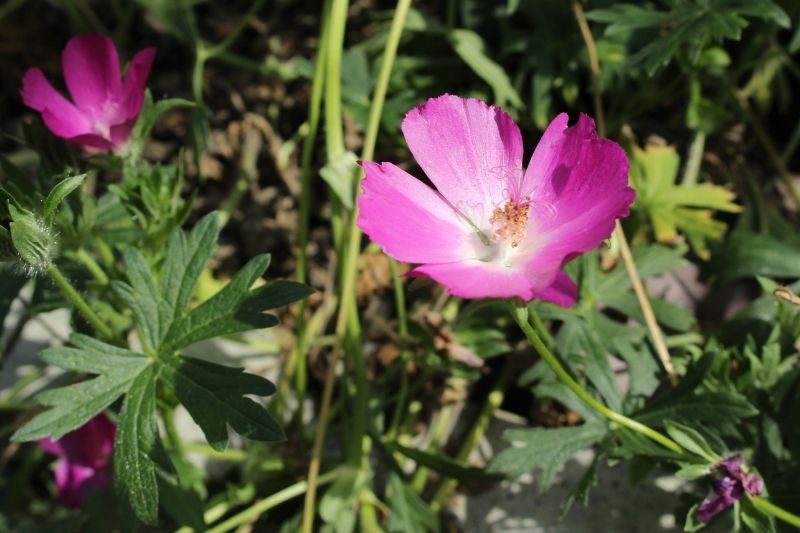
Aurélien: the Winecup or Callirhoe involucrata
If you appreciate mallows, lavateras, and other Anisodontea, then you’ll surely fall for their perennial and ground-cover cousin, the winecup (Callirhoe involucrata)!
Far less common in gardens, this Mexican species produces fine creeping stems with deeply lobed leaves, which weave between neighbouring plants without bothering them in the least. It reaches about 60 cm in diameter and 20-30 cm in height. The plant can easily be forgotten until large corollas of saturated fuchsia pink appear throughout the summer. Despite their ultra-vibrant hue, they blend effortlessly, in joyful whimsy, with blues, purples, or grey foliage: shrubby sages, immortelles, and perennial verbenas, or even yuccas will make excellent companions to create a Mediterranean atmosphere or a garden that requires no watering.
Frugal, floriferous, and quite resistant to drought once established, the winecup has many qualities and will thrive in any well-drained soil, preferably calcareous. North of the Loire, a spot in a rock garden or a sloped bed facing south will make it happy, possibly with the addition of some coarse sand or gravel to improve water drainage. In good conditions, it can be expected to withstand, despite its Central American origins, temperatures down to about -12/-15°C. A lovely addition to your borders that you won’t see everywhere!
At the end of each year, it’s an opportunity to reflect on the favourite plants of the editorial team, those that have marked our gardens, terraces, and interiors with their beauty, originality, or ease of cultivation. Behind each favourite, there is a gardener’s story, a meeting with a plant that has found its place and […]
Albino plants, with their immaculate appearance and lack of green pigment, captivate with their uniqueness as much as they intrigue. Why do some plants arise without chlorophyll, and how do they manage – or fail – to survive? Between genetic mystery and conservation challenges, these botanical curiosities offer us a fascinating window into the limits and adaptations of life. In this article, we will explore their origins, their unique functioning, and the issues related to their preservation.
What is an albino plant?
Albino plants are vegetals exhibiting a total or partial absence of chlorophyll, the green pigment that plays an essential role in photosynthesis. This pigment is crucial for capturing sunlight energy and converting it into chemical energy, allowing the plant to produce the sugars necessary for its growth: this is photosynthesis. Without chlorophyll, these plants find themselves unable to produce their own food (or at least partially), which poses significant challenges for their survival.
Appearance and characteristics
- White or translucent leaves and stems: the absence of chlorophyll gives albino plants a striking white or slightly translucent appearance, as other natural pigments (such as carotenoids or anthocyanins) may also be absent or greatly reduced.
- Leaves tinged with yellow or pale pink: in some cases, albino plants retain a small amount of other pigments that give them a slightly different coloration, such as shades of yellow or pink.
- Limited or non-existent growth: most albino plants die shortly after germination, as they cannot produce the energy necessary for development.
Comparison with albinism in animals
Albinism in plants and animals shares similarities, notably a genetic mutation affecting pigment production. However, the impacts of this condition differ significantly.
- In animals, the absence of melanin (the pigment responsible for skin, fur, or feather colour) leads to increased sensitivity to sunlight and camouflage issues, but they can generally survive.
- In plants, albinism is far more debilitating: without chlorophyll, an albino plant cannot perform photosynthesis, which directly compromises its ability to survive.
Prevalence in nature: an exceptional case
Albinism is an extremely rare phenomenon in the plant kingdom. Indeed, for a plant to become albino, it requires:
- A specific genetic mutation affecting the genes responsible for chlorophyll production.
- That this mutation is not immediately fatal during germination.
In nature, natural selection quickly eliminates albino plants, as they cannot develop independently.
The causes of albinism in plants
Genetic origin
Plant albinism is often linked to mutations in the genes responsible for chlorophyll synthesis. These mutations prevent the plant from producing this essential green pigment, resulting in a lack of coloration and an inability to perform photosynthesis.
- Genetic mutation: an alteration in the genes coding for the enzymes necessary for chlorophyll production leads to a total or partial absence of this pigment. These mutations can occur spontaneously or be inherited from parents.
- Specific cross-breeding cases: in certain species, genetic crossings between individuals carrying recessive mutations can give rise to albino plants. For example, in nurseries or hybridization projects, it is not uncommon to observe albino seedlings among varieties of vegetables, fruit trees, or orchids. However, these plants often survive only a very short time without human assistance.
Environmental factors
In addition to genetic mutations, external elements can also influence plant pigmentation.
- Environmental stress: extreme conditions, such as sudden temperature changes, excessive light exposure, or prolonged drought, can disrupt chlorophyll production processes. These conditions do not cause true genetic albinism but can lead to a temporary reduction in pigmentation.
- Diseases and pathogens: certain fungal or bacterial infections can alter the health of the plant and lead to leaf discolouration, mimicking the effect of albinism.
- Exposure to chemicals: certain weedkillers, pesticides, or pollutants can disrupt the biological mechanisms of plants and inhibit chlorophyll synthesis. These chemical impacts can cause temporary or permanent loss of pigmentation.
The consequences of albinism in plants
As mentioned earlier, albinism has major consequences for plants, as the absence of chlorophyll deprives them of their ability to perform photosynthesis. This incapacity places them in a situation of great vulnerability. Many albino plants die quickly after germination, unable to meet their energy needs. However, in some cases, they can rely on a "mother plant" or shared root systems for nourishment. This is the case for albino sequoias, which depend entirely on nutrients transferred by the roots of normal trees to survive, unlike normal plants, which can thrive due to their autonomy.
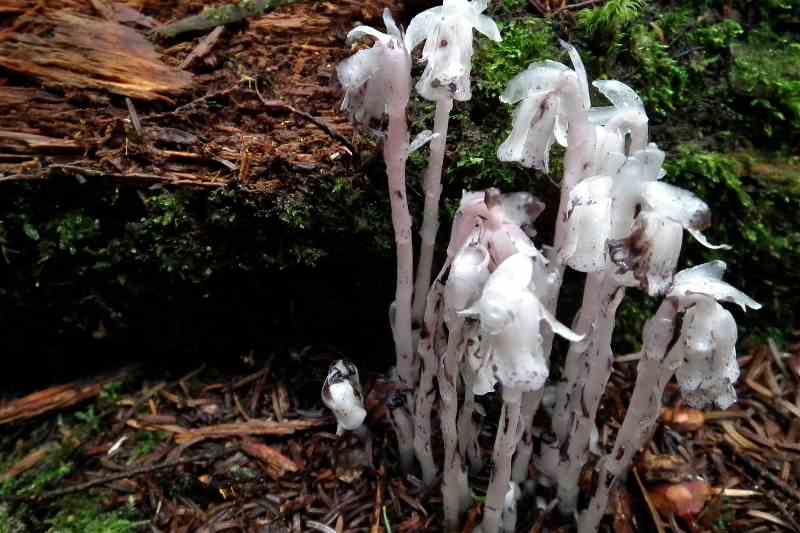
There are, however, notable exceptions. Some specific albino plants, such as Monotropa uniflora (the "ghost plant" or Indian pipe), circumvent their dependence on photosynthesis by establishing a symbiosis with mycorrhizal fungi. These fungi provide them with the necessary nutrients by tapping into the underground network of surrounding plants. This type of relationship, called mycoheterotrophy, allows these albino plants to survive and thrive despite their pigmentation defect.
This energy dependence of so-called albino plants on other plants or organisms, combined with the fragility of their state, makes their preservation difficult, especially in nature where habitat destruction further exacerbates their vulnerability.
However, these challenges come with interesting opportunities, particularly in the field of scientific research. Albino plants intrigue researchers seeking to better understand the genetic mutations responsible for their condition and their impact on plant metabolism. In horticulture, efforts are being made to maintain or even "save" certain albino varieties, for example, by using techniques such as controlled environment cultivation.
Famous examples of albino plants
Albino sequoias are probably the most fascinating examples of albino plants in nature. These rare trees, primarily located in California, survive thanks to a unique system of shared roots with normal sequoias. This underground network allows them to absorb the nutrients necessary for their survival, a dependency strategy that intrigues botanists and symbolises the interconnectedness of ecosystems.
In the horticultural world, partially albino plants, such as certain varieties of philodendrons, like Monstera deliciosa 'Variegata', have become extremely sought after. Their unique appearance, with marbled white or cream leaves, makes them prized objects for enthusiasts of slightly unusual tropical plants.
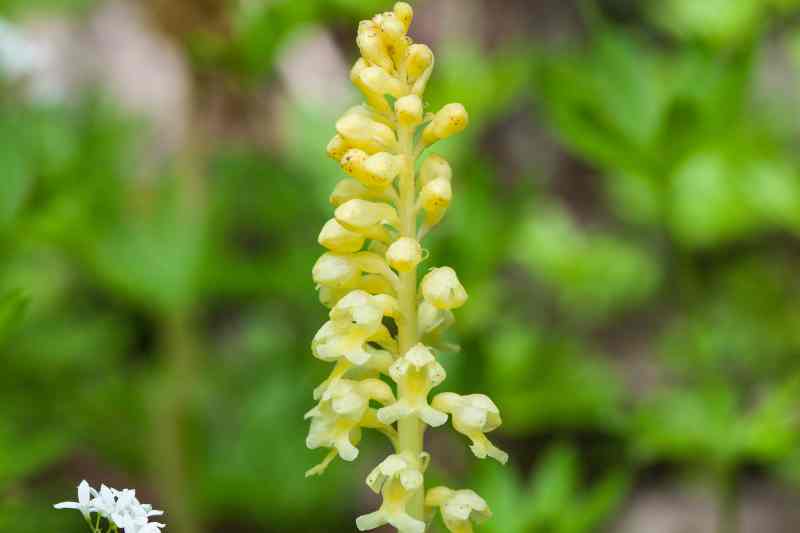
But, even within our flora, albino plants can be found. One of the most well-known cases is that of the bird's-nest orchid (Neottia nidus-avis), a European orchid devoid of chlorophyll. Like the Indian pipe, this plant derives its energy from the decomposition of organic matter in the soil, thanks to an association with mycorrhizal fungi.
Some tips on growing albino houseplants
Growing albino plants, or partially albino varieties, requires special attention. These plants should be placed in a bright environment, but especially without direct sunlight, to avoid burning the white parts of their leaves, which are particularly sensitive. Their metabolism being less efficient, they also require rich, well-drained soil, as well as appropriate fertilization to compensate for their reduced ability to produce energy.
In an ethical approach, it is also essential to respect their natural conservation. For enthusiasts, this means avoiding the collection of albino specimens from their natural habitat, as they are rare and vulnerable.
Albino plants, with their immaculate appearance and lack of green pigment, captivate with their uniqueness as much as they intrigue. Why do some plants arise without chlorophyll, and how do they manage – or fail – to survive? Between genetic mystery and conservation challenges, these botanical curiosities offer us a fascinating window into the limits […]
Do you dream of a wall covered in flowering climbing plants or a pergola overrun with lush greenery? It’s a lovely project… but things can quickly go awry if you don’t approach it correctly. Let’s be honest: between the jasmine that prefers to crawl rather than climb, the clematis that wilts in a few days, and the wisteria that turns into an invasive monster, there are plenty of stories to tell… So, if you’re ready to fail with flair, to turn your dreams of greenery into memorable plant disasters, follow the guide!
And if, along the way, you decide that planting your climbers correctly wouldn’t be such a bad idea, don’t worry: just do the exact opposite of everything we’re about to tell you here!
Let’s go, the glory of horticultural failure awaits you!
Choose your plant at random: the foundation of failure
If you want to ensure your climbers don’t survive, start by choosing your plant solely based on its appearance or the impulse buy you made at the garden centre. Who needs to wonder if that stunning bougainvillea can survive in your Alsatian garden? Not you, of course!
Why rely on the ideal climate for a plant? Install a Mediterranean plant in a cold region or an alpine variety under the scorching sun of the South. Guaranteed result: a depressed (or even dying) plant and a frustrated gardener.
Don’t consider the exposure either! It doesn’t matter if your wall faces north and never sees the sun. Put a light-loving plant, like a jasmine, there and watch it languish.
Do you love that beautiful clematis, but your garden is just a succession of rocks and sand? Or do you dream of a wisteria in calcareous soil? No worries, ignore the nature of your garden soil and plant anyway. A plant that can’t find nutrients is perfect for a quick fiasco.
You’ve got it: to succeed, you need to choose plants suited to your climate, your garden’s exposure, and the quality of your soil. But that’s not what we’re here for… is it?
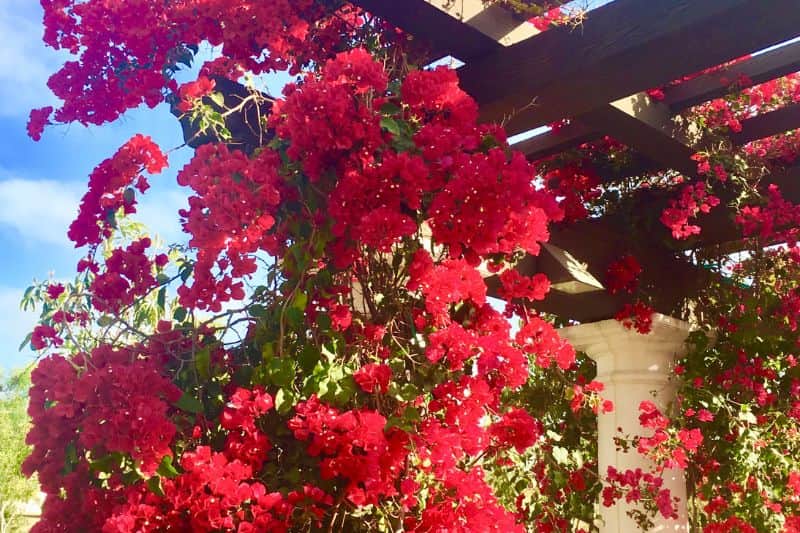
Plant in the wrong season, it’s much more fun
If you want to maximise your chances of failure, completely forget the calendar. Why wait for spring or autumn, those seasons when conditions are ideal? No, to fail, choose the extremes instead!
Planting in the middle of winter, when the ground is frozen, is an excellent idea to put your climbers directly to the test of survival.
Prefer to plant in the height of summer? Perfect, opt for a heatwave day. The parched soil and scorching air will provide an ideal combination to stress your plant from the very first minute. Don’t forget: a climber transplanted at 30°C (or more) is like running a marathon without water, except it will never finish the race.
So, for successful planting, just remember that mild seasons like autumn and spring are your allies.
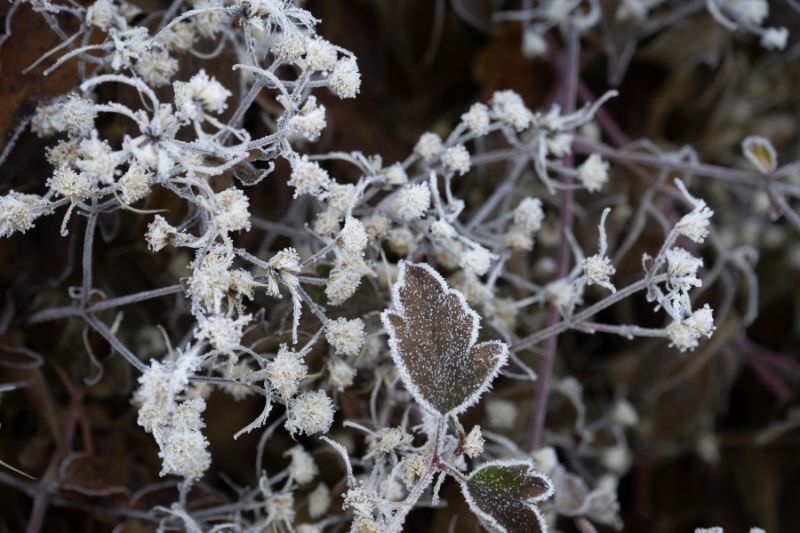
Ignore the soil: an insignificant detail
To fail at planting your climbers, nothing could be simpler: don’t worry about the soil. After all, dirt is just dirt, right? Why waste time analysing its composition or checking its water retention?
Plant directly in compacted soil, as hard as a pavement, and watch your climber struggle desperately to push its roots in. And if your ground is waterlogged after every rain, even better: the roots will love this little permanent bath… that will suffocate them.
If you have sandy soil, leave it as it is. Nutrients wash away with the slightest drop of water? Too bad for your plant; it should have been tougher.
In summary, make no effort to improve your soil. Completely ignore the importance of good drainage or adding compost.
And if you really want things to grow… a well-prepared soil, neither too heavy nor too draining, with an addition of compost or manure to enrich it is the key to success. For that, you can read our article: How to improve water retention in garden soil?

Forget about staking: let them grow freestyle
For a climber, nothing is more effective than completely skipping the support. Why bother installing a trellis, a pergola, or taut wires? Let your plant manage on its own. After all, it’s supposed to climb, right? It will find a way… or not.
If you want to add a touch of chaos, install a completely unsuitable support. Ivy has climbing roots suited for facades and walls? Give it a fence! The clematis has tendrils? A flat surface with nothing to twine around will do! And why not a flimsy string or a wobbly stake? At the first gust of wind, everything will collapse, and your plant will end up on the ground, disheartened.
Even better: let it crawl. Without a structure to cling to, your ivy or honeysuckle will decide to spread lazily on the ground. It’s no longer a climbing plant; it’s a creeping plant, but at least you’ll have innovated.
For perfectionists of failure, place your support too far from the plant. The stems will desperately search for something to cling to, never reaching their goal. A beautiful lesson in plant frustration!
Of course, to succeed, you just need to install a solid and suitable support from the start. You could even read this article full of tips: Stakes and supports for plants: everything you need to know to choose them well. But where would the fun be without a bit of chaos?
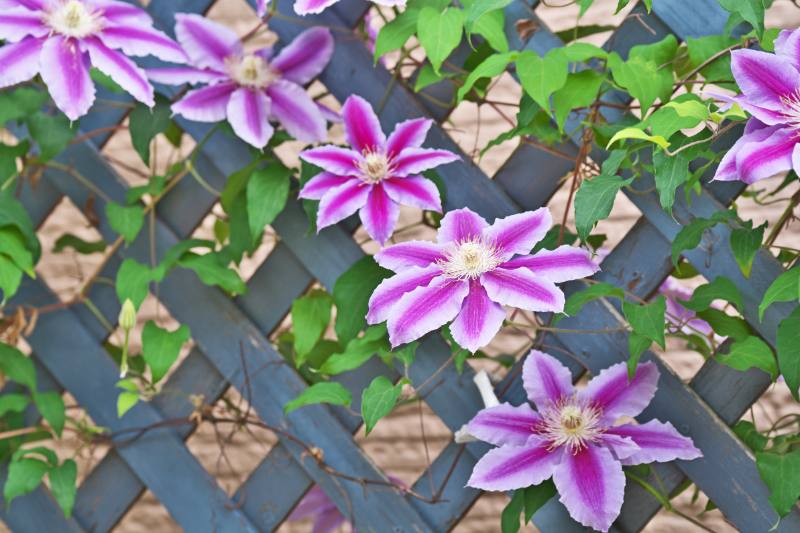
Water (or not) like a pro… of sabotage
If you dream of a climber that wilts quickly, watering is your best weapon. Two options are available: overdo it, or not at all.
For those who love excess, water generously every day, even when it rains. Ensure the soil is constantly soaked. The roots, deprived of oxygen, will slowly but surely drown. You’ll see your plant yellow, droop, and then give up all hope.
Conversely, if you prefer the dry regime, let the plant fend for itself. Forget about it during hot spells, even if it shows obvious signs of thirst. A climber that dries out is a climber that no longer climbs.
Finally, for an even more chaotic result, water completely randomly. A week of deluge followed by ten days of drought… enough to destabilise your plant and guarantee its misery.
The secret to a healthy plant? Water just the right amount, when it’s needed, taking into account the weather and the specific needs of your climber. But where would the drama be if everything went well?
Plant without considering space: long live improvisation
To ensure total failure, plant your climber anywhere, without considering what it will become in a few months or years. After all, why plan when you can improvise?
Do you dream of a wisteria? Perfect, install it at the foot of a flimsy trellis or right next to your downspout. You’ll be amazed to see this force of nature bend, break, or even tear everything in its path. If it starts invading your windows, your roof, or even your neighbour’s house, you’ve succeeded in not anticipating!
Even better: plant your wisteria or a bougainvillea right next to your plumbing! The young roots will sneak into the tiniest crevice or twine around the pipes. After a few years, your plumbing might just surprise you: leaks, blocked pipes, and why not a little flood to top it all off. After all, who would have thought a plant could have so much fun with your infrastructure?
And then, why think about the available space? Install several climbers together in the same pot or at the foot of the same support, it’s ideal for creating plant traffic jams. With a bit of luck, your climbers will suffocate together.
Never think about future maintenance. Why pruning or controlling growth? Let your plant become a wild tangle, impossible to untangle. A messy jungle, where the ambient humidity will be trapped, promoting the arrival of fungi and other moulds! It’s much more spectacular, isn’t it?
To succeed, you just need to choose the right location, sufficient space, and plan for a solid support suited to the plant’s adult size. And don’t neglect pruning.
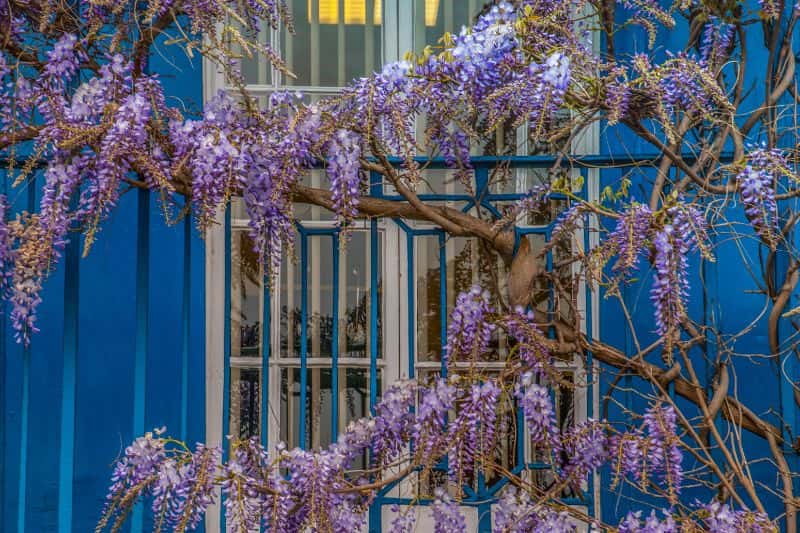
Completely ignore diseases and pests
For a climber in a sorry state, adopt a hands-off strategy. Who needs to monitor their plant for the first signs of disease or the arrival of pests? Certainly not you!
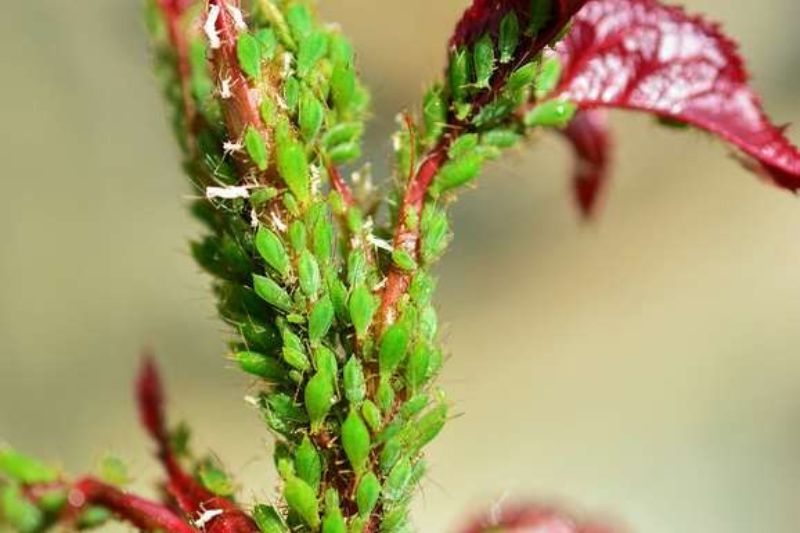
If aphids settle in and turn your young shoots into an all-you-can-eat buffet, leave them be. Maybe they’ll leave on their own… or maybe not.
Is powdery mildew covering your leaves with a lovely white veil? Consider it a natural decoration. As for slugs and snails munching on your young stems, why chase them away? They must be hungry, after all.
To top it all off, never prune the sick or damaged parts. Let these infections spread peacefully, soon turning your plant into a masterpiece of desolation. And above all, don’t disinfect your pruning shears between cuts: nothing better for transmitting diseases from one plant to another!
If you really want to perfect this method, avoid giving your plant anything to help it defend itself: no natural treatments (manures or decoctions), no black soap, and especially no mulching to keep pests away or protect the soil from temperature variations. A climber left to its own devices is a climber doomed to fail.
Of course, to succeed, you would just need to regularly monitor your plant, treat small problems quickly, and maintain a healthy environment. But that’s for cautious gardeners… not for you, right?
Do you dream of a wall covered in flowering climbing plants or a pergola overrun with lush greenery? It’s a lovely project… but things can quickly go awry if you don’t approach it correctly. Let’s be honest: between the jasmine that prefers to crawl rather than climb, the clematis that wilts in a few days, […]
The Chilean Nasturtium, scientifically known as Tropaeolum ciliatum, is raising more and more questions among gardeners. Is it an invasive plant to be feared in our gardens? While its vibrant flowering and ability to quickly cover structures make it attractive, its invasive potential can pose problems. This article aims to inform gardeners about the risks this climbing plant may represent in terms of garden invasion and effective management methods. So, should we be concerned about the Chilean Nasturtium? Let's take stock.
What is the Chilean Nasturtium?
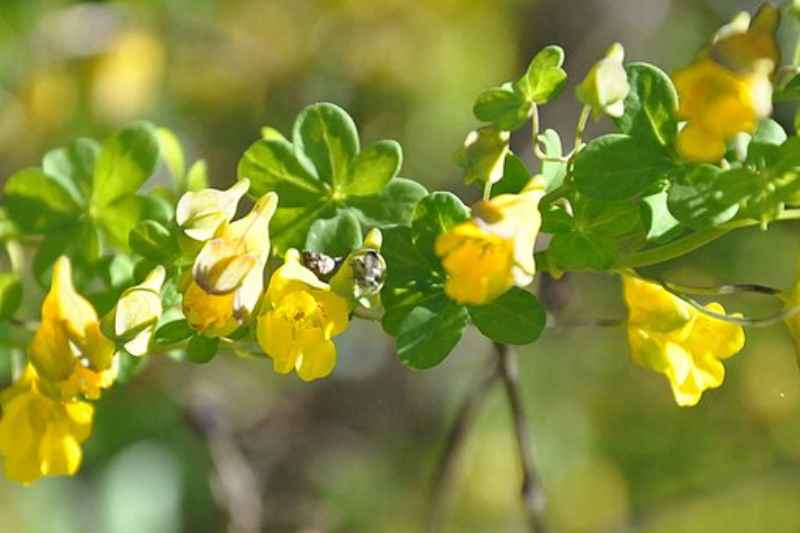
The Chilean Nasturtium (Tropaeolum ciliatum) or Indian Cress is a climbing plant native to South America, particularly found in the mountainous regions of Chile and Argentina and therefore hardy down to -15 °C. Its yellow tubular flowers have a unique shape that easily distinguishes them from those of other nasturtium species. The stems of Tropaeolum ciliatum are voluble, allowing the plant to wrap around various supports, and are covered in fine hairs that give it a distinctive texture. The leaves are palmate, meaning they are shaped like a palm, adding to the plant's aesthetic with their lush green appearance and symmetrical arrangement.
Compared to the Greater Nasturtium, beloved in our gardens, the Chilean Nasturtium has several notable differences. The flowers of Tropaeolum majus are generally larger and can vary in colour from bright red to orange and yellow, while those of Tropaeolum ciliatum are exclusively yellow and more tubular in shape. In terms of growth, Tropaeolum ciliatum has a marked climbing habit, using its voluble stems to climb on supports, whereas the Greater Nasturtium often adopts a more trailing or creeping habit.
Nasturtiums are charming and easy-to-grow plants. To learn more, read Nasturtium: sowing, planting, and maintaining.
A rather invasive character!
The Chilean Nasturtium or Nasturtium is a plant known for its vigour and rapid growth. In a short time, it can spread significantly, covering large areas with its voluble stems. This ability to climb and spread makes it an ideal plant for dressing trellises, pergolas, or fences, but it can also pose a problem if not controlled. In favourable environments, particularly in temperate regions with well-drained soils, Tropaeolum ciliatum can quickly become invasive. Worse, in gardens where it is left unchecked, it can smother other plants competing for light and nutrients. Additionally, its tendency to self-seed adds another level of difficulty, as new plants can appear in unwanted areas.
Invasive or not?
To clarify, an invasive plant is an exotic plant species that spreads rapidly in a new environment, often to the detriment of local species. It can disrupt ecosystems, reduce biodiversity, and cause economic and environmental damage.
Regarding its official status, the Chilean Nasturtium is currently not recognised as an invasive plant in France and Belgium. However, this does not mean that gardeners should not be concerned. While the lack of official recognition indicates that it has not yet shown significant ecological impact on a large scale, reports from local gardeners suggest that it can exhibit invasive behaviour under specific conditions (temperate climate and well-drained but cool soil). It is therefore crucial for gardeners to stay informed and adopt appropriate management practices to control its development and prevent any potentially invasive situations.
How to manage my Chilean Nasturtium?
Regular pruning of the stems is essential to limit its expansion and prevent it from covering too large areas. This practice helps control its growth and keep the plant within desired limits. Additionally, monitoring spontaneous seedlings (and manually removing them) helps prevent new plants from establishing in unwanted areas.
Alternatively, growing in pots is a practical solution that allows for easier control of the plant's growing space and reduces the risk of spreading. Using trellises and supports to direct vertical growth can also limit the space occupied by the plant while benefiting from its aesthetic appeal.
Chilean Nasturtium: stop or go?
The question of whether to continue planting the Chilean Nasturtium in our gardens deserves careful consideration. This plant boasts abundant and beautiful flowering, which can bring a vibrant touch of colour with its yellow tubular flowers. Furthermore, its ability to quickly cover structures makes it an ideal solution for enhancing trellises, pergolas, or fences in no time. This characteristic is certainly appreciated in gardens where a decorative and lush effect is desired quickly.
However, planting Tropaeolum ciliatum requires a certain level of vigilance and maintenance. Gardeners must be prepared to closely monitor the plant's growth to prevent it from becoming invasive. Regular pruning of the stems and removal of spontaneous seedlings require time and attention. This plant may therefore not be suitable for all gardeners, especially those seeking less demanding options in terms of maintenance.
In other words, the Chilean Nasturtium is not a plant to be categorically crossed off the list, but there are so many alternatives among climbing plants that it would be a bit foolish to insist on planting it when one knows its behaviour. For now, it is not recognised as invasive (at least not officially), but caution is warranted: so let's plant something else if possible!
Want to learn more about mastering the climbing Chilean Nasturtium? Check out our video with Michaël and Olivier, who present it in detail!
The Chilean Nasturtium, scientifically known as Tropaeolum ciliatum, is raising more and more questions among gardeners. Is it an invasive plant to be feared in our gardens? While its vibrant flowering and ability to quickly cover structures make it attractive, its invasive potential can pose problems. This article aims to inform gardeners about the risks […]
Do you dream of a planter that would send shivers of horror down the spines of gardening enthusiasts? You’ve come to the right place! We’re going to reveal the foolproof secrets, with a touch of humour, to transform your planter into a true botanical disaster. Unless, of course, you want to do the opposite and learn what not to do? Follow our six essential lessons to ensure you fail at your planter with style.
Lesson 1: mixing shade and sun plants
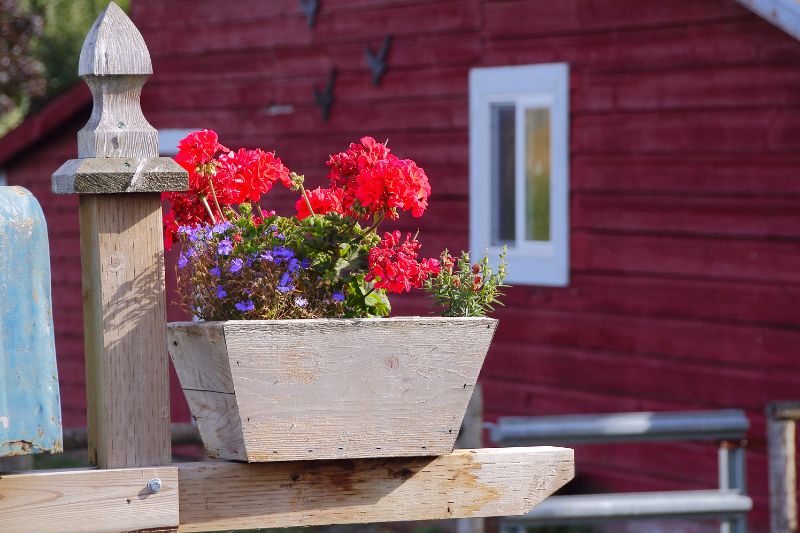
To kick off your masterpiece of a failed planter, nothing is simpler than to cheerfully mix sun-loving plants with those that prefer shade. Imagine an unlikely marriage between an elegant Hosta, which loves to bask in the shade, and a flamboyant Geranium, a sun worshipper. Well, that’s the perfect recipe for a botanical fiasco!
If you place them all in the sun, the Hosta, deprived of its beloved shade, will see its leaves burn and wilt quickly. Conversely, in the shade, the Geranium, starved of light, will become weak and stop flowering. A pairing doomed to fail from the start, but so amusing to watch to see how far it can go.
If you’re really determined to fail at your planter, why not add a semi-shade plant to the mix? A Heuchera, for example, which prefers dappled light but can tolerate a bit of sun. The confusion will be total, and your plants will go to war for the best spot where only one will truly thrive.
Lesson 2: ignoring plants' water needs
To continue your masterpiece of a failed planter, nothing is simpler than ignoring the water needs of your plants. Make sure not to choose plants with similar watering requirements. Instead, pair plants that love dry soil, like a cactus, with water-hungry plants, like an impatiens.
Then, you’ll have to juggle the watering! The cactus, drowned by excess water, will start to joyfully rot, while the impatiens, lacking moisture, will wilt sadly. It’s the perfect recipe for a horticultural disaster!
If you’re really determined to fail at your planter, why not add a plant that needs even more water, like a papyrus? The cactus and the impatiens won’t know where to turn, each trying to survive in an unsuitable environment. The chaos will be total, and your planter will be a fascinating spectacle of distressed plants.
Lesson 3: mixing colours
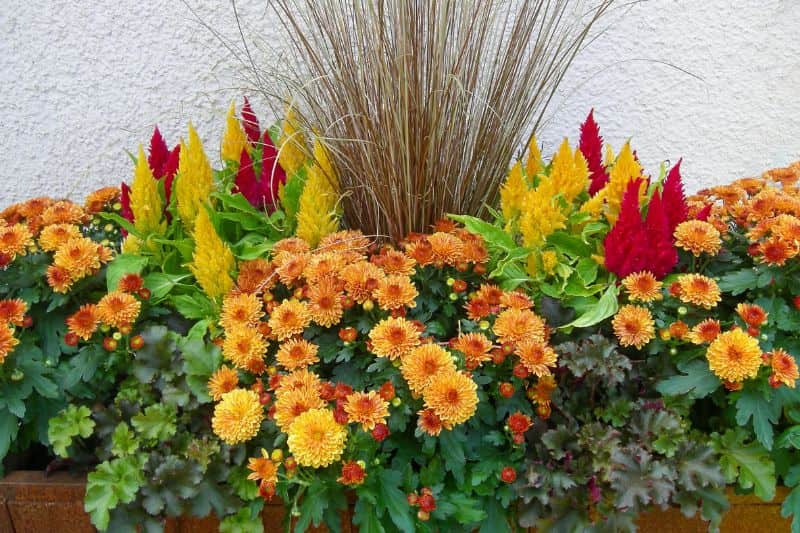
To add a touch of originality to your failed planter, cheerfully mix colours that clash with each other. Imagine a bold marriage of bright red and garish yellow or fluorescent green. Nothing like it to create a true visual festival… of bad taste! Above all, don’t choose similar colours to create a lovely gradient, nor complementary colours that work well together.
The result will be a plant patchwork where each colour seems to fight for attention, making your planter as harmonious as a Picasso painting on acid. The puzzled looks and amused smiles from your neighbours will be your reward.
To perfect this colourful cacophony, why not add pastel flowers that will be completely overshadowed by the garish colours of the other plants? The confusion will be total!
Lesson 4: mixing large and small plants
For an even more disastrous planter, mix plants of completely different sizes without hesitation. Place a bush, even a dwarf one, or a large perennial next to tiny plants. You’ll create an unbalanced composition where the small plants will be crushed by the grandeur of their neighbours. A true success… in terms of chaos!
Imagine, for example, tiny pansies desperately trying to catch a ray of sunshine, smothered by the imposing shadow of a Mexican orange blossom (Choisya). Their growth will be quickly stunted, their flowers less abundant, or even non-existent. Meanwhile, the orange blossom will thrive, spreading its branches and flowers without any consideration for its little companions.
To add to this confusion, why not introduce a climbing plant, like a clematis or ivy? It will wrap around the bush, seeking to climb ever higher. The result will be a planter where each plant will fight for its living space, creating a fascinating spectacle of plant competition.
Lesson 5: forgetting soil compatibility
To perfect your failed planter, ignore the specific soil needs of your plants. For example, joyfully plant lavenders, which love well-drained, calcareous soils, with hostas that prefer rich, moist, even heavy and slightly acidic soils. Nothing like it to create an unsuitable environment for all your plants!
The lavender, lacking drainage and dry soil, will suffer in overly moist conditions, risking root rot. On the other hand, the hosta, craving moisture, will wither in dry, poor, calcareous soil, its foliage quickly yellowing and wilting. It’s the perfect recipe for a distressed planter!
For added chaos, mix acid-loving plants with those that prefer calcareous soils, a true nightmare for them! Your plants will compete for contradictory soil conditions, ensuring a total failure of the planter.
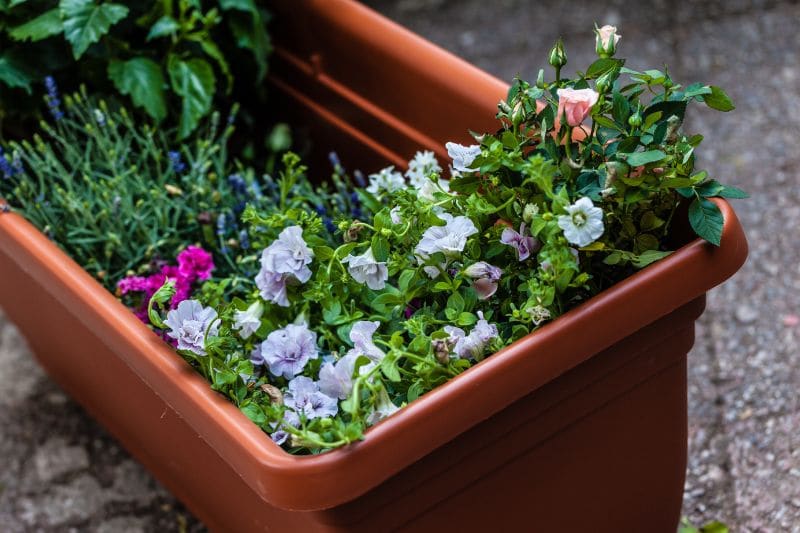
Lesson 6: placing trailing plants at the back of the planter
To complete your masterpiece of a failed planter, place trailing plants at the back. Nothing like it to create a completely unbalanced and unsightly composition. Imagine a planter where trailing petunias are hidden behind taller plants like heucheras, sages, or lobelias.
The trailing plants, which are meant to cascade elegantly over the front of the planter, will be invisible, their beauty masked by the taller plants. The plants at the front, with their delicate flowers and rapid growth, will become entangled and compressed, unable to showcase their charm either.
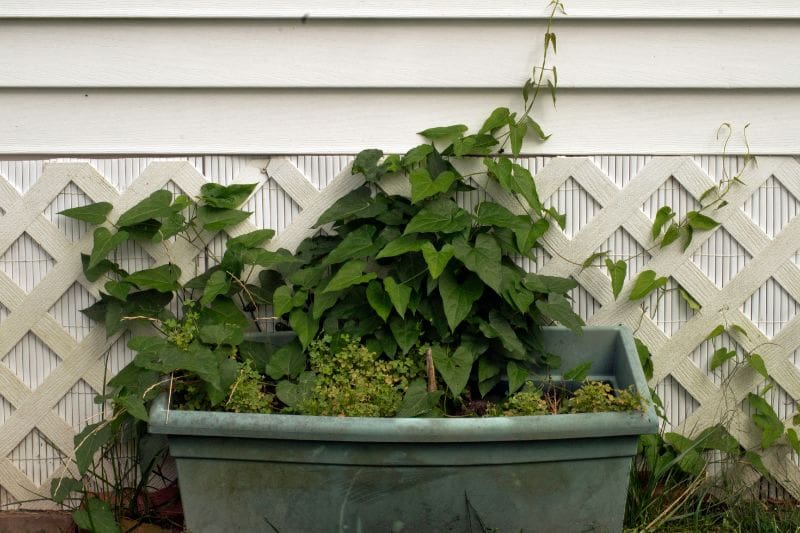
Do you dream of a planter that would send shivers of horror down the spines of gardening enthusiasts? You’ve come to the right place! We’re going to reveal the foolproof secrets, with a touch of humour, to transform your planter into a true botanical disaster. Unless, of course, you want to do the opposite and […]
Oh, look at this: a buddleia or Butterfly Bush that produces three types of flower colours! It's amazing! It's unbelievable! It's... strange, isn't it? How could such a marvel occur? A genetic aberration? A risky grafting? Or are they just pulling our leg a bit? The editorial team at Promesse de Fleurs has investigated.
The Buddleia Tricolor on paper
On paper or in online photos, this Buddleia davidii is indeed tricolour, proudly displaying (well, we can't really ask the bush) the three colours: blue, pink, and white. All in a too perfectly symmetrical arrangement (still on paper!) to be honest.
It's ugly, you might say? Well, that's subjective. But you must agree that this bush doesn't have an easy look. Let's just say it's special... Yet, it's one of the best-selling shrubs at the moment. Go figure!
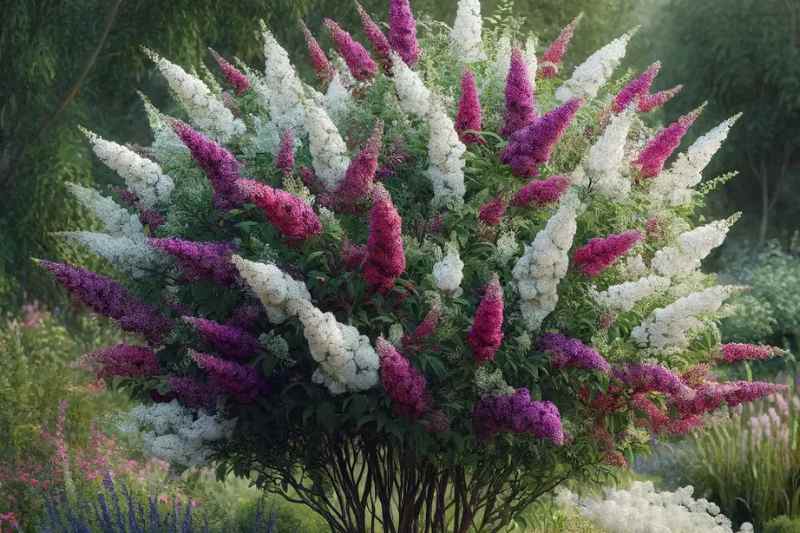
But what about in reality?
In reality, hold on to your spade, this Buddleia does not exist! At least, what you see in the doctored photos from catalogues does not exist. The Buddleia Tricolor is merely the commercial name of a "product" made up of three varieties of Buddleia: generally Buddleia 'Empire Blue', Buddleia 'Pink Delight', and Buddleia 'White Profusion'. These three fellows growing in the same pot. (please note: the varieties may actually differ depending on the market... a bit like Isio 4 oil).
Yes, but there's a "catch". The first year of planting, everything goes relatively well, but over time, one of the three shrubs, too tightly packed, will take over the other two and you'll soon find yourself with just one variety of butterfly bush. That's unfortunate! Especially at the price we pay for this Frankenstein monster.
So? Scam or not?
Yes and no. The issue does not stem from selling a pot with three different varieties. This is quite common. I’m thinking particularly of the 'Three Sisters' series: Rhododendron, Lilac, or Camellia... Yes, yes, we sell these weird things too. We’re not particularly proud of it, but they sell. It’s "trendy".
The problem lies more in the fact that horticultural professionals do not communicate clearly with the customer. 95% of gardeners do not know what these multicoloured varieties actually are, with most retailers remaining very vague, even evasive on the subject. Adding to this, they provide a poorly photoshopped illustration that bears absolutely no relation to the reality of what you will receive and attempt to grow.
Moreover, they make us believe — and it’s written in black and white on their sheets — that it’s a new variety. However, this is entirely false: placing three plants in the same pot is not enough to qualify it as a "variety". Furthermore, the commercial name should not be placed in single quotes, as is commonly seen: we do not mess around with botanical nomenclature!
So here, yes (and even a big YES), it’s deception, it’s stamping, as they clearly take the customer-gardener for a big pigeon, to put it politely...
In short, if you see this type of shrub in a catalogue, look the other way! When it seems too good to be true, in the world of horticulture or elsewhere, there’s usually something fishy going on...
Oh, look at this: a buddleia or Butterfly Bush that produces three types of flower colours! It’s amazing! It’s unbelievable! It’s… strange, isn’t it? How could such a marvel occur? A genetic aberration? A risky grafting? Or are they just pulling our leg a bit? The editorial team at Promesse de Fleurs has investigated. The […]