Hanging indoor plants: decor reaches new heights
Trailing plants for trendy interiors
Contents
Indoor hanging plants are a must to bring life to your walls and ceilings. Their trailing habit creates an airy, graphic effect while freeing up floor space. Placed on a shelf or hanging from the ceiling, these plants are ideal for small spaces or to liven up décor in a living room, a kitchen or even a bathroom. Pothos, string of hearts, wandering jew, discover which are the most beautiful trailing hanging plants and our selection of indoor hanging plants to grow!
Why choose hanging plants for your home?
Because integrating indoor plants has become a true art of living. In just a few years they have moved on from being mere houseplants to becoming statement pieces in interior design. In magazines and on social media, plant life has established itself as a must-have for on-trend interior decor. When suspended, indoor plants take on a whole new dimension. They add rhythm and airiness. Perfect for filling a slightly bare corner, often-neglected spots such as above windows or on top of furniture, they help define a space or add character to any room. They are also a real bonus in small spaces where every square metre counts.
Read also
How to water indoor plants?What type of interior?
One of the great strengths of hanging plants is their ability to complement a wide variety of interiors — from bohemian to classic. They adapt, even revealing a space’s character. Provided their position and hanging style are chosen carefully.
In a contemporary interior, with clean lines and mineral tones, they soften architectural austerity. One or two well-placed hanging plants are enough to introduce movement and enliven a space, while preserving its harmony.
In a boho or ethnic-chic setting, they take centre stage. Hung in woven baskets, or in rope, rattan or natural-fibre hangings, they mingle with textiles, rugs and handcrafted objects to create a cosy, enveloping atmosphere. They contribute to an organic, warm and on-trend aesthetic.
They also fit perfectly into wabi-sabi, Scandinavian or mid-century modern interiors, by playing on the container’s simplicity, the choice of foliage and the balance of heights. The idea is to remain understated yet vibrant.
And for a more immersive vibe, they are ideal for composing an urban jungle corner. By combining them with other plants of varied habits (climbing, upright, broad- or fine-leaved foliage), you create a plant display. Grouped at different heights, they wrap the space and compose a lush, exotic-feeling atmosphere, even in just a few square metres. They always add just the right extra touch of style.
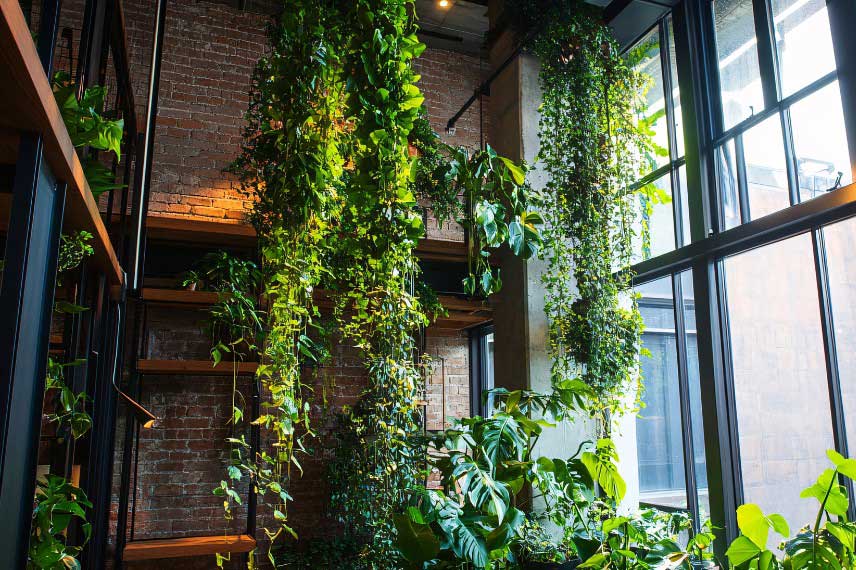
Even though hanging indoor plants integrate wonderfully into boho or ethnic interiors, they also find their place in more modern, even industrial, ambiences, where they help break up straight, rigid lines of architecture.
Where to place these beautiful hanging plants?
Placed on surfaces, hung or suspended from the ceiling, trailing plants offer great freedom of installation and suit every configuration. They dress vertical space, often left empty, and introduce greenery without overloading floor surfaces.
Côté supports, tout est permis : elles peuvent être suspendues à un crochet au plafond, à une poutre apparente, à une barre murale ou à un support spécialement conçu pour accueillir plusieurs plantes. Metal structures or wooden ladders are also becoming common: so many solutions to structure a display that is both graphic and vibrant. They fit equally well in living rooms, kitchens or bathrooms, where they benefit from ambient humidity.
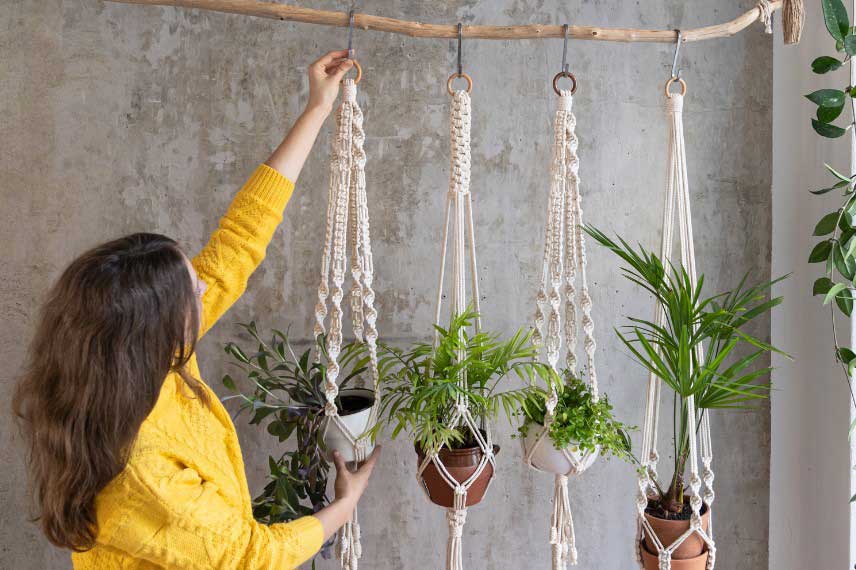
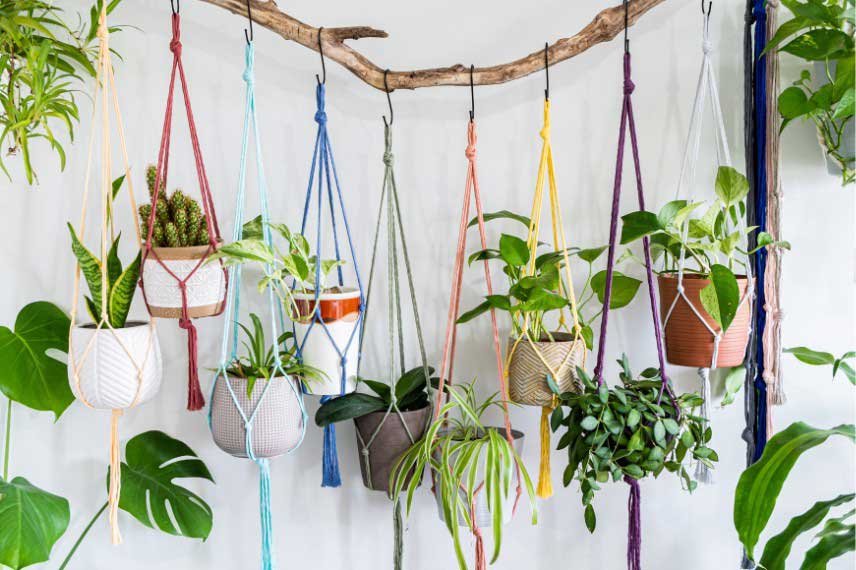
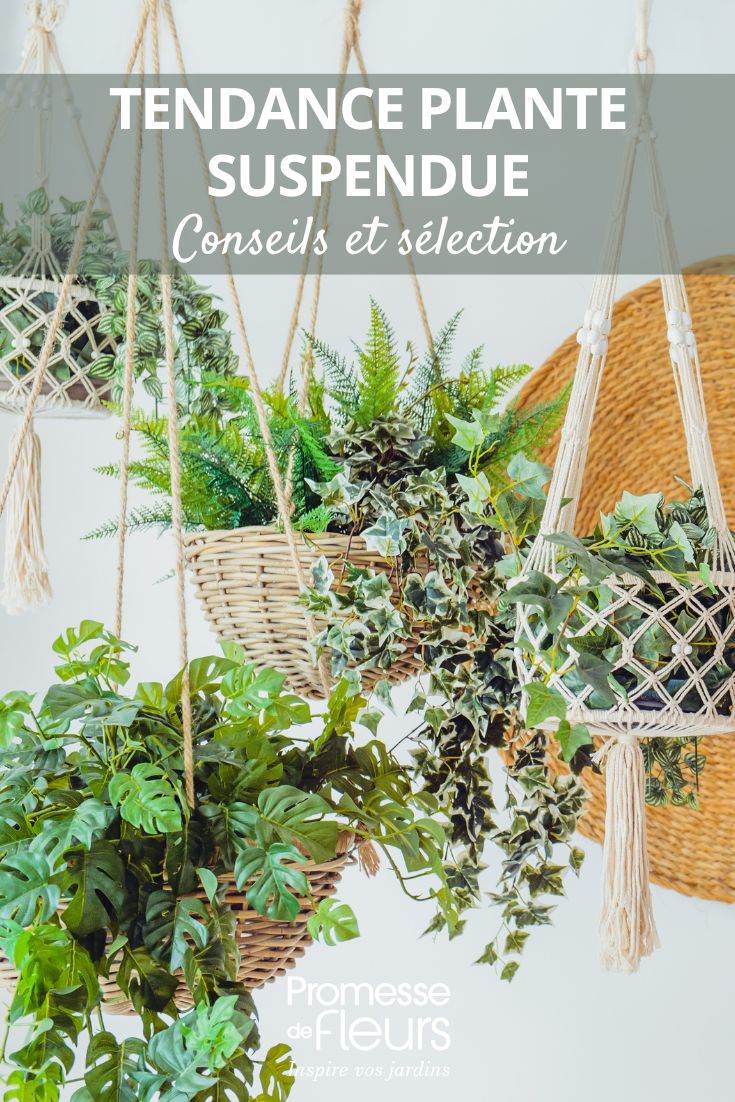
You can hang your indoor plants using macramé and hooks, attached for example to a piece of driftwood.
Drop heights: choose according to space
Not all suspended indoor plants have the same spread, and their drop length generally determines their ideal position. For high hangings — from the ceiling or on a beam — opt for varieties capable of forming long cascades, sometimes spectacular. This is the case of Philodendron scandens, which can exceed 1.50 m in length, or the “string of hearts” (Ceropegia woodii), whose thin stems easily extend over 2 m. These plants come into their own in rooms with volume or above a staircase.
For installations on a shelf, windowsill or tall piece of furniture, choose more compact trailing plants. Tradescantia and Peperomia typically have drops of 30–50 cm, ideal for adding foliage without taking up space.
Finally, some species such as Senecio herreianus or Hoyas have a gradual but well-structured growth: they suit low-hung displays as well as grouped arrangements at various heights.
Indoors, hanging plants lend themselves well to the art of accumulation: same plant in identical pots, or, conversely, different varieties combined rhythmically at varied heights for a more spontaneous look.
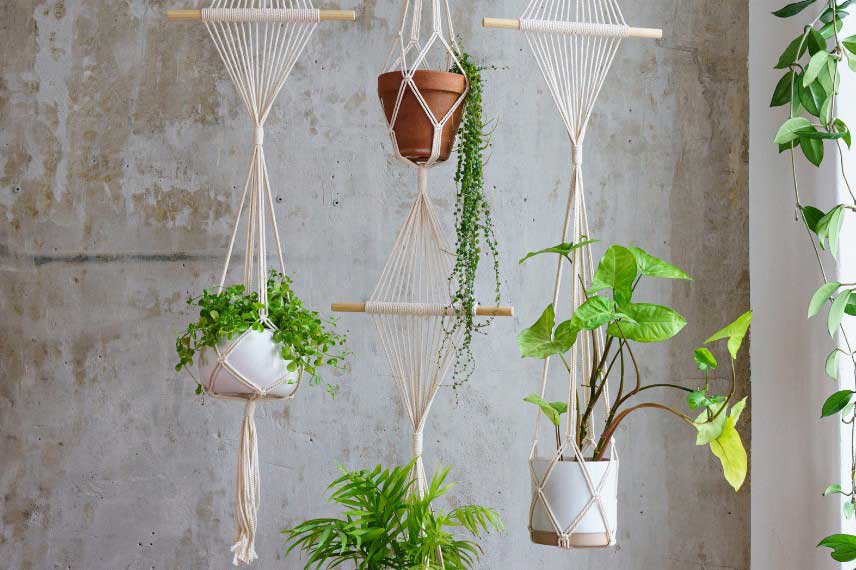
You can play with hanging heights, placing the most trailing plants higher and the more upright ones lower to add volume and rhythm to the space.
Read also
How to create an indoor living wall?Choosing the right container
Choice of container plays an essential role in success of a hanging plant, both aesthetically and practically. It should both showcase the hanging houseplant, allow good water drainage, and suit the structure chosen to hang it on.
For plants that dislike stagnant moisture — such as Hoyas, succulents or epiphytic cacti — prefer unglazed terracotta pots, porous, which promote good aeration of the growing medium and limit excess water. Stoneware or matte ceramic containers also work very well, provided effective drainage is ensured.
Very fashionable, braided rope, macramé or natural fibre hangers are perfect for bohemian or cosy interiors, and have become a must-have for contemporary plant-filled spaces. They are particularly suited to plants with a trailing or soft habit such as pothos, Hoyas, Tradescantia or ivies, which thrive there with natural ease and elegance. Minimalist cachepots or graphic wall-mounted rails, meanwhile, create more modern, elegant hangings.
Always ensure pot remains accessible for watering, or choose suspension systems that are easy to unhook. And if plant is placed on a shelf or high piece of furniture, a stable, lightweight cachepot will be easier to handle.
Hanging indoor plants: ideal varieties
For successful hanging displays, choose trailing hanging plants that are undemanding and able to thrive in aerial containers. But growing at height also brings constraints: access to the plant is often less straightforward, and watering can be tricky, especially in hard-to-reach rooms. It is important to consider light, ambient warmth and also how difficult it is to access the plant for watering, which is generally more demanding than for a plant on the floor. For example, Tradescantia and Peperomia prefer a substrate that is always slightly moist and are more sensitive to missed waterings, particularly if the air is dry. So, in some cases, it is better to choose species able to tolerate a slight dry spell between waterings. Here is a selection of varieties as visually striking as they are reliable, perfect for creating stylish indoor hanging displays.
Must-haves with trailing foliage
The Pothos (Epipremnum aureum) remains a safe bet: undemanding and tolerant of missed waterings, it comes in many variegated varieties (such as ‘Marble Queen’) and soon forms long glossy vines. Another classic, Philodendron scandens, one of the most tolerant — especially its ‘Brasil’ form with chartreuse highlights — naturally stretches downwards to form a dense, elegant green curtain. It is best placed high up, in a bright corner, so its stems have room to cascade. The Scindapsus pictus, a close cousin of pothos, stands out for its satiny, silver-speckled leaves, perfect for catching the light. It adapts well to a hanging basket or can be trained along a shelf to create a soft trailing effect.
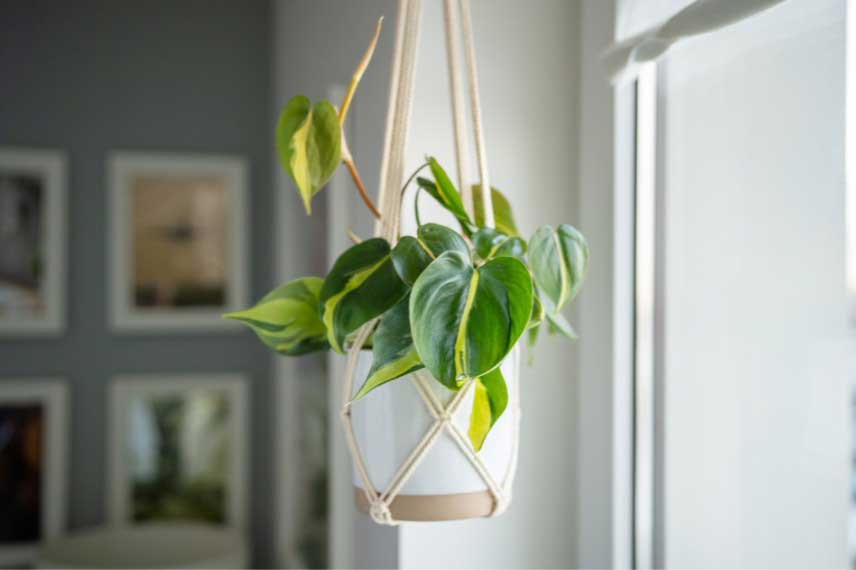
A young plant of Philodendron scandens ‘Brasil’, with variegated foliage. Over time it will form long trailing vines.
Succulents and cacti with distinctive habits
Among the easiest-to-grow plants are species capable of storing water in their stems or leaves, and thus less affected by missed waterings. TheEpiphyllum anguliger – fishbone cactus, with its very striking jagged foliage, prefers bright, indirect light and tolerates drying out between waterings. As it grows in all directions, it benefits from being hung in a pot that lets its stems grow freely, ideally in terracotta to ensure good drainage. The Senecio herreianus ‘Purple Flush’, with beads slightly tinged mauve, is also a perfect succulent for a minimalist hanging display. Place it in good indirect light to avoid thinning at the top. Hoyas — notably Hoya australis ‘Tricolor’ and Hoya ‘Mathilde Splash’ — charm with thick foliage and small waxy flowers: they like being a little pot-bound and prefer their substrate to dry out at the surface between waterings.
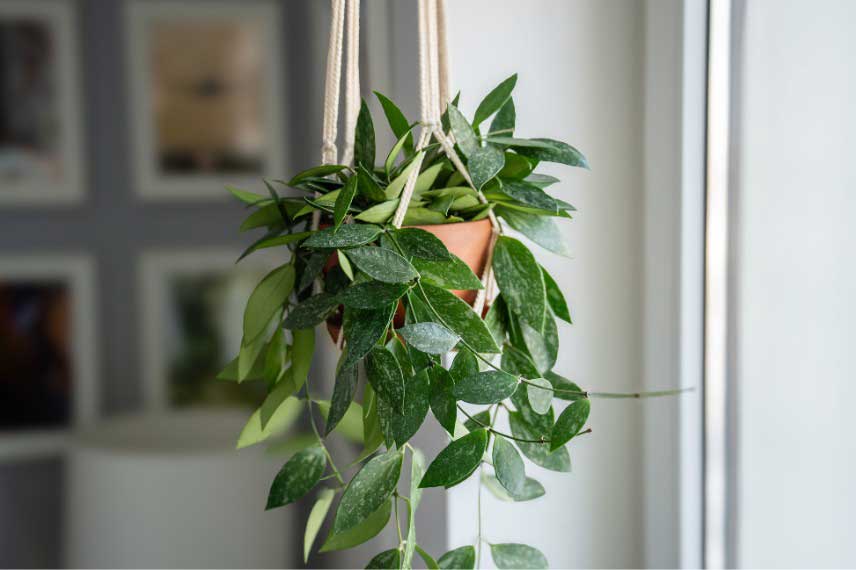
Hoyas are particularly well suited to hanging culture. Here, Hoya gracilis.
Decorative trailing foliage
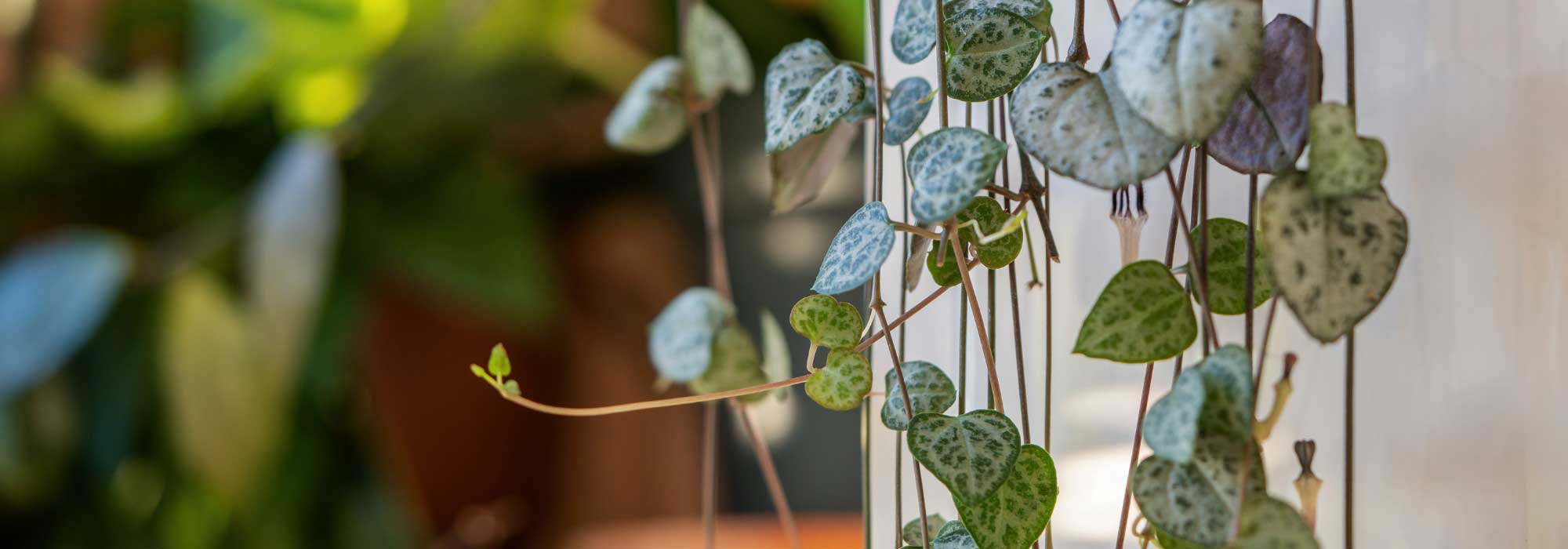
Ornamental ivies — Ivy ‘Eva’, Hedera helix ‘Yellow Ripple’ and ‘Golden Starlight’ — are classics with variegated leaves, very decorative, and appreciate a substrate that is always slightly moist. They suit bright rooms but without direct sun. They can be grown in a hanging basket or on a high shelf, from where their stems will naturally fall, creating a naturally dressed look. Another must-have, Ceropegia woodii, or “string of hearts”, enchants with its delicately silvered heart-shaped leaves borne on thin stems that cascade.
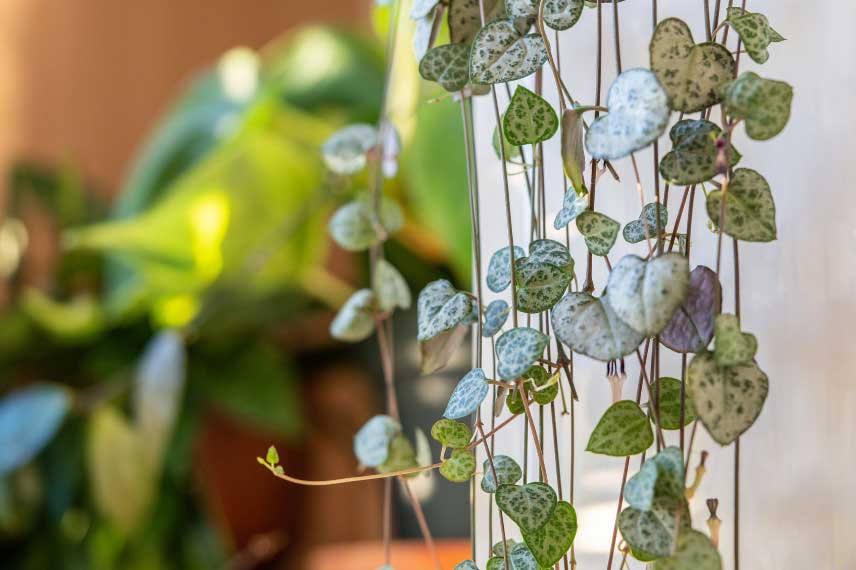
Ceropegia woodii forms long thin stems bearing small, silvered heart-shaped leaves.
Graphic and original textures
Some plants play on structure and texture to enliven a hanging display. The Peperomia ‘Hope’, with its small thick round leaves, forms arching stems with an almost succulent look, tolerating a few days of dryness. It sits equally well in a hanging bowl or on a wall shelf, where it falls in light drapes. Pair it with a round terracotta or concrete pot to emphasise the textured effect of its foliage. As for the Episcia ‘Silver Shield’, it charms with velvety silver leaves but requires a steady atmosphere and regular watering, particularly when hung. Reserve it for more attentive enthusiasts. Give it a spot sheltered from drafts, on a shelf near a window, with a good level of ambient humidity.
Colourful, bright trailing plants
Finally, to introduce touches of colour, Tradescantia, or inch plants, are excellent candidates. Tradescantia zebrina ‘Pink Joy’ shines with metallic pink and green highlights, while Tradescantia sillamontana ‘Variegata’ – woolly inch plant, rarer, presents an astonishing woolly texture. Their rapid growth makes them spectacular, but they require a moist substrate and regular watering, especially in heated interiors. Hanging displays in braided rope and cachepots in reed or rattan emphasise their natural, warm look.
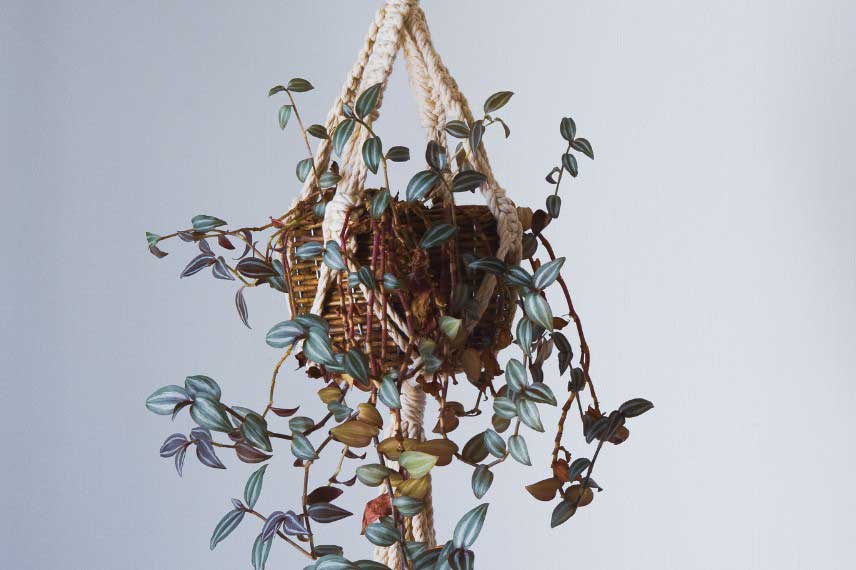 Tradescantia zebrina, brings a touch of colour with variegated foliage tinted purple, silver and pink.” width=”856″ height=”570″ /> The inch plant, Tradescantia zebrina, brings a touch of colour with variegated foliage shaded purple, silver and pink.
And why not flowering trailing plants?
Although rarer indoors, some plants offer a lovely floral display in addition to their foliage. Hoya crassipetiolata rewards with enchanting, scented star-shaped flowers. It comes into its own when hung, especially in a natural-style macramé. Tillandsia ‘Mizuki’ charms with its delicate pink-tinged flowering, perfect for a light, airy hanging display. You can also opt for Guzmania ‘Candy’, a compact bromeliad with a striking inflorescence whose colourful rosette makes an impact when suspended at eye level.
Be inspired and discover our full selection of indoor hanging plants to grow. Also consult our advice sheet “7 trailing indoor plants”
- Subscribe!
- Contents
This form is protected by reCAPTCHA - the Google Privacy Policy and Terms of Service apply.

































Comments