Ferocactus emoryi subsp. rectispinus - Barrel cactus
Ferocactus emoryi subsp. rectispinus - Barrel cactus
Ferocactus emoryi subsp. rectispinus - Barrel cactus
Ferocactus emoryi subsp. rectispinus - Barrel cactus
Ferocactus emoryi subsp. rectispinus - Barrel cactus
Ferocactus emoryi subsp. rectispinus - Barrel cactus
Ferocactus emoryi subsp. rectispinus
Emory's barrel cactus, Coville's barrel cactus
Back-to-school special offer!
Get €10 off for every €50 you spend! And get up to €40 off on a single order.
How does it work?
1. Shop your favourites
Add your favourite plants to your basket. For every €50 you spend (excluding delivery charges, store credit and the plastic-free option), you’ll receive a €10 voucher.
€50 spent = €10 voucher
€100 spent = €20 voucher
€150 spent = €30 voucher
€200 spent = €40 voucher
2. Place your order
Once your basket reaches one of the spending thresholds, place your order. You can even choose your delivery date!
3. Receive your voucher
As soon as your order has been shipped, you’ll receive an email containing your personal voucher code and its value.
4. Use it on your next order
Your voucher is valid for 90 days from the date you receive it. It can be used once only, on a new order worth at least the value of the voucher, excluding delivery charges.
Please note: Vouchers can be combined with other offers, but cannot be split or refunded.
Home or relay delivery (depending on size and destination)
Important: You may be charged customs duties by your country’s customs authorities upon delivery.
Schedule delivery date
and select date in basket
This plant carries a 12 months recovery warranty
More information
We guarantee the quality of our plants for a full growing cycle, and will replace at our expense any plant that fails to recover under normal climatic and planting conditions.
Would this plant suit my garden?
Set up your Plantfit profile →
Description
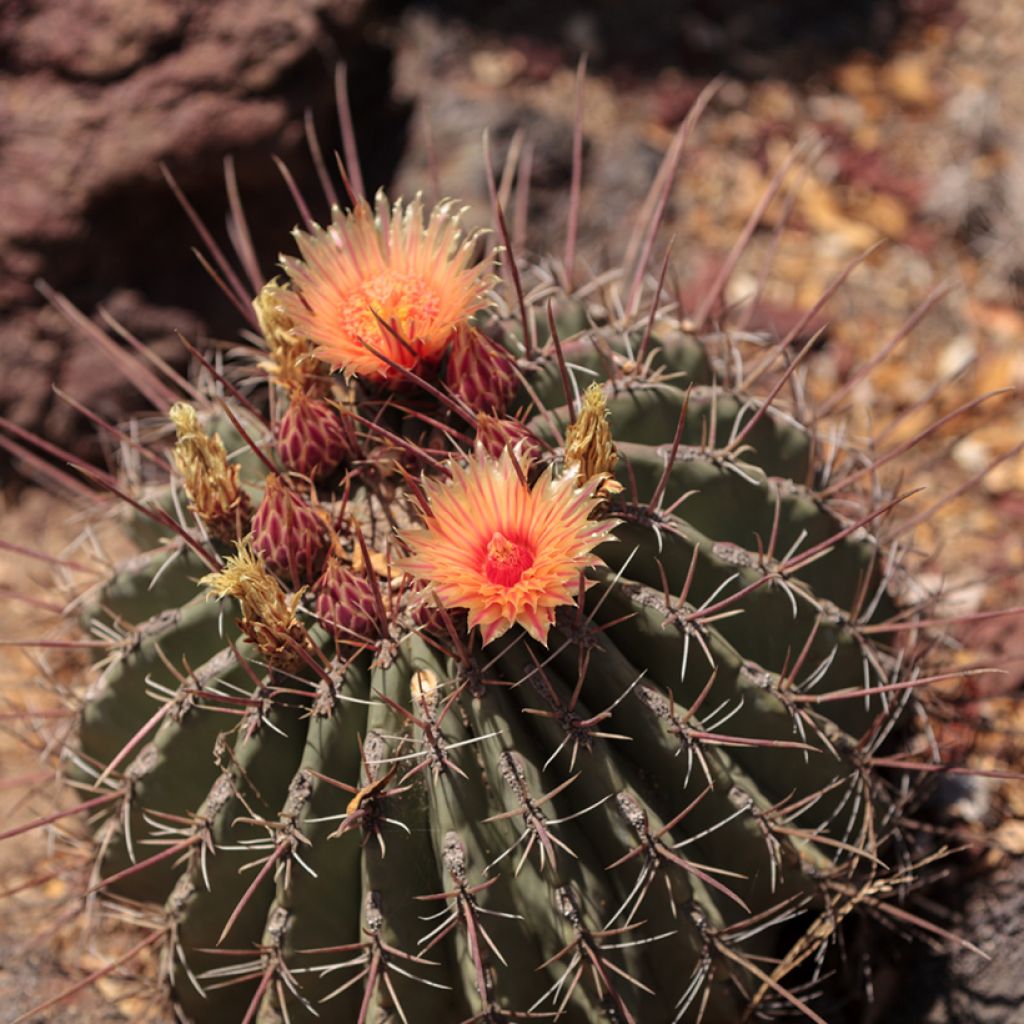
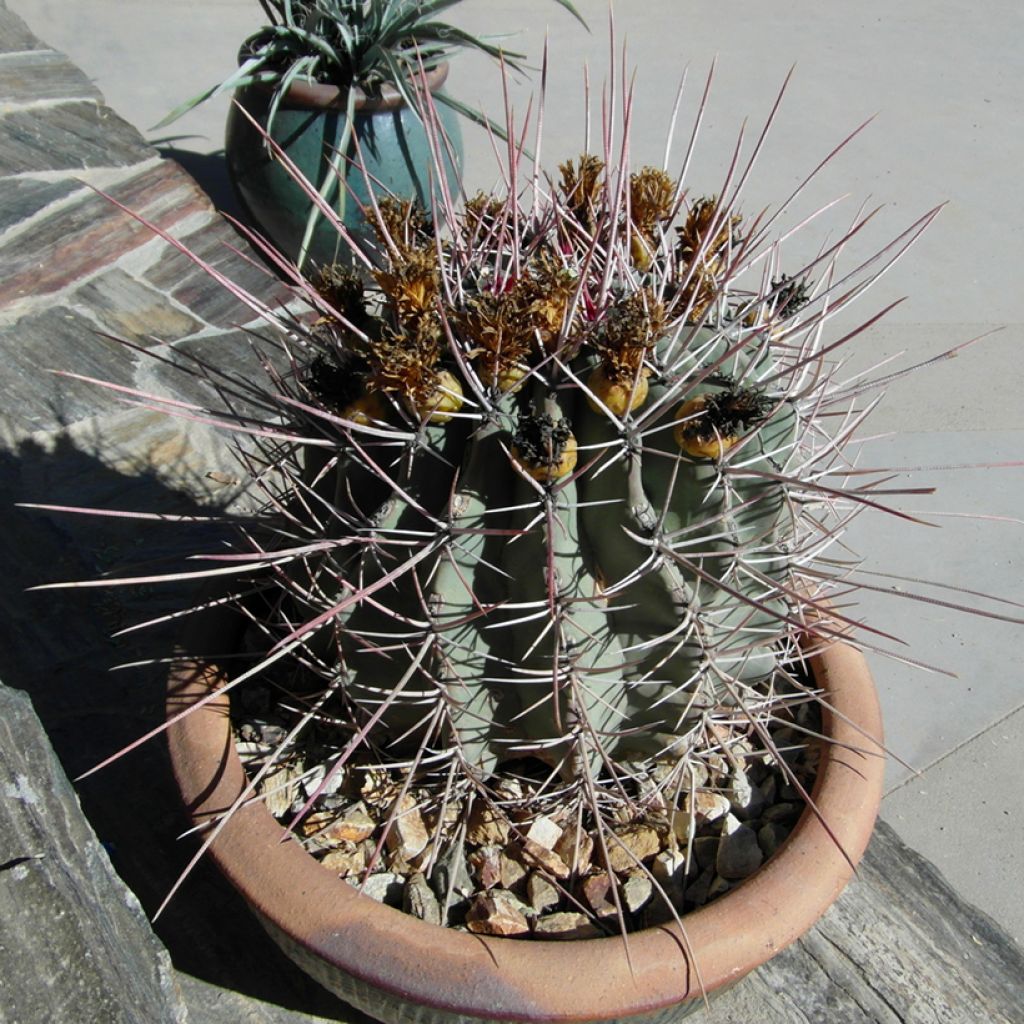
Ferocactus rectispinus is a large "barrel cactus" straight from the arid landscapes of northern Mexico and the southern United States. This solitary cactus with a globular habit in its youth gradually becomes cylindrical with age. Its green epidermis is striped with robust midribs, from which long, straight, flamboyant, menacing thorns emerge, ranging from deep red or incandescent orange to golden yellow. A lavish, striking variety, perfect for adorning the terrace in summer.
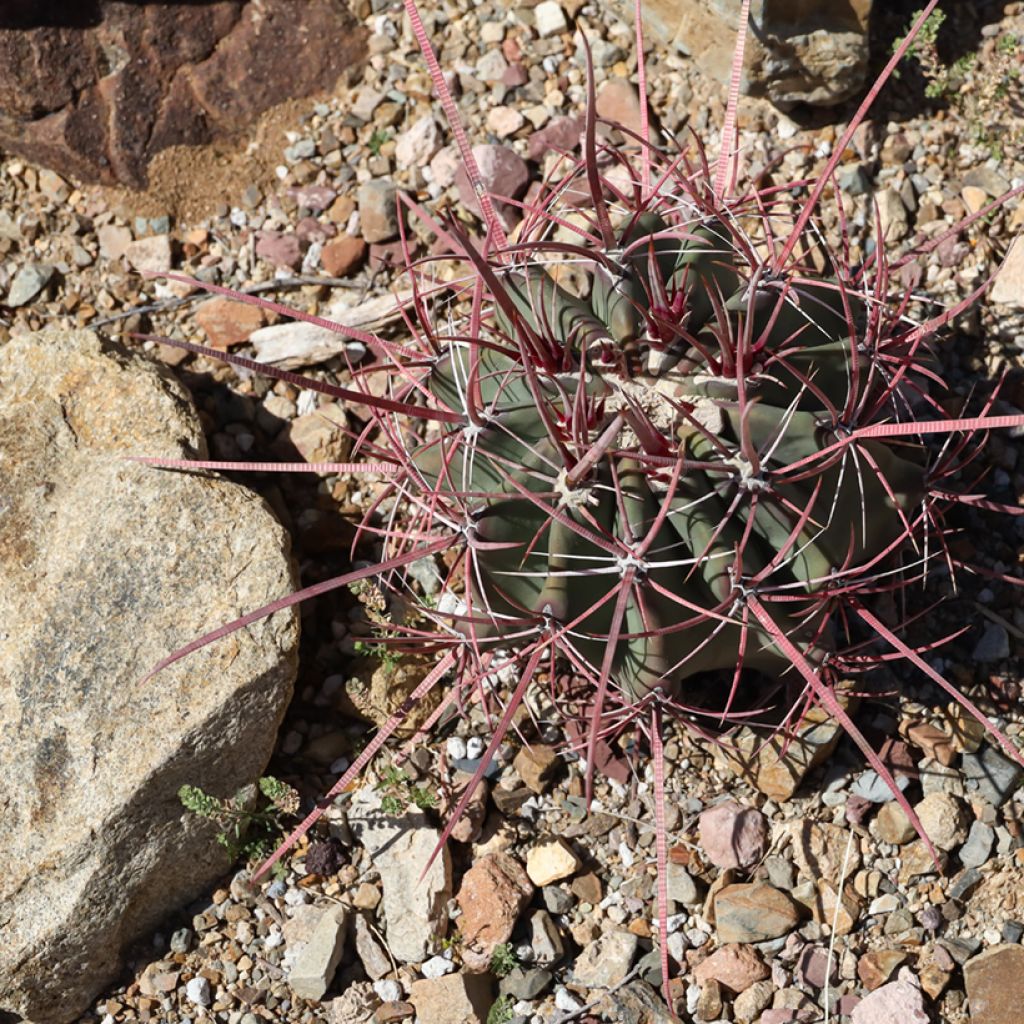
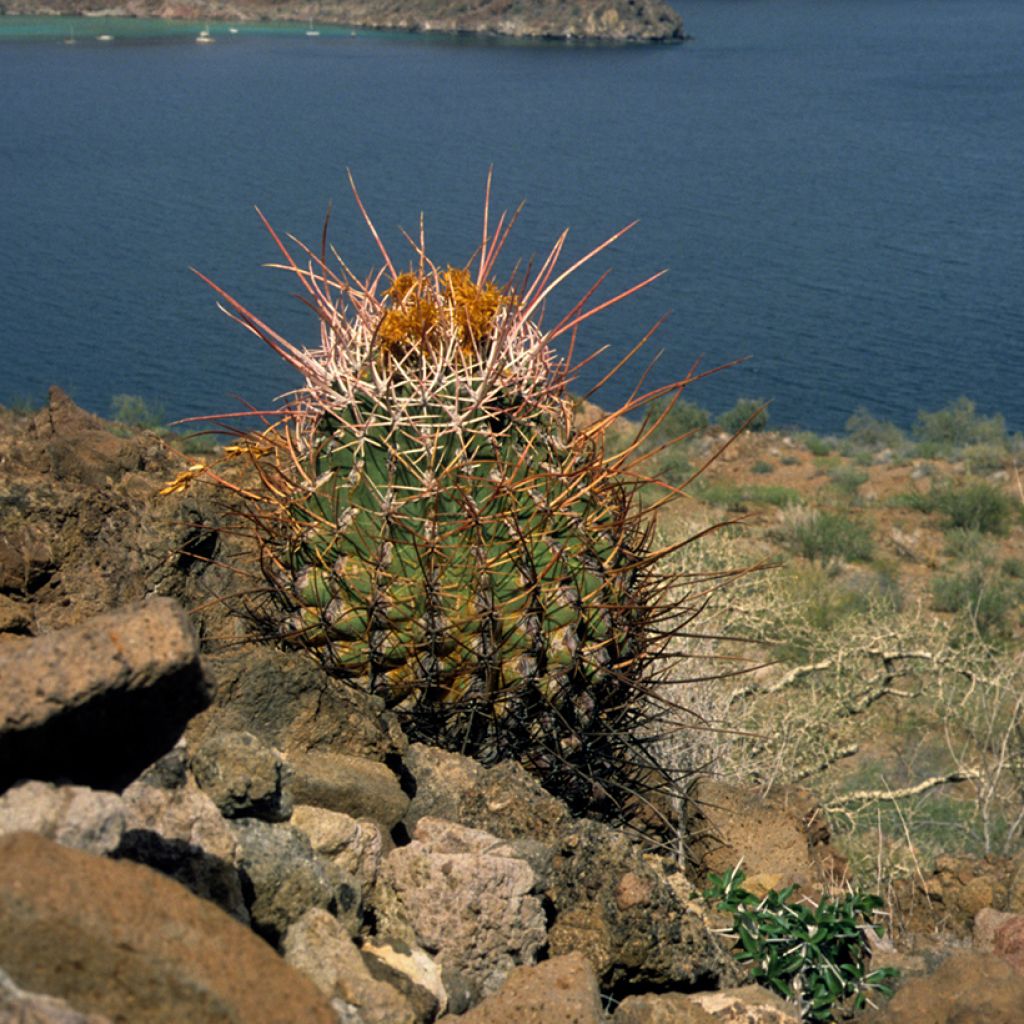
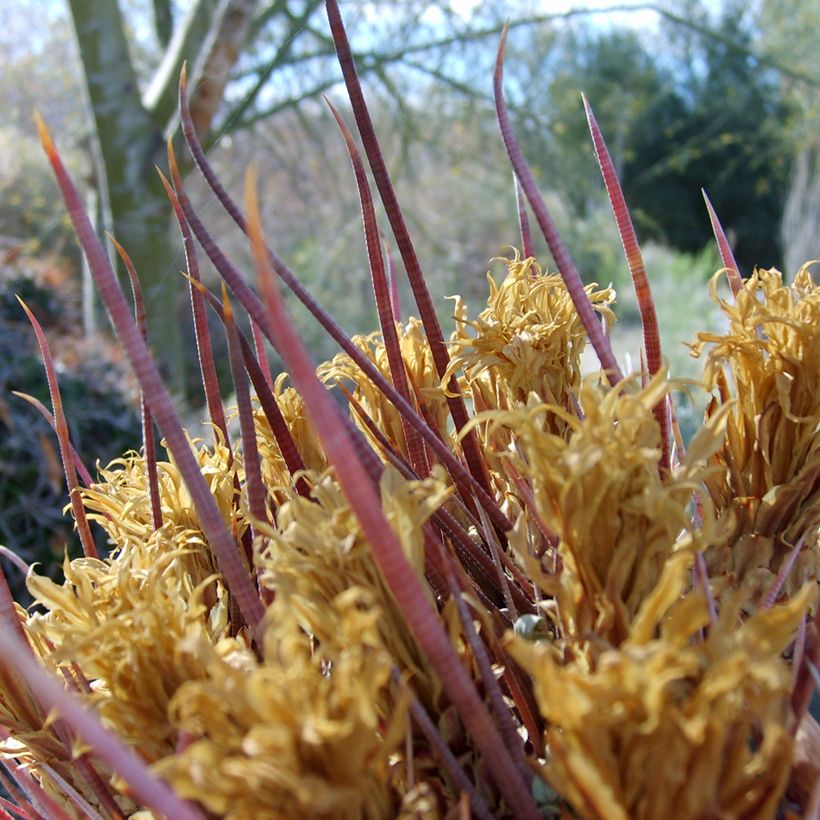
Ferocactus rectispinus, belonging to the Cactaceae family, is a species endemic to the Baja California Peninsula in Mexico, particularly around Bahía de la Concepción and Cerro Colorado. In its natural habitat, it grows on high coastal cliffs, in well-drained, even arid soils. This barrel cactus has a globular habit in young specimens, evolving into a more cylindrical shape with age. In the ground, in the wild, it can reach a height of 1.5 to 2 m and a diameter of 45 to 60 cm. In pots, it rarely exceeds 50 cm in height and 30 cm in width. Its growth is slow, it is generally solitary and does not produce offsets. Its green, fleshy stem has 15 to 21 pronounced midribs, slightly notched above each areole. The areoles, spaced 3 to 4 cm apart, are covered with brown wool. One of the most distinctive characteristics of this species is the presence of a single, straight and robust central thorn, which can measure 10 to 25 centimetres long; in fact, it is one of the longest found among cacti. These thorns, initially red or pink, may fade to paler shades over time. Around this central thorn, there are usually 5 to 9 shorter radial thorns measuring between 2.5 and 7 cm. Flowering occurs in summer if conditions are right. It takes the form of large funnel-shaped, yellow, red or orange flowers, measuring between 5 and 7.5 cm in diameter. These flowers are mainly pollinated by insects. The resulting fruits are oblong, scaly and bright yellow, measuring about 2.5 to 5 centimetres long, and contain small black seeds about 2 mm in diameter.
Ferocactus rectispinus has a symbiotic relationship with ants. The nectaries located at the top of the cactus produce nectar that attracts them. In return, they protect the plant from other harmful insects.
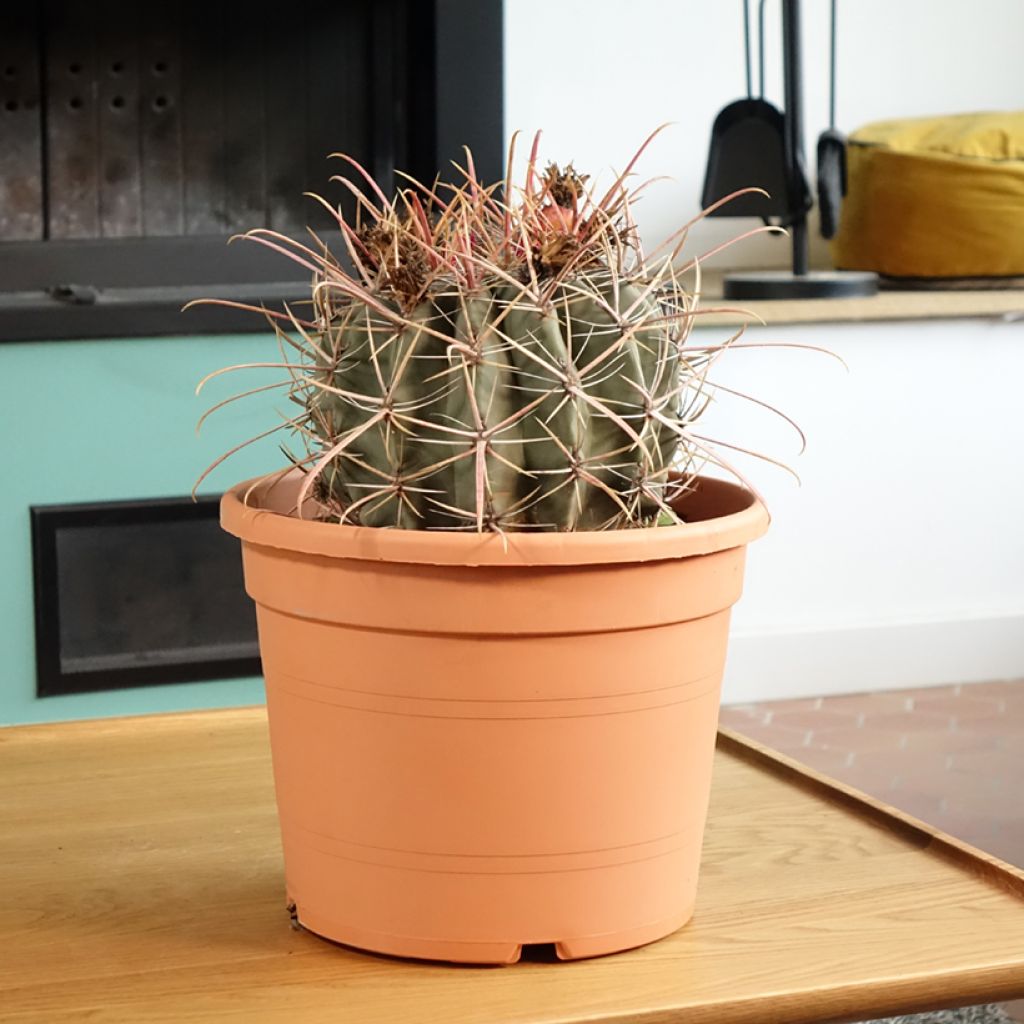
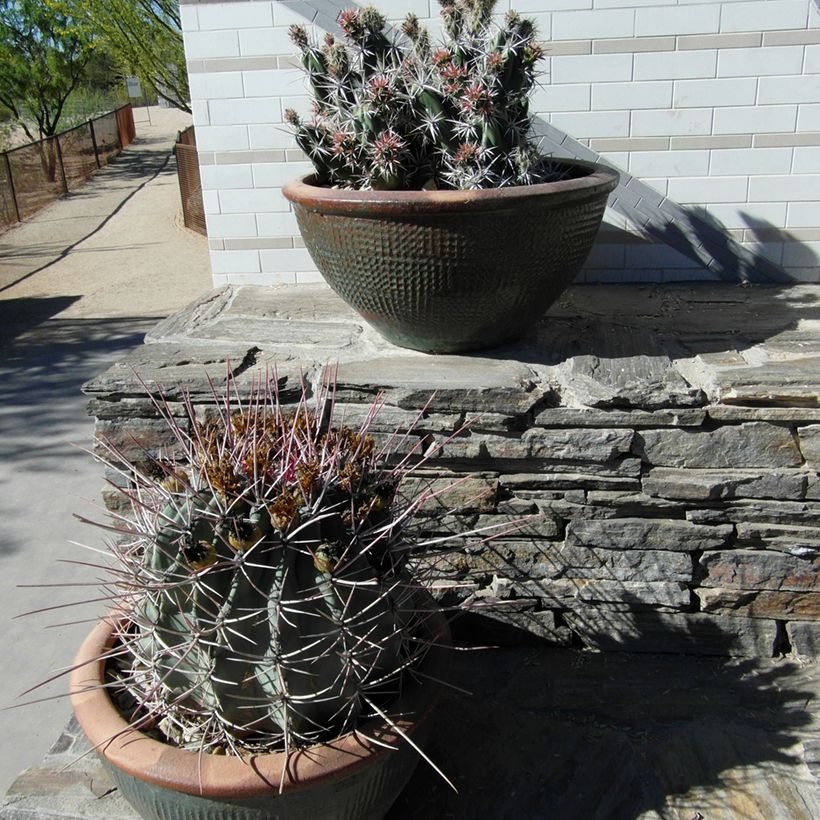
Although Ferocactus rectispinus is better suited to cultivation in the ground in favourable climates, it can also be grown in a pot that is wider than it is deep. Majestic and sculptural, it casts its massive shadow on rocky soil. This cactus fits perfectly into a desert scene, accompanied by Yucca rostrata and Aloe marlothii. It finds a perfect setting in a wide terracotta bowl, especially alongside the Pachycereus pringlei, whose slender columns enhance its architectural habit. This variety creates a miniature landscape where aridity becomes an art, sculpted by light and time.
Ferocactus emoryi subsp. rectispinus - Barrel cactus in pictures
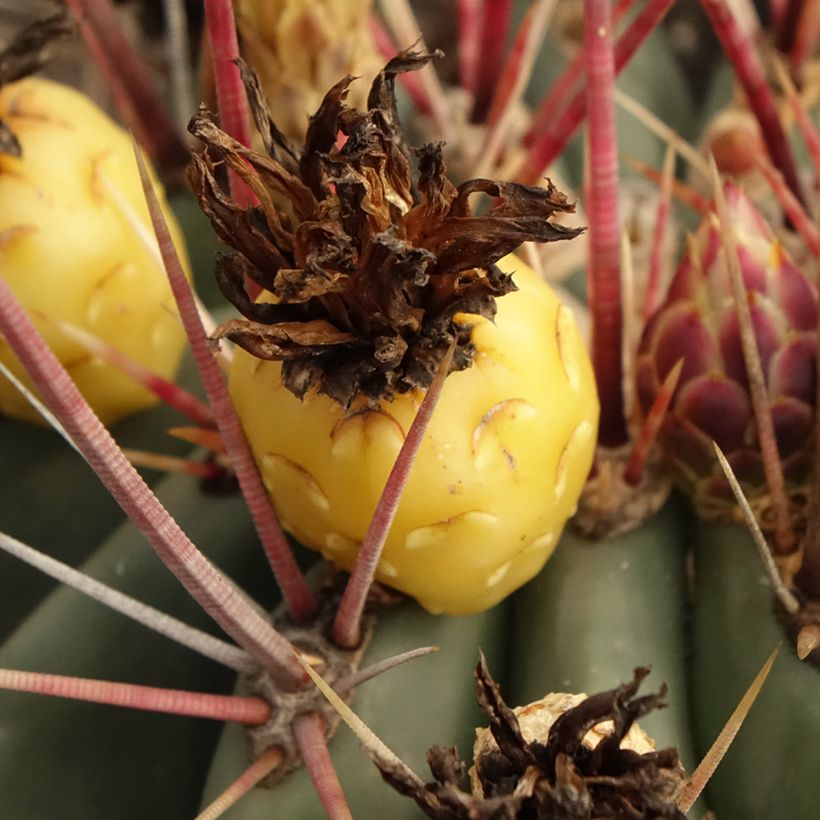
Flowering
Foliage
Plant habit
Botanical data
Ferocactus
emoryi subsp. rectispinus
Cactaceae
Emory's barrel cactus, Coville's barrel cactus
Ferocactus rectispinus, Echinocactus emoryi var. rectispinus, Echinocactus rectispinus
North America
Planting and care
Ferocactus rectispinus is a robust cactus which, due to its sensitivity to cold, is usually grown in pots. Use a wide container with drainage holes, filled with a substrate specially designed for cacti. Place the plant in full sun. Water regularly from March to October, ensuring the substrate dries out completely between waterings. As autumn approaches, gradually reduce watering until stopping completely in winter, when the cactus should be kept dry.
Although it can tolerate temperatures down to -2°C if kept dry, it is recommended to bring this cactus indoors at the first sign of cold weather, placing it in a bright but unheated location. In heated indoor spaces, a light watering every three to four weeks may be necessary to prevent excessive drying out.
When planted in the ground, this cactus is only suitable for regions with very mild and dry climates. Plant it in well-drained gravelly soil, exposed to full sun. Once established, it requires little watering, relying on natural rainfall. Pruning is not necessary. However, if parts of the plant become damaged or diseased, it is advisable to remove them with clean, sharp tools.
Always handle with care due to its sharp thorns.
Planting period
Intended location
Care
Planting & care advice
-
-
-
-
-

-

-
-
This item has not been reviewed yet - be the first to leave a review about it.
Recently viewed products
Haven't found what you were looking for?
Hardiness is the lowest winter temperature a plant can endure without suffering serious damage or even dying. However, hardiness is affected by location (a sheltered area, such as a patio), protection (winter cover) and soil type (hardiness is improved by well-drained soil).

The flowering period indicated on our website applies to countries and regions located in USDA zone 8 (France, the United Kingdom, Ireland, the Netherlands, etc.)
It will vary according to where you live:- In zones 9 to 10 (Italy, Spain, Greece, etc.), flowering will occur about 2 to 4 weeks earlier.
- In zones 6 to 7 (Germany, Poland, Slovenia, and lower mountainous regions), flowering will be delayed by 2 to 3 weeks.
- In zone 5 (Central Europe, Scandinavia), blooming will be delayed by 3 to 5 weeks.
In temperate climates, pruning of spring-flowering shrubs (forsythia, spireas, etc.) should be done just after flowering.
Pruning of summer-flowering shrubs (Indian Lilac, Perovskia, etc.) can be done in winter or spring.
In cold regions as well as with frost-sensitive plants, avoid pruning too early when severe frosts may still occur.
The planting period indicated on our website applies to countries and regions located in USDA zone 8 (France, United Kingdom, Ireland, Netherlands).
It will vary according to where you live:
- In Mediterranean zones (Marseille, Madrid, Milan, etc.), autumn and winter are the best planting periods.
- In continental zones (Strasbourg, Munich, Vienna, etc.), delay planting by 2 to 3 weeks in spring and bring it forward by 2 to 4 weeks in autumn.
- In mountainous regions (the Alps, Pyrenees, Carpathians, etc.), it is best to plant in late spring (May-June) or late summer (August-September).
The harvesting period indicated on our website applies to countries and regions in USDA zone 8 (France, England, Ireland, the Netherlands).
In colder areas (Scandinavia, Poland, Austria...) fruit and vegetable harvests are likely to be delayed by 3-4 weeks.
In warmer areas (Italy, Spain, Greece, etc.), harvesting will probably take place earlier, depending on weather conditions.
The sowing periods indicated on our website apply to countries and regions within USDA Zone 8 (France, UK, Ireland, Netherlands).
In colder areas (Scandinavia, Poland, Austria...), delay any outdoor sowing by 3-4 weeks, or sow under glass.
In warmer climes (Italy, Spain, Greece, etc.), bring outdoor sowing forward by a few weeks.
Shipping country and language
Your country of residence may be:
Your country of residence is:
For a better user experience on our website, you can select:
Your shipping country:
-
 Austria
-
 Belgium
-
 Bosnia & Herzegovina
-
 Bulgaria
-
 Croatia
-
 Cyprus
-
 Czechia
-
 Denmark
-
 Estonia
-
 Finland
-
 France
-
 Germany
-
 Greece
-
 Hungary
-
 Iceland
-
 Ireland
-
 Italy
Italy
-
 Latvia
-
 Liechtenstein
-
 Lithuania
-
 Luxembourg
-
 Malta
Malta
-
 Netherlands
-
 Poland
-
 Portugal
-
 Romania
-
 Serbia
-
 Slovakia
-
 Slovenia
-
 Spain
Spain
-
 Sweden
-
 Switzerland
Language:
-
French
-
 English
-
Spanish
-
Italian
-
German
-
Portuguese
-
Dutch
-
Finnish
My Account
Hello
My wish lists
My cart
Log in / Register
Existing customer?
This form is protected by reCAPTCHA - the Google Privacy Policy and Terms of Service apply.
New customer?
Create an account to track your orders, access our customer service and, if you wish, make the most of our upcoming offers.