Philadelphus Petite Perfume White - Mock Orange
Philadelphus Petite Perfume White - Mock Orange
Philadelphus (x) hybrida Petite Perfume White
Mock Orange
Back-to-school special offer!
Get €10 off for every €50 you spend! And get up to €40 off on a single order.
How does it work?
1. Shop your favourites
Add your favourite plants to your basket. For every €50 you spend (excluding delivery charges, store credit and the plastic-free option), you’ll receive a €10 voucher.
€50 spent = €10 voucher
€100 spent = €20 voucher
€150 spent = €30 voucher
€200 spent = €40 voucher
2. Place your order
Once your basket reaches one of the spending thresholds, place your order. You can even choose your delivery date!
3. Receive your voucher
As soon as your order has been shipped, you’ll receive an email containing your personal voucher code and its value.
4. Use it on your next order
Your voucher is valid for 90 days from the date you receive it. It can be used once only, on a new order worth at least the value of the voucher, excluding delivery charges.
Please note: Vouchers can be combined with other offers, but cannot be split or refunded.
Home or relay delivery (depending on size and destination)
Important: You may be charged customs duties by your country’s customs authorities upon delivery.
Schedule delivery date
and select date in basket
This plant carries a 24 months recovery warranty
More information
We guarantee the quality of our plants for a full growing cycle, and will replace at our expense any plant that fails to recover under normal climatic and planting conditions.
Would this plant suit my garden?
Set up your Plantfit profile →
Description
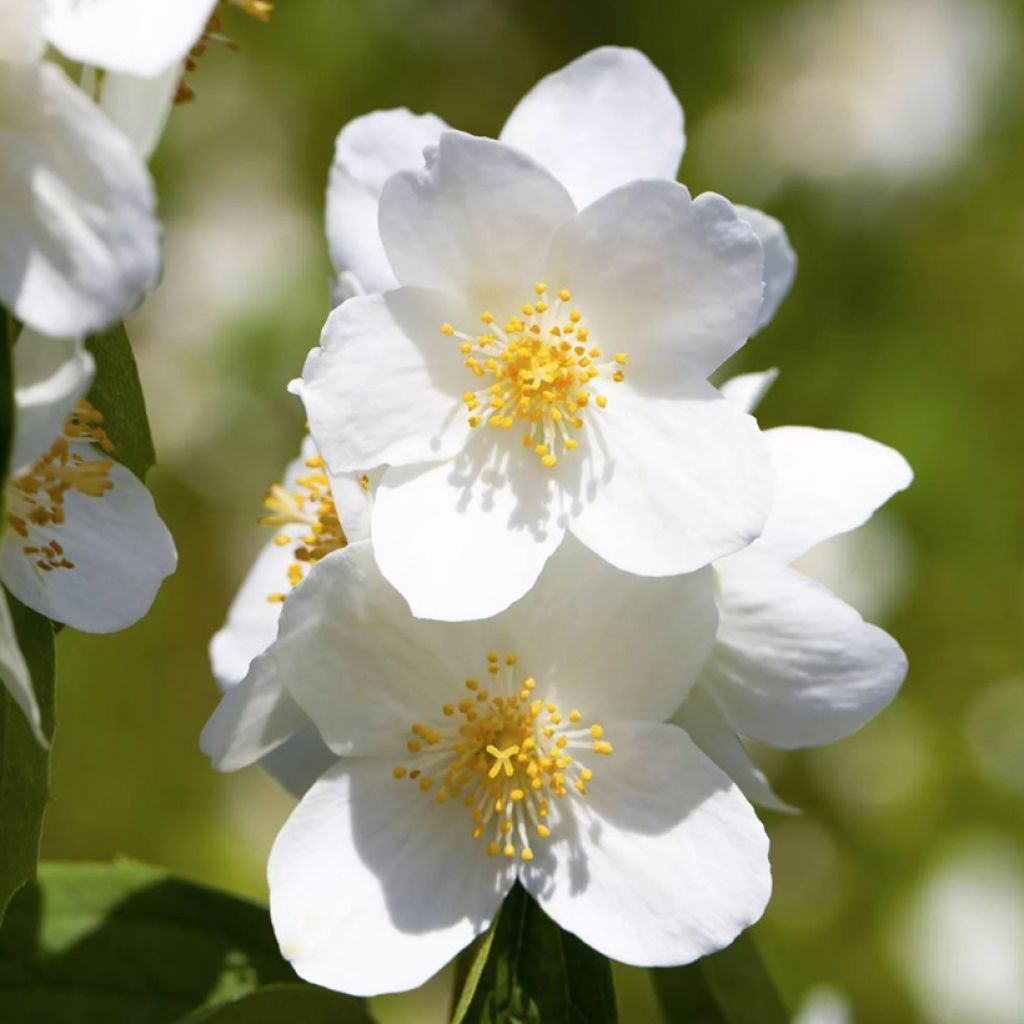
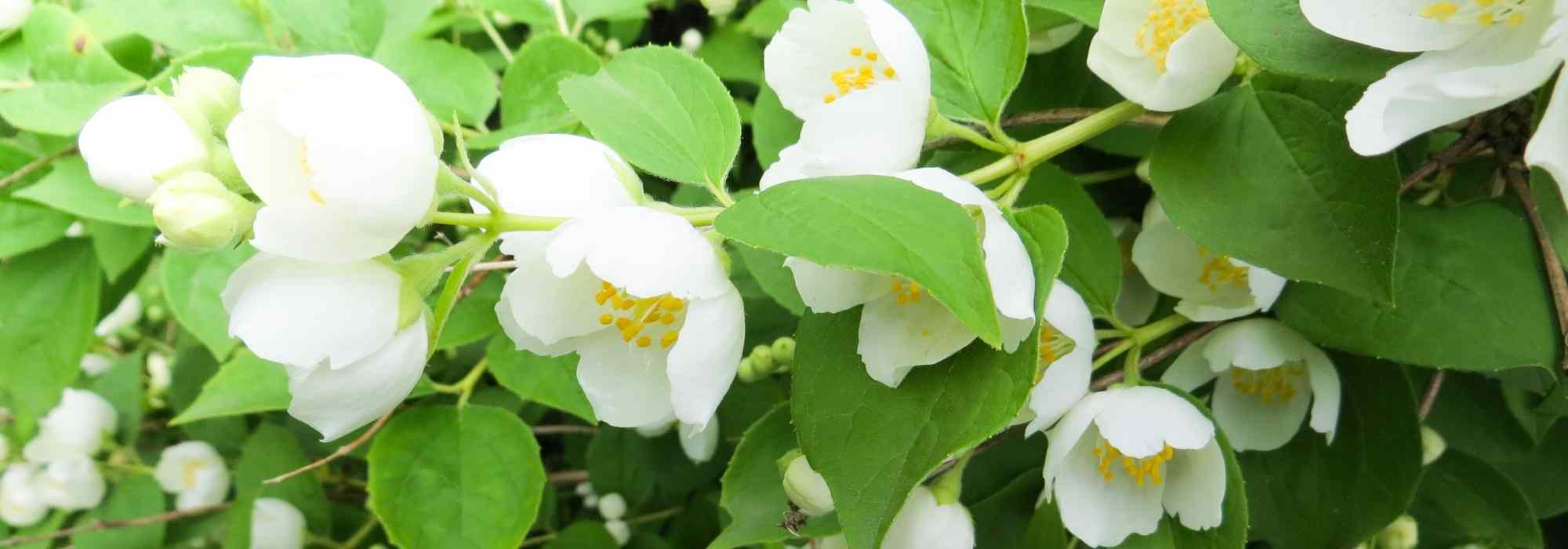
Philadelphus ‘Petite Perfume White’ is a variety of Mock Orange particularly desirable for the intoxicating fragrance of its white flowers. It forms a beautiful bush with fairly fine foliage, of a deep green colour, on which the numerous single flowers stand out remarkably with their dazzling whiteness. Their fragrance fills the garden for a month and a half in late spring. Adapting to most soils, it is very hardy and tolerates urban environments well.
All Philadelphus are deciduous bushes from the Hydrangeaceae family (like Hydrangeas), native to temperate regions of the northern hemisphere, particularly from the Far East and North America. The approximately 60 species that make up this genus were crossed with each other, first in France by Lemoine and Jacques, and then in the United States, with the fragrance of the flowers sometimes being forgotten along the way in favour of more spectacular, more double blooms...
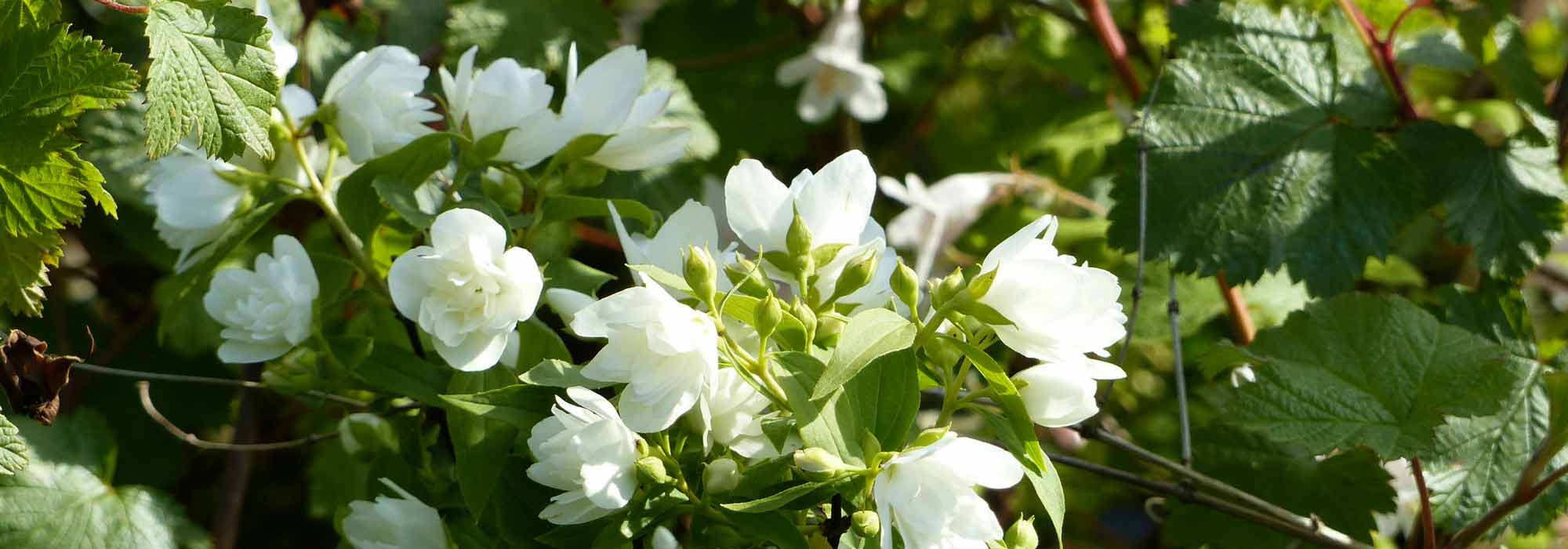
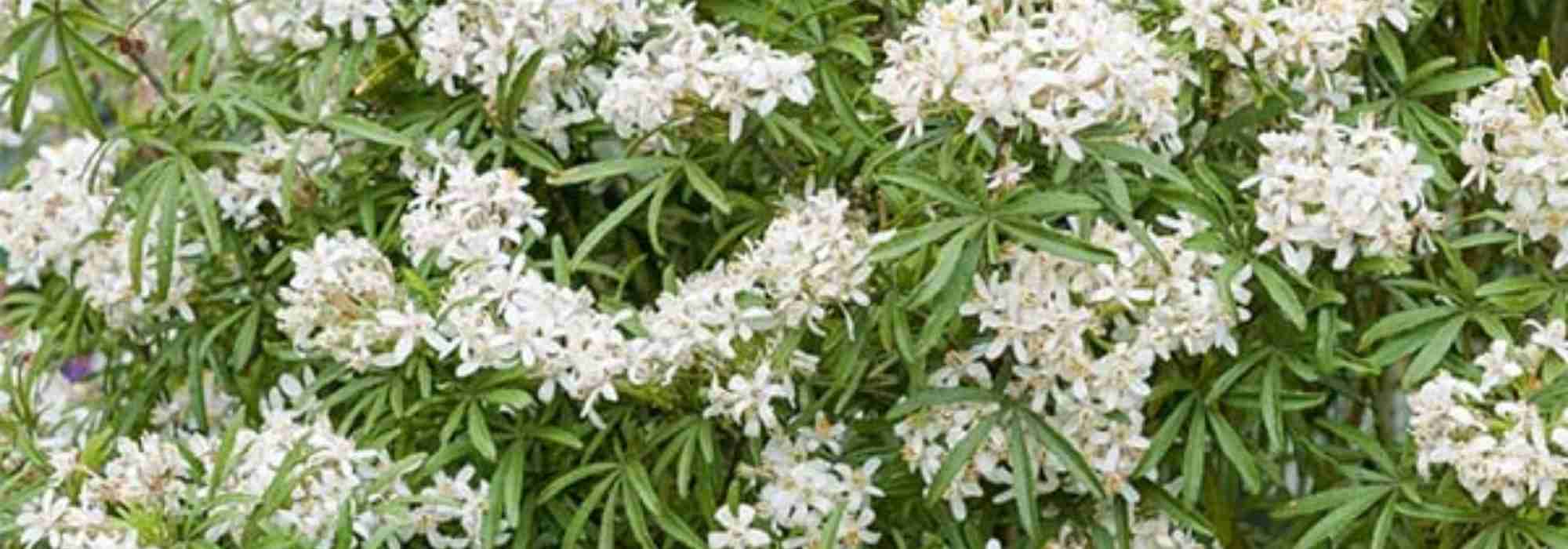
This is not the case with 'Petite Perfume White' which, as its name suggests, captivates with its fragrance. This medium-sized bush reaches a height of 1.50m (5ft) to 2m (7ft) at maturity, with a width of 1.20m (4ft) to 1.50m (5ft). It forms numerous, highly branched stems that extend in all directions. Its leaves are relatively small, about 3 to 4cm (1 to 2in) long, lanceolate in shape and pointed at the tip. They are opposite, positioned face to face with the stems, and carried by very short petioles. With a deep to dark green colour, they have clearly visible veins and form a dense mass of vegetation, a large tuft a little taller than wide, with irregular contours and a fairly natural, even somewhat wild appearance.
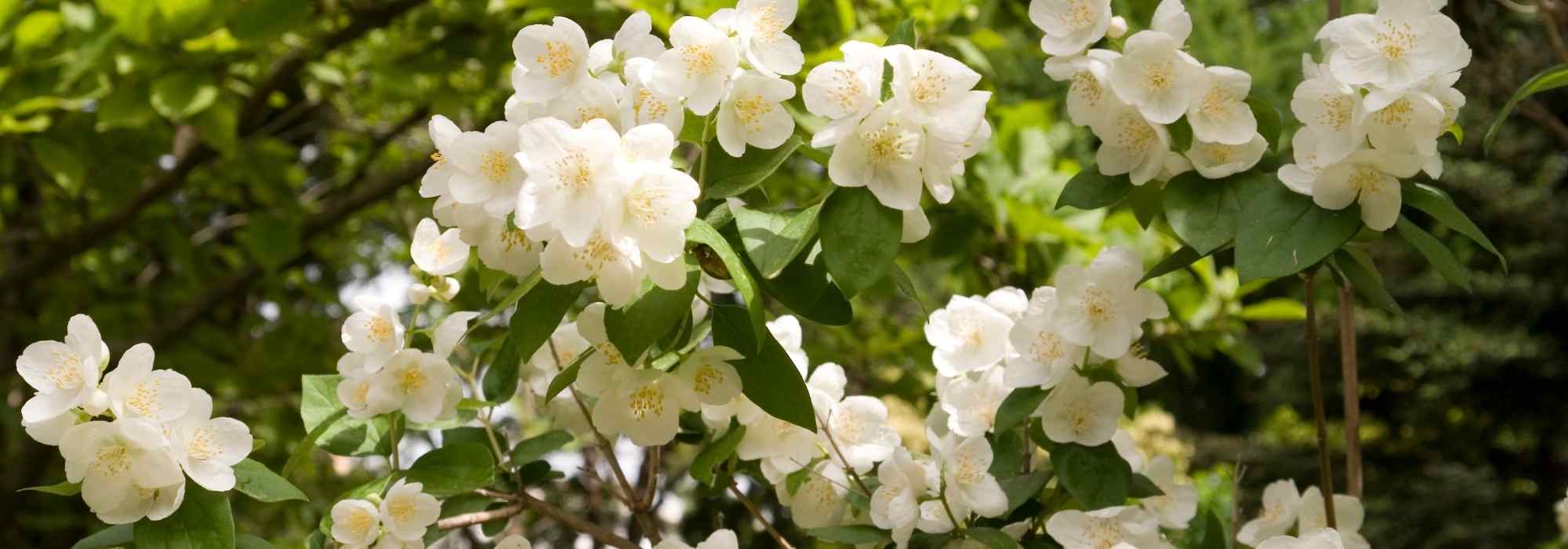
While the foliage is relatively ornamental, the main asset of this 'Petite Perfume' mock orange is its flowering. From the month of May, depending on the region, simple flowers appear, formed by four petals with rounded and slightly dentate edges. Among the purest white in the Philadelphus genus, the corollas are adorned with a small central bouquet of stamens with yellow tips, which are quite discreet. The fragrance they exude, on the other hand, dominates the garden with its power. For about six weeks, the scent of orange blossom spreads around, enchanting the sense of smell. Medium-sized, 5 to 6cm (2in) in diameter, the flowers are abundantly produced and regularly renewed, sometimes until July.
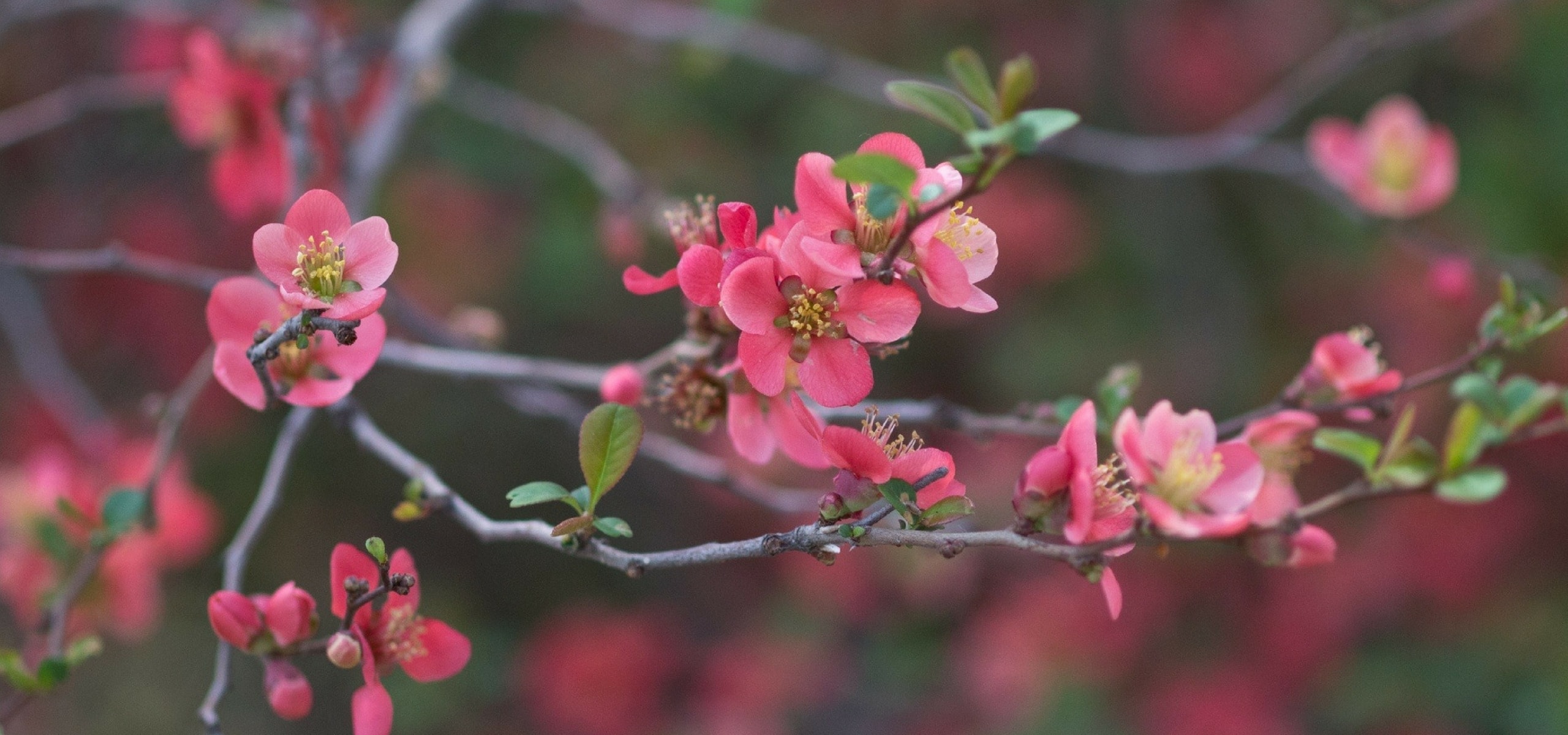
Well suited for the creation of natural-looking hedges, this bush with romantic charm will also fit perfectly in a shrub border, alongside other varieties that are also easy to grow. To enjoy early-season flowers, combine it with Forsythia 'Mikador', a compact bush covered in gold in March-April, before the first leaves emerge. Create a powerful contrast by planting it with Chaenomeles japonica 'Sargentii', a Japanese Quince that is covered in beautiful salmon-orange flowers in April. Hibiscus syriacus 'Azurii', with its large blue flowers, will take over in summer until September. It can be advantageously accompanied by one or more Lagerstroemia, or Crape Myrtle, with flowers in a variety of colours.
Plant habit
Flowering
Foliage
Botanical data
Philadelphus
(x) hybrida
Petite Perfume White
Hydrangeaceae
Mock Orange
Cultivar or hybrid
Planting and care
Philadelphus 'Petite Perfume White' is very easy to grow, requiring very little maintenance and is very accommodating and so suitable for all gardens and ideal for beginner gardeners. Ordinary, poor, even limestone soil suits it. However, it will prefer a fresh, well-drained and humus-bearing soil. Very hardy, it can withstand negative temperatures down to -25°C (-13°F). Planting is done in early spring or autumn, preferably in the sun or partial shade. Excessive heat exposure should be avoided in dry and hot climates. Dig a hole 50cm (20in) on each side and in depth, and mix potting compost with the existing soil. Soak the root ball in a bucket of water for 15 minutes before planting it in the hole, backfill around it and water thoroughly. Water regularly in the first two years, especially during hot periods, and then the plant will manage on its own.
Flowering on the previous year's shoots, Philadelphus should be pruned after flowering, in July-August, by shortening the flowering branches by one third of their length. A more severe pruning can be done every 2 to 3 years, to keep it compact and very floriferous. Simply do not hesitate to cut back the old wood and the branches that are too long to the base of the plant to encourage it to branch out from the base. A resistant bush, it can, however, be susceptible to powdery mildew, which whitens the leaves, and to black aphids that deform them with their bites.
Planting period
Intended location
Care
Planting & care advice
-
-

-
-
-
-

-
-
This item has not been reviewed yet - be the first to leave a review about it.
Recently viewed products
Haven't found what you were looking for?
Hardiness is the lowest winter temperature a plant can endure without suffering serious damage or even dying. However, hardiness is affected by location (a sheltered area, such as a patio), protection (winter cover) and soil type (hardiness is improved by well-drained soil).

The flowering period indicated on our website applies to countries and regions located in USDA zone 8 (France, the United Kingdom, Ireland, the Netherlands, etc.)
It will vary according to where you live:- In zones 9 to 10 (Italy, Spain, Greece, etc.), flowering will occur about 2 to 4 weeks earlier.
- In zones 6 to 7 (Germany, Poland, Slovenia, and lower mountainous regions), flowering will be delayed by 2 to 3 weeks.
- In zone 5 (Central Europe, Scandinavia), blooming will be delayed by 3 to 5 weeks.
In temperate climates, pruning of spring-flowering shrubs (forsythia, spireas, etc.) should be done just after flowering.
Pruning of summer-flowering shrubs (Indian Lilac, Perovskia, etc.) can be done in winter or spring.
In cold regions as well as with frost-sensitive plants, avoid pruning too early when severe frosts may still occur.
The planting period indicated on our website applies to countries and regions located in USDA zone 8 (France, United Kingdom, Ireland, Netherlands).
It will vary according to where you live:
- In Mediterranean zones (Marseille, Madrid, Milan, etc.), autumn and winter are the best planting periods.
- In continental zones (Strasbourg, Munich, Vienna, etc.), delay planting by 2 to 3 weeks in spring and bring it forward by 2 to 4 weeks in autumn.
- In mountainous regions (the Alps, Pyrenees, Carpathians, etc.), it is best to plant in late spring (May-June) or late summer (August-September).
The harvesting period indicated on our website applies to countries and regions in USDA zone 8 (France, England, Ireland, the Netherlands).
In colder areas (Scandinavia, Poland, Austria...) fruit and vegetable harvests are likely to be delayed by 3-4 weeks.
In warmer areas (Italy, Spain, Greece, etc.), harvesting will probably take place earlier, depending on weather conditions.
The sowing periods indicated on our website apply to countries and regions within USDA Zone 8 (France, UK, Ireland, Netherlands).
In colder areas (Scandinavia, Poland, Austria...), delay any outdoor sowing by 3-4 weeks, or sow under glass.
In warmer climes (Italy, Spain, Greece, etc.), bring outdoor sowing forward by a few weeks.
Shipping country and language
Your country of residence may be:
Your country of residence is:
For a better user experience on our website, you can select:
Your shipping country:
-
 Austria
-
 Belgium
-
 Bosnia & Herzegovina
-
 Bulgaria
-
 Croatia
-
 Cyprus
-
 Czechia
-
 Denmark
-
 Estonia
-
 Finland
-
 France
-
 Germany
-
 Greece
-
 Hungary
-
 Iceland
-
 Ireland
-
 Italy
Italy
-
 Latvia
-
 Liechtenstein
-
 Lithuania
-
 Luxembourg
-
 Malta
Malta
-
 Netherlands
-
 Poland
-
 Portugal
-
 Romania
-
 Serbia
-
 Slovakia
-
 Slovenia
-
 Spain
Spain
-
 Sweden
-
 Switzerland
Language:
-
French
-
 English
-
Spanish
-
Italian
-
German
-
Portuguese
-
Dutch
-
Finnish
My Account
Hello
My wish lists
My cart
Log in / Register
Existing customer?
This form is protected by reCAPTCHA - the Google Privacy Policy and Terms of Service apply.
New customer?
Create an account to track your orders, access our customer service and, if you wish, make the most of our upcoming offers.