Which berries to leave for garden birds in autumn and winter?
Selection of the main shrubs that provide food for birds in autumn and winter
Contents
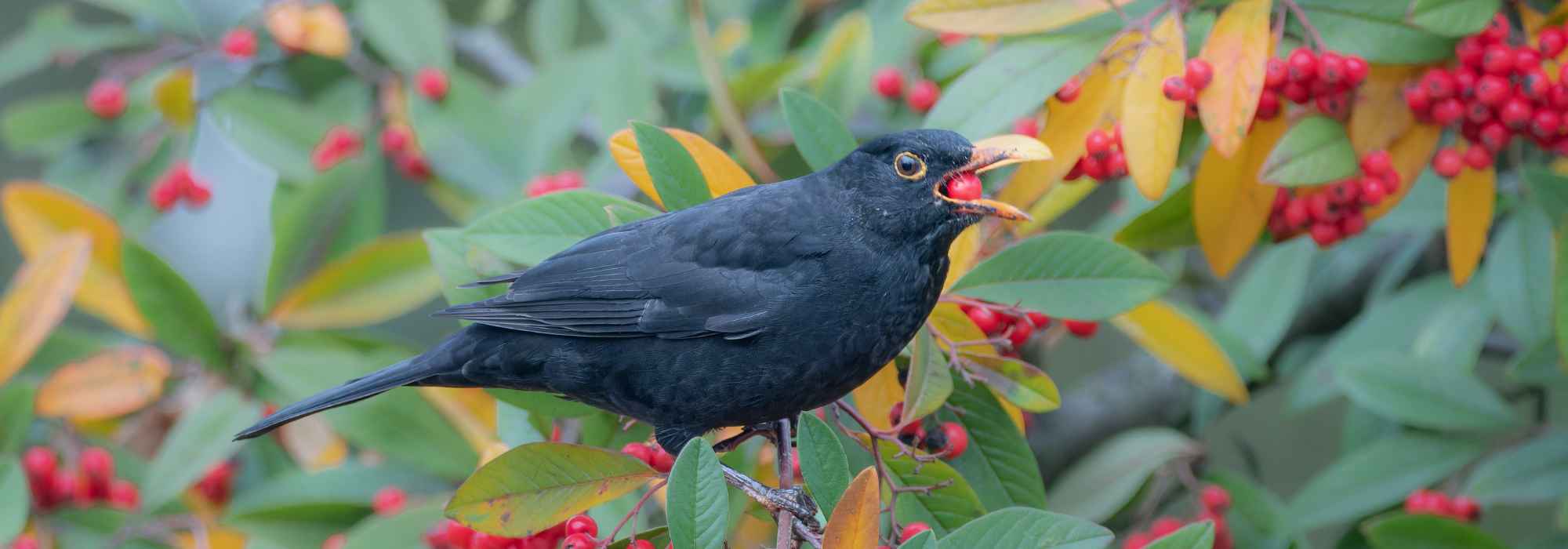
As temperatures fall with the approach of autumn, resident birds that regularly visit your garden, or migrants that settle there temporarily, have to cope with the scarcity, or even disappearance, of the larvae and insects that make up their daily meals. Many of these birds therefore change their diet and turn to fleshy berries, which provide them with the energy they need to survive in autumn, and especially in winter. Other birds, which feed on seeds, also enjoy these berries. This is why, as a gardener, it is important to leave them a few uneaten berries or avoid pruning your shrubs too severely, so that this valuable wildlife can feed throughout the cold season.
Berries that ripen between late summer and early autumn
From September onwards, autumn begins to make its presence felt. Some shrubs produce berries that ripen in late summer or early autumn. Usually very rich in sugar and water, these berries are highly sought after by birds as they are true energy “bombs”. Birds literally pounce on them to build up reserves before the autumn and then winter cold sets in. While some of these berries are edible, and even delicious when made into jams, jellies or juices, do leave a few handfuls on the trees and shrubs for our garden birds. They are extremely useful for clearing vegetable gardens, gardens and orchards of harmful insects and larvae.
Among the leading berry-producing trees is elder (Sambucus nigra), which produces umbels of purple-black berries from late summer onwards, between August and September. Packed with vitamins and sugar, these berries are much appreciated by passerines such as blackcaps, blackbirds, thrushes and starlings, which are looking to rebuild their fat reserves before the severe cold arrives.
You can also leave the berries of rowan (Sorbus aucuparia). This elegant tree, very common in the French countryside and in our beds and borders, bends under the weight of its heavy clusters of bright scarlet or orange berries from late summer onwards. These fruits particularly attract thrushes, which devour them voraciously, stripping the branches in record time.
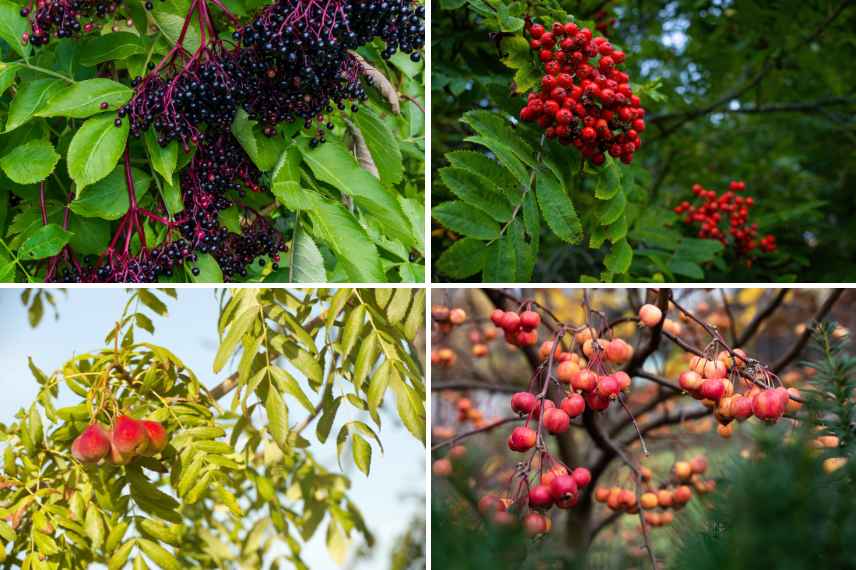
Clockwise, elder, rowan, crab apple and service tree
At the beginning of autumn, you can also rely on service tree (Sorbus domestica), a large tree that produces service tree fruits, slightly larger berries. Resembling small miniature pears, they become full of sugar and turn soft under the effect of the first autumn frosts. They are a choice delicacy for the larger garden birds, which appreciate their rich, substantial flesh.
Among the trees, crab apple (Malus) also plays a vital role for birds. While some varieties quickly lose their fruit, others, such as ‘Evereste’, retain it until winter, offering juicy, vitamin-rich flesh that blackbirds peck at with delight.
Shrubs are not left out either. Common dogwood (Cornus sanguinea), which owes its name to its red-coloured wood, produces glossy, deep purple drupes that ripen from September onwards. Their lipid content makes them ideal food for insectivorous birds as they change their diet. Virginia creeper (Parthenocissus) is also a climbing plant. It does not produce grapes but small clusters of blue-black berries, inedible to humans but much appreciated by birds, which appear among the flamboyant foliage in autumn.
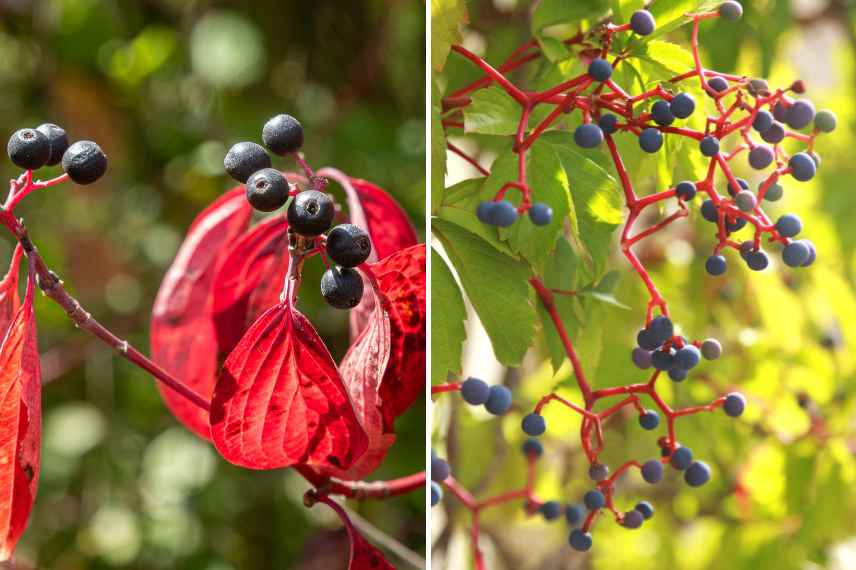
Common dogwood and Virginia creeper berries
Finally, ninebark (Physocarpus opulifolius), although mainly grown for its magnificent foliage colours, produces small red fruits in the shape of little bladders, providing a valuable food source for small seed-eating birds and tits exploring every nook and cranny of the beds and borders.
Evergreen berries that withstand the winter cold
When winter settles in for good and the thermometer regularly reads 0 °C, birds are at risk. While autumn days are devoted to building up reserves, in winter they are literally fighting for survival. Evergreen, frost-resistant berries become vital, as insects have disappeared, either dead or in diapause, and the soil is frozen. Provided, of course, that you do not prune them!
The firethorn (Pyracantha), often called pyracantha, is unquestionably the king of this category. Its dense, interwoven, thorny branches bear thousands of orange or bright red berries that do not fall. Not only do these fruits withstand sub-zero temperatures without losing their nutritional value, but the shrub’s sharp thorns also protect small birds. This vegetation forms an impenetrable barrier where they can escape terrestrial predators, such as domestic cats, while feeding out of sight. Holly (Ilex aquifolium), a classic feature of winter landscapes, plays the same role. Its brilliant red berries, protected by tough, prickly foliage, remain intact for weeks. They are generally ignored while more easily accessible food remains available, but prove vital in January and February for thrushes and blackbirds. Barberry (Berberis), another thorny shrub with elongated, pendulous, tart fruits, completes this protective arrangement. Its vitamin-rich berries help birds maintain their body temperature during freezing nights.
Cotoneaster (Cotoneaster), whether creeping or upright, is just as hardy as firethorn. Its arching branches, literally covered with small red or orange berries, brighten the garden while providing a regular food supply for wrens, robins and blackbirds.
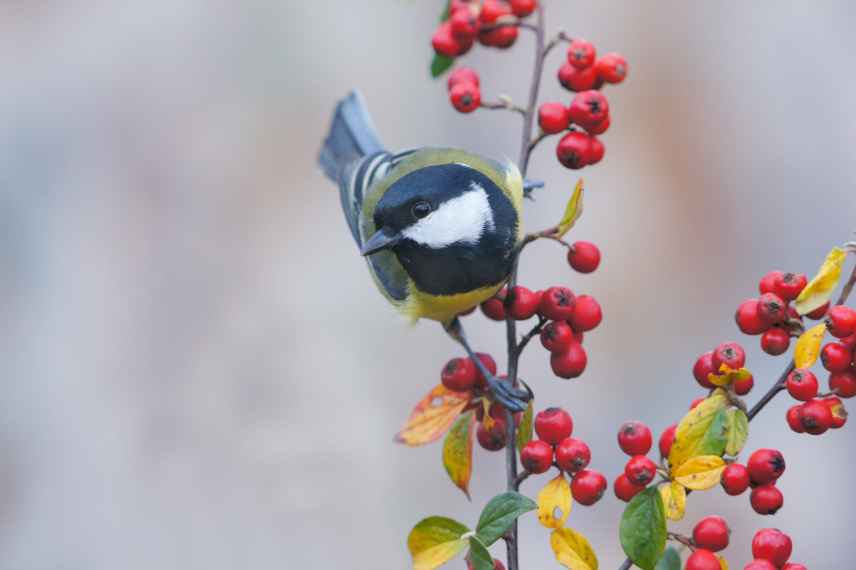
A tit enjoying cotoneaster berries
Common hawthorn (Crataegus monogyna), an essential shrub in hedgerows, also produces its famous haws. These small, mealy fruits have the particular quality of withstanding severe frost without rotting. These red berries therefore provide a food source in the depths of winter, when the rest of nature is completely barren.
More exotic berries
To enrich your garden while providing food for birds, you can include more unusual or horticultural berry-producing shrubs. The beautyberry (Callicarpa bodinieri), nicknamed the “beautyberry”, is magnificent in autumn, with clusters of intensely coloured metallic purplish-violet berries. Although these fruits are notably bitter and often ignored at the beginning of autumn, they provide a strategic food reserve at the end of the season. When temperatures fall and the other shrubs have been completely stripped bare, blackbirds and starlings eventually feed on them, finding enough food to see them through the most difficult periods.
Himalayan honeysuckle (Leycesteria formosa), native to the Himalayas, is attractive for its purple, pendulous bracts, which shelter small dark berries with a curious caramel flavour in early autumn. This very hardy shrub is particularly popular with jays, pheasants and larger perching birds, which readily come and peck the fruit directly from the stems or gather those that fall to the ground.
As for the common snowberry (Symphoricarpos albus), recognisable by its white or pink fruits resembling small beads, it adds a bright ornamental touch. Although its berries are only moderately sought after because of their spongy texture, rodents and certain opportunistic birds regularly eat them during particularly difficult periods.
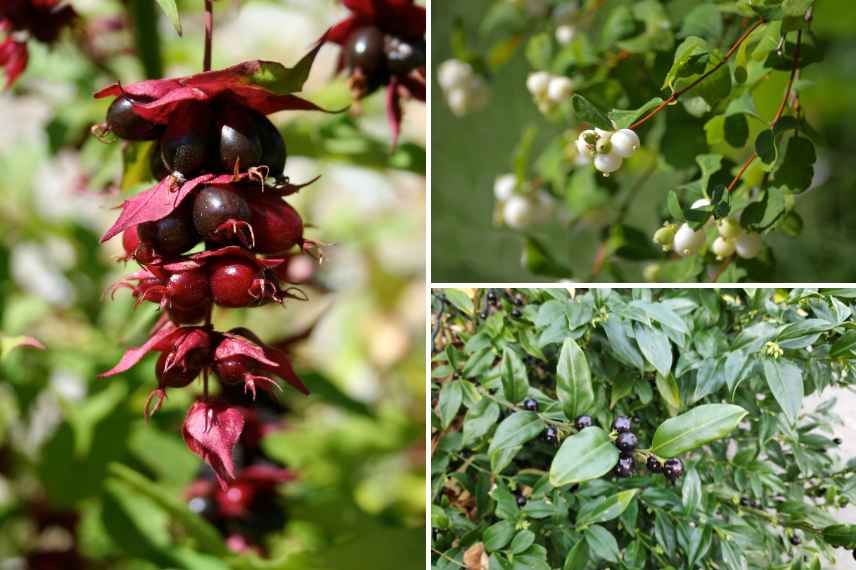
Himalayan honeysuckle, common snowberry and sweet box
Sweet box (Sarcococca confusa or Sarcococca ruscifolia), an evergreen shrub valued for its small white flowers, which open in the depths of winter and have an extraordinary vanilla fragrance, subsequently produces small, round black berries. Although inconspicuous, these fleshy berries supplement the diet of ground-feeding and insectivorous birds, which tirelessly forage through the soil and leaf litter beneath shady beds.
How to plant these trees and shrubs?
To get the most from these berry-producing trees and shrubs and provide effective support for birds from autumn until the end of winter, planting them in isolation is not always enough. It is preferable to plant a free-growing, mixed hedge with several layers. This means combining deciduous and evergreen shrubs, thorny shrubs and larger-growing trees.
Ideally, the highest layers will be occupied by rowan and service tree, whose size will attract birds and provide them with a vantage point. Next come pyracantha, cotoneaster, hawthorn and barberry, interwoven to form an impenetrable barrier against bad weather and predators. Finally, plant the lowest layers with sarcococca and small woodland shrubs, allowing birds such as blackbirds, thrushes, robins and wrens to search through the leaf litter in peace, sheltered from prying eyes.
When it comes to care, gardeners should avoid excessively severe or systematic pruning at the end of summer. If maintenance pruning is necessary to contain the volume of the hedge, it is best carried out at the end of winter, just before the nesting season begins, taking care to spare fruit-bearing branches laden with berries. By leaving the fruit in place throughout the cold season, you can ensure that the larder remains accessible when birds’ energy requirements are greatest.
- Subscribe!
- Contents
This form is protected by reCAPTCHA - the Google Privacy Policy and Terms of Service apply.

































Comments