What if tap water was holding back vegetable growth in the garden?
Limescale, chlorine, temperature: do you really need to worry about them?
Contents
Are your tomatoes failing to thrive, your lettuces turning yellow or your courgettes seeming to grow at a snail’s pace despite regular watering? Could tap water be partly to blame? Chlorine, limescale and softened water: there is no shortage of concerns. Yet tap water is generally suitable for watering the vegetable garden. A few precautions may nevertheless be useful when it is very hard, depending on the nature of the soil and the growing method. Let’s separate fact from fiction to understand the real impact of tap water on our harvests!
Tap water: take care if your water is very hard
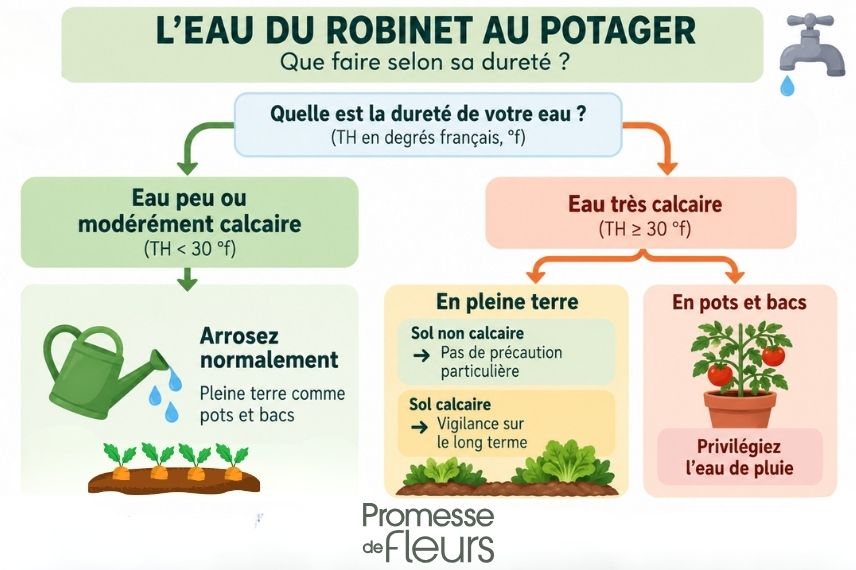
Contrary to popular belief, in most cases, tap water is perfectly suitable for watering your vegetable garden. The lime, particularly the calcium and magnesium it contains, is not toxic to vegetables: these are even useful nutrients for plants.
There is therefore no need to worry, except in two particular cases:
- If your water is very hard AND your soil is too: over time (we are talking about several seasons, or even years here), watering all summer with hard water can gradually make your soil increasingly alkaline (lime-rich).
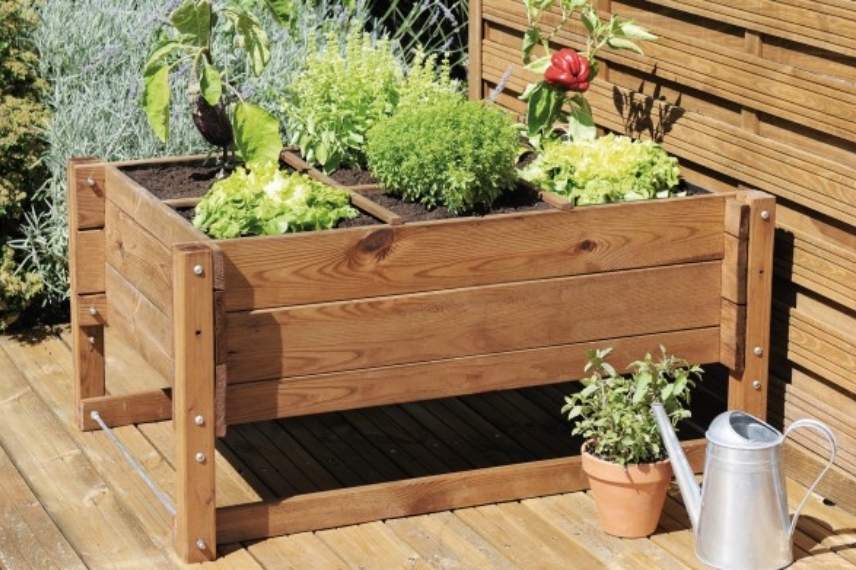
- If you grow vegetables in pots or containers: the volume of growing medium is small, watering is frequent and evaporation is significant. The minerals supplied by very hard water can therefore accumulate more easily and slow the growth of your vegetable plants.
How can I tell if my water is very hard?
White marks on taps, in the kettle or on terracotta pots are a first indication. To be certain, check the water-quality information provided with your bill or the annual summary relating to the water supply, which you normally receive once a year.
Look for the mention “hardness” or “hydrotimetric titre (TH)”, expressed in French degrees (°f). From 30 °f, water is considered very hard, and therefore lime-rich.
How can I tell if my soil is very lime-rich?
A soil is lime-rich from a pH of 7.5 or above. If you do not know the nature of your soil, the simplest option is to carry out a “pH paper” test using a little garden soil mixed with demineralised water. You can also carry out a home test by reading our article: “Acid soil, neutral soil or lime-rich soil: how can you tell?”.
Too much lime: nutrients becoming unavailable (chlorosis)
By accumulating too much lime, the pH of the soil (or the potting compost in your containers) tends to rise towards alkalinity.
The problem: in soil that is too lime-rich or has a high pH, some essential minerals become difficult for the plant to absorb. This is the case with iron and magnesium.
The result: your vegetables develop iron chlorosis. The young leaves turn yellow while retaining clearly green veins.
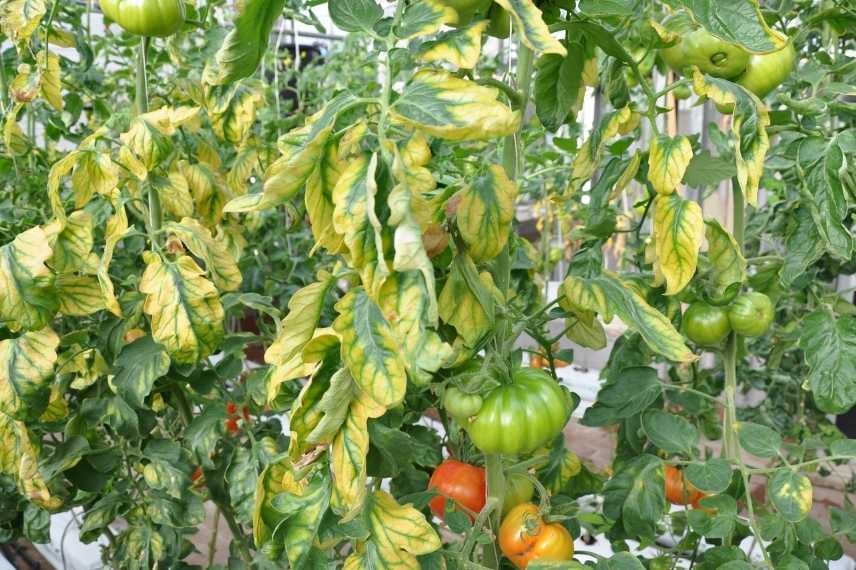
Signs of chlorosis in tomatoes
Why is there no problem in neutral or acidic soil?
In the open ground, the volume of soil is large, and it has a certain capacity to limit variations in its medium, particularly its pH, especially when it is rich in organic matter. In addition, rainfall also helps leach some of the salts supplied by watering.
What should you do if your tap water is very hard?
Prioritise rainwater
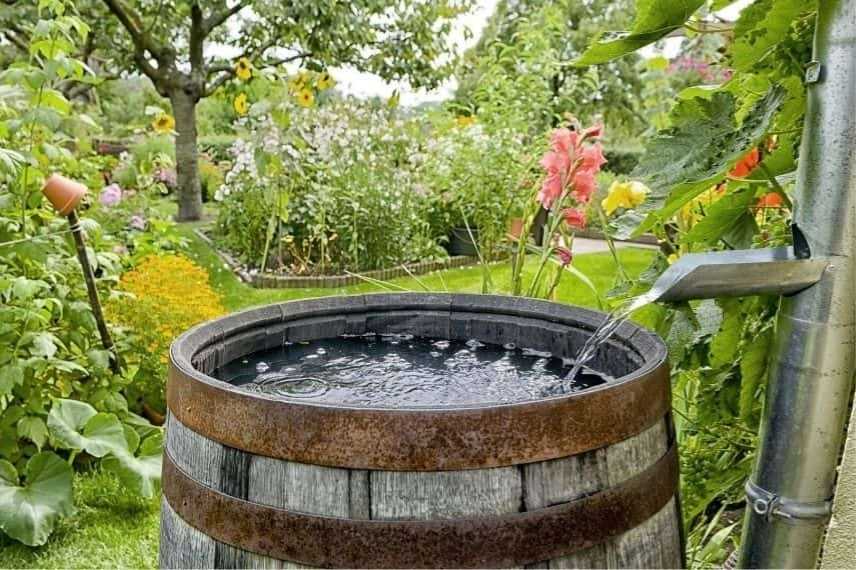
If you have the opportunity to collect rainwater, use it to water your vegetable garden. Soft and low in minerals, it is particularly well suited to vegetables grown in pots and containers, where minerals are more likely to build up over successive waterings.
When supplies run low in summer, prioritise rainwater for plants grown in pots and use tap water for those growing in the ground.
And if the tank eventually runs dry, simply continue watering with mains water: even if it is very hard, it is still preferable to a lack of water.
Maintaining soil rich in organic matter
Apply well-rotted compost once or twice a year, generally at the beginning of spring (before growing your crops) or in autumn, depending on the needs of the soil. Organic matter improves its structure and encourages soil life. In addition, well-maintained soil retains water more effectively, allowing you to leave longer intervals between waterings.
Mulching to water less often
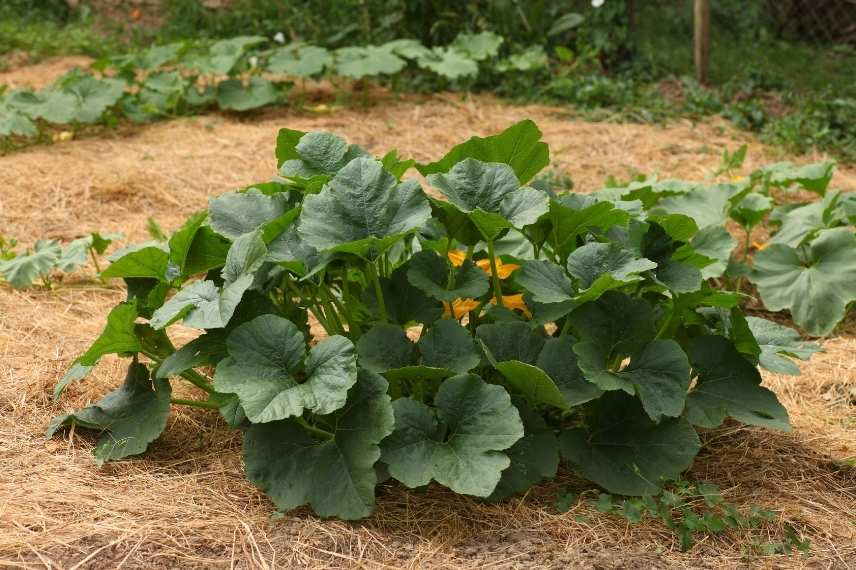
Also remember to reduce watering needs with mulch. A layer of straw, dead leaves, wood chippings or very dry grass clippings reduces evaporation and helps the soil stay cool for longer. This allows you to leave longer intervals between waterings and, at the same time, reduces the repeated addition of lime when tap water is very hard.
Watering effectively
In the vegetable garden, water thoroughly at longer intervals rather than giving small amounts every day. Water slowly at the base of the vegetables to moisten the soil deeply, adjusting the frequency according to the weather and the type of soil. In summer, water early in the morning or in the evening to limit losses through evaporation.
Chlorine in tap water: is it dangerous for the vegetable garden?
Chlorine used to sanitise drinking water is often a cause for concern in the garden. In France, its concentration remains very low: generally between 0.1 and 0.3 mg/L. At this dosage, as soon as it comes into contact with the soil, water very quickly loses its chlorine, which evaporates or becomes fixed in the first layer of soil, without causing any lasting disturbance to the living balance of your soil.
However, young seedlings, cuttings and plants grown in pots remain more sensitive to watering water and, at this scale, chlorine can prove more harmful. We recommend leaving your water to stand for a few hours in the watering can before watering your seedlings. The chlorine will naturally evaporate into the air and, to add icing to the cake, your water will reach a gentle room temperature, avoiding giving your future young shoots a cold shower!
Thermal shock: beware of cold water!
You may not always think about it, but the real problem with using a garden hose in summer is the risk of thermal shock. On a very hot day, the soil can reach 30°C (or even higher during a heatwave in bare soil), while tap water is generally between 12 and 14°C. Although open ground cushions the temperature difference to some extent thanks to its volume, surface roots are still left completely stunned.
In pots, it is even worse: the small volume of potting compost takes the full force of this refrigerator-like cold.
The result: rootlets stop taking up nutrients, the plant becomes stressed, growth slows down or stops, and flowers may drop.
To pamper your tomatoes, peppers and courgettes, here are a few good habits to adopt:
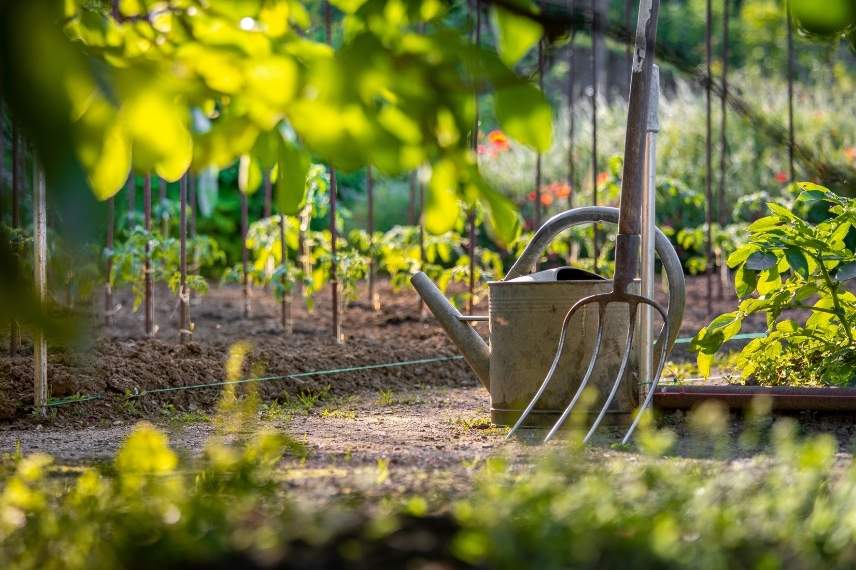
- Fill your watering cans in advance: by leaving the water to stand in the garden for a few hours, it naturally reaches the ambient temperature.
- Choose the right times: water early in the morning or at the end of the day, when the soil is less hot.
- Mulch around the base of the plants: a good layer of straw, dried grass clippings or wood chips insulates the soil from heat spikes, keeps it cool and prevents the roots from heating up.
- Install a drip irrigation system: delivered drop by drop, the water gently warms up as it comes into contact with the hose and the soil before reaching the roots.
- Make the most of rainwater: stored in a water butt, its temperature is generally much better suited to our plants (and it avoids limescale and chlorine!). However, beware of water butts exposed to full sun: during a heatwave, the water in them heats up quickly! It is better to place them in the shade or under a pergola.
Did you know? Mulched soil remains at around 20 °C to 25 °C.
Yellow foliage? Water is not necessarily to blame
If the foliage of your vegetables turns yellow, tap water and thermal shock are good suspects, but they are not the only ones! Several other factors can explain this yellowing:
- Heatwaves and scorching sun: intense heat destroys chlorophyll and discolours exposed leaves. The foliage also tends to become limp.
- Drought: to save water, the plant deliberately sacrifices its oldest leaves or those at the tips. They then turn yellow and wilt.
- Poor drainage: waterlogged soil or a saucer filled with stagnant water quickly suffocates the roots.
- Nutrient deficiency: poor or depleted soil, particularly lacking in nitrogen or iron, causes the foliage to lose its colour.
- An unsuitable container: a pot that is too small compresses the root system and restricts growth.
- Pests or diseases: attacks by aphids or red spider mites, or the appearance of fungi, prematurely weaken the plant. The leaves then tend to become blistered, curl up or develop spots.
The false good ideas for correcting hard water
Softened water is not ideal for the vegetable garden
Beware of a seemingly good idea: the standard domestic water softener. It reduces water hardness by replacing some of the calcium and magnesium with sodium. Sodium-softened water is not recommended for regularly watering the vegetable garden. If possible, use an outdoor tap supplied before the water softener.
Vinegar in watering water? Proceed with caution!
Also avoid routinely adding vinegar or another product to the watering can to “neutralise” limescale. Without knowing the exact characteristics of the water and soil, you could create an imbalance rather than solve the problem.
- Subscribe!
- Contents
This form is protected by reCAPTCHA - the Google Privacy Policy and Terms of Service apply.

































Comments