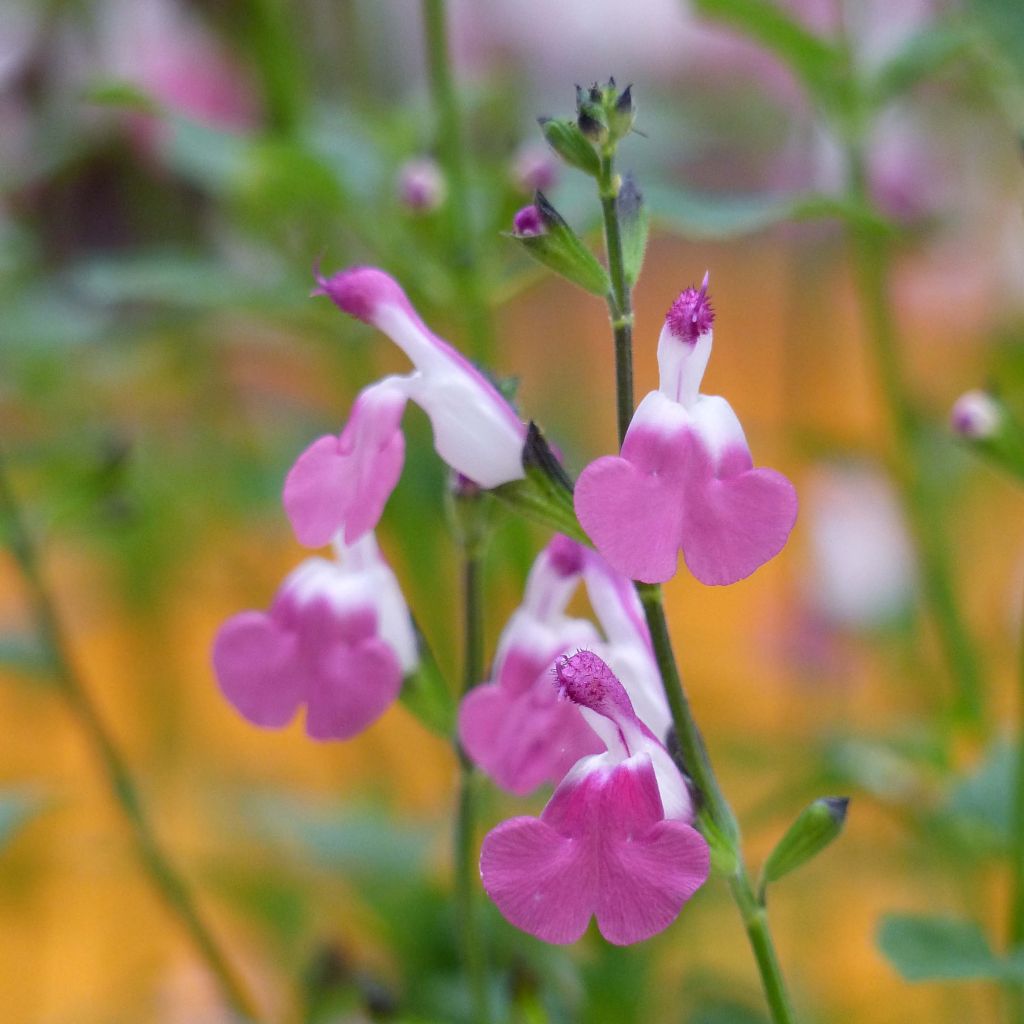
Salvia microphylla Pink Lips
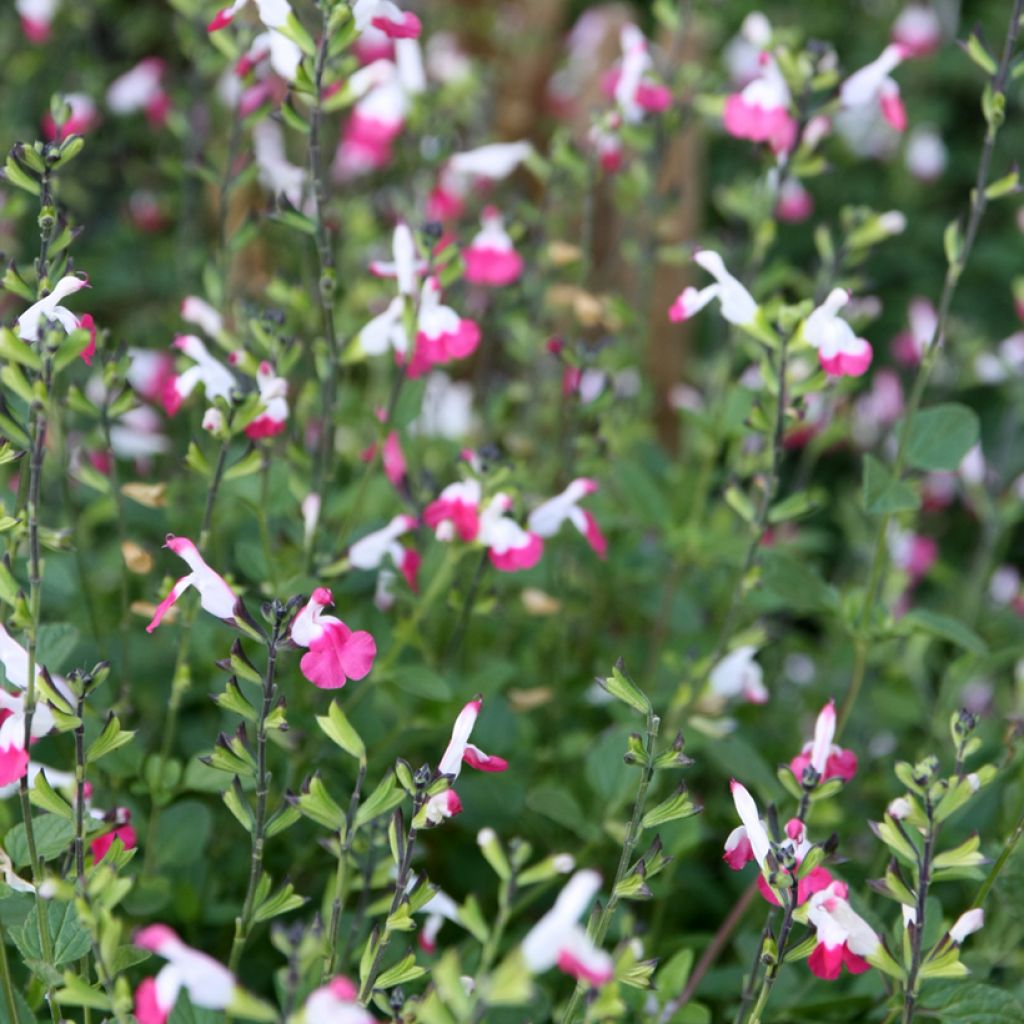
Salvia microphylla Pink Lips
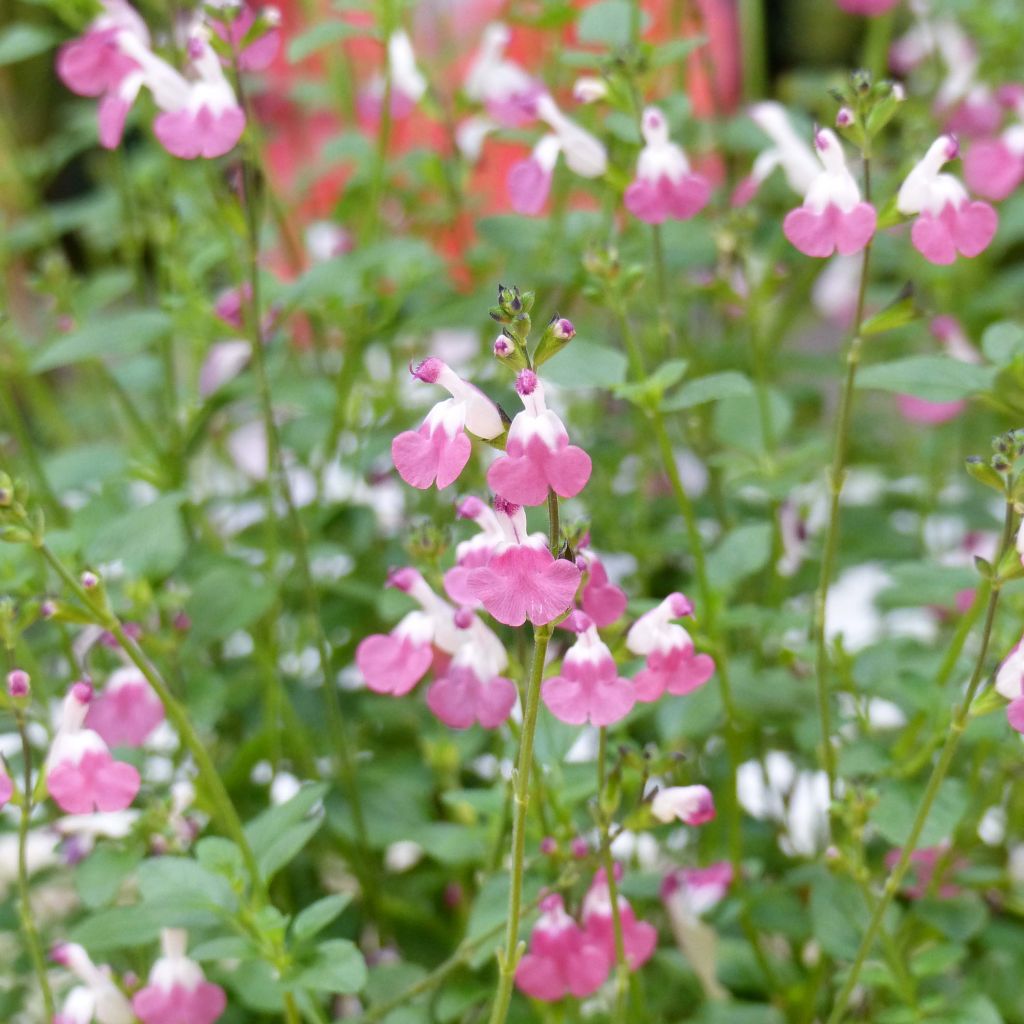
Salvia microphylla Pink Lips
Salvia microphylla Pink Lips
Salvia microphylla Pink Lips® 'Jeremy'
Sage
Unfortunately, it didn't take.
Céline , 16/10/2025
Back-to-school special offer!
Get €10 off for every €50 you spend! And get up to €40 off on a single order.
How does it work?
1. Shop your favourites
Add your favourite plants to your basket. For every €50 you spend (excluding delivery charges, store credit and the plastic-free option), you’ll receive a €10 voucher.
€50 spent = €10 voucher
€100 spent = €20 voucher
€150 spent = €30 voucher
€200 spent = €40 voucher
2. Place your order
Once your basket reaches one of the spending thresholds, place your order. You can even choose your delivery date!
3. Receive your voucher
As soon as your order has been shipped, you’ll receive an email containing your personal voucher code and its value.
4. Use it on your next order
Your voucher is valid for 90 days from the date you receive it. It can be used once only, on a new order worth at least the value of the voucher, excluding delivery charges.
Please note: Vouchers can be combined with other offers, but cannot be split or refunded.
Home or relay delivery (depending on size and destination)
Important: You may be charged customs duties by your country’s customs authorities upon delivery.
Schedule delivery date,
and select date in basket
This plant carries a 12 months recovery warranty
More information
We guarantee the quality of our plants for a full growing cycle, and will replace at our expense any plant that fails to recover under normal climatic and planting conditions.
Would this plant suit my garden?
Set up your Plantfit profile →
Description
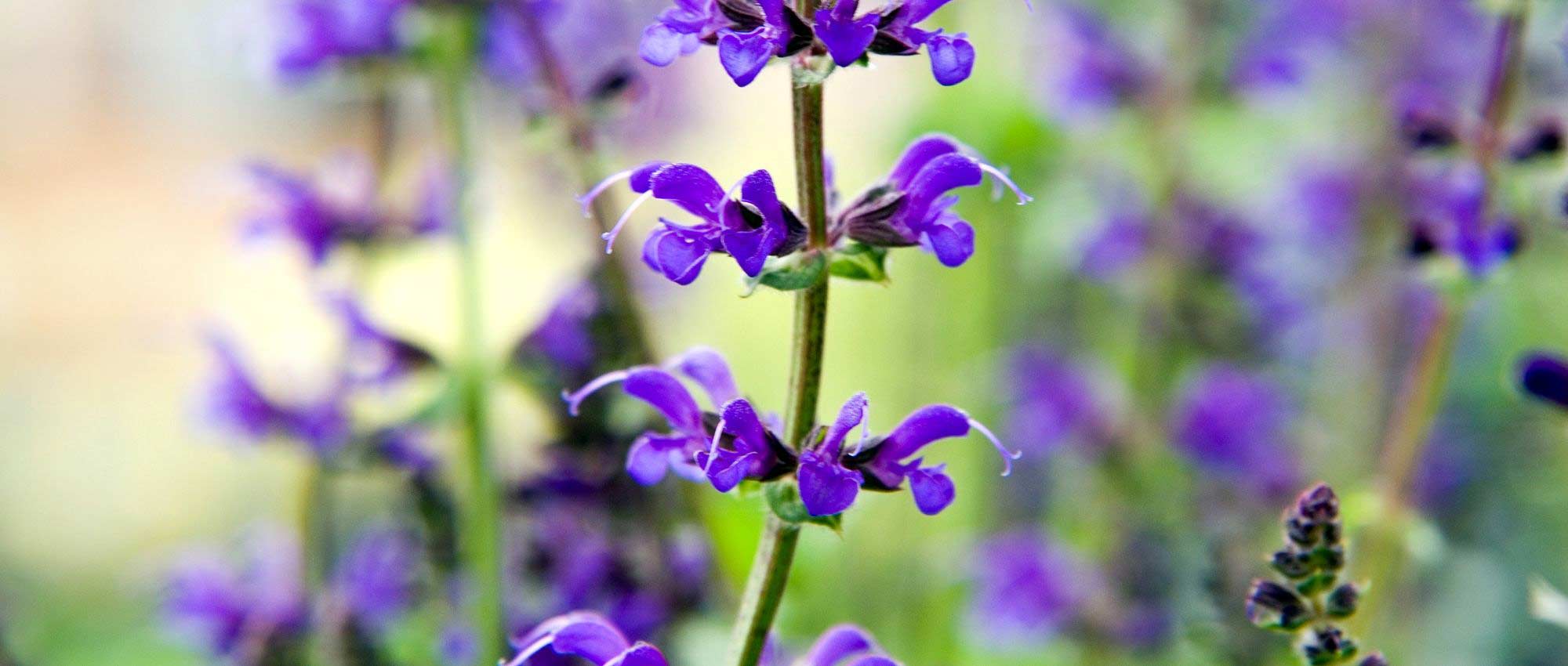
Salvia microphylla 'Pink Lips' (Jeremy) is a variety of shrubby sage that has a unique presence, both in borders and in a large pot on a terrace. This pretty version with pink and white flowers of Salvia 'Hot Lips' has the same characteristics: it is an easy-to-grow and very floriferous shrubby perennial, whose flowering changes colour depending on the ambient temperature, ranging from white to white-pink, then to pure pink. Forming in sunny borders like a bush covered in confetti for several months, it may be easier to match with many other plants in the garden than 'Hot Lips'. Place it near a pathway, where you won't miss brushing against its fragrant foliage.
Salvia microphylla 'Pink Lips' is a brand new Belgian variety derived from a shrubby botanical species called Graham's Sage. It belongs to the Lamiaceae or Labiate family. It is native to the mountains of eastern, western, and southern Mexico, as well as southern Arizona. It prefers well-drained soil and can tolerate the presence of rocks and limestone in the soil. Its hardiness is around -10° C (14° F) in almost dry soil during winter.
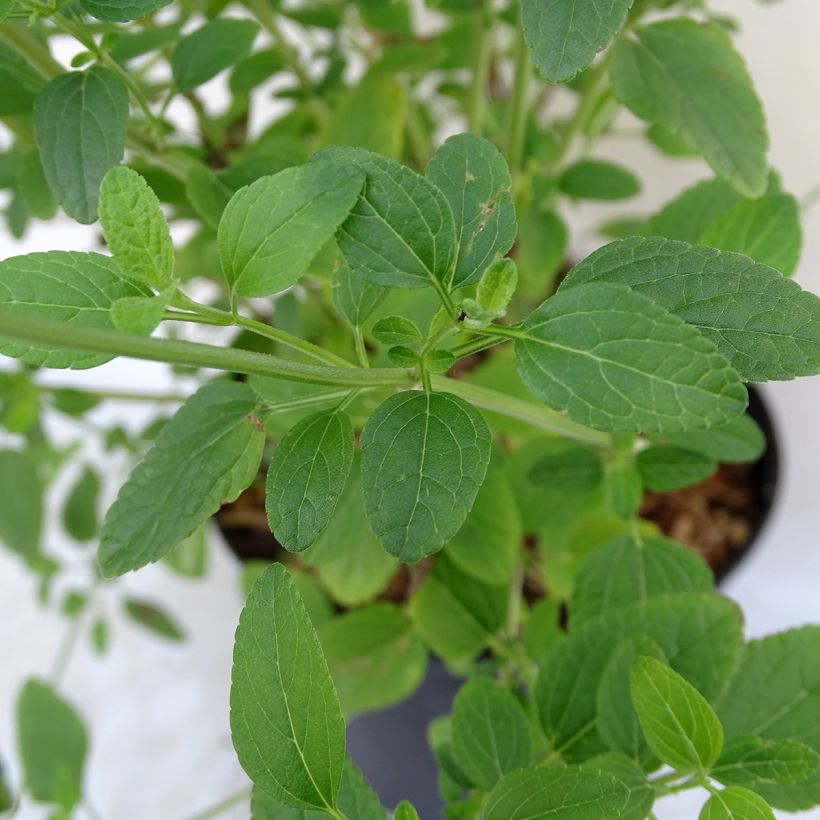
'Pink Lips' is a well-branched woody perennial plant that has a bushy and spreading habit, slightly wider than it is tall. This variety reaches about 80 cm (31.5 in) in all directions at maturity. Its nectar-rich flowering is particularly generous, spreading from May to October depending on the climate, slowing down in summer if the soil is dry. Its autumn flowering is remarkable and only stops when the cold puts an end to it. The small bilabiate flowers emerge from the foliage, clustered in spikes. They measure barely more than 2 cm (0.8 in) in length. They only live for a day, covering the ground with their petals in the evening, but will already be replaced the next morning. When the temperature is cool in spring, the flowers are mostly white. In summer, they are bi-coloured, white with pink lips, sometimes entirely pink if it is very hot. In autumn, they become a deeper pink. The semi-evergreen foliage is composed of small ovate leaves, 2 cm to 4 cm (0.8 in to 1.6 in) long, with serrated edges. The leaves are dark green, thick and aromatic, slightly sticky, and release a strongly acidic-smelling essential oil with heat. Under the effect of cold, they take on a reddish hue. This sage, known for its drought tolerance, will still require some watering in very dry climates during summer.
This eye-catching sage brings life to any flower border for almost 6 months. It works well alongside the spring blooms of rock roses, rosemary, bearded irises, and peonies. Its pink and white flowering pairs well with summer white, mauve, pink, or blue blooms. In summer, it will look sublime next to the silver foliage of cotton lavenders, Helichrysum italicum, or shrubby wormwoods. It looks fabulous when planted alongside autumn asters: choose undemanding types, such as Aster laevis, A. turbinellus, or A.amellus, for example. Gauras, tall sedums (Sedum 'Matrona'), and shrubby potentillas will create a charming tableau with it. On a terrace, place it in a large pot, right next to a Cape Plumbago; the colour combination is fantastic!
In Mexico, a delicious tea is prepared with the leaves of this sage, which is called 'mountain myrtle' there.
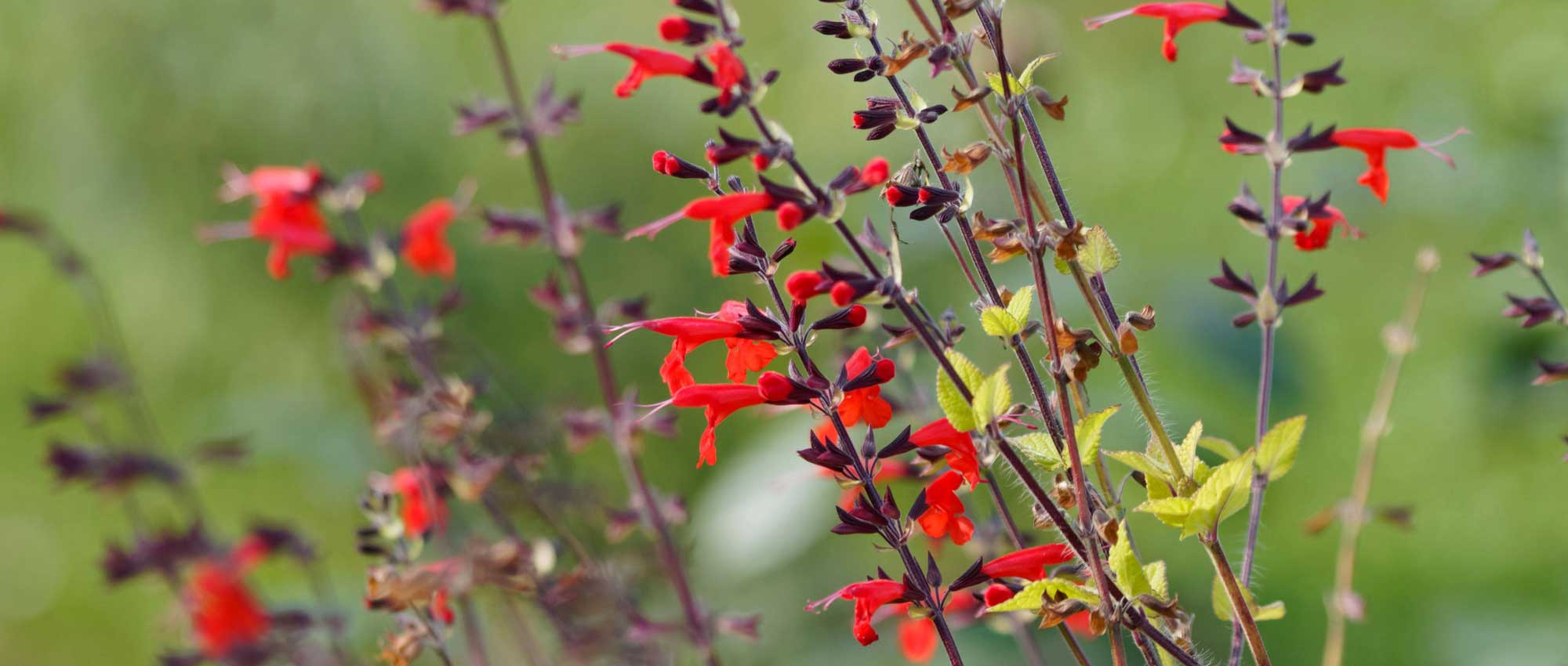
Salvia microphylla Pink Lips in pictures
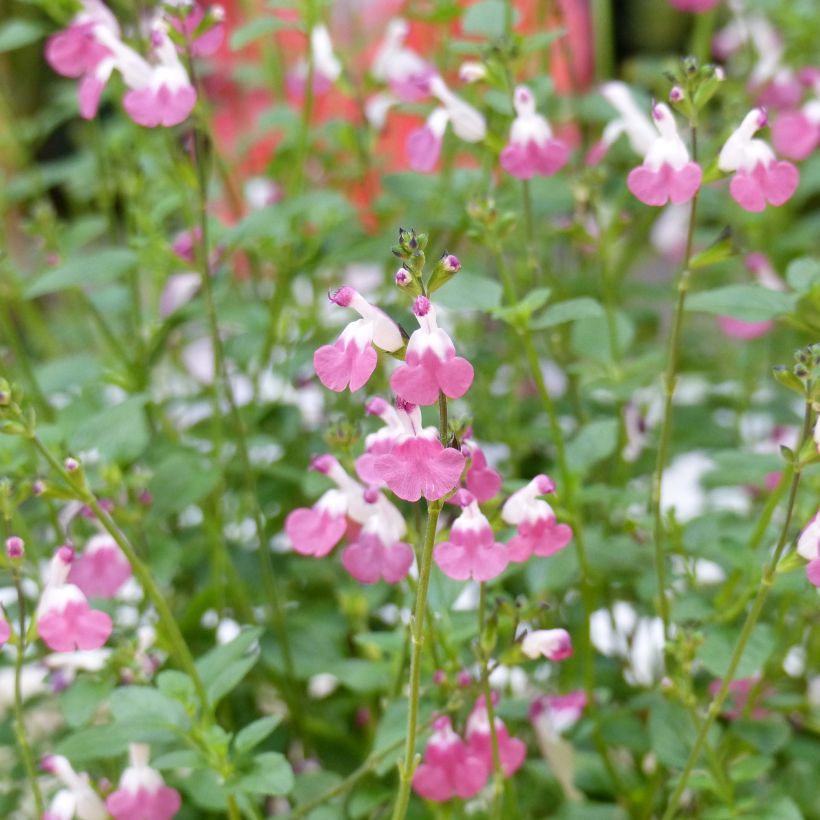
Flowering
Foliage
Plant habit
Botanical data
Salvia
microphylla
Pink Lips® 'Jeremy'
Lamiaceae
Sage
Cultivar or hybrid
Planting and care
In cold climates, plant after spring frosts. In warmer climates, plant in September-October. Choose light, ordinary, porous, rocky, even limestone soil, not too poor to support its flowering. This plant prefers sunny situations, or partial shade. It requires regular watering in autumn and spring to flower abundantly. In poor soil, incorporate a little well decomposed compost or leaf compost. Mulch it in winter. In the coldest regions, isolate it from the cold as much as possible. Position it in the warmest corner of the garden, in full sun against a south-facing wall, in a rocky or sandy slope; any substrate that does not retain moisture which would be fatal to it in winter. Under these conditions, it can withstand short frosts of around -12° C to 15°C (10.4° F to 5° F). It thrives well in pot cultivation.
Planting period
Intended location
Care
Planting & care advice
-
, onOrder confirmed
Reply from on Promesse de fleurs
Recently viewed products
Haven't found what you were looking for?
Hardiness is the lowest winter temperature a plant can endure without suffering serious damage or even dying. However, hardiness is affected by location (a sheltered area, such as a patio), protection (winter cover) and soil type (hardiness is improved by well-drained soil).

The flowering period indicated on our website applies to countries and regions located in USDA zone 8 (France, the United Kingdom, Ireland, the Netherlands, etc.)
It will vary according to where you live:- In zones 9 to 10 (Italy, Spain, Greece, etc.), flowering will occur about 2 to 4 weeks earlier.
- In zones 6 to 7 (Germany, Poland, Slovenia, and lower mountainous regions), flowering will be delayed by 2 to 3 weeks.
- In zone 5 (Central Europe, Scandinavia), blooming will be delayed by 3 to 5 weeks.
In temperate climates, pruning of spring-flowering shrubs (forsythia, spireas, etc.) should be done just after flowering.
Pruning of summer-flowering shrubs (Indian Lilac, Perovskia, etc.) can be done in winter or spring.
In cold regions as well as with frost-sensitive plants, avoid pruning too early when severe frosts may still occur.
The planting period indicated on our website applies to countries and regions located in USDA zone 8 (France, United Kingdom, Ireland, Netherlands).
It will vary according to where you live:
- In Mediterranean zones (Marseille, Madrid, Milan, etc.), autumn and winter are the best planting periods.
- In continental zones (Strasbourg, Munich, Vienna, etc.), delay planting by 2 to 3 weeks in spring and bring it forward by 2 to 4 weeks in autumn.
- In mountainous regions (the Alps, Pyrenees, Carpathians, etc.), it is best to plant in late spring (May-June) or late summer (August-September).
The harvesting period indicated on our website applies to countries and regions in USDA zone 8 (France, England, Ireland, the Netherlands).
In colder areas (Scandinavia, Poland, Austria...) fruit and vegetable harvests are likely to be delayed by 3-4 weeks.
In warmer areas (Italy, Spain, Greece, etc.), harvesting will probably take place earlier, depending on weather conditions.
The sowing periods indicated on our website apply to countries and regions within USDA Zone 8 (France, UK, Ireland, Netherlands).
In colder areas (Scandinavia, Poland, Austria...), delay any outdoor sowing by 3-4 weeks, or sow under glass.
In warmer climes (Italy, Spain, Greece, etc.), bring outdoor sowing forward by a few weeks.
Shipping country and language
Your country of residence may be:
Your country of residence is:
For a better user experience on our website, you can select:
Your shipping country:
-
 Austria
-
 Belgium
-
 Bosnia & Herzegovina
-
 Bulgaria
-
 Croatia
-
 Cyprus
-
 Czechia
-
 Denmark
-
 Estonia
-
 Finland
-
 France
-
 Germany
-
 Greece
-
 Hungary
-
 Iceland
-
 Ireland
-
 Italy
Italy
-
 Latvia
-
 Liechtenstein
-
 Lithuania
-
 Luxembourg
-
 Malta
Malta
-
 Netherlands
-
 Poland
-
 Portugal
-
 Romania
-
 Serbia
-
 Slovakia
-
 Slovenia
-
 Spain
Spain
-
 Sweden
-
 Switzerland
Language:
-
French
-
 English
-
Spanish
-
Italian
-
German
-
Portuguese
-
Dutch
-
Finnish
My Account
Hello
My wish lists
My cart
Log in / Register
Existing customer?
This form is protected by reCAPTCHA - the Google Privacy Policy and Terms of Service apply.
New customer?
Create an account to track your orders, access our customer service and, if you wish, make the most of our upcoming offers.