
Sempervivum Chic Charms Grape Galaxy® - Houseleek
Sempervivum Chic Charms Grape Galaxy® - Houseleek

Sempervivum Chic Charms Grape Galaxy® - Houseleek
Sempervivum Chic Charms Grape Galaxy® - Houseleek
Sempervivum Chic Charms Grape Galaxy® - Houseleek

Sempervivum Chic Charms Grape Galaxy® - Houseleek
Sempervivum Chic Charms Grape Galaxy® - Houseleek
Sempervivum Chic Charms Grape Galaxy® - Houseleek
Sempervivum Grape Galaxy®
Houseleek, Hen and Chicks
Generous plant, the pot is full – it’s just waiting to be planted out to fill out. Perfect.
Patricia , 23/03/2026
Back-to-school special offer!
Get €10 off for every €50 you spend! And get up to €40 off on a single order.
How does it work?
1. Shop your favourites
Add your favourite plants to your basket. For every €50 you spend (excluding delivery charges, store credit and the plastic-free option), you’ll receive a €10 voucher.
€50 spent = €10 voucher
€100 spent = €20 voucher
€150 spent = €30 voucher
€200 spent = €40 voucher
2. Place your order
Once your basket reaches one of the spending thresholds, place your order. You can even choose your delivery date!
3. Receive your voucher
As soon as your order has been shipped, you’ll receive an email containing your personal voucher code and its value.
4. Use it on your next order
Your voucher is valid for 90 days from the date you receive it. It can be used once only, on a new order worth at least the value of the voucher, excluding delivery charges.
Please note: Vouchers can be combined with other offers, but cannot be split or refunded.
Home or relay delivery (depending on size and destination)
Important: You may be charged customs duties by your country’s customs authorities upon delivery.
Schedule delivery date
and select date in basket
This plant carries a 12 months recovery warranty
More information
We guarantee the quality of our plants for a full growing cycle, and will replace at our expense any plant that fails to recover under normal climatic and planting conditions.

Would this plant suit my garden?
Set up your Plantfit profile →
Description
Sempervivum Chick Charms® 'Grape Galaxy' is a true gem for lovers of rock gardens and architectural, stylised settings. This variety of houseleek stands out with its unusual colours, where silvery grey blends with purple of varying intensity. Able to thrive where few other plants can grow, it develops large rosettes with a geometric silhouette in most well-drained soils, even poor and shallow ones. It also enjoys growing in pots, enhancing balconies and terraces. Completely unfazed by cold, this sun-lover tolerates drought very well.
Sempervivum, also called houseleek, belongs to the large Crassulaceae family. This family includes many succulents adapted to dry and poor conditions. Sedum (or stonecrop), widely used in the garden and in extreme conditions such as green roofs, is very well known; other genera are more niche, like Cotyledon from South Africa. Native to Europe and Asia Minor, the Sempervivum genus includes about forty species that are particularly robust and resistant to both cold and drought. Their diversity and ease of cultivation have given rise to nearly 4,000 varieties, of natural origin or from the work of passionate horticulturists. Among these creations, the Chick Charms series by American Chris Hansen (Michigan) stands out for its large rosettes with original hues and for easy cultivation, notably thanks to a relative tolerance to soil moisture.
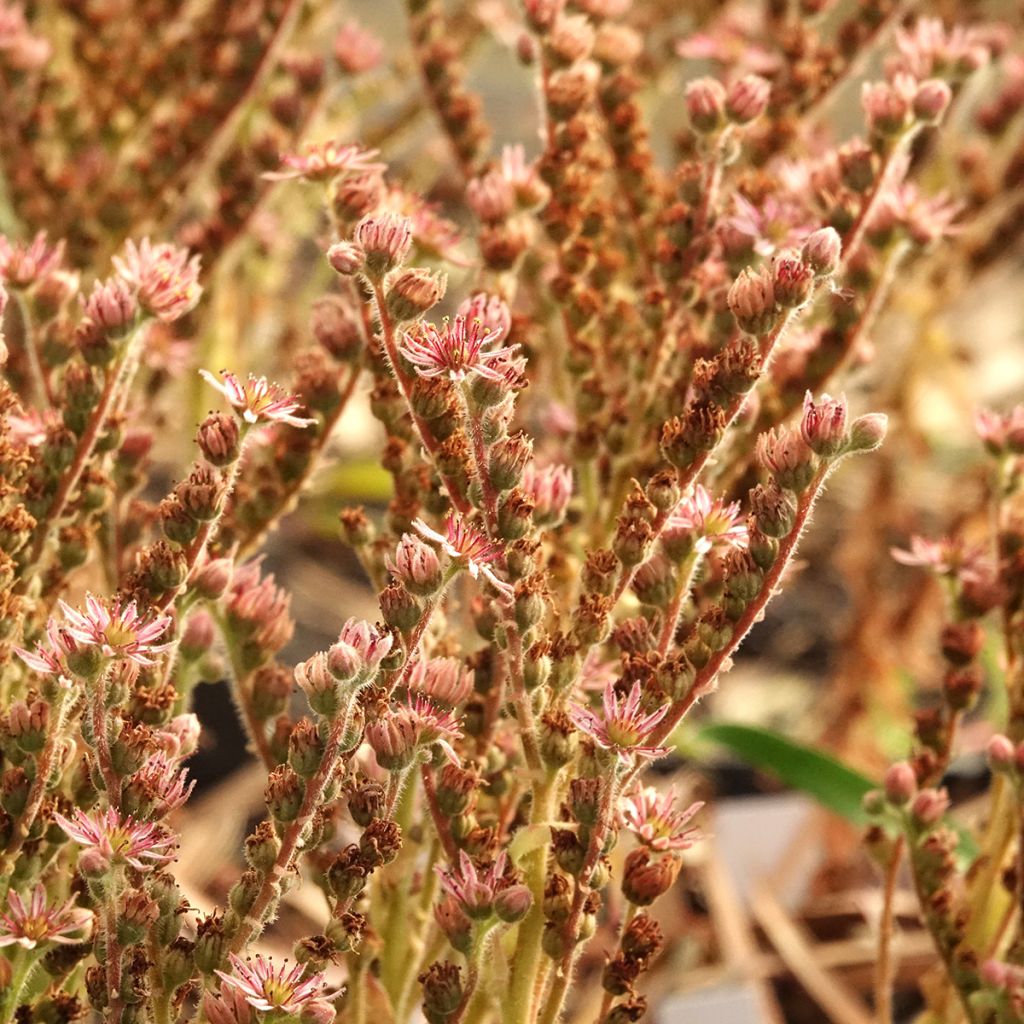
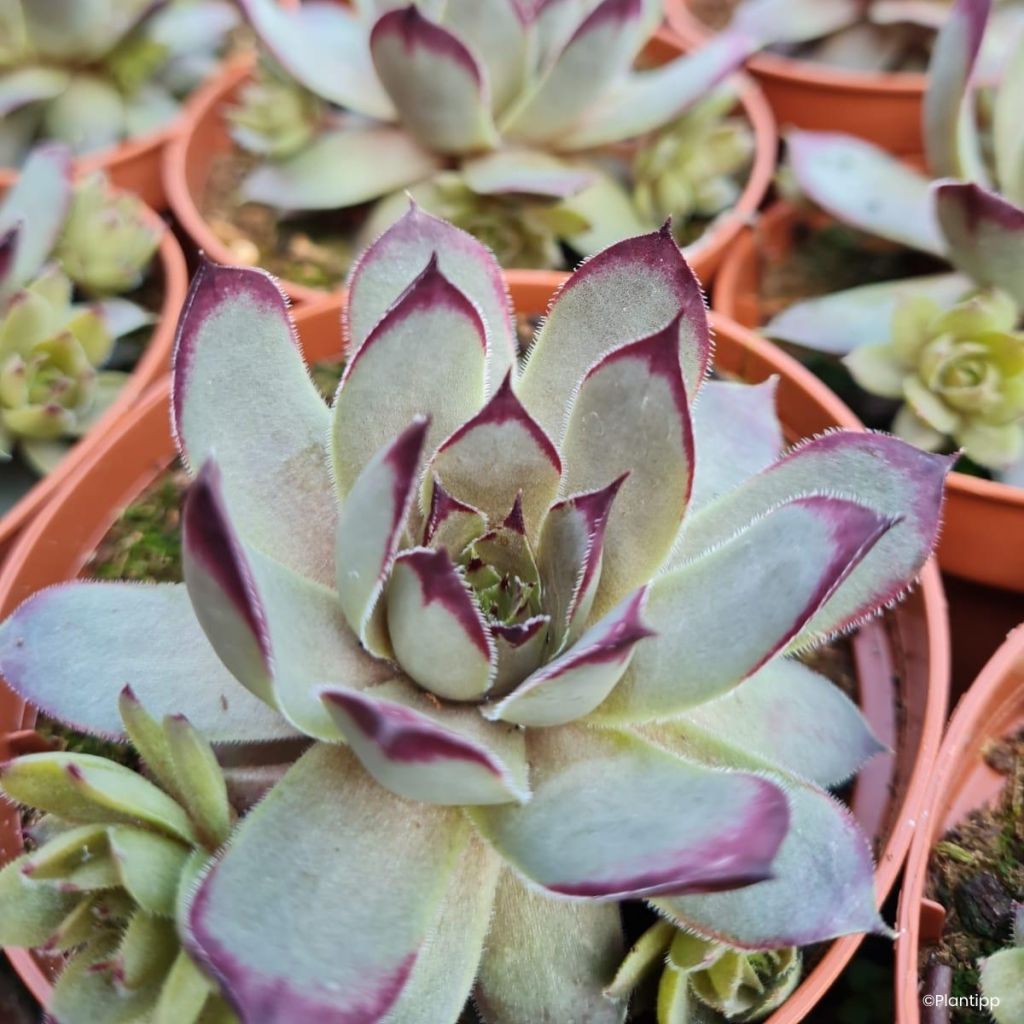
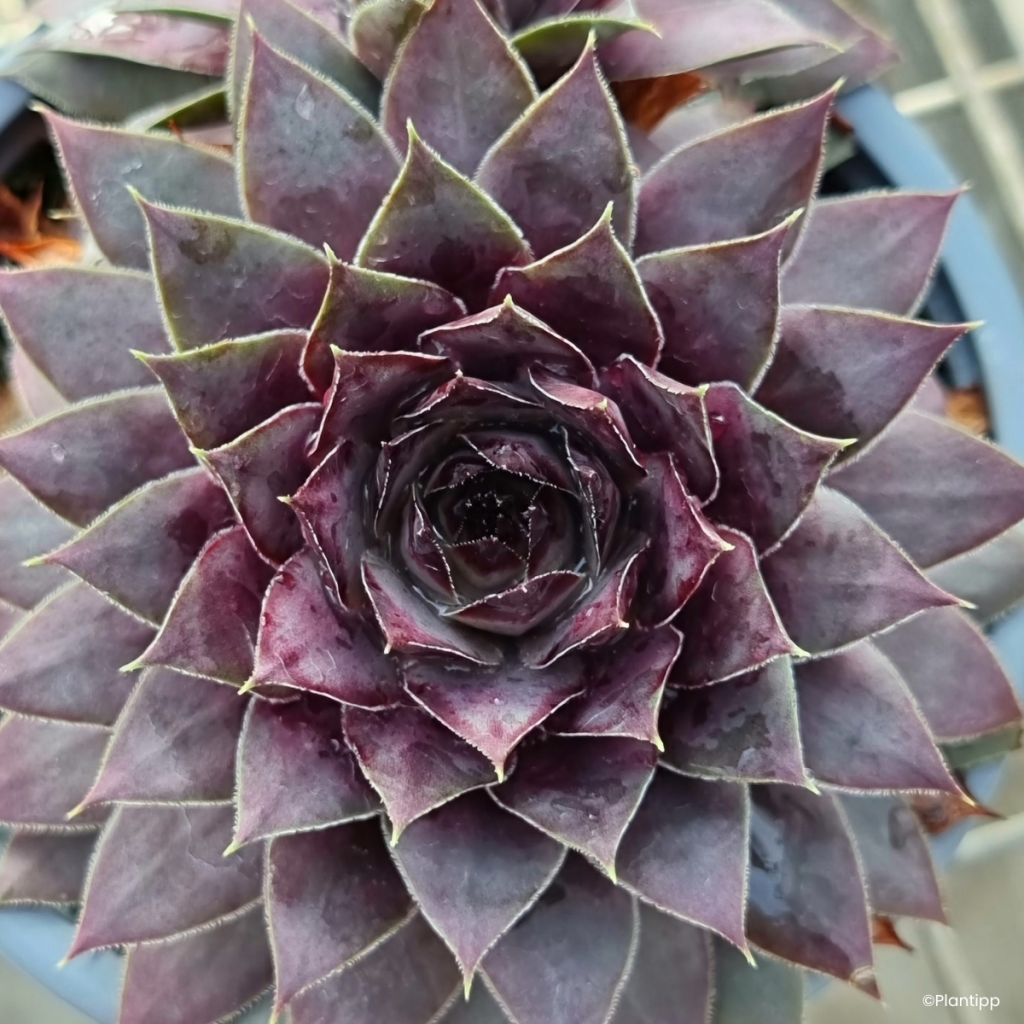
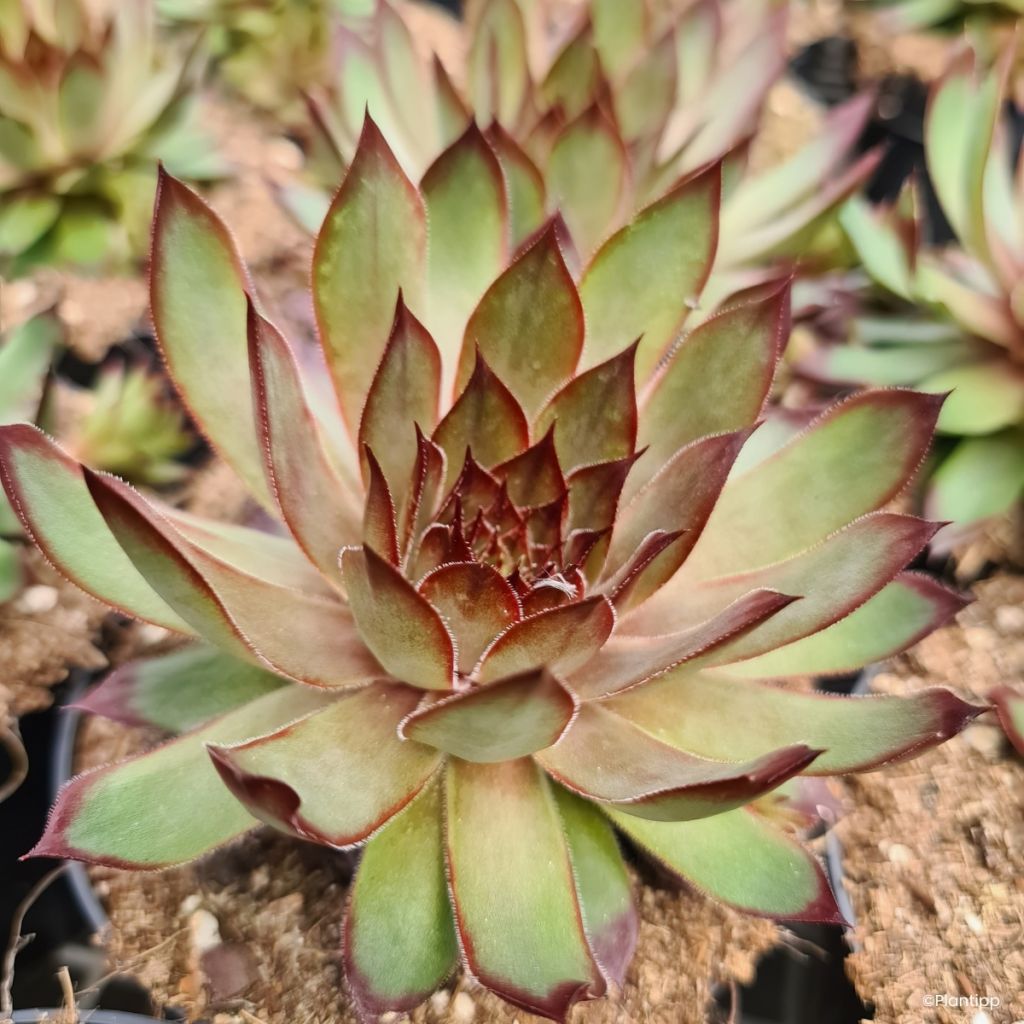
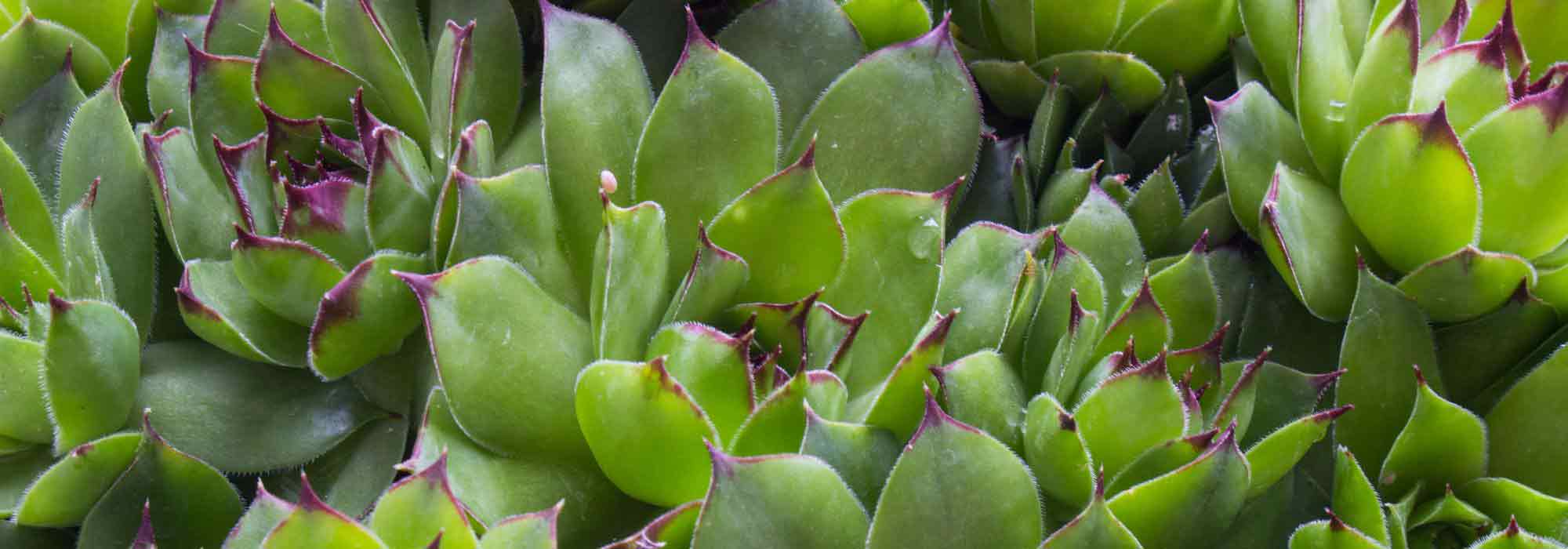
Sempervivum Grape Galaxy charms with its elegant rosettes, with near-perfect geometry. The perfect arrangement of succulent leaves forms a rosette with a bold design. Spatulate at the centre and abruptly ending in a non-prickly tip, the leaves gradually lengthen as they approach the periphery, where they are 5 to 7 cm long. At maturity, the rosette reaches 7 to 8 cm in height and 12 to 15 cm in diameter. Bordered with tiny white hairs, the fleshy leaf blade goes through different colours during its development. In spring, young leaves emerge in an olive-green tone at the centre of the rosette, before turning to a very original metallic grey, while the tip colours purple. Depending on sunlight, purple may become dominant during the season, enhanced by the border of white hairs which forms a subtle and graceful contrast. This houseleek remains highly decorative, whether grown directly in open ground or in a pot, tolerating container cultivation very well. Over time, the main rosette produces lateral offsets that gradually spread into a carpet. These young shoots can also be taken for new plantings. In summer, usually on older rosettes, a flowering stalk bearing small pink flowers may develop. When it withers, the rosette dies, but its axillary offsets take over.
With exemplary hardiness, the Grape Galaxy houseleek easily establishes itself in poor, stony or shallow soils. Its geometric silhouette makes it an ideal choice for a sunny rock garden. To create a beautiful symphony of colours, it can be paired with a Sedum reflexum 'Angelina', whose changing foliage varies from chartreuse green to orange-bronze, while its yellow flowers bloom in summer. At the bottom of your rock garden, where the soil will be a little moister, plant a few Lewisia, a small perennial with brilliant spring flowers. Forming dense and highly ornamental carpets, the different varieties of Thyme will also be perfectly at home in your scene.
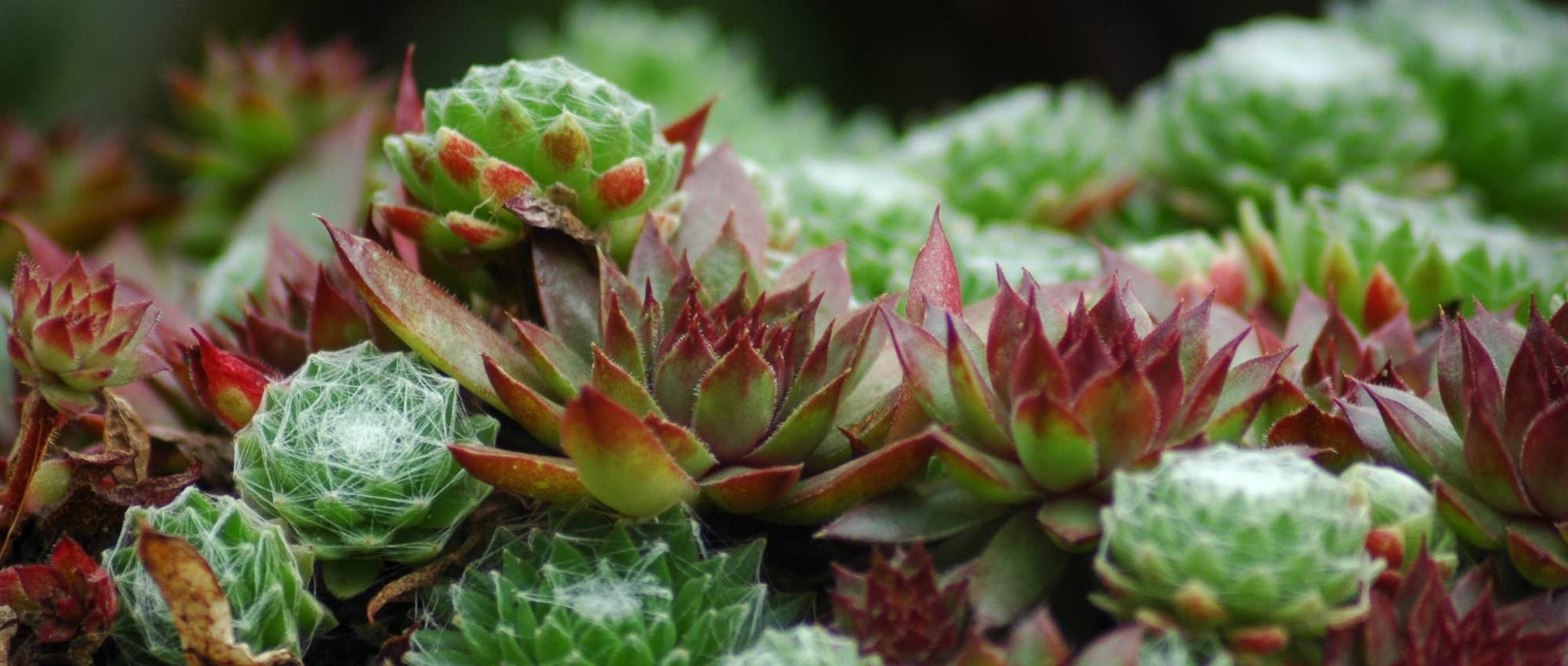
Sempervivum Chic Charms Grape Galaxy® - Houseleek in pictures
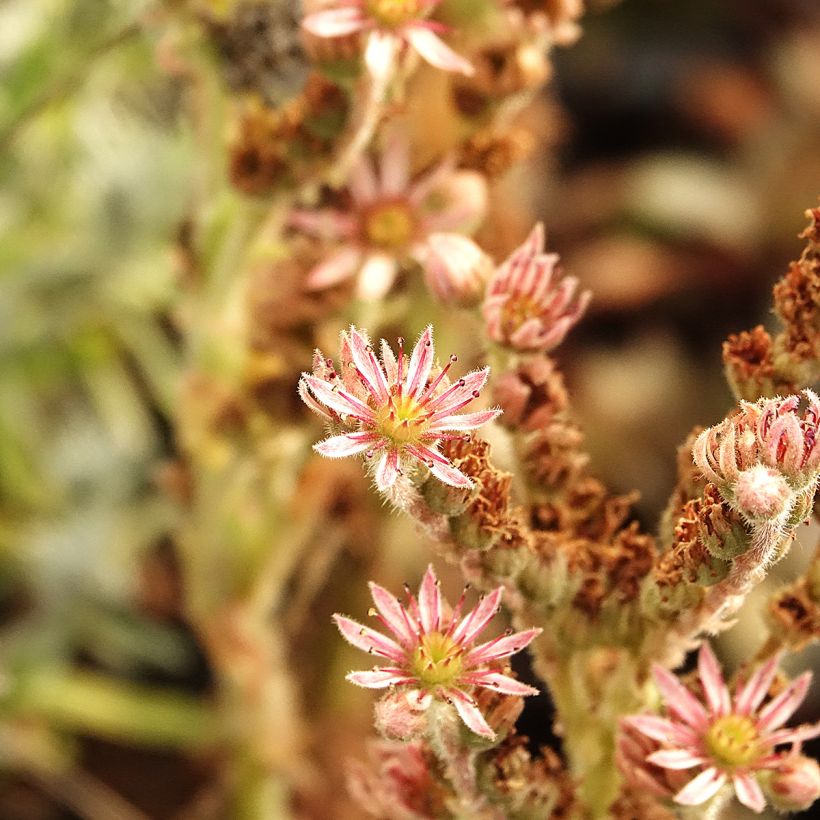

Flowering
Foliage
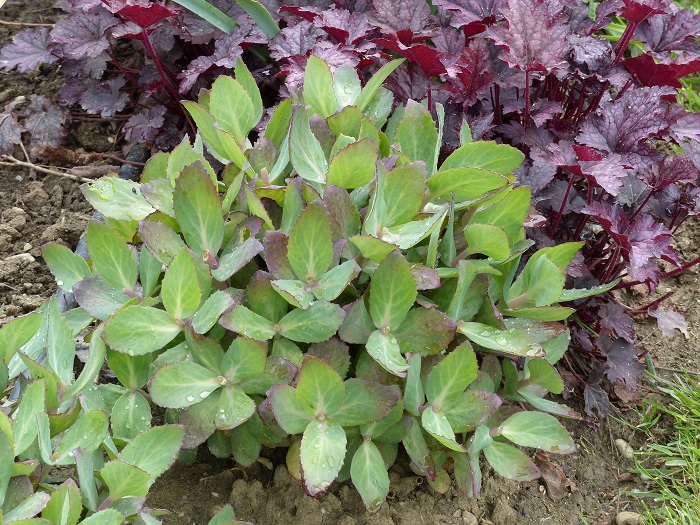
Plant habit
Botanical data
Sempervivum
Grape Galaxy®
Crassulaceae
Houseleek, Hen and Chicks
Sempervivum Grape Galaxy
Cultivar or hybrid
Planting and care
Sempervivum Chick Charms Grape Galaxy enjoys sunny to partially shaded positions (in southern regions) and well-drained, damp to dry, poor soils that do not retain water. You can plant it in spring or autumn in the ground or in a container, adding gravel or coarse sand to the planting substrate. Conversely, if you place it in a rock garden or on a low wall, give it just a little compost to help it establish. After that, it will manage on its own.
If you wish to propagate it, simply cut off a few young rosettes and replant them elsewhere, barely covering the roots. Look after it by ensuring it is not overwhelmed by taller plants, that it does not become covered with dead leaves or plant debris, and by occasionally removing the small faded flower heads.
Planting period
Intended location
Care
Planting & care advice
-
-
-
-

-
-

-

-

-
, onOrder confirmed
Reply from on Promesse de fleurs
Recently viewed products
Haven't found what you were looking for?
Hardiness is the lowest winter temperature a plant can endure without suffering serious damage or even dying. However, hardiness is affected by location (a sheltered area, such as a patio), protection (winter cover) and soil type (hardiness is improved by well-drained soil).

The flowering period indicated on our website applies to countries and regions located in USDA zone 8 (France, the United Kingdom, Ireland, the Netherlands, etc.)
It will vary according to where you live:- In zones 9 to 10 (Italy, Spain, Greece, etc.), flowering will occur about 2 to 4 weeks earlier.
- In zones 6 to 7 (Germany, Poland, Slovenia, and lower mountainous regions), flowering will be delayed by 2 to 3 weeks.
- In zone 5 (Central Europe, Scandinavia), blooming will be delayed by 3 to 5 weeks.
In temperate climates, pruning of spring-flowering shrubs (forsythia, spireas, etc.) should be done just after flowering.
Pruning of summer-flowering shrubs (Indian Lilac, Perovskia, etc.) can be done in winter or spring.
In cold regions as well as with frost-sensitive plants, avoid pruning too early when severe frosts may still occur.
The planting period indicated on our website applies to countries and regions located in USDA zone 8 (France, United Kingdom, Ireland, Netherlands).
It will vary according to where you live:
- In Mediterranean zones (Marseille, Madrid, Milan, etc.), autumn and winter are the best planting periods.
- In continental zones (Strasbourg, Munich, Vienna, etc.), delay planting by 2 to 3 weeks in spring and bring it forward by 2 to 4 weeks in autumn.
- In mountainous regions (the Alps, Pyrenees, Carpathians, etc.), it is best to plant in late spring (May-June) or late summer (August-September).
The harvesting period indicated on our website applies to countries and regions in USDA zone 8 (France, England, Ireland, the Netherlands).
In colder areas (Scandinavia, Poland, Austria...) fruit and vegetable harvests are likely to be delayed by 3-4 weeks.
In warmer areas (Italy, Spain, Greece, etc.), harvesting will probably take place earlier, depending on weather conditions.
The sowing periods indicated on our website apply to countries and regions within USDA Zone 8 (France, UK, Ireland, Netherlands).
In colder areas (Scandinavia, Poland, Austria...), delay any outdoor sowing by 3-4 weeks, or sow under glass.
In warmer climes (Italy, Spain, Greece, etc.), bring outdoor sowing forward by a few weeks.
Shipping country and language
Your country of residence may be:
Your country of residence is:
For a better user experience on our website, you can select:
Your shipping country:
-
 Austria
-
 Belgium
-
 Bosnia & Herzegovina
-
 Bulgaria
-
 Croatia
-
 Cyprus
-
 Czechia
-
 Denmark
-
 Estonia
-
 Finland
-
 France
-
 Germany
-
 Greece
-
 Hungary
-
 Iceland
-
 Ireland
-
 Italy
Italy
-
 Latvia
-
 Liechtenstein
-
 Lithuania
-
 Luxembourg
-
 Malta
Malta
-
 Netherlands
-
 Poland
-
 Portugal
-
 Romania
-
 Serbia
-
 Slovakia
-
 Slovenia
-
 Spain
Spain
-
 Sweden
-
 Switzerland
Language:
-
French
-
 English
-
Spanish
-
Italian
-
German
-
Portuguese
-
Dutch
-
Finnish
My Account
Hello
My wish lists
My cart
Log in / Register
Existing customer?
This form is protected by reCAPTCHA - the Google Privacy Policy and Terms of Service apply.
New customer?
Create an account to track your orders, access our customer service and, if you wish, make the most of our upcoming offers.