Pleioblastus pygmaeus - Dwarf Bamboo
Pleioblastus pygmaeus - Dwarf Bamboo
Pleioblastus pygmaeus - Dwarf Bamboo
Pleioblastus pygmaeus
Dwarf fern-leaf Bamboo, Dwarf Bamboo
My rating is noted as 5 when I was giving it a 3. And I put down 3, optimistically, hoping for a possible recovery in the spring. Please rectify.
Yannick, 20/11/2020
Back-to-school special offer!
Get €10 off for every €50 you spend! And get up to €40 off on a single order.
How does it work?
1. Shop your favourites
Add your favourite plants to your basket. For every €50 you spend (excluding delivery charges, store credit and the plastic-free option), you’ll receive a €10 voucher.
€50 spent = €10 voucher
€100 spent = €20 voucher
€150 spent = €30 voucher
€200 spent = €40 voucher
2. Place your order
Once your basket reaches one of the spending thresholds, place your order. You can even choose your delivery date!
3. Receive your voucher
As soon as your order has been shipped, you’ll receive an email containing your personal voucher code and its value.
4. Use it on your next order
Your voucher is valid for 90 days from the date you receive it. It can be used once only, on a new order worth at least the value of the voucher, excluding delivery charges.
Please note: Vouchers can be combined with other offers, but cannot be split or refunded.
Home or relay delivery (depending on size and destination)
Important: You may be charged customs duties by your country’s customs authorities upon delivery.
Schedule delivery date,
and select date in basket
This plant carries a 24 months recovery warranty
More information
We guarantee the quality of our plants for a full growing cycle, and will replace at our expense any plant that fails to recover under normal climatic and planting conditions.
Would this plant suit my garden?
Set up your Plantfit profile →
Description
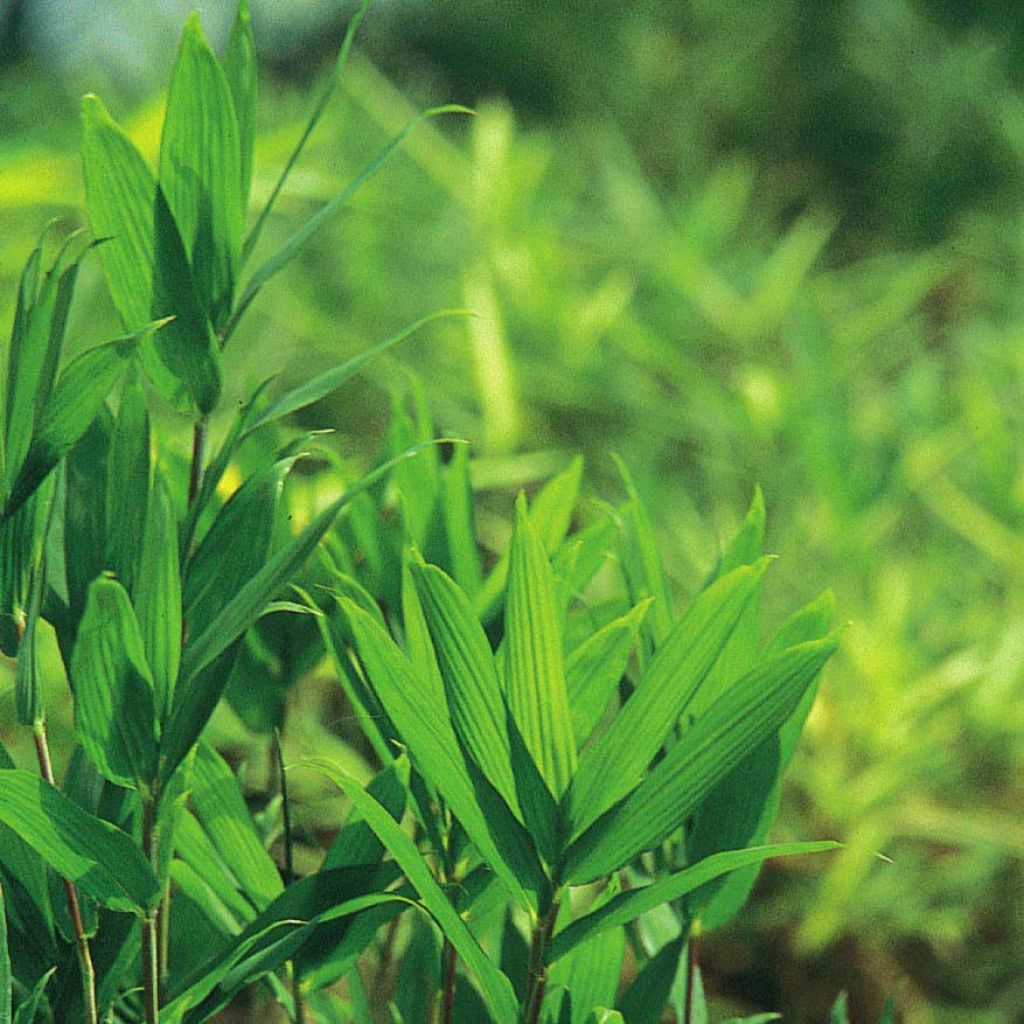
Pleioblastus pygmaeus, as its species name suggests, is a very low-growing, very dense bamboo. It spreads through its trailing rhizomes, eventually forming beautiful ground cover on a slope or long, neatly manicured borders. Its dense foliage will be more or less evergreen depending on the severity of the winter, and therefore attractive for much of the year. In its native Japan, this bamboo is often planted en masse on roundabouts where it requires little maintenance, apart from occasional watering during prolonged droughts and one or two annual trims to restore its vigour. It has a spectacular carpet-like appearance. Invite it into a natural garden to replace boxwood or even grass in non-trafficked areas, or showcase it in a container on the patio!
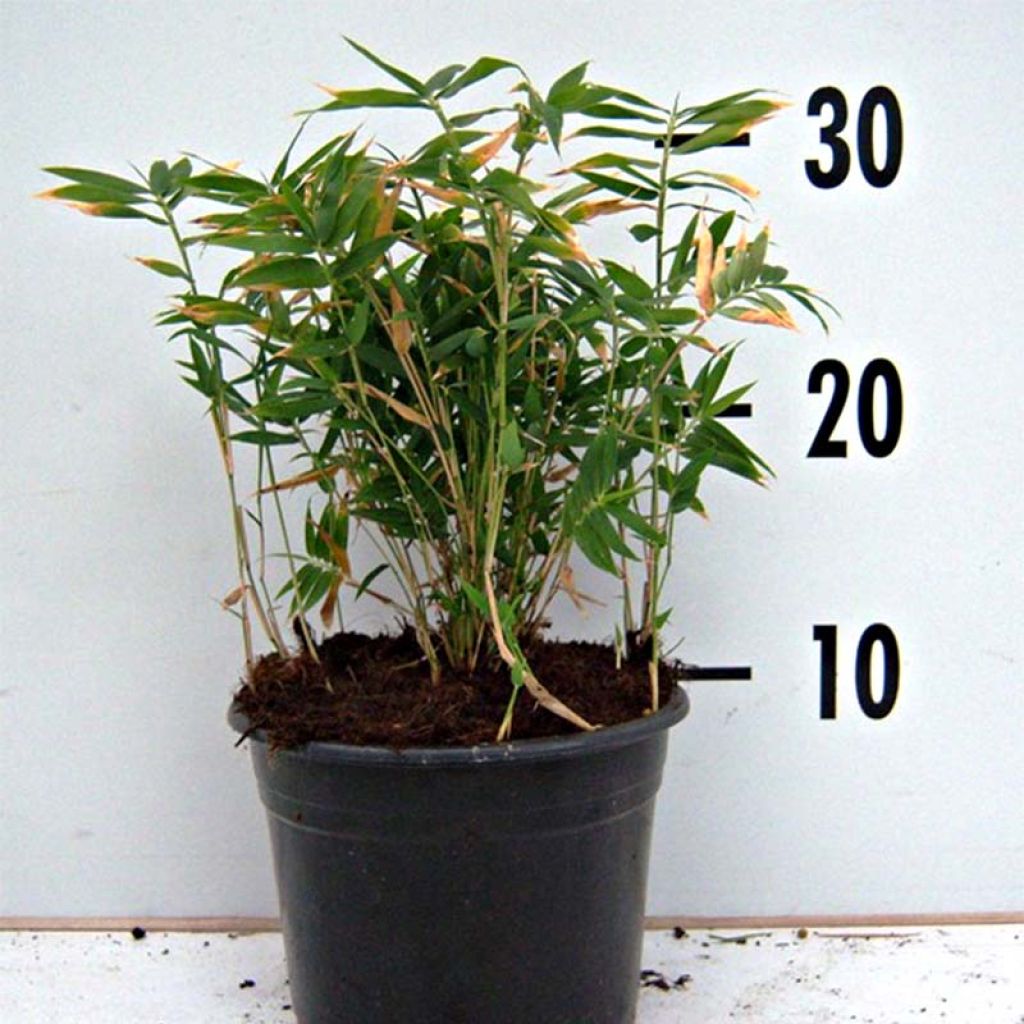
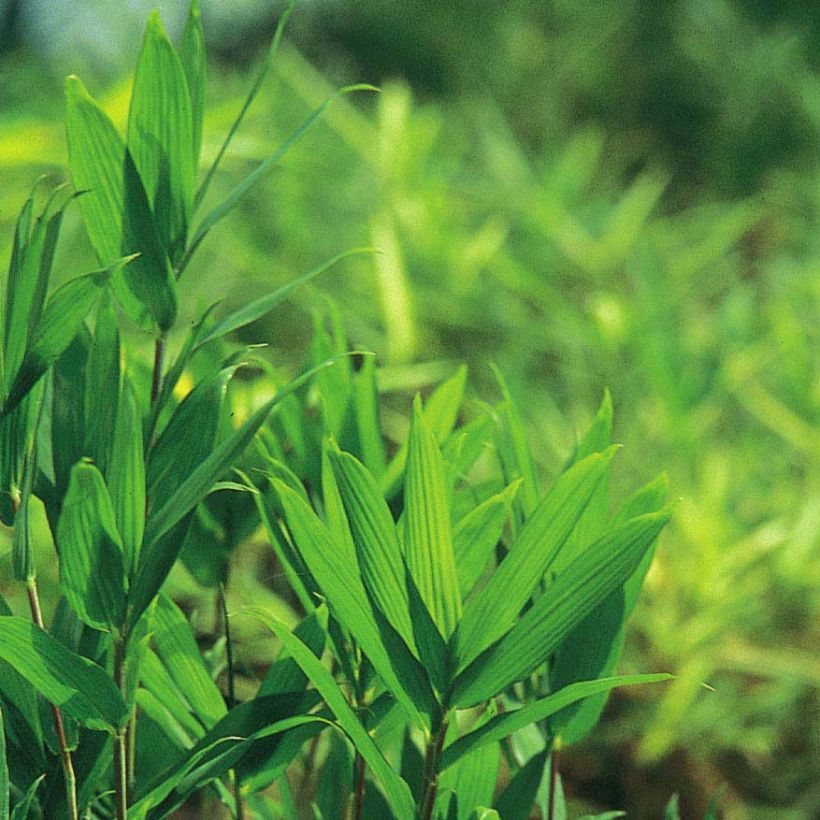
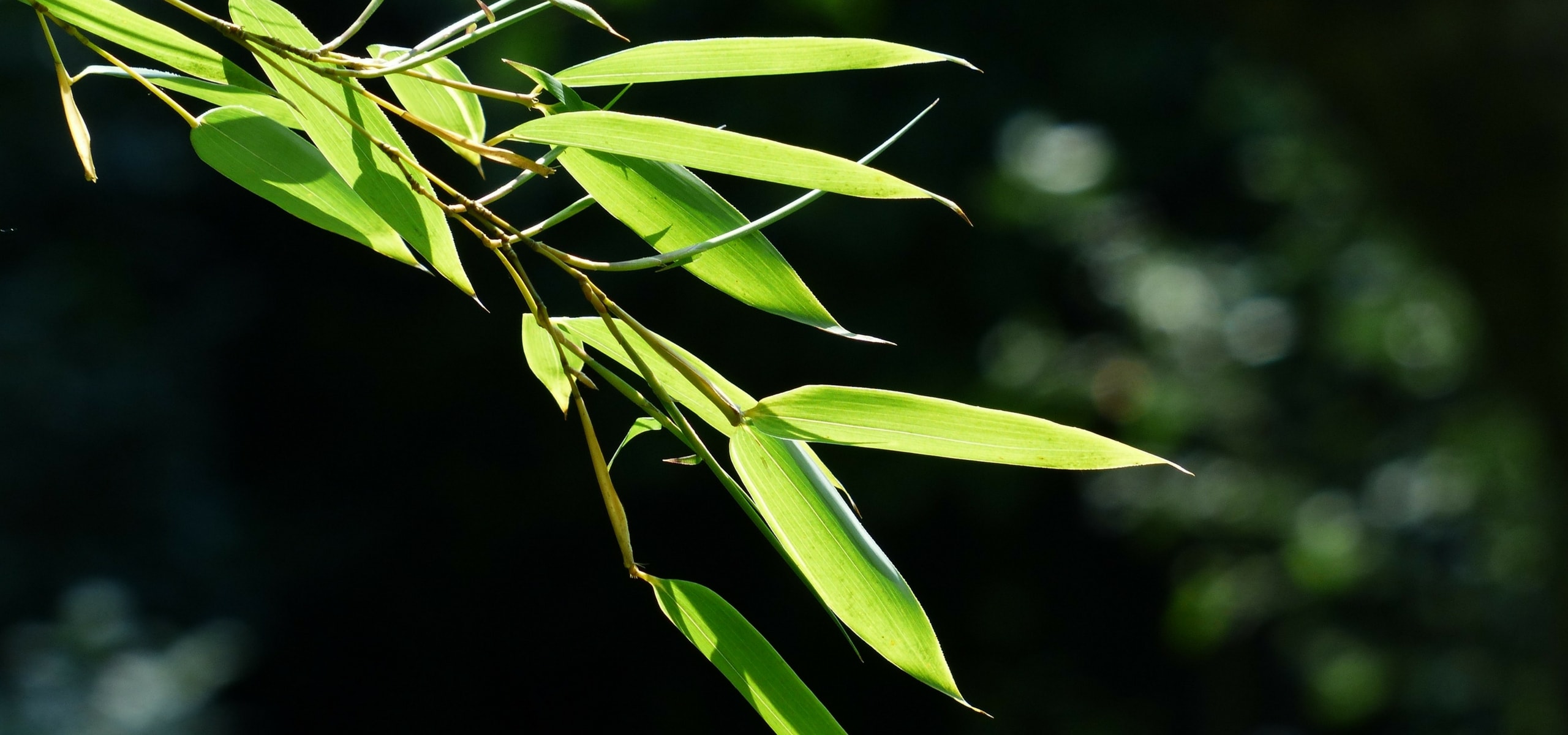
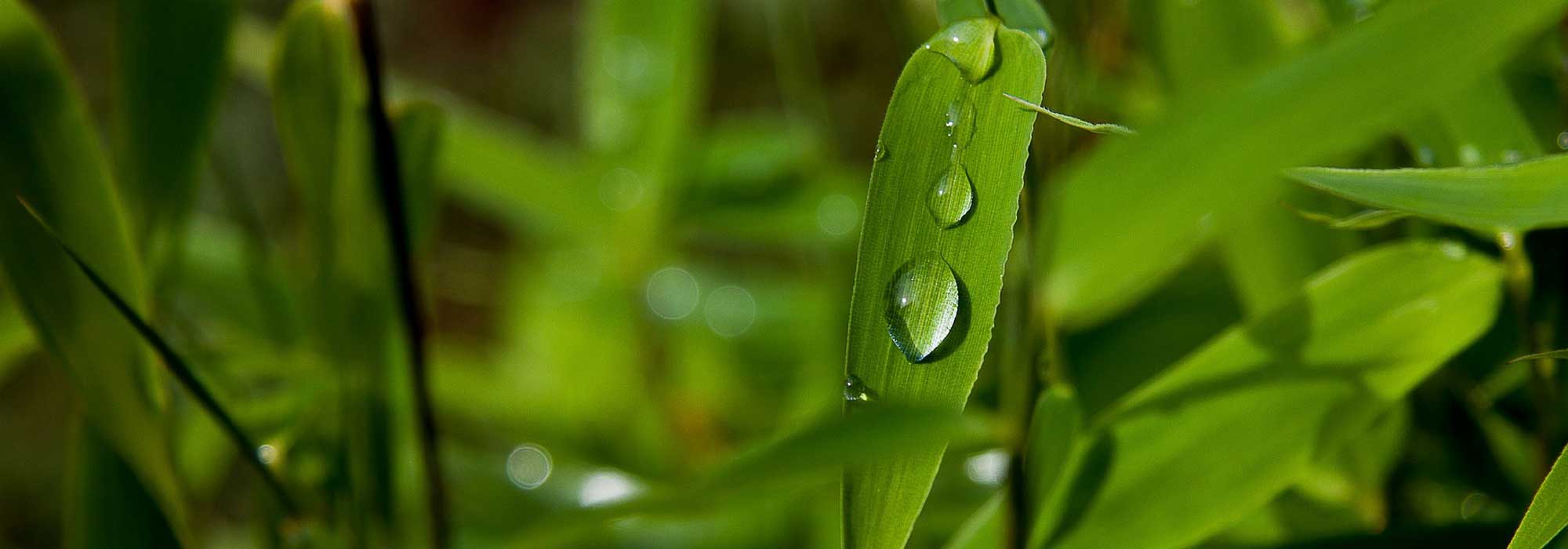
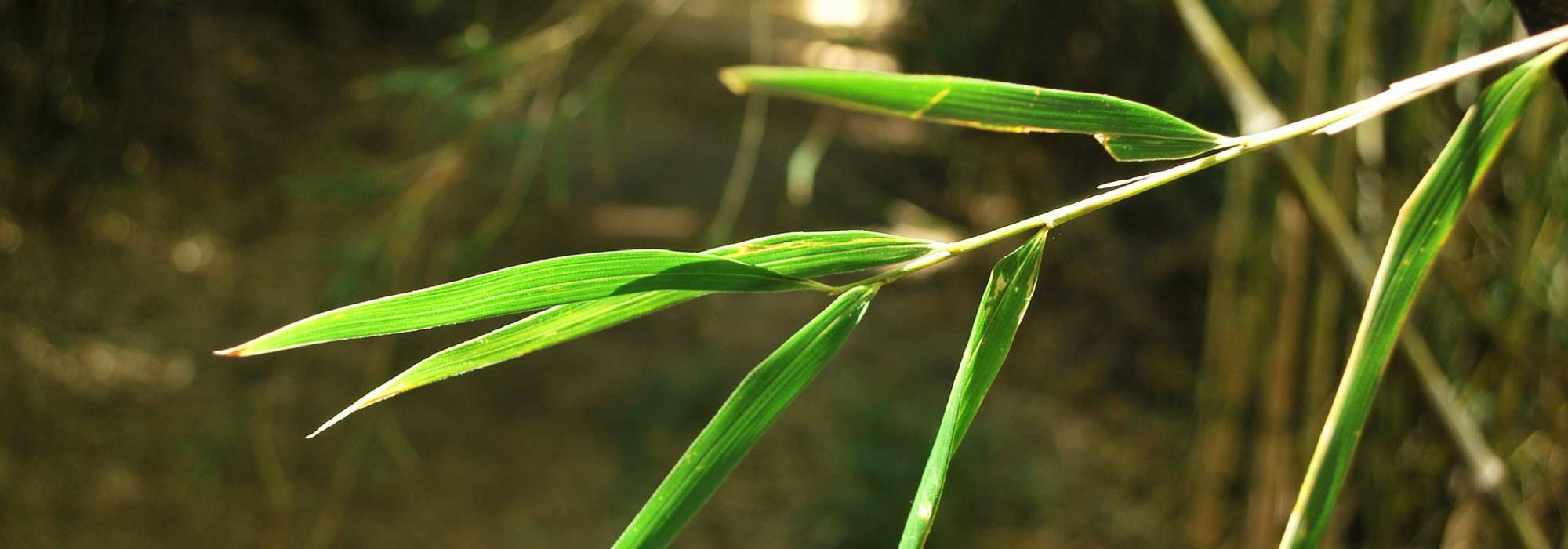
Pleioblastus pygmaeus is a low-growing and very dense botanical bamboo, with a particularly compact habit. Like all bamboos, it belongs to the grass family Poaceae. This Pleioblastus is well adapted to our temperate climates and cold winters, it also tolerates temporary droughts, and thrives in any position or soil without excessive limestone. However, it dislikes waterlogged soils in winter. This bamboo has hollow, green culms (or canes), which are very thin, with a diameter of 1 to 2 mm (1in). These grow to less than 1m (3ft) in height. In cultivation, it is usually maintained at a height of 40 cm (16in) through annual trimming. It has rapid growth and spreads over large areas through its trailing rhizomes (a characteristic that varies depending on the climate and soil type), forming a dense and luxuriant carpet. Its semi-evergreen foliage is composed of lacelike leaves which are a beautiful bright green shade, shiny on top, lighter underneath. This bamboo tolerates root competition very well, and can even overpower other plants in some cases.
Robust, hardy, and undemanding, this bamboo thrives almost everywhere, to the point of becoming invasive. To contain its growth, we recommend giving it a large slope to colonize or using bamboo root barriers to protect neighbouring plants. It is perfectly suited for Zen gardens, wild gardens, exotic gardens, or contemporary-style gardens. Tolerating full sun as well as shade in hot and sunny climates, it can be used as understory planting and even used in lightly shaded areas as groundcover under trees such as the caramel tree, or Acer griseus, or Japanese maples. It can also create large low borders, to replace boxwood along a path, a bed, or to separate different areas of the garden. It can even replace grass in less trafficked areas of the garden. This dwarf bamboo can also be cultivated in pots to decorate balconies, patios, as well as bright and cool interiors.
Pleioblastus pygmaeus - Dwarf Bamboo in pictures
Plant habit
Foliage
Botanical data
Pleioblastus
pygmaeus
Poaceae
Dwarf fern-leaf Bamboo, Dwarf Bamboo
East Asia
Planting and care
Pleioblastus pygmaeus is a low-maintenance bamboo that is easy to grow in all positions (in full sun or partial shade). It thrives in any soil which is well drained but without excessive limestone. It dislikes waterlogged soils in autumn and winter. Although it is very accommodating regarding the nature of the soil, it prefers a neutral to slightly acidic soil, moist and not too dry throughout the year. In the ground, it tolerates moderate periods of drought quite well. It should be planted in late summer or autumn, or even in spring. Its invasiveness depends on the climate and the nature of the soil, but it is recommended, during planting, to install a bamboo root barrier to limit its spreading area. It can withstand temperatures down to -15°C (5°F), but its foliage will burn and therefore become deciduous below -10/-12°C (14/10.4°F). For pot cultivation, use well-drained soil and provide organic fertilizer twice a year to avoid yellowing of the leaves due to excess water and lack of nutrients. Propagation can be done through rhizome cuttings or clump division.
This dwarf bamboo will benefit from being pruned every year in late winter or early spring to encourage the development of new foliage.
Planting period
Intended location
Care
Planting & care advice
-
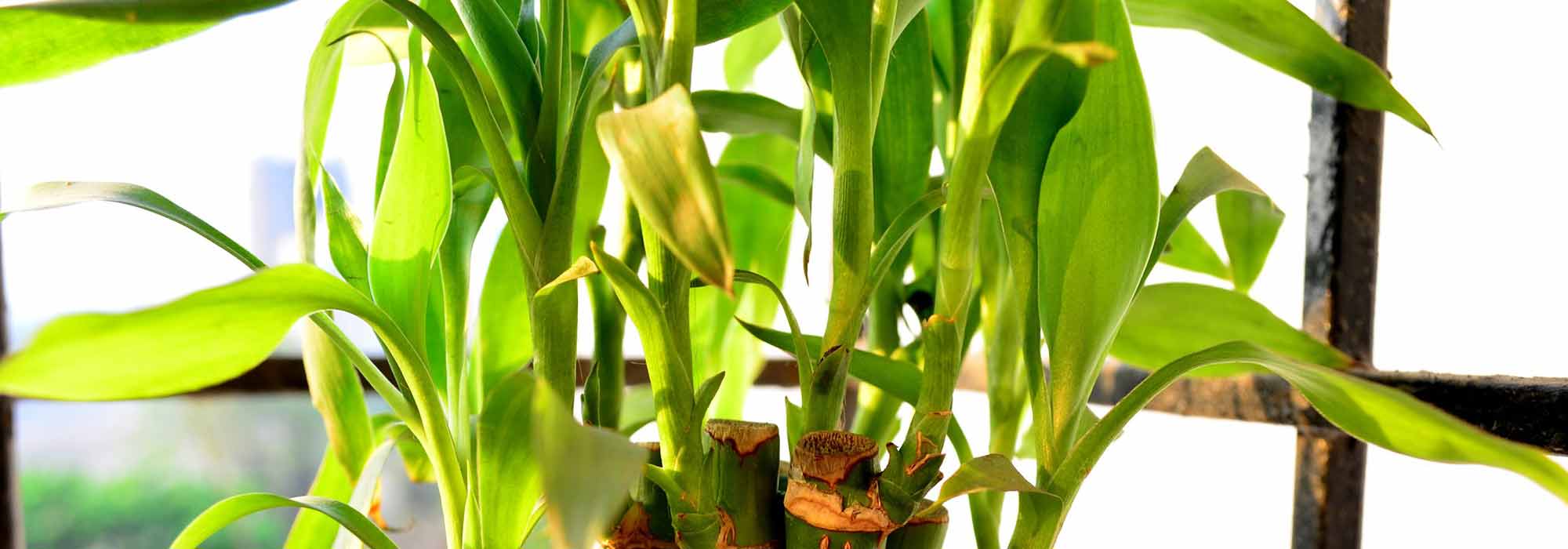
-
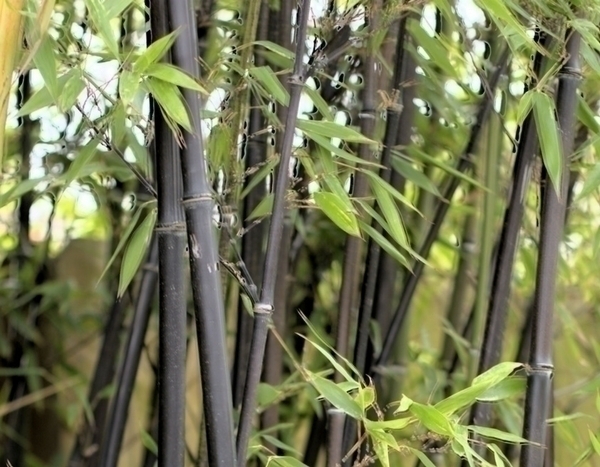
-
-
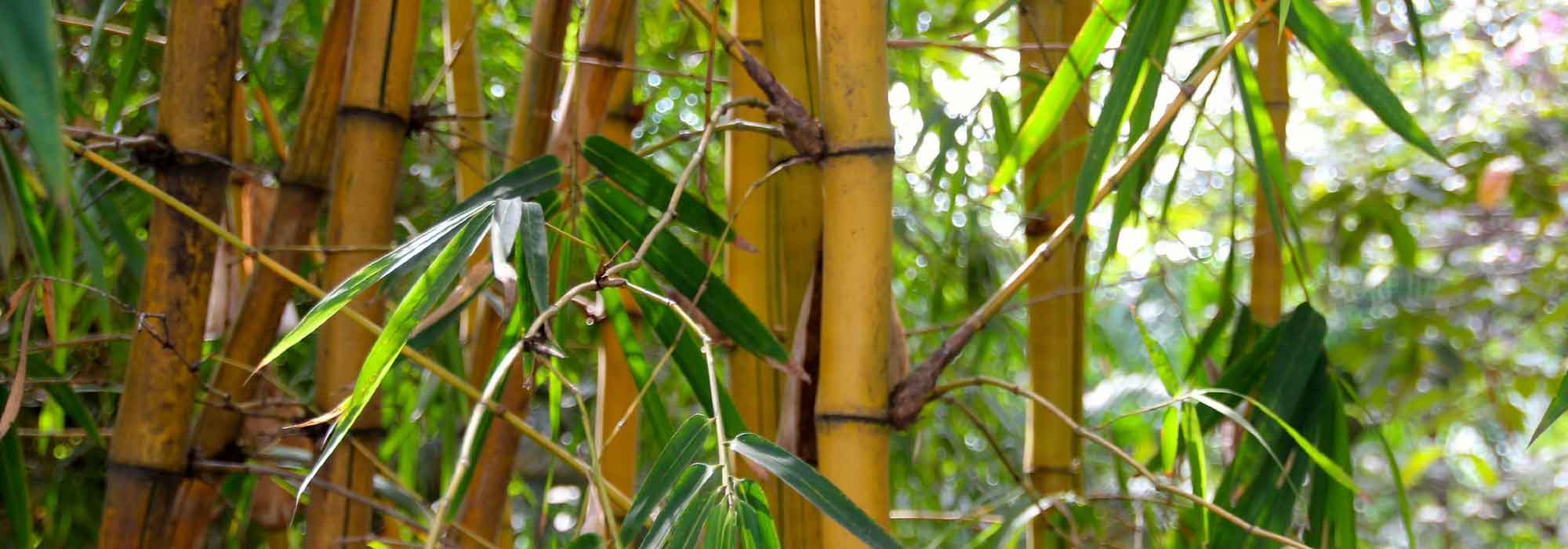
-
-
-
-
-
, onOrder confirmed
Reply from on Promesse de fleurs
Recently viewed products
Haven't found what you were looking for?
Hardiness is the lowest winter temperature a plant can endure without suffering serious damage or even dying. However, hardiness is affected by location (a sheltered area, such as a patio), protection (winter cover) and soil type (hardiness is improved by well-drained soil).

The flowering period indicated on our website applies to countries and regions located in USDA zone 8 (France, the United Kingdom, Ireland, the Netherlands, etc.)
It will vary according to where you live:- In zones 9 to 10 (Italy, Spain, Greece, etc.), flowering will occur about 2 to 4 weeks earlier.
- In zones 6 to 7 (Germany, Poland, Slovenia, and lower mountainous regions), flowering will be delayed by 2 to 3 weeks.
- In zone 5 (Central Europe, Scandinavia), blooming will be delayed by 3 to 5 weeks.
In temperate climates, pruning of spring-flowering shrubs (forsythia, spireas, etc.) should be done just after flowering.
Pruning of summer-flowering shrubs (Indian Lilac, Perovskia, etc.) can be done in winter or spring.
In cold regions as well as with frost-sensitive plants, avoid pruning too early when severe frosts may still occur.
The planting period indicated on our website applies to countries and regions located in USDA zone 8 (France, United Kingdom, Ireland, Netherlands).
It will vary according to where you live:
- In Mediterranean zones (Marseille, Madrid, Milan, etc.), autumn and winter are the best planting periods.
- In continental zones (Strasbourg, Munich, Vienna, etc.), delay planting by 2 to 3 weeks in spring and bring it forward by 2 to 4 weeks in autumn.
- In mountainous regions (the Alps, Pyrenees, Carpathians, etc.), it is best to plant in late spring (May-June) or late summer (August-September).
The harvesting period indicated on our website applies to countries and regions in USDA zone 8 (France, England, Ireland, the Netherlands).
In colder areas (Scandinavia, Poland, Austria...) fruit and vegetable harvests are likely to be delayed by 3-4 weeks.
In warmer areas (Italy, Spain, Greece, etc.), harvesting will probably take place earlier, depending on weather conditions.
The sowing periods indicated on our website apply to countries and regions within USDA Zone 8 (France, UK, Ireland, Netherlands).
In colder areas (Scandinavia, Poland, Austria...), delay any outdoor sowing by 3-4 weeks, or sow under glass.
In warmer climes (Italy, Spain, Greece, etc.), bring outdoor sowing forward by a few weeks.
Shipping country and language
Your country of residence may be:
Your country of residence is:
For a better user experience on our website, you can select:
Your shipping country:
-
 Austria
-
 Belgium
-
 Bosnia & Herzegovina
-
 Bulgaria
-
 Croatia
-
 Cyprus
-
 Czechia
-
 Denmark
-
 Estonia
-
 Finland
-
 France
-
 Germany
-
 Greece
-
 Hungary
-
 Iceland
-
 Ireland
-
 Italy
Italy
-
 Latvia
-
 Liechtenstein
-
 Lithuania
-
 Luxembourg
-
 Malta
Malta
-
 Netherlands
-
 Poland
-
 Portugal
-
 Romania
-
 Serbia
-
 Slovakia
-
 Slovenia
-
 Spain
Spain
-
 Sweden
-
 Switzerland
Language:
-
French
-
 English
-
Spanish
-
Italian
-
German
-
Portuguese
-
Dutch
-
Finnish
My Account
Hello
My wish lists
My cart
Log in / Register
Existing customer?
This form is protected by reCAPTCHA - the Google Privacy Policy and Terms of Service apply.
New customer?
Create an account to track your orders, access our customer service and, if you wish, make the most of our upcoming offers.