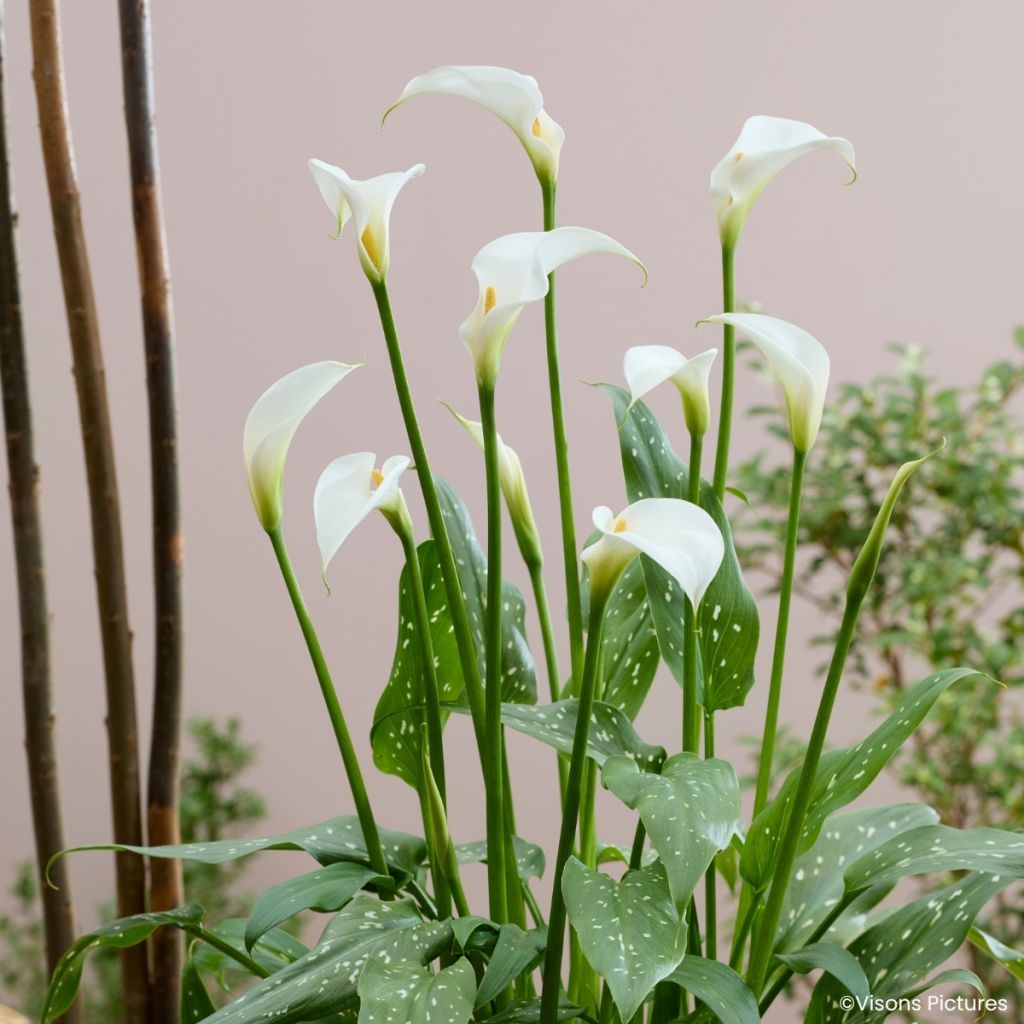
Zantedeschia aethiopica Scented Lady - Arum lily
Zantedeschia aethiopica Scented Lady - Arum lily
Zantedeschia aethiopica Scented Lady
Arum Lily, Calla Lily
Back-to-school special offer!
Get €10 off for every €50 you spend! And get up to €40 off on a single order.
How does it work?
1. Shop your favourites
Add your favourite plants to your basket. For every €50 you spend (excluding delivery charges, store credit and the plastic-free option), you’ll receive a €10 voucher.
€50 spent = €10 voucher
€100 spent = €20 voucher
€150 spent = €30 voucher
€200 spent = €40 voucher
2. Place your order
Once your basket reaches one of the spending thresholds, place your order. You can even choose your delivery date!
3. Receive your voucher
As soon as your order has been shipped, you’ll receive an email containing your personal voucher code and its value.
4. Use it on your next order
Your voucher is valid for 90 days from the date you receive it. It can be used once only, on a new order worth at least the value of the voucher, excluding delivery charges.
Please note: Vouchers can be combined with other offers, but cannot be split or refunded.
Home or relay delivery (depending on size and destination)
Important: You may be charged customs duties by your country’s customs authorities upon delivery.
Schedule delivery date
and select date in basket
This plant carries a 12 months recovery warranty
More information
We guarantee the quality of our plants for a full growing cycle, and will replace at our expense any plant that fails to recover under normal climatic and planting conditions.
Would this plant suit my garden?
Set up your Plantfit profile →
Description
Zantedeschia aethiopica ‘Scented Lady’ is an elegant arum lily with a bonus: its white spathes emit an unusual and very pleasant, light floral fragrance. This variety forms an opulent clump of luxuriant foliage topped with large ivory flowers. It is a beautiful plant for moist, rich soil, which also thrives at the water's edge or in a large container. It always makes a striking impression.
This variety belongs to the Araceae family. The species Zantedeschia aethiopica, known by the common names arum lily, calla lily, or lily of the Nile, has the main botanical synonyms Calla aethiopica, Richardia aethiopica, Arodes aethiopicum and Colocasia aethiopica. Despite its name, it is not native to Ethiopia but to Southern Africa, mainly South Africa, Lesotho, and Eswatini. In the wild, it is found in wetlands, marshes, cool alpine meadows, along watercourses, and in formerly inhabited places, from the coast to high altitudes. It is a rhizomatous perennial: its thick crown stores reserves and allows it to regrow each year.
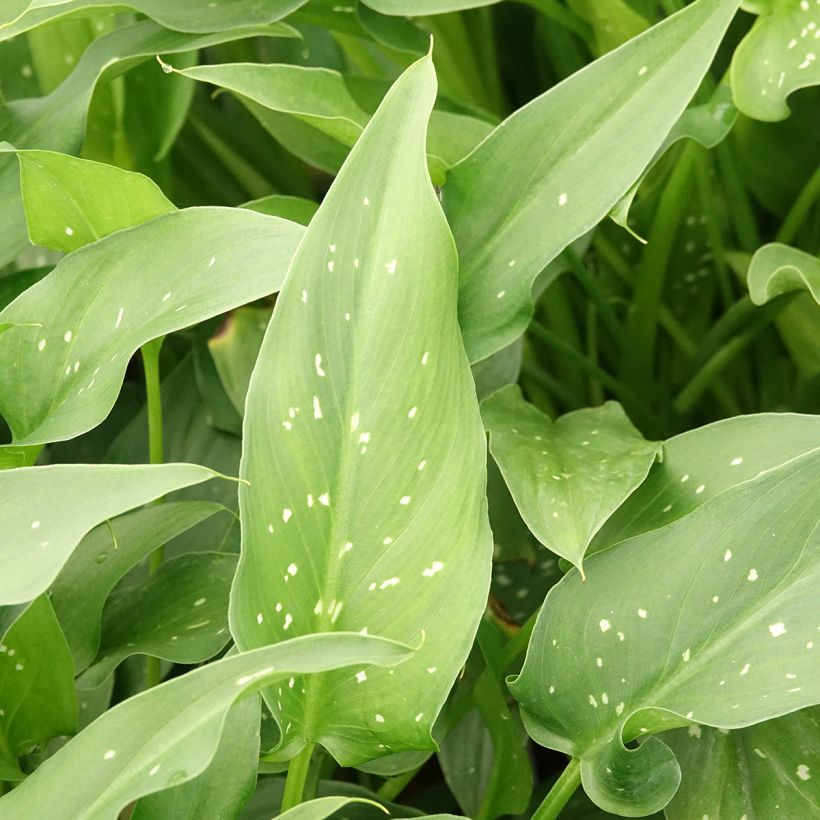
The cultivar ‘Scented Lady’ is a French introduction by Turcieflor. This selection is distinguished from the typical species by its more pronounced fragrance and its particularly neat appearance. The plant forms an upright, dense clump, 60 to 80 cm tall and about 45 to 60 cm wide, or even more in very rich soil. Its growth is rapid, and the crown gradually widens. The leaves, borne on long, fleshy petioles, are arrow or spear-shaped, thick, glossy, and a bright to dark green. If the winter is mild and the summer not too dry, the foliage may persist through part of the winter; elsewhere, it disappears in summer and/or as soon as it freezes seriously. The "flowers" are actually inflorescences: a large white to ivory spathe, rolled into a funnel, surrounds a pale yellow spadix where the tiny true flowers are located. Each spathe measures 15 to 20 cm long, about 8 cm in diameter. Flowering occurs from May to July; it can be earlier or later depending on the climate and soil moisture. Hardiness: down to -8 / -10 °C in almost dry soil; the crown should be protected under a thick mulch in cold regions.
The white arum lily has been cultivated in Europe for several centuries and long held a place of honour in cottage gardens as well as in floral art.
In the garden, Zantedeschia ‘Scented Lady’ thrives anywhere the soil is rich and moist in season, but not waterlogged in winter. Plant it near a pond, in a damp border, or in a large container watered generously in summer. Its handsome, lush vegetation pairs well with soft foliage and light flowering plants. You can combine it with Rodgersia pinnata ‘Chocolate Wings’, Iris ensata ‘Variegata’, or Astilbe ‘Vision in Red’. Kenilworth ivy (Cymbalaria muralis) will be a charming companion in a large container, as it will spill over the edge and trail down to the ground.
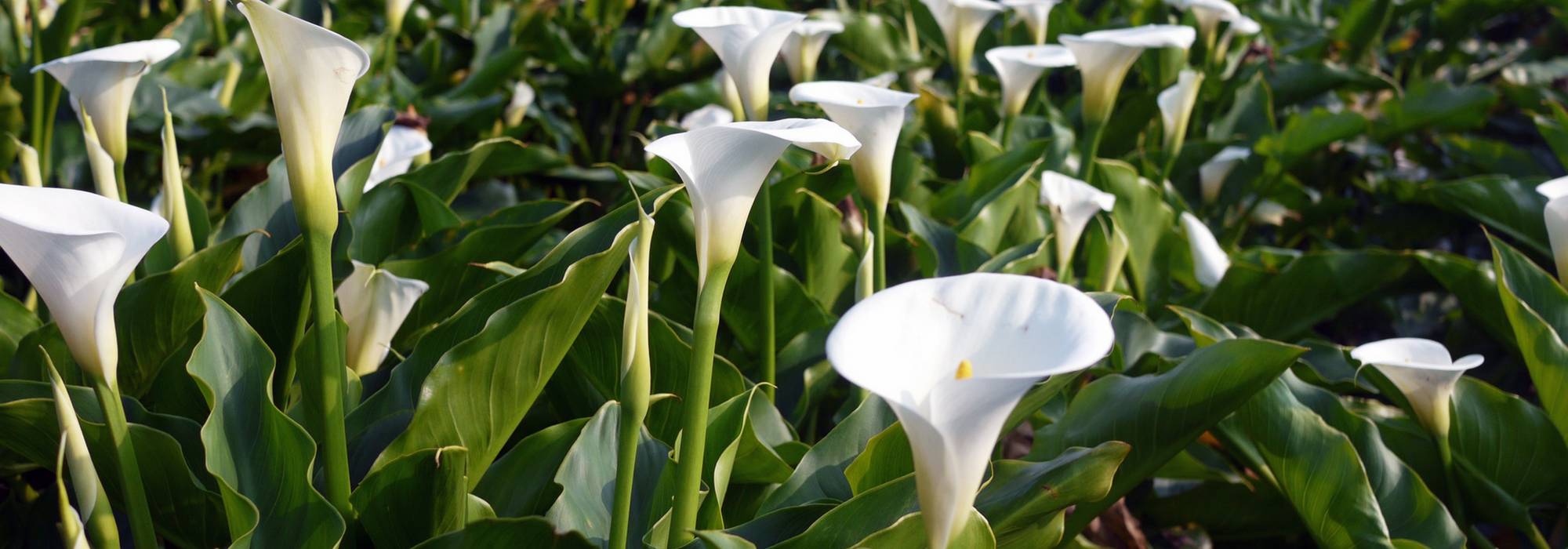
Zantedeschia aethiopica Scented Lady - Arum lily in pictures
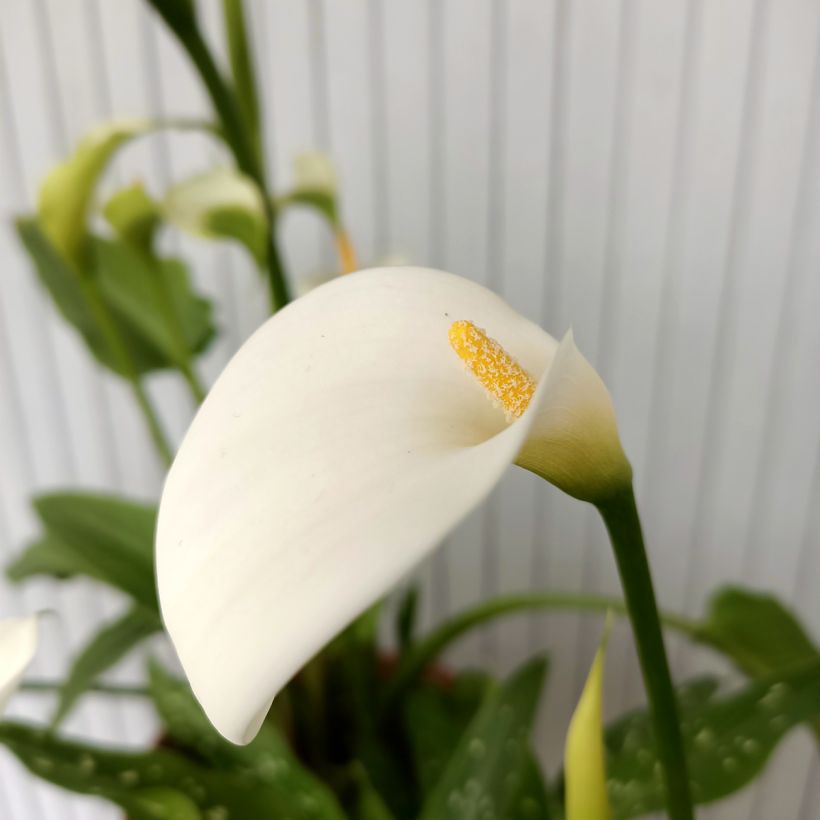
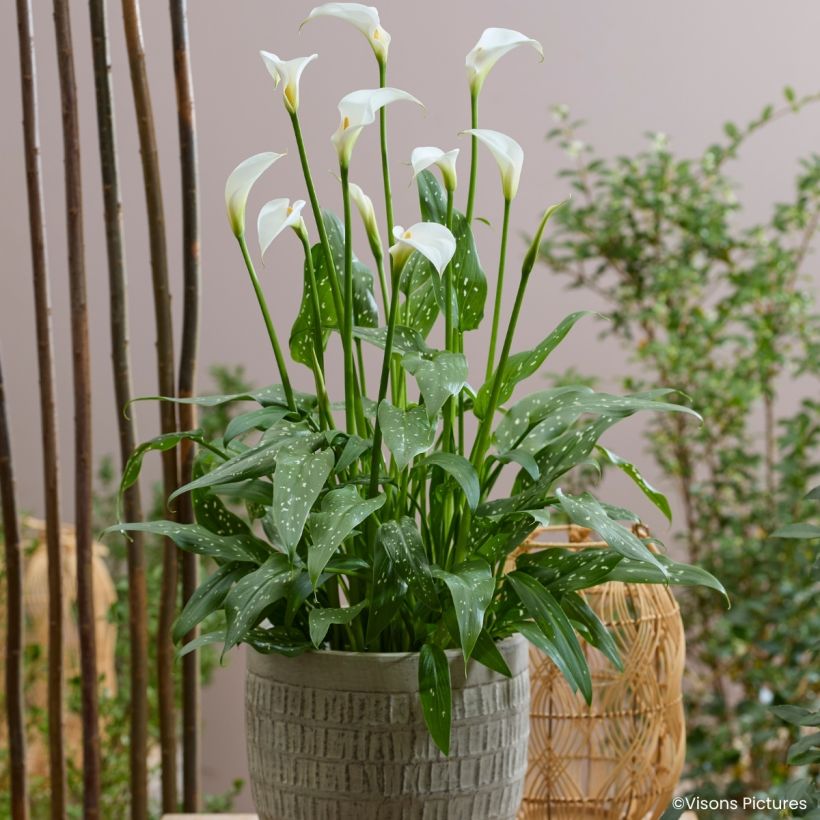
Flowering
Foliage
Plant habit
Botanical data
Zantedeschia
aethiopica
Scented Lady
Araceae
Arum Lily, Calla Lily
Calla aethiopica, Richardia aethiopica, Arodes aethiopicum, Colocasia aethiopica
Cultivar or hybrid
Planting and care
Plant the Scented Lady arum plants in good garden soil enriched with compost. Choose a deep, damp to moist soil, even flooded in spring and summer, and a sunny position in cool climates, or partial shade in very sunny climates. Avoid the sun during the hottest hours in Mediterranean regions, as this could cause scorching on the foliage. In a pot, the arum will need watering every evening in summer.
The hardiness of this plant is around -8/-10°C at its peak if conditions are optimal, that is, if the crown is not in frozen soil. Protection is essential in winter. Place a thick mulch over the crowns, which you can cover with a waterproof tarpaulin to avoid significant moisture, which, combined with the cold, would be fatal to the plant.
Planting period
Intended location
Care
Planting & care advice



This item has not been reviewed yet - be the first to leave a review about it.
Recently viewed products
Haven't found what you were looking for?
Hardiness is the lowest winter temperature a plant can endure without suffering serious damage or even dying. However, hardiness is affected by location (a sheltered area, such as a patio), protection (winter cover) and soil type (hardiness is improved by well-drained soil).

The flowering period indicated on our website applies to countries and regions located in USDA zone 8 (France, the United Kingdom, Ireland, the Netherlands, etc.)
It will vary according to where you live:- In zones 9 to 10 (Italy, Spain, Greece, etc.), flowering will occur about 2 to 4 weeks earlier.
- In zones 6 to 7 (Germany, Poland, Slovenia, and lower mountainous regions), flowering will be delayed by 2 to 3 weeks.
- In zone 5 (Central Europe, Scandinavia), blooming will be delayed by 3 to 5 weeks.
In temperate climates, pruning of spring-flowering shrubs (forsythia, spireas, etc.) should be done just after flowering.
Pruning of summer-flowering shrubs (Indian Lilac, Perovskia, etc.) can be done in winter or spring.
In cold regions as well as with frost-sensitive plants, avoid pruning too early when severe frosts may still occur.
The planting period indicated on our website applies to countries and regions located in USDA zone 8 (France, United Kingdom, Ireland, Netherlands).
It will vary according to where you live:
- In Mediterranean zones (Marseille, Madrid, Milan, etc.), autumn and winter are the best planting periods.
- In continental zones (Strasbourg, Munich, Vienna, etc.), delay planting by 2 to 3 weeks in spring and bring it forward by 2 to 4 weeks in autumn.
- In mountainous regions (the Alps, Pyrenees, Carpathians, etc.), it is best to plant in late spring (May-June) or late summer (August-September).
The harvesting period indicated on our website applies to countries and regions in USDA zone 8 (France, England, Ireland, the Netherlands).
In colder areas (Scandinavia, Poland, Austria...) fruit and vegetable harvests are likely to be delayed by 3-4 weeks.
In warmer areas (Italy, Spain, Greece, etc.), harvesting will probably take place earlier, depending on weather conditions.
The sowing periods indicated on our website apply to countries and regions within USDA Zone 8 (France, UK, Ireland, Netherlands).
In colder areas (Scandinavia, Poland, Austria...), delay any outdoor sowing by 3-4 weeks, or sow under glass.
In warmer climes (Italy, Spain, Greece, etc.), bring outdoor sowing forward by a few weeks.
Shipping country and language
Your country of residence may be:
Your country of residence is:
For a better user experience on our website, you can select:
Your shipping country:
-
 Austria
-
 Belgium
-
 Bosnia & Herzegovina
-
 Bulgaria
-
 Croatia
-
 Cyprus
-
 Czechia
-
 Denmark
-
 Estonia
-
 Finland
-
 France
-
 Germany
-
 Greece
-
 Hungary
-
 Iceland
-
 Ireland
-
 Italy
Italy
-
 Latvia
-
 Liechtenstein
-
 Lithuania
-
 Luxembourg
-
 Malta
Malta
-
 Netherlands
-
 Poland
-
 Portugal
-
 Romania
-
 Serbia
-
 Slovakia
-
 Slovenia
-
 Spain
Spain
-
 Sweden
-
 Switzerland
Language:
-
French
-
 English
-
Spanish
-
Italian
-
German
-
Portuguese
-
Dutch
-
Finnish
My Account
Hello
My wish lists
My cart
Log in / Register
Existing customer?
This form is protected by reCAPTCHA - the Google Privacy Policy and Terms of Service apply.
New customer?
Create an account to track your orders, access our customer service and, if you wish, make the most of our upcoming offers.