





























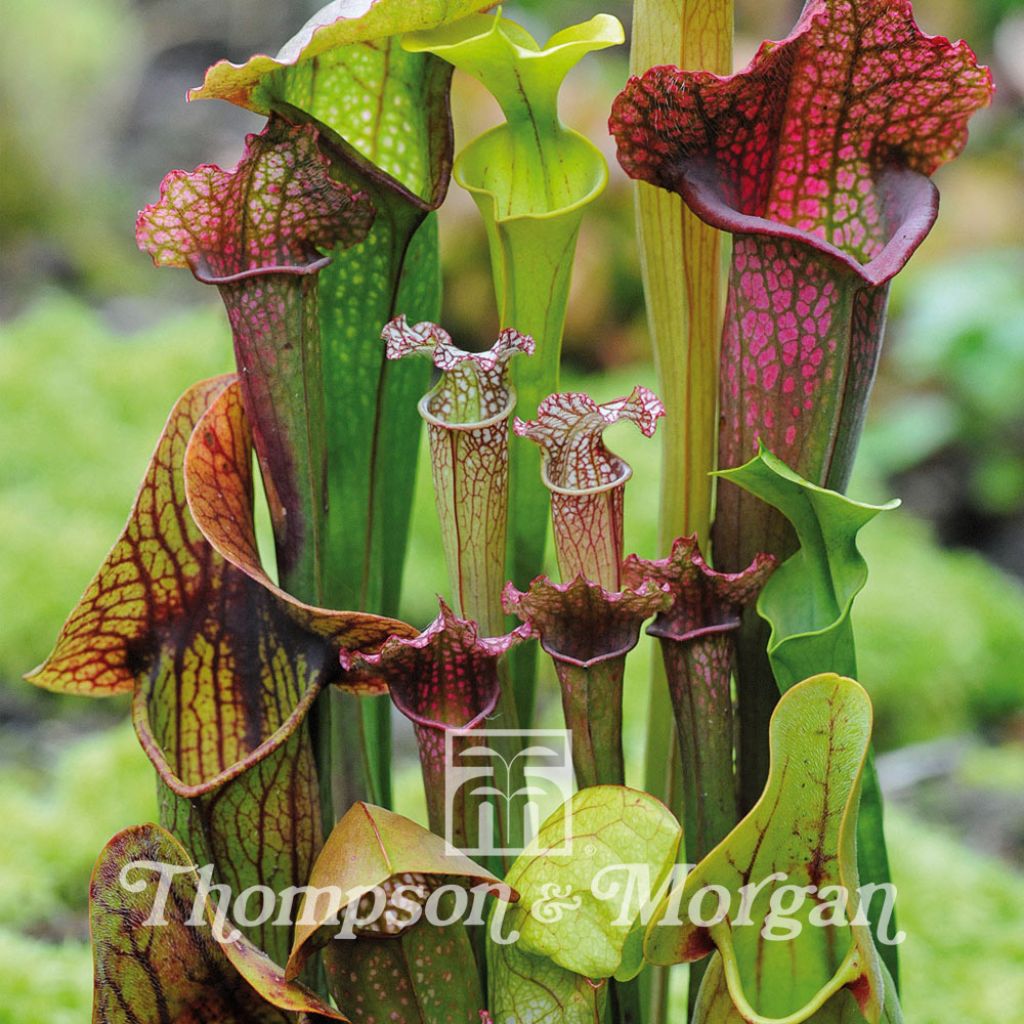
Sarracenia New Hybrids en mélange (Attrape-Mouches de Vénus)
Sarracenia New Hybrids
Sarracenia New Hybrids
Pitcher plant, Trumpet pitcher
The ideal is to obtain these plants from specialists.
marc, 02/02/2021
Special offer!
Receive a €20 voucher for any order over €90 (excluding delivery costs, credit notes, and plastic-free options)!
1- Add your favorite plants to your cart.
2- Once you have reached €90, confirm your order (you can even choose the delivery date!).
3- As soon as your order is shipped, you will receive an email containing your voucher code, valid for 3 months (90 days).
Your voucher is unique and can only be used once, for any order with a minimum value of €20, excluding delivery costs.
Can be combined with other current offers, non-divisible and non-refundable.
This plant carries a 6 months recovery warranty
More information
We guarantee the quality of our plants for a full growing cycle, and will replace at our expense any plant that fails to recover under normal climatic and planting conditions.

Would this plant suit my garden?
Set up your Plantfit profile →
Description
This Sarracenia New Hybrids mix, also known as Pitcher Plants or Sarracenias, brings together various hybrids from the 8 species that make up the genus. After 3 or 4 years of cultivation, they produce strange flowers surrounded by modified leaves, forming very decorative cones in shades of deep red or yellowish-green, which retain rainwater. These are deadly traps for insects that drown in them, providing the plant with an extra source of food that it struggles to find in the extremely poor peaty soil. More or less hardy, but perennial, they prefer the shelter of a greenhouse or conservatory to thrive, requiring acidic, peaty, moist to waterlogged soil, and a sunny or semi-shaded exposure.
Sarracenia are perennial plants native to the eastern United States, where they grow in bogs and marshes. They are divided into 8 species and numerous hybrids, and belong to the Sarraceniaceae family. The plants in the New Hybrids mix are fascinating. They resemble clusters of cones, varying in width, also known as urns, emerging directly from the ground, with clumps measuring about 30cm (12in) in all directions. They all bear strange flowers with numerous petals, with styles forming an umbrella sheltering the stamens. They are generally red, purple, yellow or greenish, or a combination of these two colours. These colours are also found in the modified leaves, forming a cone, also called foliar pitchers, as decorative as the flowers. Attracted by the colours and the promise of sweet nectar, insects dive into the water-filled cones, sliding on the inner walls of the cone, which are often lined with downward-facing hairs, making any attempt to climb back up futile, leading to certain death. The plant uses the proteins contained in the insects' bodies, 'digesting' them with specific enzymes to extract assimilable nitrogenous substances. This adaptation fulfils their need to supplement the nitrogen intake necessary for their life and growth in nutrient-poor soils. Bogs are indeed very low in organic matter.
Incredibly fascinating, the Sarracenia 'New Hybrids Mixed' make a focal point in a warm greenhouse, conservatory, or in a small garden that can be dedicated to them near a window. These amazing plants, like orchids, deserve a special spot within sight to be able to observe them up close. In a mild climate garden, one can create an artificial bog near a water source and choose companion plants such as the pitcher plant, Greenland moss, Canadian rhododendron, other carnivorous plants like sundews, cottongrass, black crowberry, cranberry, or black spruce.
Report an error about the product description
Flowering
Foliage
Plant habit
Botanical data
Sarracenia
New Hybrids
Sarraceniaceae
Pitcher plant, Trumpet pitcher
Cultivar or hybrid
Planting and care
Sarracenias require an acidic substrate practically devoid of organic matter.
Sow the seeds on the surface of pots filled with a 50/50 mix of peat moss and perlite. Do not cover the seeds as light aids germination. Place the pots in a tray filled with distilled water or rainwater. Avoid using tap water as it contains chlorine and limestone, or other minerals that could potentially damage the sensitive roots of young Sarracenia plants. Place the tray in a propagator or in a warm, bright location and maintain a temperature of around 25-27°C (77-80.6°F). Transplant the young plants into 7.5cm (3in) pots and repot as necessary into 13cm (5in) and finally 20cm (8in) pots.
Sarracenias require a winter dormancy period during which watering should be severely limited, and they need maximum light. They will thrive best in full sun. Flowering only occurs when the plant is several years old (3 or 4 years).
Pot Culture:
Water immediately after planting, only with rainwater, osmosis water or demineralized water. Watering should be regular throughout the growing season. Place a saucer under the pot and keep it filled with water.
Place the pot in full sun on a windowsill or balcony.
If it freezes, wrap the pot in bubble wrap. Sarracenias can tolerate temperatures as low as -15°C (5°F), generally.
Remove faded pitchers and flowers.
Field of Plants Culture:
Water with rainwater. Afterwards, these plants require no further maintenance. The pitchers provide all the necessary elements for the plant's growth by 'digesting' insects. In case of drought, water abundantly, as the soil should never dry out.
In both cultivation methods: never apply fertilizer.
Sowing period
Intended location
-
, onOrder confirmed
Reply from on Promesse de fleurs
Haven't found what you were looking for?
Hardiness is the lowest winter temperature a plant can endure without suffering serious damage or even dying. However, hardiness is affected by location (a sheltered area, such as a patio), protection (winter cover) and soil type (hardiness is improved by well-drained soil).

Photo Sharing Terms & Conditions
In order to encourage gardeners to interact and share their experiences, Promesse de fleurs offers various media enabling content to be uploaded onto its Site - in particular via the ‘Photo sharing’ module.
The User agrees to refrain from:
- Posting any content that is illegal, prejudicial, insulting, racist, inciteful to hatred, revisionist, contrary to public decency, that infringes on privacy or on the privacy rights of third parties, in particular the publicity rights of persons and goods, intellectual property rights, or the right to privacy.
- Submitting content on behalf of a third party;
- Impersonate the identity of a third party and/or publish any personal information about a third party;
In general, the User undertakes to refrain from any unethical behaviour.
All Content (in particular text, comments, files, images, photos, videos, creative works, etc.), which may be subject to property or intellectual property rights, image or other private rights, shall remain the property of the User, subject to the limited rights granted by the terms of the licence granted by Promesse de fleurs as stated below. Users are at liberty to publish or not to publish such Content on the Site, notably via the ‘Photo Sharing’ facility, and accept that this Content shall be made public and freely accessible, notably on the Internet.
Users further acknowledge, undertake to have ,and guarantee that they hold all necessary rights and permissions to publish such material on the Site, in particular with regard to the legislation in force pertaining to any privacy, property, intellectual property, image, or contractual rights, or rights of any other nature. By publishing such Content on the Site, Users acknowledge accepting full liability as publishers of the Content within the meaning of the law, and grant Promesse de fleurs, free of charge, an inclusive, worldwide licence for the said Content for the entire duration of its publication, including all reproduction, representation, up/downloading, displaying, performing, transmission, and storage rights.
Users also grant permission for their name to be linked to the Content and accept that this link may not always be made available.
By engaging in posting material, Users consent to their Content becoming automatically accessible on the Internet, in particular on other sites and/or blogs and/or web pages of the Promesse de fleurs site, including in particular social pages and the Promesse de fleurs catalogue.
Users may secure the removal of entrusted content free of charge by issuing a simple request via our contact form.
The flowering period indicated on our website applies to countries and regions located in USDA zone 8 (France, the United Kingdom, Ireland, the Netherlands, etc.)
It will vary according to where you live:
- In zones 9 to 10 (Italy, Spain, Greece, etc.), flowering will occur about 2 to 4 weeks earlier.
- In zones 6 to 7 (Germany, Poland, Slovenia, and lower mountainous regions), flowering will be delayed by 2 to 3 weeks.
- In zone 5 (Central Europe, Scandinavia), blooming will be delayed by 3 to 5 weeks.
In temperate climates, pruning of spring-flowering shrubs (forsythia, spireas, etc.) should be done just after flowering.
Pruning of summer-flowering shrubs (Indian Lilac, Perovskia, etc.) can be done in winter or spring.
In cold regions as well as with frost-sensitive plants, avoid pruning too early when severe frosts may still occur.
The planting period indicated on our website applies to countries and regions located in USDA zone 8 (France, United Kingdom, Ireland, Netherlands).
It will vary according to where you live:
- In Mediterranean zones (Marseille, Madrid, Milan, etc.), autumn and winter are the best planting periods.
- In continental zones (Strasbourg, Munich, Vienna, etc.), delay planting by 2 to 3 weeks in spring and bring it forward by 2 to 4 weeks in autumn.
- In mountainous regions (the Alps, Pyrenees, Carpathians, etc.), it is best to plant in late spring (May-June) or late summer (August-September).
The harvesting period indicated on our website applies to countries and regions in USDA zone 8 (France, England, Ireland, the Netherlands).
In colder areas (Scandinavia, Poland, Austria...) fruit and vegetable harvests are likely to be delayed by 3-4 weeks.
In warmer areas (Italy, Spain, Greece, etc.), harvesting will probably take place earlier, depending on weather conditions.
The sowing periods indicated on our website apply to countries and regions within USDA Zone 8 (France, UK, Ireland, Netherlands).
In colder areas (Scandinavia, Poland, Austria...), delay any outdoor sowing by 3-4 weeks, or sow under glass.
In warmer climes (Italy, Spain, Greece, etc.), bring outdoor sowing forward by a few weeks.