Clematis Robert Brydon
Clematis Robert Brydon
Clematis Robert Brydon
Clematis × jouiniana Robert Brydon
Tube clematis
It's not really shooting up yet, but it seems quite sturdy.
Chantal, 13/05/2025
Back-to-school special offer!
Get €10 off for every €50 you spend! And get up to €40 off on a single order.
How does it work?
1. Shop your favourites
Add your favourite plants to your basket. For every €50 you spend (excluding delivery charges, store credit and the plastic-free option), you’ll receive a €10 voucher.
€50 spent = €10 voucher
€100 spent = €20 voucher
€150 spent = €30 voucher
€200 spent = €40 voucher
2. Place your order
Once your basket reaches one of the spending thresholds, place your order. You can even choose your delivery date!
3. Receive your voucher
As soon as your order has been shipped, you’ll receive an email containing your personal voucher code and its value.
4. Use it on your next order
Your voucher is valid for 90 days from the date you receive it. It can be used once only, on a new order worth at least the value of the voucher, excluding delivery charges.
Please note: Vouchers can be combined with other offers, but cannot be split or refunded.
Home or relay delivery (depending on size and destination)
Important: You may be charged customs duties by your country’s customs authorities upon delivery.
Schedule delivery date,
and select date in basket
This plant carries a 12 months recovery warranty
More information
We guarantee the quality of our plants for a full growing cycle, and will replace at our expense any plant that fails to recover under normal climatic and planting conditions.
Would this plant suit my garden?
Set up your Plantfit profile →
Description
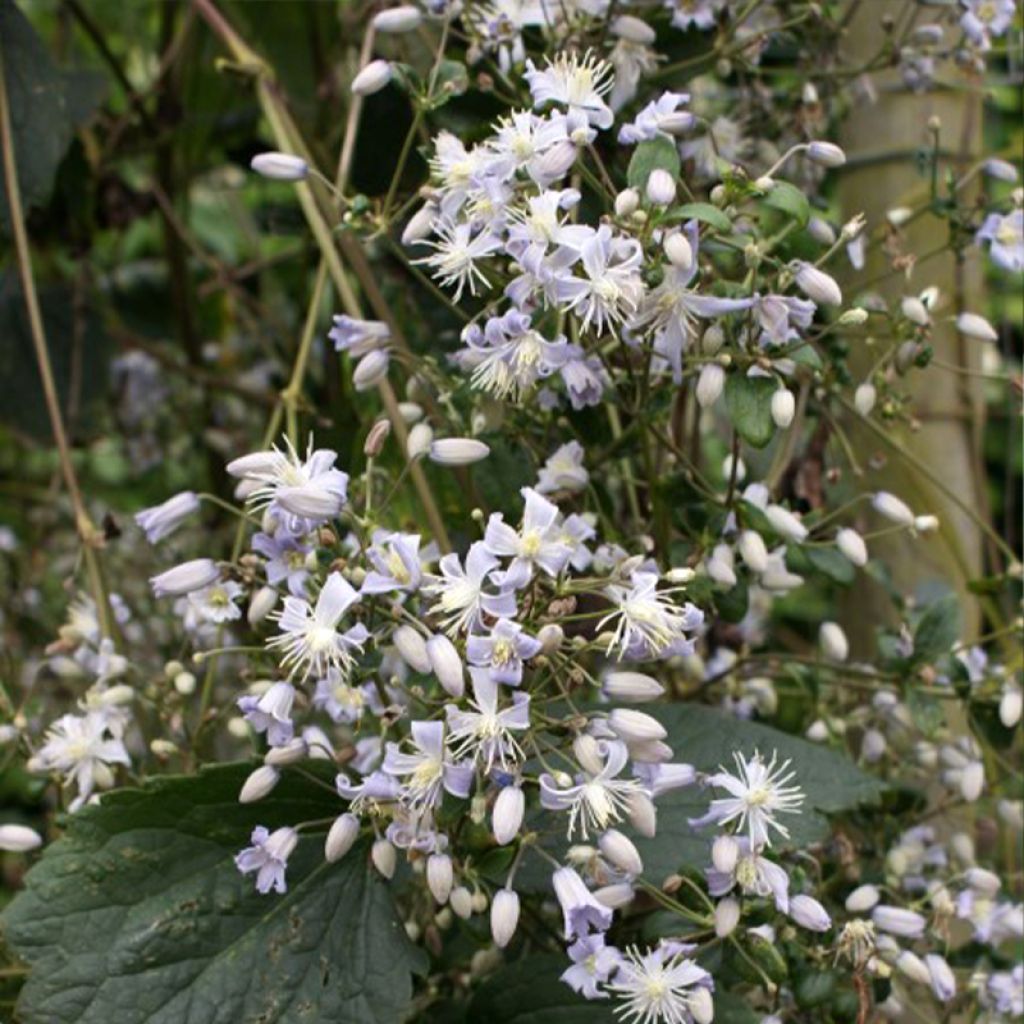
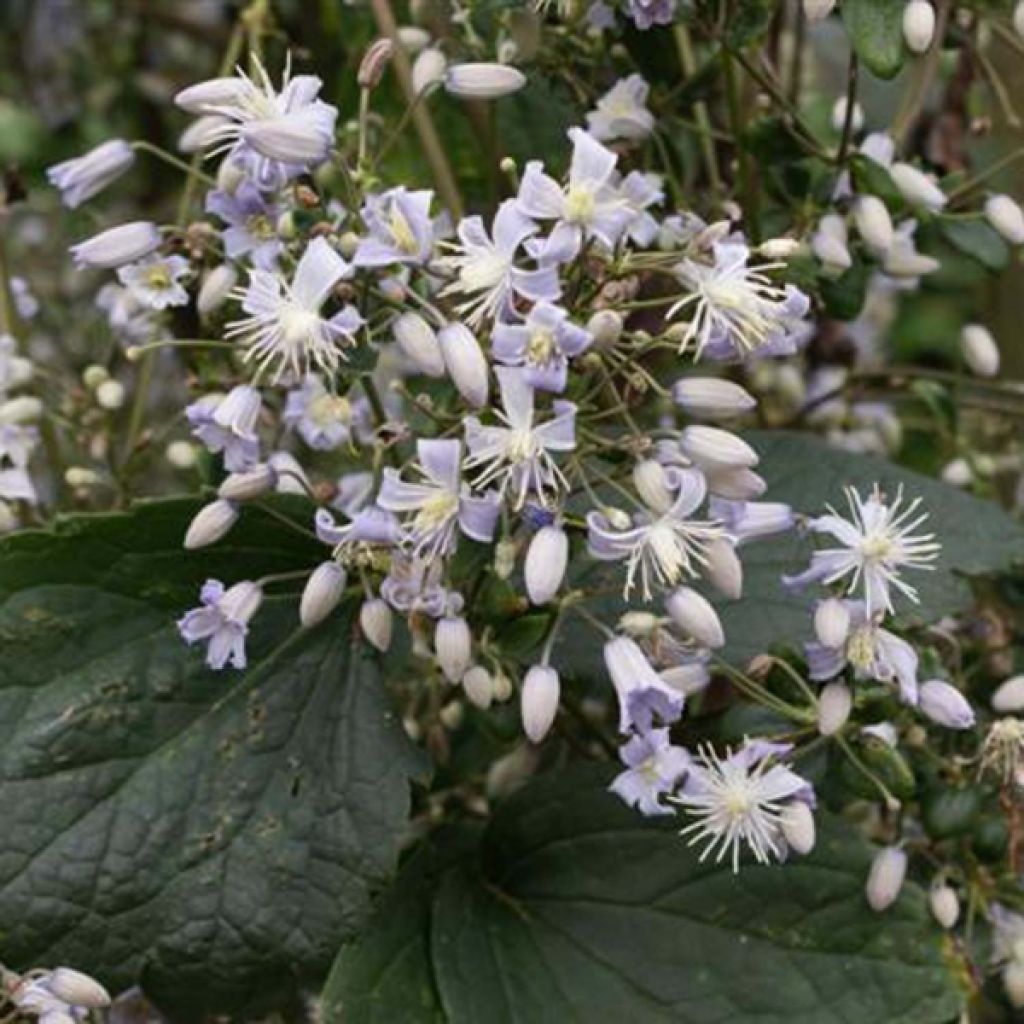
The Clematis ‘Mrs Robert Brydon’, still often sold under the name Clematis jouiniana ‘Robert Brydon’, is a herbaceous clematis that does not climb, unlike many varieties. Its long stems do not cling to a support: they spread widely, trail over a low wall, or slip into the lower branches of a shrub. At the end of summer, they are covered with a multitude of small, white-blue to pale mauve flowers. Robust, very hardy and undemanding, this old variety makes an excellent groundcover for large borders and slopes.
This plant belongs to the family Ranunculaceae and the horticultural group Heracleifolia. It has a perennial stump, slightly woody at the base, and its new shoots appear each year in spring. Much of the vegetation dies back in winter and will be replaced the following year. Its official name is Clematis ‘Mrs Robert Brydon’. The plant was long classified among the Clematis × jouiniana, an old and vigorous hybrid of Clematis vitalba and C. tubulosa.
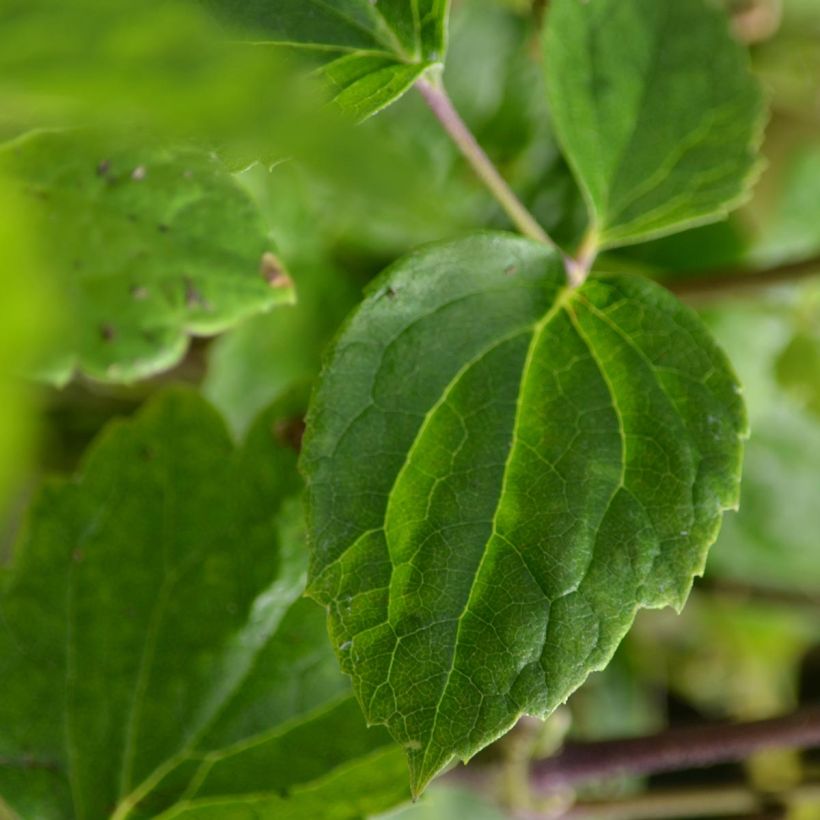
'Mrs Robert Brydon' was discovered in the 1930s in the garden of Elizabeth Prentiss, in Cleveland, Ohio. Her gardener, Robert Brydon, made it known and named it after his wife. Its parentage was long debated. Modern horticultural sources present it as a spontaneous hybrid between Clematis tubulosa and C. virginiana. The former is a perennial or an undershrub native to eastern China and Korea. The latter is a vigorous climbing clematis from temperate regions of Canada and the United States. The growth of ‘Mrs Robert Brydon’ starts unhurriedly in spring, then its stems lengthen rapidly from mid-summer. Thick, ramified and flexible, they measure 1.50 to 2 m long, sometimes 2.50 m in rich soil. They can cover an area of 1.50 to 2 m wide or climb to the same height when guided into a shrub. The deciduous leaves are arranged in pairs along the stems. They are divided into three oval to elliptical leaflets, 3 to 8 cm long, glossy dark green. From July to September, even until October in a mild climate, the shoot tips and leaf axils bear numerous branched clusters. The single flowers, 2.5 to 3 cm in diameter, have four narrow sepals, cream-white to very pale lavender blue. Their bluish edge and slightly recurved tip give the flower a fresh and delicate appearance. Long cream stamens occupy the centre of the corolla. The flowers give off a light fragrance and attract pollinating insects. They are followed by small fruits grouped into silvery grey fluffy heads, which remain decorative in autumn. This abundant flowering, combined with solid vegetation that is simply pruned in spring, explains the longevity of this variety in gardens for nearly a century.
The clematis 'Mrs Robert Brydon' is mainly used as a groundcover, but its stems can also slip into the lower branches of a shrub. The Physocarpus ‘Midnight’ has almost black foliage that will highlight its white-blue flowers. Nearby, you can plant the Clematis recta ‘Purpurea’. It will form a flexible clump, notable in spring for its young purplish leaves, then in summer under a cloud of small, fragrant white flowers. A little further on, the Aster ‘Little Carlow’ will offer in September a multitude of small lavender blue daisies. In a more romantic border, the shrub rose ‘Alden Biesen’, covered in clusters of small pink flowers, can support the stems of this pretty variety ‘Mrs Robert Brydon’.
Advice: avoid excess fertiliser which stimulates foliage at the expense of flowers. Do not mulch, to avoid excessive moisture that encourages wilt disease.
Clematis Robert Brydon in pictures
Plant habit
Flowering
Foliage
Botanical data
Clematis
× jouiniana
Robert Brydon
Ranunculaceae
Tube clematis
Clematis x jouiniana 'Mrs Robert Brydon', Clematis heracleifolia 'Mrs Robert Brydon'
Cultivar or hybrid
Planting and care
Plant Clematis ‘Mrs Robert Brydon’ in spring or autumn, in sun or light partial shade. It tolerates ordinary, clay or chalky soil, but grows best in deep, fertile, well-loosened soil that retains moisture without becoming waterlogged. Unlike woody climbing clematis, this herbaceous variety should be planted at ground level, without burying the base of the stems deeply. Water regularly during the first summer, then during prolonged dry spells. A compost mulch in spring supports its growth and flowering. The stems can run freely over the ground or be trained into a shrub, over a low trellis or along a low wall. Watch out for aphids and young shoots which are sometimes nibbled by slugs in spring.
Planting period
Intended location
Care
Planting & care advice
-
, onOrder confirmed
Reply from on Promesse de fleurs
Recently viewed products
Haven't found what you were looking for?
Hardiness is the lowest winter temperature a plant can endure without suffering serious damage or even dying. However, hardiness is affected by location (a sheltered area, such as a patio), protection (winter cover) and soil type (hardiness is improved by well-drained soil).

The flowering period indicated on our website applies to countries and regions located in USDA zone 8 (France, the United Kingdom, Ireland, the Netherlands, etc.)
It will vary according to where you live:- In zones 9 to 10 (Italy, Spain, Greece, etc.), flowering will occur about 2 to 4 weeks earlier.
- In zones 6 to 7 (Germany, Poland, Slovenia, and lower mountainous regions), flowering will be delayed by 2 to 3 weeks.
- In zone 5 (Central Europe, Scandinavia), blooming will be delayed by 3 to 5 weeks.
In temperate climates, pruning of spring-flowering shrubs (forsythia, spireas, etc.) should be done just after flowering.
Pruning of summer-flowering shrubs (Indian Lilac, Perovskia, etc.) can be done in winter or spring.
In cold regions as well as with frost-sensitive plants, avoid pruning too early when severe frosts may still occur.
The planting period indicated on our website applies to countries and regions located in USDA zone 8 (France, United Kingdom, Ireland, Netherlands).
It will vary according to where you live:
- In Mediterranean zones (Marseille, Madrid, Milan, etc.), autumn and winter are the best planting periods.
- In continental zones (Strasbourg, Munich, Vienna, etc.), delay planting by 2 to 3 weeks in spring and bring it forward by 2 to 4 weeks in autumn.
- In mountainous regions (the Alps, Pyrenees, Carpathians, etc.), it is best to plant in late spring (May-June) or late summer (August-September).
The harvesting period indicated on our website applies to countries and regions in USDA zone 8 (France, England, Ireland, the Netherlands).
In colder areas (Scandinavia, Poland, Austria...) fruit and vegetable harvests are likely to be delayed by 3-4 weeks.
In warmer areas (Italy, Spain, Greece, etc.), harvesting will probably take place earlier, depending on weather conditions.
The sowing periods indicated on our website apply to countries and regions within USDA Zone 8 (France, UK, Ireland, Netherlands).
In colder areas (Scandinavia, Poland, Austria...), delay any outdoor sowing by 3-4 weeks, or sow under glass.
In warmer climes (Italy, Spain, Greece, etc.), bring outdoor sowing forward by a few weeks.
Shipping country and language
Your country of residence may be:
Your country of residence is:
For a better user experience on our website, you can select:
Your shipping country:
-
 Austria
-
 Belgium
-
 Bosnia & Herzegovina
-
 Bulgaria
-
 Croatia
-
 Cyprus
-
 Czechia
-
 Denmark
-
 Estonia
-
 Finland
-
 France
-
 Germany
-
 Greece
-
 Hungary
-
 Iceland
-
 Ireland
-
 Italy
Italy
-
 Latvia
-
 Liechtenstein
-
 Lithuania
-
 Luxembourg
-
 Malta
Malta
-
 Netherlands
-
 Poland
-
 Portugal
-
 Romania
-
 Serbia
-
 Slovakia
-
 Slovenia
-
 Spain
Spain
-
 Sweden
-
 Switzerland
Language:
-
French
-
 English
-
Spanish
-
Italian
-
German
-
Portuguese
-
Dutch
-
Finnish
My Account
Hello
My wish lists
My cart
Log in / Register
Existing customer?
This form is protected by reCAPTCHA - the Google Privacy Policy and Terms of Service apply.
New customer?
Create an account to track your orders, access our customer service and, if you wish, make the most of our upcoming offers.