12 fragrant shrubs for a fragrant garden all year round
Our selection to scent every season
Contents
Fragrance is a real asset in the garden. It complements flowering and foliage, and for some plants, announces their presence before you even see them. Soft, sweet, musky, fruity… the range of fragrances is just as broad as that of colours and forms. And the beautiful season is not the only time of year to offer pleasant scents. Discover our selection of 12 fragrant shrubs with powerful scents, to perfume your garden throughout the year!

Fragrant Shrubs for Spring
Golden Currant – Ribes odoratum
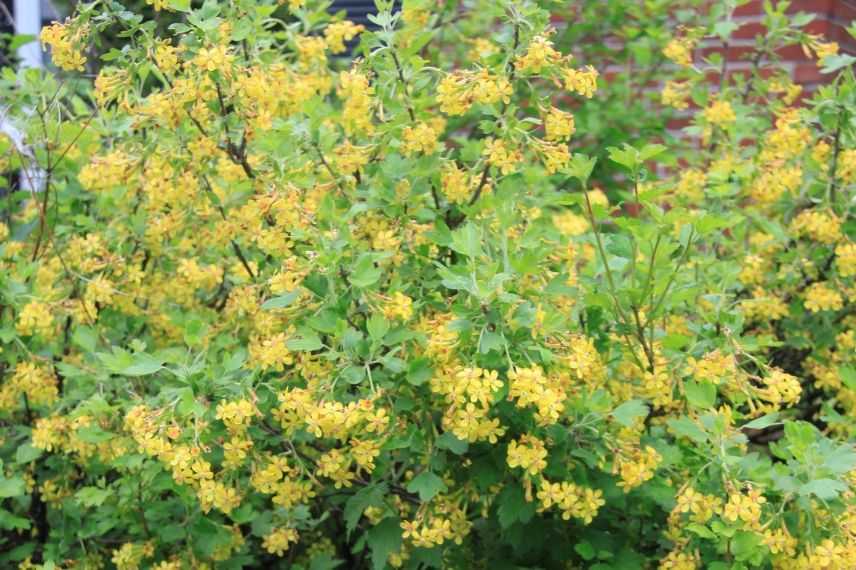
A shrub with a bushy, rounded habit, the Golden Currant has plenty to offer. In the heart of spring, its many tubular flowers, blending yellow and orange, release a clearly perceptible fragrance into the surrounding air. They are followed by black fruits, which are edible but of limited culinary interest. Thornless, this ornamental currant bears toothed foliage in a vivid green, which turns a magnificent purple in autumn. Hardy to at least -15 °C, this 2m shrub fits just as well into hedges as into beds and borders.
- Its requirements
Plant it in any ordinary, deep, moisture-retentive soil, even chalky soil, in full sun or partial shade.
- Its fragrance
Sweet but clearly present, the Golden Currant’s fragrance is reminiscent of carnation. It carries some distance from the shrub.
→ Discover all our flowering currant varieties and our guide: Flowering currants: planting, growing and care
Burkwood Viburnum – Viburnum burkwoodii
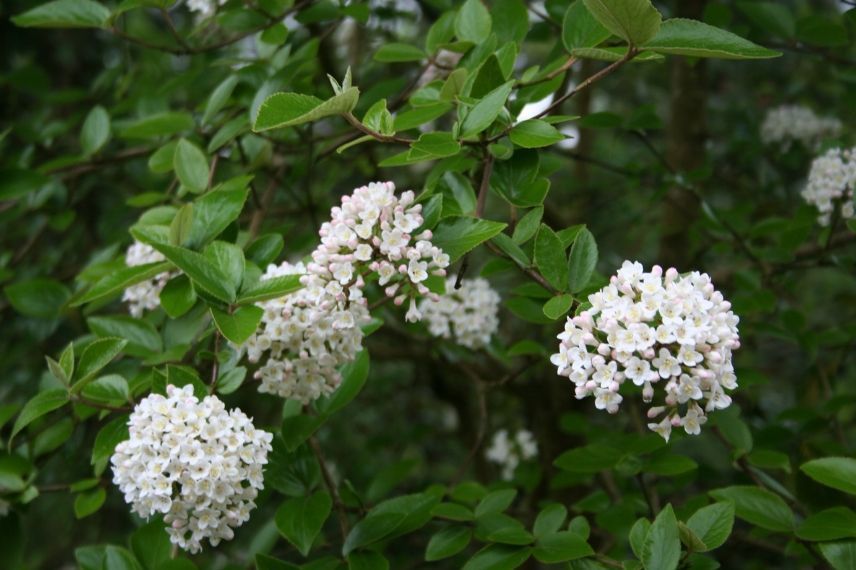
A must-have in a fragrant garden, the Burkwood Viburnum brightens spring with its small white flowers tinged with pale pink, gathered into numerous balls around 10cm across. Its fragrance is simply wonderful at this time! The deciduous to semi-evergreen foliage is borne by a shrub around 2.50m tall, with a sometimes slightly untidy habit. Green during the growing season, the leaves once again draw attention to this superb shrub in autumn, when they take on particularly warm colours. Hardy to -20°C, this viburnum is easy to grow and takes centre stage in the garden several times a year. The variety ‘Ann Russell’ differs from the type by its more limited growth and more compact habit.
- Its requirements
Plant your viburnum in moist but well-drained soil, without too much chalk, in full sun or partial shade.
- Its fragrance
Reminiscent of lily, it also releases notes of jasmine and tuberose. Very powerful, it can truly be detected several metres away!
→ Discover our wide range of viburnums and our guide: Viburnums: planting, pruning and growing
Lilac – Syringa
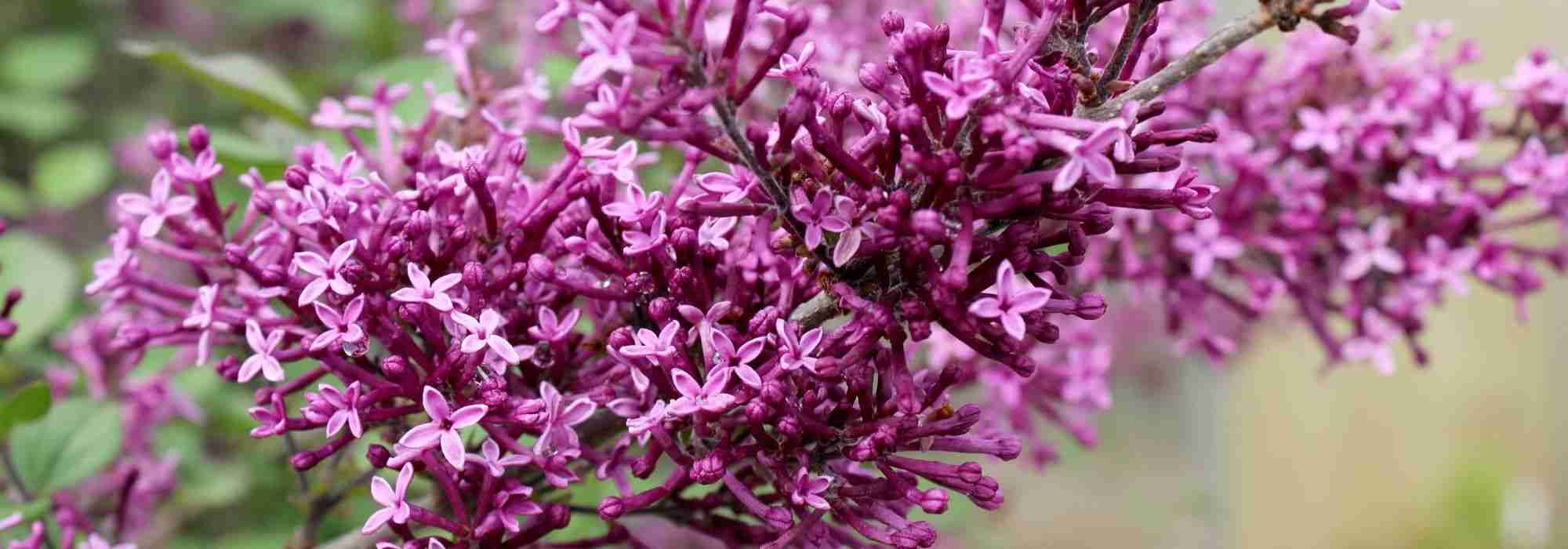
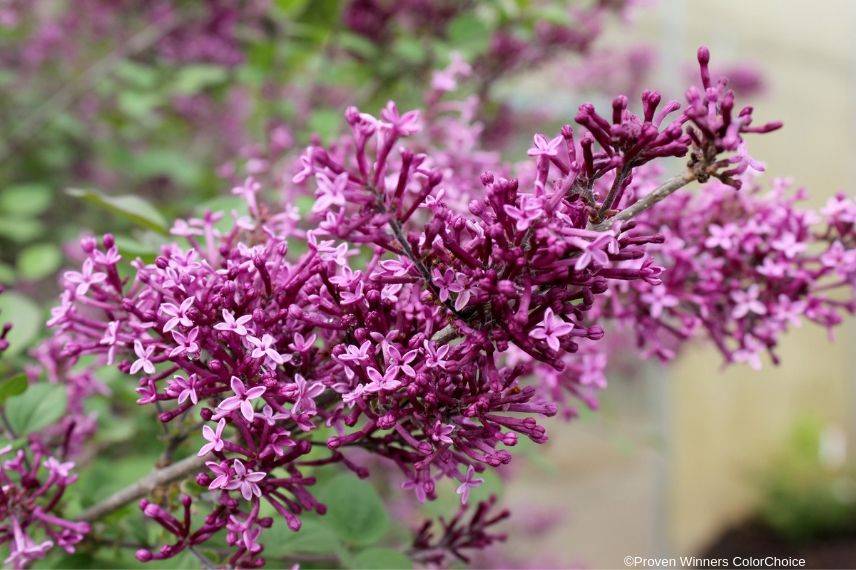
Lilacs are emblematic of a fragrant spring. These hardy, very easy-to-grow shrubs have an upright, dense habit, forming a well-branched bush that becomes more relaxed with age. Fast-growing, lilac produces clusters of nectar-rich flowers in various colours around April-May, ranging from white to deep burgundy, with different shades of pink and blue in between. Some even offer colour combinations, such as the variety ‘Sensation’. Single or double, the flowers emerge from medium-green foliage in easily recognisable pyramidal thyrses. Recent hybrids, such as Lilac Bloomerang ‘Dark Purple’, provide an encore, offering repeat flowering once the summer heat has passed. Fast-growing, lilacs can reach over 6 metres, but some dwarf varieties, such as ‘Bloomerang Pink Perfume‘, do not exceed 1.30m, allowing them to be planted anywhere, even in a pot on a terrace.
- Its requirements
Lilac grows in any ordinary, well-drained soil, even chalky ground. It thrives in full sun or partial shade.
- Its fragrance
A fragrance steeped in nostalgia, one that inevitably reminds us of our grandparents’ gardens, to the point of becoming a benchmark. Sweet and tender, it combines floral and aniseed notes.
→ Discover all our lilac varieties and our guide: Planting, pruning and caring for lilacs
Read also
10 fragrant and scented plantsFragrant Shrubs for Summer
Butterfly Bush – Buddleia
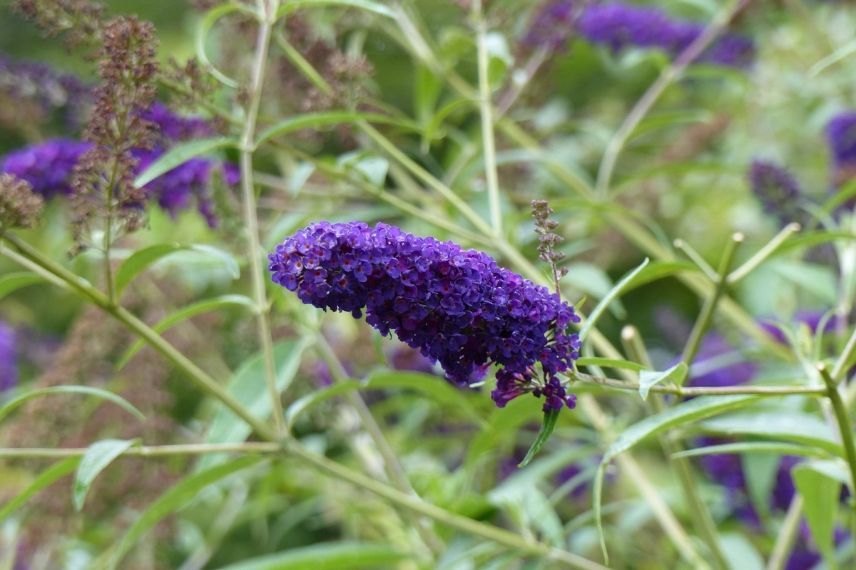
A small bush or handsome shrub, the butterfly bush grows from 1.20 m to 4 m, depending on the variety. Its spreading silhouette showcases deciduous or more or less evergreen foliage, ranging from green to silvery, with a downy underside. Between June and October, long nectar-rich spikes adorn the plant and attract butterflies. There is a wide choice of colours, including bright blue in ‘Empire Blue’, white in ‘White Profusion’ and pink in ‘Summer Beauty’. There are also various shades, and some are even bicoloured, as with the ‘Flower Power’ variety.
Hardy down to -20°C, fast-growing and free from disease, these shrubs find a place in every garden. They are also resistant to pollution and cope well with heat and drought. Dwarf varieties, such as ‘Nanho Blue’, even allow you to enjoy them on a terrace.
- Its requirements
Buddleia grows in any well-drained soil, even poor, chalky soil. Plant it in full sun and preferably sheltered from the wind.
- Its fragrance
Dominated by honeyed scents, it gives off musky notes with a hint of carnation. The fragrance is clearly noticeable when you pass close to the shrub.
→ Discover our selection of butterfly bushes and our guide: Planting, pruning and caring for butterfly bush.
Japanese Snowbell – Styrax japonicus
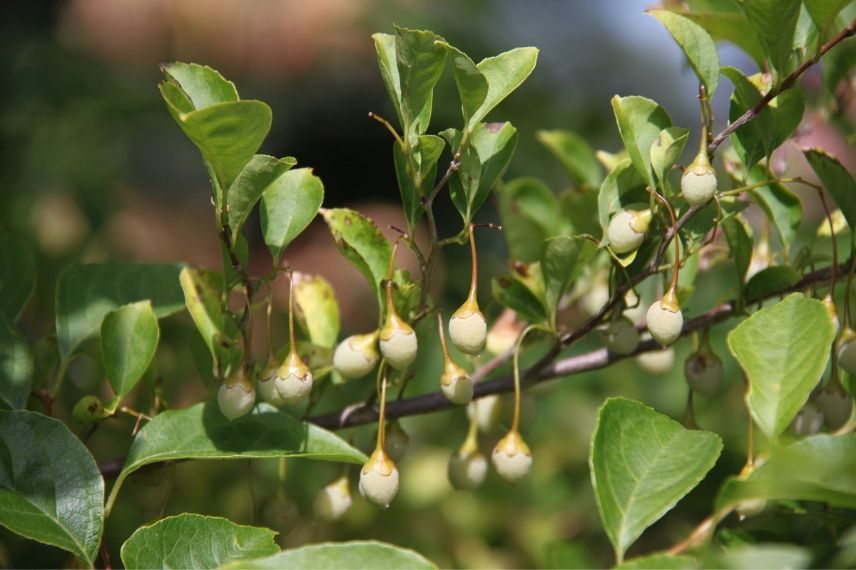
Once somewhat little-known, Japanese snowbell is becoming more popular every year. It certainly has plenty to offer! This shrub has an elegant habit and a tiered silhouette, with horizontal branches that bear deciduous leaves in a beautiful dark green, slightly bluish on the underside. In autumn, they burst into superb shades of yellow and orange. This unusual shrub is also valued for its fragrant flowering, which takes place in early summer, producing a multitude of white bells, whose trailing habit further enhances their striking architectural effect. Dry, creamy-white drupes follow the flowers. Moderately fast-growing, Styrax is very long-lived and rarely exceeds 3 to 4 m. Hardy (-15°C), highly resistant to disease and easy to grow, it deserves to be better known and used in the garden or in a pot.
- Its requirements
Styrax prefers light, neutral to acidic soils that are rich in organic matter and remain moist. In the warmest regions, plant it in partial shade. Elsewhere, it can tolerate full sun. Simply avoid very hot, scorching positions.
- Its fragrance
Its fresh, indulgent fragrance is both vanilla-like and sweet.
→ Discover our Styrax species and our guide: Planting, caring for and pruning Styrax
Harlequin Glorybower – Clerodendron trichotomum
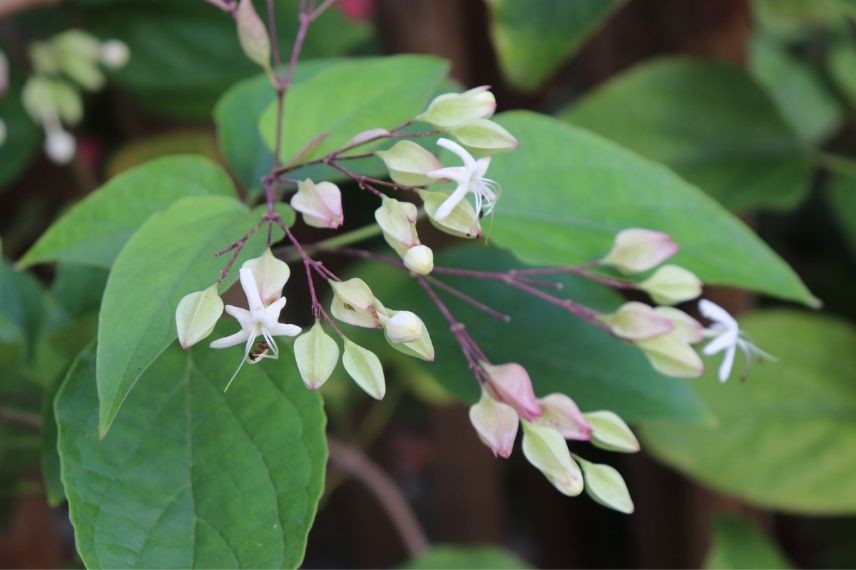
Known as Harlequin Glorybower, the Chance Tree or Turquoise Tree, Clerodendron is an unusual shrub with an exotic appearance. Its deciduous leaves are green in the species, while those of the Variegatum cultivar are variegated with yellow, which turns white as the season progresses. The prominent veins give the foliage an attractive relief, while the underside is downy. When crushed, the leaves release unusual peanut-like notes. From July to October, the plant is adorned with panicles of star-shaped, highly fragrant white flowers with purple calyxes. They are followed by small round berries, resembling delightful precious stones, turquoise blue and set in a bright red casing. These qualities are complemented by fast growth, very good disease resistance, minimal care requirements and good hardiness (-15°C). What more could you ask for?
Clerodendron trichotomum
- Its requirements
Easy to grow, Clerodendron is happy in any well-drained, moist soil, in full sun or partial shade. Avoid heavy, airless soils that become waterlogged in winter, as well as excessive heat in summer.
- Its fragrance
While the peanut-like smell of its crushed foliage may be surprising and is not to everyone’s taste, the jasmine-like fragrance of its flowers is delicious, especially at dusk.
→ Discover our Styrax species and our guide: Planting, caring for and pruning Styrax.
Fragrant shrubs for autumn
Autumn Camellia – Camellia sasanqua
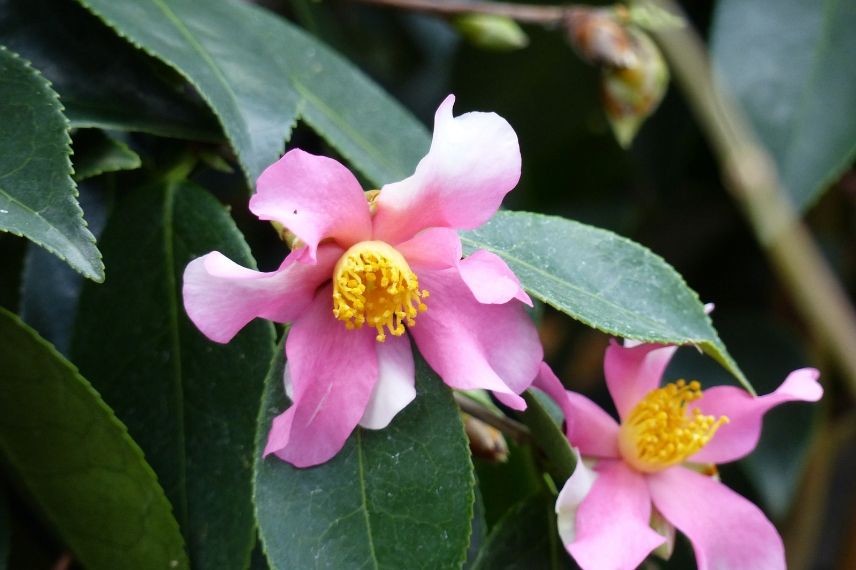
With a species name like that, Camellia sasanqua (pronounced ‘What does it smell like?‘) simply had to feature in a selection of fragrant shrubs. This small camellia has typically glossy, thick and leathery evergreen foliage, and stays within reasonable proportions (1.50 to 3m), making it easy to incorporate, even in smaller spaces or in a pot. Slow to moderately vigorous, it has the particularity of flowering in autumn, generally between October and December, with single or double flowers in shades of pink, red or white. Some varieties have a particularly noticeable fragrance, such as ‘Setsugekka’, with single white flowers and golden stamens, or ‘Yume’, with highly fragrant pink and white flowers and an exceptionally long flowering period.
Although autumn camellia tolerates drought fairly well once established, it is somewhat more sensitive to cold (-10°C), especially when the cold spell is prolonged.
- Its requirements
Like all camellias, Camellia sasanqua requires acidic soil. Lime is its enemy! Light soil, rich in humus and remaining cool, is ideal. Heavy, damp soils in winter should be avoided. A sunny position is possible in northern France. Further south, choose partial shade. In all cases, shelter your camellia from cold, drying winds.
- Its fragrance
The fragrance may evoke jasmine tea or lily, but not all varieties are equally powerful.
→ Discover our autumn-flowering camellias and our guide: Planting, pruning and caring for camellias
Oleaster – Elaeagnus ebbingei
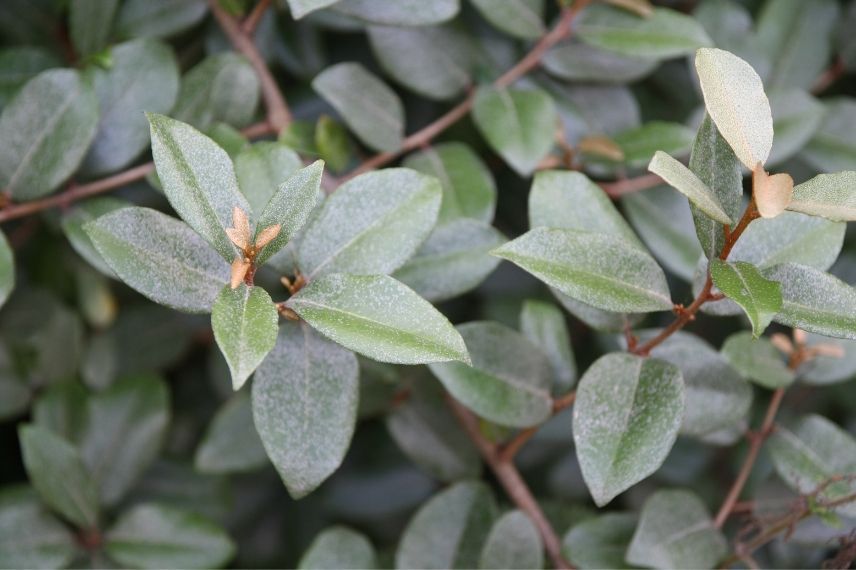
Although it may seem inconspicuous at first, oleaster really comes into its own in autumn. It is not its small cream, bell-shaped flowers that attract attention, but rather the powerful fragrance they give off. Ideal for hedges, topiary or even pots, this evergreen shrub has dense foliage, green with silvery undersides in the type, or bright variegation, as in ‘Limelight’ and ‘Gilt Edge’. Edible orange fruits follow the flowering period. Very hardy and tolerant of wind and salt-laden spray, this fast-growing shrub reaches 1.70 m to 3 or 4 m. Its branches may bear a few thorns.
- Its requirements
Not fussy about soil, oleaster will grow even in poor, dry and chalky soil. It also thrives in a richer, cooler substrate. Happy in sun or partial shade, it is also ideal for creating windbreak hedges by the coast.
- Its fragrance
Very powerful, especially when compared with the size of its flowers, it can be detected from a distance. An oleaster hedge fills the entire garden with fragrance combining carnation, jasmine and honey in autumn.
→ Discover all our oleaster varieties and our guide: Planting, pruning and caring for Elaeagnus.
Fragrant Osmanthus – Osmanthus heterophyllus
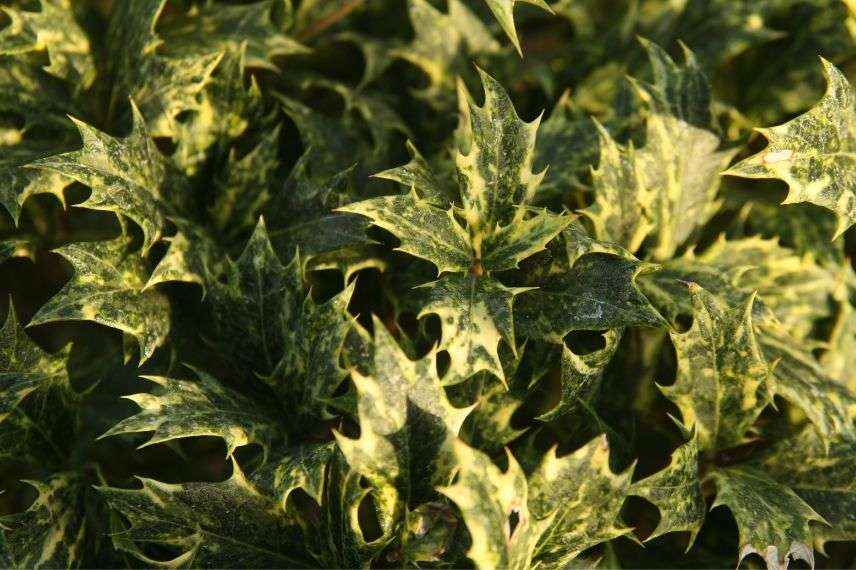
At first glance, fragrant Osmanthus resembles holly, but differs from it through a powerful fragrance that spreads in late autumn. Its glossy foliage is strongly thorny and remains on the plant all year round. Green in ‘Gulftide’, it bears variegated foliage in ‘Tricolor’, or purple foliage in ‘Purpureus’. This compact, bushy shrub bears bright white flowers in autumn, followed by midnight-blue fruits. Very easy to grow and adaptable, Osmanthus tolerates salt-laden spray, is unaffected by disease and has good hardiness (-10°C to -15°C). This makes it an ideal shrub for beginner gardeners. Although it responds well to pruning, it is fairly slow-growing.
- Its requirements
Plant Osmanthus in light, rich, well-drained, cool but non-calcareous soil. Avoid waterlogged soil in winter or soil that is too dry in summer. Happy in sun north of the Loire, it tolerates partial shade perfectly further south, as long as it receives sufficient light to flower well.
- Its fragrance
Perceptible from several metres away, it is dominated by scents of jasmine and gardenia, mingled with notes of apricot and peach.
→ Discover our range of Osmanthus and our guide: Planting, pruning and caring for Osmanthus.
Read also
Scented geraniums: how to succeed ?Fragrant Shrubs for Winter
Bodnant Viburnum – Viburnum bodnantense
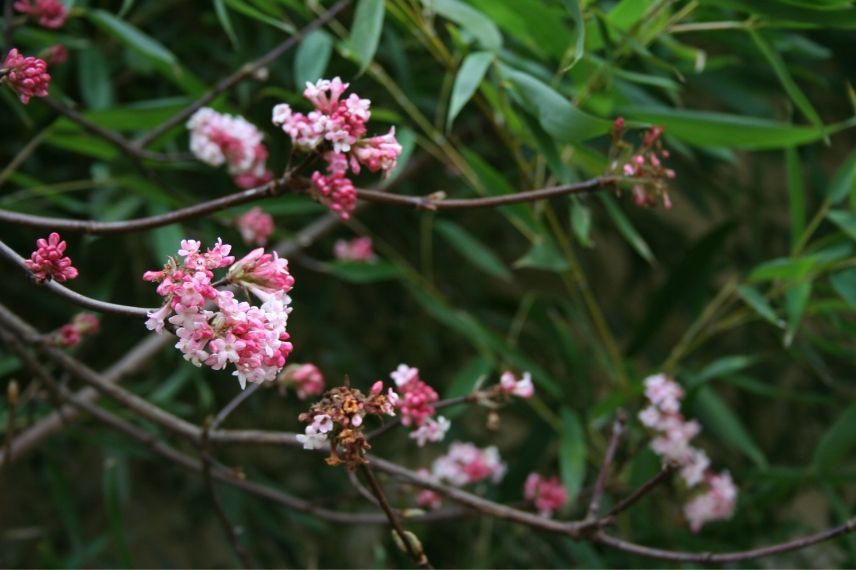
When it flowers on its bare wood, between November and February, Bodnant Viburnum brings a touch of cheer to the grey winter landscape. Its bright pink buds open into numerous clusters of pale pink, delicately scented flowers, a delightful surprise at this time of year. Its deciduous foliage, with prominent veins, takes over in spring, emerging in bronze tones before turning green as the season progresses, then becoming tinged with purplish red in autumn. The Bodnant Viburnum varieties ‘Dawn’ and ‘Charles Lamont’ are quite similar. Both are easy to grow and hardy (-15°C), with moderate growth, and the shrub eventually reaches 2.50 to 3m.
- Its requirements
Plant Bodnant Viburnum in full sun or partial shade, in any type of moist, deep soil. It can tolerate a little lime, but not too much. Shelter it from cold winds.
- Its fragrance
Its fragrance is a surprise in the depths of winter, and its vanilla notes, combining heliotrope and carnation, are particularly noticeable when the weather becomes a little milder.
→ Discover our wide range of Viburnums and our guide: Planting, pruning and caring for Viburnums.
Mahonia – Oregon grape
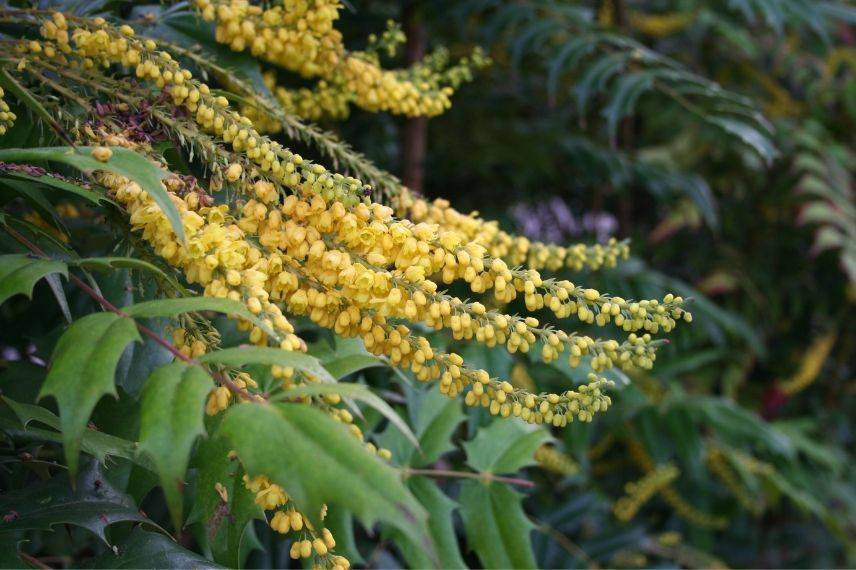
A hardy shrub, Mahonia offers fragrant winter flowering, with terminal clusters of bright yellow flowers that are subsequently replaced by decorative midnight-blue berries. The foliage, thick and leathery, is deeply divided and spiny. Evergreen, it becomes attractively tinged with red as temperatures fall. Some, such as Mahonia aquifolium ‘Apollo’, do not exceed 1.50m, while others can reach 5 m, such as Mahonia media ‘Charity’. Easy to grow, this exotic-looking shrub works equally well in beds and borders, beneath deciduous trees or even in a container.
- Its requirements
Although it prefers neutral to acidic soils, Mahonia can tolerate a little lime, particularly the aquifolium species. It thrives in moist, light and well-drained soil, but can cope with less-than-ideal conditions. In the South of France, place it in partial shade or dappled shade. Further north, it can tolerate a sunnier position. In all cases, avoid heavy, waterlogged soils.
- Its fragrance
Both sweet and floral, it combines honey and narcissus notes, dominated by scents reminiscent of lily of the valley.
→ Discover our selection of Mahonias and our guide: Planting, pruning and caring for Mahonias
Winter Sweet – Chimonanthus praecox
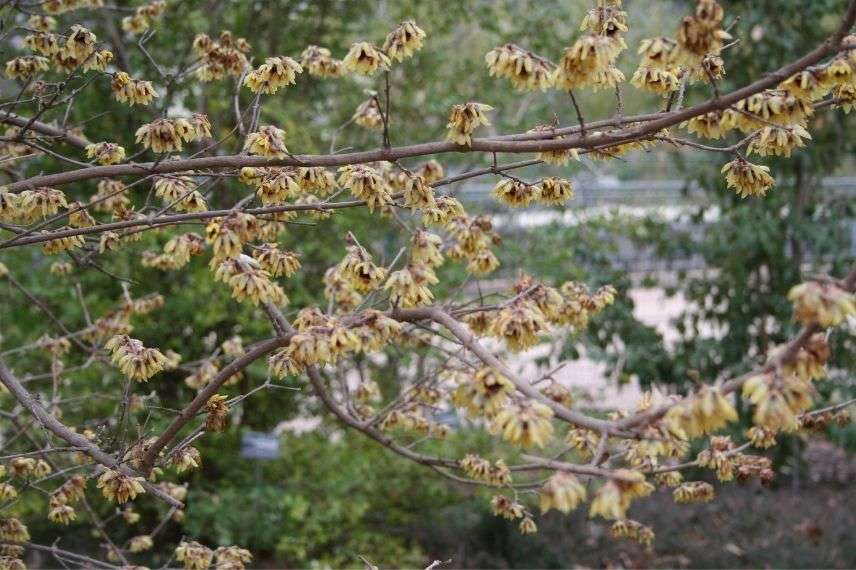
A deciduous shrub with an upright habit, whose winter flowering is among the most fragrant, Chimonanthus flowers from December to February on bare branches. Its small yellow bells, with a waxy appearance, tinged with purple at the centre, only appear after several years of growing. During the growing season, the shrub displays dark green foliage and forms a mass around 3 m high, ideal for setting off colourful foreground flowers. It can also scent a terrace if you grow it in a pot. The variety ‘Grandiflorus’ has more strongly coloured flowers and slightly longer leaves. Slow-growing, Chimonanthus can withstand temperatures of around -15°C.
- Its requirements
Chimonanthus tolerates any ordinary soil, even lime-rich or heavy soil, provided it is well drained. It grows equally well in partial shade or full sun, but prefers positions sheltered from the midday sun.
- Its fragrance
Powerful and easily detectable, even in cool weather, it is quite complex. It combines notes of hyacinth, honey, spices and jasmine.
→ To find out everything about this shrub, discover our guide: “Chimonanthus: planting, growing and pruning”
A few tips for enjoying fragrances in the garden
Scent in the garden can be a real bonus but, if used incorrectly, it may go unnoticed or, on the contrary, become overpowering.
Here are a few tips to help you make the most of it:
- Use shrubs whose fragrant flowers open in different seasons, so that they scent the garden throughout the year.
- If several fragrant shrubs flower at the same time, do not place them side by side. Some scents combine very badly.
- Place your favourite fragrances near the house or a well-used passage, so that you can enjoy them fully.
- Plant fragrant shrubs along the axis of the prevailing winds. Their scents will then reach you more easily.
- For plants with a truly powerful fragrance, take care not to risk overpowering or sickening people. Placed near seating areas or the windows of the house, they may become unpleasant for some people.
- Finally, remember that the strength of a fragrance, for the same plant, can vary according to temperature, humidity or even the time of day (or night). So, some days are more suitable than others for filling your nostrils with scent.
- Subscribe!
- Contents
This form is protected by reCAPTCHA - the Google Privacy Policy and Terms of Service apply.

































Comments