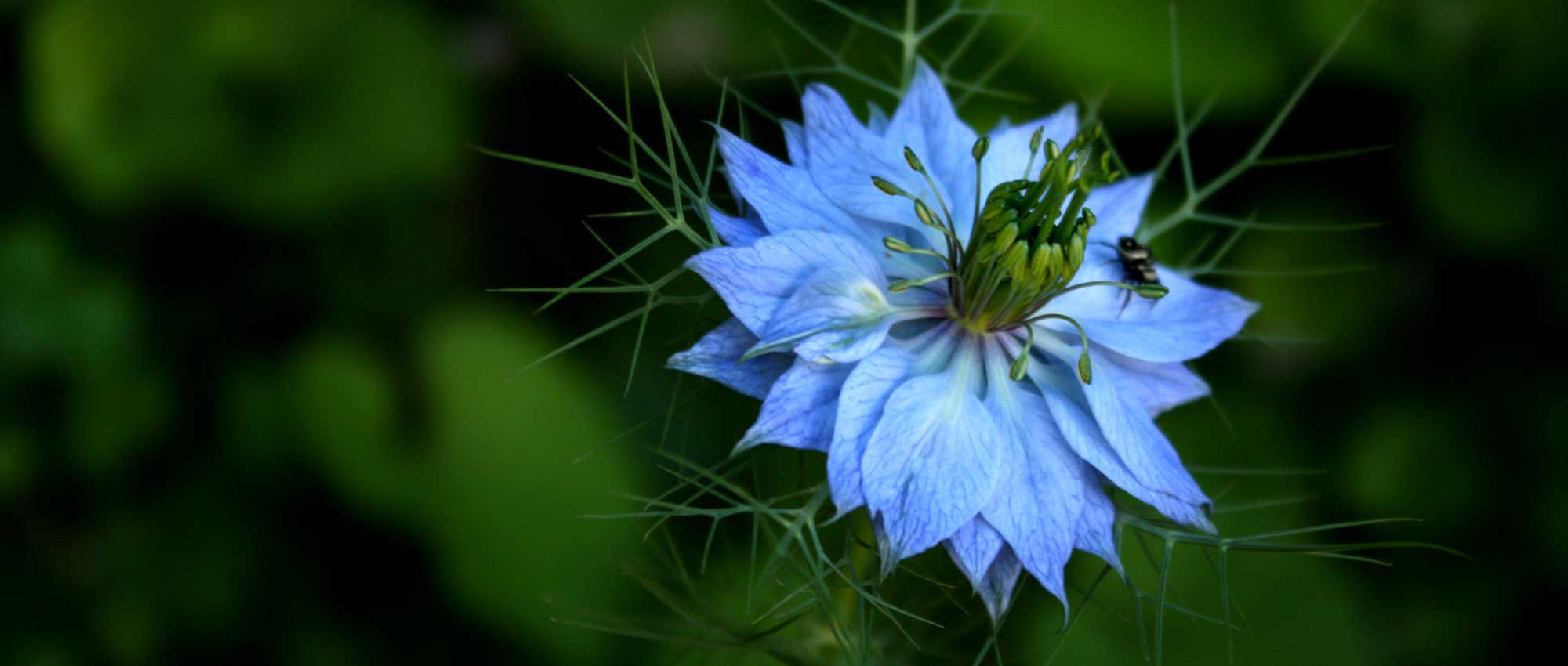
Love-in-a-mist (Nigella damascena): sowing, cultivation and care
Contents
Love-in-a-mist in a nutshell
- Nigella produces beautiful star-shaped flowers, often blue but also white or pink
- Appreciated for its very fine, airy, light foliage
- It bears extremely decorative fruits!
- Nigella is a small plant with a very natural look… It has lots of charm!
- Very easy to sow and to grow, it thrives almost anywhere and requires almost no care!
- It self-seeds spontaneously in the garden
A word from our Expert
Nigella is a small annual plant that offers airy, very refined flowering and extremely fine decorative foliage! Best known is the Damask nigella, Nigella damascena. It bears star-shaped flowers, often blue but sometimes pink or white. You can pick its flowers to create bouquets… and even make dried bouquets with the fruits, almost as decorative as the flowers! Nigella is also known for edible seeds; however, these come not from the ornamental species, Nigella damascena, but from another species, Nigella sativa — not to be confused!
Undemanding and requiring almost no maintenance, Nigella is among the easiest plants to grow! It thrives in free-draining, light soil, even poor in organic matter. It prefers a sunny position or light shade. It is not susceptible to diseases, and very easy to propagate by sowing! It also tends to self-seed in the garden. It does not smother other plants, but fills gaps in borders!
Botany
Botanical data
- Latin name Nigella damascena
- Family Ranunculaceae
- Common name Love in a mist
- Flowering usually between June and August
- Height between 20 and 50 cm
- Exposure sun or light shade
- Soil type well-drained, light. Tolerates poor, rocky soils.
- Hardiness between −15 and −20 °C
Love in a mist comprises around twenty species of annual plants native to Europe, Asia and North Africa. Best known is Love in a mist, Nigella damascena. Found around the Mediterranean, in southern Europe and North Africa. Occurs wild in France alongside a few other Nigella species. Seen in fields, wasteland, roadsides and rocky ground.
Name of Love in a mist derives from Latin niger — ‘black’ — referring to colour of its seeds. In French it is sometimes called Cheveux de Vénus because of its fine, feathery foliage divided into linear segments. In English, nigella is known as Love in a mist (a reference to its gauzy foliage), or Devil in the bush.
Love in a mist belongs to family Ranunculaceae. This is a large family, comprising over 2,000 species, mostly herbaceous and often toxic. Hellebores, aconites, columbines, clematis, delphiniums and anemones are among members of this family.
Love in a mist is a small plant: it grows between 20 cm and 50 cm tall, sometimes up to 60 cm, with a spread of 20–25 cm. Plants grow taller in rich, organic substrate. Prefers position at front of borders, in front of taller plants. Forms clumps that expand over the years, made up of erect stems, sometimes branched but sometimes simple.
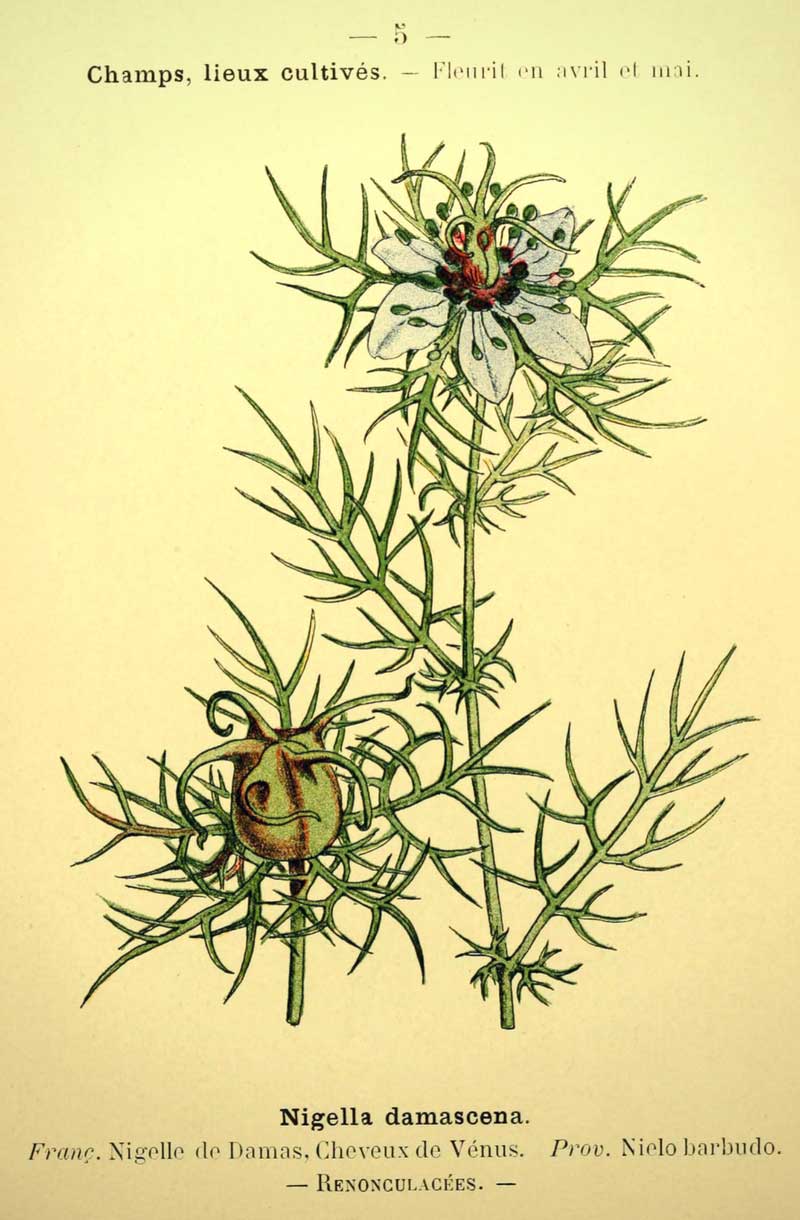
Nigella damascena: botanical plate
Love in a mist flowers in summer, generally between June and July–August, sometimes into September. Flowering may be earlier or later depending on sowing date. Blooms do not last very long, but are quickly followed by decorative fruits!
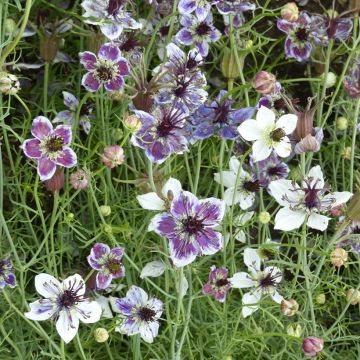
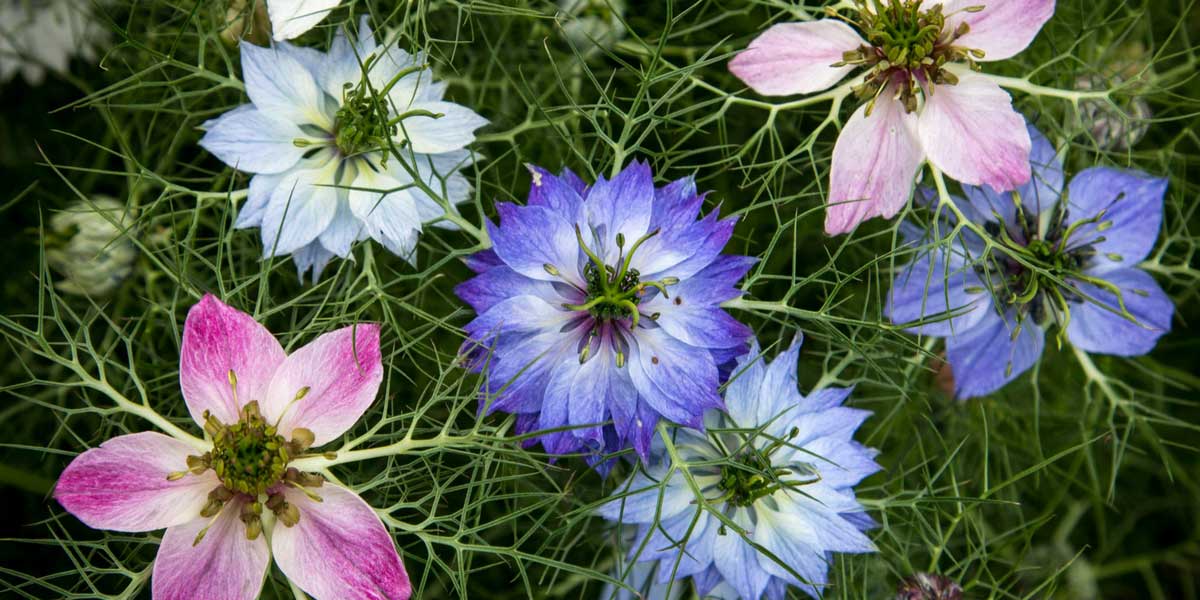
Flowers are usually soft, pastel shades. They are often pale blue, but can also be white or pink, sometimes almost red, or mauve‑violet. For example, varieties ‘Persian Rose’ and ‘Mulberry Rose’ bear splendid pink flowers. Oriental nigella, Nigella orientalis, stands out with yellow blooms. Mixed seed mixes are also available that produce a range of colours. It is common for Love in a mist to display subtle variations in hue from one flower to another, and for a single flower’s colour to change slightly over time. For example, ‘Mulberry Rose’ flowers open a soft pink and deepen to a richer pink. In variety ‘Dwarf Moody Blue’, flowers are violet‑mauve and shift towards blue. Sometimes a striking contrast appears between petaloid sepals, often white or pale blue, and stamens/pistils, which can be very dark — black or burgundy.
Love in a mist bears very pretty star‑shaped flowers, usually solitary and borne at stem tips. Flowers measure 3–5 cm in diameter. They consist of five to twenty‑five petaloid sepals (petal‑like) that are coloured. These surround five to ten often smaller petals, which sometimes bear nectar consumed by insects. Flowers are hermaphrodite, each with male organs (stamens) and female organs (pistils). At centre of the flower are five to ten erect, clustered pistils surrounded by numerous stamens. Styles are long and thin, resembling leaf segments, and are often curved towards stamens to facilitate fertilisation. Pistils and stamens are usually highly decorative, adding detail and refinement to the flower, and sometimes provide an attractive contrast with the paler sepals. Directly beneath the coloured sepals, Love in a mist has five bracts divided into fine strips, matching appearance of the plant’s other leaves. These are all inserted at the same level. Flower appears nestled in a silky case of very fine leaves. Some forms stand out with very different blooms, such as Nigella ‘Blue Stars’, which bears small five‑petalled blue‑violet flowers with a centre full of stamens. These look much simpler than in other nigella!
Feel free to use Love in a mist in cut arrangements — flowers hold up fairly well in a vase.
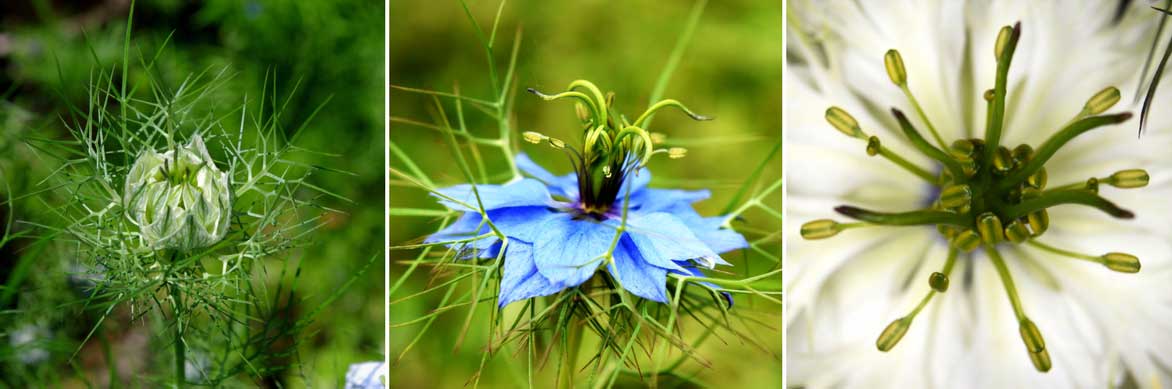
A Love in a mist flower bud opening (photo JLPC) / a Nigella damascena flower / detail of stamens and pistils
Leaves of Love in a mist are divided into extremely fine segments. They are laciniate, which makes them very ornamental. Foliage is gauzy, light and feathery. Its fineness has earned the plant the name Cheveux de Vénus. Leaves are alternate, placed one after another along the stem. They measure 8–15 cm in length and are light green. Foliage is quite characteristic and allows easy identification of the plant, even at seedling stage.
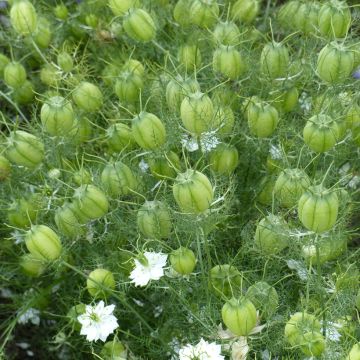
Fruits of Nigella damascena are very decorative. These are large, globose, inflated capsules that turn brown at maturity. Surrounded by dried, very fine bracts, they also bear thread‑like, erect styles at their top. Capsules are divided into several locules that contain the seeds. Capsules open when ripe and release numerous small black seeds. Seeds are three‑faced, wrinkled and striate. Although annual, Love in a mist self‑sows readily, allowing it to persist in the garden. You can cut stems bearing the capsules and use them in dried bouquets. They are very decorative and original! Leave some fruits on the plant to allow natural reseeding.
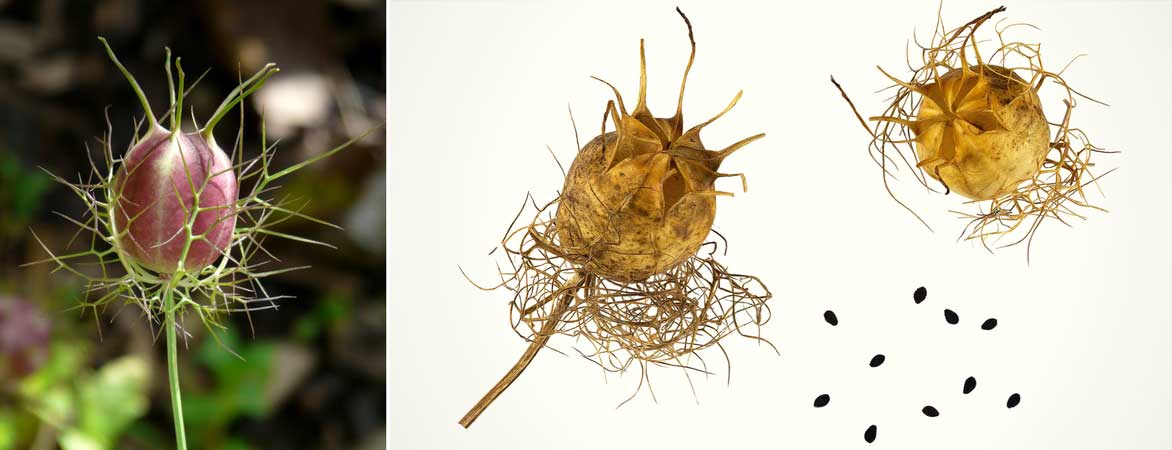
A Nigella capsule / Fruits and seeds of Nigella damascena (photo Roger Culos – Museum of Toulouse)
Botanical species
- Nigella damascena
This is the true Love in a mist, most commonly grown for its ornamental quality. It has given rise to numerous varieties!
- Nigella orientalis
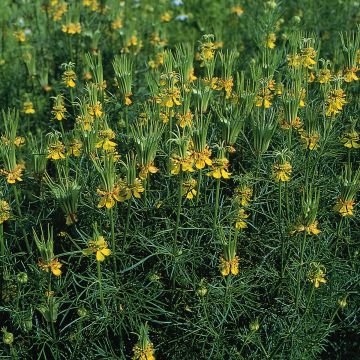
Nigella orientalis bears yellow flowers with petals curved downwards. Appreciated for its unusual, bright flowering. Most cultivated variety is ‘Transformer’.
- Nigella hispanica
Taller than Nigella damascena, reaching 60–70 cm. Bears deep blue flowers and reddish stamens.
- Nigella sativa
This nigella is grown for its seeds, used as a spice known as black cumin. Flowers are often pale blue or white.
Main varieties of nigella

Love-in-a-mist African Bride Seeds - Nigella papillosa
- Flowering time July to September
- Height at maturity 50 cm

Love-in-a-mist Delft Blue Seeds - Nigella papillosa
- Flowering time July to October
- Height at maturity 60 cm

Love-in-a-mist Miss Jekyll Blue Seeds - Nigella damascena
- Flowering time July to September
- Height at maturity 50 cm

Love-in-a-mist Miss Jekyll Alba Seeds - Nigella damascena
- Flowering time July to September
- Height at maturity 50 cm

Love-in-a-mist Persian Rose Seeds - Nigella damascena
- Flowering time July to September
- Height at maturity 50 cm

Nigella damascena Moody Blues - seeds
- Flowering time July to September
- Height at maturity 50 cm

Nigella garidella Blue Stars - Love-in-a-mist Seeds
- Flowering time August to October
- Height at maturity 30 cm

Nigella Midnight Blue - seeds
- Flowering time June to October
- Height at maturity 70 cm
Discover other Nigella -Love-in-a-mist seeds
View all →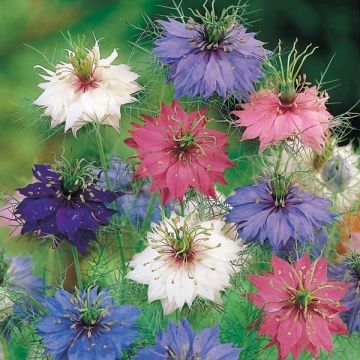
Available in 1 sizes
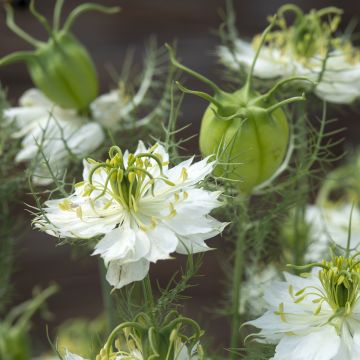
Available in 1 sizes
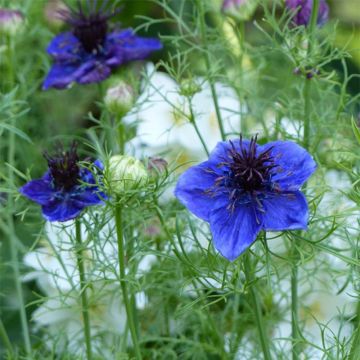
Available in 1 sizes
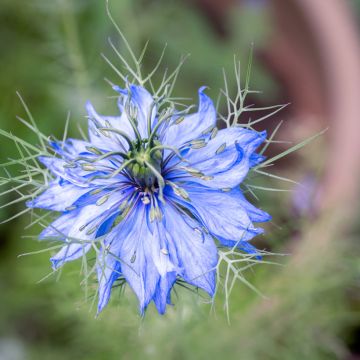
Available in 1 sizes
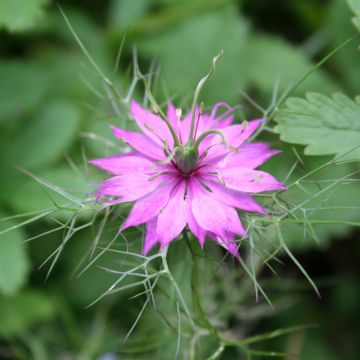
Available in 1 sizes
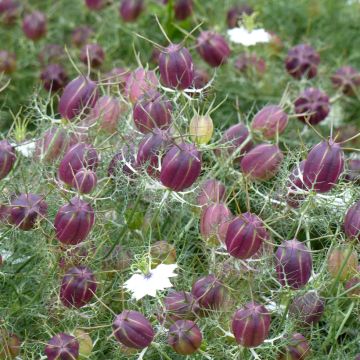
Available in 1 sizes
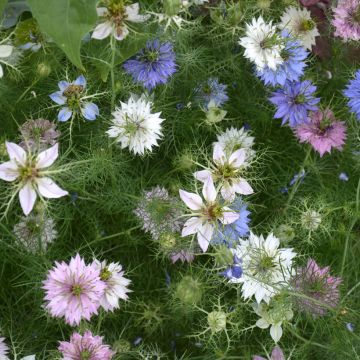
Available in 1 sizes
Available in 1 sizes
Available in 1 sizes
Available in 1 sizes
Sowing
Where to sow Nigella damascena?
Sow nigella directly in open ground, in full sun or in a lightly shaded spot. In dense shade, flowering may be less abundant. Nigella prefers rich soils but will also cope with poor soils. It is a relatively undemanding plant that can grow in any soil type. It will grow taller in soils rich in organic matter but may then produce more foliage at the expense of flowering. Nigella prefers soils with a neutral pH.
Nigella damascena likes well-draining substrates where water soaks away easily. It grows very well in sandy soils. If your garden soil is heavy, compact and holds water, we recommend adding draining materials: pumice, gravel or coarse sand. Nigella is an easy plant that needs little: it is perfect for filling areas of the garden where soil is poor and dry, such as rockeries. You can sow it on a bank or in parts of the garden that are difficult to plant.
Nigella is a fairly low-growing plant: place it preferably at the front of borders, just in front of taller plants. It can also help fill gaps in beds. Don’t hesitate to sow it alongside other annuals (poppy, cosmos, etc.)
You can grow it in a pot or window box, for example on a balcony or windowsill.
→ Learn more in our tutorial: How to sow nigella seeds?
When to sow?
Nigella is often sown in spring, from March to May. But it can also be sown in autumn, especially in regions with relatively mild winters; in that case it will flower earlier. Ideally, stagger sowings so flowering periods follow one another over a longer time!
How to sow Nigella damascena?
Nigella is very easy to sow! Sow preferably in its final position, as its roots are fragile and do not like being disturbed.
In open ground:
- Prepare soil by breaking up clods and removing large stones, roots and weeds to obtain a fine, even surface. Optionally add a little well-rotted compost. Level the area so the sowing surface is flat.
- Sow by scattering seeds on the soil surface. We recommend sowing broadcast for a natural effect. You can also use a seed drill.
- Cover with a thin layer of compost, then firm very lightly.
- Water gently with a fine spray.
Keep soil moist until germination, which will occur after one to two weeks. Then thin seedlings by removing some young plants. Remaining plants should be spaced about 20 cm apart.
In pots:
If you want to grow it in containers, you can sow Nigella damascena in a pot or window box. Place a drainage layer at the bottom of the pot (gravel, broken pot shards or clay balls) to allow water to drain. Then use a mix of compost and coarse sand, spread seeds on the surface and water with a fine spray.
Read also
Sowing a flower meadow: why, howCare
Nigella damascena doesn’t really need care, apart from occasional watering during hot spells and a little weeding. Plants grown in pots will need more frequent watering than those grown in ground, as soil dries out faster.
We recommend leaving faded flowers on the plant, not cutting them, so you can enjoy the decorative capsules that will form and allow the plant to produce seeds. You can either let it self-seed, or harvest the seeds for sowing or to give away! Although nigella tends to self-seed, it doesn’t become invasive… It usually fills gaps in borders.
You can weed nigella clumps by removing any weeds that sometimes creep in. Weed especially when capsules are present, to allow seeds to settle on bare soil and self-seed easily. Conversely, young nigella shoots are easy to spot, so remove them if they appear where not wanted.
Don’t hesitate to harvest nigella flowers for bouquets! Cutting them may slightly prolong flowering; however, it will prevent you enjoying the decorative capsules. Try always to leave a few flowers in place, both so they can self-seed and so you have some capsules. Especially as these can also be used in dried bouquets! Cut stems while still fresh and tie them together. Then hang them upside down to dry.
Nigella damascena is not susceptible to diseases. It doesn’t need any treatment! The only problem may be slugs and snails, which sometimes eat young shoots.
Multiplication
Nigella are very easily propagated by sowing, which you can do directly in the ground or in pots. When ripe, the capsules turn brown and begin to open slightly. That’s the time to harvest them to collect the seeds. You can also let Nigella self-seed, and you can pot up any spontaneous seedlings in the garden while they are still very young. Similarly, if you need to transplant Nigella, do so while the seedlings are still small, as they do not tolerate being moved well.
It is possible to keep the seeds for later sowing. Place them in a paper bag or an envelope and store it in a dry, cool, dark place. Remember to label them (plant name and harvest date). In theory, Nigella seeds remain viable for two years, but it is preferable to sow them within a year.
Over time, the flowers of cultivated varieties may drift slightly in colour. It can be worth buying new plants to restore the original variety.
Association
Nigella pairs perfectly with other annuals to create a country-style border, with a wild, very natural look. For example, you can combine it with cosmos, especially the white-flowered types (such as the ‘Purity’ variety). Blue and white are colours that work very well together. It will accompany beautifully the cornflowers (Centaurea cyanus), the intense red blooms of poppies, or the superb flowering of Oriental poppies. Scatter these flowers among the fine foliage of grasses (Penisetum, Stipa pennata…), and enjoy in particular the very delicate spikes of Briza media. Plant nigella alongside wildflowers, which bring charm and lightness. Indeed, nigella is often included in wildflower meadow mixes! It can associate well with centauries, calendulas, sainfoin (Onobrychis viciifolia), wild chicory (Cichorium intybus), and especially with flax, Linum perenne. You will feel as if you have a real field of flowers!
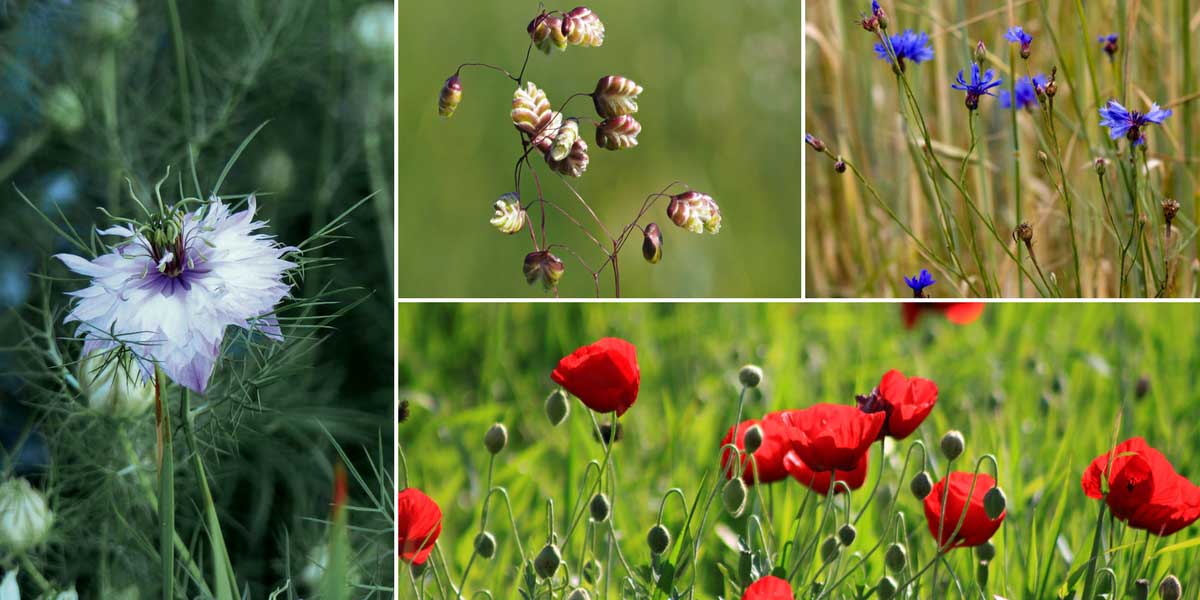
Nigella damascena can be paired with the fine spikes of the grass Briza media (photo Hajotthu), as well as cornflowers (photo Tauri Pärna), and poppies
Nigella can also find a place in the foreground of a perennial border. With the delicacy and very refined aspect of its flowers, it complements shrub roses wonderfully. You can plant it just in front of them. Don’t hesitate to pair it with calendulas, California poppies (Eschscholzia californica) or Lychnis coronaria. It’s perfect for filling gaps in borders, spaces left empty by other plants! Their elegance and natural charm allow nigella to blend nicely with lilies (Lilium candidum, Lilium martagon, Asiatic lilies…). With such combinations – nigella, roses, lilies… – you can easily create lovely bouquets to decorate your home!
Make the most of different nigella varieties to play with colour! White-flowered forms will soften the brighter blooms of other plants. They have a very elegant look and, when combined with roses, astrances and gypsophilas, you can easily achieve a very romantic garden! Plant blue-flowered nigellas with other blooms in similar tones: blue, mauve and white. For a deep, intense border, nigellas can be paired with plants in dark shades: purple, black, brown, midnight blue…
Because nigella tolerates poor, dry, stony soils well, you can place it in a rockery alongside other sun-loving, free-draining plants. For example, with grasses, achilleas or lavenders…
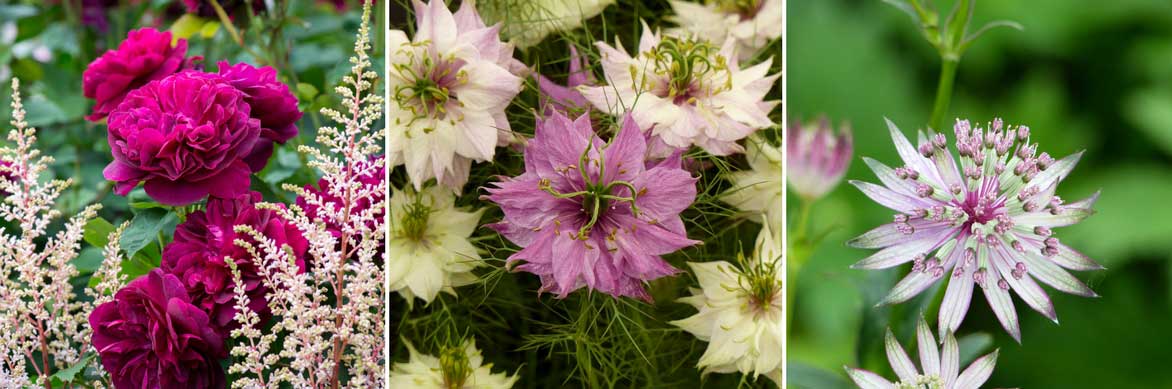
An idea for a romantic border: Rose ‘Darcey Bussell’ and Astilbe japonica ‘Peach Blossom’ (photo Nicola Stocken – GAP Photos) / Nigella damascena ‘Mulberry Rose’ / Astrantia major ‘Ruby Star’
Did you know?
- Spice and medicinal plant
Seeds of cultivated nigella, Nigella sativa, are often consumed as a spice, their aroma reminiscent of both strawberry and pepper. Already used in ancient Egypt, they took the name Black Cumin, and are sometimes present in ras-el-hanout spice blend. They can be sprinkled over salads or into rice or vegetable dishes… However, they should be eaten in moderation, in small quantities. Likewise, avoid consuming those of Nigella damascena; they are not edible and may even be toxic. Nigella oil is also produced, noteworthy for its antioxidant and anti-inflammatory properties. It is used externally for skin and hair care, but also internally, where it can be added to salads or various dishes.
Useful resources
- Our Love-in-a-mist seeds!
- Our advice sheet – Sowing annual seeds: how to do it successfully, in open ground or in trays
- An article by Ingrid on our blog – Natural garden: 5 remarkable wild plants
- To pair love-in-a-mist with other plants in the garden, take inspiration from the Naturalistic garden style
- An interesting article about love-in-a-mist
Frequently asked questions
-
Can I sow nigella in a pot to plant it later in the garden?
It's possible, but not recommended, because nigella's roots are fragile and it copes poorly with transplanting. If you must, do it fairly early: plant it in the garden while still a small seedling. It is always preferable to sow it directly in the ground.
-
Can I harvest and consume nigella seeds?
No, at least not those of Nigella damascena. Seeds used as a spice come from a different species, Nigella sativa. Caution is advised, as nigellas belong to the family Ranunculaceae, which includes several toxic plants.
-
Can nigella become invasive if I let it self-seed spontaneously?
No. Nigella self-seeds abundantly in the garden, but in a non-invasive way. It tends to fill gaps and unoccupied spaces. It is easy to weed out. If you want to stop its spread, simply cut flowers or fruits and, for example, make them into cut flower arrangements... This will prevent it from self-seeding.
- Subscribe!
- Contents
This form is protected by reCAPTCHA - the Google Privacy Policy and Terms of Service apply.

































Comments