
Cyclamen coum Pink with Grey Foliage

Cyclamen coum Pink with Grey Foliage

Cyclamen coum Pink with Grey Foliage

Cyclamen coum Pink with Grey Foliage

Cyclamen coum Pink with Grey Foliage

Cyclamen coum Pink with Grey Foliage
Cyclamen coum Pink with Grey Foliage
Cyclamen coum Rose feuillage gris
Eastern sowbread, round-leaved cyclamen
Back-to-school special offer!
Get €10 off for every €50 you spend! And get up to €40 off on a single order.
How does it work?
1. Shop your favourites
Add your favourite plants to your basket. For every €50 you spend (excluding delivery charges, store credit and the plastic-free option), you’ll receive a €10 voucher.
€50 spent = €10 voucher
€100 spent = €20 voucher
€150 spent = €30 voucher
€200 spent = €40 voucher
2. Place your order
Once your basket reaches one of the spending thresholds, place your order. You can even choose your delivery date!
3. Receive your voucher
As soon as your order has been shipped, you’ll receive an email containing your personal voucher code and its value.
4. Use it on your next order
Your voucher is valid for 90 days from the date you receive it. It can be used once only, on a new order worth at least the value of the voucher, excluding delivery charges.
Please note: Vouchers can be combined with other offers, but cannot be split or refunded.
Why not try an alternative variety in stock?
View all →
Available in 3 sizes

Available in 4 sizes

Available in 1 sizes

Available in 1 sizes

Available in 2 sizes
This plant carries a 12 months recovery warranty
More information
We guarantee the quality of our plants for a full growing cycle, and will replace at our expense any plant that fails to recover under normal climatic and planting conditions.
Would this plant suit my garden?
Set up your Plantfit profile →
Description
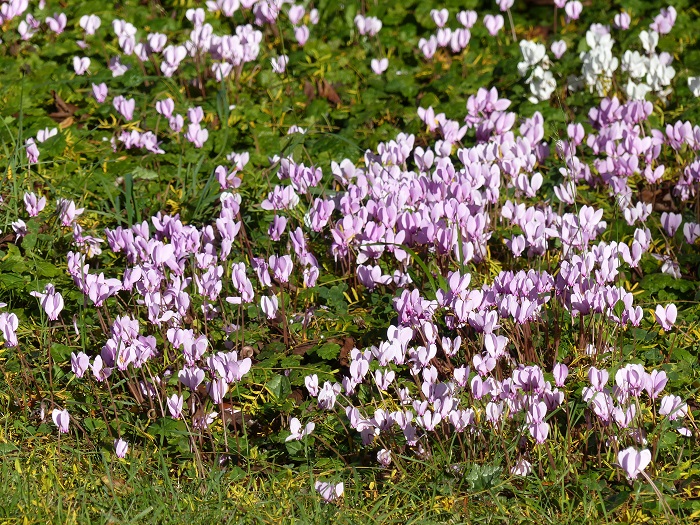
This selection of Cyclamen Coum is characterised by a flowering in a pink shade of red and rather large heart-shaped leaves with a velvety grey colour. It is a small, hardy plant that blooms as early as February, bringing some colour to the garden when other flowers are scarce. Its beautiful foliage develops in autumn and remains until late spring. It dries up in early summer when the tuber enters a period of dormancy. Plant it in partial shade or shade, under deciduous trees, along a path, in a shaded rockery, where it will slowly spread to form a beautiful carpet.
Cyclamen Coum is a small perennial plant with tuberous roots belonging to the Primulaceae family. It is not native to the island of Kos, Greece, but rather to the mountains of Bulgaria, Turkey, and Lebanon, specifically Eastern Cilicia, where it is usually found in shaded areas. This small species measures about 10 cm in height.
Cyclamen Coum has given rise to numerous forms with varied flowers and foliage, including this pink variety with grey foliage. Some producers have made it their speciality, notably Kwekerij Koen, who works on a small scale. Their nursery is located in Westland, Netherlands, and is known for its horticultural production. Kwekerij is passionate about hybridising botanical cyclamens: Cyclamen Coum, C. hederifolium, and C. purpurascens. They pollinate the parent lines with a brush, then collect the seeds, sow them, and later transplant them into pots. We are offering them exclusively today.
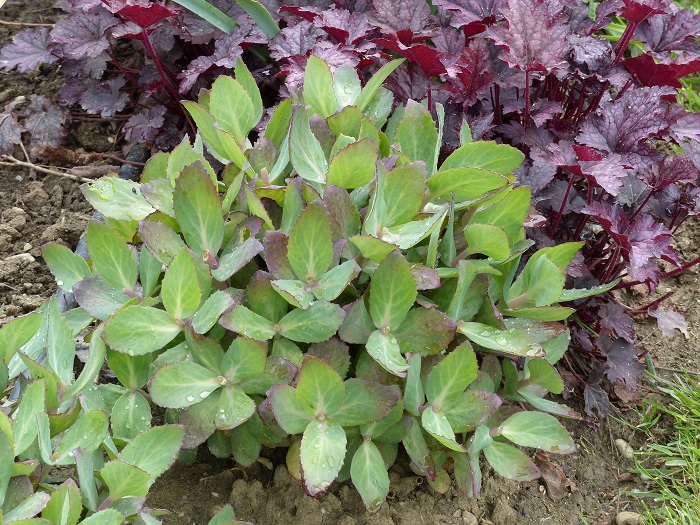
The tubers of Cyclamen Coum are round and compressed, measuring up to 6.5 cm in diameter, covered with a smooth and velvety "skin", and have roots originating from their centre and base. The foliage generally develops in autumn after a dry summer. It may sometimes appear at the same time as the flowers in January and February in cool and humid climates. The rounded leaves measure 4 to 5 cm in diameter. The variety presented here is very uniform, greyish-green, slightly elongated, and undulated. The foliage disappears as soon as the soil dries up in June, and the plant goes into a resting phase. This variety is resistant to our average winters, but a layer of dead leaves will be beneficial in case of prolonged frost.
The flowering of the pink Cyclamen Coum with grey foliage occurs between mid-February and the end of March, depending on the climate. Initially lying on the ground, the pointed flower buds straighten up on reddish peduncles. Each flower, quite stout, measuring 1 to 2 cm in length, comprises five pink-red petals with rounded edges, curving backwards. After pollination, the flower gives way to a small round fruit, with the floral stem spiralling to allow the fruit to come into contact with the ground. Ants, which delight in their sweet flesh, disperse the seeds.
Plant Cyclamen Coum by mixing the varieties in a carpet-like arrangement. They will multiply independently over the years, creating unforgettable scenes in the garden's somewhat shaded and dry areas, which are challenging to design. The cyclamen is a perfect plant to enhance the base of a deciduous tree in an understory soil, with the Christmas rose, for example. It is resistant to cold, but its tuber fears excessive moisture in winter and summer and does not tolerate complete drying out in summer. It will find its place in a partially shaded rockery, not too dry, in the company of blanda anemones 'Blue Shades' and hepaticas, for example. To have two flowering periods, plant Cyclamen cilicicum and Cyclamen de Naples, which flower in autumn.

Flowering
Foliage
Plant habit
Botanical data
Cyclamen
coum
Rose feuillage gris
Primulaceae
Eastern sowbread, round-leaved cyclamen
Hybrid Cyclamen coum
Cultivar or hybrid
Planting and care
The corky tubercle of the pink Cyclamen Coum should be planted 2 cm deep (the top of the tubercle should be 2 cm below the surface of the soil) in well-drained soil, even if it is limestone and rocky. Plant your cyclamens in partial shade, in light and worked soil. You can plant them in groups of 3 or 5. Cyclamen coum appreciate slightly limestone soils, dry in summer but not excessively, which corresponds to their resting period, and they dislike heavy and saturated soils in winter. They are excellent plants for relatively dry undergrowth and shaded rockeries. They can also be planted in the short grass meadow. They multiply independently with the help of ants that disperse the seeds. Depending on the climate, it can take them six months to regain their natural organic cycle.
Planting period
Intended location
Care
Planting & care advice
-
-

-
-

-

-

-

-

This item has not been reviewed yet - be the first to leave a review about it.
Recently viewed products
Haven't found what you were looking for?
Hardiness is the lowest winter temperature a plant can endure without suffering serious damage or even dying. However, hardiness is affected by location (a sheltered area, such as a patio), protection (winter cover) and soil type (hardiness is improved by well-drained soil).

The flowering period indicated on our website applies to countries and regions located in USDA zone 8 (France, the United Kingdom, Ireland, the Netherlands, etc.)
It will vary according to where you live:- In zones 9 to 10 (Italy, Spain, Greece, etc.), flowering will occur about 2 to 4 weeks earlier.
- In zones 6 to 7 (Germany, Poland, Slovenia, and lower mountainous regions), flowering will be delayed by 2 to 3 weeks.
- In zone 5 (Central Europe, Scandinavia), blooming will be delayed by 3 to 5 weeks.
In temperate climates, pruning of spring-flowering shrubs (forsythia, spireas, etc.) should be done just after flowering.
Pruning of summer-flowering shrubs (Indian Lilac, Perovskia, etc.) can be done in winter or spring.
In cold regions as well as with frost-sensitive plants, avoid pruning too early when severe frosts may still occur.
The planting period indicated on our website applies to countries and regions located in USDA zone 8 (France, United Kingdom, Ireland, Netherlands).
It will vary according to where you live:
- In Mediterranean zones (Marseille, Madrid, Milan, etc.), autumn and winter are the best planting periods.
- In continental zones (Strasbourg, Munich, Vienna, etc.), delay planting by 2 to 3 weeks in spring and bring it forward by 2 to 4 weeks in autumn.
- In mountainous regions (the Alps, Pyrenees, Carpathians, etc.), it is best to plant in late spring (May-June) or late summer (August-September).
The harvesting period indicated on our website applies to countries and regions in USDA zone 8 (France, England, Ireland, the Netherlands).
In colder areas (Scandinavia, Poland, Austria...) fruit and vegetable harvests are likely to be delayed by 3-4 weeks.
In warmer areas (Italy, Spain, Greece, etc.), harvesting will probably take place earlier, depending on weather conditions.
The sowing periods indicated on our website apply to countries and regions within USDA Zone 8 (France, UK, Ireland, Netherlands).
In colder areas (Scandinavia, Poland, Austria...), delay any outdoor sowing by 3-4 weeks, or sow under glass.
In warmer climes (Italy, Spain, Greece, etc.), bring outdoor sowing forward by a few weeks.
Shipping country and language
Your country of residence may be:
Your country of residence is:
For a better user experience on our website, you can select:
Your shipping country:
-
 Austria
-
 Belgium
-
 Bosnia & Herzegovina
-
 Bulgaria
-
 Croatia
-
 Cyprus
-
 Czechia
-
 Denmark
-
 Estonia
-
 Finland
-
 France
-
 Germany
-
 Greece
-
 Hungary
-
 Iceland
-
 Ireland
-
 Italy
Italy
-
 Latvia
-
 Liechtenstein
-
 Lithuania
-
 Luxembourg
-
 Malta
Malta
-
 Netherlands
-
 Poland
-
 Portugal
-
 Romania
-
 Serbia
-
 Slovakia
-
 Slovenia
-
 Spain
Spain
-
 Sweden
-
 Switzerland
Language:
-
French
-
 English
-
Spanish
-
Italian
-
German
-
Portuguese
-
Dutch
-
Finnish
My Account
Hello
My wish lists
My cart
Log in / Register
Existing customer?
This form is protected by reCAPTCHA - the Google Privacy Policy and Terms of Service apply.
New customer?
Create an account to track your orders, access our customer service and, if you wish, make the most of our upcoming offers.