Gardenia jasminoides Celestial Star
Gardenia jasminoides Celestial Star
Gardenia jasminoides 'PS-2013-4' CELESTIAL STAR®
Common Gardenia, Cape Jasmine, Cape Jessamine
Back-to-school special offer!
Get €10 off for every €50 you spend! And get up to €40 off on a single order.
How does it work?
1. Shop your favourites
Add your favourite plants to your basket. For every €50 you spend (excluding delivery charges, store credit and the plastic-free option), you’ll receive a €10 voucher.
€50 spent = €10 voucher
€100 spent = €20 voucher
€150 spent = €30 voucher
€200 spent = €40 voucher
2. Place your order
Once your basket reaches one of the spending thresholds, place your order. You can even choose your delivery date!
3. Receive your voucher
As soon as your order has been shipped, you’ll receive an email containing your personal voucher code and its value.
4. Use it on your next order
Your voucher is valid for 90 days from the date you receive it. It can be used once only, on a new order worth at least the value of the voucher, excluding delivery charges.
Please note: Vouchers can be combined with other offers, but cannot be split or refunded.
Why not try an alternative variety in stock?
View all →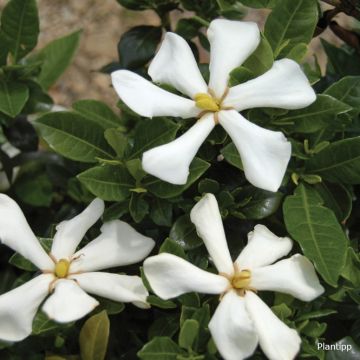
Available in 1 sizes
Available in 1 sizes
Available in 1 sizes
Available in 1 sizes
Available in 1 sizes
This plant carries a 24 months recovery warranty
More information
We guarantee the quality of our plants for a full growing cycle, and will replace at our expense any plant that fails to recover under normal climatic and planting conditions.
Would this plant suit my garden?
Set up your Plantfit profile →
Description
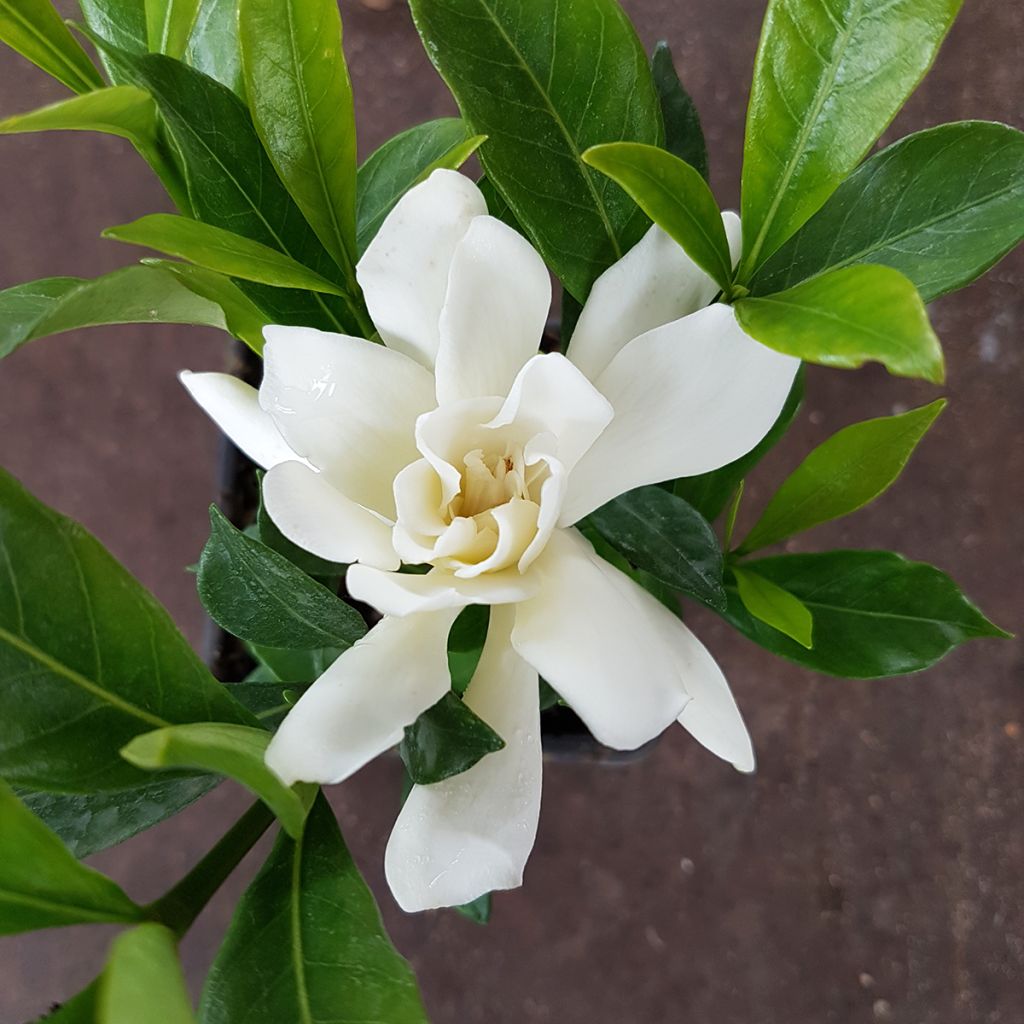
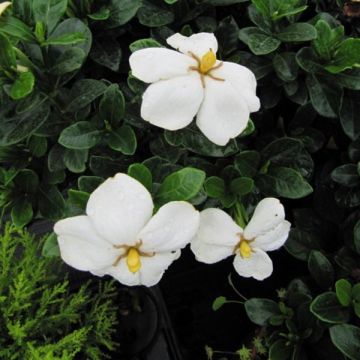
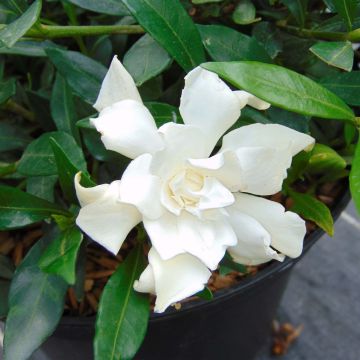
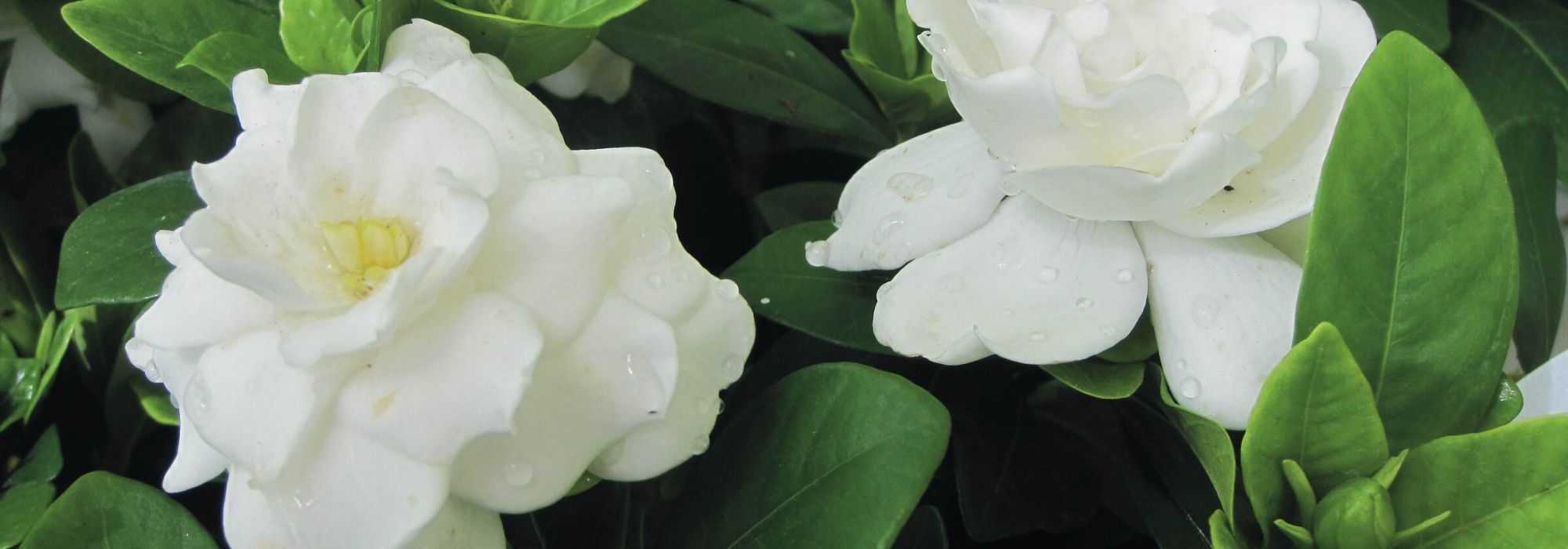
Gardenia jasminoides 'Celestial Star' is an American variety interesting for its superior hardiness compared to most varieties. It is a dense bush, as wide as it is tall, with beautiful dark green evergreen foliage that forms a lovely backdrop for the flowers. From May onwards, large double, pure white flowers appear, perfuming the air with a sweet fragrance. It is compact enough to be grown in a pot in harsh climates, it enjoys filtered sunlight and dislikes drafts. When planted outdoors, it requires non-chalky, moist and humus-bearing soil, and thrives in gardens along the Atlantic coast or in the south, under a dappled shade that maintains a certain level of humidity.
Gardenia is a member of the large Rubiaceae family, which includes about 600 genera and 10,000 species of herbaceous, woody (trees, shrubs), and climbing plants, from cold regions of the globe to the Tropics. It is notably the family of the Coffee plant and ornamental plants such as Cephalanthus with its curious spherical, white flowers. There are about sixty species of Gardenia (or even up to 250 according to botanical classifications), including some medium-sized trees, but mainly evergreen shrubs living in tropical regions of Asia and Africa. Gardenia jasminoides, or Cape Jasmine, is the only one grown outdoors in mild areas such as the Atlantic coast and Mediterranean regions. It originates from certain areas of Southeast Asia, including China and southern Japan. In these regions, it can grow into small trees reaching up to 5m high, flowering between July and December.
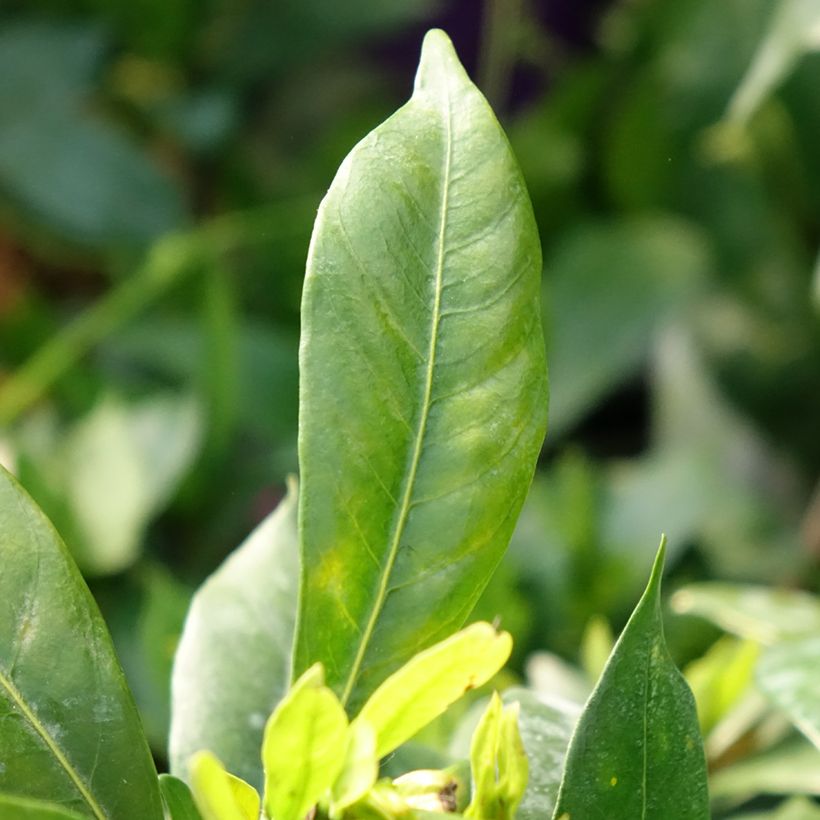
In our climates, development is much more restricted. 'Celestial Star' is a recent American variety (2019), created by breeder James Berry, and reaches about 1.10m in all directions at 10 years old. Its growth is quite slow. The elliptical leaves are quite leathery and small, measuring 3 to 10cm long, with a slightly glossy varnished surface. They are dark green, even darker when the plant is shaded. The flowers bloom from May to July, with sporadic blooms until September. They are larger than most other varieties, reaching 8 to 9cm in diameter. They are double, spiralled, with spreading outer petals and a swirling centre.
Planted in a pot, this 'Celestial Star' gardenia will enhance and perfume a terrace like nothing else. It can also be sheltered in a bright unheated room during winter to protect it from severe cold. In coastal Atlantic regions, it can be planted outdoors. Pair it with other plants with a tropical vibe to create an inspiring scene. A Cycas revoluta planted in a beautiful terracotta pot will be a perfect companion. This architectural plant is straight from prehistoric times with its dwarf palm-like appearance evoking distant lands. In humid oceanic climates, you can plant it in a flower bed alongside the Cape Fuchsia 'Blacher', a perennial whose long cherry red tubular flowers will create a vibrant color contrast in summer.

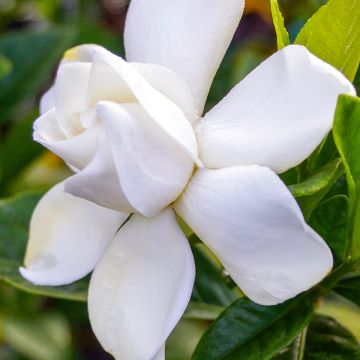
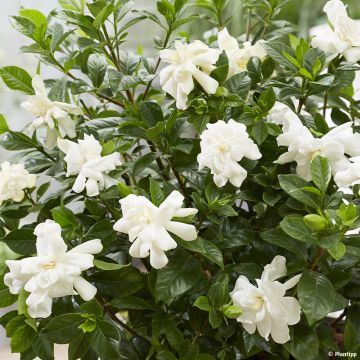
Gardenia jasminoides Celestial Star in pictures
Plant habit
Flowering
Foliage
Botanical data
Gardenia
jasminoides
'PS-2013-4' CELESTIAL STAR®
Rubiaceae
Common Gardenia, Cape Jasmine, Cape Jessamine
Cultivar or hybrid
Planting and care
Plant Gardenia jasminoides 'Celestial Star' in a pot or in a partially shaded bed, in moist, humus-rich, light, acidic to neutral soil. It dislikes limestone, which causes its leaves to turn yellow. The soil should always remain slightly moist, without being waterlogged. The exposure is important; the Gardenia likes heat (not drought) but the harsh rays of the sun can burn its foliage. Give it partial shade, in a bright location, well protected from cold and dry winds. This bush does not like to be moved, even when grown in a pot: the flowers can fall if you change the position of your budding gardenia. The gardenia has roughly the same requirements as camellias, but is a bit more delicate and often less cold-resistant.
Planting period
Intended location
Care
Planting & care advice
-
-

-
-
-

-
-
-

This item has not been reviewed yet - be the first to leave a review about it.
Recently viewed products
Haven't found what you were looking for?
Hardiness is the lowest winter temperature a plant can endure without suffering serious damage or even dying. However, hardiness is affected by location (a sheltered area, such as a patio), protection (winter cover) and soil type (hardiness is improved by well-drained soil).

The flowering period indicated on our website applies to countries and regions located in USDA zone 8 (France, the United Kingdom, Ireland, the Netherlands, etc.)
It will vary according to where you live:- In zones 9 to 10 (Italy, Spain, Greece, etc.), flowering will occur about 2 to 4 weeks earlier.
- In zones 6 to 7 (Germany, Poland, Slovenia, and lower mountainous regions), flowering will be delayed by 2 to 3 weeks.
- In zone 5 (Central Europe, Scandinavia), blooming will be delayed by 3 to 5 weeks.
In temperate climates, pruning of spring-flowering shrubs (forsythia, spireas, etc.) should be done just after flowering.
Pruning of summer-flowering shrubs (Indian Lilac, Perovskia, etc.) can be done in winter or spring.
In cold regions as well as with frost-sensitive plants, avoid pruning too early when severe frosts may still occur.
The planting period indicated on our website applies to countries and regions located in USDA zone 8 (France, United Kingdom, Ireland, Netherlands).
It will vary according to where you live:
- In Mediterranean zones (Marseille, Madrid, Milan, etc.), autumn and winter are the best planting periods.
- In continental zones (Strasbourg, Munich, Vienna, etc.), delay planting by 2 to 3 weeks in spring and bring it forward by 2 to 4 weeks in autumn.
- In mountainous regions (the Alps, Pyrenees, Carpathians, etc.), it is best to plant in late spring (May-June) or late summer (August-September).
The harvesting period indicated on our website applies to countries and regions in USDA zone 8 (France, England, Ireland, the Netherlands).
In colder areas (Scandinavia, Poland, Austria...) fruit and vegetable harvests are likely to be delayed by 3-4 weeks.
In warmer areas (Italy, Spain, Greece, etc.), harvesting will probably take place earlier, depending on weather conditions.
The sowing periods indicated on our website apply to countries and regions within USDA Zone 8 (France, UK, Ireland, Netherlands).
In colder areas (Scandinavia, Poland, Austria...), delay any outdoor sowing by 3-4 weeks, or sow under glass.
In warmer climes (Italy, Spain, Greece, etc.), bring outdoor sowing forward by a few weeks.
Shipping country and language
Your country of residence may be:
Your country of residence is:
For a better user experience on our website, you can select:
Your shipping country:
-
 Austria
-
 Belgium
-
 Bosnia & Herzegovina
-
 Bulgaria
-
 Croatia
-
 Cyprus
-
 Czechia
-
 Denmark
-
 Estonia
-
 Finland
-
 France
-
 Germany
-
 Greece
-
 Hungary
-
 Iceland
-
 Ireland
-
 Italy
Italy
-
 Latvia
-
 Liechtenstein
-
 Lithuania
-
 Luxembourg
-
 Malta
Malta
-
 Netherlands
-
 Poland
-
 Portugal
-
 Romania
-
 Serbia
-
 Slovakia
-
 Slovenia
-
 Spain
Spain
-
 Sweden
-
 Switzerland
Language:
-
French
-
 English
-
Spanish
-
Italian
-
German
-
Portuguese
-
Dutch
-
Finnish
My Account
Hello
My wish lists
My cart
Log in / Register
Existing customer?
This form is protected by reCAPTCHA - the Google Privacy Policy and Terms of Service apply.
New customer?
Create an account to track your orders, access our customer service and, if you wish, make the most of our upcoming offers.