Catalpa bignonioides seeds - Indian bean tree
Catalpa bignonioides seeds - Indian bean tree
Catalpa bignonioides seeds - Indian bean tree
Catalpa bignonioides seeds - Indian bean tree
Catalpa bignonioides
Indian Bean Tree, Cigar Tree, Southern Catalpa
Back-to-school special offer!
Get €10 off for every €50 you spend! And get up to €40 off on a single order.
How does it work?
1. Shop your favourites
Add your favourite plants to your basket. For every €50 you spend (excluding delivery charges, store credit and the plastic-free option), you’ll receive a €10 voucher.
€50 spent = €10 voucher
€100 spent = €20 voucher
€150 spent = €30 voucher
€200 spent = €40 voucher
2. Place your order
Once your basket reaches one of the spending thresholds, place your order. You can even choose your delivery date!
3. Receive your voucher
As soon as your order has been shipped, you’ll receive an email containing your personal voucher code and its value.
4. Use it on your next order
Your voucher is valid for 90 days from the date you receive it. It can be used once only, on a new order worth at least the value of the voucher, excluding delivery charges.
Please note: Vouchers can be combined with other offers, but cannot be split or refunded.
Why not try an alternative variety in stock?
View all →
Available in 1 sizes
Available in 1 sizes
Available in 1 sizes
Available in 1 sizes
Available in 1 sizes
Available in 1 sizes
Available in 1 sizes
Available in 1 sizes
Available in 1 sizes
Available in 1 sizes
This plant carries a 6 months recovery warranty
More information
We guarantee the quality of our plants for a full growing cycle, and will replace at our expense any plant that fails to recover under normal climatic and planting conditions.
Would this plant suit my garden?
Set up your Plantfit profile →
Description
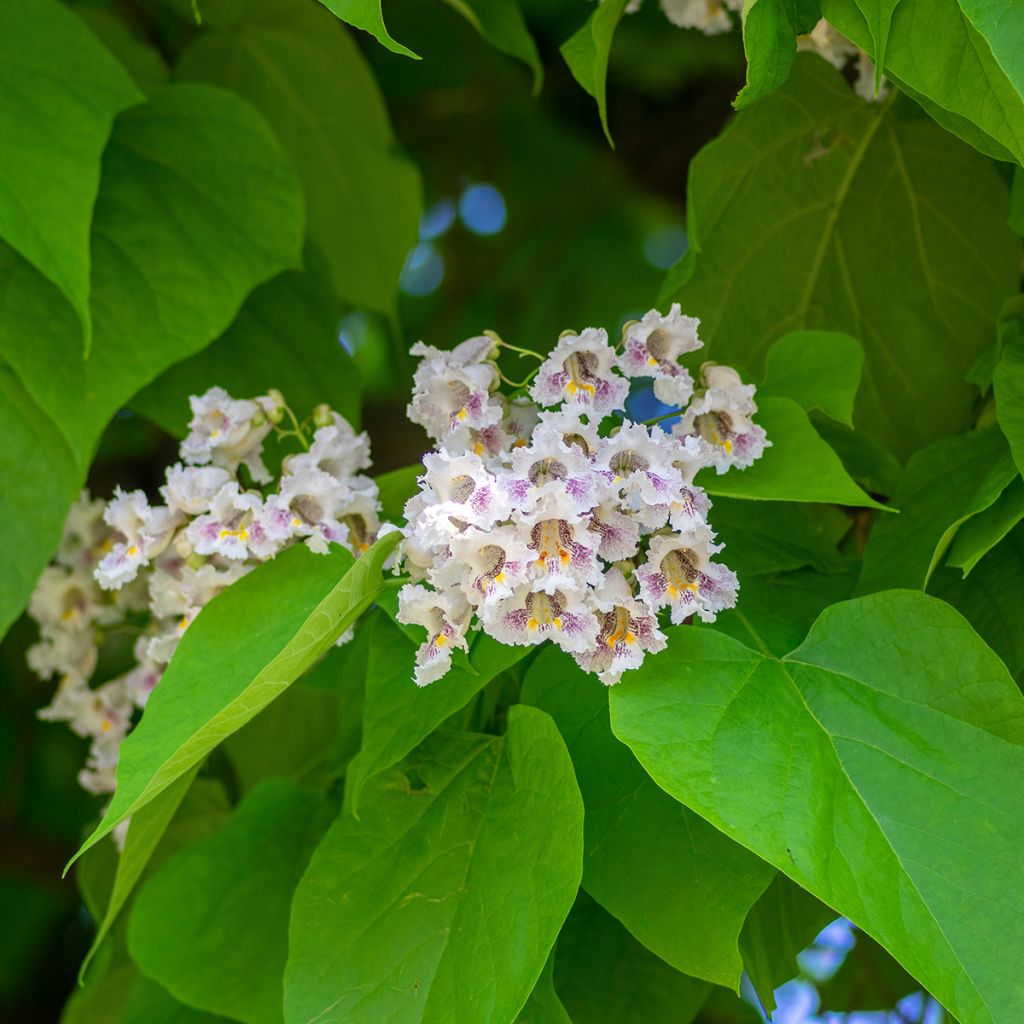
Catalpa bignonioides, common catalpa or broad-leaved catalpa, is a firm favourite in gardens. It is a handsome shade tree, with ornamental foliage, flowering and fruit. Its large heart-shaped leaves, white flowers speckled with yellow and purple, and long hanging pods give it an almost exotic look, although it is very hardy and easy to grow.
Growing from seed allows you to watch several catalpas grow, well suited to your plot. They grow quickly, and in 6 or 7 years you will have specimens capable of providing welcome shade.
This tree belongs to the Bignoniaceae family, the same as climbing bignonias. The species Catalpa bignonioides is the currently accepted name; several older names are attached to it, including Bignonia catalpa, Catalpa syringaefolia, Catalpa arborea or Catalpa catalpa. Native to the south-eastern United States, where it is found along rivers and at the edge of deciduous-leaved forests. Introduced to Europe in the 18th century, it has become a common ornamental tree in parks and gardens.
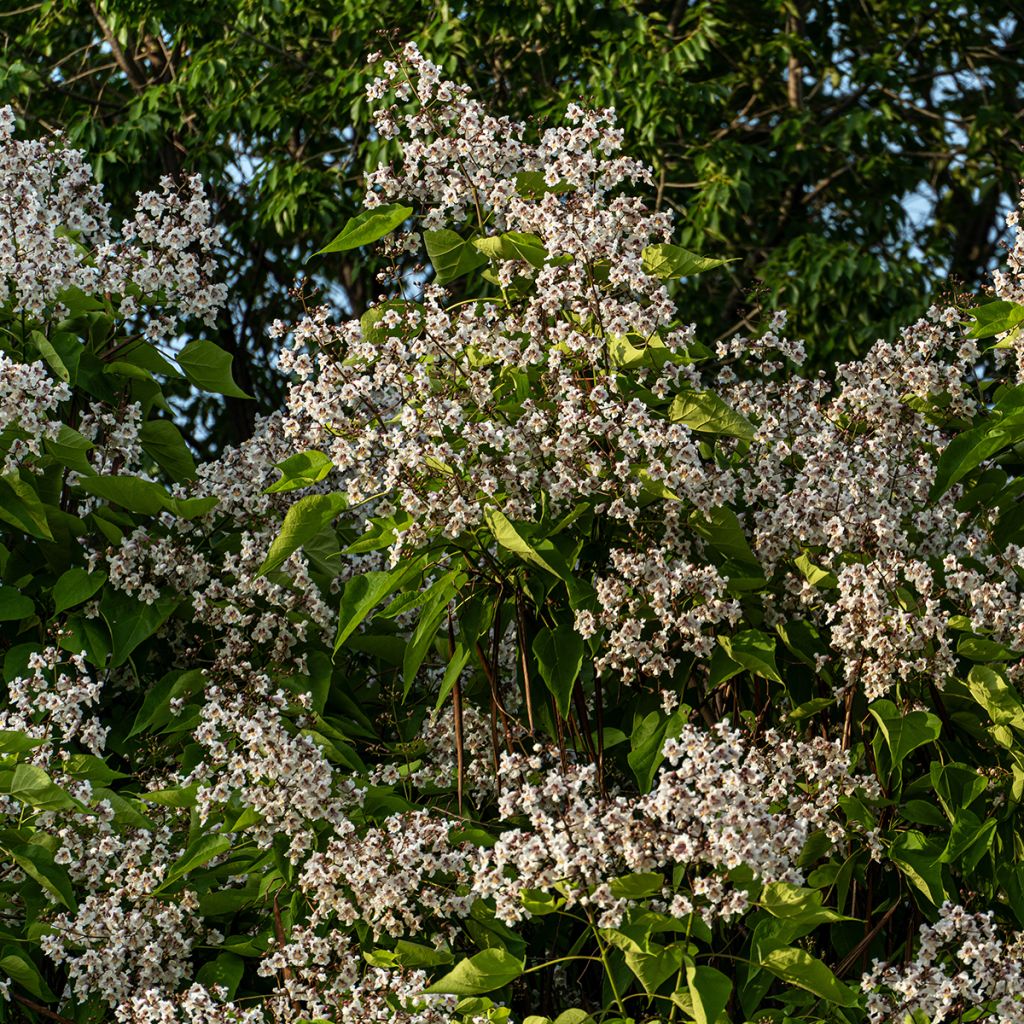
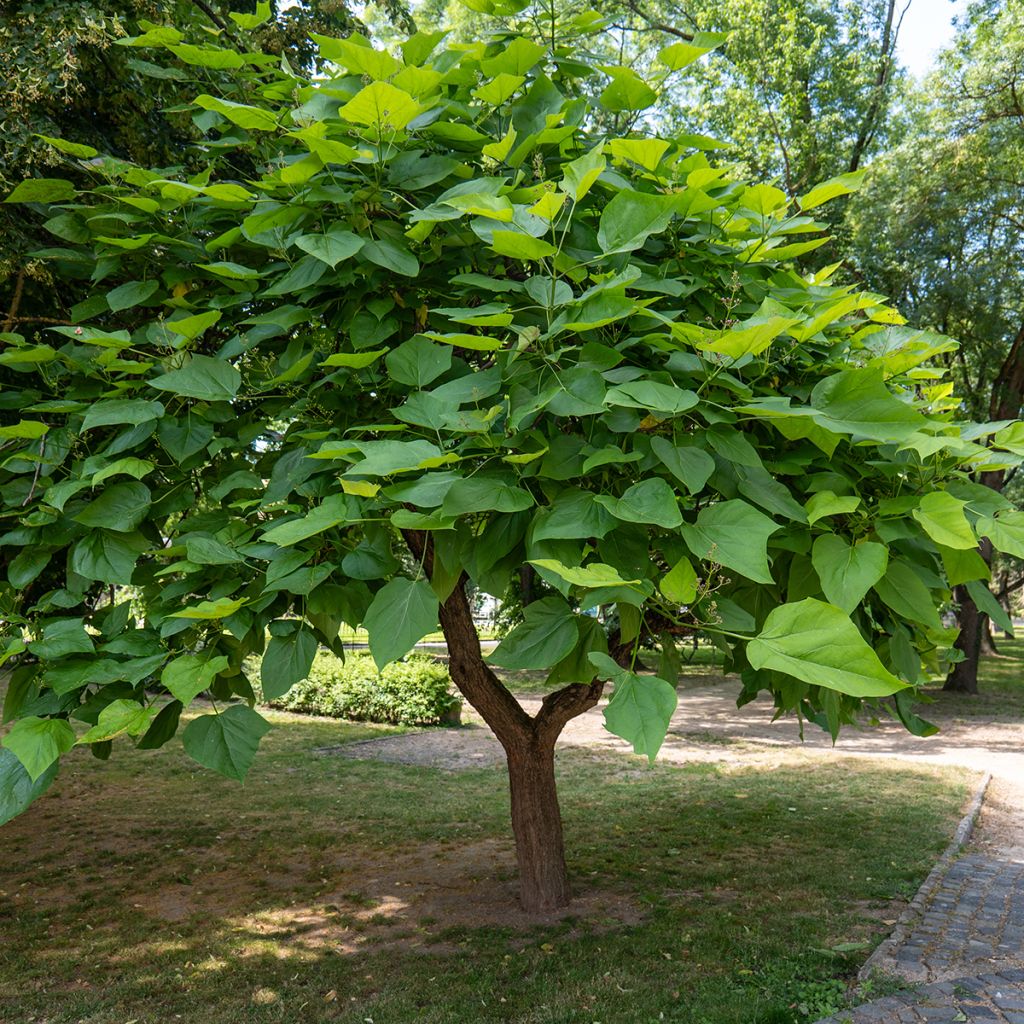
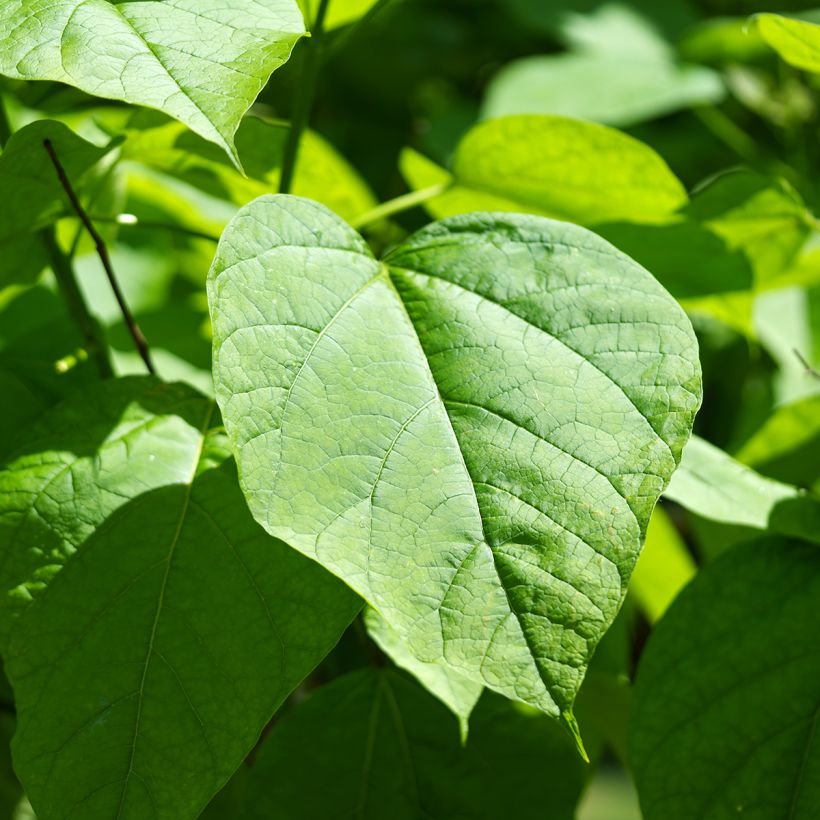
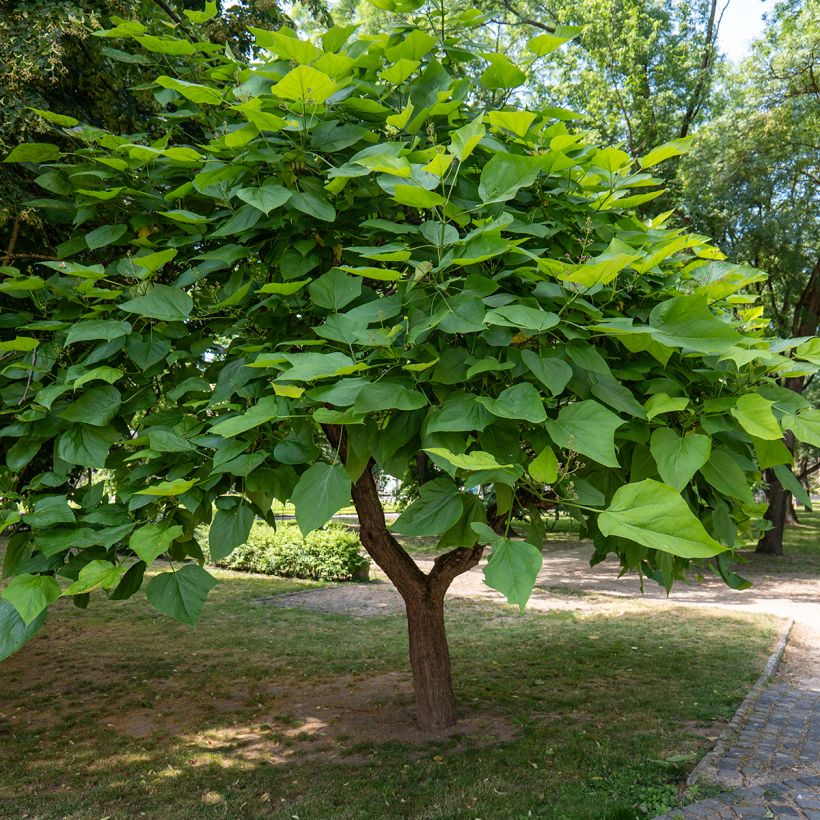
It is a medium to large deciduous tree, developing a fairly short trunk and a broad, rounded, very spreading crown. At maturity, it reaches 10 to 15m tall with an 8 to 12m spread; it reaches 5 to 6m tall in about ten years. The simple, entire, heart-shaped leaves measure 15 to 25cm long and 10 to 20cm wide. They are grouped in twos or threes, are light green, smooth on the upper surface, more downy underneath, and give off a strong smell when crushed. They appear late in spring and fall fairly early in autumn. In early summer, the catalpa bears large upright panicles of bell-shaped flowers, creamy white spotted with yellow and purple inside, visited by insects. Each flower measures 3 to 4cm long. They are followed by long slender, cylindrical, pendulous capsules, sometimes exceeding 30cm in length, which persist throughout winter. The winged seeds are dispersed by the wind.
The root system is vigorous, rather shallow and spreading, with thick fleshy roots. They anchor the tree and make it useful for stabilising certain soils, but should not be planted too close to a wall, pipe or terrace.
In the garden, broad-leaved catalpa proves far less demanding than its appearance suggests. It grows in most garden soils, even heavy or clayey ones, provided they do not remain waterlogged permanently. Growing from seed is the most economical method of obtaining this tree. The drawback is the patience required: from sowing, allow about 3 to 4 years for a young tree of 2 to 3m, then 8 to 12 years for a fine, well-formed specimen.
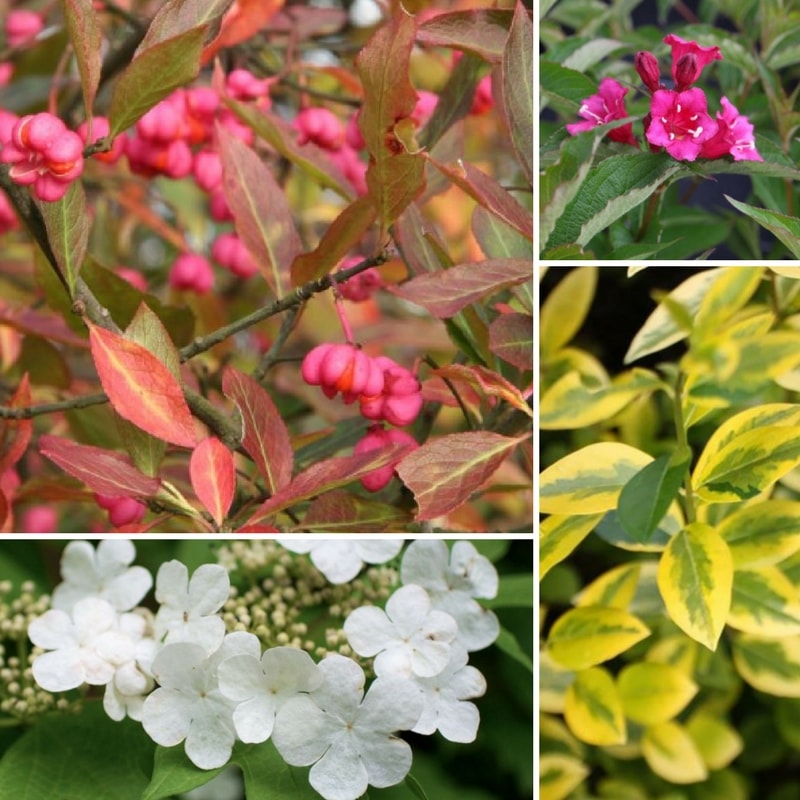
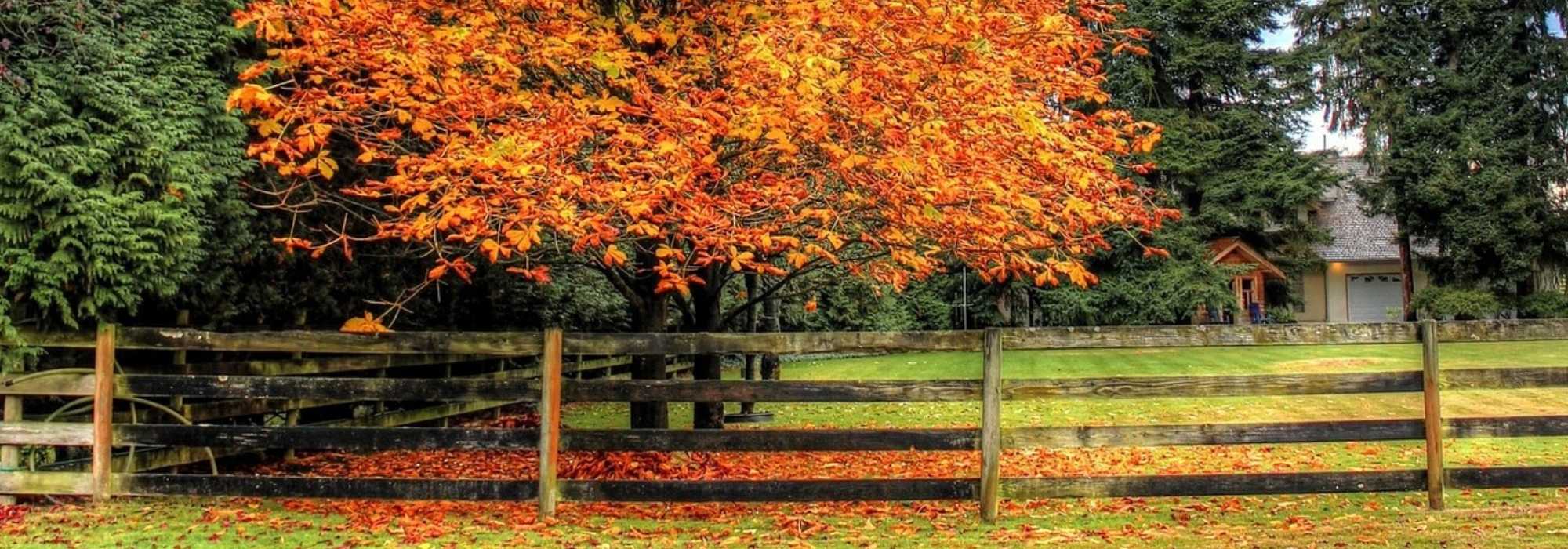
It is first and foremost a shade tree: plant it near a terrace, at the edge of a lawn or close to a play area, giving it room to spread its crown. You can pair it with a lighter tree such as Heptacodium miconioides, adorned with red bracts in late summer, or with a Parrotia persica 'Vanessa', for its superb autumn foliage. The catalpa plays the role of the great leafy parasol, while the other shrubs dress its base.
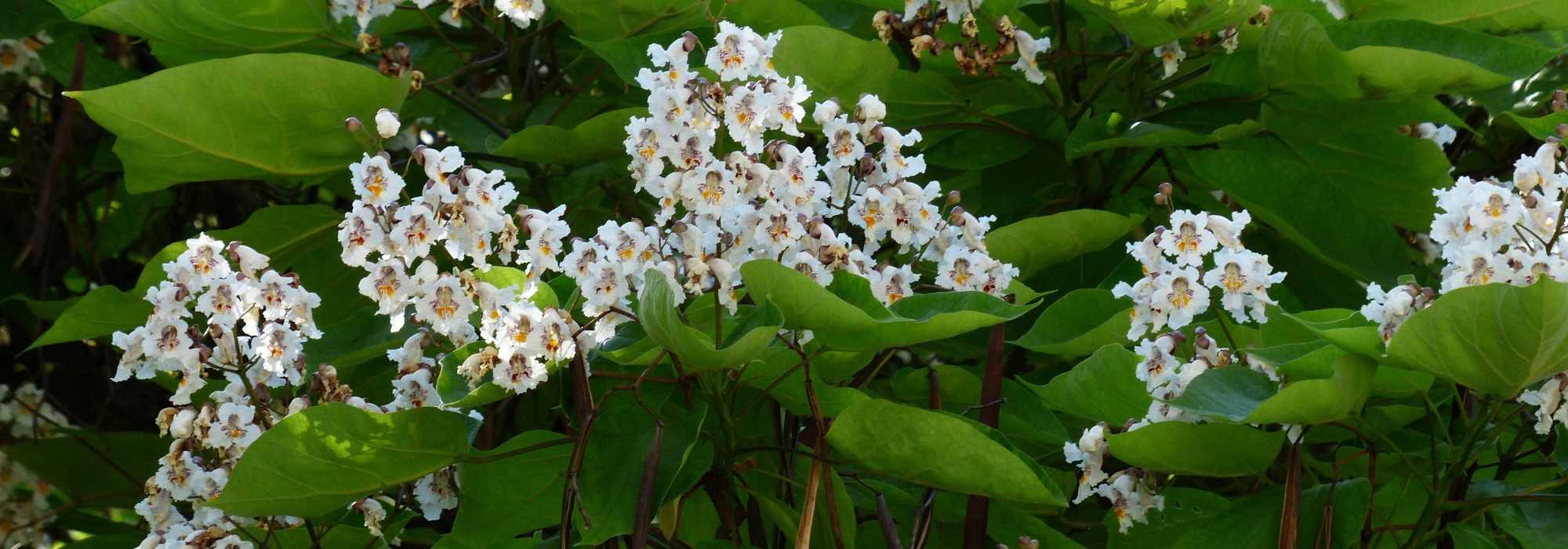
Catalpa bignonioides seeds - Indian bean tree in pictures
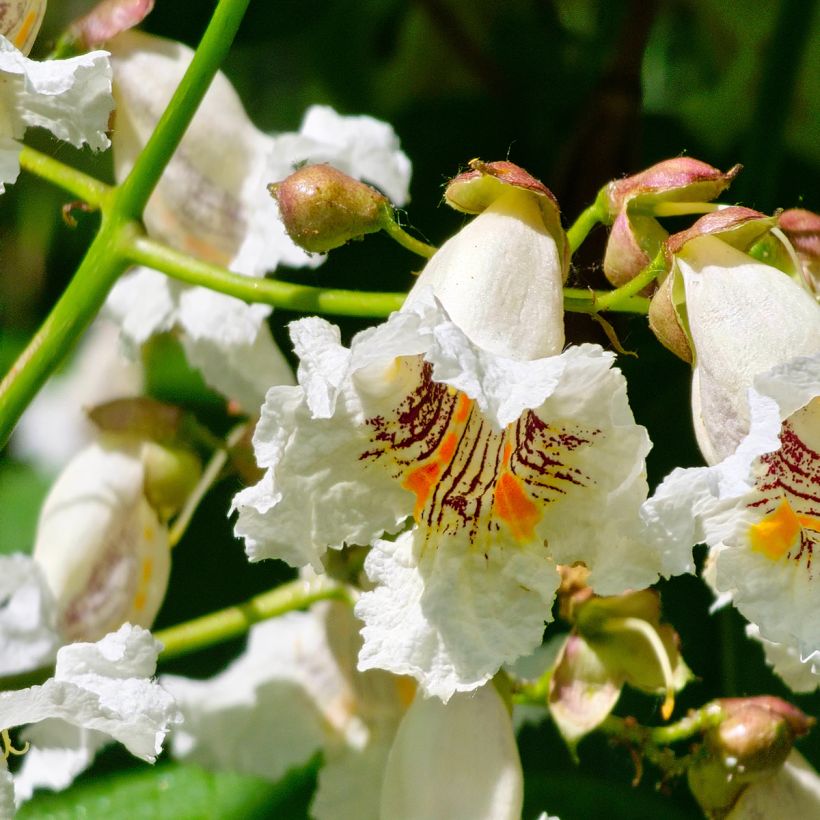
Flowering
Foliage
Plant habit
Botanical data
Catalpa
bignonioides
Bignoniaceae
Indian Bean Tree, Cigar Tree, Southern Catalpa
Bignonia catalpa, Catalpa syringaefolia, Catalpa arborea, Catalpa catalpa
North America
Planting and care
Common catalpa (Catalpa bignonioides) is easy to grow from seed
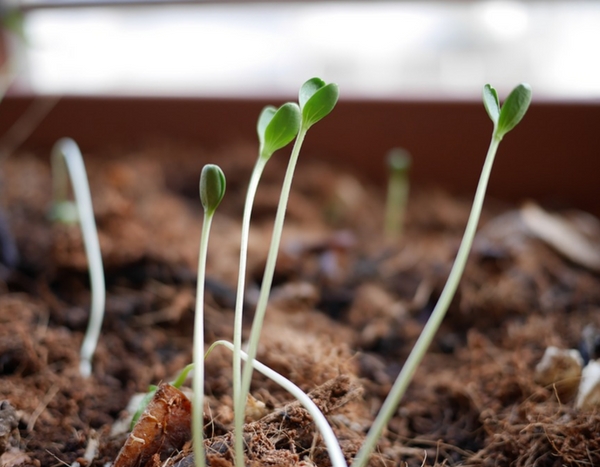
Sow from late winter to late spring in a seed tray or deep box, in a mixture of seed compost and sand. Place the seeds on the surface or very lightly covered (3 to 5mm of substrate), then spray with water to ensure good contact with the soil. Place the tray at 15–20 °C, in full light but out of scorching sun. The substrate should simply remain moist, never waterlogged. Germination usually takes two to four weeks, sometimes a little longer; it is therefore worth keeping the trays for a while before deciding to discard them.
As soon as the young catalpas have two to three true leaves, prick them out into individual deep pots, ideally of the forest pot type, in a more nutritious mixture: good potting compost, a little sand or pozzolana, and, if possible, one third garden soil. Lift the seedlings carefully, keeping as many roots as possible, then water to settle them in.
Place the pots outside in bright partial shade, sheltered from drying winds. Growth can be rapid in the first season, but it is best to keep the young trees in pots until the first winter, or even a second year in cold climates, so that they develop a good root system.
Plant in open ground in autumn, or early spring outside frost periods. Catalpa likes deep, fertile soils that remain moist in summer but where water does not stagnate in winter. A good garden soil, even slightly clayey, suits it well. On the other hand, avoid very chalky soils, which can cause chlorosis.
Prepare a wide planting hole, mix the excavated soil with mature compost, then position the tree at the same depth as it was in its pot. Water abundantly, then mulch generously around the base (wood chippings, dead leaves…) to retain moisture. In windy areas, a sturdy stake helps keep the trunk straight in the early years.
Care: catalpa mainly needs water in the first few years. In summer, keep an eye on the soil: it should remain slightly moist deep down. Mulching limits evaporation and gradually improves soil structure. An application of compost in spring is enough; fertilisers too rich in nitrogen are not advisable, as they encourage soft wood. Once well established, the tree becomes very tolerant and copes easily with periods of moderate drought. It may be somewhat prone to powdery mildew or a few leaf spots, but these are not serious on a vigorous specimen.
Sowing period
Intended location
Planting & care advice
-
-
-

-
-

-
-
-
This item has not been reviewed yet - be the first to leave a review about it.
Recently viewed products
Haven't found what you were looking for?
Hardiness is the lowest winter temperature a plant can endure without suffering serious damage or even dying. However, hardiness is affected by location (a sheltered area, such as a patio), protection (winter cover) and soil type (hardiness is improved by well-drained soil).

The flowering period indicated on our website applies to countries and regions located in USDA zone 8 (France, the United Kingdom, Ireland, the Netherlands, etc.)
It will vary according to where you live:- In zones 9 to 10 (Italy, Spain, Greece, etc.), flowering will occur about 2 to 4 weeks earlier.
- In zones 6 to 7 (Germany, Poland, Slovenia, and lower mountainous regions), flowering will be delayed by 2 to 3 weeks.
- In zone 5 (Central Europe, Scandinavia), blooming will be delayed by 3 to 5 weeks.
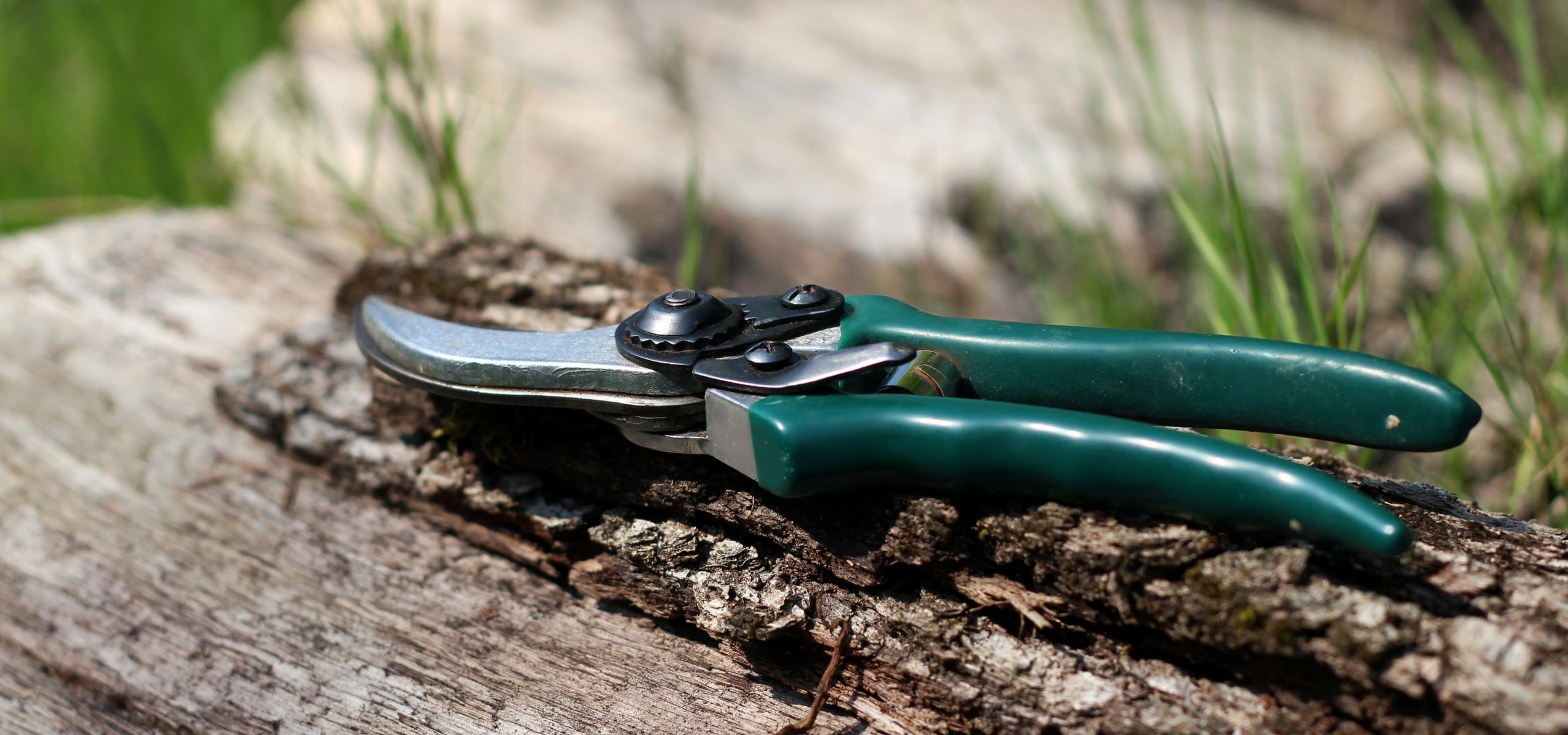
In temperate climates, pruning of spring-flowering shrubs (forsythia, spireas, etc.) should be done just after flowering.
Pruning of summer-flowering shrubs (Indian Lilac, Perovskia, etc.) can be done in winter or spring.
In cold regions as well as with frost-sensitive plants, avoid pruning too early when severe frosts may still occur.
The planting period indicated on our website applies to countries and regions located in USDA zone 8 (France, United Kingdom, Ireland, Netherlands).
It will vary according to where you live:
- In Mediterranean zones (Marseille, Madrid, Milan, etc.), autumn and winter are the best planting periods.
- In continental zones (Strasbourg, Munich, Vienna, etc.), delay planting by 2 to 3 weeks in spring and bring it forward by 2 to 4 weeks in autumn.
- In mountainous regions (the Alps, Pyrenees, Carpathians, etc.), it is best to plant in late spring (May-June) or late summer (August-September).
The harvesting period indicated on our website applies to countries and regions in USDA zone 8 (France, England, Ireland, the Netherlands).
In colder areas (Scandinavia, Poland, Austria...) fruit and vegetable harvests are likely to be delayed by 3-4 weeks.
In warmer areas (Italy, Spain, Greece, etc.), harvesting will probably take place earlier, depending on weather conditions.
The sowing periods indicated on our website apply to countries and regions within USDA Zone 8 (France, UK, Ireland, Netherlands).
In colder areas (Scandinavia, Poland, Austria...), delay any outdoor sowing by 3-4 weeks, or sow under glass.
In warmer climes (Italy, Spain, Greece, etc.), bring outdoor sowing forward by a few weeks.
Shipping country and language
Your country of residence may be:
Your country of residence is:
For a better user experience on our website, you can select:
Your shipping country:
-
 Austria
-
 Belgium
-
 Bosnia & Herzegovina
-
 Bulgaria
-
 Croatia
-
 Cyprus
-
 Czechia
-
 Denmark
-
 Estonia
-
 Finland
-
 France
-
 Germany
-
 Greece
-
 Hungary
-
 Iceland
-
 Ireland
-
 Italy
Italy
-
 Latvia
-
 Liechtenstein
-
 Lithuania
-
 Luxembourg
-
 Malta
Malta
-
 Netherlands
-
 Poland
-
 Portugal
-
 Romania
-
 Serbia
-
 Slovakia
-
 Slovenia
-
 Spain
Spain
-
 Sweden
-
 Switzerland
Language:
-
French
-
 English
-
Spanish
-
Italian
-
German
-
Portuguese
-
Dutch
-
Finnish
My Account
Hello
My wish lists
My cart
Log in / Register
Existing customer?
This form is protected by reCAPTCHA - the Google Privacy Policy and Terms of Service apply.
New customer?
Create an account to track your orders, access our customer service and, if you wish, make the most of our upcoming offers.