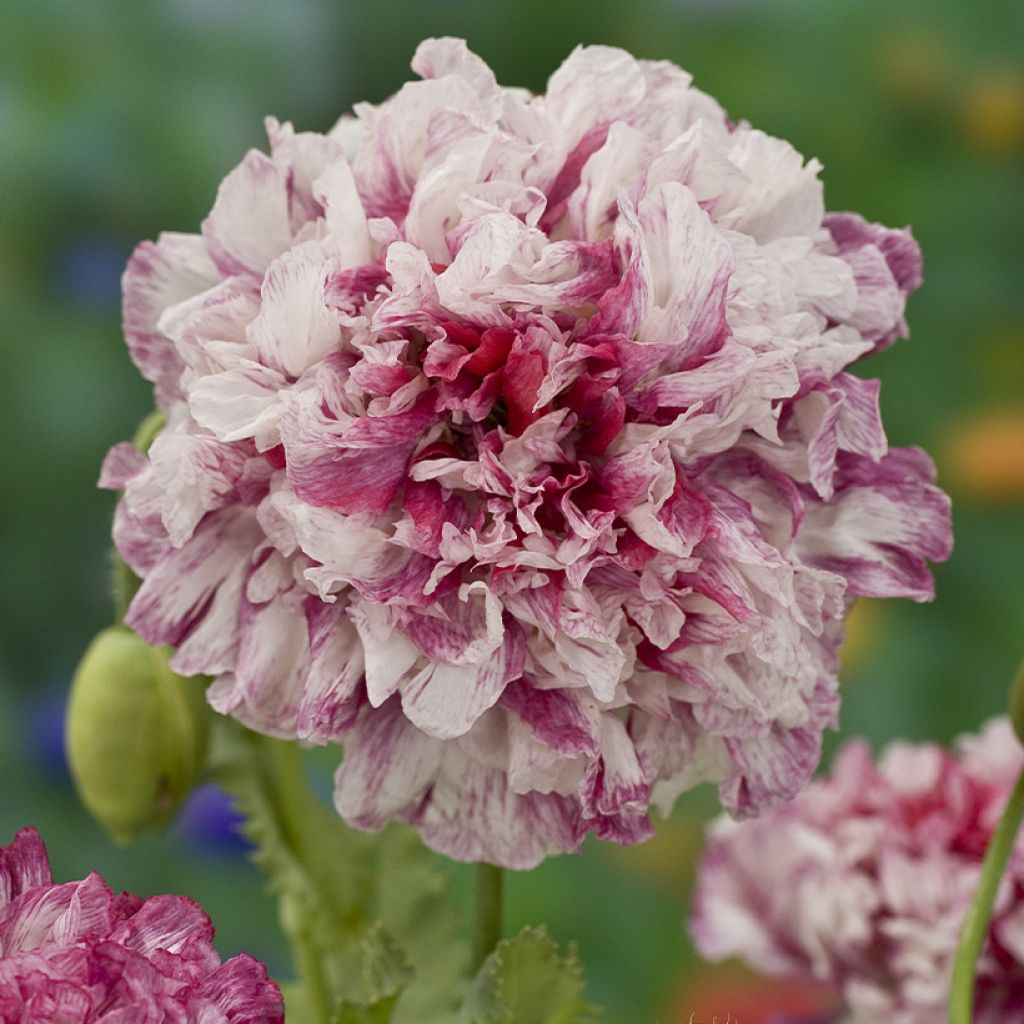
Papaver somniferum Flemish Antique - Opium Poppy seeds
Papaver somniferum Flemish Antique - Opium Poppy seeds
Papaver paeoniflorum (somniferum var. paeoniflorum)
Opium Poppy, Peony Poppy
Back-to-school special offer!
Get €10 off for every €50 you spend! And get up to €40 off on a single order.
How does it work?
1. Shop your favourites
Add your favourite plants to your basket. For every €50 you spend (excluding delivery charges, store credit and the plastic-free option), you’ll receive a €10 voucher.
€50 spent = €10 voucher
€100 spent = €20 voucher
€150 spent = €30 voucher
€200 spent = €40 voucher
2. Place your order
Once your basket reaches one of the spending thresholds, place your order. You can even choose your delivery date!
3. Receive your voucher
As soon as your order has been shipped, you’ll receive an email containing your personal voucher code and its value.
4. Use it on your next order
Your voucher is valid for 90 days from the date you receive it. It can be used once only, on a new order worth at least the value of the voucher, excluding delivery charges.
Please note: Vouchers can be combined with other offers, but cannot be split or refunded.
Home or relay delivery (depending on size and destination)
Important: You may be charged customs duties by your country’s customs authorities upon delivery.
Schedule delivery date,
and select date in basket
This plant carries a 6 months recovery warranty
More information
We guarantee the quality of our plants for a full growing cycle, and will replace at our expense any plant that fails to recover under normal climatic and planting conditions.
Would this plant suit my garden?
Set up your Plantfit profile →
Description
Papaver somniferum 'Flemish Antique' is a charming annual poppy, with large peony-like flowers in tousled pompons, striped with white and pink tones with shades of dark red. Each one is composed of a multitude of crumpled and randomly coloured petals that give it a unique beauty. Opulent flowers that bloom in summer, at the end of tall, sturdy stems emerging from abundant, wavy, cut, glaucous green foliage. The flowers are followed by decorative fruits filled with seeds. This variety is sown directly in open ground in spring, or early autumn in mild regions. It will easily self-seed in light, sunny soil.
The annual poppy 'Flemish Antique' is a horticultural variety dating back to 1996, obtained by Sahin, classified in the category of opium poppies with peony-like flowers. All poppies belong to the Papaveraceae family. 'Flemish Antique' is derived from the closely related Papaver "paeoniflorum" to P. somniferum. The latter is found in Asian mountains, but also in Europe, on limestone soils. This plant, probably originating from regions between the Mediterranean and Asia Minor, has given rise to a multitude of varieties long cultivated for ornamental purposes. Its life cycle is annual: the plant germinates, flowers, produces seeds, and dies in less than a year.
'Flemish Antique' has magnificent glaucous foliage, with beautiful lobed and elliptical leaves showing a notched edge. From this 30 to 45 cm wide clump of foliage, remarkable solitary flowers emerge from June to August on tall stems, 80-90 cm above the ground. Reaching 10 cm in diameter, they are very double, spherical and formed by countless petals. The flower's centre is almost invisible. The floweringis attractive to pollinating insects and gives way to a characteristic, onamental fruit filled with small black seeds which takes on slate blue highlights when drying, changing with the light, due to the crystallized wax film that protects it. Opium poppies have a taproot that does not tolerate transplanting well, which is why it is preferable to sow them in place. They are hardy annual plants, early autumn sowings are able to withstand not too harsh winters. In this case, flowering is earlier in spring.
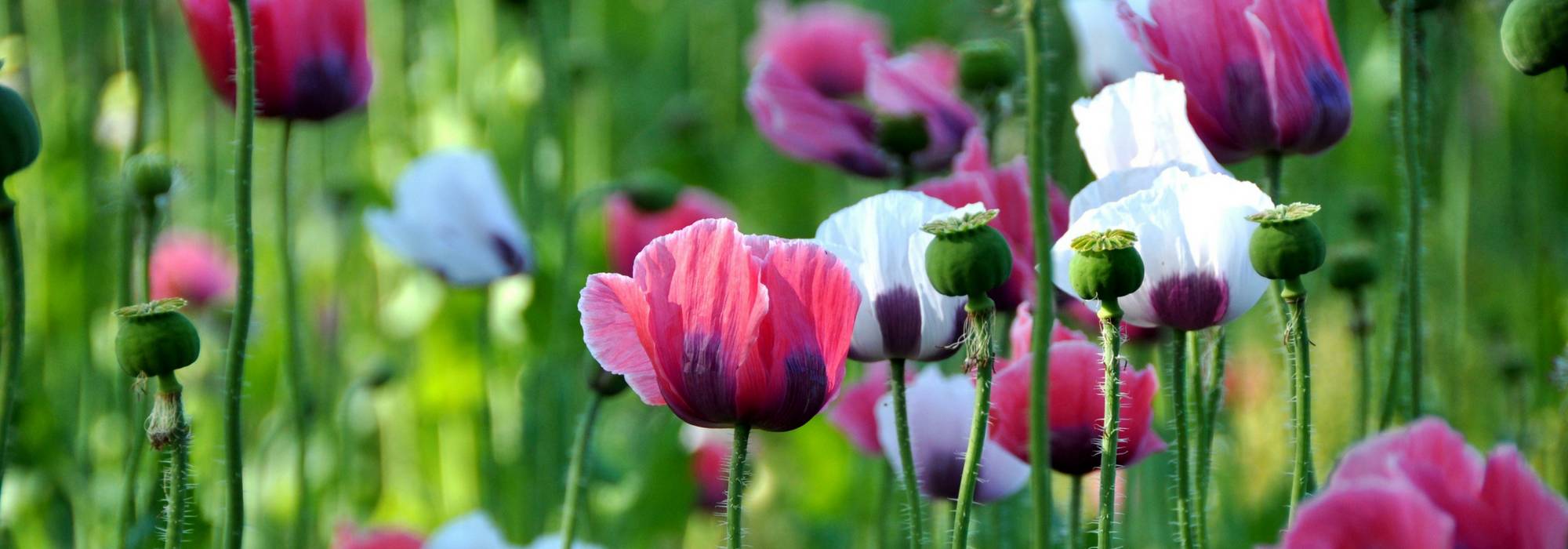
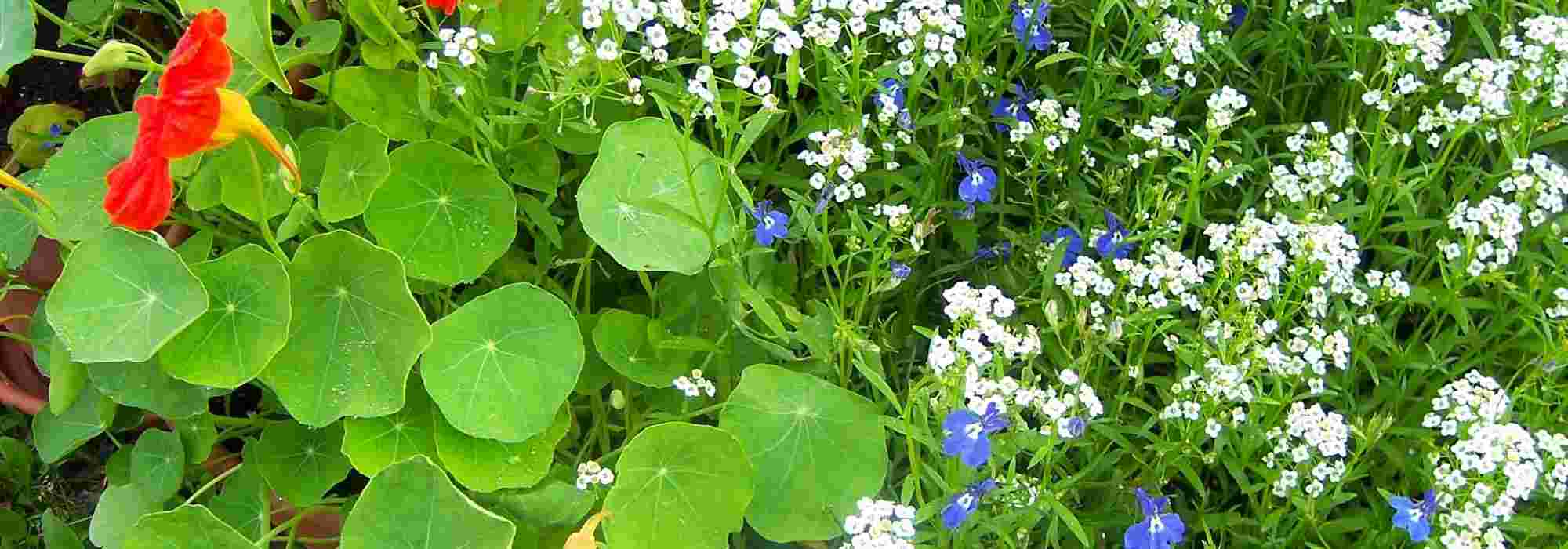
Opium poppies are at home in sophisticated or romantic gardens, cottage gardens and neglected gardens where they quickly and effortlessly create infinitely delicate waves of flowers, moving in their bright, dark, or pastel colours, dancing on the foam of their foliage. Simply scatter the seeds on well-prepared soil among other plants, along borders or in flower beds. While not very long-lasting when cut, the flowers of the 'Flemish Antique' Poppy have a charm when planted en masse, with large daisies, among the shifting foliage of grasses, or even with landscape shrub roses. This annual plant, like cosmos, has no equivalent for filling in empty spaces, between annuals or late-flowering perennials like giant asters that take over, in full sun.
Once the flowering is exhausted, there are still the fruits, precious for dried bouquets and often perceived as a majestic element of the garden or a somewhat enigmatic vestige of summer.
Flowering
Foliage
Plant habit
Botanical data
Papaver
paeoniflorum (somniferum var. paeoniflorum)
Papaveraceae
Opium Poppy, Peony Poppy
Cultivar or hybrid
Planting and care
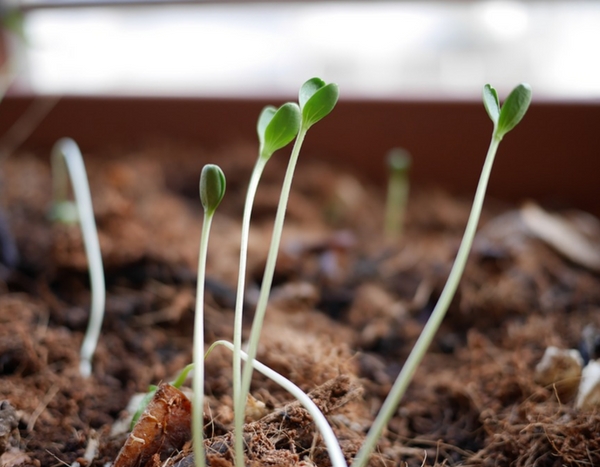
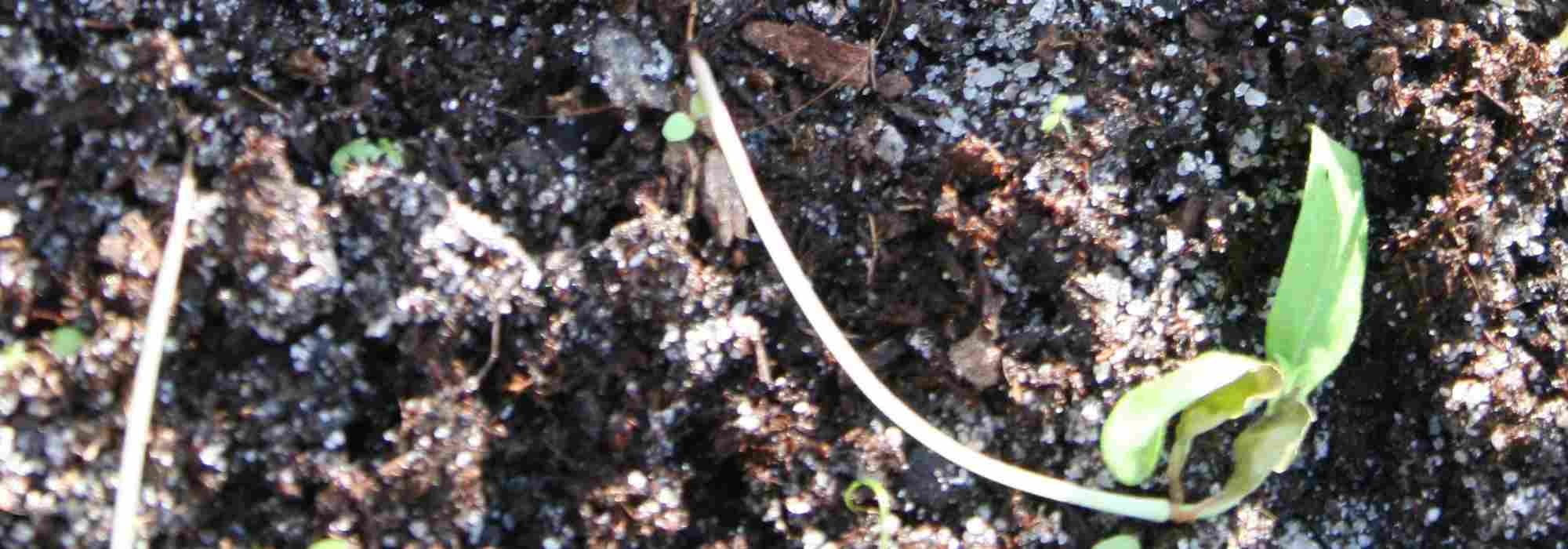
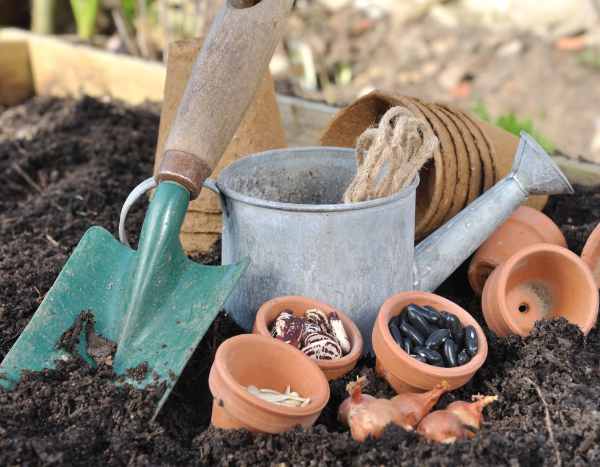
Sow the seeds of annual poppy Flemish Antique directly in place, outdoors, in spring or early autumn. Choose a sunny spot with fertile, well-drained soil that has been well prepared beforehand. Sow the fine seeds just below the surface of the soil. Water regularly, especially during dry periods. Germination usually takes 15 to 20 days at 16-20°C.
When the young poppy plants are sufficiently developed to be handled, thin out the seedlings to leave one plant every 30 cm. They should not lack water or nutrients during the growth and flowering period. Opium poppies easily self-seed in the garden. Remove faded flowers if you want to avoid self-seeding.
While they prefer light and loamy soils, annual poppies are undemanding plants that adapt to most well-worked soils. Their seeds retain their viability for a long time, and it is not uncommon to see seedlings reappear years after a 'failed' sowing, following soil cultivation.
Important note: all poppies are toxic. However, the seeds produced by the P. somniferum and P. paeoniflorum species can be consumed. Generally, the seeds are used in bakery recipes (bread, brioche...)
Sowing period
Intended location
Planting & care advice
-
-

-
-
-
-

-
-

This item has not been reviewed yet - be the first to leave a review about it.
Recently viewed products
Haven't found what you were looking for?
Hardiness is the lowest winter temperature a plant can endure without suffering serious damage or even dying. However, hardiness is affected by location (a sheltered area, such as a patio), protection (winter cover) and soil type (hardiness is improved by well-drained soil).

The flowering period indicated on our website applies to countries and regions located in USDA zone 8 (France, the United Kingdom, Ireland, the Netherlands, etc.)
It will vary according to where you live:- In zones 9 to 10 (Italy, Spain, Greece, etc.), flowering will occur about 2 to 4 weeks earlier.
- In zones 6 to 7 (Germany, Poland, Slovenia, and lower mountainous regions), flowering will be delayed by 2 to 3 weeks.
- In zone 5 (Central Europe, Scandinavia), blooming will be delayed by 3 to 5 weeks.
In temperate climates, pruning of spring-flowering shrubs (forsythia, spireas, etc.) should be done just after flowering.
Pruning of summer-flowering shrubs (Indian Lilac, Perovskia, etc.) can be done in winter or spring.
In cold regions as well as with frost-sensitive plants, avoid pruning too early when severe frosts may still occur.
The planting period indicated on our website applies to countries and regions located in USDA zone 8 (France, United Kingdom, Ireland, Netherlands).
It will vary according to where you live:
- In Mediterranean zones (Marseille, Madrid, Milan, etc.), autumn and winter are the best planting periods.
- In continental zones (Strasbourg, Munich, Vienna, etc.), delay planting by 2 to 3 weeks in spring and bring it forward by 2 to 4 weeks in autumn.
- In mountainous regions (the Alps, Pyrenees, Carpathians, etc.), it is best to plant in late spring (May-June) or late summer (August-September).
The harvesting period indicated on our website applies to countries and regions in USDA zone 8 (France, England, Ireland, the Netherlands).
In colder areas (Scandinavia, Poland, Austria...) fruit and vegetable harvests are likely to be delayed by 3-4 weeks.
In warmer areas (Italy, Spain, Greece, etc.), harvesting will probably take place earlier, depending on weather conditions.
The sowing periods indicated on our website apply to countries and regions within USDA Zone 8 (France, UK, Ireland, Netherlands).
In colder areas (Scandinavia, Poland, Austria...), delay any outdoor sowing by 3-4 weeks, or sow under glass.
In warmer climes (Italy, Spain, Greece, etc.), bring outdoor sowing forward by a few weeks.
Shipping country and language
Your country of residence may be:
Your country of residence is:
For a better user experience on our website, you can select:
Your shipping country:
-
 Austria
-
 Belgium
-
 Bosnia & Herzegovina
-
 Bulgaria
-
 Croatia
-
 Cyprus
-
 Czechia
-
 Denmark
-
 Estonia
-
 Finland
-
 France
-
 Germany
-
 Greece
-
 Hungary
-
 Iceland
-
 Ireland
-
 Italy
Italy
-
 Latvia
-
 Liechtenstein
-
 Lithuania
-
 Luxembourg
-
 Malta
Malta
-
 Netherlands
-
 Poland
-
 Portugal
-
 Romania
-
 Serbia
-
 Slovakia
-
 Slovenia
-
 Spain
Spain
-
 Sweden
-
 Switzerland
Language:
-
French
-
 English
-
Spanish
-
Italian
-
German
-
Portuguese
-
Dutch
-
Finnish
My Account
Hello
My wish lists
My cart
Log in / Register
Existing customer?
This form is protected by reCAPTCHA - the Google Privacy Policy and Terms of Service apply.
New customer?
Create an account to track your orders, access our customer service and, if you wish, make the most of our upcoming offers.