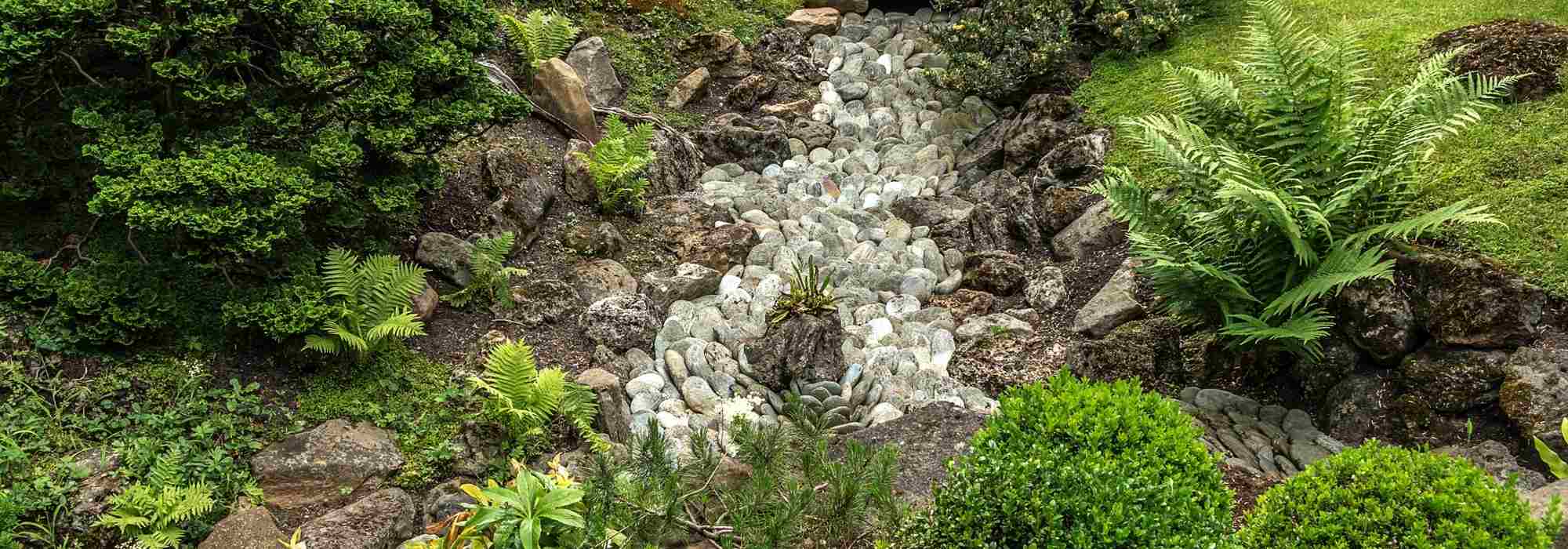
Creating a dry river bed in a Japanese garden
Choosing stones and plants, layout and symbolism: all you need to know about Japanese dry riverbeds
Contents
Creating a Japanese garden at home is an ambitious project. Inserting a mineral river into it is adopting a strong aesthetic, associated with contemplation and the course of life.
This dry river, one of the elements of a zen garden, recreates an imaginary watercourse, and can be adorned with a stone lantern, or ideally left natural with a few chosen plants around.
How to avoid mistakes? Which technique to apply? Which plants and materials will bring you closest to Japanese spirit? We guide you through this article to properly lay out your dry stone river.

The subtle art of the Japanese dry river
Japanese garden is visually restrained, aesthetic and follows very precise codes and symbolism, both in materials and plants.
One may want, when lacking a water feature, an element essential to the japonising garden’s mineral component, to recreate a watercourse in mineral form. It corresponds to what is called in Japanese the kare-sansui. Formed of gravel, rocks and sometimes moss, this garden represents mountain landscapes or rivers in an abstract way. Dry rivers (kare-gawa) are another iconic example, often extending the concept.
It should not be confused with the dry garden or zen garden, carefully raked, nor with the tobi-ishi (a kind of crossing: stepping stones across a stone path, known here as Japanese stepping stones), and even less with the koke-niwa (moss garden), the chaniwa (tea garden), or the stroll garden (chi-sen).
In a japonising garden, the dry river therefore embodies water without having a physical presence. It symbolises both water and earth, the flow of life, perpetual movement, and invites reflection on impermanence. Pebbles, shingle and gravel represent water, waves, currents or waterfalls, while rocks stand for islands or mountains. Plants and rocks refer to other elements, such as fire and air.
Dry river has its roots in Zen Buddhism, where simplicity and meditation are central.
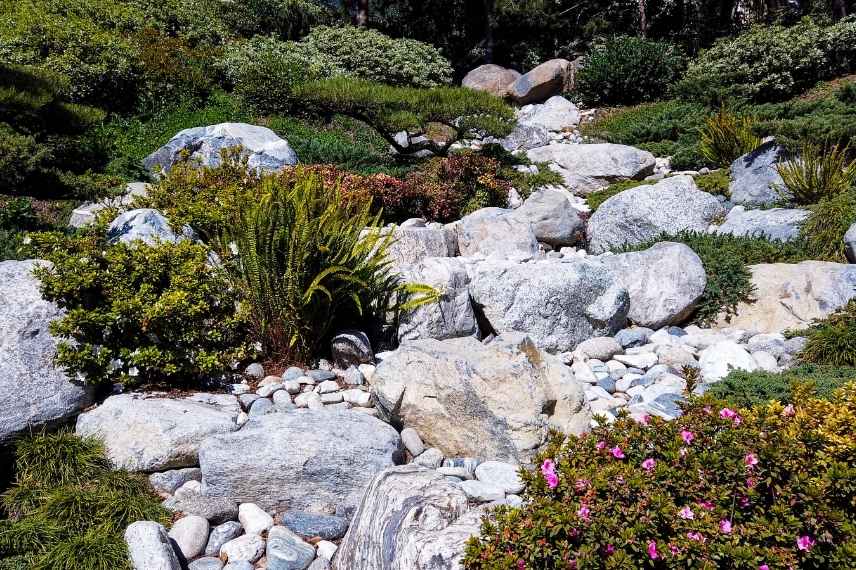
Dry river depicted here in a mountain garden
Read also
Create a Japanese or Zen gardenWhere to place a dry stream in a Japanese garden?
The dry riverbed suits gardens designed entirely in the Japanese spirit. It is there that it takes on its full symbolism and fits best into the landscape. It is often also considered when the garden lacks a water feature.
Small gardens or, conversely, large gardens where a Japanese-style area has been set aside can equally be envisaged. In the latter case, it is a transition within another garden. The stone river can thus serve to delimit an area or the Japanese garden within a large garden.
Les rain gardens, designed as a buffer zone during rain events, are another idea for integrating a mineral river, as are dry gardens or mountain gardens. A sunken or hollow area, forming like a riverbed, is obviously ideal.
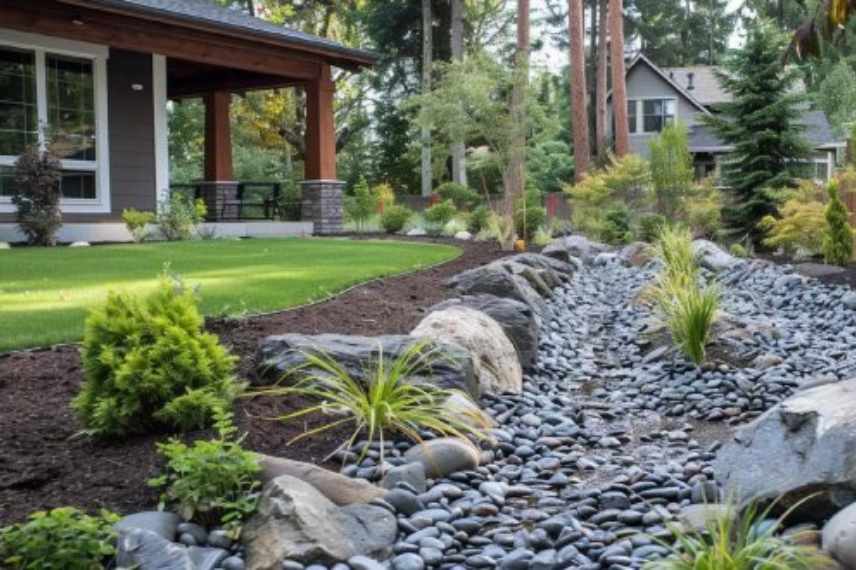
Dry riverbed as a strong element in a garden
Finally, it can also be inserted into an unpromising spot, where the lawn grows poorly for example, to transform the area by adding stones.
In all configurations, keep in mind to create a very well-tended area, as required by the flawless aesthetic of the Japanese garden.
How to build it?
Water, main element of Japanese garden with stone, is symbolised by gravel and pebbles. The idea is to materialise a sinuous river, which evokes a watercourse, and to flank it with a few slightly larger stones.
It is therefore important to draw a plan beforehand, and to use a preliminary sketch, to scale if possible, to know the right quantity of stones to include. Take inspiration from walks in nature or photographs to find the most natural shape, or from photos taken on a trip to Kyoto if you are lucky enough to go. Closer to home, visit the Maulévrier Oriental Park (Maine-et-Loire), Eric Borja’s Zen Garden (Drôme) or, in the Paris region, the Albert Kahn Gardens.
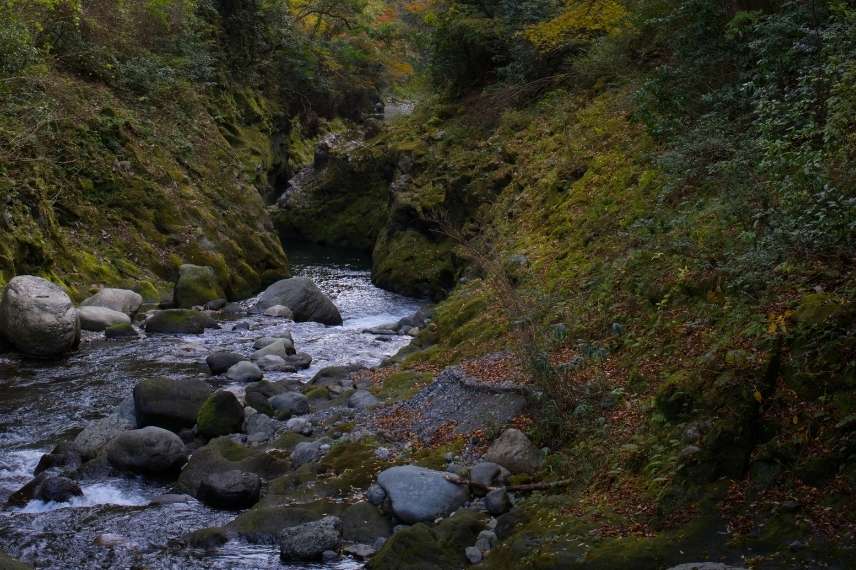
Natural mountain or valley rivers are a good source of inspiration: take some photos!
Call on a landscaper if that intimidates you, or set out on this distinctive landscaping project yourself.
The steps will include:
- location to be defined, a major one, so this layout takes its full dimension and symbolism (see above);
- layout, to be designed as natural as possible, with two or three curves;
- supply of stones/pebbles (calculated in tonnes);
- creation of the “river” bed by excavating 5 to 10 cm and laying a geotextile;
- implementation by placing the mineral elements and the plantings: a meticulous placement will give a much more satisfying result. Laying techniques vary — diagonally to suggest the movement of water, by embedding the stones slightly (to one-third of their height) for a natural effect.
As a guide, creating a dry river 3 cm high over about 50 m² requires roughly 2 tonnes of material depending on the size of the gravel and pebbles.
One can take inspiration from the Albert Kahn garden near Paris to shape the river as pebble paving laid vertically or tilted like fish scales: they more faithfully depict the flow of a torrent or of flowing water.
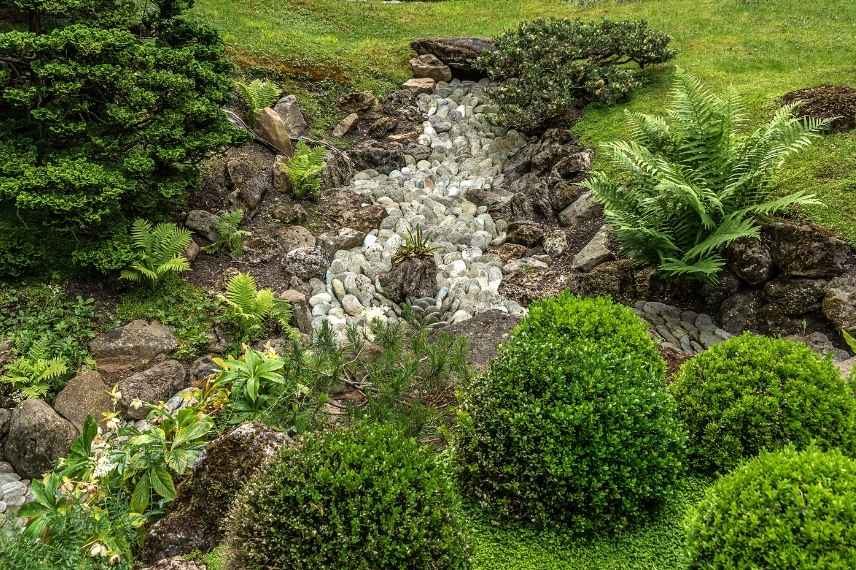
A magnificent installation at the Albert Kahn Gardens (92)
Larger, more rugged stones can also complement the setting, at a distance from the dry river, to symbolise mountains, another key element of Japanese garden. Avoid caricature or a kitsch appearance — this area must remain decidedly restrained.
Which plants for a dry riverbed?
Success of a dry river lies in precise planting along the pebbles: not an easy task, which must convey a natural look, as if banks of this stone river were vegetated. Be sparing, avoid planting a profusion of plants. Best to concentrate on two or three plants, repeated in patterns.
For an organic note, opt for low-growing plants with cushion, mound or creeping habit (heathers, Hebe, Pinus mugo, Chamaecyparis obtusa ‘Nana Gracilis’). Avoid flowering displays, unless grouped in a single small, bounded area—for example white or blue water irises (Iris ensata), which remain low—and always favour dark or uniform foliage colours for greater realism.
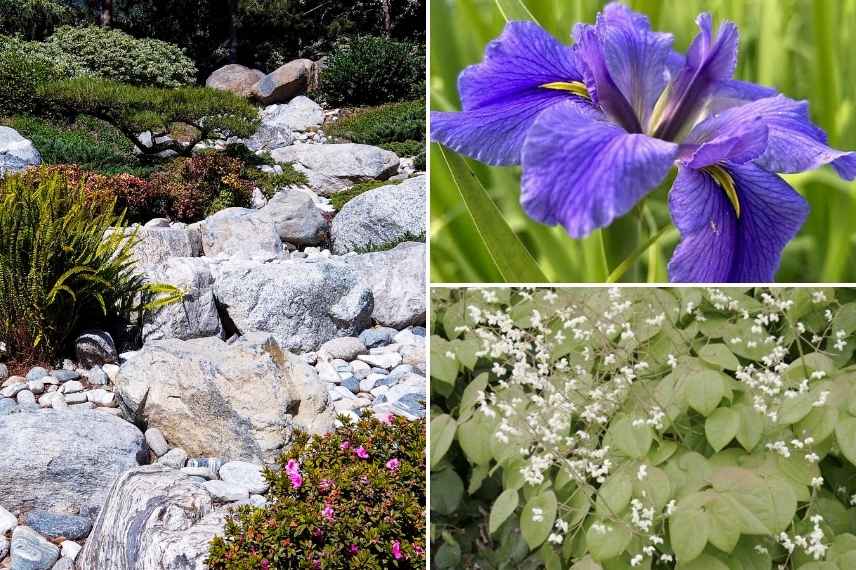
Iris laevegiata ‘Latour Marjac’, and Epimedium
You can place at most a few evergreen shrubs of rounded, contorted and dwarf habit, because view should carry into the distance, unobstructed. If necessary, a slightly taller specimen can act as an intruder, but sit it well back: Prunus mume (Japanese apricot), or ideally a conifer such as a Japanese false cypress (hinoki) or a dwarf Chamaecyparis (such as C. lawsoniana ‘Green Globe’).
In shade or semi-shade
Provide evergreen ferns, Carex, Ophiopogon, Acorus or Farfugium in very moist ground, Epimedium (Warley bishop’s hat), hostas, saxifrages, Ophiopogon and Japanese (forest) grass, evergreen groundcovers with a moss-like appearance such as pearlwort, and in moist ground a single type of water iris (for example Iris ensata or Iris kaempferi).
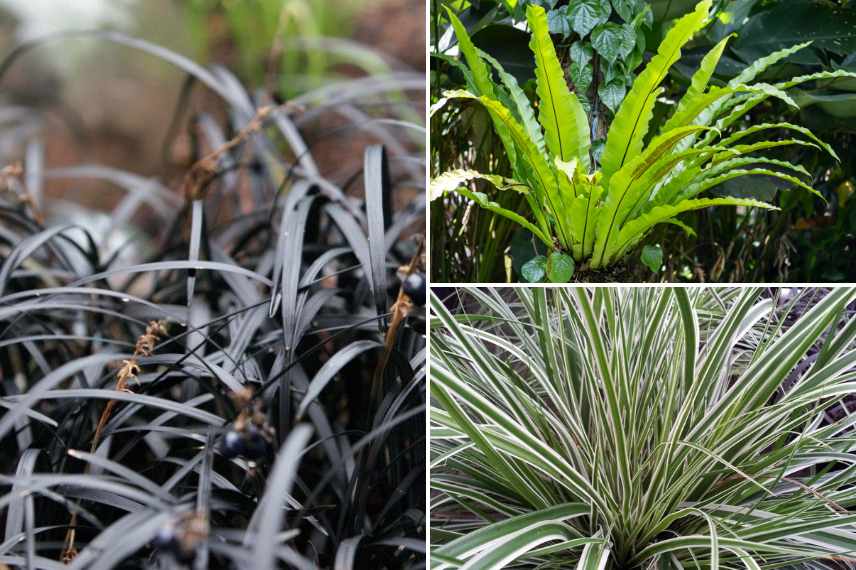
Ophiopogon planiscapus ‘Nigrescens’, Asplenium scolopendrium and Carex oshimensis ‘Everest’
N.B.: all Japanese ferns are particularly suitable, such as Athyrium niponicum, more or less silvery, but also Pteris nipponica, a bicoloured fern for mild-climate regions, which can be replaced elsewhere by Cyrtomium falcatum or Cyrtomium fortunei. Prefer evergreen ferns.
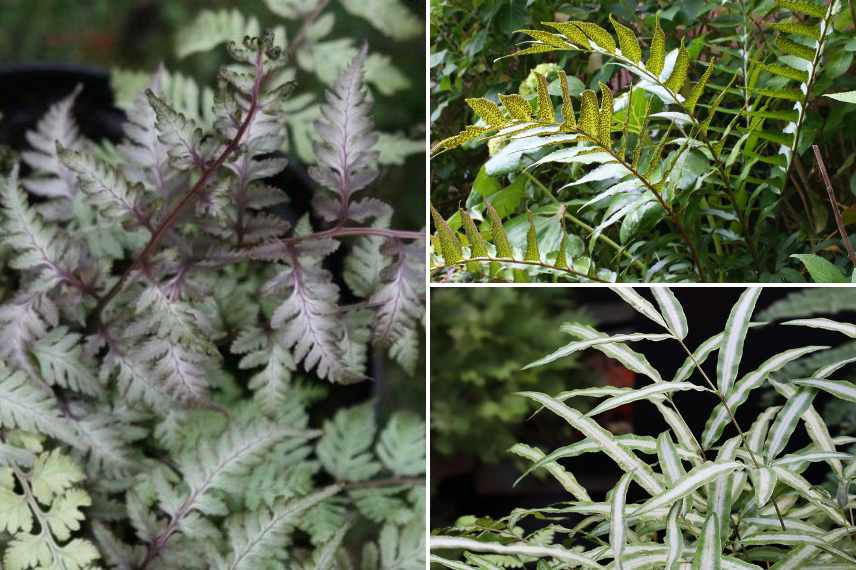
Athyrium nipponicum ‘Pictum‘, Cyrtomium falcatum and Pteris nipponicum
In full sun
Choose plants that will cope well, surrounded by warming mineral: fescues, heathers (Calluna or Erica types), Hebe, helxine, Zoysia tenuifolia or Mascarene lawn, but also creeping euonymus such as Euonymus fortunei ‘Wolong Ghost’ or Euonymus fortunei ‘Minimus’, Cotoneaster dammeri with a trailing habit, etc.
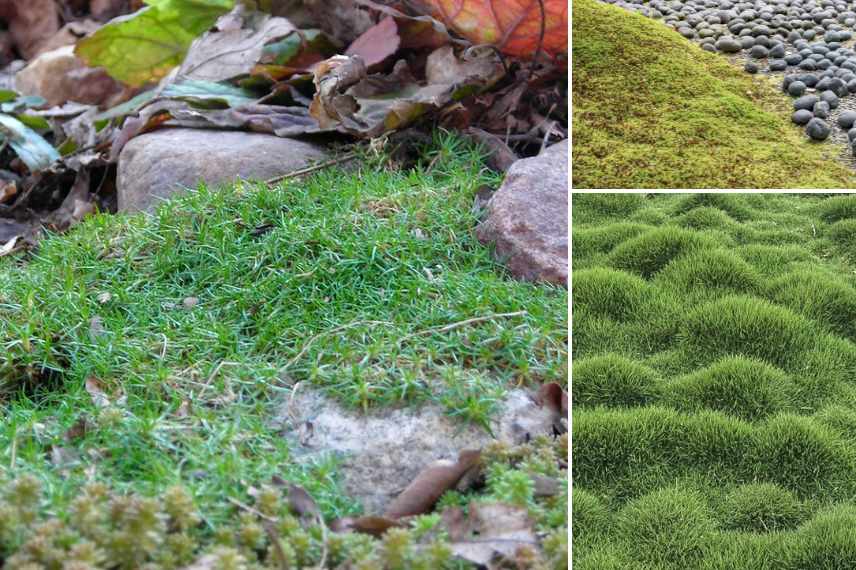
Pearlwort, mosses and Mascarene lawn recreate illusion of freshness around stones simulating a nearby spring
Cushion-forming plants such as a Hebe pinguifolia or a non-flowering shrubby veronica forming a compact cushion like Hebe ‘Emerald Green’ are also well suited. Finally, dwarf conifers such as Pinus mugo ‘Mops’ should be planted slightly set back.
Materials: stone, pebbles
Now turn to materials, heart of mineral symbolism and spiritual element. The art of arranging stones has a name in Japanese, ishi-wo-taten-koto. It follows ancestral rules to evoke nature with restraint and intent. Perfection, purity, restraint, immortality, stability, meditation: these are the key words to keep in mind.
For choice of stones, true energies and structure of the Japanese garden, opt for pebbles or smooth polished stones: they effectively evoke water, like river pebbles in grey‑blue or white tones. Angular schist or granite stones are grouped in odd numbers to symbolise natural asymmetry (3, 5 or 7 for large “rivers”). Largest stones, the boulders, will simulate mountains or waterfalls; flat stones will represent islands. As noted above, stones that form the riverbed are imbricated and set into the ground as naturally as possible, with rocks placed in the hollows of the curves.
Avoid overly coloured stones, or sand, inappropriate here as reserved for raked zen gardens.
The main mistake to avoid is aligning stones in a railway‑track effect and mixing textures without harmony by placing smooth pebbles and raw stones side by side without transition. A too‑uniform look will appear artificial.
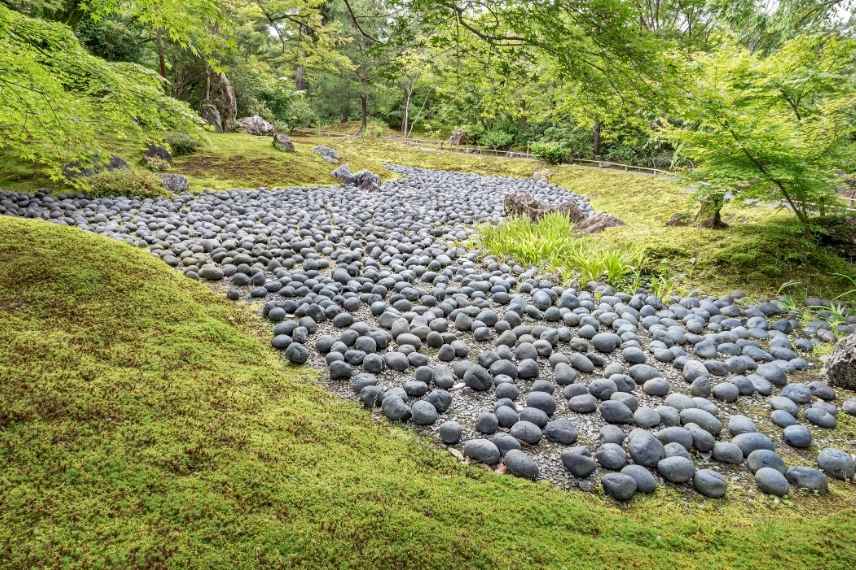
This example is more modern, very restrained, evoking a mineral river with sparse riverside planting, and is suited to a large plot, for instance
Dalles like stepping stones crossing the river accentuate the illusion of a watercourse (although originally intended to cross the tea garden). But it is better to avoid installing the small iconic bridge on this imaginary river, rather kitsch in this context, whereas it enhances a small stream or pond when that is an option.
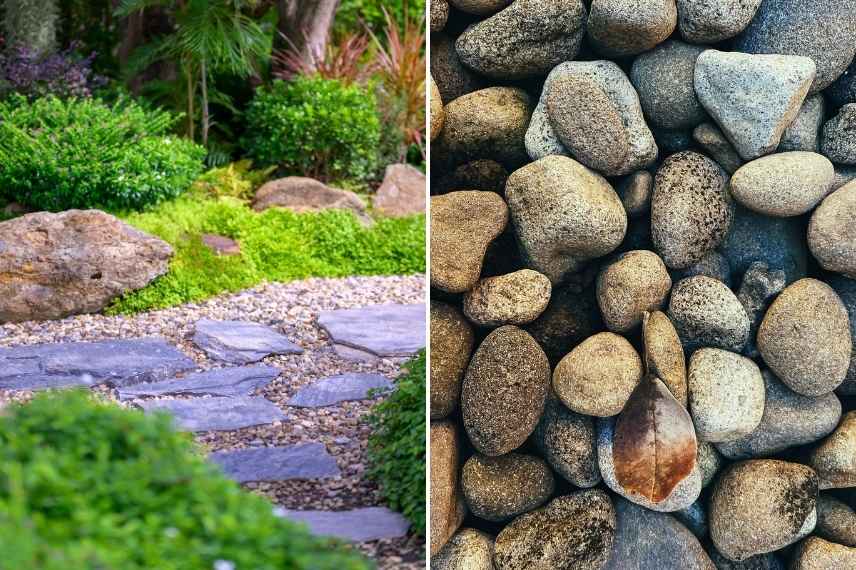
Schist can enhance the river, but it is stones polished by water that remain the visually dominant element
- Subscribe!
- Contents
This form is protected by reCAPTCHA - the Google Privacy Policy and Terms of Service apply.

































Comments