Terraces, courtyards, patios and small bohemian balconies are the new stars of summer! This very colourful "boho" trend that has invaded our interiors and wardrobes also appears in our summer green retreats. It matches the sunny cheerfulness of a season when we spend a lot of time outdoors.
Let’s take inspiration from the gypsy world to prepare bright alcoves on balconies, terraces and inner courtyards from the first fine days, with planting ideas and decorative elements. We explore this Boho Patio in three scenes easy to recreate at home!
Boho Patio codes
The bohemian atmosphere dresses itself in vivid, deep and variegated colours that answer one another, but also in associations of warm tones in the blooms: intense reds, deep violets, Indian pinks and spicy oranges, not forgetting bicoloured flowers. Bluish, golden or purplish foliage helps to reinforce this playful mood, bringing red or variegated splashes.
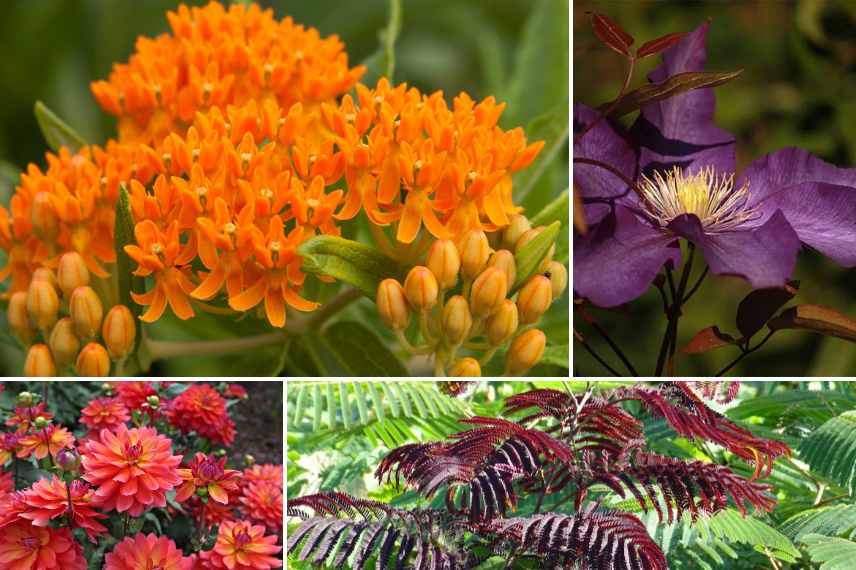
This mixed-up planting borrows from gypsy culture a festive, hybrid universe that laughs at convention and pairs a whole spectrum of colours, provided they are warm and bright.
This style is also based on improvisation, like manouche music, and on bold accents. This temperament appears in the garden in temporary scenes created especially for the summer months, and in the accumulation of mismatched small objects (side tables, stools, small cushions, etc.).
On the décor side, important for dining and relaxation areas, have fun with mismatched pairings: rustic furniture repainted turquoise or green, rattan chairs, fabric pouffes, Provençal floral and ethnic patterns juxtaposed with strong colours: turquoise, pink, orange and bright yellow. The advantage of this bohemian décor is that you can mix disparate objects and accessories, using what you already have at home or stored in the attic, to give them a second life: bring out granny’s lace and embroidery for the summer, macramé and trimmings, old rattan armchairs, baskets and fruit crates, airy curtains. In a joyful mix of materials, the décor is done!

On a sun-drenched terrace
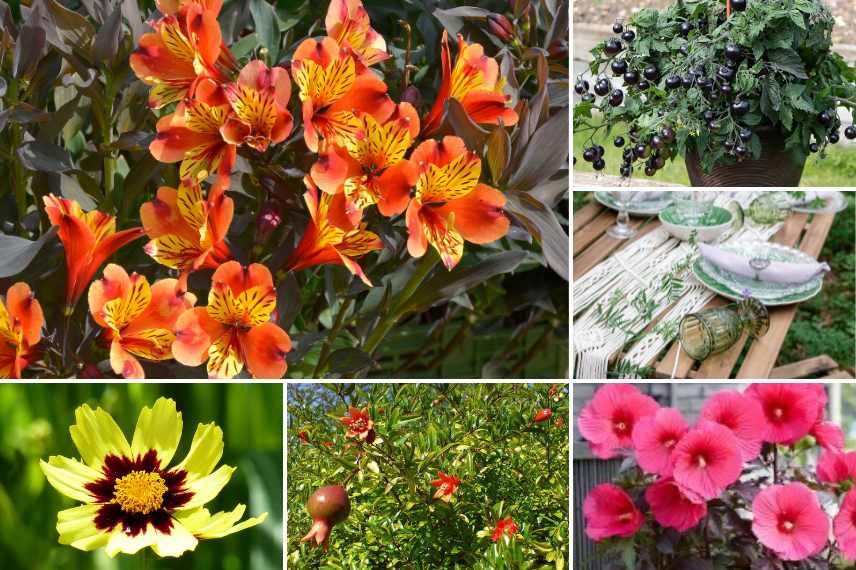
Terrace or balcony are often west- or south-facing. They can be radically transformed into an ultra-cheerful cocoon with sun-tolerant plants that do well in pots. Explore a plant colour palette ranging from saffron yellow to violet for a truly bohemian vibe.
Alstroemerias 'Indian Summer', orange and yellow contrasting against bronze foliage, will look stunning alongside Coreopsis 'Cosmic Eye', a bright yellow spotted with purple, or the pretty all-yellow 'Full Moon Madness'. Add other long-flowering plants such as a common Rose mallow 'Pink Passion' with giant flowers and dark purple foliage, and provide more foliage interest with a pomegranate that can be grown in a pot, such as Punica granatum 'Nana', whose brilliant flowers will pair beautifully with the other perennials. For snacking at aperitif time, invite, for example, the surprising cherry tomatoes 'Akoya', whose fruits turn almost black.
In a semi-shaded urban patio
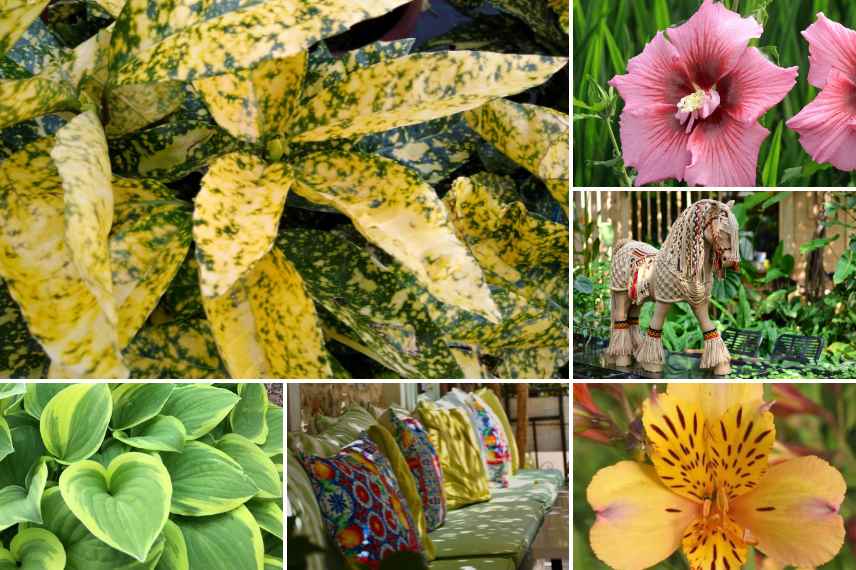
Small city courtyards benefit from focusing on colour and variegated or golden foliage to lift them out of the shade. In a semi-shaded patio receiving enough light and warmth in summer, opt for sunny flowers and a few "indestructibles":
Hosta 'The King', Hakonechloa macra and an Aucuba japonica 'Crotonifolia' for their golden and variegated foliage (Aucuba will reward you with pretty red berries a little earlier) together with the bold flowers of Hibiscus syriacus 'Hibisa rosada', and the Peruvian lily 'Duc d'Anjou'.
The bohemian spirit will also be present in accessories, essential in less bright areas and in smaller spaces.
Beyond plants, bring colour without fearing the boldest mixes. Dare genre-mixing: antique rug + Italian ceramics + small disparate or oversized objects and a cosy bench, etc. Here, the evening atmosphere will be especially worked on: lanterns, paper lanterns and candles, and don’t forget a crochet throw in these patios that are often cooler at night.
Garden refuge as an improvised alcove
This bohemian trend can also be expressed in a corner of the garden used as an improvised summer retreat.
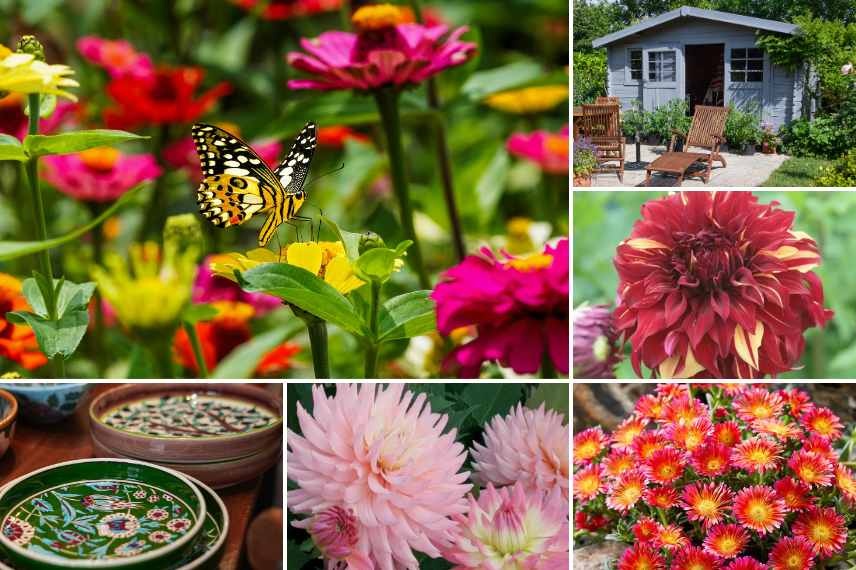
In front of a shed, garden shelter or at the foot of a fine tree from which a rattan chair is hung, set up a summer hideaway using bohemian codes. A temporary terrace, improvised with clip-together wooden decking tiles readily available from DIY stores, is easy to install. In summer it becomes a true green cocoon perfect for relaxing on a garden sofa made of a few stacked pallets or large pouffes, in a fairground style.
Here, a few colourful annuals join the party: multicoloured zinnias and orange calendulas (marigolds) sown in pots in spring, or beds of African marigold 'Mango Tango' around the area, as well as sun-loving perennials such as the charming Delosperma 'Ocean Sunset Orange Glow'. Count on two striking pots of dahlias with evocative names, the fiery 'Bohemian Spartacus' and the more restrained compact 'Melody Gipsy', for a long and remarkable display. Sunflowers 'Mongolian Giant' will bring pep and height, while a pot of basil 'Everleaf Emerald Tower' will be handy for salads at barbecues or sunny lunches.
Gather your most colourful pots, bring in lace, hangings, vintage crockery and cushions: job done!
Discover other plants ideal for composing this bohemian green décor on a terrace in our "Boho Patio" selection online and in our trend booklet!
Feeling the bohemian spirit? Find our advice on creating a bohemian garden, and our inspirational sequences: Catalane and Peach Raspberry.
This Boho Patio trend also draws on recycling second‑hand objects. Explore our topics to let your creativity run free: Decor idea: plants in unusual containers; How to make a planter from a pallet?; Recycling in the garden and How to use and properly integrate terracotta pots in the garden?
Terraces, courtyards, patios and small bohemian balconies are the new stars of summer! This very colourful “boho” trend that has invaded our interiors and wardrobes also appears in our summer green retreats. It matches the sunny cheerfulness of a season when we spend a lot of time outdoors. Let’s take inspiration from the gypsy world […]
The Cutie Pie rose is a brand new miniature rose with generous flowering reminiscent of the delicacy of apple blossom. Initially carmine pink with a white centre at the start of flowering, its petals lighten to pale pink in summer. Highly appreciated by pollinators, its flowers continuously renew until the first autumn frosts. Requiring little maintenance, it has a very healthy compact foliage and thornless branches.
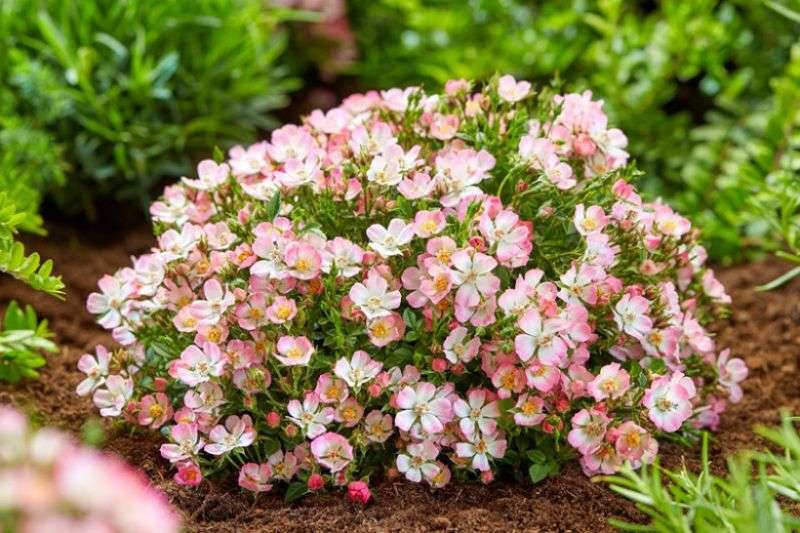
Whatever the style of your garden or terrace, this miniature rose is very easy to grow if you give it a lovely spot in the sun. Like a perennial plant, its small size, 15-20 cm high and 30 cm wide, allows you to tuck it in anywhere. At the edge of a path or to fill a space in the foreground of a border. Used as groundcover, three plants spaced 30 cm apart create a beautiful dense and flowering cushion in my rockery, accompanied by hardy geraniums, carnations, phlox, or nepeta.
On your terrace, it will thrive in a pot (30-40 cm) in dark grey tones that will enhance its beauty. By the second year, it will form an incredible dome of flowers.
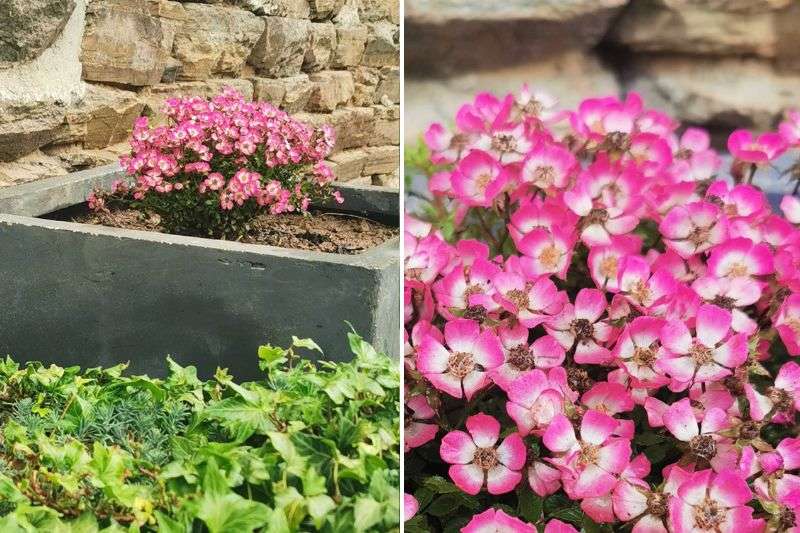
In terms of maintenance, regularly remove faded roses to encourage it to produce even more new flowering shoots. In the ground, it shows itself to be perfectly resistant to cold and drought. Water it once a week during the first year after planting, and it will manage very well on its own thereafter. In pots, protect it in regions with very harsh winters and ensure proper watering and fertilisation.
Don't miss out on this little gem; it will undoubtedly become a must-have!
The Cutie Pie rose is a brand new miniature rose with generous flowering reminiscent of the delicacy of apple blossom. Initially carmine pink with a white centre at the start of flowering, its petals lighten to pale pink in summer. Highly appreciated by pollinators, its flowers continuously renew until the first autumn frosts. Requiring little […]
Do you only have a small garden or simply a terrace and dream of a water feature? Do you have a larger garden but do not want to turn it into a mini war zone, even temporarily, to dig a simple pond? Are you mad about aquatic plants but already have no room left in your pond?
Here’s the solution: a miniature water garden!
Mini pond: some basic tips before you start...
You can perfectly well create mini-ponds that are both attractive and beneficial for wildlife in very small containers, provided you respect a few rules:
- First of all, find suitable containers: glazed terracotta, zinc or tin, an old trough, a hollowed stone, a half-barrel, plastic or resin, ... Any container that can hold (and retain!) a liquid, in this case water.
- If it isn’t watertight, you can try to seal the container with a waterproof coating or line it with a PVC or EPDM membrane as you would for a "real" pond.
- If you multiply mini-ponds, favour an odd number and vary shapes and sizes; it will be more pleasing to the eye. Although two or four aren’t bad either... Or eighteen. Actually no: do as you please!
- Containers should have a minimum depth of 40 cm to accommodate a wide choice of plants. Obviously the deeper the better, but 40–50 cm will already be sufficient for most aquatic plants.
- Place mini-ponds in partial shade to provide enough light for life within them (flora and fauna) while avoiding excessive evaporation in hot weather. Avoid positioning them under a tree so leaves, twigs or fruit don’t dirty the water... Choose location carefully because once filled they will be hard to move...
- Choose plants according to pond size. But you can already include a small oxygenating plant to clarify the water, an attractive flowering floating plant and a more upright aquatic perennial.
→ If you’re looking for good ideas to choose aquatic plants, read Pond: 10 aquatic plants, submerged or floating.
Please note: before planting in your small pond, perform a watertightness test on chosen container. It may seem obvious but micro-leaks can be hard to detect. Fill to brim with water and leave overnight. If level has dropped, change container or seal it.
Some ideas for very small ponds for a terrace or even a table
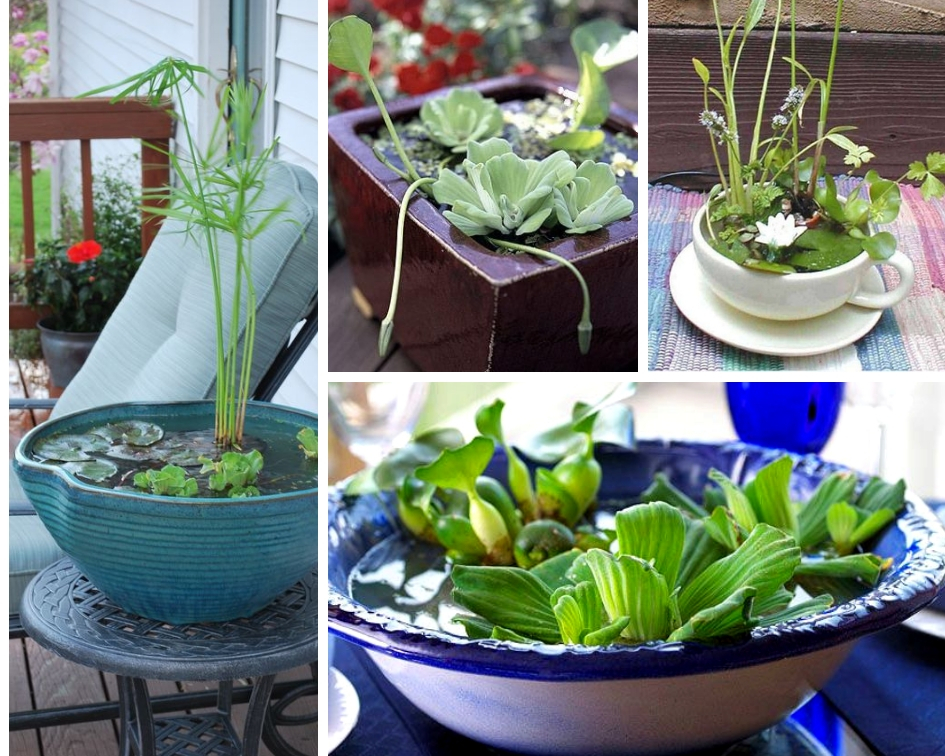
Even very small, these mini-ponds can host some plants. (source: Pinterest)
Even a space as small as a terrace, or even a tiny table, can host a mini water garden. Use a small container 30 cm deep and place a tiny flowering floating plant. The effect will be striking while adding a welcome touch of coolness in summer. You can even be a bit original, as with the teacup-pond above.
Upcycling: half-barrel, old basins or zinc wash tubs
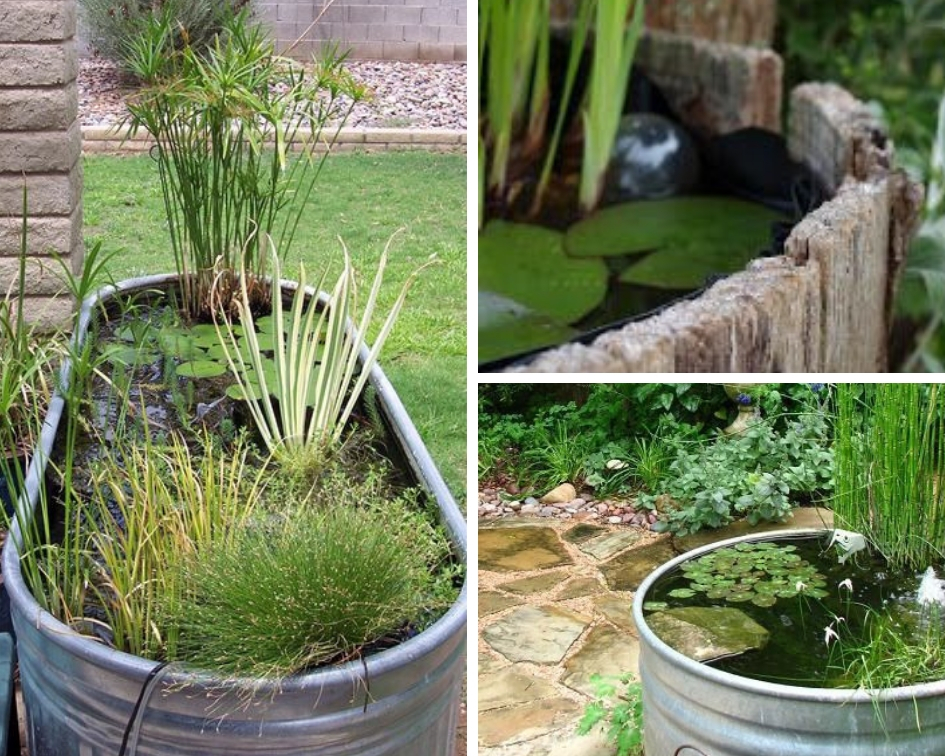
Zinc wash tubs, old basins, barrels... Everything is good for your mini water garden (source: Pinterest)
You often find old zinc wash tubs, basins, troughs or half-barrels at flea markets. Snap them up! (figuratively speaking...) Any more-or-less watertight container will do. If it isn’t, you can always line it with a pond liner... As these containers are often large, you can be freer with number and choice of plants.
With fish?
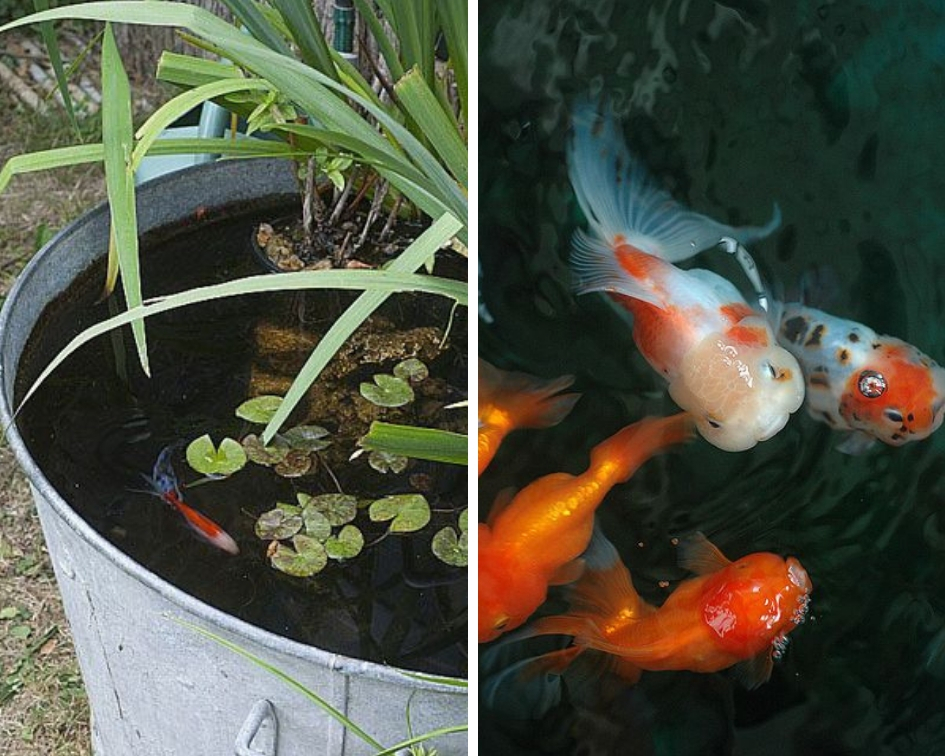
Koi carp are out of the question as they need a large volume of clear water. As for goldfish seen, sadly, in very small containers, know that this can only be a temporary situation — and only when they are very young. Indeed, goldfish, like all cyprinids, also need a large volume of water to live. Remember adults reach 30 centimetres in length. Let’s not contribute to animal suffering by continuing the age-old "goldfish in a bowl" tradition, which is true torment for these fish.
... or not at all

Paradoxically, the largest dragonflies are often happy in relatively small containers.
Fish are cute... but they eat everything! So if you want to see tadpoles, dragonflies or diving beetles: forget fish. Even in small containers you can host a small fauna, notably insects (dragonflies, beetles, pond skaters, ...), crustaceans and molluscs. Amphibians are more complicated but... it has been done!
Please note: what about mosquitoes? Generally, I tell people they needn’t worry about possible mosquito breeding in their ponds because predators living there keep populations in check. But in these small containers of stagnant water, that may not be the case... Stay vigilant.
In conclusion
No need for a large garden or massive works to enjoy water and aquatic plants. Often a simple basin can already host significant flora and even fauna. It’s simple, quick and inexpensive — in short: go for it!
Do you only have a small garden or simply a terrace and dream of a water feature? Do you have a larger garden but do not want to turn it into a mini war zone, even temporarily, to dig a simple pond? Are you mad about aquatic plants but already have no room left in […]
September is a somewhat pivotal month. At home it smells of fresh stationery, while the garden shows its first decline, fortunately tempered by the long-awaited flowering of asters and Japanese anemones mingling with ornamental grasses. Even though we can still enjoy the end of season, it’s already time to bring in the wood. Feeling down? Me too… I know that soon the long, dark tunnel of winter will have to be crossed and that the scope of small pleasures will concentrate mainly around the house.
To fight this, the best solution is to get a head start now by composing the planters and pots that will brighten late winter and early spring.
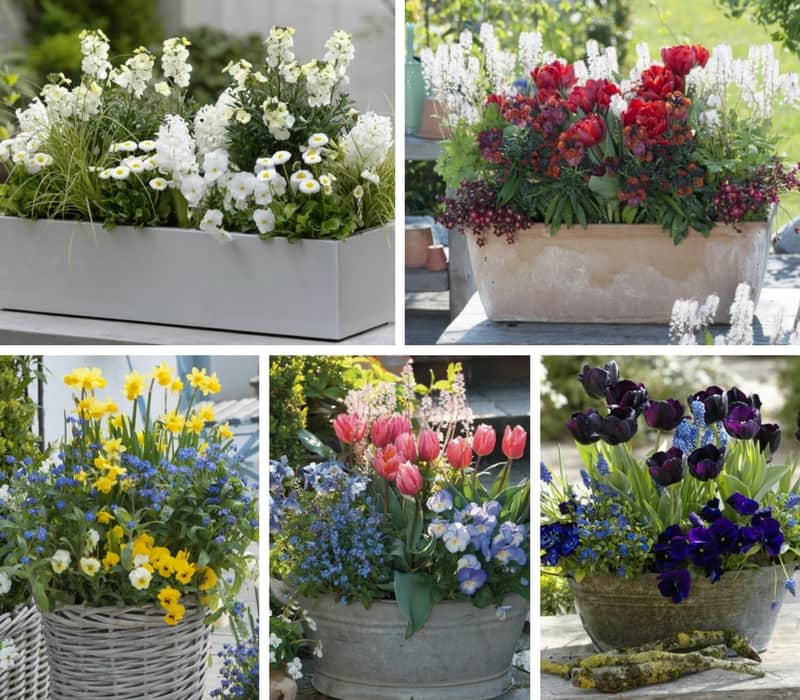
And for that, nothing beats biennials such as pansies, primroses, daisies and wallflowers! Sold as plug plants, they are economical, but need a little time to develop properly… which isn’t necessarily a problem, because they pair wonderfully with small spring bulbs (crocus, muscari, mini-narcissi…) which also need to be planted at the end of summer.
Timing couldn’t be better!
Lovely late-winter arrangements: essential ingredients
To start, think about your future arrangements… and select plants according to a dominant colour or a mood (contemporary or more romantic).
What’s important to create aesthetic, dynamic groupings is to vary the forms (upright plants, mounded, trailing) while creating a harmony (for this, try to match at least one foliage with the colour of your flowers) or a strong contrast in tones.
To compose your planters, the recipe is quite simple:
- start by choosing from the wide range of biennials,
- add ornamental grasses or evergreen perennials (Acorus gramineus Ogon, Carex oshimensis Evergold, Ophiopogon, Tiarella Morning Star)…
- then season the lot with small bulbs — early ones such as snowdrops and crocus or later ones such as fritillaries and tulips…

Nothing will be lost since you can, if you wish, plant the perennials and small bulbs in the garden or keep them to create new arrangements later.
Does this seem complicated? Do you want to enjoy the pleasure of doing it yourself but fear making mistakes? Relax… Pierre has put together 5 lovely combinations, in very different styles, ready to plant and guaranteed to succeed!
How to prepare spring planters in autumn?
In September and October, as soon as you receive your plug plants, place them in your containers (if these haven’t been chosen yet or if you are planting directly in the ground in the garden, let them wait a little in pots filled with a good potting compost).
To do this:
- Prepare your planters and pots by first checking that the base has drainage holes,
- place a layer of clay pebbles or any other material to improve drainage at the bottom,
- fill your container with a good potting compost for planters or flowering plants (this often determines success). If you are unsure of its quality, consider adding a few Osmocote Exact R pellets, a slow-release fertiliser that will act for several months,
- plant and give a first watering!
Tips and little extras that make the difference
Choosing the right container is an important step. If you opt for colourful pots or planters, try to make sure they harmonise with the colours of your arrangement without being too dominant: your pot should not steal the show from your flowers. Terracotta, rattan and zinc are safe choices. Slightly weathered by time, these materials only become more attractive. Don’t hesitate to use recycled items!
Mulching is often neglected when planting above ground. Yet it’s useful and attractive… once your plants start to develop well, cover the compost with a thin layer of flax chippings, cocoa husk or buckwheat. This will allow you to space out watering a little and will give a neat appearance to your pots.
Finally, let your imagination run free and punctuate your planters with decorative elements. You can find charming little pick-in-the-ground ornaments in shops, but the garden also hides many treasures: think of the colourful twigs of cornelian cherry or Cornus sibirica and the pretty branches of willows and contorted hazels — they cost nothing and help to embellish your arrangements while waiting for the blooms!
Further reading :
Discover our planting sheet: "Plant biennials in plug plants"
and our advice sheet: "Biennial plants: everything you’ve always wanted to know!"
September is a somewhat pivotal month. At home it smells of fresh stationery, while the garden shows its first decline, fortunately tempered by the long-awaited flowering of asters and Japanese anemones mingling with ornamental grasses. Even though we can still enjoy the end of season, it’s already time to bring in the wood. Feeling down? […]
Installing a balcony vegetable garden and growing vegetables and herbs, even in town, is perfectly possible. In previous articles, we saw that there are many solutions for urban gardening even without a garden: grow bags, and also raised beds.
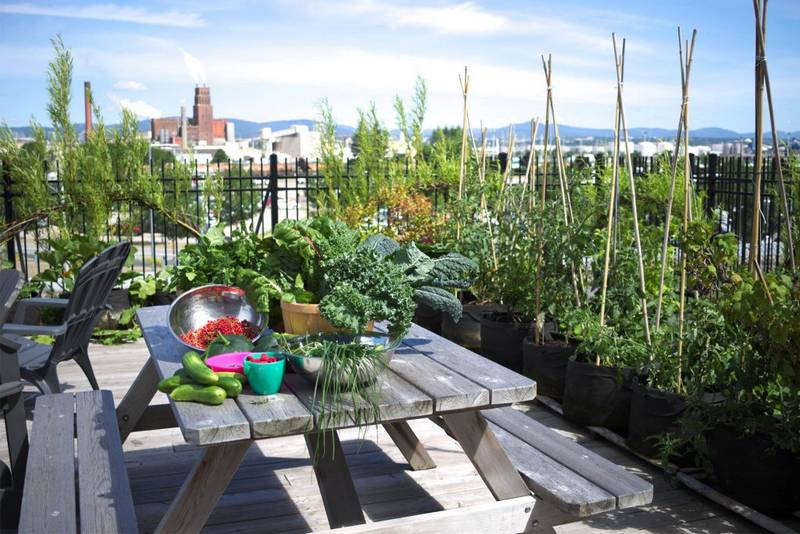
Still, you can’t make the walls any bigger! What other option is there? Choose vegetables and varieties suited to small spaces. These compact or dwarf vegetable plants are often productive. They yield full-size or small-scale vegetables, which is perfect when you don’t need to feed a large family or when you grow as much for enjoyment as for flavour!
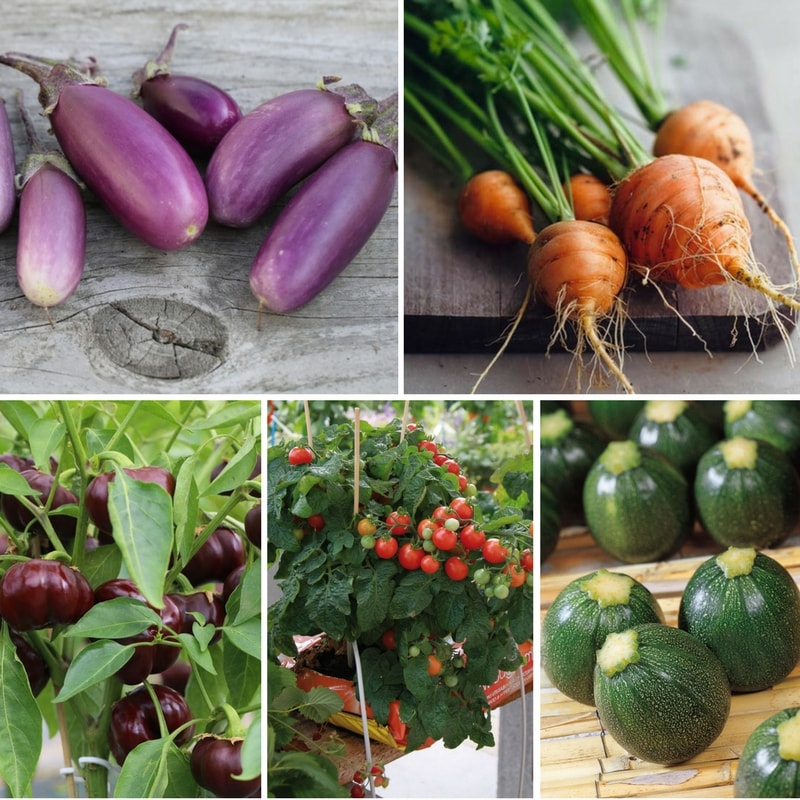
To prevent you from restricting yourself to radishes, we have prepared on the site a wide selection of vegetables perfectly suited to small spaces and also ideal for mini vegetable gardens (including square beds); here is a sample:
1) Salads
Almost all lettuces can be grown in pots, but admit that a large heading lettuce, for example, takes up a lot of room. That’s why we recommend cut-and-come-again lettuces and mescluns. However, if you insist on harvesting neat heading lettuces, I recommend:
- Tom Thumb butterhead lettuce: a butterhead type that forms small heads about 15 cm across.
- Little Gem lettuce, the romaine cousin, produces small tender-headed lettuces with excellent flavour.
2) Tomatoes
Cherry tomato is queen of the balcony. If you have a large balcony, you can grow any variety. Otherwise, to avoid the plant taking over the space with its generosity, choose varieties that are productive but of moderate vigour. Some trailing types can even be grown in hanging pots.
- Cherry tomatoes Balconi Red and Balconi Yellow are two F1 hybrids. They produce small ruby-red and golden-yellow fruits about 3 cm in diameter. Their advantage is an ultra-compact habit, with bushy plants that only reach about 30 cm high and as wide.
- Pendulina Red and Pendulina Yellow are similar. From Sweden, they are well suited to hanging pots and will form cascades of pretty cherry fruits weighing 15–30 g, red or yellow depending on the variety.
3) Courgettes
Non-vining courgettes are also available in miniature forms and are easy to grow, such as:
- Courgette 'Patio Star' F1. Ideal for pots, it forms plants about 45 cm high and 60 cm wide and yields delicious small cylindrical dark-green fruits.
- Round 'Eight Ball' courgette stands out for its round fruits: excellent quality and harvestable once about 5 cm in diameter. This variety is repeat-bearing and produces over a long period.
4) Peppers and chillies
Still in the "sun veg" category, peppers and chillies love sunny small spaces. Among miniature varieties, you will probably fall for:
- the Mini Chocolate Bell pepper: productive, producing small red-brown fruits 3–5 cm across.
As for chillies, I invite you to discover:
- Red Cherry chilli (small) produces round fruits the size of a cherry tomato, bright red. Beware, it is very hot!
5) Aubergines
Aubergines love heat and will be perfectly happy on a balcony or terrace sheltered from draughts. Lack of space is a great opportunity to discover surprising varieties.
- 'Patio Baby' aubergine is a very early and productive variety that produces compact plants with small fruits, ideal for container growing or confined spaces. Plant in April–May for harvest from July to October.
- Pusa Purple Cluster aubergine has much to recommend it: originating from India, it is productive and forms clusters of small purple fruits on plants of normal size, very decorative and tasty.
- White Round Egg aubergine is a dwarf variety, producing pretty white, round fruits the size of an egg on plants about 30 cm high.
- If you prefer classic types, the Ophelia aubergine is perfect: the plant stays under 35 cm and its dark-purple fruits reach about the size of a golf ball.
6) Carrots
Growing carrots on a balcony is not difficult, but you must choose a container deep enough for root development. Half-long carrots (such as Carotte de Luc) are therefore well suited, but in pots or standard window boxes, peg-top varieties give the best results. I particularly recommend:
- Carrot 'Marché de Paris': an early variety with round, reddish-orange roots, tender and flavoursome. These small carrots are great glazed or as a snack.
7) Cucumbers
Cucumbers are often seen as space-hungry, but they trellis easily. In small gardens or containers, snack-type cucumbers such as 'Rocky', 'Broumana F1' or 'Iznik F1' are popular. They are just as crisp as standard types, but fruit size does not exceed 15 cm.
8) Beans, peas, broad beans
Dwarf beans and dwarf peas are not necessarily the best answer to limited space… Prefer pole varieties of beans and peas that use vertical space by climbing trellises. Plants occupy less ground area and provide abundant harvests. If you like broad beans, I especially recommend the variety Robin Hood, which yields nice short pods with green seeds on plants about 30 cm high.
The list is not exhaustive and for other vegetables, such as cabbages, leeks, sweetcorn... please consult our collection of balcony vegetables on our site.
To conclude, allow me to remind you of key success factors for growing beautiful vegetables on a balcony or terrace:
- use quality potting compost (avoid the cheapest bags that dry out very quickly)
- remember to fertilise regularly
- monitor watering, as container-grown crops are more vulnerable to dry spells.
Installing a balcony vegetable garden and growing vegetables and herbs, even in town, is perfectly possible. In previous articles, we saw that there are many solutions for urban gardening even without a garden: grow bags, and also raised beds. Still, you can’t make the walls any bigger! What other option is there? Choose vegetables and […]
Well, that's it! Dresses and shorts are out, ice-cream vendors are out too, and metro journeys are unbearable (more than usual, I mean...): no doubt, it's finally summer! You might say, about time... Only I, who easily get caught off guard, am leaving tomorrow for a week and hadn't planned this avalanche of sunshine... In short, panic: how will my plants cope without regular watering?
Some of you may be in the same situation as me. Leaving for a few days? Here are a few last-minute tips to limit the damage:
Gather plants in the shade
Your plants will cope better with lack of water if they are in the shade, which seems obvious. Do not hesitate to move them to a more suitable spot: a better-oriented window, a corner under an awning. You can also use solar protection in the form of filtering screens (fabric shade cloth, reed screens...). They will considerably reduce the negative effects by removing direct sun that can be fatal. You could also bring some indoors. It's not ideal, but if you really have no choice, it can prevent unnecessary heat stress for plants that tolerate a more confined atmosphere.
Place saucers under pots
Many of us remove saucers for aesthetic reasons, but believe me, this is a question of survival. Ignore the look (after all, only your neighbours will have to put up with it 😉 ) and put a water reserve under each pot. The aim is to make a good store of water before you leave.
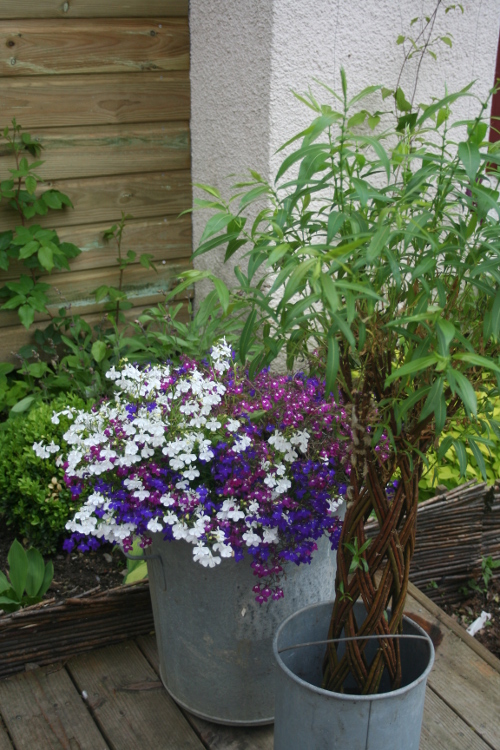
Water very regularly a few days beforehand
Of course it all depends on the plant concerned (cactus lovers, this isn't for you!), but thorough watering will help the plant tolerate a prolonged absence. Personally, I made sure not to miss a single watering (unlike usual...), preferably early in the morning or late in the evening. If you're at home, it's easy to fix a missed watering. If you're away, it's better that the plant is as robust as possible to face future heat and water shortages.
Likewise, don't hesitate to "bassin" your most fragile plants (this also applies to houseplants). A prolonged soak of the pot in a water tray allows the plant to hydrate deeply, which is very beneficial.
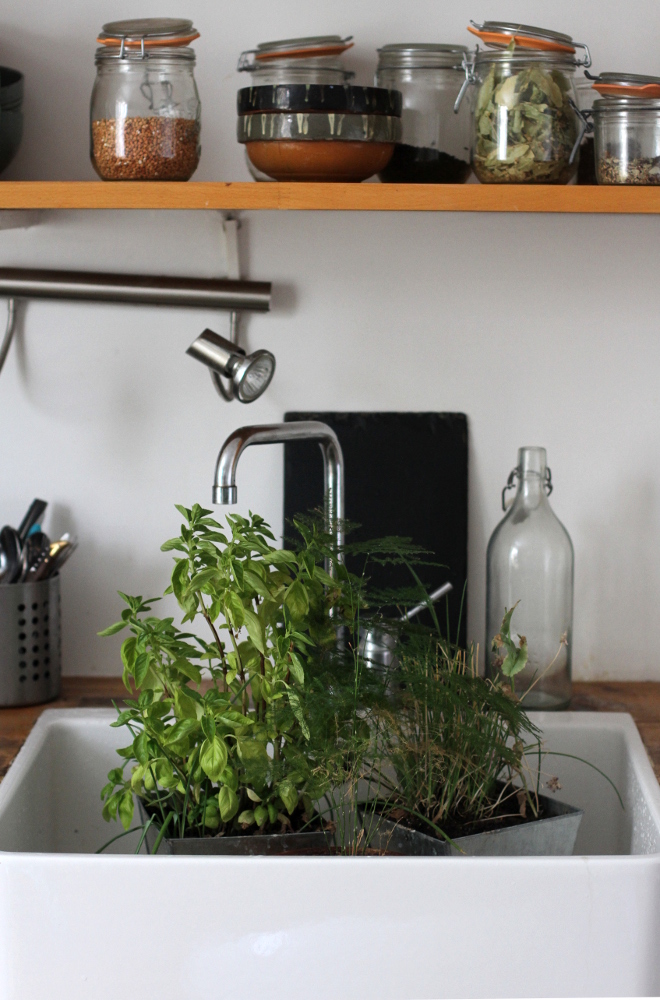
Finally, don't skip the very last watering, just before you leave. This final care can really make a difference. It will prolong plant hydration as much as possible, leaving them to wait for your return or a providential rain... Ideally, proceed twice: give a first generous watering. Then after half an hour, check pots and planters again. At that point, top up water for the plants that have already absorbed everything: besides deeply rehydrating the rootball, you can be sure the plants will be fully watered.
Watering tip: the perforated water bottle
This trick is very simple: recycle a mineral water bottle to make a water reserve. Once turned upside down and with a small hole pierced in the cap, you can place it at each pot and planter. The bottle will return water to the plant slowly and regularly. It's the good old drip technique! It can really help for a last-minute departure.
There you go! I hope these few tips have helped. Of course, you can still rely on a friendly neighbour to look after your little darlings, but it's better to organise for next time. For example, favour drought-tolerant varieties (sedum, santoline, gaura, nepeta....). And don't skimp on tricks that make all the difference: for example at Promesse de Fleurs, you can find the stockosorb, a water-retainer that significantly reduces watering, absorbing the water and releasing it when required... Magical, isn't it?
Right then, I'm off to do some waterings... 😉
Well, that’s it! Dresses and shorts are out, ice-cream vendors are out too, and metro journeys are unbearable (more than usual, I mean…): no doubt, it’s finally summer! You might say, about time… Only I, who easily get caught off guard, am leaving tomorrow for a week and hadn’t planned this avalanche of sunshine… In […]
A green corner in a small space? It's possible! There are many combinations to create a beautiful balcony full of flowers, but results don't always live up to expectations... Several points must be observed, as in the garden, to be fully satisfied with your creation: exposure, available space, etc. Personally, I gave in to a little whim: a clematis on my windowsill.
How to choose the right clematis?
First, think carefully about the size it will reach when mature: preferably choose a small-growing variety. This is the case, for example, of clematis 'Baby Star', which does not exceed 1.5 metres in height and is therefore ideal in a pot on a balcony. The larger the plant, the larger the pot required to accommodate it. On the promesse de fleurs website, a selection of clematis for pot growing is offered... but the choice is vast and, to decide, you need to play with colours and foliage. For example, clematis 'Early Sensation' is well suited to pot culture and has the advantage of evergreen foliage. Others have a very long flowering period, others are scented...
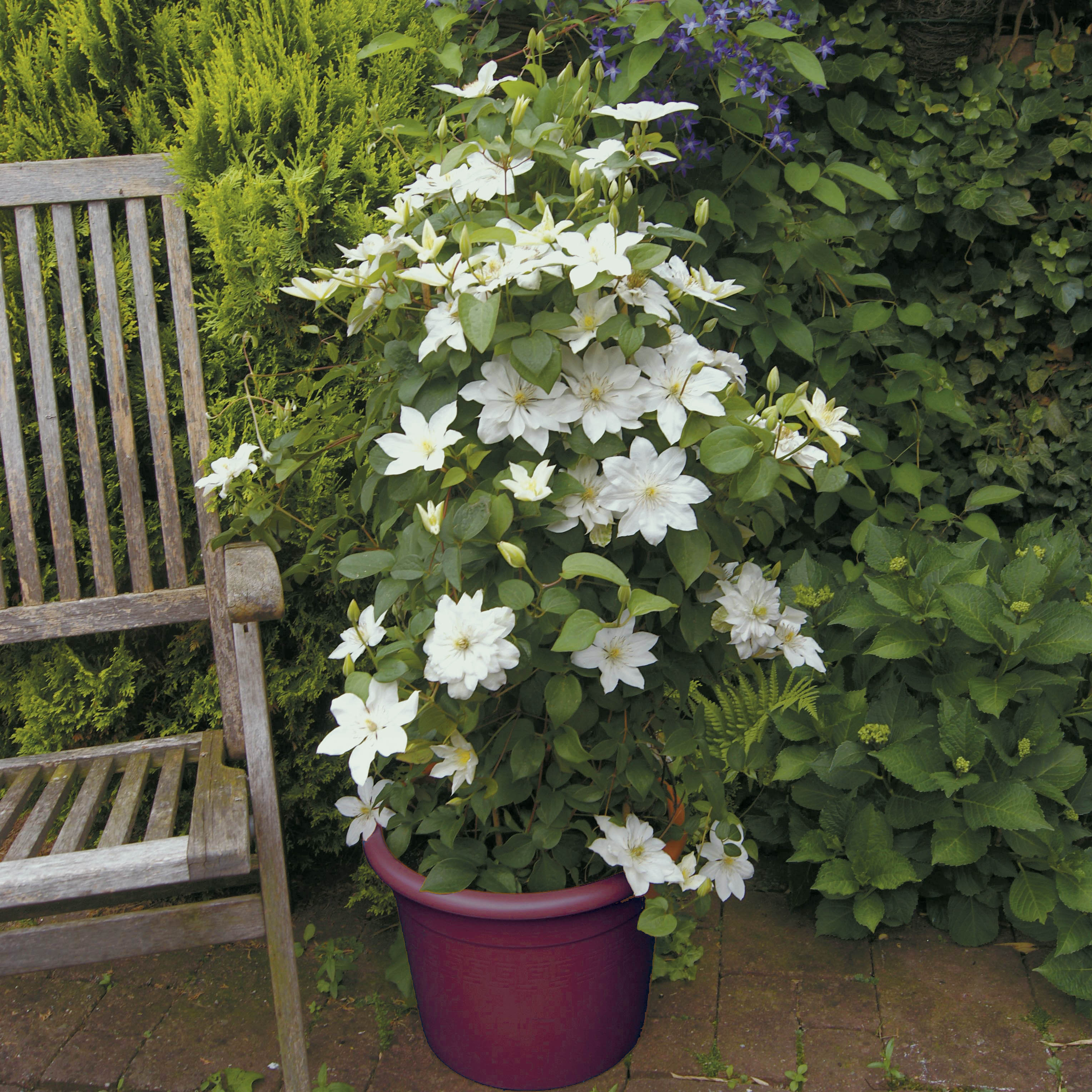
When planting, make sure to provide good drainage at the bottom of the pot; clematis do not like stagnant water... prefer a fertile soil, even enriched with compost. Next, provide a support for your climber: for example a wooden trellis or a bamboo obelisk. If you have the room, let it run along the branches of a shrub planted nearby... Personally, I simply installed stainless steel wires attached to hooks: the clematis' tendrils had no problem finding something to cling to!
Then, it's like in the garden: keep roots cool in the shade and the top in the sun! Most often, sun is the key to a good display of flowers, provided watering is regular. Clematis also like their roots to be cool: we all know the old trick of placing a tile to protect the base, but better is to try plant associations that will provide this role. For example, bushy, undemanding perennials can coexist with the clematis in the pot and provide the necessary shading. My top choice? hardy geraniums, of course! Easy to grow and very floriferous, they are the ideal companions for a potted climber.
I tried: clematis and geranium combinations
- In shade: clematis 'Sweet Summer Love' placed against a shadier window flowered quite well! Its medium size is suitable for pot culture and, the icing on the cake, its flowers exude a sweet fragrance... I paired it with the well-known hardy geranium 'Orion', tireless. The combination is very pretty, even in shade! I even added a small fuchsia, and the three seem to coexist without too much trouble. However, I think the pot (less than 30 cm in diameter) will need to be changed next year.

- In sun: clematis 'Dancing Dorien' has taken place in a zinc pot, with another hardy geranium, 'Dragon Heart', which has delighted me for a month now, without interruption. Flowering slowed in mid-June (I missed one or two waterings...) before restarting with renewed vigour. It pairs wonderfully with the double white flowers of 'Dancing Dorien', which has just begun to flower.
The result? Two flower-filled windowsills that I hope will last all summer...
A green corner in a small space? It’s possible! There are many combinations to create a beautiful balcony full of flowers, but results don’t always live up to expectations… Several points must be observed, as in the garden, to be fully satisfied with your creation: exposure, available space, etc. Personally, I gave in to a […]
Left neglected all winter, terraces and balconies look sorry for themselves under spring's renewing sun. But many enthusiasts don't have a garden, and these small spaces are for them the only places to pamper if they want to enjoy a little time outdoors. If you read the article: Ten landscapers' tips for garden design, you now know the basics to steer your creativity. But arranging a terrace remains fairly specific: dulled, dirty floor, frost-damaged plants and broken pots?
Here are some tips to restore sparkle to this special space in a few hours or a weekend!
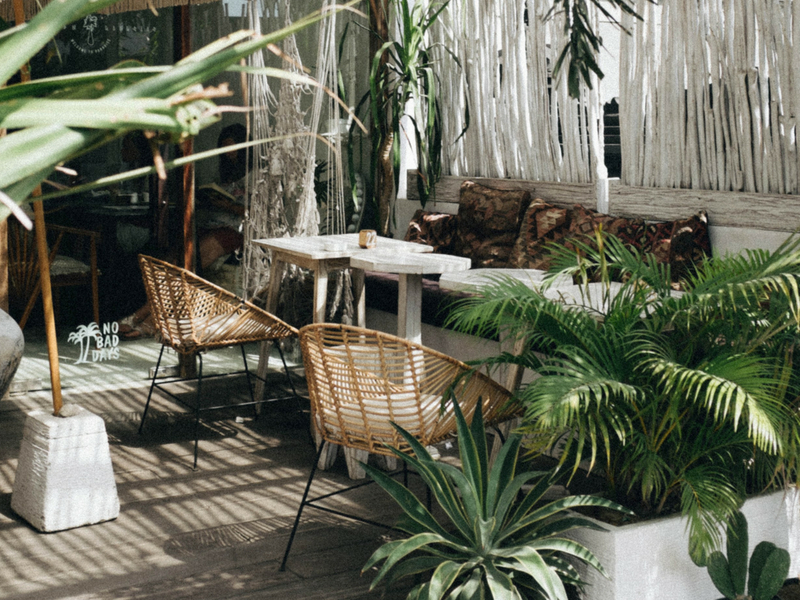
1- Clear the clutter
Because spring cleaning includes the terrace, it is essential to start by getting rid of anything that clutters the view (and so stifles your creativity). Don't hesitate to throw away cracked, unsightly pots, annuals that didn't survive winter cold, and any accumulated rubbish on the floor. A final sweep will make things clearer and make the space seem a little larger than you imagined...
Note: some plants may still be dormant: put your shrubs and perennials aside for now, even if they look very poorly. Give them a chance: they may simply take a little longer to wake up than others...
2- Refresh terrace flooring
A terrace that has aged badly is obvious from its surface: either too worn or simply out of date, the floor alone can affect the whole feel of the layout. Today there are very simple solutions to give it a new lease of life. For example, wooden decking tiles are very easy to lay and dress the outdoor space on their own. They now come in various formats, more adaptable (square, rectangular), and with a wide range of wood species.
Another, more recent solution: interlocking tiles. They are also very easy to install and cuts are not hard to make. Above all, they allow endless combinations. For example, for a client's terrace I chose to replace the floor (gravel-effect slabs with a look a little too "standard" for my taste...) with a mix of wood/slate/grass. These tiles come in a wide choice of materials and allow you to dare all sorts of fantasies: natural wood, composite wood, stone, and even artificial grass (some of which have a truly striking visual effect).
Note: check headroom under openings (doors and French doors): there must be enough space to install a new covering. Although many materials are offered in different thicknesses today (sometimes very slim for interlocking tiles), this is a detail not to overlook when buying. Most importantly: any raising of the floor must comply with current standards regarding balustrade height to avoid risk of falls.
3- Play with views
It's important to place a terrace or balcony within its surrounding environment: an intrusive neighbour's view or a splendid outlook will be handled very differently in a layout. Thus, some terraces will benefit from being screened from neighbours' sight; in that case opt for a play of screens and strategically placed climbers.
The terrace then becomes an intimate, secret space, enclosed by vegetation. Conversely, if overlooking neighbours isn't an issue and the view is breathtaking, it's important to make the most of that environmental asset and highlight it. In a terrace layout with a view over the Angoulême plateau, for example, I chose to install a pergola oriented directly towards that view so the eye is naturally drawn to the landscape whenever one steps outside. Seating can also be positioned with this in mind.
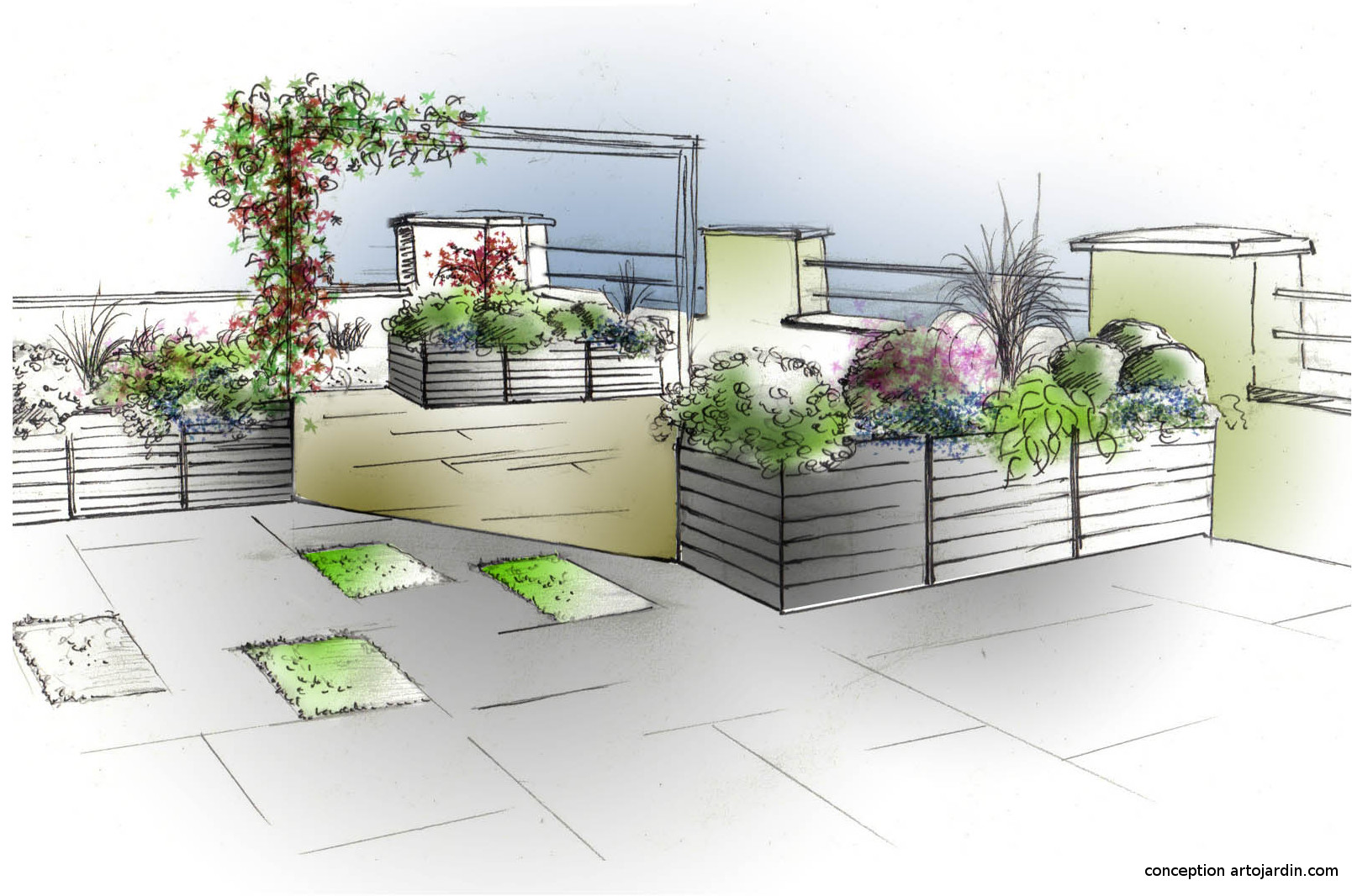
Note: there are regulations on installing screens and pergolas, so check before undertaking any remodelling.
4- Choose a standout colour
Small spaces have the advantage of being easy to arrange and allowing more freedom than large projects. It's the perfect time to opt for colour! A bright red for a contemporary scheme, a pastel blue for a romantic balcony... anything is possible, the important thing is to find coherence and harmony. Colour can appear on furniture cushions, pergola curtains, pottery...
Note: one colour is fine; two can work if well thought out. Beyond that, you risk visual overload. And so might your neighbours.
5- Choose plants suited to terraces and balconies
Plants should be chosen by affinity first, but also in coherence with the proposed layout. Grasses are perfect, for example, for a contemporary scheme, such as Pennisetum 'Karley Rose' or Imperata 'Red Baron'; also alliums, eremurus, and clipped boxwood. Others lend themselves better to a Mediterranean feel: lavender, rosemary or heathers — choice is wide.
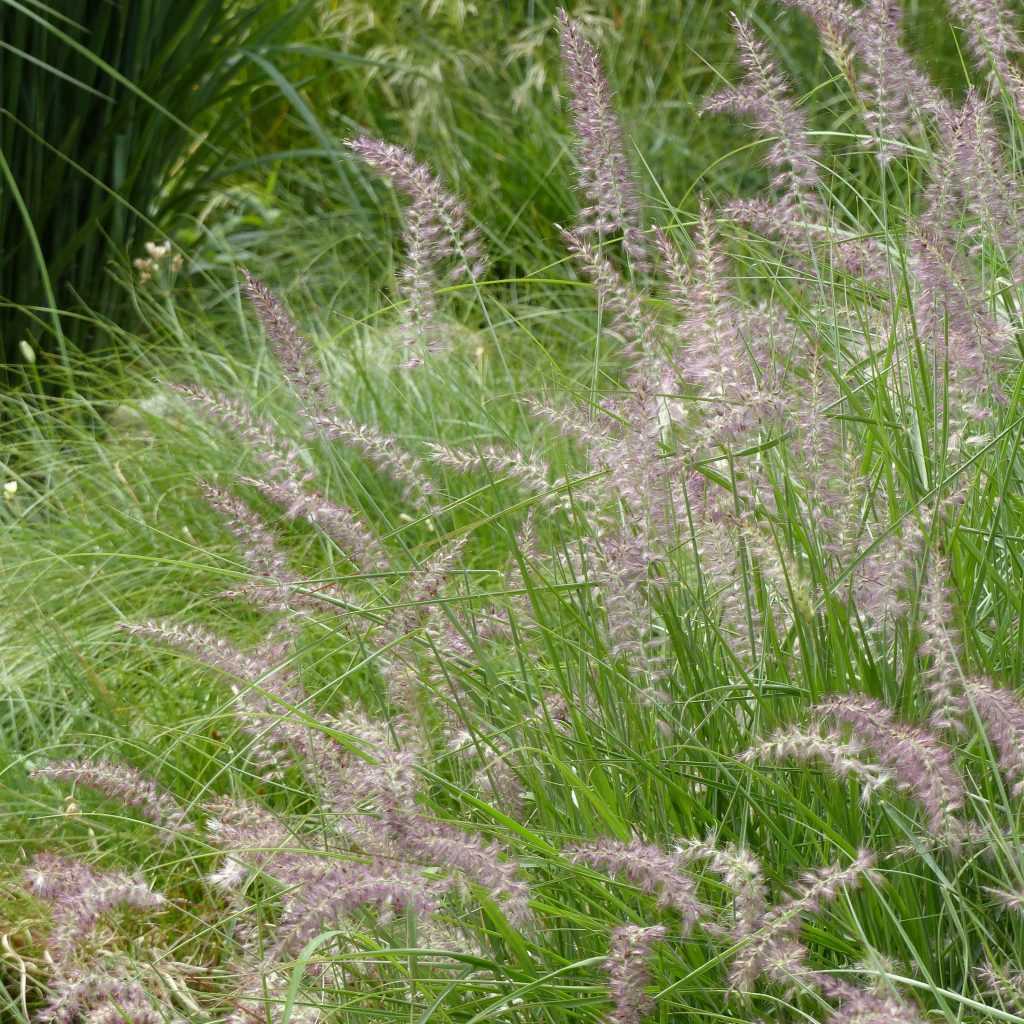
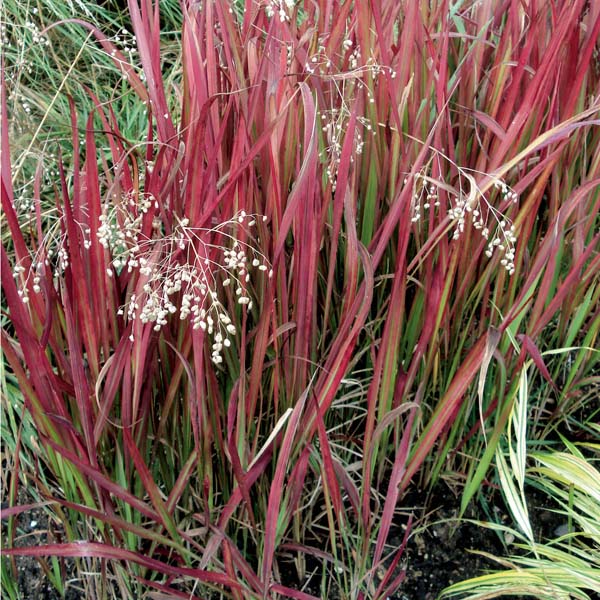
Note: the difficulty lies in the container, as a plant will be more stressed in a planter than in the ground. Choose plants better suited to container culture, and select sufficiently large containers and an appropriate substrate.
6- Use décor as an extension of the house
A terrace or balcony is fundamentally an extension of the home, a vital living space, especially for those without a garden. The aim is to make the most of this space. So give free rein to your creativity: pictures, ornaments, candlesticks... the idea is to reinforce the mood you have chosen.
Thus, for a bohemian scheme, and if the balcony is covered, you can lay rugs on the floor, install ethnic-style tables, seating made from recycled materials, or strings of colourful bunting. Also select suitable lighting: designer globe lights, fairy lights, Asian lanterns... Finally, choice of materials (for pots, tables, benches...) is important: terracotta, coloured resin, zinc, natural wood, Corten... materials alone dictate the atmosphere of the place.
Note: the golden rule is moderation once again. Choose a style and stick to it. Lighting should remain restrained: the aim is to create a cosy and welcoming atmosphere.
Left neglected all winter, terraces and balconies look sorry for themselves under spring’s renewing sun. But many enthusiasts don’t have a garden, and these small spaces are for them the only places to pamper if they want to enjoy a little time outdoors. If you read the article: Ten landscapers’ tips for garden design, you […]
I'd love to, but I can't…
That is the refrain,
of gardeners without a garden.
Having lived for a long time in hostile surroundings — by which I mean the city — I sympathise. Yet, solutions for garden without a garden are plentiful and all it takes is a balcony, a terrace or even a sunlit courtyard to create a real oasis! Among the many techniques used in urban agriculture, one stands out for both its effectiveness and its flexibility of use: growing in bags.
Why grow in bags?
Bag growing, or "jardi-sac", has several advantages :
- bags are light, can be delivered by post without difficulty, like an order from Promesse de Fleurs ;-), and easy to set up,
- they come in a wide range of sizes, are suited to small spaces and can accommodate bulky crops (while bag-grown potatoes are a classic, you can also grow all vegetables, including the most cumbersome such as rhubarb, artichokes and even fruit trees),
- the material they're made from, breathable and permeable, allows excellent root development, prevents root circling while letting excess water drain away freely,
- durable, bags withstand both high heat and severe frost (unlike terracotta pots) and have a long service life.
Which types of bags to choose?
Growing bags are readily available, and among the many products—whose quality and appearance can vary greatly—two brands really stand out : Bacsac and Smartpots.
- Bacsac is a French company, founded in 2009. It has developed a wide range of products designed for urban gardens. Its collection comes in every shape: from the round XXL bag of 930 litres to the 16-cell square vegetable planter, via hanging bags with integrated support (clever!) and small 10-litre bags which, when assembled, allow creation of green walls. These bags are offered in many colourways, adding a stylish, decorative touch to balconies and terraces.
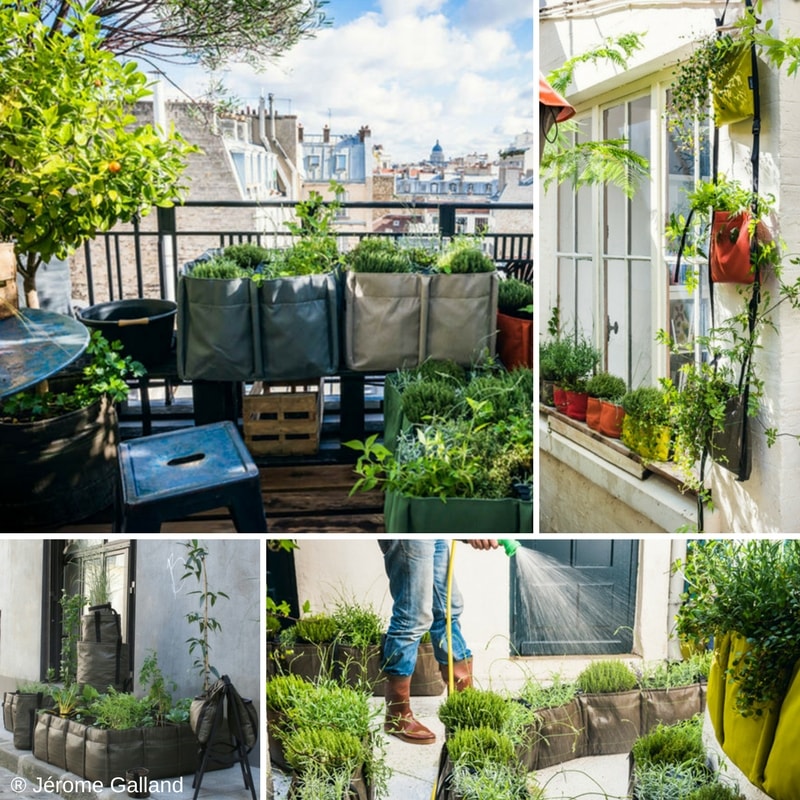
- The Smartpots are made in the USA. While their design is simpler, they are also manufactured from high-quality geotextile and come in an impressive range of sizes suitable for dressing a railing, a wall, a narrow passage and even creating instant gardens. Less "technical", their price is also lower. Note that these bags are used in Canada by Urbainculteurs in the majority of their soilless projects, which is also a mark of quality.
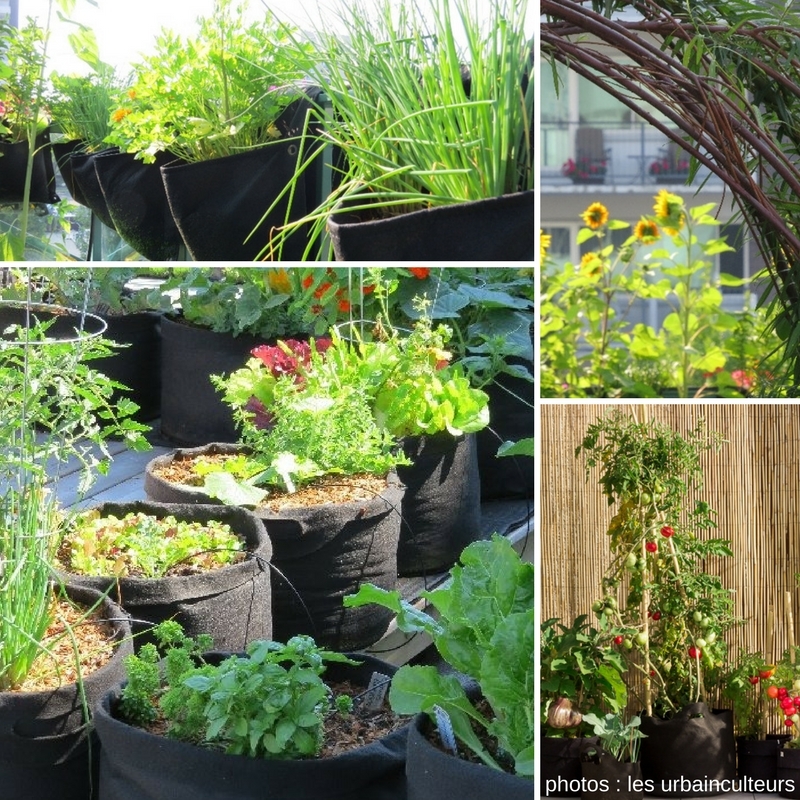
It is also possible to make your own growing bags, as members of « Potage toit » did when they installed an enormous edible garden on the roof of Royal Library Albert 1er in Brussels (you'll find the tutorial on their site under "Documents and guides").
Conditions for success
While using suitable containers is important, to maximise chances of success follow a few precautions:
- choose a well-exposed spot so plants can receive at least 6 hours of sun per day,
- use a quality potting mix (avoid the cheapest options) and remember to feed regularly (a worm composter or a compost bag allow you to make your own natural fertiliser while recycling kitchen waste),
- monitor watering, because mixes in pots or bags dry out quickly.
So, city dwellers, what do you think? What will you be doing this year? A mini vegetable patch? Some herbs and a few edible flowers? A dwarf fruit tree? A lovely selection of berries?
Further reading :
Great urban agriculture projects: www.urbainculteurs.org and www.potage-toit.be
I’d love to, but I can’t… That is the refrain, of gardeners without a garden. Having lived for a long time in hostile surroundings — by which I mean the city — I sympathise. Yet, solutions for garden without a garden are plentiful and all it takes is a balcony, a terrace or even a […]