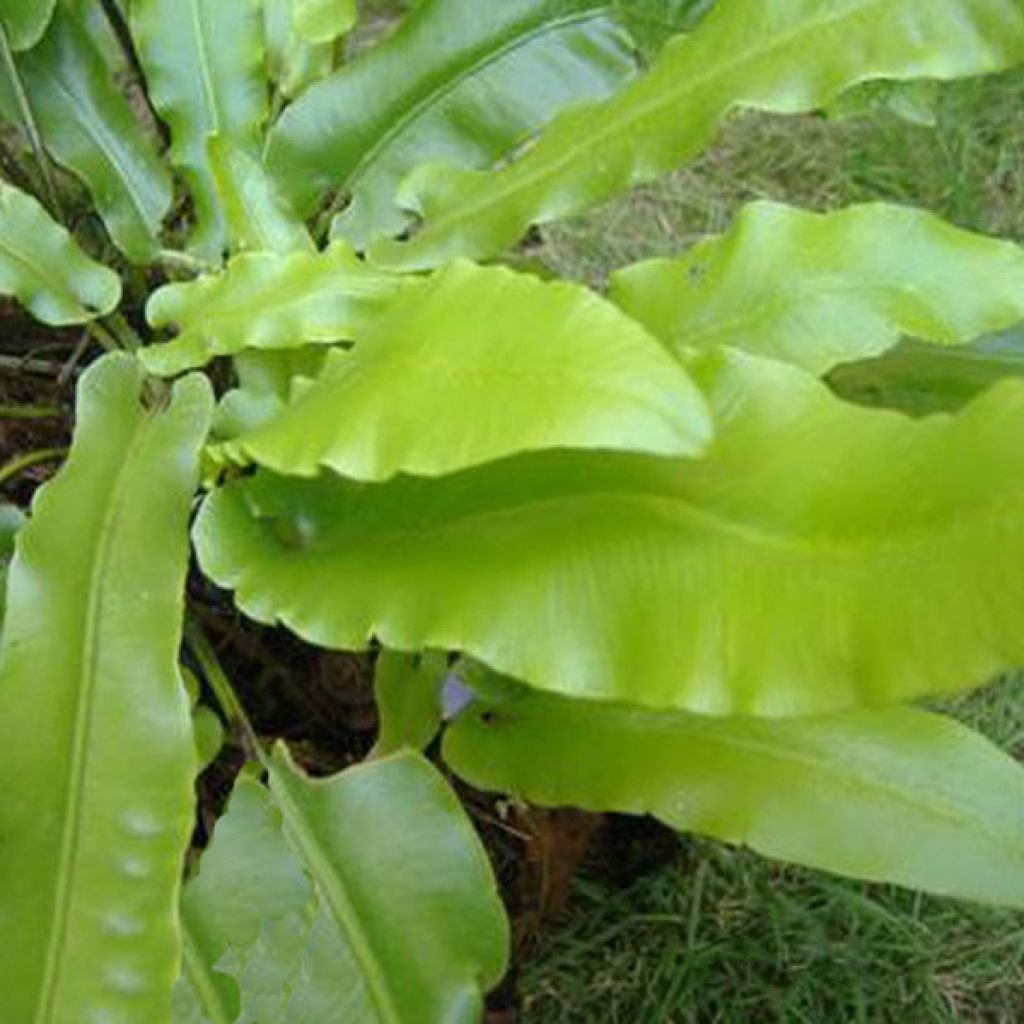
Phyllitis scolopendrium - Langue de Cerf, Scolopendre, Herbe à rate, Herbe hépatique

Phyllitis scolopendrium - Langue de Cerf, Scolopendre, Herbe à rate, Herbe hépatique
Phyllitis scolopendrium - Langue de Cerf, Scolopendre, Herbe à rate, Herbe hépatique
Phyllitis scolopendrium
quickly acclimated! very happy :-)
Céline, 19/07/2025
Back-to-school special offer!
Get €10 off for every €50 you spend! And get up to €40 off on a single order.
How does it work?
1. Shop your favourites
Add your favourite plants to your basket. For every €50 you spend (excluding delivery charges, store credit and the plastic-free option), you’ll receive a €10 voucher.
€50 spent = €10 voucher
€100 spent = €20 voucher
€150 spent = €30 voucher
€200 spent = €40 voucher
2. Place your order
Once your basket reaches one of the spending thresholds, place your order. You can even choose your delivery date!
3. Receive your voucher
As soon as your order has been shipped, you’ll receive an email containing your personal voucher code and its value.
4. Use it on your next order
Your voucher is valid for 90 days from the date you receive it. It can be used once only, on a new order worth at least the value of the voucher, excluding delivery charges.
Please note: Vouchers can be combined with other offers, but cannot be split or refunded.
Home or relay delivery (depending on size and destination)
Important: You may be charged customs duties by your country’s customs authorities upon delivery.
Schedule delivery date,
and select date in basket
This plant carries a 12 months recovery warranty
More information
We guarantee the quality of our plants for a full growing cycle, and will replace at our expense any plant that fails to recover under normal climatic and planting conditions.


Would this plant suit my garden?
Set up your Plantfit profile →
Description
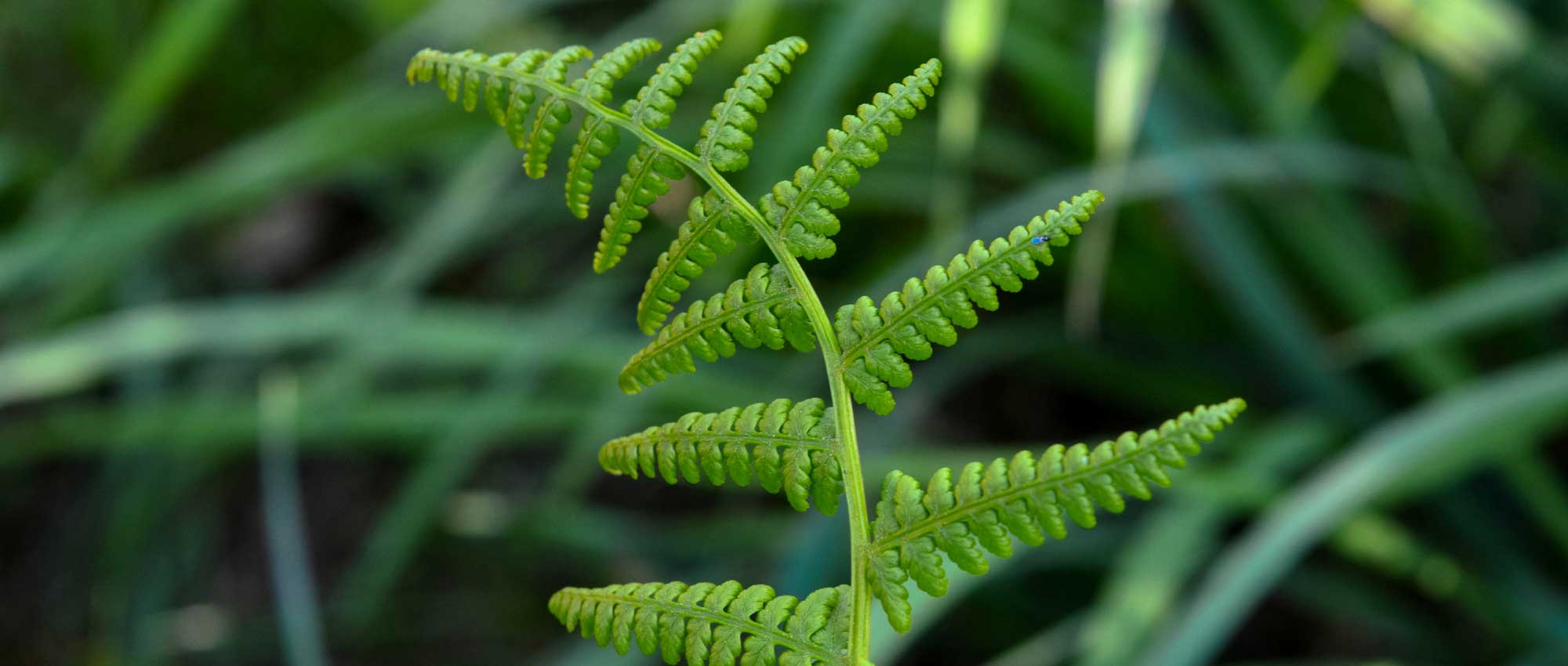
Asplenium scolopendrium, the hart's tongue fern or hart's tongue, is recognisable by its entire fronds, long, flexible and glossy, very different from the finely cut foliage of other ferns. It forms a very fresh green rosette that remains decorative all year round. Very hardy, this variety simply dresses woodland, the foot of slightly damp walls, a small shady courtyard or shady rockeries. Its long ribbon-like fronds contrast with the finer foliage of other shade plants.
This species belongs to the family Aspleniaceae. It is also called hart's tongue, hart's tongue fern, Asplenium scolopendrium or hart's tongue fern. Its main botanical synonyms are Phyllitis scolopendrium, Scolopendrium lingua, Scolopendrium officinale and Scolopendrium officinarum. Its natural range covers much of the temperate Northern Hemisphere: Europe, western and eastern Asia, North Africa, and several regions of North America down to Mexico. In Europe, it grows in ravine forests, on shady slopes, along streams and in crevices of limestone rocks. It also colonises old walls, wells and ancient masonry where the joints remain damp. It is a perennial fern: its short rootstock remains in place for several years. Its growth is slow to moderate. Its vegetation reaches 40 to 60 cm in height and 45 to 60 cm in spread. The fronds are most often 30 to 50 cm long, sometimes more in a cool, sheltered spot. They emerge tightly at the centre of the rosette, first curled into croziers, then straighten before arching. Their lamina, thick and slightly leathery, is entire. It takes the form of a long lanceolate ribbon, pointed at the tip and heart-shaped at the base, with smooth or slightly undulate margins. They are light green to deep green, with a glossy surface that reflects light well. The petiole is short, brownish and covered with brown scales near the rootstock. The roots, fibrous and fairly thick, penetrate damp crevices. The foliage is evergreen in winter. This fern produces neither flowers nor fruit. The spores form under the mature fronds, in sori, along long oblique lines arranged on either side of the midrib. These sori turn reddish-brown when ripe. Their arrangement recalls the legs of a centipede, an old name for millipedes, and explains the epithet scolopendrium. The name Asplenium refers to the ancient use of certain ferns against spleen ailments. This species has received the Royal Horticultural Society's Award of Garden Merit.
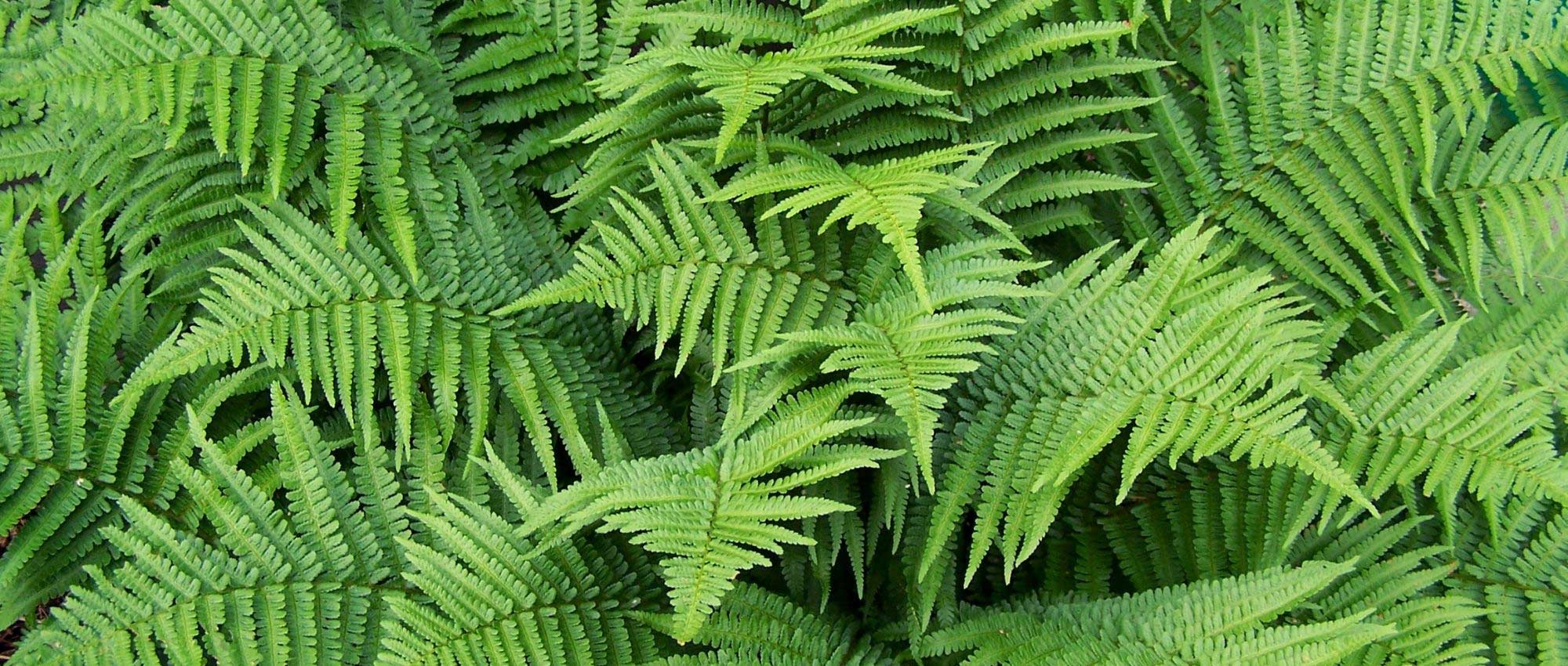
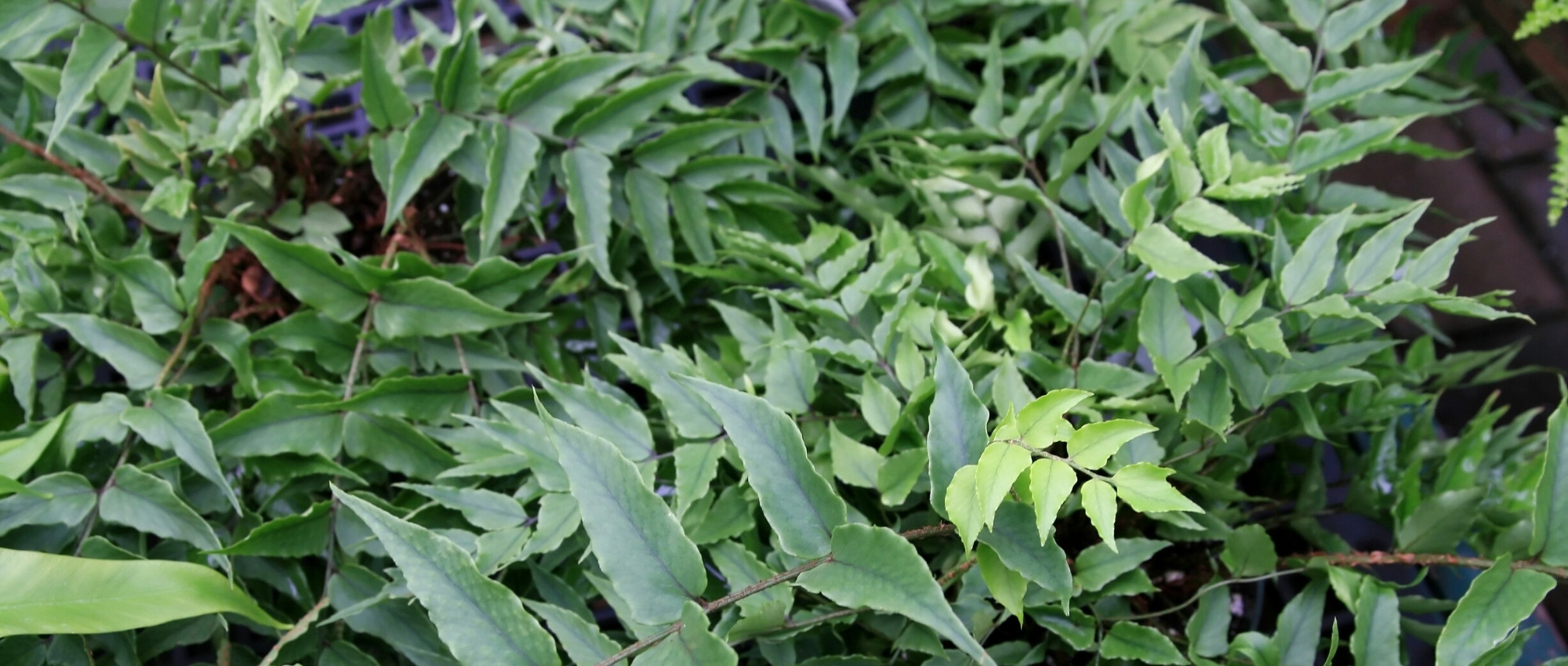
The hart's tongue fern is lovely at the foot of deciduous shrubs, on a cool slope or in a north-facing rockery. Planted in small groups along a shady wall, it forms distinct rosettes and does not spread by offshoots. Its fronds stand out among the cut leaves of Epimedium ‘Amber Queen’, topped with amber-yellow flowers in spring. The large variegated leaves of Hosta ‘Emily Dickinson’ create another contrast. Polygonatum falcatum ‘Variegatum’ enriches the ensemble with its arching stems and white bell flowers. At the front, Heuchera ‘Ginger Ale’ displays silvery orange foliage. These four plants form a shade bed with very complementary silhouettes.
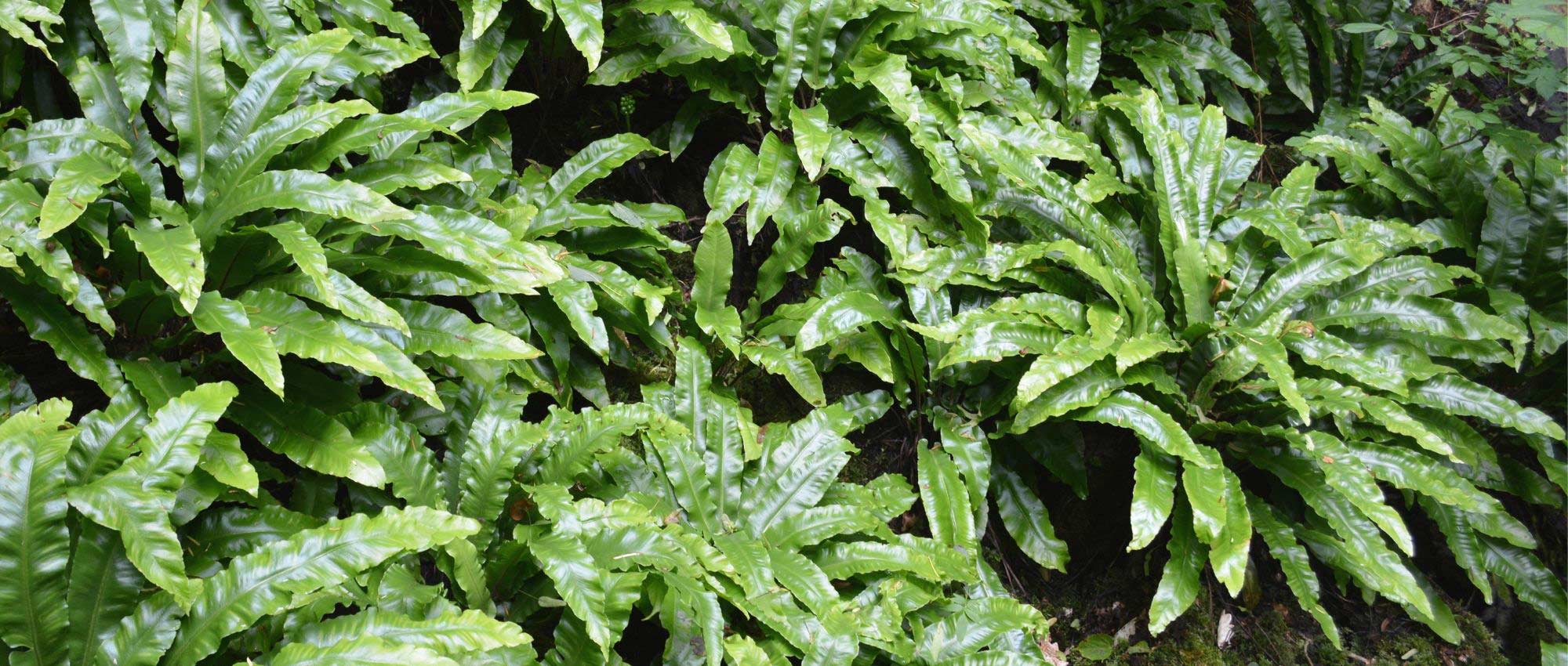
Phyllitis scolopendrium - Langue de Cerf, Scolopendre, Herbe à rate, Herbe hépatique in pictures
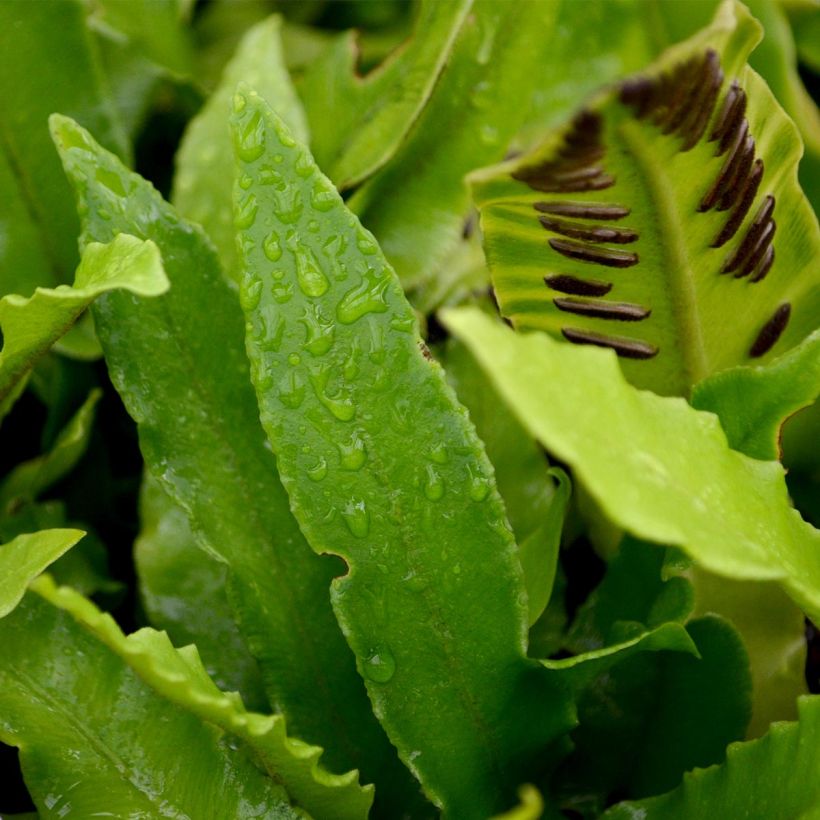
Foliage
Plant habit
Botanical data
Phyllitis
scolopendrium
Aspleniaceae
Asplenium scolopendrium, Phyllitis scolopendrium, Scolopendrium lingua, Scolopendrium officinale, Scolopendrium officinarum
Western Europe, Central Europe, Eastern Europe, Southern Europe, North Africa, East Asia, West Asia, North America
Planting and care
The hart's tongue fern is planted in spring or autumn, preferably in March or October, outside periods of frost and drought. It thrives in shade or partial shade, under deciduous trees, at the foot of a north-facing wall, or in a shaded rock garden. Burning sun can dry out its fronds, especially when the soil is dry. A neutral to chalky soil, rich in humus, moist and well-drained suits it. It accepts a stony soil if leaf mould accumulates between the stones, but dreads compacted and waterlogged soils in winter. At planting, the collar remains at ground level. A generous watering naturally settles the soil around the roots, then a mulch of dead leaves helps retain moisture. Watering is continued for the first year and during dry periods. An application of mature compost or leaf mould in autumn suffices thereafter. At the end of winter, only the dry or damaged fronds are cut, without touching the young croziers gathered at the centre of the clump.
Planting period
Intended location
Care
Planting & care advice




-
, onOrder confirmed
Reply from on Promesse de fleurs
Recently viewed products
Haven't found what you were looking for?
Hardiness is the lowest winter temperature a plant can endure without suffering serious damage or even dying. However, hardiness is affected by location (a sheltered area, such as a patio), protection (winter cover) and soil type (hardiness is improved by well-drained soil).

The flowering period indicated on our website applies to countries and regions located in USDA zone 8 (France, the United Kingdom, Ireland, the Netherlands, etc.)
It will vary according to where you live:- In zones 9 to 10 (Italy, Spain, Greece, etc.), flowering will occur about 2 to 4 weeks earlier.
- In zones 6 to 7 (Germany, Poland, Slovenia, and lower mountainous regions), flowering will be delayed by 2 to 3 weeks.
- In zone 5 (Central Europe, Scandinavia), blooming will be delayed by 3 to 5 weeks.
In temperate climates, pruning of spring-flowering shrubs (forsythia, spireas, etc.) should be done just after flowering.
Pruning of summer-flowering shrubs (Indian Lilac, Perovskia, etc.) can be done in winter or spring.
In cold regions as well as with frost-sensitive plants, avoid pruning too early when severe frosts may still occur.
The planting period indicated on our website applies to countries and regions located in USDA zone 8 (France, United Kingdom, Ireland, Netherlands).
It will vary according to where you live:
- In Mediterranean zones (Marseille, Madrid, Milan, etc.), autumn and winter are the best planting periods.
- In continental zones (Strasbourg, Munich, Vienna, etc.), delay planting by 2 to 3 weeks in spring and bring it forward by 2 to 4 weeks in autumn.
- In mountainous regions (the Alps, Pyrenees, Carpathians, etc.), it is best to plant in late spring (May-June) or late summer (August-September).
The harvesting period indicated on our website applies to countries and regions in USDA zone 8 (France, England, Ireland, the Netherlands).
In colder areas (Scandinavia, Poland, Austria...) fruit and vegetable harvests are likely to be delayed by 3-4 weeks.
In warmer areas (Italy, Spain, Greece, etc.), harvesting will probably take place earlier, depending on weather conditions.
The sowing periods indicated on our website apply to countries and regions within USDA Zone 8 (France, UK, Ireland, Netherlands).
In colder areas (Scandinavia, Poland, Austria...), delay any outdoor sowing by 3-4 weeks, or sow under glass.
In warmer climes (Italy, Spain, Greece, etc.), bring outdoor sowing forward by a few weeks.
Shipping country and language
Your country of residence may be:
Your country of residence is:
For a better user experience on our website, you can select:
Your shipping country:
-
 Austria
-
 Belgium
-
 Bosnia & Herzegovina
-
 Bulgaria
-
 Croatia
-
 Cyprus
-
 Czechia
-
 Denmark
-
 Estonia
-
 Finland
-
 France
-
 Germany
-
 Greece
-
 Hungary
-
 Iceland
-
 Ireland
-
 Italy
Italy
-
 Latvia
-
 Liechtenstein
-
 Lithuania
-
 Luxembourg
-
 Malta
Malta
-
 Netherlands
-
 Poland
-
 Portugal
-
 Romania
-
 Serbia
-
 Slovakia
-
 Slovenia
-
 Spain
Spain
-
 Sweden
-
 Switzerland
Language:
-
French
-
 English
-
Spanish
-
Italian
-
German
-
Portuguese
-
Dutch
-
Finnish
My Account
Hello
My wish lists
My cart
Log in / Register
Existing customer?
This form is protected by reCAPTCHA - the Google Privacy Policy and Terms of Service apply.
New customer?
Create an account to track your orders, access our customer service and, if you wish, make the most of our upcoming offers.