Yellow Kiwi Duo
Yellow Kiwi Duo
Actinidia chinensis
Chinese gooseberry, kiwi fruit
Back-to-school special offer!
Get €10 off for every €50 you spend! And get up to €40 off on a single order.
How does it work?
1. Shop your favourites
Add your favourite plants to your basket. For every €50 you spend (excluding delivery charges, store credit and the plastic-free option), you’ll receive a €10 voucher.
€50 spent = €10 voucher
€100 spent = €20 voucher
€150 spent = €30 voucher
€200 spent = €40 voucher
2. Place your order
Once your basket reaches one of the spending thresholds, place your order. You can even choose your delivery date!
3. Receive your voucher
As soon as your order has been shipped, you’ll receive an email containing your personal voucher code and its value.
4. Use it on your next order
Your voucher is valid for 90 days from the date you receive it. It can be used once only, on a new order worth at least the value of the voucher, excluding delivery charges.
Please note: Vouchers can be combined with other offers, but cannot be split or refunded.
This plant carries a 12 months recovery warranty
More information
We guarantee the quality of our plants for a full growing cycle, and will replace at our expense any plant that fails to recover under normal climatic and planting conditions.
Description
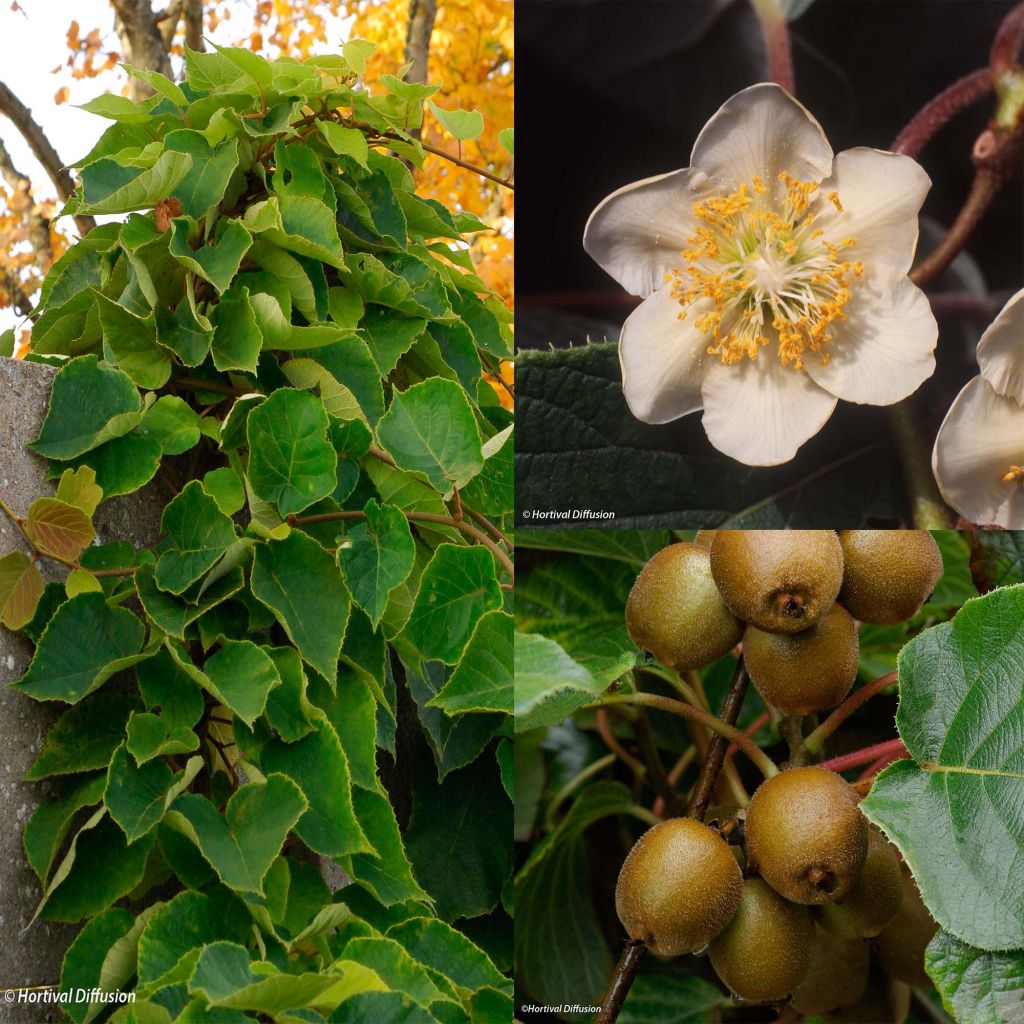
Duo of Minkigold and Minkimale Kiwi (Actinidia chinensis). The 'Minkimale' variety is a male plant that allows the 'Minkigold' plant to bear fruit, producing golden kiwis with yellow flesh and a slight apple fragrance. The kiwi must be trained along a pergola, trellis, or arbour. Planting is ideally done in autumn or any time of the year without frost, starting from the 4th or 5th year, for a harvest around November.
The Kiwi (Actinidia chinensis or deliciosa), also known as Chinese gooseberry, yang tao, or vegetable mouse, is the fruit of the Actinidia plant. It belongs to the Actinidiaceae family, like its cousin, the Kiwaï (Actinidia arguta). Originating from China, the kiwi is a vigorous climber, capable of growing 3m per year under favourable conditions. This climbing plant needs to be trained on sturdy support, such as a wall with solid wires, a trellis, an arbour, a tree trunk, or a fence. It can reach a height of 6m and a spread of 4m and requires pruning to control its growth.
Some varieties are self-fertile (male and female flowers on the same plant) and can be planted alone. Other varieties bear either male flowers (like Minkimale) or female flowers (like Minkigold) and require the presence of a plant of the opposite sex for pollination. One male plant can pollinate approximately 5 to 6 female plants. Only female plants produce fruits.
The Kiwi is very hardy, able to withstand temperatures as low as -15°C, but is sensitive to late frosts as the buds freeze at -5°C. Its foliage is deciduous. The stems bear large, ovate, and entire leaves, dark matte green on the upper side and lighter underneath, covered with tiny red hairs, just like the stems. From the third or fourth year of cultivation, clusters of flowers appear in May-June on the previous year's branches. These are fragrant flowers with broad cream-white petals. Male flowers have numerous yellow stamens, while female flowers have white stigmas.
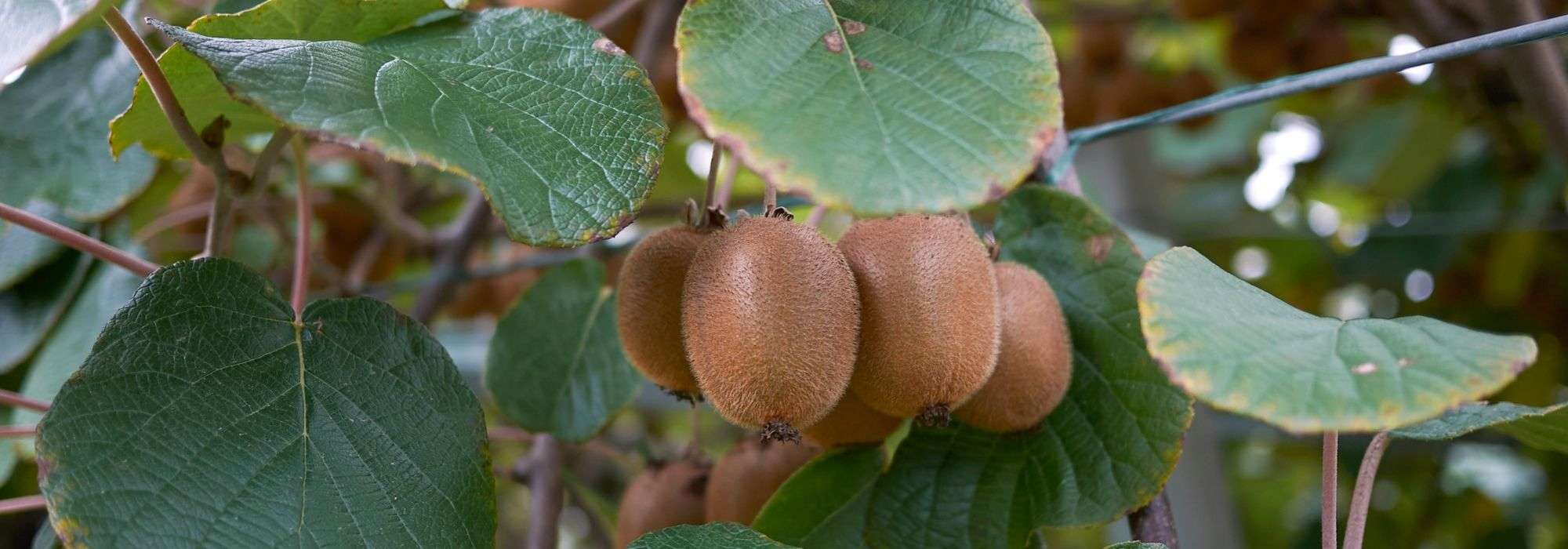
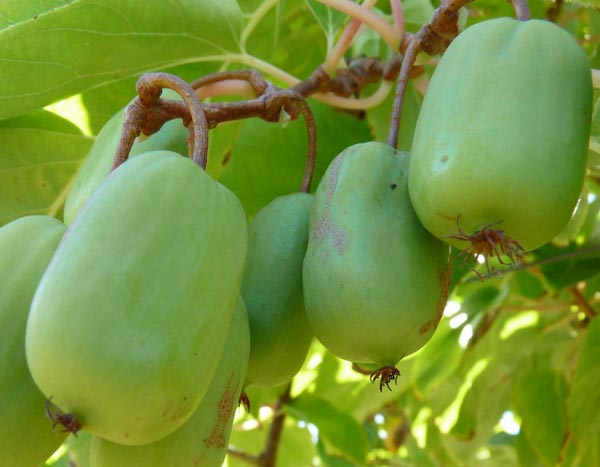
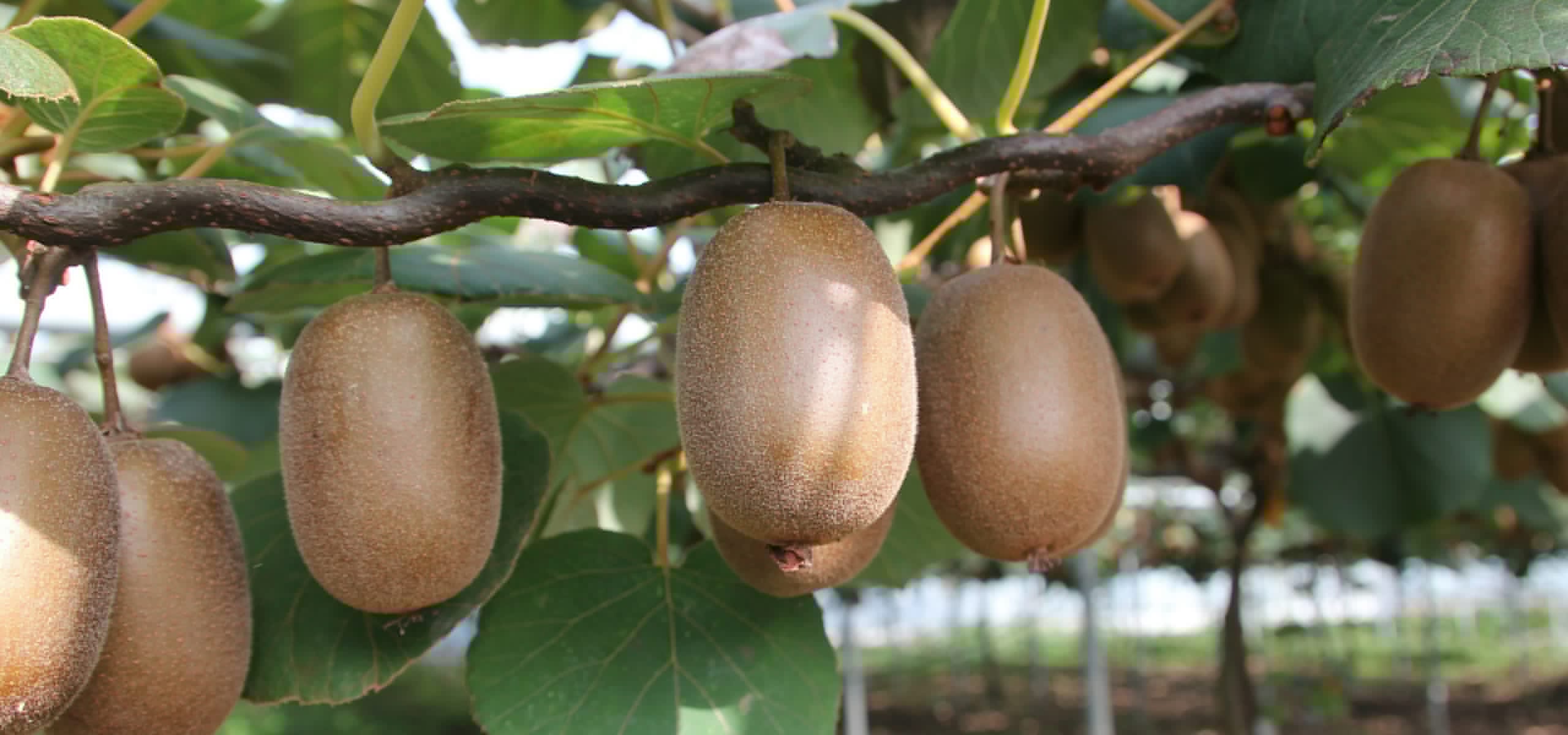
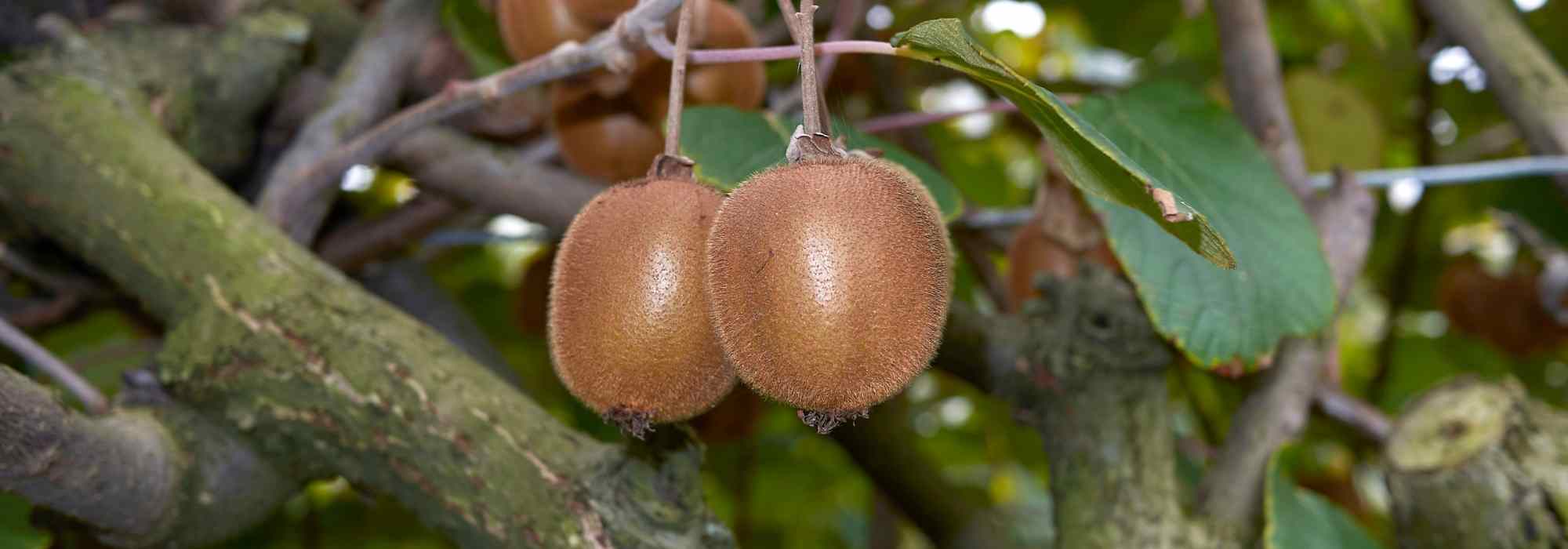
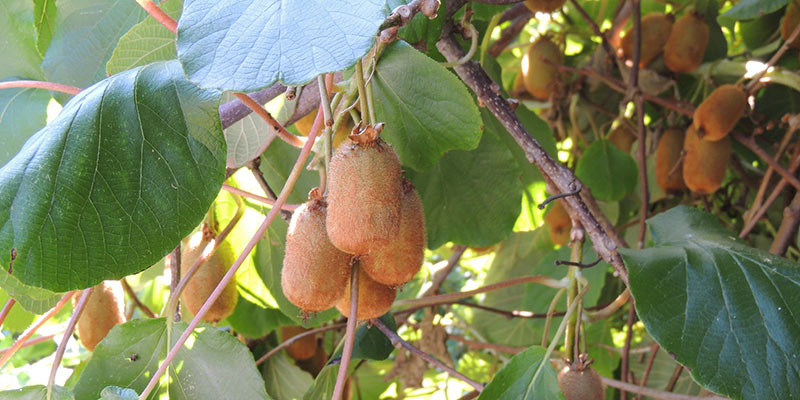
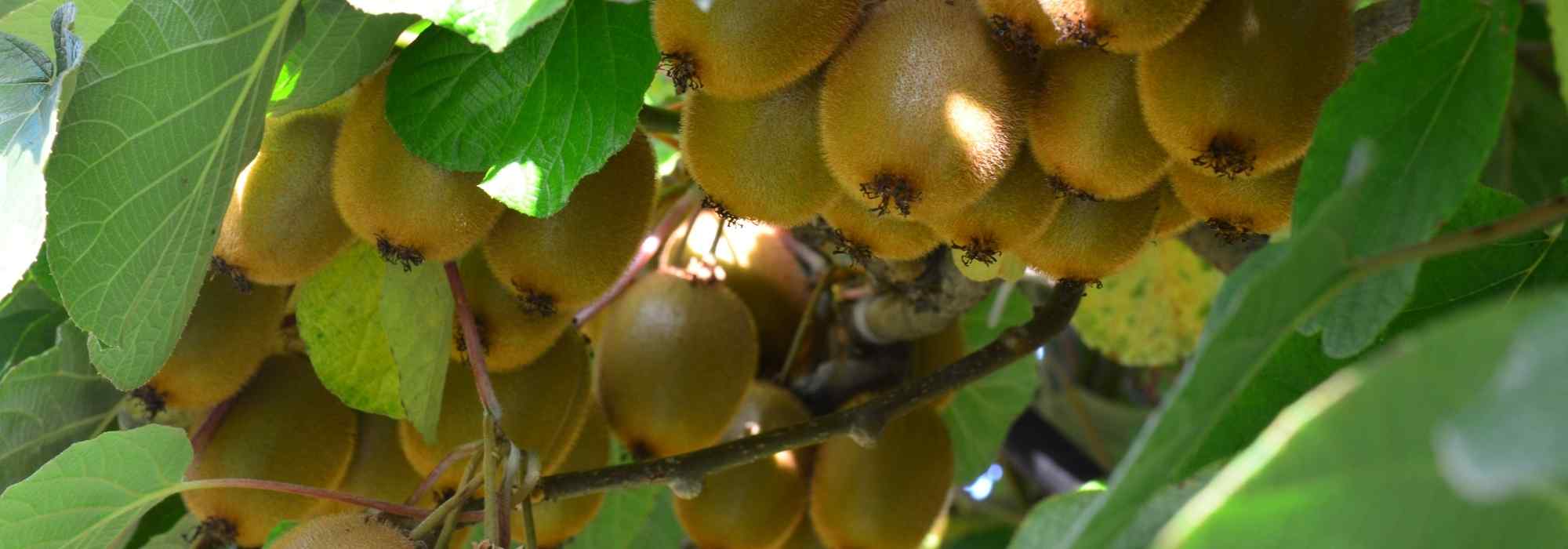
On female plants, the flowering is followed by the formation of large, fleshy, oblong berries weighing approximately 60 grams. The skin is hairy for Actinidia deliciosa species or smooth for Actinidia chinensis species. The flesh is green, sometimes yellow for certain varieties like Minkigold, and contains numerous tiny black seeds. Kiwi is rich in vitamin C, fibre, and minerals such as potassium, magnesium, and calcium. Harvesting takes place around November, before the frosts. The fruits can be picked even if they are still green as they ripen after harvest. They can be stored well at a cool temperature of 5°C, in a cellar, for over a month. The kiwi is ripe when it is soft to the touch. Place the kiwis next to apples or bananas to speed up their ripening. Once peeled, the kiwi can be enjoyed on its own or mixed with other autumn fruits, used in jams, or used to decorate pies and certain savoury dishes.
Plant habit
Fruit
Flowering
Foliage
Botanical data
Actinidia
chinensis
Actinidiaceae
Chinese gooseberry, kiwi fruit
Central Asia
Planting and care
Preferably planted in autumn, but can be planted all year round outside frosty periods. Kiwifruit thrives in cool, rich, light, well-drained, non-calcareous soil. The plant fears stagnant humidity—plant in a sunny spot away from strong winds. Space the plants 3 to 4 metres apart.
Dig a 50cm hole in all directions. Spread a layer of gravel at the bottom, followed by a layer of soil mixed with peat or compost. Place the root ball (the plant's collar should be level with the ground) and cover with soil. Give the plant solid support to help its branches climb. Press down and water thoroughly. Kiwifruit has tracer roots, which grow horizontally below the surface of the soil, so if necessary, lightly hoe the surface only. Mulch the plants for the first three winters.
Kiwifruit requires little maintenance; simply water it regularly. In hot weather, water it once or twice a week. Once established and rooted, the plant takes care of itself and requires less water. At the end of winter, lightly dig in organic fertiliser or well-rotted manure at the foot of the plant. Tie the stems loosely as they grow. They will wrap around the support.
Although not very sensitive to insects and pests, Kiwifruit can be a victim of red spiders in a hot, dry environment. To eliminate them, spray the foliage and soil lightly and regularly.
Planting period
Intended location
Care
Planting & care advice
-
-
-
-
-
-
-
-
This item has not been reviewed yet - be the first to leave a review about it.
Recently viewed products
Haven't found what you were looking for?
Hardiness is the lowest winter temperature a plant can endure without suffering serious damage or even dying. However, hardiness is affected by location (a sheltered area, such as a patio), protection (winter cover) and soil type (hardiness is improved by well-drained soil).

The flowering period indicated on our website applies to countries and regions located in USDA zone 8 (France, the United Kingdom, Ireland, the Netherlands, etc.)
It will vary according to where you live:- In zones 9 to 10 (Italy, Spain, Greece, etc.), flowering will occur about 2 to 4 weeks earlier.
- In zones 6 to 7 (Germany, Poland, Slovenia, and lower mountainous regions), flowering will be delayed by 2 to 3 weeks.
- In zone 5 (Central Europe, Scandinavia), blooming will be delayed by 3 to 5 weeks.
In temperate climates, pruning of spring-flowering shrubs (forsythia, spireas, etc.) should be done just after flowering.
Pruning of summer-flowering shrubs (Indian Lilac, Perovskia, etc.) can be done in winter or spring.
In cold regions as well as with frost-sensitive plants, avoid pruning too early when severe frosts may still occur.
The planting period indicated on our website applies to countries and regions located in USDA zone 8 (France, United Kingdom, Ireland, Netherlands).
It will vary according to where you live:
- In Mediterranean zones (Marseille, Madrid, Milan, etc.), autumn and winter are the best planting periods.
- In continental zones (Strasbourg, Munich, Vienna, etc.), delay planting by 2 to 3 weeks in spring and bring it forward by 2 to 4 weeks in autumn.
- In mountainous regions (the Alps, Pyrenees, Carpathians, etc.), it is best to plant in late spring (May-June) or late summer (August-September).
The harvesting period indicated on our website applies to countries and regions in USDA zone 8 (France, England, Ireland, the Netherlands).
In colder areas (Scandinavia, Poland, Austria...) fruit and vegetable harvests are likely to be delayed by 3-4 weeks.
In warmer areas (Italy, Spain, Greece, etc.), harvesting will probably take place earlier, depending on weather conditions.
The sowing periods indicated on our website apply to countries and regions within USDA Zone 8 (France, UK, Ireland, Netherlands).
In colder areas (Scandinavia, Poland, Austria...), delay any outdoor sowing by 3-4 weeks, or sow under glass.
In warmer climes (Italy, Spain, Greece, etc.), bring outdoor sowing forward by a few weeks.
Shipping country and language
Your country of residence may be:
Your country of residence is:
For a better user experience on our website, you can select:
Your shipping country:
-
 Austria
-
 Belgium
-
 Bosnia & Herzegovina
-
 Bulgaria
-
 Croatia
-
 Cyprus
-
 Czechia
-
 Denmark
-
 Estonia
-
 Finland
-
 France
-
 Germany
-
 Greece
-
 Hungary
-
 Iceland
-
 Ireland
-
 Italy
Italy
-
 Latvia
-
 Liechtenstein
-
 Lithuania
-
 Luxembourg
-
 Malta
Malta
-
 Netherlands
-
 Poland
-
 Portugal
-
 Romania
-
 Serbia
-
 Slovakia
-
 Slovenia
-
 Spain
Spain
-
 Sweden
-
 Switzerland
Language:
-
French
-
 English
-
Spanish
-
Italian
-
German
-
Portuguese
-
Dutch
-
Finnish
My Account
Hello
My wish lists
My cart
Log in / Register
Existing customer?
This form is protected by reCAPTCHA - the Google Privacy Policy and Terms of Service apply.
New customer?
Create an account to track your orders, access our customer service and, if you wish, make the most of our upcoming offers.