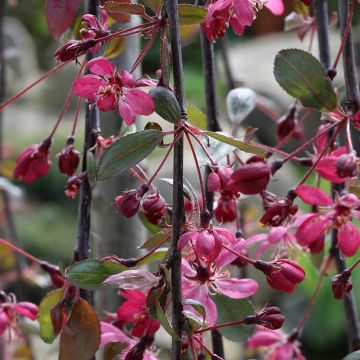
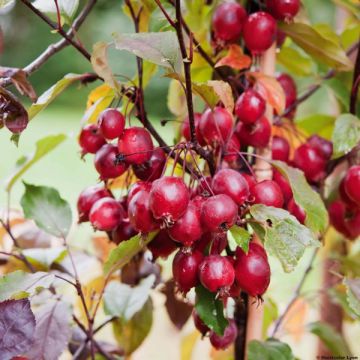
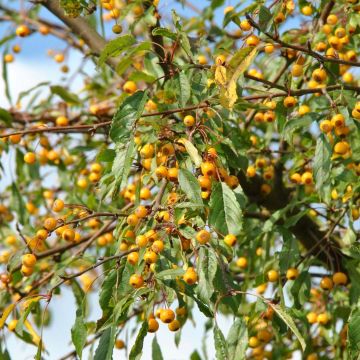
With its prettily rounded small silhouette, Malus ‘JFS Sparkling Sprite’ works well in small city gardens, as a specimen on a lawn, as a pair to frame a path or in a row in a paved courtyard. In a large container, it takes centre stage on a sunny terrace, offering flowers in spring and colourful fruits into winter. At its base, plant bulbs of tulips and daffodils or even Grecian windflowers, which will enhance its flowering. To play on foliage contrasts, combine it with low evergreens such as Hebe (shrubby veronicas) or lavandins. In a more country-style garden, the old rose ‘Complicata’, covered with large bright pink single flowers in June, forms a beautiful backdrop for the foliage and fruits of Malus ‘Sparkling Sprite’.
Malus Sparkling Sprite - Crab Apple
Malus Sparkling Sprite - Crab Apple
Malus Sparkling Sprite - Crab Apple
Malus Sparkling Sprite - Crab Apple
Malus Sparkling Sprite - Crab Apple
Malus × domestica ‘JFS KW207’ Sparkling Sprite
Apple Tree, Crab Apple
Be the first to leave a review
Back-to-school special offer!
Get €10 off for every €50 you spend! And get up to €40 off on a single order.
How does it work?
1. Shop your favourites
Add your favourite plants to your basket. For every €50 you spend (excluding delivery charges, store credit and the plastic-free option), you’ll receive a €10 voucher.
€50 spent = €10 voucher
€100 spent = €20 voucher
€150 spent = €30 voucher
€200 spent = €40 voucher
2. Place your order
Once your basket reaches one of the spending thresholds, place your order. You can even choose your delivery date!
3. Receive your voucher
As soon as your order has been shipped, you’ll receive an email containing your personal voucher code and its value.
4. Use it on your next order
Your voucher is valid for 90 days from the date you receive it. It can be used once only, on a new order worth at least the value of the voucher, excluding delivery charges.
Please note: Vouchers can be combined with other offers, but cannot be split or refunded.
Why not try an alternative variety in stock?
View all →
7 in stock
79,00 €
•
7.5L/10L pot
Available in 1 sizes
20 in stock
29,50 €
•
4L/5L pot
Available in 3 sizes
10 in stock
From
24,50 €
•
4L/5L pot
Available in 1 sizes
5 in stock
43,50 €
•
Bare root
Available in 2 sizes
6 in stock
95,00 €
•
7.5L/10L pot
Available in 1 sizes
17 in stock
29,50 €
•
3L/4L pot
Available in 4 sizes
4 in stock
From
29,50 €
•
3L/4L pot
Available in 1 sizes
11 in stock
29,50 €
•
4L/5L pot
Available in 1 sizes
4 in stock
49,00 €
•
7.5L/10L pot
Available in 1 sizes
5 in stock
49,00 €
•
4L/5L pot
Available in 1 sizes
This plant carries a 24 months recovery warranty
More information
We guarantee the quality of our plants for a full growing cycle, and will replace at our expense any plant that fails to recover under normal climatic and planting conditions.
This small apple tree with a compact and rounded habit reaches about 3–3.5m in height and spread. Its pink-red flower buds open in April–May; it produces a profusion of white flowers, followed in autumn by yellow fruits turning orange, which persist late into the season. Very hardy (at least -25°C), it tolerates summer drought and adapts to various well-drained soil types. This variety has excellent resistance to diseases such as scab, fire blight, rust and mildew.
Flower size
3 cm
Height at maturity
3.25 m
Spread at maturity
3.25 m
Exposure
Sun, Partial shade
Hardiness
Hardy down to -34.5°C
Drought resistance
Average
Would this plant suit my garden?
Set up your Plantfit profile →
Best planting time
March, October
Recommended planting time
February to April, September to November
JAN
J
FEB
F
MAR
M
APR
A
MAY
M
JUN
J
JUL
J
AUG
A
SEP
S
OCT
O
NOV
N
DEC
D
Flowering time
April to May
JAN
J
FEB
F
MAR
M
APR
A
MAY
M
JUN
J
JUL
J
AUG
A
SEP
S
OCT
O
NOV
N
DEC
D
Description
Malus ‘JFS Sparkling Sprite’ (‘JFS-KW207’) is an ornamental apple tree with a compact habit, ideal for small gardens or avenue planting. Its abundant spring flowering, decorative fruits lasting into winter, and luminous foliage make this small tree a highly decorative subject all year round. Disease-resistant, very hardy, and accommodating, it appeals equally to amateur gardeners and landscape professionals. It is particularly suited to urban gardens concerned with biodiversity and can also be grown in a container.
Malus ‘JFS Sparkling Sprite’ belongs to the Rosaceae family. This cultivar is also marketed under the name Sparkling Sprite®. It was raised by Keith Warren of J. Frank Schmidt & Son Co. (Oregon, USA) from an open-pollinated seedling of ‘KW‑8MX’ and was introduced in 2017. It belongs to a series of ornamental apple trees selected for their compact habit, slow growth and excellent disease resistance. This cultivar is distinguished by its small size (under 4m), dense crown and increased tolerance to pathogens such as scab, fire blight, rust and mildew.
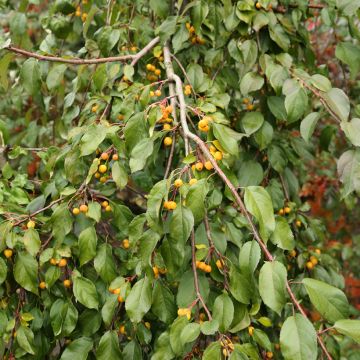
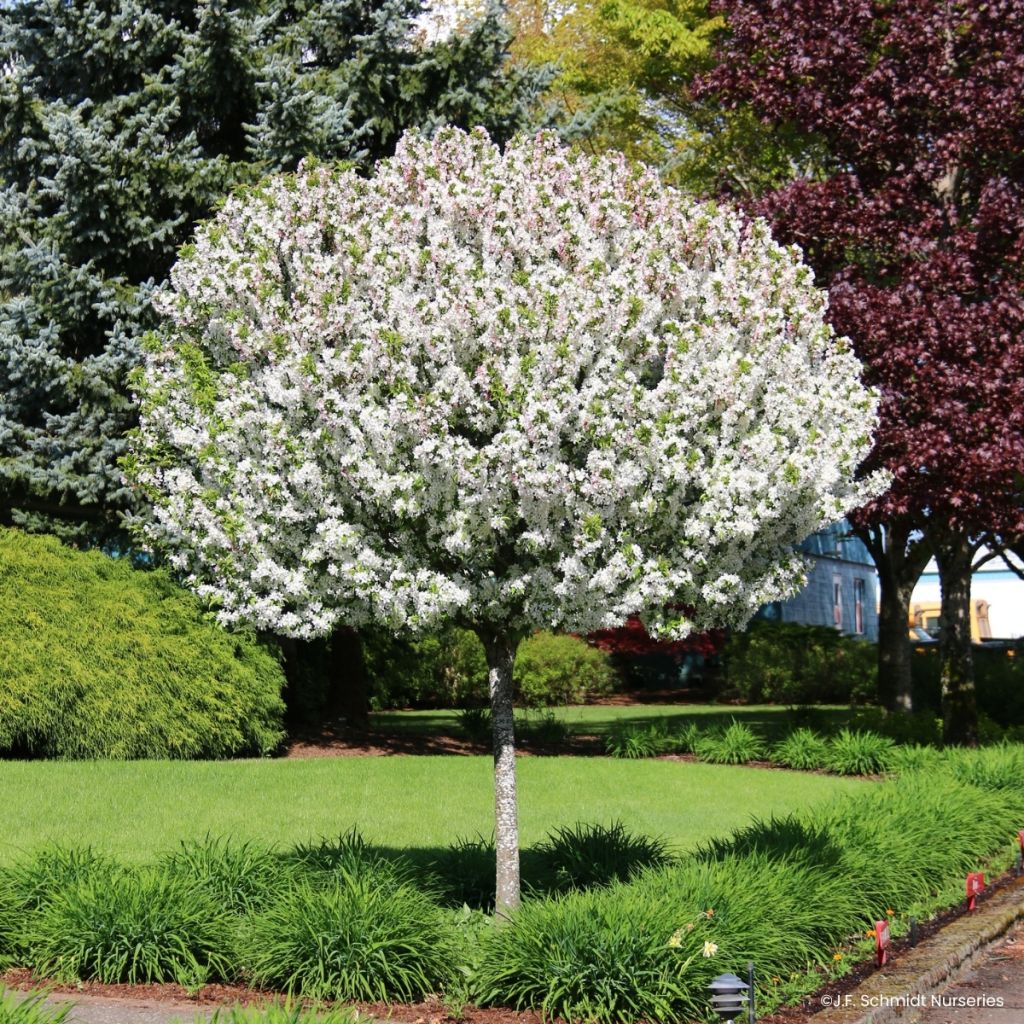
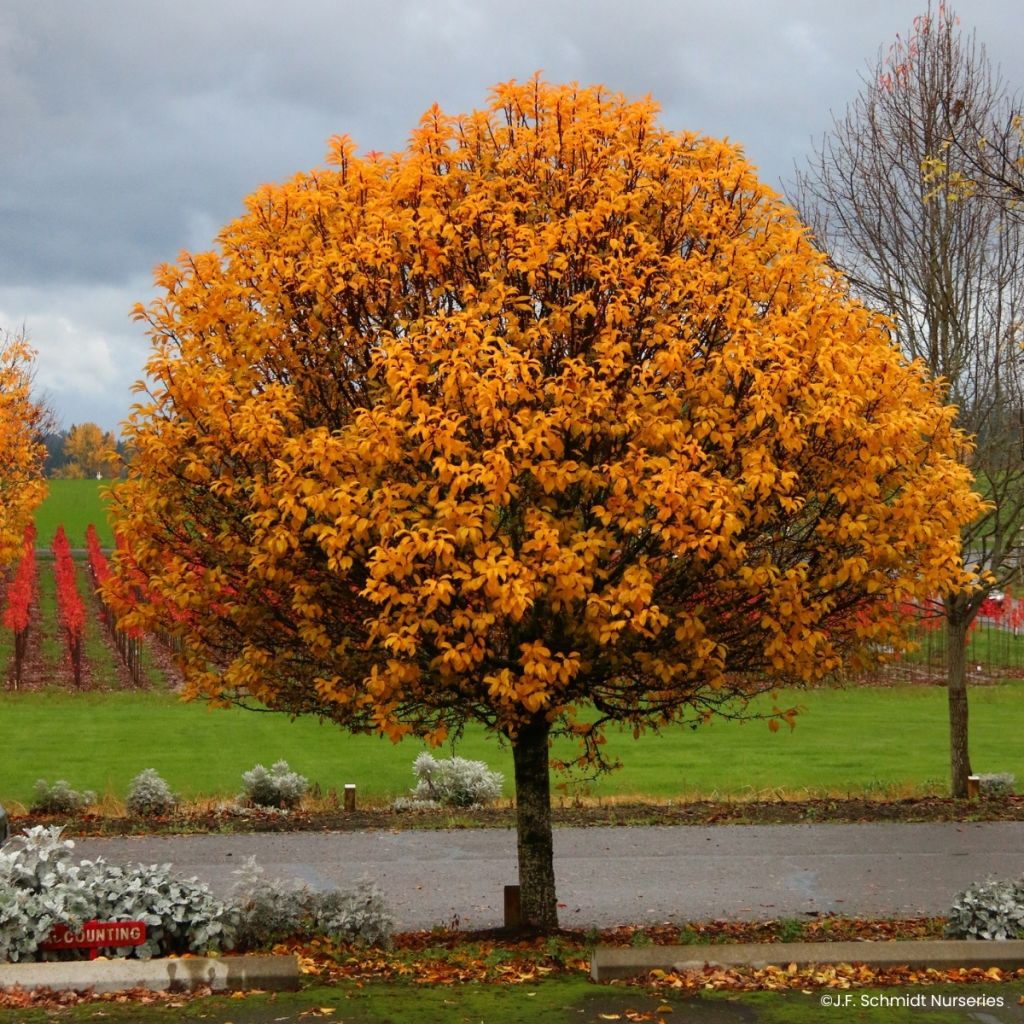
It is a tree usually top-grafted onto a short trunk, reaching 3 to 4m in height and spread, with moderate, balanced growth. Its habit is dense, rounded to globular, naturally neat without pruning. The foliage is deciduous, composed of simple, elliptical to oblong leaves, measuring 4 to 6cm long. They are bright green in season, then turn yellow in autumn before falling. The twigs are slender and flexible, and the grey-brown bark is smooth. The root system is typical of grafted apple trees: shallow, with a secondary taproot and moderate lateral roots, suitable for container growing or urban planting.
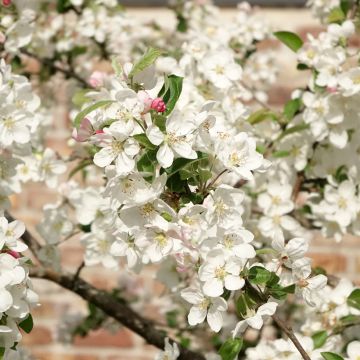
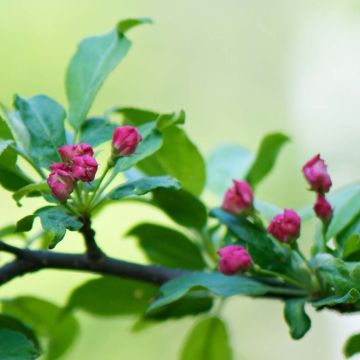
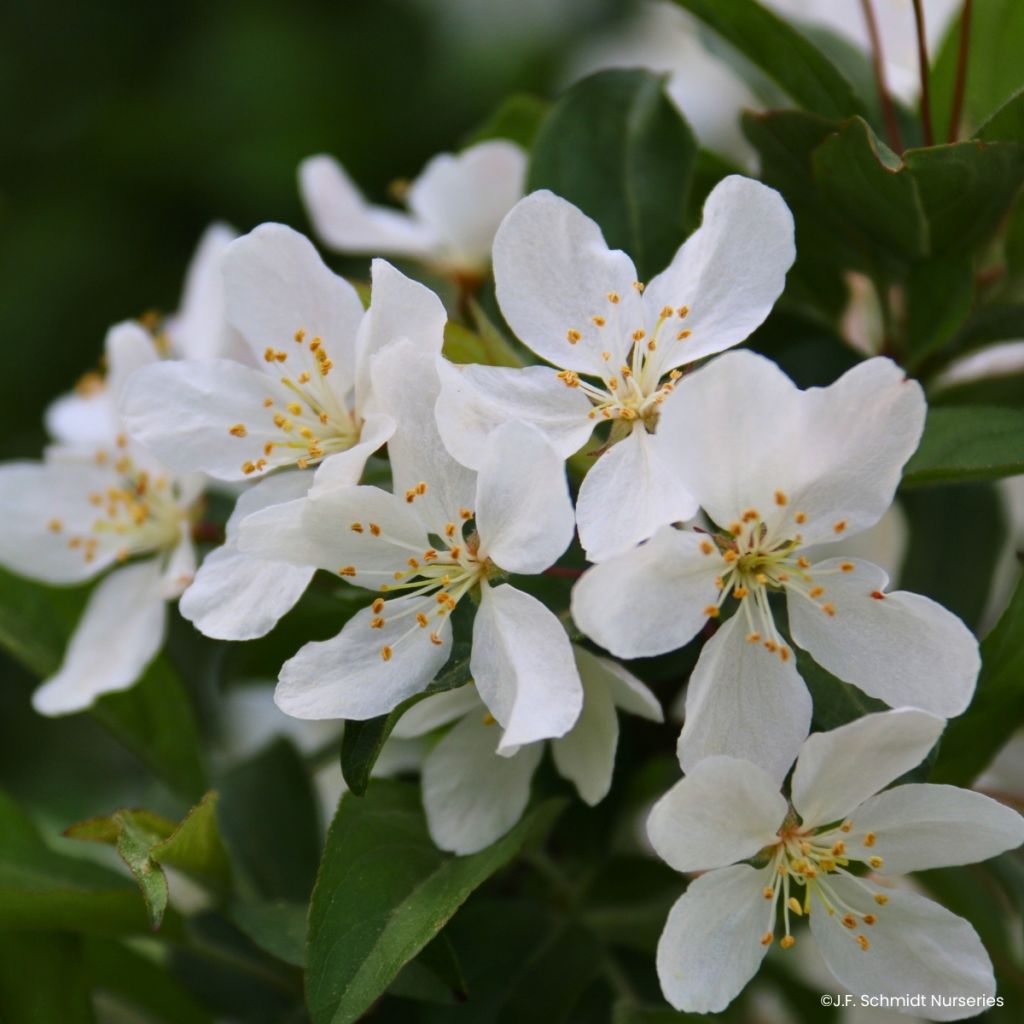
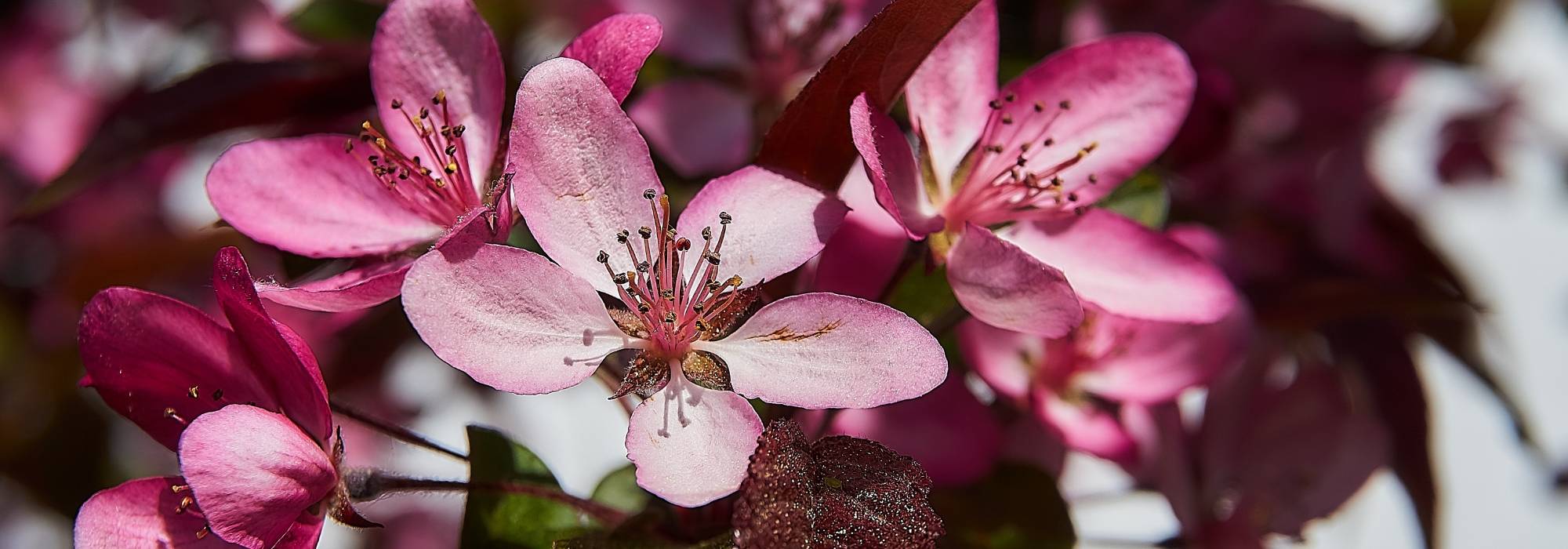
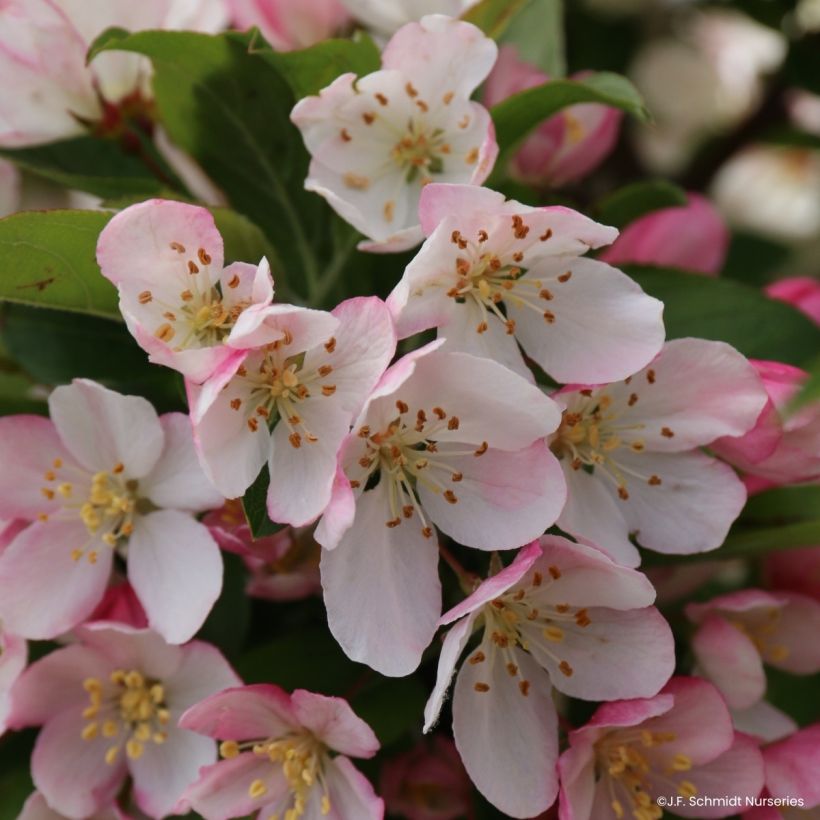
Flowering occurs in April-May: reddish-pink flower buds open into single, white flowers, with just a blush of pink, 2.5 to 3cm in diameter, with five petals, lightly scented, pollinated by insects.
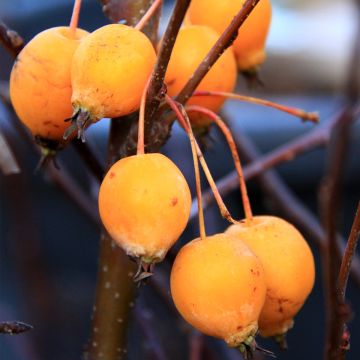
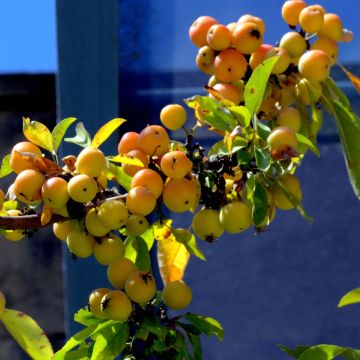
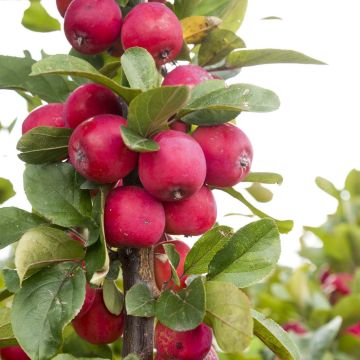
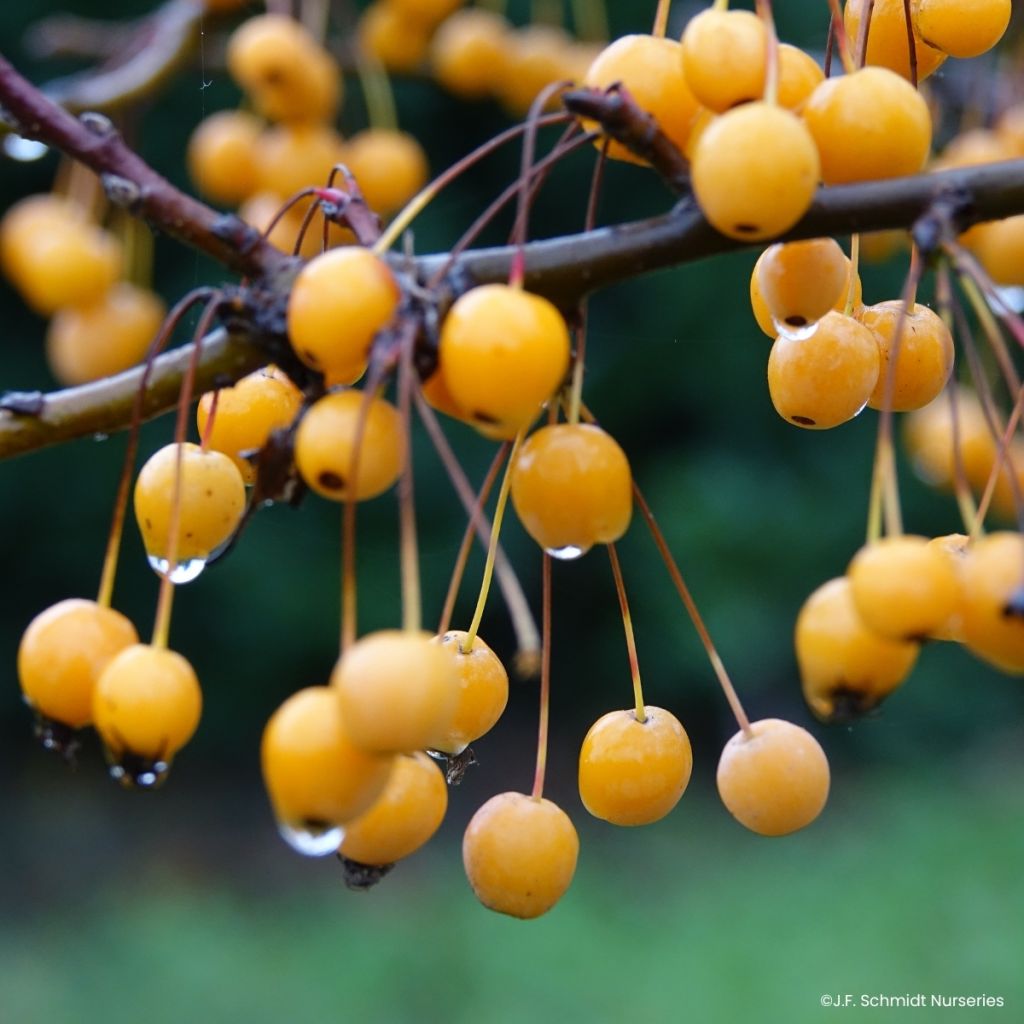
Fruits appear in late summer, around September: the small, round, 6 to 10mm diameter fruits, change from golden yellow to orange in autumn and persist on the tree into winter. They are not edible to humans, but they are very decorative and feed the birds.
This cultivar offers many advantages: it is very hardy (USDA zone 4, about –34 °C), tolerates harsh winters and moderately dry summers, and adapts to different types of well-drained soils.
Malus Sparkling Sprite - Crab Apple in pictures
Malus Sparkling Sprite - Crab Apple (Flowering)
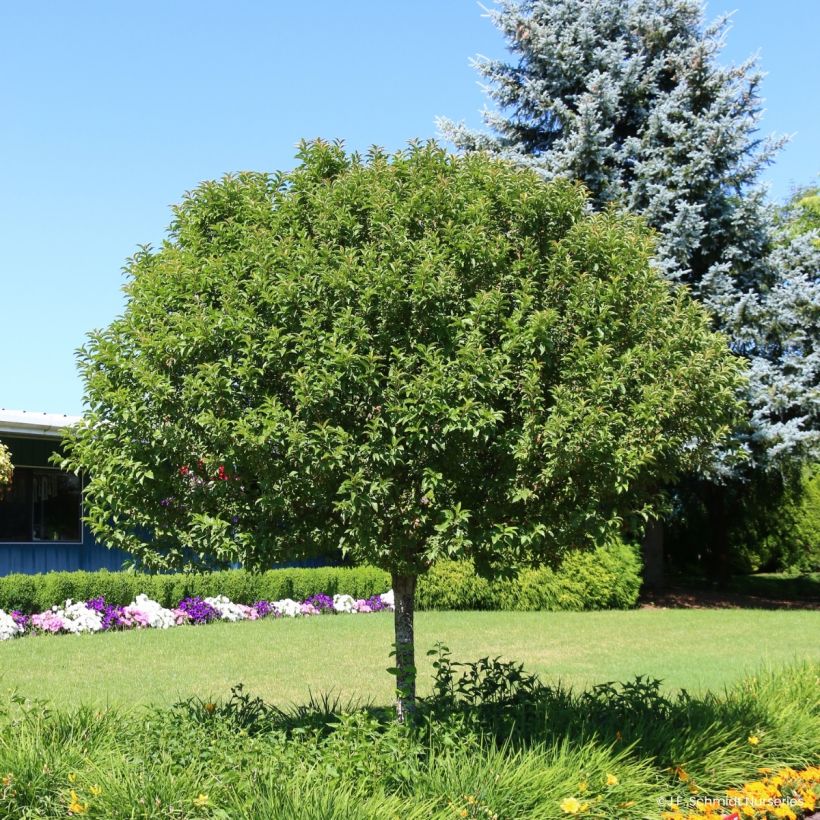
Malus Sparkling Sprite - Crab Apple (Plant habit)
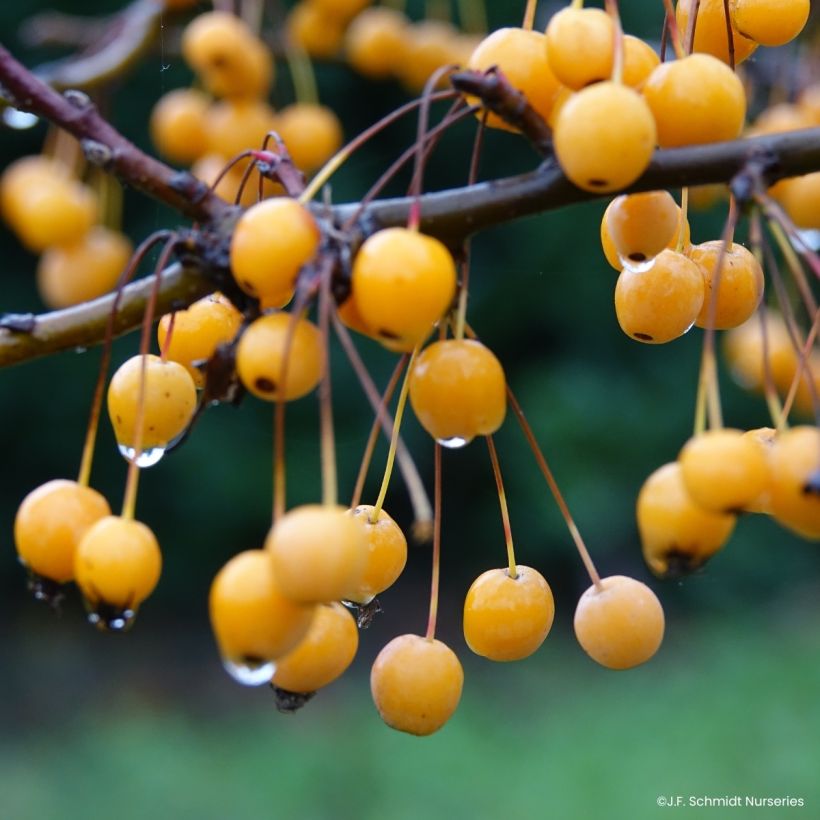
Malus Sparkling Sprite - Crab Apple (Harvest)
Plant habit
Height at maturity
3.25 m
Spread at maturity
3.25 m
Habit
irregular, bushy
Growth rate
slow
Flowering
Flower colour
white
Flowering time
April to May
Inflorescence
Corymb
Flower size
3 cm
Fragrance
slightly scented,
Bee-friendly
Attracts pollinators
Fruit colour
orange
Foliage
Foliage persistence
Deciduous
Foliage colour
green
Botanical data
Genus
Malus
Species
× domestica
Cultivar
‘JFS KW207’ Sparkling Sprite
Family
Rosaceae
Other common names
Apple Tree, Crab Apple
Botanical synonyms
Malus ‘JFS KW207’, Malus Sparkling Sprite
Origin
Cultivar or hybrid
Product reference
•
24794
Planting and care
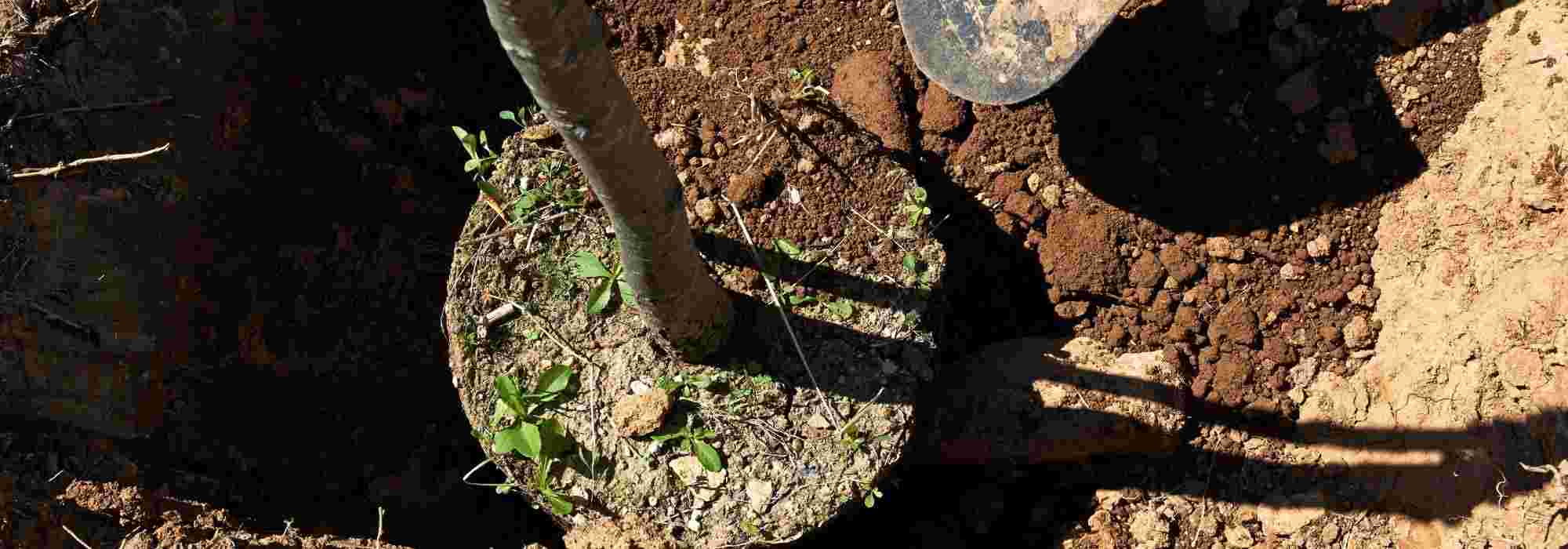
Easy to grow in ordinary but well-drained soil, Malus Sparkling Sprite requires a sunny position. Ornamental Malus are generally very accommodating, but they prefer fertile, moist, deep soils. After careful planting and establishment with regular watering during the first two years, they manage on their own. Plant it in sun or partial shade in moist, fairly rich, well-loosened soil, allowing it room to spread. Dig a large planting hole. If the soil is poor, add potting compost to the planting soil and apply fertiliser or compost at its base each spring. To prevent diseases, treat in spring with Bordeaux mixture.
Planting period
Best planting time
March, October
Recommended planting time
February to April, September to November
Intended location
Suitable for
Meadow
Type of use
Border, Free-standing, Small gardens, Container
Hardiness
Hardy down to -34.5°C (USDA zone 4)
Show map
Ease of cultivation
Beginner
Exposure
Sun, Partial shade
Soil pH
Any
Soil type
Clayey (heavy), Clayey-chalky (heavy and alkaline), Silty-loamy (rich and light)
Soil moisture
Moist soil, rich, well-drained
Care
Pruning instructions
Prune lightly to neaten the shape or train the shrub after flowering, avoiding cutting thick branches. Pruning is not essential for this variety.
Pruning
Pruning recommended once a year
Pruning time
May to June
Soil moisture
Moist soil
Drought resistance
Average
Disease resistance
Very good
Overwinter
Can be left in the ground
Planting & care advice
-
-
-

-
-
-
-
-
This item has not been reviewed yet - be the first to leave a review about it.
Leave a review →
Share your review
Recently viewed products
Haven't found what you were looking for?
Hardiness is the lowest winter temperature a plant can endure without suffering serious damage or even dying. However, hardiness is affected by location (a sheltered area, such as a patio), protection (winter cover) and soil type (hardiness is improved by well-drained soil).

Flora
Online now
The flowering period indicated on our website applies to countries and regions located in USDA zone 8 (France, the United Kingdom, Ireland, the Netherlands, etc.)
It will vary according to where you live:- In zones 9 to 10 (Italy, Spain, Greece, etc.), flowering will occur about 2 to 4 weeks earlier.
- In zones 6 to 7 (Germany, Poland, Slovenia, and lower mountainous regions), flowering will be delayed by 2 to 3 weeks.
- In zone 5 (Central Europe, Scandinavia), blooming will be delayed by 3 to 5 weeks.
In temperate climates, pruning of spring-flowering shrubs (forsythia, spireas, etc.) should be done just after flowering.
Pruning of summer-flowering shrubs (Indian Lilac, Perovskia, etc.) can be done in winter or spring.
In cold regions as well as with frost-sensitive plants, avoid pruning too early when severe frosts may still occur.
The planting period indicated on our website applies to countries and regions located in USDA zone 8 (France, United Kingdom, Ireland, Netherlands).
It will vary according to where you live:
- In Mediterranean zones (Marseille, Madrid, Milan, etc.), autumn and winter are the best planting periods.
- In continental zones (Strasbourg, Munich, Vienna, etc.), delay planting by 2 to 3 weeks in spring and bring it forward by 2 to 4 weeks in autumn.
- In mountainous regions (the Alps, Pyrenees, Carpathians, etc.), it is best to plant in late spring (May-June) or late summer (August-September).
The harvesting period indicated on our website applies to countries and regions in USDA zone 8 (France, England, Ireland, the Netherlands).
In colder areas (Scandinavia, Poland, Austria...) fruit and vegetable harvests are likely to be delayed by 3-4 weeks.
In warmer areas (Italy, Spain, Greece, etc.), harvesting will probably take place earlier, depending on weather conditions.
The sowing periods indicated on our website apply to countries and regions within USDA Zone 8 (France, UK, Ireland, Netherlands).
In colder areas (Scandinavia, Poland, Austria...), delay any outdoor sowing by 3-4 weeks, or sow under glass.
In warmer climes (Italy, Spain, Greece, etc.), bring outdoor sowing forward by a few weeks.
Shipping country and language
Your country of residence may be:
Your country of residence is:
For a better user experience on our website, you can select:
Your shipping country:
-
 Austria
-
 Belgium
-
 Bosnia & Herzegovina
-
 Bulgaria
-
 Croatia
-
 Cyprus
-
 Czechia
-
 Denmark
-
 Estonia
-
 Finland
-
 France
-
 Germany
-
 Greece
-
 Hungary
-
 Iceland
-
 Ireland
-
 Italy
Italy
-
 Latvia
-
 Liechtenstein
-
 Lithuania
-
 Luxembourg
-
 Malta
Malta
-
 Netherlands
-
 Poland
-
 Portugal
-
 Romania
-
 Serbia
-
 Slovakia
-
 Slovenia
-
 Spain
Spain
-
 Sweden
-
 Switzerland
Language:
-
French
-
 English
-
Spanish
-
Italian
-
German
-
Portuguese
-
Dutch
-
Finnish
Confirm
My Account
Hello
My wish lists
My cart
We have merged your shopping carts! Items added to the basket during a previous session have been retrieved.
Log in / Register
Existing customer?
This form is protected by reCAPTCHA - the Google Privacy Policy and Terms of Service apply.
New customer?
Create an account to track your orders, access our customer service and, if you wish, make the most of our upcoming offers.