Molucella laevis Pixie Bells

Molucella laevis Pixie Bells
Molucella laevis Pixie Bells
Moluccella laevis Pixie Bells
Bells of Ireland, Shellflower
Back-to-school special offer!
Get €10 off for every €50 you spend! And get up to €40 off on a single order.
How does it work?
1. Shop your favourites
Add your favourite plants to your basket. For every €50 you spend (excluding delivery charges, store credit and the plastic-free option), you’ll receive a €10 voucher.
€50 spent = €10 voucher
€100 spent = €20 voucher
€150 spent = €30 voucher
€200 spent = €40 voucher
2. Place your order
Once your basket reaches one of the spending thresholds, place your order. You can even choose your delivery date!
3. Receive your voucher
As soon as your order has been shipped, you’ll receive an email containing your personal voucher code and its value.
4. Use it on your next order
Your voucher is valid for 90 days from the date you receive it. It can be used once only, on a new order worth at least the value of the voucher, excluding delivery charges.
Please note: Vouchers can be combined with other offers, but cannot be split or refunded.
Why not try an alternative variety in stock?
View all →
Available in 1 sizes

Available in 1 sizes
Available in 1 sizes
Available in 1 sizes

Available in 1 sizes

Available in 1 sizes

Available in 1 sizes

Available in 1 sizes
Available in 1 sizes

Available in 1 sizes
This plant carries a 6 months recovery warranty
More information
We guarantee the quality of our plants for a full growing cycle, and will replace at our expense any plant that fails to recover under normal climatic and planting conditions.

Would this plant suit my garden?
Set up your Plantfit profile →
Description
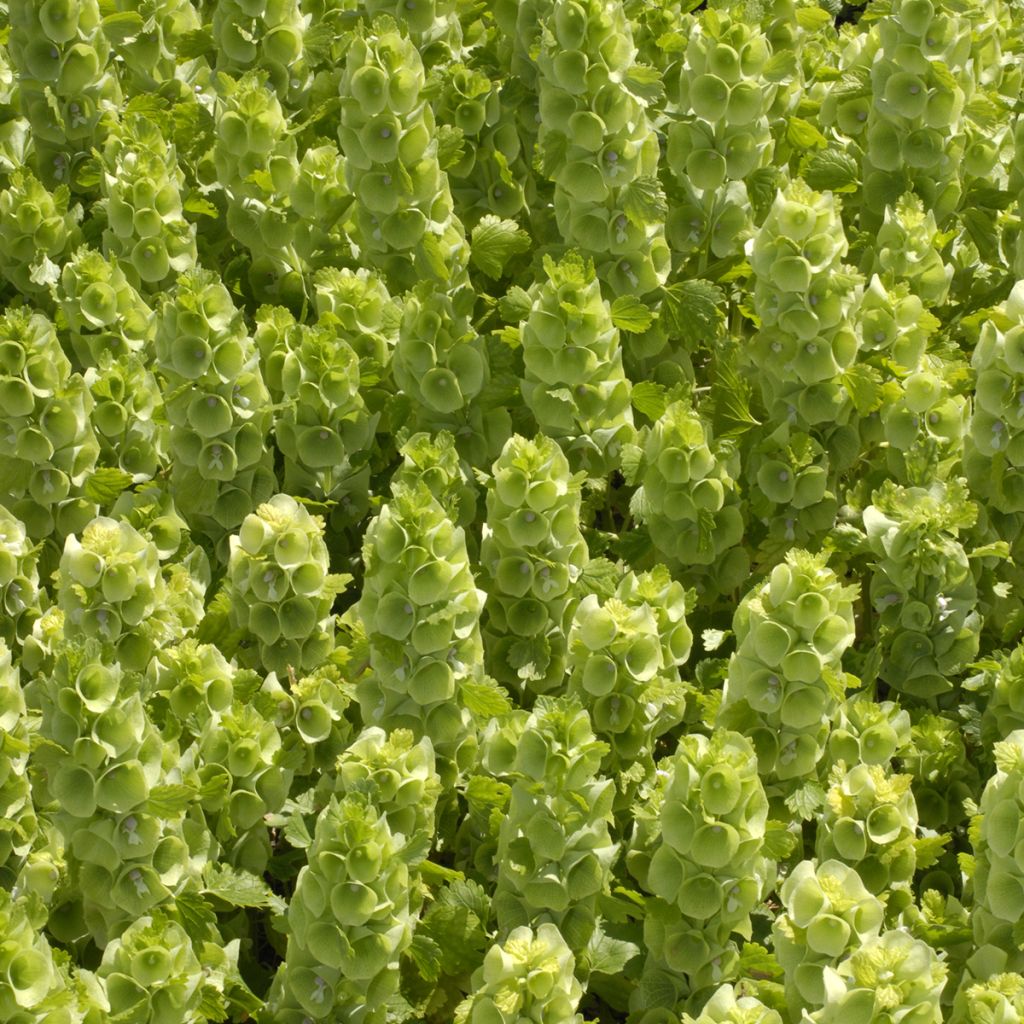
Molucella laevis 'Pixie Bells' is a variety of Molucella, also known as Molucca Balm, selected for its very dense, apple green flower spikes. Its bell-shaped flowers cluster tightly on tall floral stems emerging from aromatic foliage. This annual plant, dressed in green, was once a symbol of good fortune. It is appreciated for its unique charm and ease of cultivation. It will grow in any good garden soil where it can self-seed, in full sun or partial shade. Its green flowers are long-lasting in fresh or dried bouquets.
The 'Pixie Bells' Molucella is an award-winning horticultural selection in England by the R.H.S for its ornamental qualities and performance in the garden. The typical Molucella laevis is an herbaceous annual or biennial plant of the mint family, related to mints and salvias. Contrary to its name of Molucca Balm, it is native to Turkey, Syria, and the Caucasus, and is found in the Mediterranean region. In the wild, it is found in forests, scrub vegetation, and semi-steppe regions. While it appreciates humus-bearing soils (rich in leaf compost), the molucella is not demanding in terms of the soil it grows in, as long as it is well-drained and not waterlogged. Its name "Irish Bells" probably comes from its very green colour.
With rapid growth, the Molucella laevis 'Pixie Bells' forms a upright and branching clump within a few months, reaching a height of 70-80cm in flower with a spread of 30cm. Its hollow stems are adorned with aromatic, rounded and plicate leaves with scalloped edges, resembling those of common balm. They display different shades of green, ranging from acidic green to leaf green. Flowering occurs in spring or summer, depending on the climate and sowing date, from April to June in warmer regions or July-August further north. Curious flowers composed of a campanulate, pale green calyx with tiny white to pinkish spikes emerge from multiple, very upright floral stems, surrounded by small leaves and pairs of small thorns. These 3cm wide calyxes, bell-shaped and tightly packed, are the highlight of the flowering: very durable, they slowly change from apple green to pale beige, sometimes with purple spots. Very visited by pollinating insects, the strangely scented flowers produce small black, triangular seeds that can self-seed and germinate in spring or autumn in mild climates, in light soils.
The 'Pixie Bells' Molucella is a plant whose light appearance and lovely green colour enhance all neighboring plants, such as Lady's Mantle (Alchemilla mollis) and spurges. Easy to combine with many perennials, it is the queen of English or cottage gardens and romantic borders. For example, associate it with foxgloves, campanulas, and columbines in a moist, partial shade soil. In full sun and drier soil, it will accompany rose campions (Lychnis coronaria), bushy salvias, California poppies, or perennial salvias. It can also be sown with cornflowers, blue perennial flax, Centaureas, clary sage, or snapdragons to quickly create colourful displays. Its naturally upright habit makes it an ideal plant for adding verticality to flower pots. Cut flowers can be used in contemporary or more rustic-style bouquets. To dry them, pick the fully open floral stems and hang them upside down in a dry and well-ventilated room until the calyxes turn whitish.
Eco-friendly tip:
Like marigolds, Molucella laevis is a host plant for nematodes: it can be interesting to plant it near the vegetable garden to protect tomato crops, for example. It is also a good source of nectar for bees.
Report an error about the product description
Flowering
Foliage
Plant habit
Botanical data
Moluccella
laevis
Pixie Bells
Lamiaceae
Bells of Ireland, Shellflower
Cultivar or hybrid
Planting and care
The 'Pixie Bells' Molucella laevis is sown from February to March or April, in a heated greenhouse or indoors, in pots, covering the seeds with a thin layer of compost or vermiculite. Germination can take up to 1 month. To facilitate seed germination, subject them to a cold treatment, for example by enclosing them in a plastic bag and placing it in the vegetable compartment of the refrigerator two weeks before sowing. The day before sowing, soak them in warm water. Transplant the seedlings as soon as they are large enough to handle, and keep them under a frame until May. Finally, plant them permanently in the ground or in pots, spacing them 25cm apart.
In mild climates, seeds can be sown directly in the ground in early autumn, in a well-prepared soil, enriched with compost and sand, and free from roots or weeds. Thin out your seedlings, keeping only one plant every 25-30cm. Take care when handling your young molucellas, as their roots do not tolerate transplantation well.
Cultivation:
Plant the Irish bells with a spacing of 25cm between each plant. Place them in full sun or partial shade, in any well-drained soil, preferably enriched with compost. Choose a sheltered position from strong winds that could bend the flower stems. The molucella adapts to the climate: it will germinate in early autumn and bloom in spring in our warm regions, while the soil is still cool. Further north, it will germinate in spring and bloom in summer. This plant requires no special treatment and can do without fertilizers.
Sowing period
Intended location
Planting & care advice
-

-
-

-

-

-
-

-
This item has not been reviewed yet - be the first to leave a review about it.
Recently viewed products
Haven't found what you were looking for?
Hardiness is the lowest winter temperature a plant can endure without suffering serious damage or even dying. However, hardiness is affected by location (a sheltered area, such as a patio), protection (winter cover) and soil type (hardiness is improved by well-drained soil).

The flowering period indicated on our website applies to countries and regions located in USDA zone 8 (France, the United Kingdom, Ireland, the Netherlands, etc.)
It will vary according to where you live:- In zones 9 to 10 (Italy, Spain, Greece, etc.), flowering will occur about 2 to 4 weeks earlier.
- In zones 6 to 7 (Germany, Poland, Slovenia, and lower mountainous regions), flowering will be delayed by 2 to 3 weeks.
- In zone 5 (Central Europe, Scandinavia), blooming will be delayed by 3 to 5 weeks.
In temperate climates, pruning of spring-flowering shrubs (forsythia, spireas, etc.) should be done just after flowering.
Pruning of summer-flowering shrubs (Indian Lilac, Perovskia, etc.) can be done in winter or spring.
In cold regions as well as with frost-sensitive plants, avoid pruning too early when severe frosts may still occur.
The planting period indicated on our website applies to countries and regions located in USDA zone 8 (France, United Kingdom, Ireland, Netherlands).
It will vary according to where you live:
- In Mediterranean zones (Marseille, Madrid, Milan, etc.), autumn and winter are the best planting periods.
- In continental zones (Strasbourg, Munich, Vienna, etc.), delay planting by 2 to 3 weeks in spring and bring it forward by 2 to 4 weeks in autumn.
- In mountainous regions (the Alps, Pyrenees, Carpathians, etc.), it is best to plant in late spring (May-June) or late summer (August-September).
The harvesting period indicated on our website applies to countries and regions in USDA zone 8 (France, England, Ireland, the Netherlands).
In colder areas (Scandinavia, Poland, Austria...) fruit and vegetable harvests are likely to be delayed by 3-4 weeks.
In warmer areas (Italy, Spain, Greece, etc.), harvesting will probably take place earlier, depending on weather conditions.
The sowing periods indicated on our website apply to countries and regions within USDA Zone 8 (France, UK, Ireland, Netherlands).
In colder areas (Scandinavia, Poland, Austria...), delay any outdoor sowing by 3-4 weeks, or sow under glass.
In warmer climes (Italy, Spain, Greece, etc.), bring outdoor sowing forward by a few weeks.
Shipping country and language
Your country of residence may be:
Your country of residence is:
For a better user experience on our website, you can select:
Your shipping country:
-
 Austria
-
 Belgium
-
 Bosnia & Herzegovina
-
 Bulgaria
-
 Croatia
-
 Cyprus
-
 Czechia
-
 Denmark
-
 Estonia
-
 Finland
-
 France
-
 Germany
-
 Greece
-
 Hungary
-
 Iceland
-
 Ireland
-
 Italy
Italy
-
 Latvia
-
 Liechtenstein
-
 Lithuania
-
 Luxembourg
-
 Malta
Malta
-
 Netherlands
-
 Poland
-
 Portugal
-
 Romania
-
 Serbia
-
 Slovakia
-
 Slovenia
-
 Spain
Spain
-
 Sweden
-
 Switzerland
Language:
-
French
-
 English
-
Spanish
-
Italian
-
German
-
Portuguese
-
Dutch
-
Finnish
My Account
Hello
My wish lists
My cart
Log in / Register
Existing customer?
This form is protected by reCAPTCHA - the Google Privacy Policy and Terms of Service apply.
New customer?
Create an account to track your orders, access our customer service and, if you wish, make the most of our upcoming offers.