Compost with or without peat: which one to choose and at what price?
Our tips for making the right choice
Contents
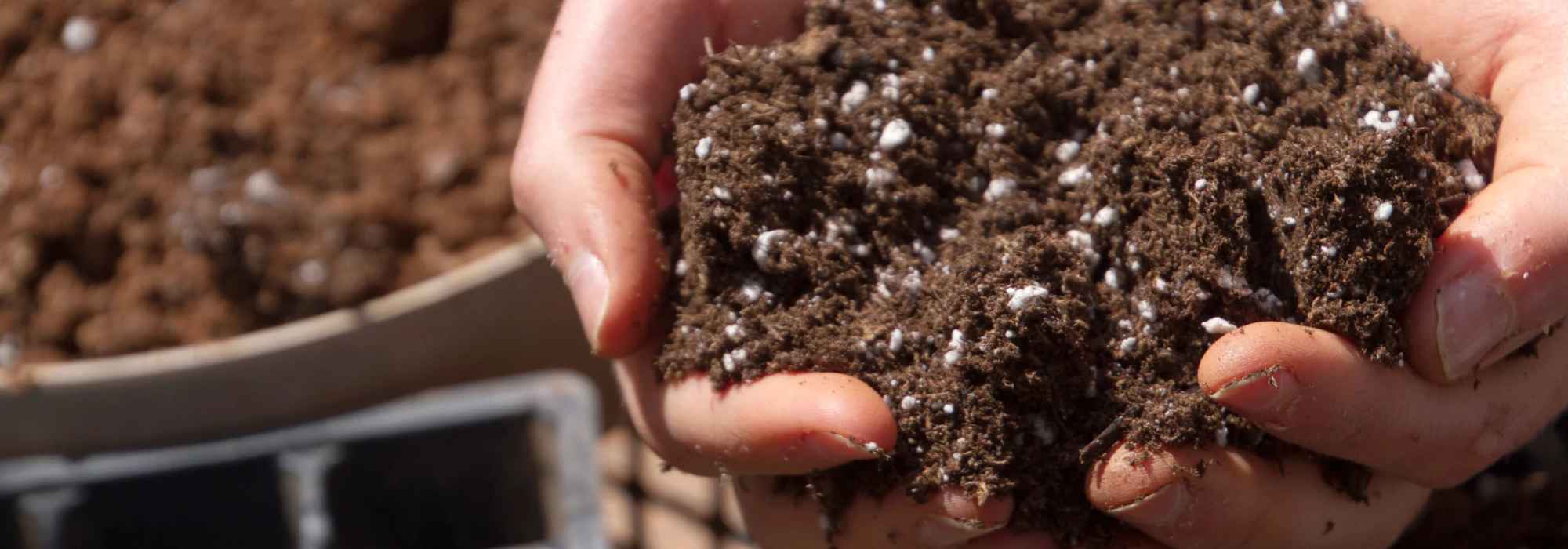
Commonly used in gardening, peat-based potting compost is gradually making way for peat-free potting compost, in order to preserve peat bogs. These fragile natural habitats store significant amounts of carbon and are home to distinctive biodiversity. Peat-free potting compost is not necessarily more expensive than conventional potting compost, as the price depends on its ingredients and quality. Differences in price, environmental impact and effectiveness for plants: which potting compost should you choose for more responsible gardening without spending more?
Key points to remember about potting compost with or without peat
|
What is the difference between peat-based and peat-free potting compost?
The main difference lies in the materials that make up the potting compost. A traditional potting compost contains a variable proportion of peat, mixed with other organic materials such as compost, mineral materials such as sand or perlite, and sometimes fertilisers. Peat comes from the accumulation, over thousands of years, of partially decomposed plant matter, mainly in peat bogs, which are wet environments with low oxygen levels.
Peat-free potting compost replaces this ingredient with materials such as wood fibres, composted bark or green waste compost. Wood fibres help to aerate the compost, while composted bark contributes to the structure of the growing medium. Green waste compost can provide nutrients, and coir fibres help retain water. However, none of these components exactly reproduces all the properties of peat. This is why the quality of peat-free potting compost depends above all on the balance of its formulation.
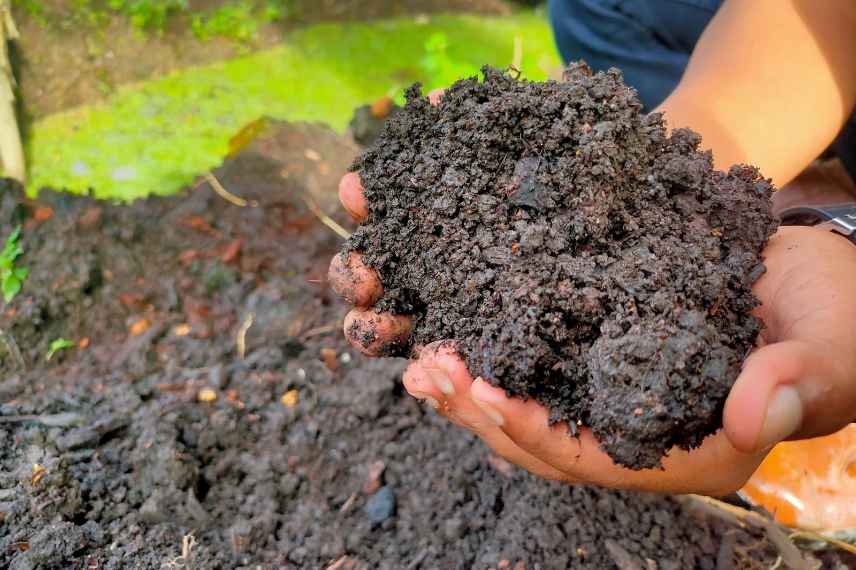
Peat used in the making of the main traditional potting composts
Is peat-free potting compost as effective as potting compost containing peat?
Peat-free potting compost can be just as effective in the garden as traditional peat-based compost, provided it is of very good quality. Effectiveness depends mainly on the balance between water retention, aeration, fertilisation and the plants’ needs. The Royal Horticultural Society (RHS), the UK’s leading horticultural organisation, has carried out several comparative trials on ornamental and vegetable plants. Its research shows that it is possible to grow plants of comparable quality in substrates with or without peat.
What difference does it make to water retention and watering?
Many gardeners believe that peat-free potting compost requires more watering. This is not necessarily true! Some formulations even have a greater water-retention capacity than mixtures containing peat. During trials carried out in nurseries and published in November 2024, the RHS observed that five of the six peat-free substrates studied retained, on average, as much or more moisture than the reduced-peat control substrates, with the same watering regime.
For the average gardener, the main challenge is to water differently. Peat-free potting compost, which is rich in wood fibres, may appear dry on the surface even though it remains moist at the bottom of the pot. Before watering, it is therefore better to check the moisture a few centimetres below the surface or lift the container to assess its weight.
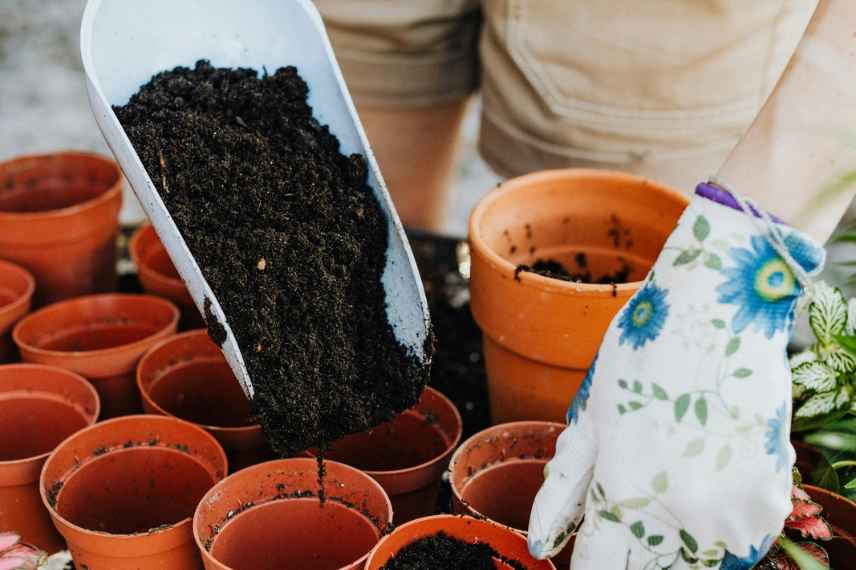
Peat-free potting compost can be just as effective in the garden as traditional peat-based compost, provided it is of very good quality
What difference does it make to plant growth?
Plant growth depends more on the quality of the mixture and fertilisation than on the presence of peat. The RHS has also shown that systematically increasing fertiliser applications in peat-free potting compost does not necessarily improve growth and may even slow it down.
Ultimately, it is best to choose potting compost, with or without peat, that is suited to your plants and to follow the manufacturer’s fertilisation instructions.
Potting compost with or without peat: what are the price differences?
Peat-free potting compost is not necessarily more expensive than traditional potting compost. Prices vary according to the brand, composition, quality of the growing medium and packaging. To compare prices, it is better to look at the price per litre rather than the price of the bag.
Price comparison of potting compost with or without peat
To compare prices, the most reliable approach is to look at the cost per litre rather than the price of the bag. Here are some examples of universal potting composts sold in France. The prices allow you to compare different ranges, with or without peat, and several packaging sizes.
| Brand and product | Peat | Volume | Price including VAT | Price per litre |
| Fertiligène – universal | None | 40 L | 12.90 € | 0.32 € |
| KB Gardener’s potting compost | None | 40 L | 12.99 € | 0.32 € |
| Algoflash – universal | None | 40 L | 12.90 € | 0.32 € |
| Verve – universal | None | 40 L | 5.99 € | 0.15 € |
| GoodHome – potting compost for pots and containers | None | 10 L | 3.99 € | 0.40 € |
| Ecolabel universal | None | 40 L | 12.90 € | 0.32 € |
| Gardenstar – universal | None | 40 L | 4.99 € | 0.12 € |
| Gardenstar – universal UAB | Yes | 40 L | 5.99 € | 0.15 € |
| Vilmorin – universal | Yes | 5 L | 4.55 € | 0.91 € |
| Terraland – universal | Yes | 40 L | 7.19 € | 0.17 € |
| Algoflash – universal | Yes | 10 L | 7.49 € | 0.74 € |
Public prices including VAT recorded on the websites of Castorama, Auchan, Leroy Merlin, Vilmorin, Mr. Bricolage, Jardiland and Promesse de Fleurs on 30 October 2026, excluding delivery costs. Prices and availability may change depending on the retailer and store.
Potting compost with or without peat: which is the most economical?
For the same 40 L format, peat-based potting compost remains more economical, with an average cost per litre of €0.16 for the 40 L format, compared with €0.26 for peat-free alternatives. For large-scale projects or filling sizeable containers, traditional peat-based potting compost therefore remains more economical.
By contrast, for the smaller 5 and 10 L volumes, the price of peat-based potting compost rises sharply, reaching €0.91/L for Vilmorin and €0.74/L for Algoflash. At the same time, peat-free potting compost such as GoodHome, at €0.40/L, is more competitive than some small-volume peat-based products. For occasional planting or indoor repotting, these potting composts are more economical.
Overall, 40 L bags of peat-based potting compost offer the lowest price per litre, but budget peat-free potting composts (Gardenstar peat-free at €0.12/L) show that it is possible to combine a limited budget with a more environmentally responsible alternative. However, choosing a peat-free formula from major manufacturers means paying an average of 30% to 40% more for 40 L bags than for entry-level peat-based products. It is also worth noting that the differences between brands are significant.
Why are peat-free potting composts better for the environment?
The main environmental benefit of peat-free potting compost is that it protects peat bogs from being excavated. Peat bogs are exceptionally rich wetland habitats. Although they cover only a tiny fraction of the Earth’s surface, they act as one of the planet’s most powerful carbon sinks, storing enormous quantities of greenhouse gases. According to the United Nations Environment Programme (UNEP), peat bogs cover around 3% of the world’s land surface, yet contain almost a third of the carbon stored in the planet’s soils. When peat bogs are drained and exploited for horticulture, this carbon, trapped for millennia, is suddenly released into the atmosphere as carbon dioxide (CO2), actively contributing to global warming.
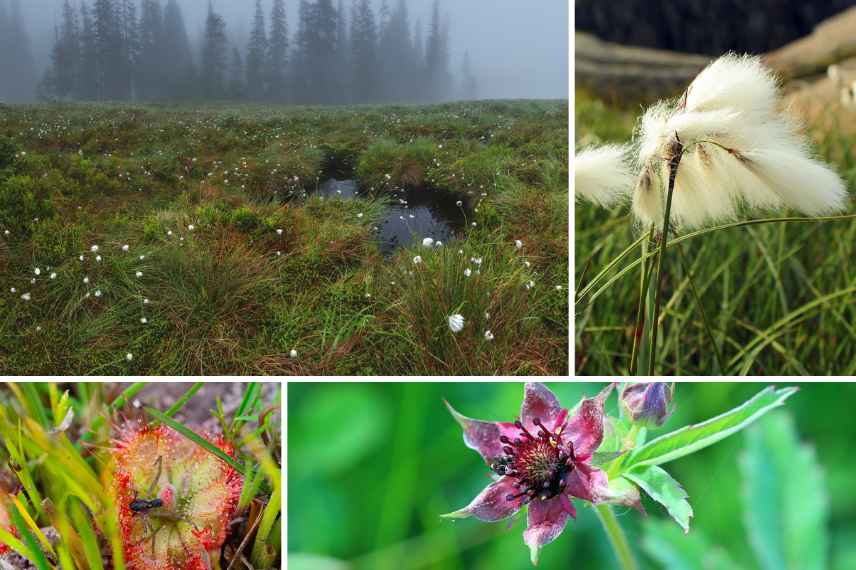
Peat bogs are home to a range of distinctive wildlife and flora, including cottongrass, marsh cinquefoil and the carnivorous plant Drosera
What is more, the destruction of these wetlands leads to the permanent loss of wildlife and flora that are highly specific to these unique habitats. They are home to various carnivorous plants such as Drosera, orchids, mosses such as sphagnum moss, and other distinctive plants such as marsh cinquefoil and cottongrass. Not forgetting the distinctive wildlife, including insects and amphibians.
Finally, let us not forget that peat regenerates at an extremely slow rate, at around one millimetre per year.
Is peat-free potting compost necessarily more environmentally friendly?
You may be disappointed, but the answer is no. Indeed, we absolutely need to look at alternatives to peat. Coir fibres, for example, generally come from tropical regions and need to be transported to Europe. Wood fibres or composted bark may come from more local resources, but processing them also consumes energy. Plant-based compost, meanwhile, makes it possible to make use of organic waste, provided that quality requirements are met.
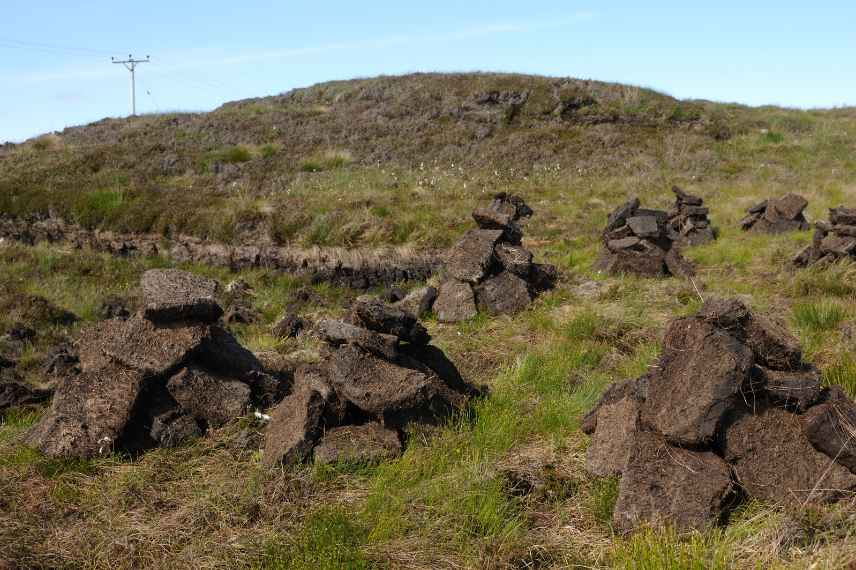
An exploited peat bog
That is why, to be beyond reproach from an environmental point of view, it is better to choose peat-free potting compost made from local or regional raw materials, with the source clearly stated by the manufacturer. However, this is not always very easy to find…
FAQ
Can a peat-based potting compost be replaced directly with a peat-free potting compost?
Yes, a traditional potting compost can be replaced with a peat-free potting compost for most plants. However, you need to choose a product suited to the type of growing and observe how it behaves during the first few waterings. Watering frequency and feeding may need some adjustment. Please note that carnivorous plants require pure peat, possibly mixed with sand.
Does organic potting compost necessarily contain less peat?
No, potting compost suitable for organic growing can contain peat. This indication concerns compliance with the rules applying to its use in organic growing, not the absence of peat. To check its composition, consult the raw materials listed on the packaging.
Can you make your own peat-free potting compost?
Yes, it is possible to prepare certain peat-free mixes from mature compost, garden soil and materials that promote aeration. The proportions must be adapted to the plants.
- Subscribe!
- Contents
This form is protected by reCAPTCHA - the Google Privacy Policy and Terms of Service apply.
























Comments