The idea for this personal take came to me from a thought I had at a recent plant swap. While a charming lady was offering some perennial plants, I asked her straight out: 'What colour are the flowers?' — 'Yellow,' she replied. And I retorted, rather bluntly: 'Oh no, no yellow for me.' I immediately felt bad, finding myself oddly rude and not very respectful. If she reads this article, may she forgive me, because yellow is one of the most radiant colours there is! Proof in pictures…
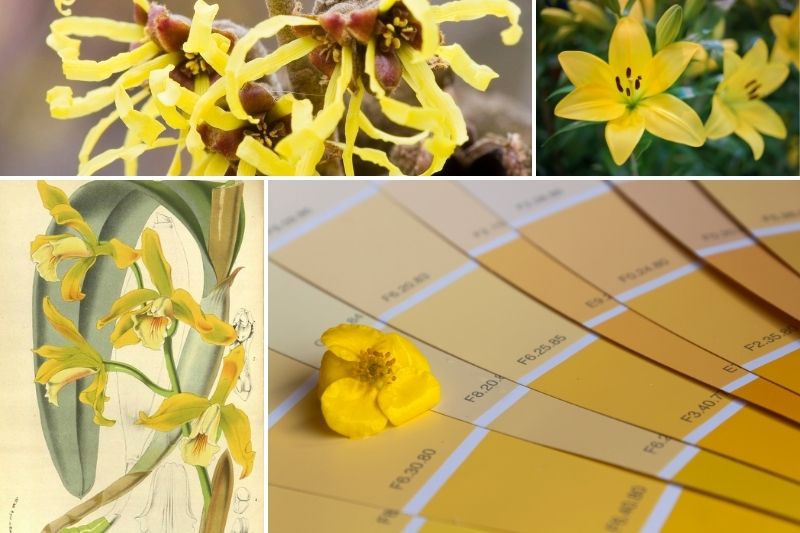
Yellow in the garden: why such hostility?
One could almost speak of a divisive colour in the garden, so much does yellow provoke either rejection or genuine passion. Even though it evokes the image of the sun and is a symbol of cheerfulness and dynamism, it is one of the colours gardeners often shun. Yet yellow is the colour of wonderful shrubs and blooms such as winter-flowering mimosa or Laburnum, those delightful yellow laburnum arches in spring that usually win unanimous praise.
This lack of enthusiasm even shows up, I find when looking into the subject, in our articles at Promesse de fleurs, where we address yellow flowering far less than the popular themes of blue, pink or white gardens.
Yellow has a bad reputation in many fields. It is rarely chosen as a dominant colour in décor. A primary colour with blue and red, yellow stands apart in our plant choices, and some refuse even to have a single yellow flower in their beds. Is that because it is associated with certain weeds (dandelion, sow-thistle, buttercup, celandine and others) or because it is said to be hard to pair? I would lean towards the latter reason, to which I return below.
In art, it was one of the major colours of the Fauvist movement, brought to its height by Vincent Van Gogh with his vivid yellow blocks on sunflowers or by Klimt.
But, once associated with the sacred, yellow declined from the Middle Ages, gradually evolving into a negative symbol, until it became the colour of the yellow Star of David. Even language turned on it with a few unflattering expressions, such as a forced laugh or the "Yellow Peril". In the West, offering yellow roses long signified infidelity and, more broadly, separation. Yellow therefore evokes deceit and betrayal, whereas it carries a very positive connotation in the East.
Yellow and yellows
Yet there is not one yellow but many yellows, just like the gradients in all colours.
From very pale, almost white yellow to saffron yellow, it is a wide spectrum! Let us set aside yellow or golden foliage here, which is generally better accepted by many gardeners.
St John's-wort, forsythia, mahonia: the vivid yellow of these shrubs, often considered mundane, may be one reason for the contempt shown towards yellow. Or is it still too closely associated in our minds with 1970s gardens that featured rather unnatural yellow roses, almost artificial chrysanthemums and overly gilded conifers? Finally, some summer bedding displays seen in parks or roundabouts, at times almost garish, put many people off…
Unless the lemon-yellow of the few adventitious weeds mentioned earlier puts us off this delightful colour. But it is more likely the difficulty of combining yellow flowers well with other garden blooms that makes us hesitate to use it. In short: people often fear that saturated yellow will jar with other plants in the garden.
My favourite yellow flowers
I am one of those who do not plant too many yellow flowers in the garden. My view has nevertheless evolved with my wanderings through English gardens that dare, in some cases, a monochrome yellow garden, less common than the famous white garden at Sissinghurst. Marvels can be found there, as at Burton Agnes Hall.
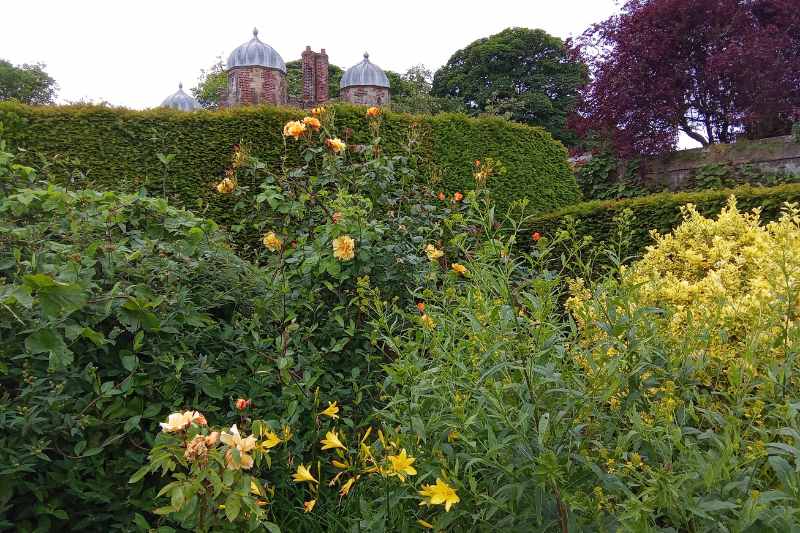
For my part, special mention goes to pale and pastel yellow blooms that are so easy to pair. Light, creamy, butter, anise, straw or slightly apricot yellows actually harmonise with many garden flowers: all blues, pinks and oranges, mauves and purples, from pale lavender to plum. They are found in some old or species roses like 'Mermaid', many honeysuckles, oleander luteum 'Plenum', Liriodendron, some magnolias and exquisite Michelia, of great delicacy, and many other shrubs and perennial plants.
I admit that brilliant yellow is also the colour of spring! Daffodils are its true ambassadors. And if you do not want to incorporate yellow elsewhere in the garden throughout the year, spring is a real opportunity to punctuate the early fine days with a Banks' rose, some sunlit tulips and other bulbs or chartreuse-flowered euphorbias, or an azalea 'Harvest Moon' that pair wonderfully with the many blue and white spring blooms.
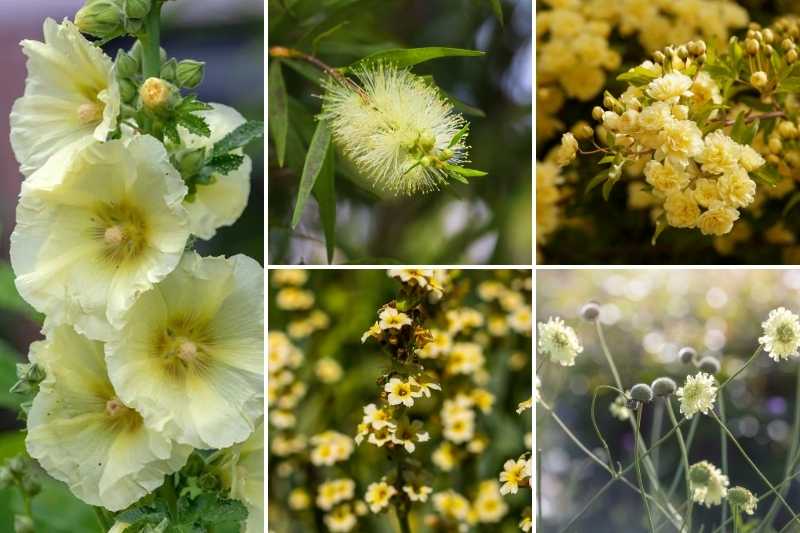
Using yellow: how not to go wrong?
I also like to see brighter yellow blooms parade through summer beds, in a naturalistic planting with rudbeckias or sunlit achilleas, in English hot borders that blend all warm colours of the colour wheel. It is also perfect in exotic gardens, alongside orange blooms, with which it creates a beautiful gradient. Finally, many marginal or aquatic plants flower in yellow, making them excellent choices for water gardens or pond edges, enhanced by yellow-flag iris, ligularias, yellow water lilies and a few touches of purple foliage. Last option for this much-maligned yellow: it is a standout colour in dry gardens, appearing alongside senecios, Helychrisum and other succulent plants paired with greyed and silvery foliage and some blue or orange blooms.
My final tip: avoid adding yellow blooms to beds that are already richly coloured (except in a naturalistic context). The result can be a garish effect not in the best taste. It's better to stick to a successful two-colour combination, or three colours, and play with contrasting foliage or work in gradients. Introduce it in small doses, unless aiming for a monochrome garden — to me, that is the best way to exalt it!
Not convinced? Still hesitating? Do you tend to use yellow mainly in handsome winter-flowering shrubs? What are your experiences with yellow in the garden? Tell us how you use it, and feel free to comment to continue this age-old debate about yellow in the garden.
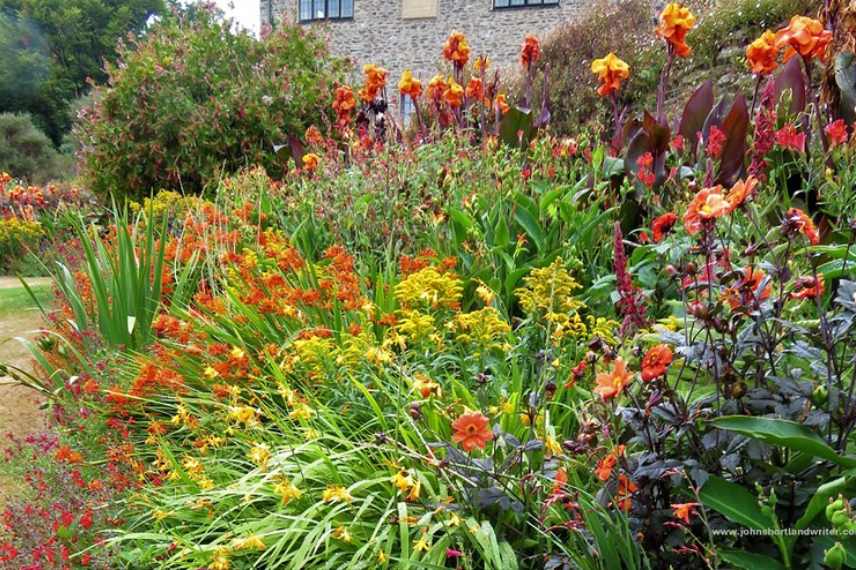
a successful trilogy of yellow, orange and purple
Further reading…
Top up your ideas with tips and inspiration from the editorial team in our dedicated section on the Yellow garden. On our online shop, discover our wide range of yellow-flowering shrubs, as well as our yellow roses, and our yellow-flowering bulbs.
Leïla tackled this subject in How to pair yellow flowers in the garden? and Michaël in Toning down yellow flowers in the garden.
And if, like me, you enjoy history and the symbolism of colours, add French author Michel Pastoureau's work on the colour yellow to your summer reading: Yellow: A History of a Colour, published by Points in France.































Comments