
Rosa 'Sourire d'Isabelle' - Climbing Rose
Rosa 'Sourire d'Isabelle' - Climbing Rose
Rosa 'Sourire d'Isabelle' - Climbing Rose

Rosa 'Sourire d'Isabelle' - Climbing Rose
Rosa 'Sourire d'Isabelle' - Climbing Rose
Rosa 'Sourire d'Isabelle' - Climbing Rose

Rosa 'Sourire d'Isabelle' - Climbing Rose
Rosa 'Sourire d'Isabelle' - Climbing Rose
Rosa x grimpant Sourire d'Isabelle® VEL10kgua
VEL10kgua
Gorgeous rose plant received and immediately planted on the same day. After a week of being planted, the young shoots are already emerging! It's very promising! Thank you!
PATRICIA, 18/03/2024
Back-to-school special offer!
Get €10 off for every €50 you spend! And get up to €40 off on a single order.
How does it work?
1. Shop your favourites
Add your favourite plants to your basket. For every €50 you spend (excluding delivery charges, store credit and the plastic-free option), you’ll receive a €10 voucher.
€50 spent = €10 voucher
€100 spent = €20 voucher
€150 spent = €30 voucher
€200 spent = €40 voucher
2. Place your order
Once your basket reaches one of the spending thresholds, place your order. You can even choose your delivery date!
3. Receive your voucher
As soon as your order has been shipped, you’ll receive an email containing your personal voucher code and its value.
4. Use it on your next order
Your voucher is valid for 90 days from the date you receive it. It can be used once only, on a new order worth at least the value of the voucher, excluding delivery charges.
Please note: Vouchers can be combined with other offers, but cannot be split or refunded.
Home or relay delivery (depending on size and destination)
Important: You may be charged customs duties by your country’s customs authorities upon delivery.
Schedule delivery date,
and select date in basket
This plant carries a 24 months recovery warranty
More information
We guarantee the quality of our plants for a full growing cycle, and will replace at our expense any plant that fails to recover under normal climatic and planting conditions.

Description
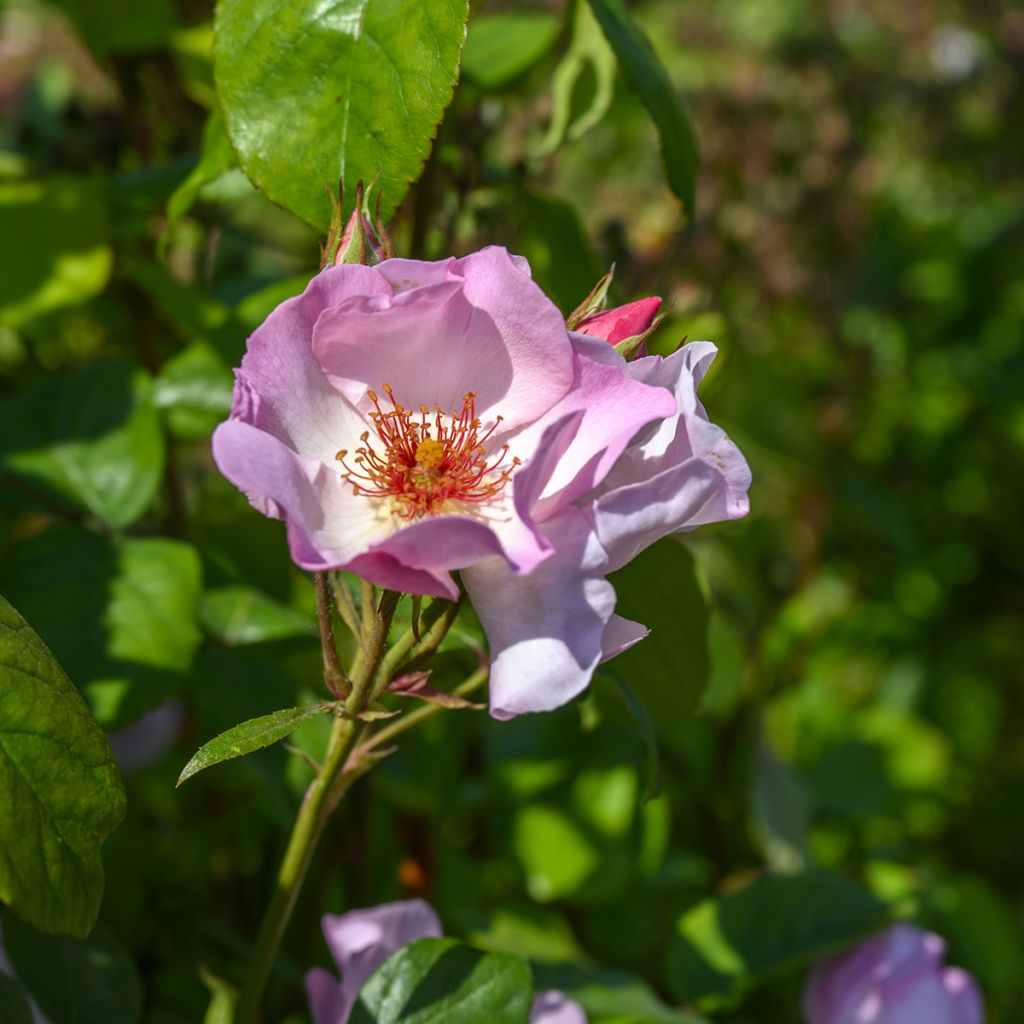
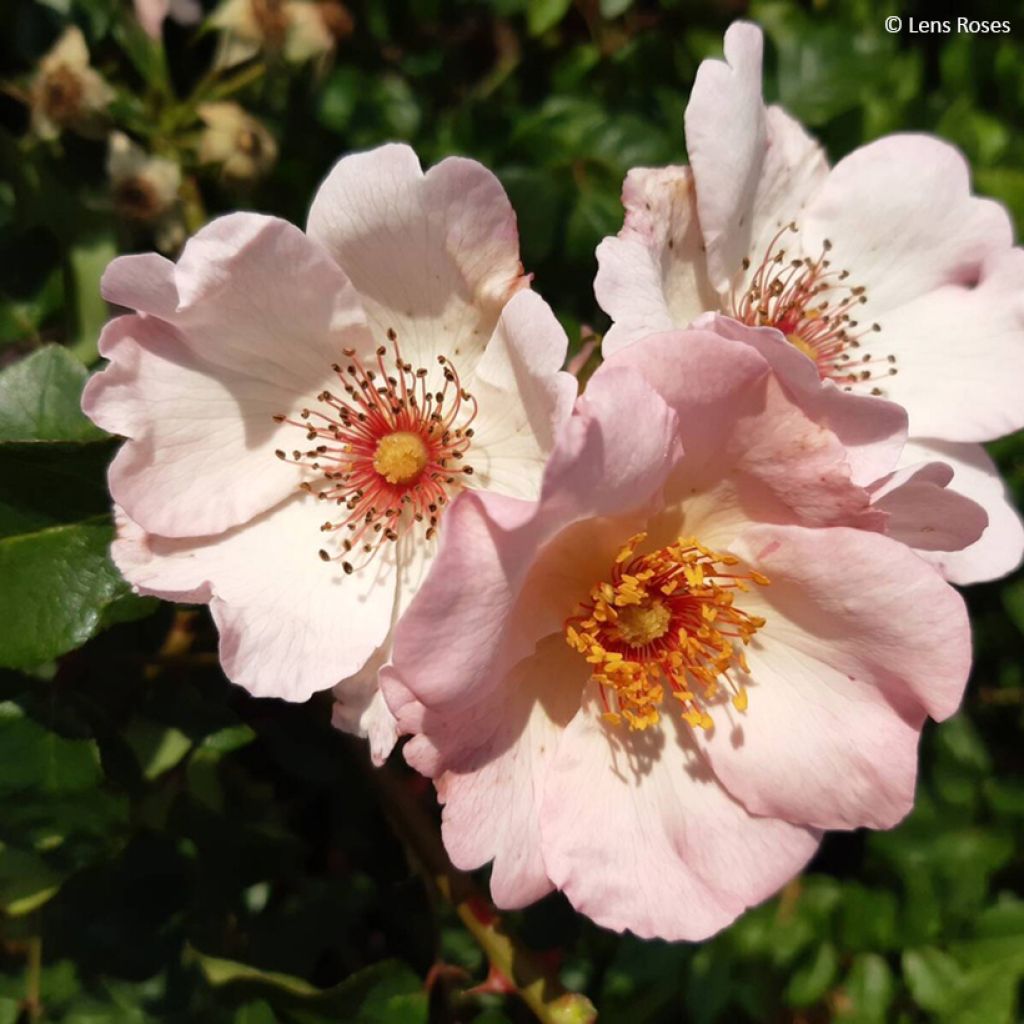
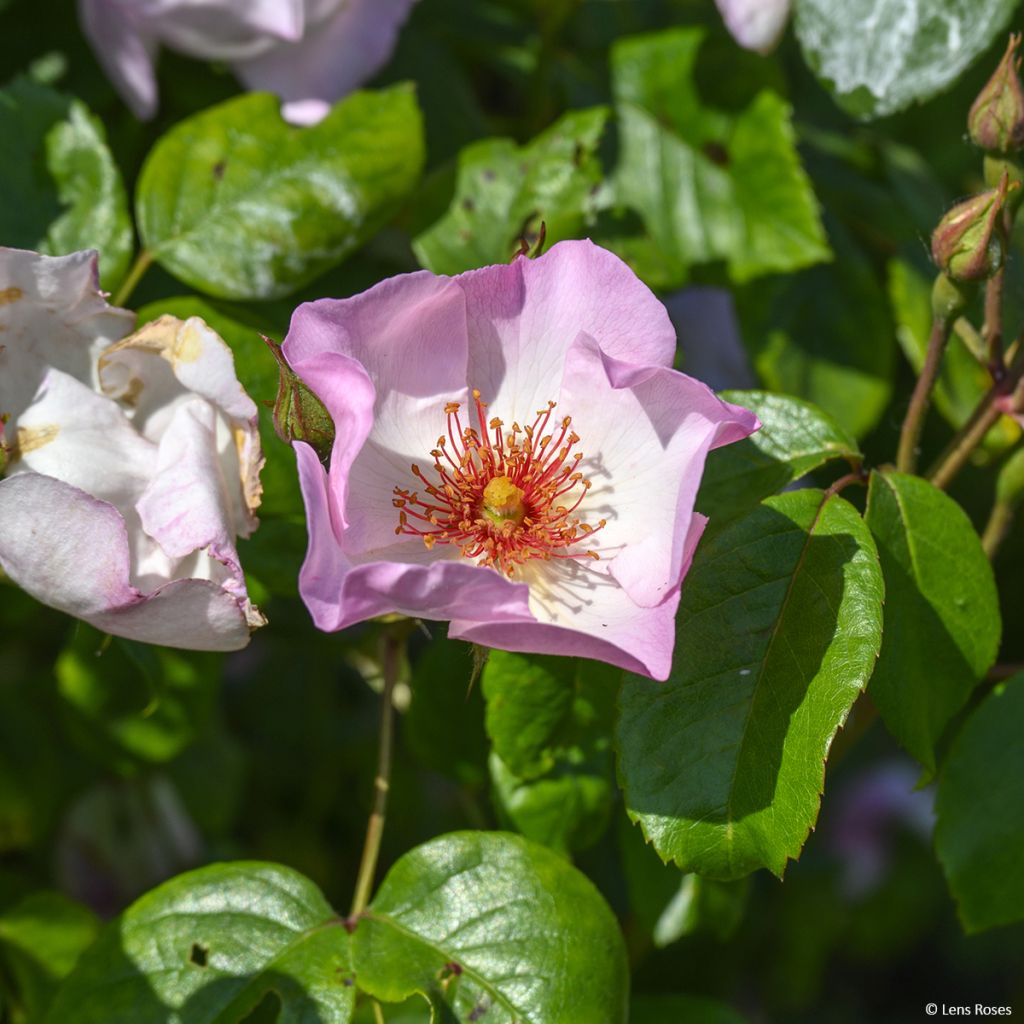
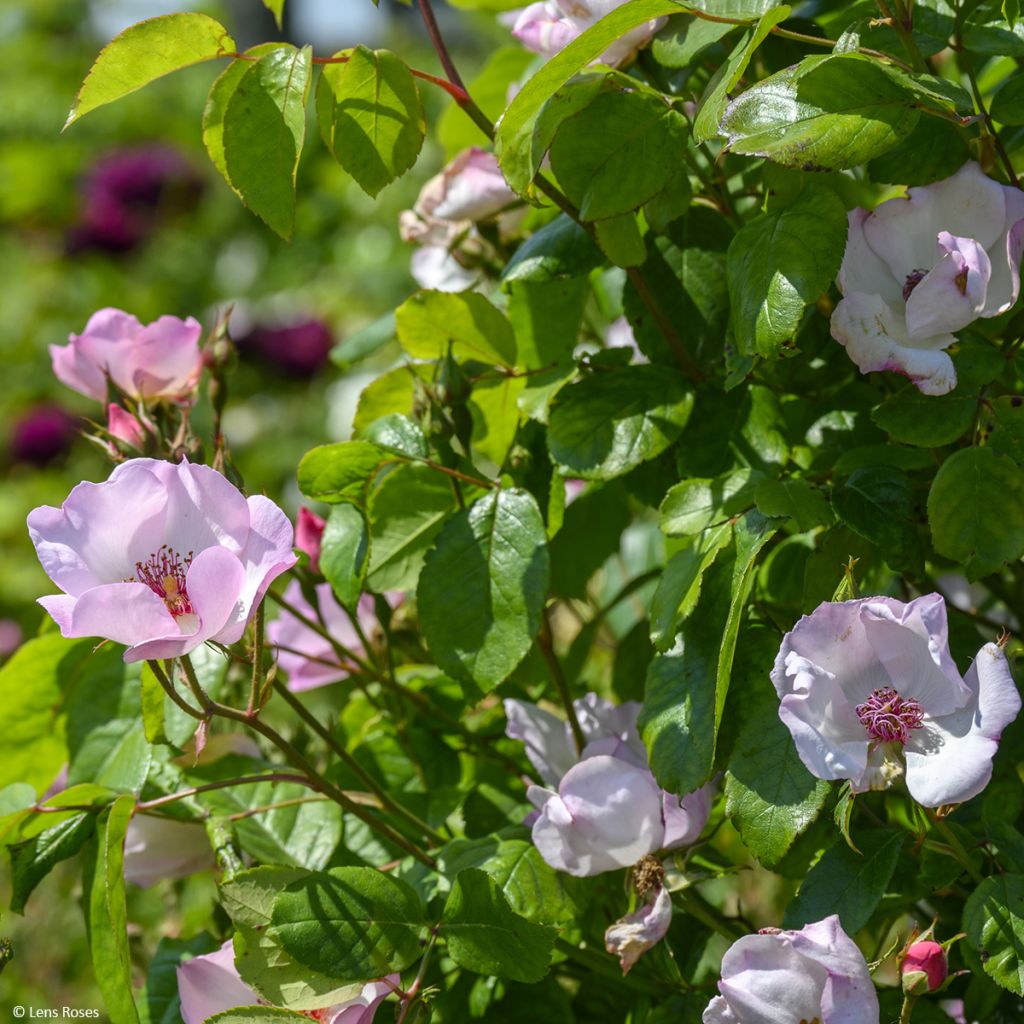
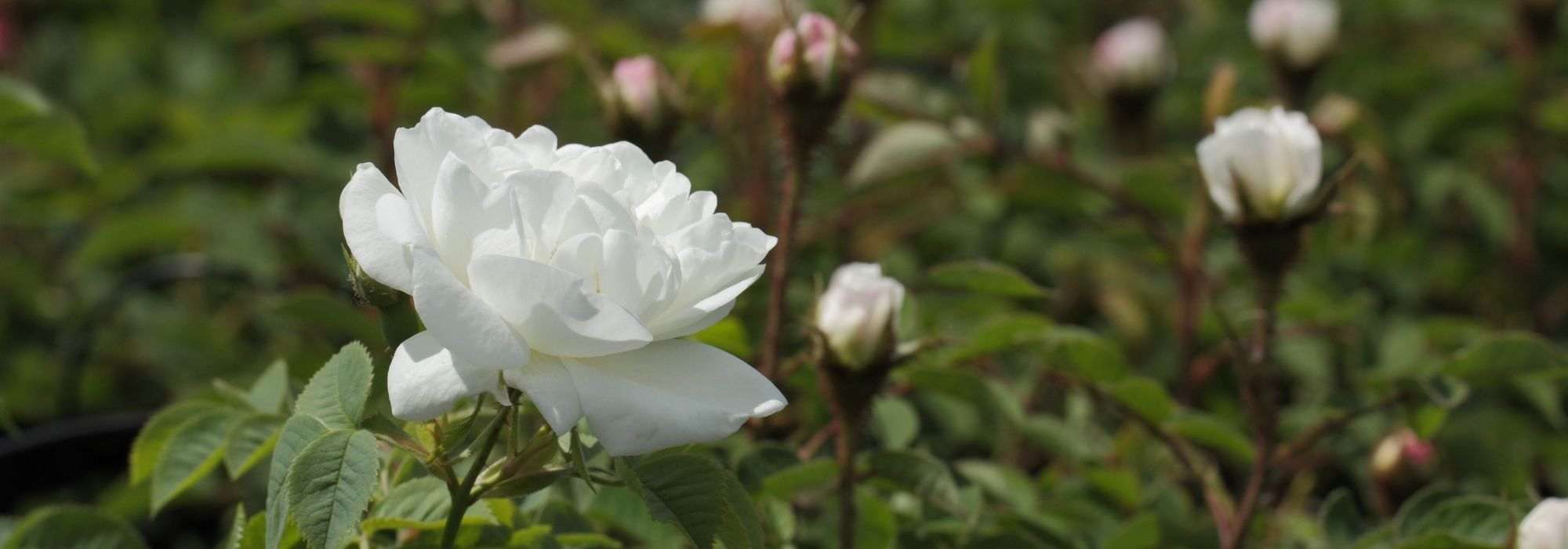
The 'Smile of Isabelle' Rose is a climbing variety of modest size that stands out for its unique and charming perpetual flowering. From late spring to early autumn, it is adorned with large pastel pink wild roses gathered in delicately scented bouquets. A pretty bouquet of violet stamens turning pink makes them irresistible, just like their small pink and orange heart. This variety, which is popular with bees, also produces small fruits at the end of the season, much to the delight of birds.
This Smile of Isabelle 'VEL10kgual' rose is a creation of Lens Roses dating back to 2019, awarded in 2013. The well-branched plant will reach 2.50 m (8ft) to 3 m (10ft) in height with a spread of 1.50 m (5ft) to 2 m (7ft). Its long stems are thorny, adorned with healthy, elegant foliage of a glossy medium green. Deciduous, it is absent in winter. The flowers of this perpetual variety form from June onwards, then in successive waves until October, if the soil does not dry out too much. Gathered in bouquets, they emerge on short shoots of the 2nd year, as brightly pink buds. Then, they open almost flat as corollas measuring 7 cm (3in) in diameter. Coquettish, simple, charming, they exhale a light exotic fruit scent. Their color is a pearly light pink on the edges, with the center almost white. The beautiful stamens, initially violet and orange, turn violet-pink. Pollinated by bees, the flowers transform into small fruits that are a treat for birds in the winter. They are actually fleshy false fruits called hips. They contain a large quantity of achenes with a single seed.
'Smile of Isabelle' is a evocative name for an enchanting climbing rose that has its place in a romantic or English-style setting. Like other climbing roses, it is incomparable for adorning walls, fences, arbors, and pergolas. To accompany it, consider the perennial pea 'Pink Pearl' and charming bell-shaped clematis such as 'Rooguchi' or 'Etoile Rose'. It is an ideal companion for small trees that it will revive, or charming cabins that it gives a lot of charm to. Trained on an arch, it will create a romantic and fragrant passage.
Awards:
- Baden-Baden, 2013: Bronze Medal
- Hradec Kralove, 2013: Certificate of Merit

Plant habit
Flowering
Foliage
Botanical data
Rosa
x grimpant
Sourire d'Isabelle® VEL10kgua
Rosaceae
VEL10kgua
Cultivar or hybrid
Planting and care
The 'Smile of Isabelle' rose adapts to any soil, even heavy or sandy; as long as the planting is taken care of, it does not lack water or nutrients. Plant it in ordinary, well-worked, well-drained soil and in a sunny or partially shaded location. Plant it in early spring or autumn, never when it freezes.
To keep your rose bush in good shape, you should prune it regularly. The main branches should be kept intact while the lateral branches should be trimmed to about 3 to 5 cm (1 to 2 inches) from the main branches. This will help rejuvenate the plant and encourage the growth of flowers at the base of the plant. This type of rose is quite hardy and can tolerate temperatures as low as -20°C (-4°F). In order to prevent hips, it's recommended to remove dead wood during winter and faded flowers throughout the year. If necessary, light pruning can be done in spring after the risk of frost has passed. If you have enough space, you can let climbing roses grow naturally without pruning.
If you plant a climbing rose next to a living tree, the rose's root system will compete with the already well-established tree's root system. To control watering, here's a tip: plant the rose in a large container with a perforated bottom at the base of the tree; the tree's roots will not penetrate the container for at least a year. Remove the container after 1 year, for example, by cutting one side without disturbing the rose's root system. By then, the rose will have had enough time to develop its deep root system in the soil and be more resistant.
Roses often develop unsightly stains at the end of summer. However, this is a natural occurrence and does not harm the rose's growth.
Planting period
Intended location
Care
Planting & care advice
-

-

-

-

-

-

-
-

-
, onOrder confirmed
Reply from on Promesse de fleurs
Recently viewed products
Haven't found what you were looking for?
Hardiness is the lowest winter temperature a plant can endure without suffering serious damage or even dying. However, hardiness is affected by location (a sheltered area, such as a patio), protection (winter cover) and soil type (hardiness is improved by well-drained soil).

The flowering period indicated on our website applies to countries and regions located in USDA zone 8 (France, the United Kingdom, Ireland, the Netherlands, etc.)
It will vary according to where you live:- In zones 9 to 10 (Italy, Spain, Greece, etc.), flowering will occur about 2 to 4 weeks earlier.
- In zones 6 to 7 (Germany, Poland, Slovenia, and lower mountainous regions), flowering will be delayed by 2 to 3 weeks.
- In zone 5 (Central Europe, Scandinavia), blooming will be delayed by 3 to 5 weeks.
In temperate climates, pruning of spring-flowering shrubs (forsythia, spireas, etc.) should be done just after flowering.
Pruning of summer-flowering shrubs (Indian Lilac, Perovskia, etc.) can be done in winter or spring.
In cold regions as well as with frost-sensitive plants, avoid pruning too early when severe frosts may still occur.
The planting period indicated on our website applies to countries and regions located in USDA zone 8 (France, United Kingdom, Ireland, Netherlands).
It will vary according to where you live:
- In Mediterranean zones (Marseille, Madrid, Milan, etc.), autumn and winter are the best planting periods.
- In continental zones (Strasbourg, Munich, Vienna, etc.), delay planting by 2 to 3 weeks in spring and bring it forward by 2 to 4 weeks in autumn.
- In mountainous regions (the Alps, Pyrenees, Carpathians, etc.), it is best to plant in late spring (May-June) or late summer (August-September).
The harvesting period indicated on our website applies to countries and regions in USDA zone 8 (France, England, Ireland, the Netherlands).
In colder areas (Scandinavia, Poland, Austria...) fruit and vegetable harvests are likely to be delayed by 3-4 weeks.
In warmer areas (Italy, Spain, Greece, etc.), harvesting will probably take place earlier, depending on weather conditions.
The sowing periods indicated on our website apply to countries and regions within USDA Zone 8 (France, UK, Ireland, Netherlands).
In colder areas (Scandinavia, Poland, Austria...), delay any outdoor sowing by 3-4 weeks, or sow under glass.
In warmer climes (Italy, Spain, Greece, etc.), bring outdoor sowing forward by a few weeks.
Shipping country and language
Your country of residence may be:
Your country of residence is:
For a better user experience on our website, you can select:
Your shipping country:
-
 Austria
-
 Belgium
-
 Bosnia & Herzegovina
-
 Bulgaria
-
 Croatia
-
 Cyprus
-
 Czechia
-
 Denmark
-
 Estonia
-
 Finland
-
 France
-
 Germany
-
 Greece
-
 Hungary
-
 Iceland
-
 Ireland
-
 Italy
Italy
-
 Latvia
-
 Liechtenstein
-
 Lithuania
-
 Luxembourg
-
 Malta
Malta
-
 Netherlands
-
 Poland
-
 Portugal
-
 Romania
-
 Serbia
-
 Slovakia
-
 Slovenia
-
 Spain
Spain
-
 Sweden
-
 Switzerland
Language:
-
French
-
 English
-
Spanish
-
Italian
-
German
-
Portuguese
-
Dutch
-
Finnish
My Account
Hello
My wish lists
My cart
Log in / Register
Existing customer?
This form is protected by reCAPTCHA - the Google Privacy Policy and Terms of Service apply.
New customer?
Create an account to track your orders, access our customer service and, if you wish, make the most of our upcoming offers.