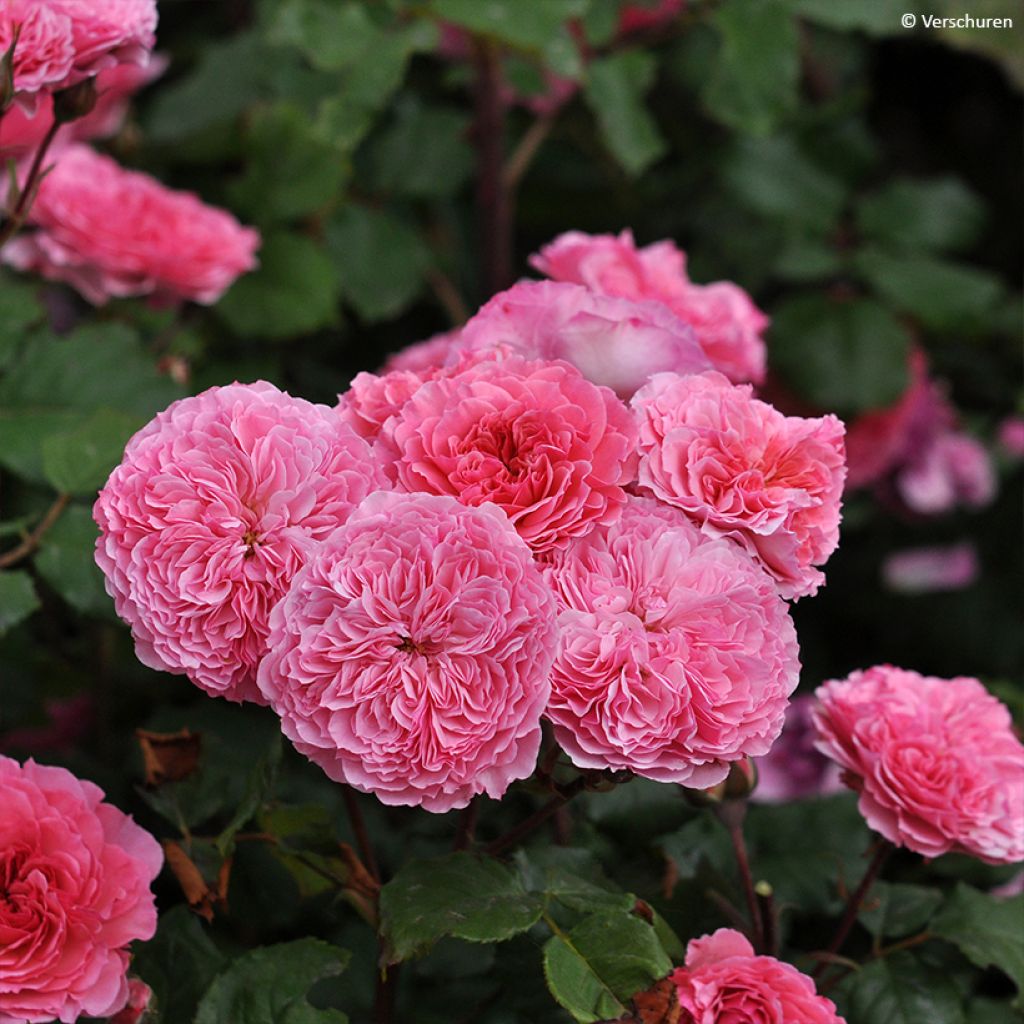
Rosa x floribunda Taste of Love 'Theo Clevers' - Floribunda Rose
Rosa x floribunda Taste of Love 'Theo Clevers' - Floribunda Rose
Rosa x floribunda Taste of Love® Theo Clevers® 'Bozkatafra'
Bozkatafra
Even though I didn't plant it straight away, it was magnificent this summer and into late summer. It doubled in height and flowered several times. The flowers are superb.
Gwendolyne, 20/12/2025
Back-to-school special offer!
Get €10 off for every €50 you spend! And get up to €40 off on a single order.
How does it work?
1. Shop your favourites
Add your favourite plants to your basket. For every €50 you spend (excluding delivery charges, store credit and the plastic-free option), you’ll receive a €10 voucher.
€50 spent = €10 voucher
€100 spent = €20 voucher
€150 spent = €30 voucher
€200 spent = €40 voucher
2. Place your order
Once your basket reaches one of the spending thresholds, place your order. You can even choose your delivery date!
3. Receive your voucher
As soon as your order has been shipped, you’ll receive an email containing your personal voucher code and its value.
4. Use it on your next order
Your voucher is valid for 90 days from the date you receive it. It can be used once only, on a new order worth at least the value of the voucher, excluding delivery charges.
Please note: Vouchers can be combined with other offers, but cannot be split or refunded.
Home or relay delivery (depending on size and destination)
Important: You may be charged customs duties by your country’s customs authorities upon delivery.
Schedule delivery date,
and select date in basket
This plant carries a 6 months recovery warranty
More information
We guarantee the quality of our plants for a full growing cycle, and will replace at our expense any plant that fails to recover under normal climatic and planting conditions.

Description
The bush rose Taste of Love 'Theo Clevers' or 'Bozkatafra' is a small, dense bush with extraordinary flowering. From July to October, clusters of pink flowers reminiscent of some old varieties bloom. These roses are made up of many petals, which are appreciated for their appearance and flavour as they are edible. They have a strawberry aroma that works wonders in fruit salads, confectionery, jams, and jellies. Resistant to diseases and easy to grow, this medium-sized rose can be planted alone or in flower beds and can also be grown in a large pot to enhance a terrace or balcony.
The variety 'Theo Clevers' or 'Bozkatafra' is part of the Taste of Love collection, which brings together roses with edible petals that borrow their aroma from different fruits. The genus Rosa is extremely prolific in botanical species and horticultural cultivars. Classified into large groups, roses are enriched with a new range of sensations.
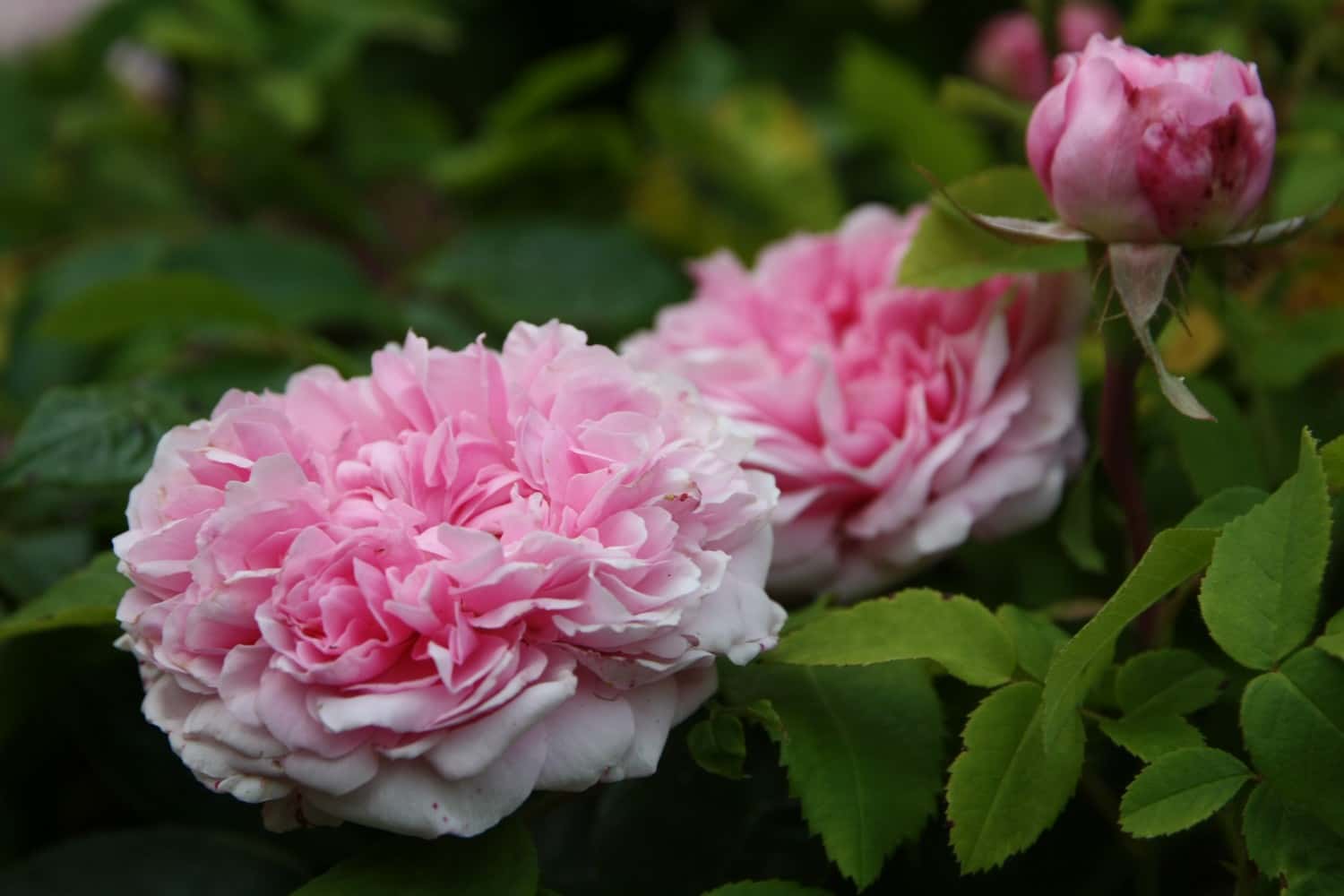
'Theo Clevers' is a recent variety that appeared on the market in 2019, bred by Peter Cox. It forms a dense bush 70 to 80 cm (28 to 32in) in height and about 50 cm (20in) wide, with beautiful foliage composed of dark green leaflets with a slightly shiny surface. This dark vegetation is a perfect background to highlight the beauty of the flowers. The corollas are uniformly and homogeneously pink, with an impressive number of tightly-packed petals: usually between 130 and 140! The flowering starts in July and continues in successive waves until October, producing large clusters called corymbs, clearly visible above the foliage. Measuring approximately 7 cm (3in) in diameter, the flowers exude a pleasant fragrance with notes of strawberry. The petals are also edible and have a strawberry taste. Very floriferous, the rose will not suffer from the generous harvests you make, as new flower buds will form. Just leave enough for the plant to maintain its ornamental value.
The foliage of this rose is highly resistant to diseases, allowing it to be grown organically and fully enjoy its taste qualities! Deciduous, it will shed its leaves in autumn and reappear the following spring.
Theo Clevers rose, with its resemblance to old roses, possesses all the advantages of modern roses: beauty, fragrance, disease resistance... plus a real culinary interest. You can grow it in a container or a large pot on a terrace, so it is within reach, or at the base of an arch where you have trained a clematis, one of the plants that pairs well with roses. Plant it in groups of 3 or 5 in the garden, or integrate it into a flower bed. Plant low perennials like Campanula carpatica, which will spread as a carpet of bluebells in summer. An Iris germanica Gracchus, with its yellow petals dominating cream sepals veined with purple, will extend the flowering period to May and surprise you by blooming again in October, creating a stunning contrast with the roses!
In the kitchen:
Harvest the petals of flowers that are almost fully open but not faded (they quickly lose their aroma), preferably in the morning. Only consume flowers from untreated plants. The petals will keep for 12 to 14 days in the refrigerator at a temperature of 5°C (41°F). You can use them in confectionery, to flavour jellies, jams, fruit salads, prepare syrup, or to flavour drinks. You can also make delicious sorbets, as 'Theo Clever' is named after a renowned Dutch ice cream maker.

Rosa x floribunda Taste of Love 'Theo Clevers' - Floribunda Rose in pictures
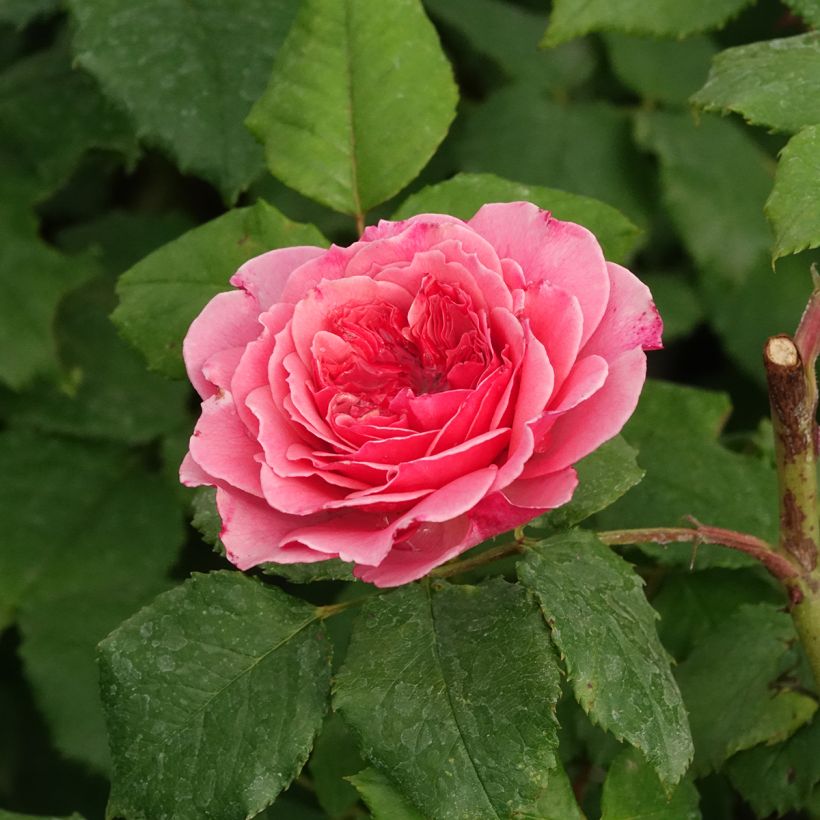

Plant habit
Flowering
Foliage
Botanical data
Rosa
x floribunda
Taste of Love® Theo Clevers® 'Bozkatafra'
Rosaceae
Bozkatafra
Cultivar or hybrid
Planting and care
Plant your 'Theo Clevers' Rose in a sunny position or light shade in a warm climate. Bedding roses are tolerant but won't appreciate excessive limestone or acidity. They adapt to any garden if the soil is well-worked and sufficiently rich. In excessively sandy, compacted, or dry soil in summer, it is preferable to add compost or well-rotted manure to the existing soil when planting. Soak the root ball in a bucket of water for fifteen minutes before planting, then place the rose in the planting hole, backfill around it, and water thoroughly. Then, provide regular watering during the first year, gradually reducing the frequency to encourage the roots to penetrate the soil.
Roses are hungry plants so that a specific fertiliser application will be beneficial at the start of growth and regularly throughout the flowering period. Preferably choose organic fertilisers that are richer in potash (the K in the NPK formula) than nitrogen (the N). As the flowers bloom, remove faded blooms to encourage the development of other buds.
Planting period
Intended location
Care
Planting & care advice
-

-

-

-

-

-

-
-

-
, onOrder confirmed
Reply from on Promesse de fleurs
Recently viewed products
Haven't found what you were looking for?
Hardiness is the lowest winter temperature a plant can endure without suffering serious damage or even dying. However, hardiness is affected by location (a sheltered area, such as a patio), protection (winter cover) and soil type (hardiness is improved by well-drained soil).

The flowering period indicated on our website applies to countries and regions located in USDA zone 8 (France, the United Kingdom, Ireland, the Netherlands, etc.)
It will vary according to where you live:- In zones 9 to 10 (Italy, Spain, Greece, etc.), flowering will occur about 2 to 4 weeks earlier.
- In zones 6 to 7 (Germany, Poland, Slovenia, and lower mountainous regions), flowering will be delayed by 2 to 3 weeks.
- In zone 5 (Central Europe, Scandinavia), blooming will be delayed by 3 to 5 weeks.
In temperate climates, pruning of spring-flowering shrubs (forsythia, spireas, etc.) should be done just after flowering.
Pruning of summer-flowering shrubs (Indian Lilac, Perovskia, etc.) can be done in winter or spring.
In cold regions as well as with frost-sensitive plants, avoid pruning too early when severe frosts may still occur.
The planting period indicated on our website applies to countries and regions located in USDA zone 8 (France, United Kingdom, Ireland, Netherlands).
It will vary according to where you live:
- In Mediterranean zones (Marseille, Madrid, Milan, etc.), autumn and winter are the best planting periods.
- In continental zones (Strasbourg, Munich, Vienna, etc.), delay planting by 2 to 3 weeks in spring and bring it forward by 2 to 4 weeks in autumn.
- In mountainous regions (the Alps, Pyrenees, Carpathians, etc.), it is best to plant in late spring (May-June) or late summer (August-September).
The harvesting period indicated on our website applies to countries and regions in USDA zone 8 (France, England, Ireland, the Netherlands).
In colder areas (Scandinavia, Poland, Austria...) fruit and vegetable harvests are likely to be delayed by 3-4 weeks.
In warmer areas (Italy, Spain, Greece, etc.), harvesting will probably take place earlier, depending on weather conditions.
The sowing periods indicated on our website apply to countries and regions within USDA Zone 8 (France, UK, Ireland, Netherlands).
In colder areas (Scandinavia, Poland, Austria...), delay any outdoor sowing by 3-4 weeks, or sow under glass.
In warmer climes (Italy, Spain, Greece, etc.), bring outdoor sowing forward by a few weeks.
Shipping country and language
Your country of residence may be:
Your country of residence is:
For a better user experience on our website, you can select:
Your shipping country:
-
 Austria
-
 Belgium
-
 Bosnia & Herzegovina
-
 Bulgaria
-
 Croatia
-
 Cyprus
-
 Czechia
-
 Denmark
-
 Estonia
-
 Finland
-
 France
-
 Germany
-
 Greece
-
 Hungary
-
 Iceland
-
 Ireland
-
 Italy
Italy
-
 Latvia
-
 Liechtenstein
-
 Lithuania
-
 Luxembourg
-
 Malta
Malta
-
 Netherlands
-
 Poland
-
 Portugal
-
 Romania
-
 Serbia
-
 Slovakia
-
 Slovenia
-
 Spain
Spain
-
 Sweden
-
 Switzerland
Language:
-
French
-
 English
-
Spanish
-
Italian
-
German
-
Portuguese
-
Dutch
-
Finnish
My Account
Hello
My wish lists
My cart
Log in / Register
Existing customer?
This form is protected by reCAPTCHA - the Google Privacy Policy and Terms of Service apply.
New customer?
Create an account to track your orders, access our customer service and, if you wish, make the most of our upcoming offers.