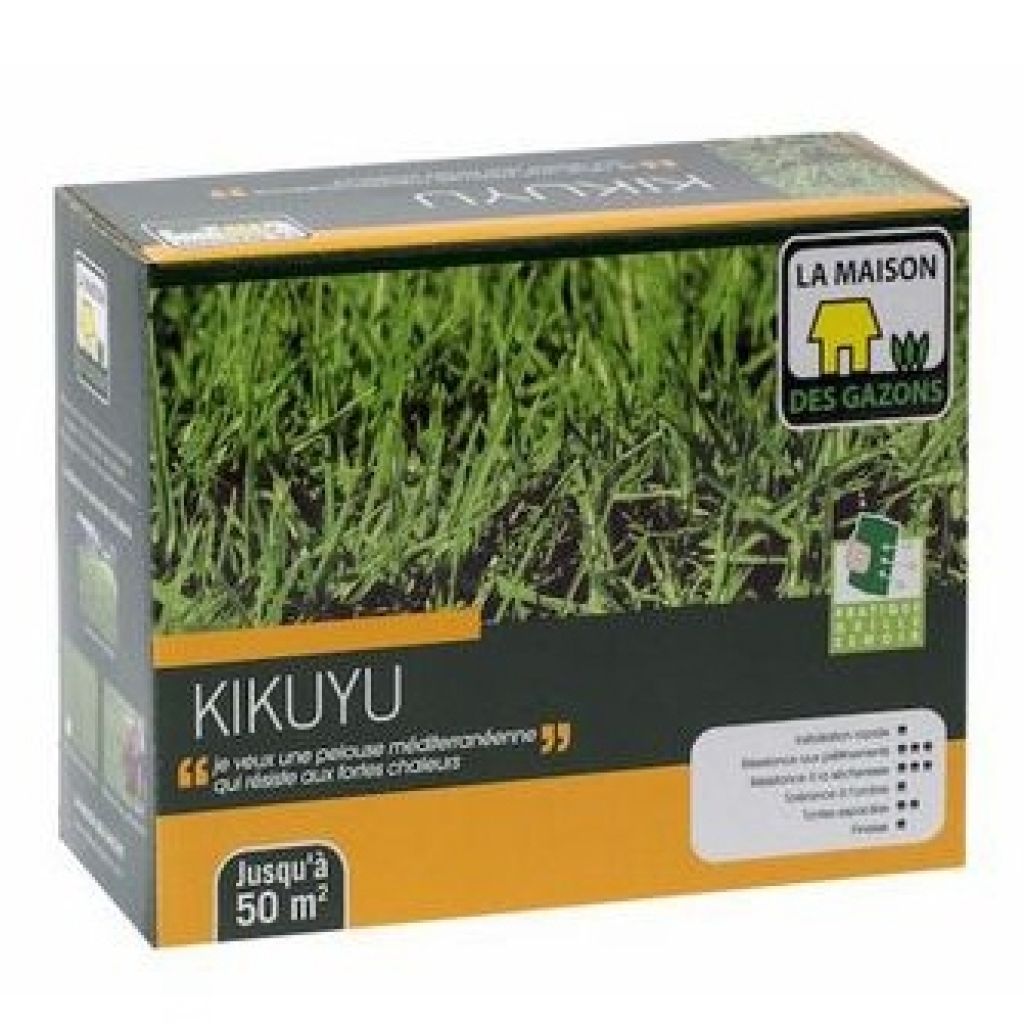
Pennisetum clandestinum
Pennisetum clandestinum
Pennisetum clandestinum
Kikuyu Grass, Kikuyu-grass, Kikuyu, Couch Grass
Thank you to the individuals (Laurent for order preparation and Manon from the shipping department). Just to let you know, the seeds of Kikuyu grass are in an airtight bag, inside the box.
Thierry, 15/09/2021
Back-to-school special offer!
Get €10 off for every €50 you spend! And get up to €40 off on a single order.
How does it work?
1. Shop your favourites
Add your favourite plants to your basket. For every €50 you spend (excluding delivery charges, store credit and the plastic-free option), you’ll receive a €10 voucher.
€50 spent = €10 voucher
€100 spent = €20 voucher
€150 spent = €30 voucher
€200 spent = €40 voucher
2. Place your order
Once your basket reaches one of the spending thresholds, place your order. You can even choose your delivery date!
3. Receive your voucher
As soon as your order has been shipped, you’ll receive an email containing your personal voucher code and its value.
4. Use it on your next order
Your voucher is valid for 90 days from the date you receive it. It can be used once only, on a new order worth at least the value of the voucher, excluding delivery charges.
Please note: Vouchers can be combined with other offers, but cannot be split or refunded.
Home or relay delivery (depending on size and destination)
Important: You may be charged customs duties by your country’s customs authorities upon delivery.
Schedule delivery date,
and select date in basket
This plant carries a 6 months recovery warranty
More information
We guarantee the quality of our plants for a full growing cycle, and will replace at our expense any plant that fails to recover under normal climatic and planting conditions.

Would this plant suit my garden?
Set up your Plantfit profile →
Description
Kikuyu, in Latin Pennisetum clandestinum, is an evergreen grass of subtropical origin used as an alternative to turf in regions unaffected by heavy frosts. It has broad and hairy foliage and forms a dense, greasy-looking carpet that withstands trampling and drought if not too prolonged. The plant is sensitive to heavy frosts and its foliage may turn yellow in winter in the case of persistent frost. This grass, which tolerates salt spray, will work wonders on the Atlantic coast of our country, or in slightly watered gardens in the Midi. The seeds are sown in spring after frosts, in the sun, in a rather rich and well-prepared soil, preferably not too chalky.
Pennisetum clandestinum belongs to the large family of Poaceae, it is a perennial grass native to Central Africa frequently used in green spaces in Mediterranean climates, as it appreciates heat and has relatively low frost resistance. Kikuyu takes a little time to establish, but it has long trailing rhizomes that can quickly colonize the area once well established. Its foliage consists of fairly wide leaves, covered in hair and of a bright green colour. If not mowed, it forms a carpet 30 to 60cm (12 to 24in) high, which persists in mild winters. This plant adapts to dry summers: a lack of water slows down its growth, greatly reducing the number of mowing required in summer. By reducing water inputs, it is possible to maintain the carpet at an average height of 8 to 15cm (3 to 6in). It is advisable not to mow a Kikuyu lawn too often or too short. It can be mixed with semi-trailing fescue seeds for faster establishment.
Composition:
- 100% Pennisetum clandestinum
Usage and dosage:
- Sowing rate: 10 to 15g/m2
In our driest regions, watering once a week can be beneficial to maintain a vibrant green colour in the Kikuyu lawn. The plantation should be regularly watered and cleared of "weeds" during the establishment period. Once established, the plant can become invasive in hot and humid climates. Ideal for small city gardens, kikuyu is useful for covering slopes, effectively stabilizing the soil and limiting erosion phenomena.
Report an error about the product description
Flowering
Foliage
Plant habit
Botanical data
Pennisetum
clandestinum
Poaceae
Kikuyu Grass, Kikuyu-grass, Kikuyu, Couch Grass
Cultivar or hybrid
Planting and care
Sowing:
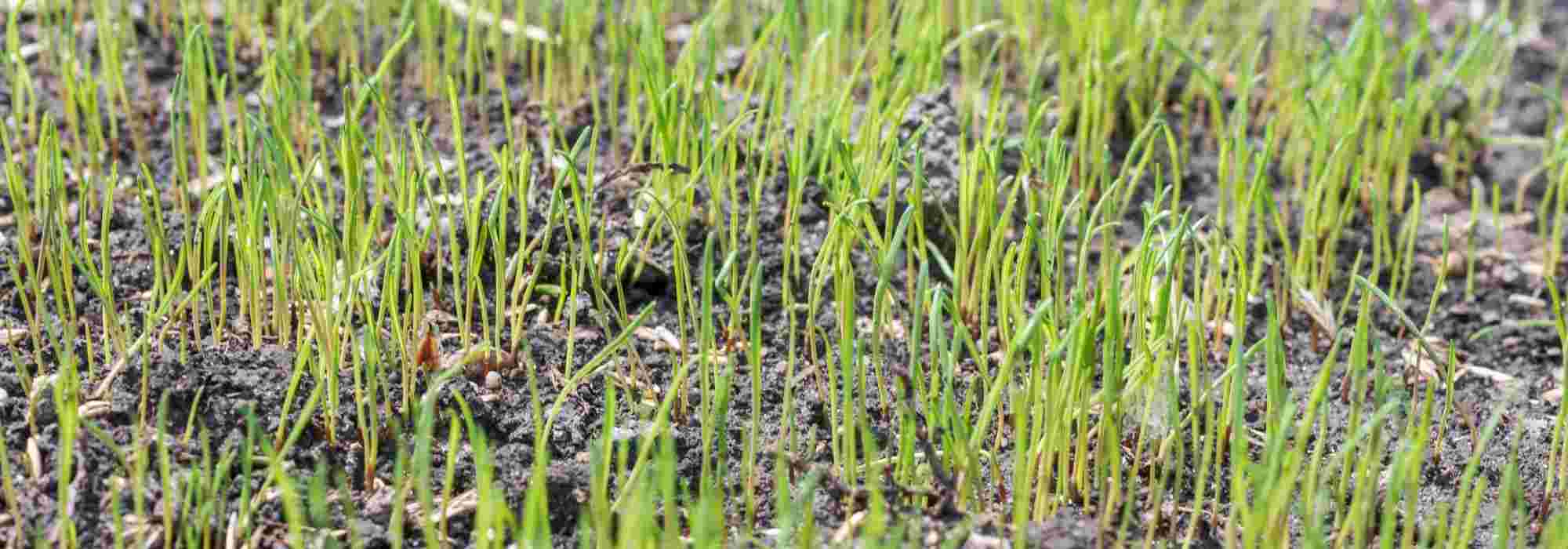
Sow directly in place in full sun, in April-May, after the frost, in a well-cultivated soil, free from weeds, refined and raked. Sow by broadcasting on the surface of the soil and lightly rake to cover the seeds. Optionally, pass the roller to ensure good adhesion of the seeds to the soil. Regularly water with a fine rain to keep the soil slightly moist until germination if it doesn't rain. Regularly water and remove "weeds" during the first months, until the plants establish themselves.
Kikuyu prefers fertile and slightly acidic to neutral soils, but it adapts well to slightly calcareous soil. In sandy and poor soils, it is necessary to add some topsoil, potting soil or compost and regularly provide lawn fertilizer in spring.
Once well established, Kikuyu will be satisfied with rainwater. In our driest and hottest regions, watering once a week in summer (15 litres of water/m²) will keep the foliage green. Lack of water slows down the growth of this grass, resulting in less mowing. The foliage often turns yellow as soon as the soil cools too much, in November-December, and then turns green again in April. The plant dies below -10°C (14°F).
Dosage:
- sow 10-15g/m²;
Sowing period
Intended location
Planting & care advice
-
-

-

-
-

-

-

-
-
, onOrder confirmed
Reply from on Promesse de fleurs
Recently viewed products
Haven't found what you were looking for?
Hardiness is the lowest winter temperature a plant can endure without suffering serious damage or even dying. However, hardiness is affected by location (a sheltered area, such as a patio), protection (winter cover) and soil type (hardiness is improved by well-drained soil).

The flowering period indicated on our website applies to countries and regions located in USDA zone 8 (France, the United Kingdom, Ireland, the Netherlands, etc.)
It will vary according to where you live:- In zones 9 to 10 (Italy, Spain, Greece, etc.), flowering will occur about 2 to 4 weeks earlier.
- In zones 6 to 7 (Germany, Poland, Slovenia, and lower mountainous regions), flowering will be delayed by 2 to 3 weeks.
- In zone 5 (Central Europe, Scandinavia), blooming will be delayed by 3 to 5 weeks.
In temperate climates, pruning of spring-flowering shrubs (forsythia, spireas, etc.) should be done just after flowering.
Pruning of summer-flowering shrubs (Indian Lilac, Perovskia, etc.) can be done in winter or spring.
In cold regions as well as with frost-sensitive plants, avoid pruning too early when severe frosts may still occur.
The planting period indicated on our website applies to countries and regions located in USDA zone 8 (France, United Kingdom, Ireland, Netherlands).
It will vary according to where you live:
- In Mediterranean zones (Marseille, Madrid, Milan, etc.), autumn and winter are the best planting periods.
- In continental zones (Strasbourg, Munich, Vienna, etc.), delay planting by 2 to 3 weeks in spring and bring it forward by 2 to 4 weeks in autumn.
- In mountainous regions (the Alps, Pyrenees, Carpathians, etc.), it is best to plant in late spring (May-June) or late summer (August-September).
The harvesting period indicated on our website applies to countries and regions in USDA zone 8 (France, England, Ireland, the Netherlands).
In colder areas (Scandinavia, Poland, Austria...) fruit and vegetable harvests are likely to be delayed by 3-4 weeks.
In warmer areas (Italy, Spain, Greece, etc.), harvesting will probably take place earlier, depending on weather conditions.
The sowing periods indicated on our website apply to countries and regions within USDA Zone 8 (France, UK, Ireland, Netherlands).
In colder areas (Scandinavia, Poland, Austria...), delay any outdoor sowing by 3-4 weeks, or sow under glass.
In warmer climes (Italy, Spain, Greece, etc.), bring outdoor sowing forward by a few weeks.
Shipping country and language
Your country of residence may be:
Your country of residence is:
For a better user experience on our website, you can select:
Your shipping country:
-
 Austria
-
 Belgium
-
 Bosnia & Herzegovina
-
 Bulgaria
-
 Croatia
-
 Cyprus
-
 Czechia
-
 Denmark
-
 Estonia
-
 Finland
-
 France
-
 Germany
-
 Greece
-
 Hungary
-
 Iceland
-
 Ireland
-
 Italy
Italy
-
 Latvia
-
 Liechtenstein
-
 Lithuania
-
 Luxembourg
-
 Malta
Malta
-
 Netherlands
-
 Poland
-
 Portugal
-
 Romania
-
 Serbia
-
 Slovakia
-
 Slovenia
-
 Spain
Spain
-
 Sweden
-
 Switzerland
Language:
-
French
-
 English
-
Spanish
-
Italian
-
German
-
Portuguese
-
Dutch
-
Finnish
My Account
Hello
My wish lists
My cart
Log in / Register
Existing customer?
This form is protected by reCAPTCHA - the Google Privacy Policy and Terms of Service apply.
New customer?
Create an account to track your orders, access our customer service and, if you wish, make the most of our upcoming offers.