Cupressocyparis leylandii Atro - Leyland cypress
Cupressocyparis leylandii Atro - Leyland cypress
Cupressocyparis leylandii Atro
Leyland cypress
Back-to-school special offer!
Get €10 off for every €50 you spend! And get up to €40 off on a single order.
How does it work?
1. Shop your favourites
Add your favourite plants to your basket. For every €50 you spend (excluding delivery charges, store credit and the plastic-free option), you’ll receive a €10 voucher.
€50 spent = €10 voucher
€100 spent = €20 voucher
€150 spent = €30 voucher
€200 spent = €40 voucher
2. Place your order
Once your basket reaches one of the spending thresholds, place your order. You can even choose your delivery date!
3. Receive your voucher
As soon as your order has been shipped, you’ll receive an email containing your personal voucher code and its value.
4. Use it on your next order
Your voucher is valid for 90 days from the date you receive it. It can be used once only, on a new order worth at least the value of the voucher, excluding delivery charges.
Please note: Vouchers can be combined with other offers, but cannot be split or refunded.
Home or relay delivery (depending on size and destination)
Important: You may be charged customs duties by your country’s customs authorities upon delivery.
Schedule delivery date,
and select date in basket
This plant carries a 24 months recovery warranty
More information
We guarantee the quality of our plants for a full growing cycle, and will replace at our expense any plant that fails to recover under normal climatic and planting conditions.
Would this plant suit my garden?
Set up your Plantfit profile →
Description
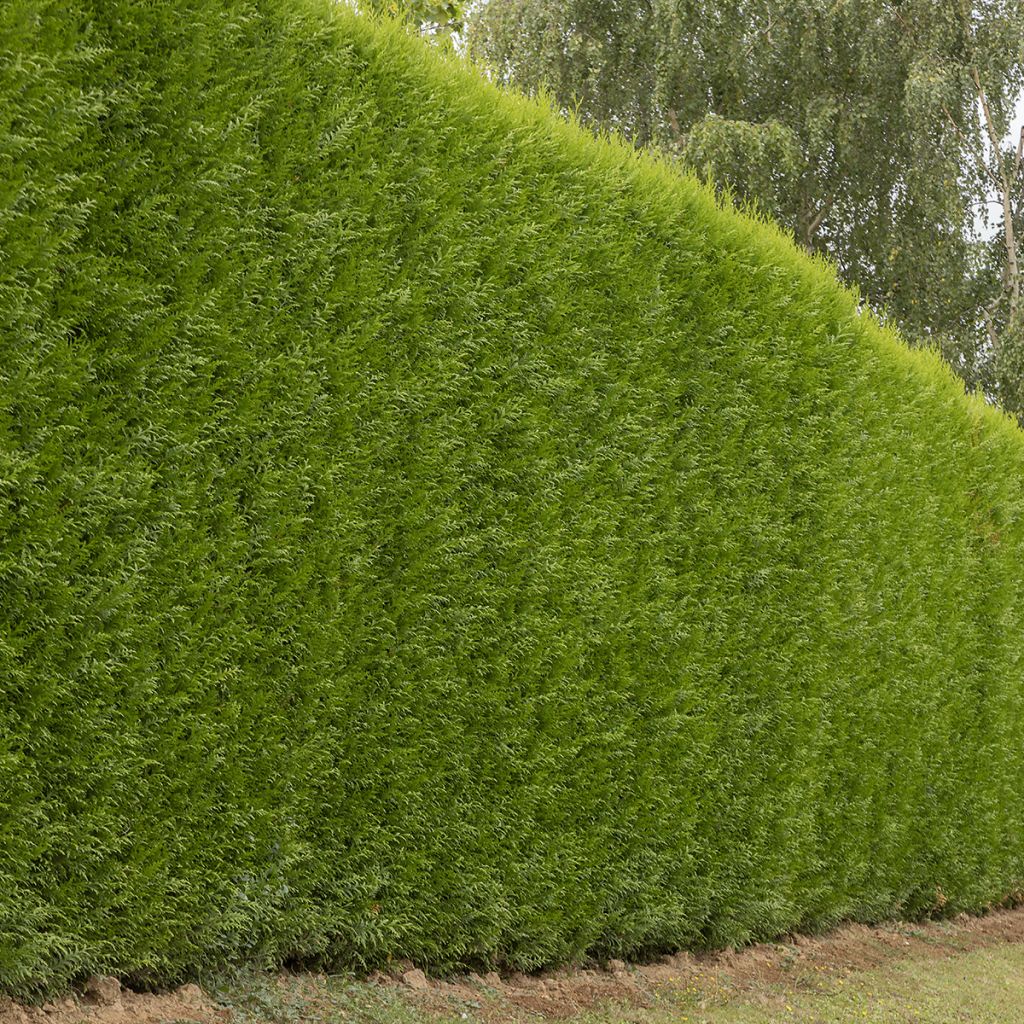
Chamaecyparis x leylandii ‘Atro’ is a variety of Leyland cypress that stands out for its very fast growth and narrower, more compact habit, requiring less pruning than the type species. It is a large columnar conifer with very fine, dense evergreen foliage in a beautiful matt medium green, forming thick, robust screening hedges in no time at all! It is also used for avenues or as a specimen to give a more permanent and refined structure to the garden. This hardy conifer is undemanding. Nevertheless, it appreciates a sunny position and moist, fertile, deep but well-drained soils.
Cupressocyparis leylandii is a spontaneous hybrid between Cupressus macrocarpa, the Lambert cypress or Monterey cypress, native to the forests bordering the central Californian coast, and Chamaecyparis nootkatensis, the Nootka false-cypress, native to the northern part of the west coast of North America. These two, large, hardy conifers are accommodating with regard to soil, and prefer rather humid climates. Both belong to the Cupressaceae family.
The variety ‘Atro’ is a very beautiful form of this species that reaches a mature size of 25m tall with a 5m spread. From a young age, it shows a columnar habit much narrower, denser and more compact than that of the type species, supported by upright branches emerging from the base of the trunk. Its thin, flattened branches are densely covered with leaves in fine, scaly branchlets of a matt medium green.
Its growth is very fast once established. Regular pruning (1 to 2 times a year) will obviously be necessary if you want to keep it at 2 or 3 m in height in a conventional hedge. This conifer naturally displays a columnar, very elegant habit, resembling a Thuja. Its flexible, upright branches are clothed in foliage that appears rather coarse when observed up close, aromatic when crushed. Its scent is slightly acidic. Its small, blunt, triangular, deep green leaves are overlapping on short cylindrical branchlets, which are themselves set on branches. This conifer produces pollen in early spring, which can be allergenic for some people. The globose, green female cones turn brown at maturity. The reddish-brown bark becomes greyish with age. The root system of this tree is a taproot, allowing it to anchor very deeply in the soil to draw water and nutrients and resist wind. Its hardiness is very good, around -15/-20°C. But its branches will not hold the weight of snow, which can permanently deform it!
The Leyland cypress is perfect in a large non-boundary hedge, preferably unpruned, whose role is to shelter the garden, for example, at the edges of the countryside. In this use, it will relieve the gardener of repeated pruning. A boon for urban or very windy coastal gardens, widely planted in housing estates, this cypress ensures permanent decoration all year round while perfectly fulfilling its role as a privacy screen. It provides structure when placed as a specimen or in groups of 3, and can replace the Provence cypress in large gardens. Like many conifers, it integrates into gardens of all styles, contemporary, wild, romantic or English. Also, try composing an evergreen and varied hedge by associating it with, for example, Elaeagnus ebbingei, Photinia Red Robin, Hicksii hybrid yew, holly, Japanese spindle, or Griselinia littoralis, Olearia traversii, strawberry trees and holm oaks in climates that are not too cold.
Report an error about the product description
Plant habit
Flowering
Foliage
Botanical data
Cupressocyparis
leylandii
Atro
Cupressaceae
Leyland cypress
Cultivar or hybrid
Planting and care
Plant Leyland cypress in a sunny position in ordinary but well-prepared and deep soil, as its taproot will need to go down to find water and ensure a good anchorage for its tall stature. Choose its location carefully, as this large main taproot does not like being disturbed or broken. This conifer does not need to be staked at planting. If it is very exposed to wind, it would be preferable to guy it while it establishes.
Trees planted as specimens naturally develop a beautiful silhouette, which should not be disturbed by pruning. On the other hand, those used for hedging can be pruned regularly, but sparingly, applying a wound sealant to the largest cuts. Remember that cypresses dislike pruning, which makes them susceptible to diseases. A specimen planted in rich, moist soil will naturally be more resistant to diseases and pests, especially if it is pruned only lightly.
This conifer can be susceptible to cortical canker (a pathogenic fungus), especially if it is subjected to repeated pruning. Its most common pests are red spider mites, aphids, scale insects, bark beetles and jewel beetles, which are virulent in hot, dry weather; it is advisable to spray the foliage in hot, dry weather to prevent the proliferation of mites.
Planting period
Intended location
Care
Planting & care advice
-
-
-

-
-
-
-

-

This item has not been reviewed yet - be the first to leave a review about it.
Recently viewed products
Haven't found what you were looking for?
Hardiness is the lowest winter temperature a plant can endure without suffering serious damage or even dying. However, hardiness is affected by location (a sheltered area, such as a patio), protection (winter cover) and soil type (hardiness is improved by well-drained soil).

The flowering period indicated on our website applies to countries and regions located in USDA zone 8 (France, the United Kingdom, Ireland, the Netherlands, etc.)
It will vary according to where you live:- In zones 9 to 10 (Italy, Spain, Greece, etc.), flowering will occur about 2 to 4 weeks earlier.
- In zones 6 to 7 (Germany, Poland, Slovenia, and lower mountainous regions), flowering will be delayed by 2 to 3 weeks.
- In zone 5 (Central Europe, Scandinavia), blooming will be delayed by 3 to 5 weeks.
In temperate climates, pruning of spring-flowering shrubs (forsythia, spireas, etc.) should be done just after flowering.
Pruning of summer-flowering shrubs (Indian Lilac, Perovskia, etc.) can be done in winter or spring.
In cold regions as well as with frost-sensitive plants, avoid pruning too early when severe frosts may still occur.
The planting period indicated on our website applies to countries and regions located in USDA zone 8 (France, United Kingdom, Ireland, Netherlands).
It will vary according to where you live:
- In Mediterranean zones (Marseille, Madrid, Milan, etc.), autumn and winter are the best planting periods.
- In continental zones (Strasbourg, Munich, Vienna, etc.), delay planting by 2 to 3 weeks in spring and bring it forward by 2 to 4 weeks in autumn.
- In mountainous regions (the Alps, Pyrenees, Carpathians, etc.), it is best to plant in late spring (May-June) or late summer (August-September).
The harvesting period indicated on our website applies to countries and regions in USDA zone 8 (France, England, Ireland, the Netherlands).
In colder areas (Scandinavia, Poland, Austria...) fruit and vegetable harvests are likely to be delayed by 3-4 weeks.
In warmer areas (Italy, Spain, Greece, etc.), harvesting will probably take place earlier, depending on weather conditions.
The sowing periods indicated on our website apply to countries and regions within USDA Zone 8 (France, UK, Ireland, Netherlands).
In colder areas (Scandinavia, Poland, Austria...), delay any outdoor sowing by 3-4 weeks, or sow under glass.
In warmer climes (Italy, Spain, Greece, etc.), bring outdoor sowing forward by a few weeks.
Shipping country and language
Your country of residence may be:
Your country of residence is:
For a better user experience on our website, you can select:
Your shipping country:
-
 Austria
-
 Belgium
-
 Bosnia & Herzegovina
-
 Bulgaria
-
 Croatia
-
 Cyprus
-
 Czechia
-
 Denmark
-
 Estonia
-
 Finland
-
 France
-
 Germany
-
 Greece
-
 Hungary
-
 Iceland
-
 Ireland
-
 Italy
Italy
-
 Latvia
-
 Liechtenstein
-
 Lithuania
-
 Luxembourg
-
 Malta
Malta
-
 Netherlands
-
 Poland
-
 Portugal
-
 Romania
-
 Serbia
-
 Slovakia
-
 Slovenia
-
 Spain
Spain
-
 Sweden
-
 Switzerland
Language:
-
French
-
 English
-
Spanish
-
Italian
-
German
-
Portuguese
-
Dutch
-
Finnish
My Account
Hello
My wish lists
My cart
Log in / Register
Existing customer?
This form is protected by reCAPTCHA - the Google Privacy Policy and Terms of Service apply.
New customer?
Create an account to track your orders, access our customer service and, if you wish, make the most of our upcoming offers.