Shrubs with berries and fruit that remain decorative throughout winter
Ornamental berries: species that really last all winter
Contents
We love shrubs that hold on to their berries well into winter, such as holly, a shrub inseparable from cold weather in the garden and the festive season. If its red berries remain on the shrub for many months, this is not the case for all berry-producing plants or those with decorative small fruits, which often end up in the birds’ larder as early as autumn. Shimmering in a thousand colours, yellow, orange, red or blue, here are the small winter berries that cling firmly to the branches until February, brightening up the bare garden for our greatest pleasure!
The essentials
|
Read also
The Winter gardenHollies
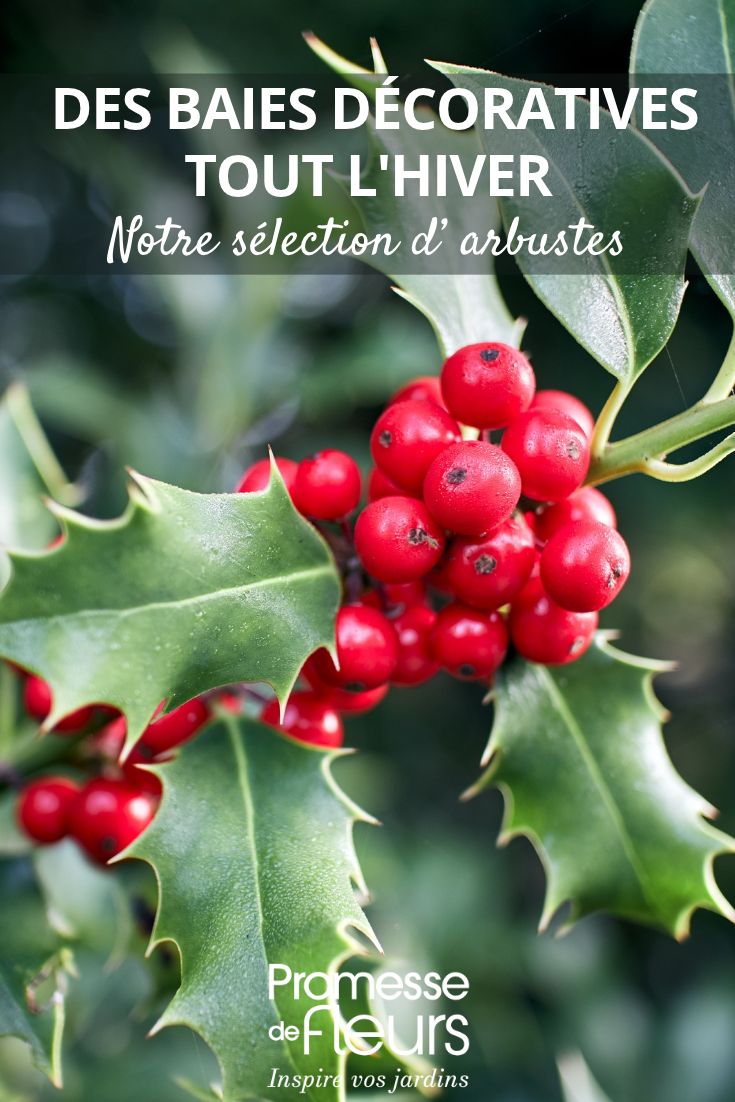
Hollies are the shrubs that keep their berries firmly attached to their branches for the longest, in the axils of the leaves, very often until early spring.
We are really talking about hollies in the plural here, as there are so many distinct species, including some with variegated foliage margined in white or cream, some with non-prickly foliage, and others with particularly decorative fruits. Birds relish them, especially blackbirds. True harbingers of Christmas, hollies are actually already bearing fruit in October for some varieties and species.
Their growth is slow, but they eventually reach 4 to 6 m in height, even in difficult conditions, and their excellent hardiness makes them suitable for almost every region of France.
Among the interesting species, Ilex paraguariensis keeps its dark red drupes later into the season, as they reach maturity slightly later. On Ilex verticillata (pictured), the berries gradually turn a very dark red, almost purple. Some hollies also stand out for their berries, which are orange rather than red, notably on Ilex verticillata ‘Magical Daydream’.
The essential point to know is that holly is dioecious. Only female plants bear berries, provided that a male plant flowers nearby!
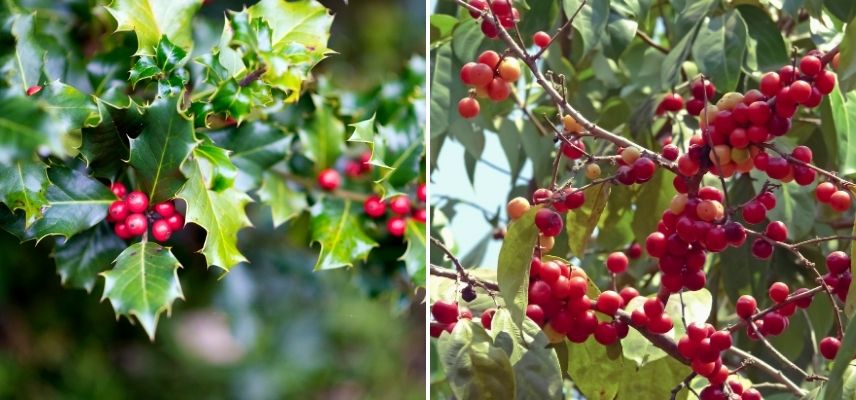
Ilex aquifolium and Ilex verticillata
Gaultheria
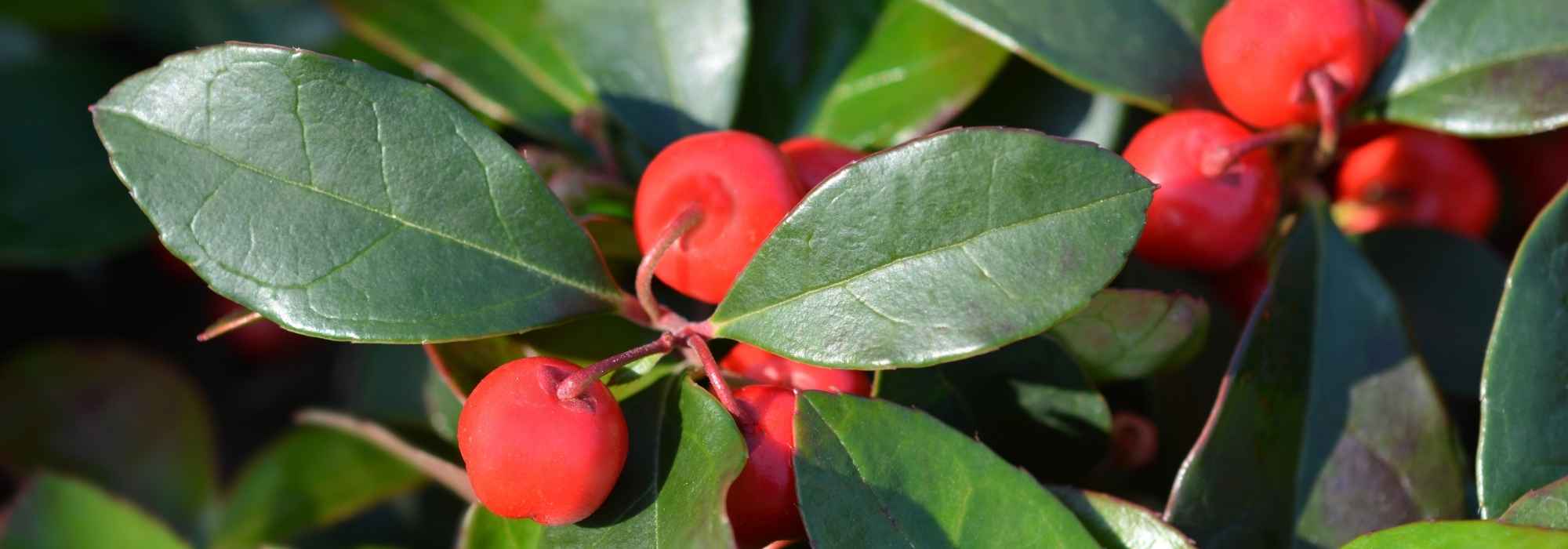
Second star of winter, gaultheria, also often called pernettya, is another of the shrubs valued for its bright red berries, which remain on the plant for a long time. Gaultheria is also often seen at florists’ around Christmas, used in floral arrangements for window boxes or as a table centrepiece. This shrub belongs to the Ericaceae family, like heathers, and its flowering is a typical example, with delightful little white bells.
The small, perfectly round fruits, like sweets, are among the longest-lasting fruit displays in the winter garden. Depending on the variety, they are most often red or white, or even bicoloured, as with ‘Color Surprise‘. They remain until spring without losing their brilliance.
There are three main species of this small shrub: Gaultheria procumbens, creeping and flowering from the end of summer, checkerberry (Gaultheria procumbens), a low-growing plant (0.15 to 0.20 m), and Gaultheria mucronata, the most common species. All are ideal for edging, a shaded bed or a winter container display.
Growing gaultheria requires ericaceous compost that is moist, acidic and humus-rich: in chalky soil, the foliage turns yellow and the plant declines. Pernettyas are dioecious: as with holly, a male plant must be planted close to the female plants to produce berries, with approximately one male for every four or five females. Checkerberry, on the other hand, only needs acidic soil well amended with organic matter to fruit generously.
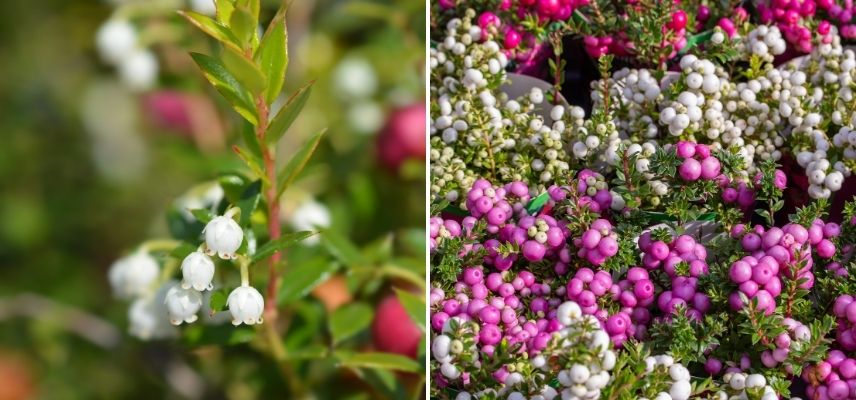
Gaultheria
Winter Mahonias
It is after their divine, fragrant yellow flowering between November and February, depending on the species and cultivars, that winter mahonias produce clusters of green berries in long spikes, which gradually turn blue. They are so numerous on Mahonia japonica that they look like little berries. On this species, as well as on Mahonia bealei, the fruits appear later than on the well-known hybrid, Mahonia x media ‘Charity’.
These charming little fruits in the heart of winter remain attached for a long time, allowing the garden’s various birds plenty of time to feast on them. Although they are neither red nor shiny like most of the berries that adorn the garden in winter, we love the pruinose coating, that bluish layer which gives them a highly original and distinctive appearance.
Mahonia is a remarkably tolerant partial-shade shrub: once established, it tolerates drought and dry soils, and its prickly foliage retains its colour all year round. Mahonia x media can reach up to 3 m in height.
N.B.: all mahonias produce these little fruits, although they will be black on thornless mahonias, which flower earlier in the season, in autumn. Oregon grape, which flowers at the end of winter, produces its fruits much earlier in the year, in May.
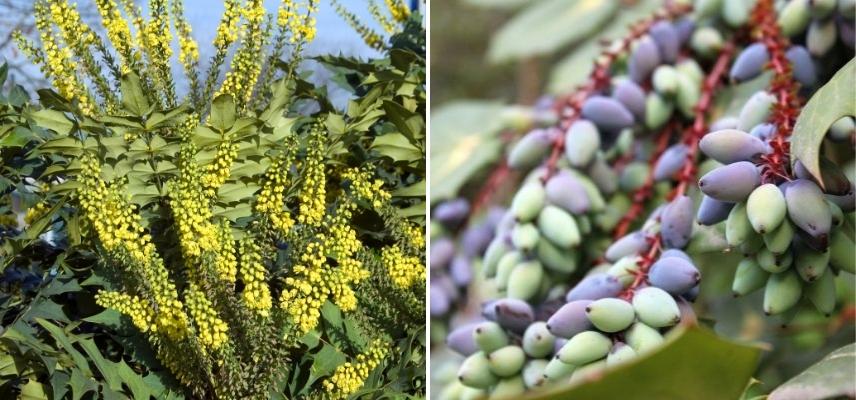
Mahonia ‘Winter Sun’ in bright yellow flower, with green then blue fruiting on Mahonia bealei.
Nandina domestica, or heavenly bamboo
Heavenly bamboo, known to everyone as sacred bamboo, bears clusters of particularly glossy bright red berries that remain until spring, on foliage that turns purple in cold weather. The very loose summer flowering, in large cream panicles, has transformed by autumn into clusters of red fruit.
Some varieties or species less well known than Nandina domestica bear white or yellow fruit. For heavenly bamboo to produce fruit, make sure you have two plants, male and female, growing side by side, as it is also a dioecious shrub. Only hermaphrodite varieties such as ‘Richmond’ can produce fruit without another Nandina nearby.
This is one of the longest-lasting displays of fruit in the garden during winter, persisting until spring and creating a particularly interesting colour effect when the coloured young shoots of early spring harmonise with the fruit still on the plant.
It is hardy to around -10 to -12 °C, which means it must be planted in a sheltered position in cold regions, or grown in a pot and brought indoors during severe frosts. It prefers rich, moisture-retentive soil and a sunny or lightly shaded position.
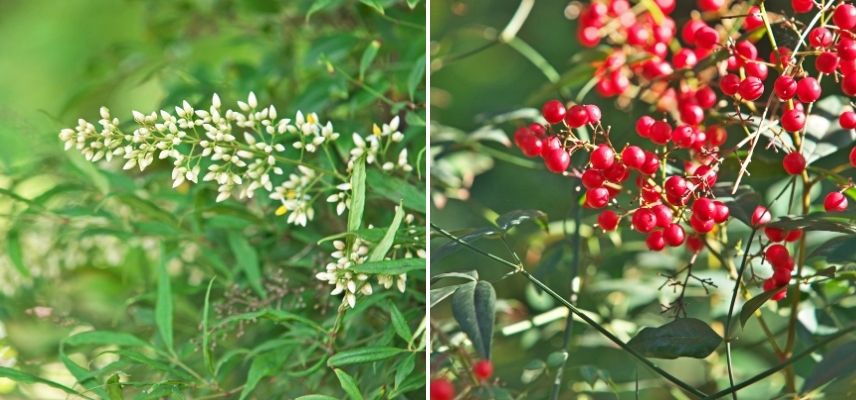
Nandina domestica: flowering and bright red berries in the depths of winter.
Stinking iris
Here at last is a perennial plant with a remarkable character: this Iris foetidissima, as it is known by its Latin name, slowly but surely transforms its flowering into orange-red seeds that persist for a very long time, enclosed in the dried capsule. This unusual feature is what makes it so interesting, as some people find its flowering rather ordinary and inconspicuous. But look closely: the flower is remarkably delicate, in pastel shades, and above all, stinking iris grows very well in partial shade, at the edge of woodland and even in dry shade. It simply takes a little time to settle in, so be patient if you want to see the winter surprise it promises! Planted en masse or in groups, the sight of its little red seeds will delight you until January.
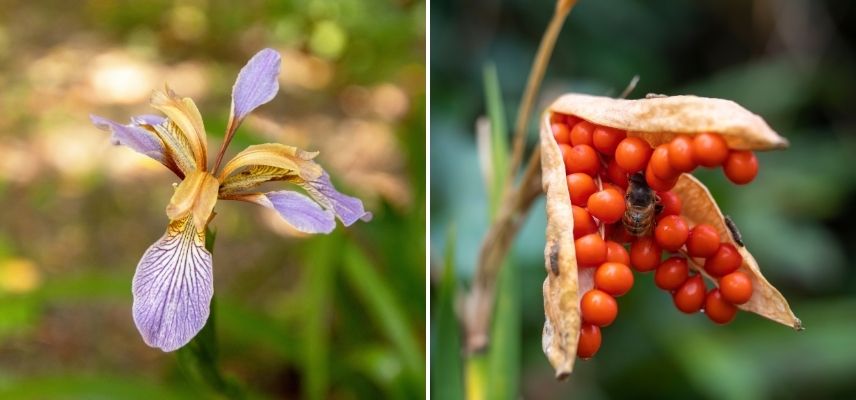
Iris foetidissima
Other interesting berries found in autumn
Alas, alas! Much to our dismay, these shrubs turn red for a while in autumn, often in October, but birds eagerly seek them out when they are plentiful in the garden… They eventually gorge themselves on them until they can eat no more. Generally, there may sometimes be none left as early as November, depending on the number of birds or small mammals living in the garden.
They are nevertheless very beautiful shrubs that bring autumn colour to the garden, such as barberries (often bearing fruit until November), pyracantha, whose small fruits brighten up autumn, crab apples (Malus), David viburnum and guelder rose, and angelica tree, covered with fruit in September-October, dog roses (Rosa canina and rosa rugosa), hawthorns (Crataegus orientalis and Crataegus azarolus), blackthorn, Sorbus, beautyberry and so on.
Sea buckthorn fares rather well, with its clusters of small orange berries, tightly packed along the branches and lasting longer into winter. Its berries are not easy to pick, however, as the shrub is very thorny. The white berries of snowberry (Symphoricarpos) can last until January or even longer, but this depends greatly on its position and the growing region. Cotoneaster also remains, depending on the region, bright red throughout all or much of the winter.
It is worth noting that laurustinus takes over from the middle of winter in some regions, such as north of the Loire, offering its metallic blue berries after its white flowering.
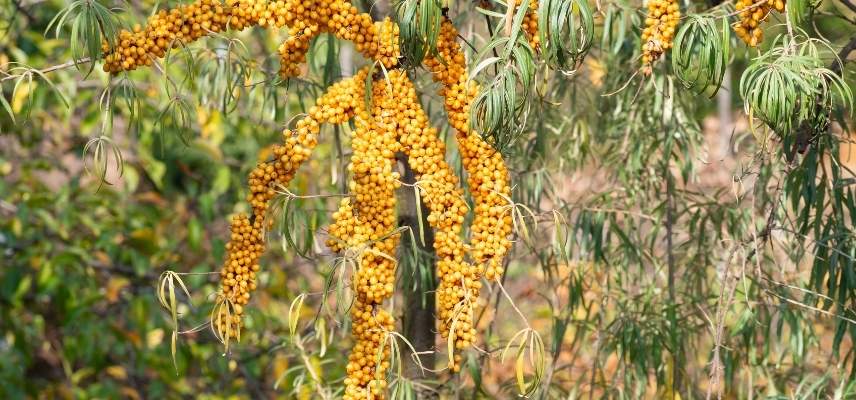
Hippophae rhamnoides
Do you like fruiting plants in the garden? Discover our selection of shrubs with ornamental fruit! You can also read our articles on plants that offer at least one additional feature through their flowering or foliage: 9 trees with ornamental fruit; 8 viburnums with ornamental fruit; 10 little-known edible berries; 6 climbing plants with ornamental fruit; 7 euonymus with ornamental fruit.
Frequently asked questions
Decorative berries and birds: how can you have both?
Not easy when there are plenty of birds in the countryside… The solution is to choose species with staggered fruiting periods: the berries richest in lipids (pyracantha, rowan, guelder rose) are eaten from autumn onwards, while firmer berries (holly, gaultheria, snowberry) last until the end of winter, when birds have no other choice. Plant at least two or three species rather than a single specimen, and accept that the berries will eventually be eaten: a shrub that still has all its berries in spring is rarely a sign of success. It is more likely to indicate a lack of biodiversity.
Can decorative berries be kept on a balcony?
Yes, with creeping gaultheria (Gaultheria procumbens) in a low pot, pernettya in a container filled with acid-loving compost, or nandina in a pot in mild regions. Choose a pot that is deep enough, provide good drainage and reduce winter watering while keeping it regular: in a pot, the compost freezes more quickly than in the open ground.
Why have my berries not lasted as long this year?
The persistence of berries and small fruits on shrubs varies from one winter to the next. It depends on the local climate and the warmth of the previous summer: a sunny summer encourages abundant flowering, followed by plentiful, firm fruit, while a cooler summer produces fewer berries, sometimes with less vigour. The birds’ appetite also varies from one year to the next, as does the severity of the winter: repeated frosts or waterlogged soil damage the fruits more quickly. The berries’ varying persistence simply reflects the conditions of the season that has passed.
- Subscribe!
- Contents
This form is protected by reCAPTCHA - the Google Privacy Policy and Terms of Service apply.

































Comments