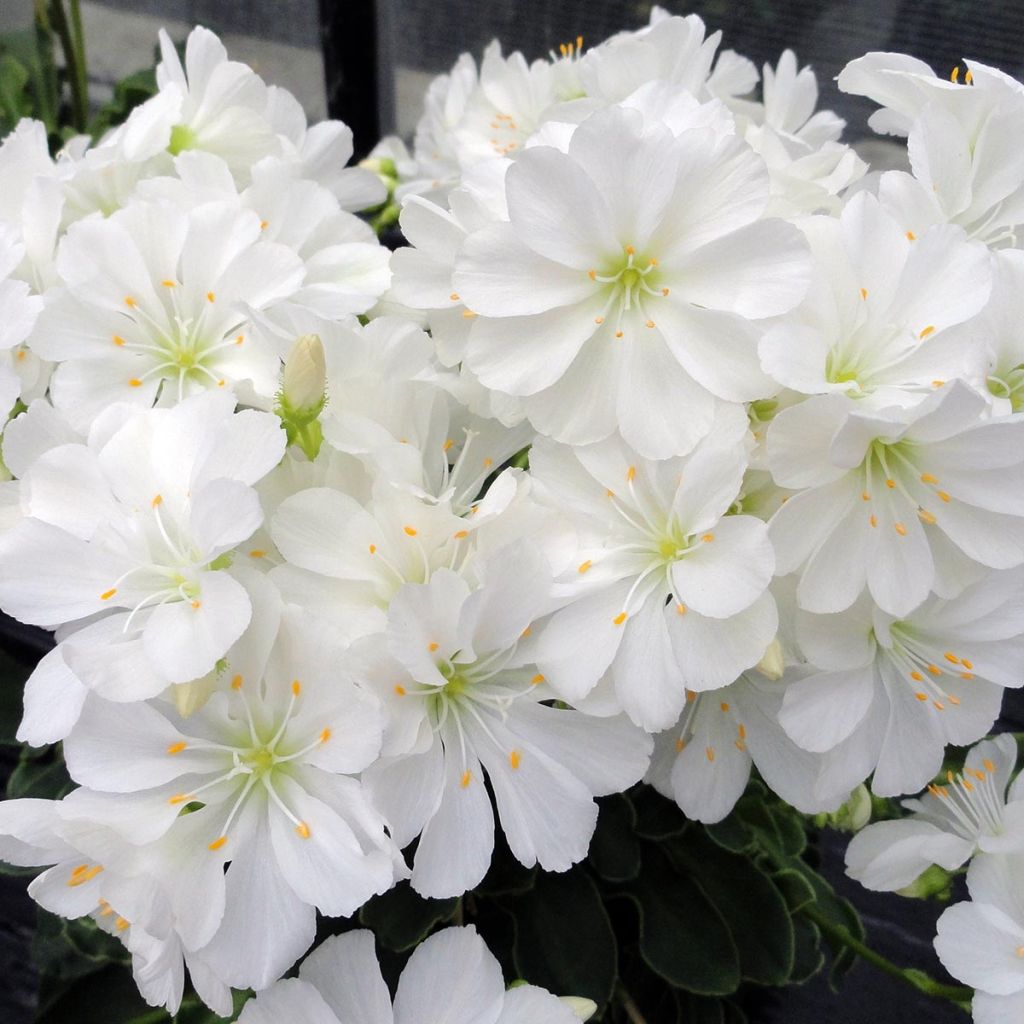
Lewisia cotyledon Elise White
Lewisia cotyledon Elise White
Lewisia cotyledon Elise White
Siskiyou Lewisia, Cliff Maids
The plug plants were potted on as soon as they arrived, and the young plants were planted out, some in November and others in March, all in a sunny position with fairly dry, well-drained soil. Out of the six I had, all died except one, which gave me a few flowers before it also bowed out. I won't persist and will turn to other flowers instead.
Julie, 22/04/2025
Back-to-school special offer!
Get €10 off for every €50 you spend! And get up to €40 off on a single order.
How does it work?
1. Shop your favourites
Add your favourite plants to your basket. For every €50 you spend (excluding delivery charges, store credit and the plastic-free option), you’ll receive a €10 voucher.
€50 spent = €10 voucher
€100 spent = €20 voucher
€150 spent = €30 voucher
€200 spent = €40 voucher
2. Place your order
Once your basket reaches one of the spending thresholds, place your order. You can even choose your delivery date!
3. Receive your voucher
As soon as your order has been shipped, you’ll receive an email containing your personal voucher code and its value.
4. Use it on your next order
Your voucher is valid for 90 days from the date you receive it. It can be used once only, on a new order worth at least the value of the voucher, excluding delivery charges.
Please note: Vouchers can be combined with other offers, but cannot be split or refunded.
Home or relay delivery (depending on size and destination)
Important: You may be charged customs duties by your country’s customs authorities upon delivery.
Schedule delivery date,
and select date in basket
This plant carries a 6 months recovery warranty
More information
We guarantee the quality of our plants for a full growing cycle, and will replace at our expense any plant that fails to recover under normal climatic and planting conditions.
Would this plant suit my garden?
Set up your Plantfit profile →
Description
Lewisia cotyledon 'Elise White' brings the elegance and simplicity of pure white to this series of Siskiyou Lewises selected for their ability to flower at a very young age, from the first year of cultivation. On these adorable little perennials, a multitude of brightly coloured small star-shaped flowers bloom in spring and a good part of summer. Lovely in rock gardens, Lewisia 'Elise' are also very decorative plants for sunny flower pots. Plant in well-drained soil, in full sun or partial shade in hot climates.
Lewisia plants belong to the Portulacaceae family, recently reclassified into the Montiaceae family. They are all native to the North American Rocky Mountains and were discovered in the early 19th century. They grow in small isolated populations in rocky crevices or gravelly scree. Lewisia cotyledon 'Elise White' is an evergreen perennial, stemless, with an underground storage organ called a caudex and a reddish-fusiform, branched, and pivot root system. It hybridizes and self-seeds easily in rocky terrain.
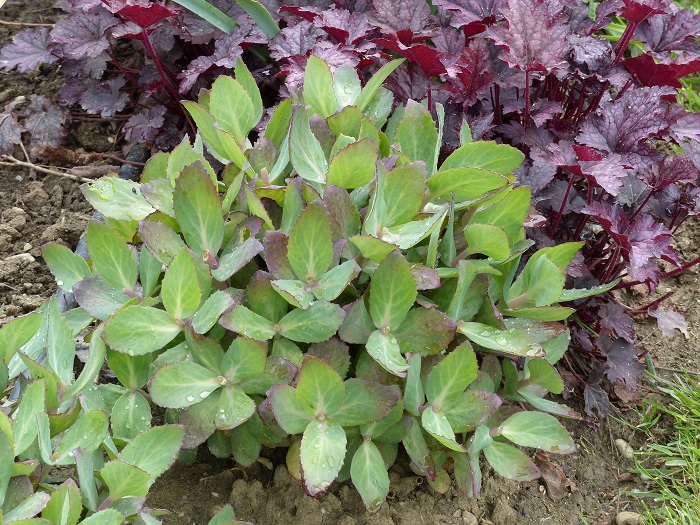
The 'Elise' selection brings together some magnificent forms with very vivid or very tender colours: sumptuous shades of pink, salmon, orange, white, and yellow, on single or bicoloured flowers. These plants have a loose tufted habit, reaching about 25cm (10in) in all directions. They form rosettes of succulent dark glaucous leaves that blush with the cold. The leaves measure 5 to 10cm (2 to 4in) long, are narrow, and spatulate-shaped. The flowering takes place in spring, from March to June-July, earlier or later depending on the climate. The flowers, about 3cm (1in) in diameter, are star-shaped with 7 to 12 shiny, slightly fringed petals. They are grouped in small bouquets carried by a stem overhanging the rosettes of leaves. They close at night.
A charming little plant, Lewisia cotyledon 'Elise White' captivates with an abundance of delicate and bright flowers that appear to be 'grafted' onto the stones. Whether in a border, in a pot on a balcony, or placed on top of a wall, it is easy to find a special place for this little marvel, away from winter humidity, which it fears more than the cold.
Lewisia is also known as 'Bitter root' because its edible roots, covered with a bitter skin, were traditionally harvested by indigenous tribes to be consumed once peeled and cooked, grilled, or dried, and even served as currency. It is said that a plant kept dry for five years is capable of resurrecting to produce beautiful flowers the following summer. At least, that was the adventure experienced by a curious London botanist.
Note: Please be aware that our young plug plants are professional products reserved for experienced gardeners: upon receipt, transplant and store them in a sheltered place (veranda, greenhouse, cold frame...) at a temperature above 14°C (57.2°F) for a few weeks before planting them outside once the risk of frost has definitively passed.
Report an error about the product description
Flowering
Foliage
Plant habit
Botanical data
Lewisia
cotyledon
Elise White
Portulacaceae (Montiaceae)
Siskiyou Lewisia, Cliff Maids
North America
Planting and care
Lewisia cotyledon 'Elise White' is a very hardy plant. The choice of location is crucial: the soil must be well-drained and fertile. In the case of heavy soil, plant on a mound or add river sand and gravel to lighten the soil. Stagnant water around the roots of this plant would cause it to rot immediately. For pot planting, prefer a terracotta pot with drainage holes at the bottom. Provide a layer of gravel or clay pellets to facilitate water drainage. The substrate should be composed equally of leaf compost, river sand, and compost. Never let water stagnate in the saucer and let the mixture dry almost completely between each watering. Apply liquid fertilizer every 15 days during the growth period. In the ground, fertilizer is unnecessary, and even harmful.
Plant Lewisia in full sun in cool climates, or in partial shade in the hottest regions. To reliably bloom every year, this plant needs a cold season; do not bring your pots indoors in winter, but protect them from rain that could, if it is too abundant for a long period, destroy the plants.
Planting period
Intended location
Care
Planting & care advice
-
-
-
-
-

-
-
-
-
, onOrder confirmed
Reply from on Promesse de fleurs
Recently viewed products
Haven't found what you were looking for?
Hardiness is the lowest winter temperature a plant can endure without suffering serious damage or even dying. However, hardiness is affected by location (a sheltered area, such as a patio), protection (winter cover) and soil type (hardiness is improved by well-drained soil).

The flowering period indicated on our website applies to countries and regions located in USDA zone 8 (France, the United Kingdom, Ireland, the Netherlands, etc.)
It will vary according to where you live:- In zones 9 to 10 (Italy, Spain, Greece, etc.), flowering will occur about 2 to 4 weeks earlier.
- In zones 6 to 7 (Germany, Poland, Slovenia, and lower mountainous regions), flowering will be delayed by 2 to 3 weeks.
- In zone 5 (Central Europe, Scandinavia), blooming will be delayed by 3 to 5 weeks.
In temperate climates, pruning of spring-flowering shrubs (forsythia, spireas, etc.) should be done just after flowering.
Pruning of summer-flowering shrubs (Indian Lilac, Perovskia, etc.) can be done in winter or spring.
In cold regions as well as with frost-sensitive plants, avoid pruning too early when severe frosts may still occur.
The planting period indicated on our website applies to countries and regions located in USDA zone 8 (France, United Kingdom, Ireland, Netherlands).
It will vary according to where you live:
- In Mediterranean zones (Marseille, Madrid, Milan, etc.), autumn and winter are the best planting periods.
- In continental zones (Strasbourg, Munich, Vienna, etc.), delay planting by 2 to 3 weeks in spring and bring it forward by 2 to 4 weeks in autumn.
- In mountainous regions (the Alps, Pyrenees, Carpathians, etc.), it is best to plant in late spring (May-June) or late summer (August-September).
The harvesting period indicated on our website applies to countries and regions in USDA zone 8 (France, England, Ireland, the Netherlands).
In colder areas (Scandinavia, Poland, Austria...) fruit and vegetable harvests are likely to be delayed by 3-4 weeks.
In warmer areas (Italy, Spain, Greece, etc.), harvesting will probably take place earlier, depending on weather conditions.
The sowing periods indicated on our website apply to countries and regions within USDA Zone 8 (France, UK, Ireland, Netherlands).
In colder areas (Scandinavia, Poland, Austria...), delay any outdoor sowing by 3-4 weeks, or sow under glass.
In warmer climes (Italy, Spain, Greece, etc.), bring outdoor sowing forward by a few weeks.
Shipping country and language
Your country of residence may be:
Your country of residence is:
For a better user experience on our website, you can select:
Your shipping country:
-
 Austria
-
 Belgium
-
 Bosnia & Herzegovina
-
 Bulgaria
-
 Croatia
-
 Cyprus
-
 Czechia
-
 Denmark
-
 Estonia
-
 Finland
-
 France
-
 Germany
-
 Greece
-
 Hungary
-
 Iceland
-
 Ireland
-
 Italy
Italy
-
 Latvia
-
 Liechtenstein
-
 Lithuania
-
 Luxembourg
-
 Malta
Malta
-
 Netherlands
-
 Poland
-
 Portugal
-
 Romania
-
 Serbia
-
 Slovakia
-
 Slovenia
-
 Spain
Spain
-
 Sweden
-
 Switzerland
Language:
-
French
-
 English
-
Spanish
-
Italian
-
German
-
Portuguese
-
Dutch
-
Finnish
My Account
Hello
My wish lists
My cart
Log in / Register
Existing customer?
This form is protected by reCAPTCHA - the Google Privacy Policy and Terms of Service apply.
New customer?
Create an account to track your orders, access our customer service and, if you wish, make the most of our upcoming offers.