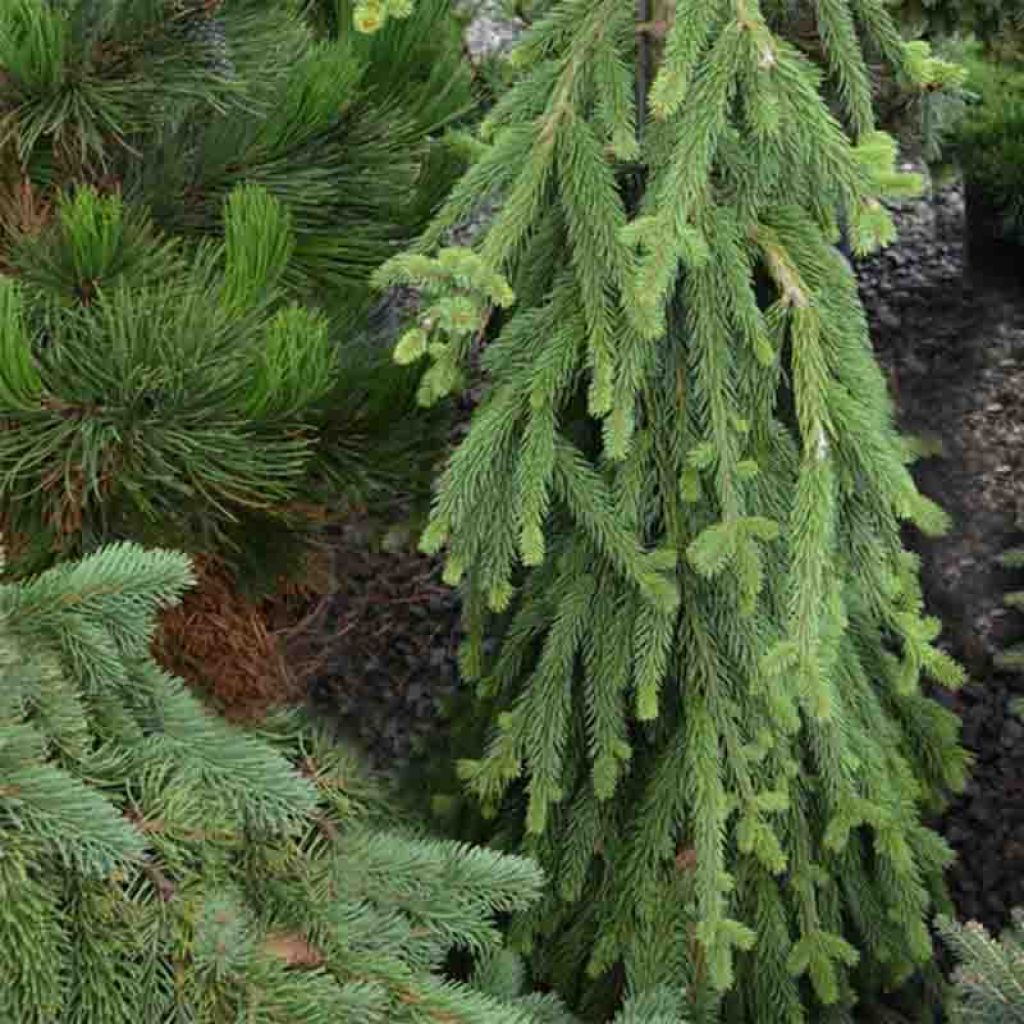
Picea abies Frohburg - Norway Spruce
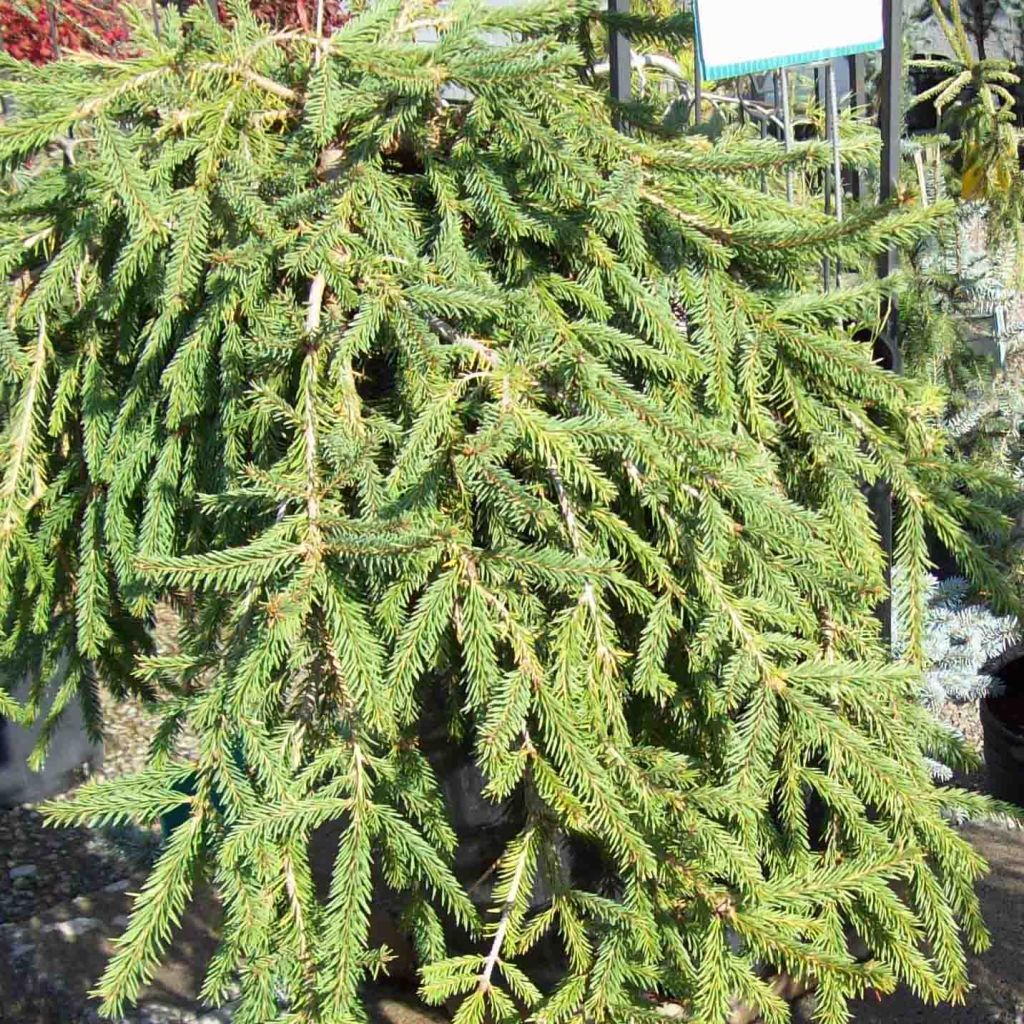
Picea abies Frohburg - Norway Spruce
Picea abies Frohburg - Norway Spruce
Picea abies Frohburg
Norway Spruce, Common Spruce, European Spruce
Very average for the price, but compensated by 1 cercis.
roland N., 18/09/2017
Back-to-school special offer!
Get €10 off for every €50 you spend! And get up to €40 off on a single order.
How does it work?
1. Shop your favourites
Add your favourite plants to your basket. For every €50 you spend (excluding delivery charges, store credit and the plastic-free option), you’ll receive a €10 voucher.
€50 spent = €10 voucher
€100 spent = €20 voucher
€150 spent = €30 voucher
€200 spent = €40 voucher
2. Place your order
Once your basket reaches one of the spending thresholds, place your order. You can even choose your delivery date!
3. Receive your voucher
As soon as your order has been shipped, you’ll receive an email containing your personal voucher code and its value.
4. Use it on your next order
Your voucher is valid for 90 days from the date you receive it. It can be used once only, on a new order worth at least the value of the voucher, excluding delivery charges.
Please note: Vouchers can be combined with other offers, but cannot be split or refunded.
Why not try an alternative variety in stock?
View all →
Available in 1 sizes
Available in 1 sizes
Available in 1 sizes
Available in 2 sizes
Available in 1 sizes

Available in 1 sizes
Available in 1 sizes
Available in 2 sizes
Available in 1 sizes
Available in 2 sizes
This plant carries a 24 months recovery warranty
More information
We guarantee the quality of our plants for a full growing cycle, and will replace at our expense any plant that fails to recover under normal climatic and planting conditions.
Would this plant suit my garden?
Set up your Plantfit profile →
Description
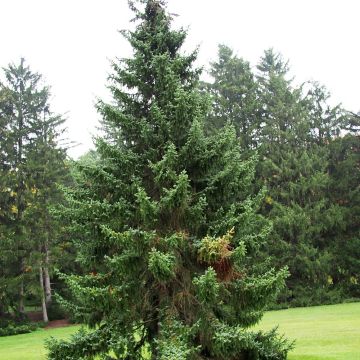
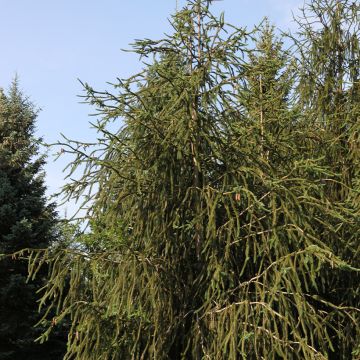
Picea abies 'Frohburg', also known as the Norway spruce, truly stands out with its unusual habit. It is so weeping that its top seems to want to touch the ground. Its picturesque foliage forms a long dark green mane and its base is completely hidden under a dense skirt. This hardy and whimsical conifer grows slowly, reaching a height of 5 to 6m (16 to 20ft) with a spread of 1 to 2m (3 to 7ft). It can be planted as a specimen tree to adorn a large slope or as the centrepiece of a flower bed, and it can also become a delightful bonsai. It thrives in sunny locations and prefers moist, well-drained soil without too much limestone.
Picea abies, also known as the Norway spruce or red spruce, is an evergreen conifer belonging to the pine family (Pinaceae), native to Northern Europe, specifically Scandinavia. In its natural environment, it has a typically conical and pyramidal habit and can reach a height of 30m (98ft), or even more in Eastern Europe. This species is traditionally used as a Christmas tree in Europe. It prefers well-drained and cool soils and can withstand very low temperatures.
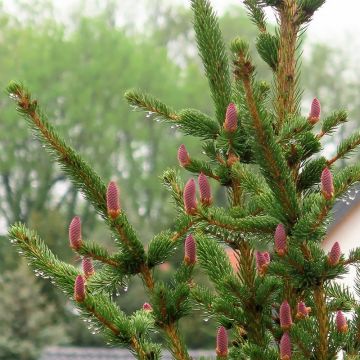
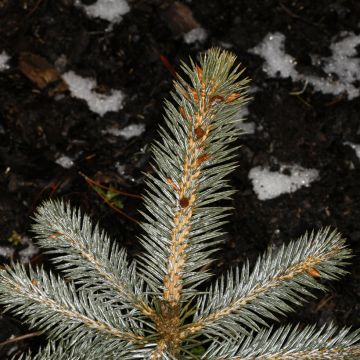
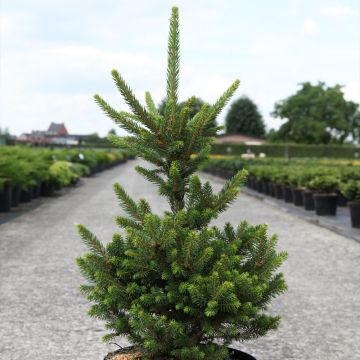
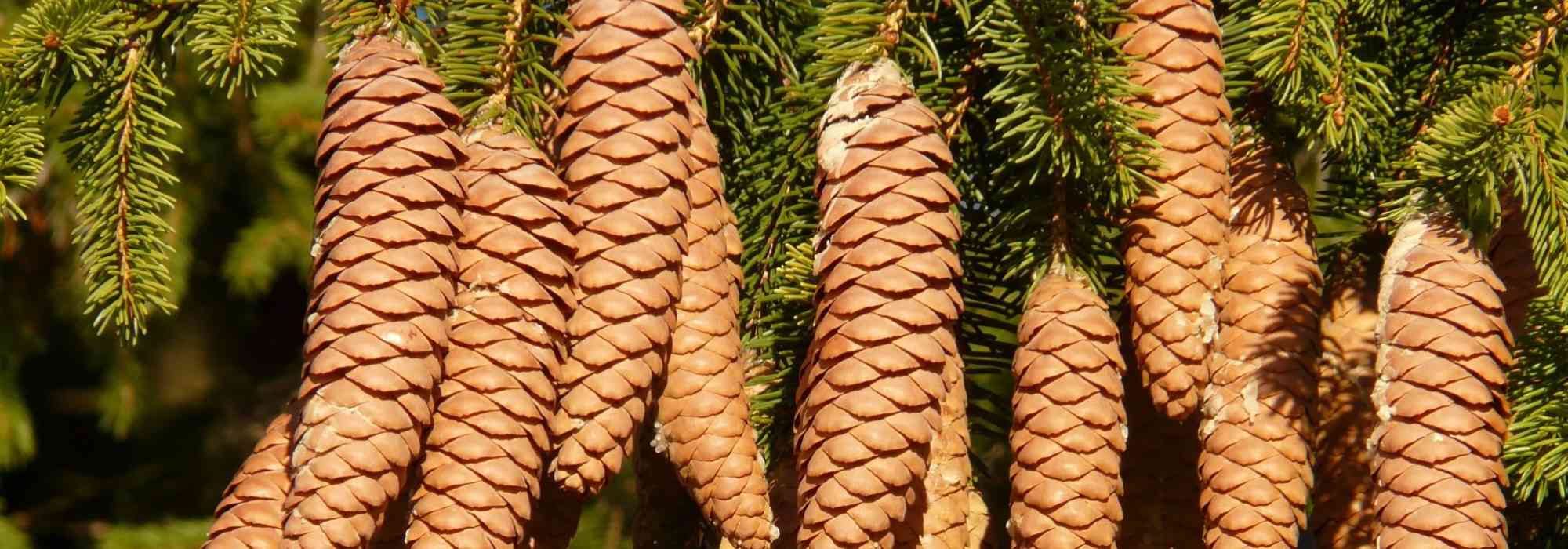
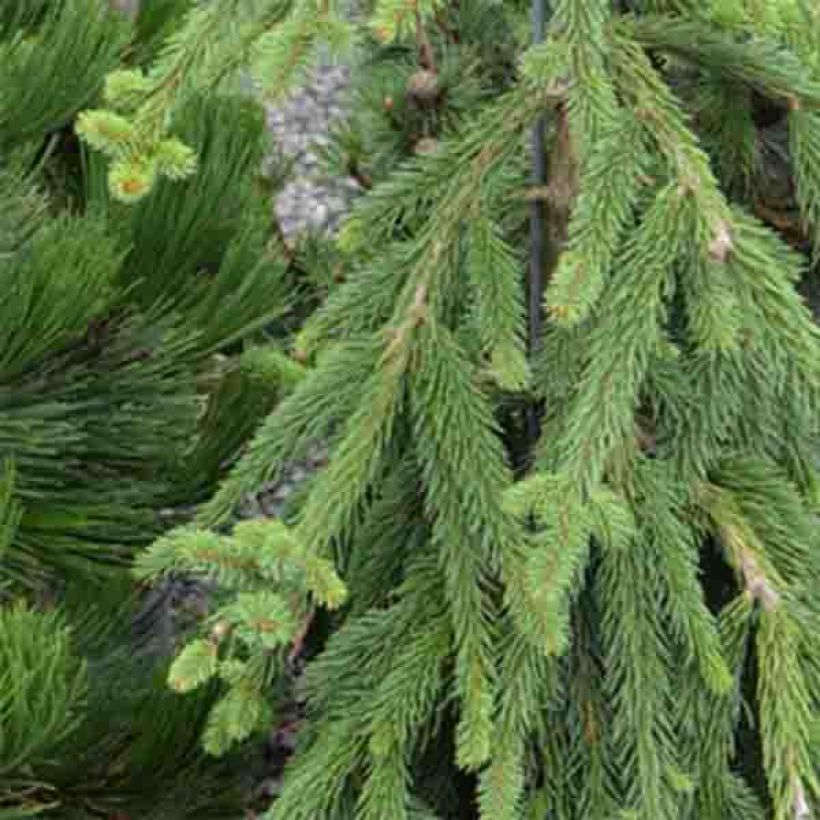
The variety 'Frohburg', derived from this species, is a highly distinctive form with an intensely weeping habit. After a few years, it forms a small, mysterious and twisted tree, rather upright, covered with abundant vegetation. Its growth is quite slow, and the trunk requires staking until it reaches the desired height. This conifer develops long, flexible and drooping branches, tightly packed together. Over time, the highest branches bend almost to the ground, further accentuating the weary appearance of its silhouette. Its foliage is a bright and vibrant green. Its small leaves are stiff, prickly needles arranged all around the branches, in a 'brush' shape. Initially erect, the female cones located at the terminal position resemble reddish cigars, then they become pendulous. The male pollen sacs appear on the previous year's branches, they have an oval spindle shape and are yellow-orange. The root system of spruces is shallow and spreading, which makes them difficult to transplant when mature and particularly sensitive to wind.
The weeping spruce 'Frohburg', with its exceptional ornamental qualities, deserves to be more commonly planted in cool soil. Its picturesque appearance and strong personality make it suitable for being the centrepiece of a flower bed, as a specimen tree on a lawn, as its silhouette stands out beautifully against a clear sky. It can be placed near a swimming pool, as it complements geometric lines and masonry structures. It can also be installed near a water feature, as it performs well in moist soil. It also lends itself well to the art of bonsai. The true graphic qualities of conifers naturally impose themselves in the design of a contemporary garden, which favors the aesthetics of shapes, silhouettes and textures over the dance of blooms. These plants, with their reassuring permanence, provide lasting structure to a flower bed, mark pathways, border terraces, easily substituting for the strong presence of trimmed boxwood or holly. They also pair well with Mahonias, heathers, or tousled grasses with complementary temperaments. The key is to play with volumes and colours.
Picea abies Frohburg - Norway Spruce in pictures
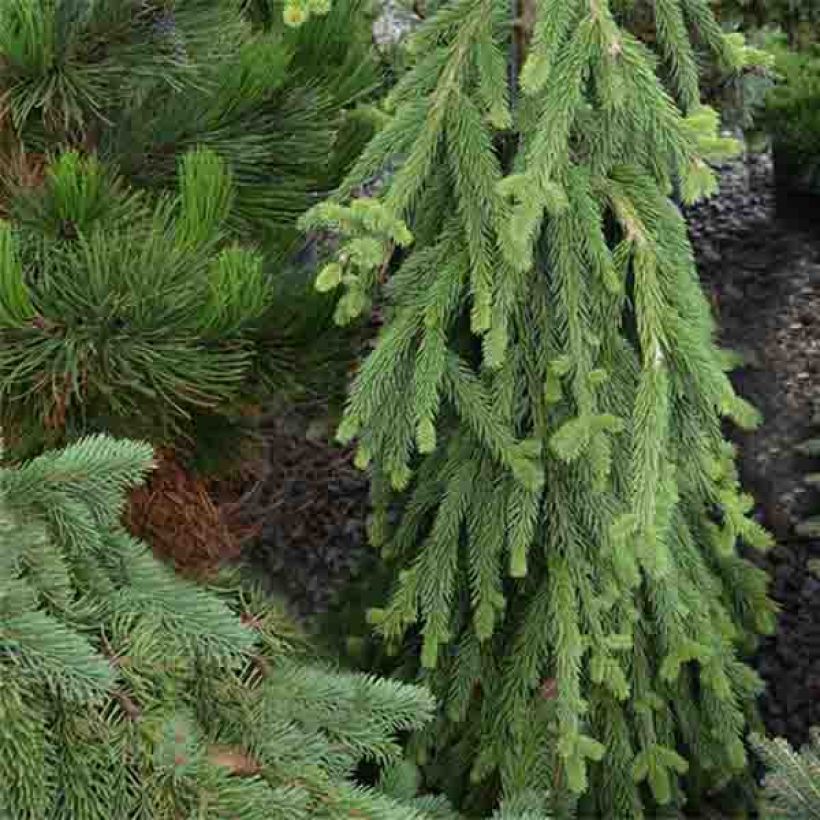
Plant habit
Flowering
Foliage
Botanical data
Picea
abies
Frohburg
Pinaceae
Norway Spruce, Common Spruce, European Spruce
Cultivar or hybrid
Planting and care
Picea abies 'Frohburg' should be planted from September to November and from February to June in deep, well-drained, light, neutral to acidic soil, retaining moisture. Choose a very sunny or semi-shaded location, sheltered from prevailing winds. Soak the root balls well before planting. Add organic amendment at planting and water generously in the first few years, and during prolonged drought. Apply a special conifer fertilizer every year in April and weed the soil in summer. This extremely hardy conifer, however, fears heavy soils that become waterlogged in winter. Pruning is not necessary, on the contrary, as this plant expresses its full potential when allowed to grow freely. This variety should be staked up to the desired height.
Planting period
Intended location
Care
Planting & care advice
-
-
-

-

-
-
-

-

-
, onOrder confirmed
Reply from on Promesse de fleurs
Recently viewed products
Haven't found what you were looking for?
Hardiness is the lowest winter temperature a plant can endure without suffering serious damage or even dying. However, hardiness is affected by location (a sheltered area, such as a patio), protection (winter cover) and soil type (hardiness is improved by well-drained soil).

The flowering period indicated on our website applies to countries and regions located in USDA zone 8 (France, the United Kingdom, Ireland, the Netherlands, etc.)
It will vary according to where you live:- In zones 9 to 10 (Italy, Spain, Greece, etc.), flowering will occur about 2 to 4 weeks earlier.
- In zones 6 to 7 (Germany, Poland, Slovenia, and lower mountainous regions), flowering will be delayed by 2 to 3 weeks.
- In zone 5 (Central Europe, Scandinavia), blooming will be delayed by 3 to 5 weeks.
In temperate climates, pruning of spring-flowering shrubs (forsythia, spireas, etc.) should be done just after flowering.
Pruning of summer-flowering shrubs (Indian Lilac, Perovskia, etc.) can be done in winter or spring.
In cold regions as well as with frost-sensitive plants, avoid pruning too early when severe frosts may still occur.
The planting period indicated on our website applies to countries and regions located in USDA zone 8 (France, United Kingdom, Ireland, Netherlands).
It will vary according to where you live:
- In Mediterranean zones (Marseille, Madrid, Milan, etc.), autumn and winter are the best planting periods.
- In continental zones (Strasbourg, Munich, Vienna, etc.), delay planting by 2 to 3 weeks in spring and bring it forward by 2 to 4 weeks in autumn.
- In mountainous regions (the Alps, Pyrenees, Carpathians, etc.), it is best to plant in late spring (May-June) or late summer (August-September).
The harvesting period indicated on our website applies to countries and regions in USDA zone 8 (France, England, Ireland, the Netherlands).
In colder areas (Scandinavia, Poland, Austria...) fruit and vegetable harvests are likely to be delayed by 3-4 weeks.
In warmer areas (Italy, Spain, Greece, etc.), harvesting will probably take place earlier, depending on weather conditions.
The sowing periods indicated on our website apply to countries and regions within USDA Zone 8 (France, UK, Ireland, Netherlands).
In colder areas (Scandinavia, Poland, Austria...), delay any outdoor sowing by 3-4 weeks, or sow under glass.
In warmer climes (Italy, Spain, Greece, etc.), bring outdoor sowing forward by a few weeks.
Shipping country and language
Your country of residence may be:
Your country of residence is:
For a better user experience on our website, you can select:
Your shipping country:
-
 Austria
-
 Belgium
-
 Bosnia & Herzegovina
-
 Bulgaria
-
 Croatia
-
 Cyprus
-
 Czechia
-
 Denmark
-
 Estonia
-
 Finland
-
 France
-
 Germany
-
 Greece
-
 Hungary
-
 Iceland
-
 Ireland
-
 Italy
Italy
-
 Latvia
-
 Liechtenstein
-
 Lithuania
-
 Luxembourg
-
 Malta
Malta
-
 Netherlands
-
 Poland
-
 Portugal
-
 Romania
-
 Serbia
-
 Slovakia
-
 Slovenia
-
 Spain
Spain
-
 Sweden
-
 Switzerland
Language:
-
French
-
 English
-
Spanish
-
Italian
-
German
-
Portuguese
-
Dutch
-
Finnish
My Account
Hello
My wish lists
My cart
Log in / Register
Existing customer?
This form is protected by reCAPTCHA - the Google Privacy Policy and Terms of Service apply.
New customer?
Create an account to track your orders, access our customer service and, if you wish, make the most of our upcoming offers.