Shading a swimming pool: which plants to choose?
Ideal shrubs and trees for shade
Contents
Pool owners often seek, in addition to a contemporary or more traditional layout that blends into the greenery, essential shade for the hottest days. Whether it’s an in-ground, above-ground or infinity pool, a natural pool or a lap pool, planting around a pool becomes essential with summers becoming increasingly hot.
But pools, like gardens, are subject to trends. Pool planting is no longer done as it used to be. Here is our selection of plants suited to bring extra coolness to the garden.
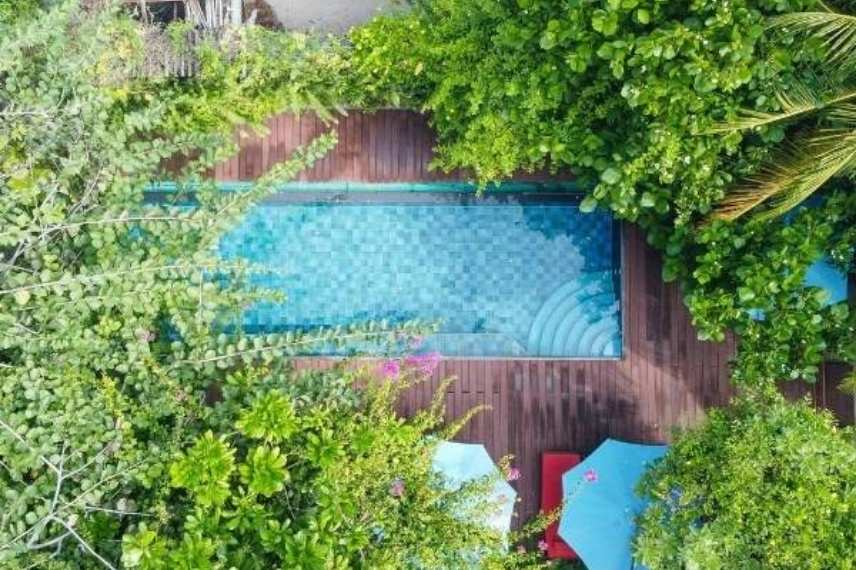
Shade is becoming increasingly necessary around pools in summer
Why should you consider shade when landscaping around a pool?
Simply because pool and its surroundings reflect a great deal of heat, even though water volume and cooling blue colour suggest otherwise. Earthworks around the structure, made of inert materials (wood decking or stone), store heat for much of the day, pools being installed in sunlight (remember imprint left by swimmer in that cult 1980s advert for a famous French pastis brand!).
Presence of trees and vegetation tall enough to provide welcome — even lifesaving — shade in the height of summer is therefore the way to avoid baking on exit from a refreshing dip in the hottest climates.
Because a parasol or shade sail, however large or offset, do filter harmful sun rays, but do not play expected role of natural air conditioner. It is trees that cool ambient air, ten times more than a parasol, thanks to evapotranspiration.
Trees and large shrubs are therefore major allies for creating shade, denser or lighter depending on species chosen.
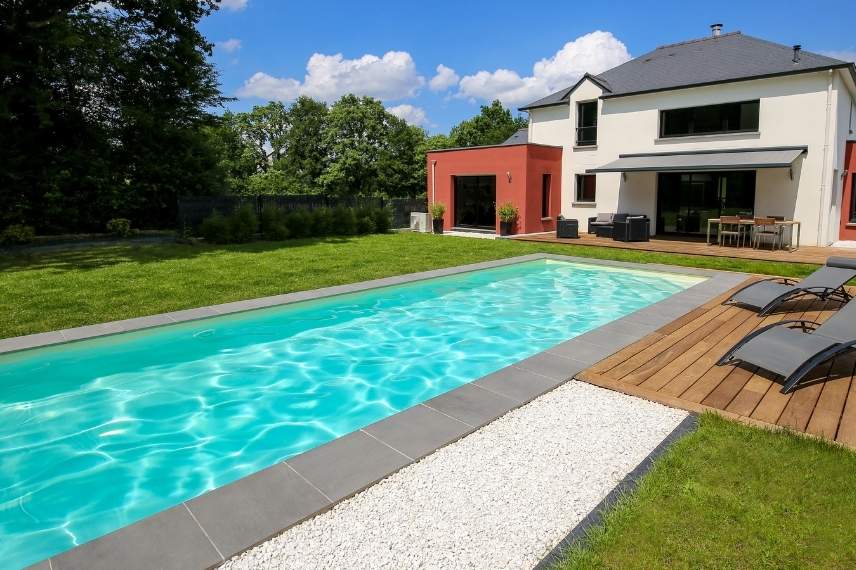
Bare pool — a sight without any vegetation other than surrounding decking — probably already belongs to another era.
Read also
Which plants to choose around a pool?Constraints to consider when shading a swimming pool
Pool remains a structuring feature around a house, which should be sunny, but not a beach for lazing about. Combining sunlounging and shade is exactly what people look for, and that comes with a few constraints :
- Exposure : generally you want a pool sunny in the afternoon. Study sun path during first summer in advance to shade pool deck at that time of day. Bear in mind that summer shading at ground level is reduced because sun is near zenith in summer. A common mistake is misjudging shade cast by a tree at maturity.
A coppiced tree (multiple trunks arising from ground level) produces broader, lower shade over a pool, because its canopy spreads from the base, unlike a standard tree on stem (tall trunks with crown higher up and often narrower).
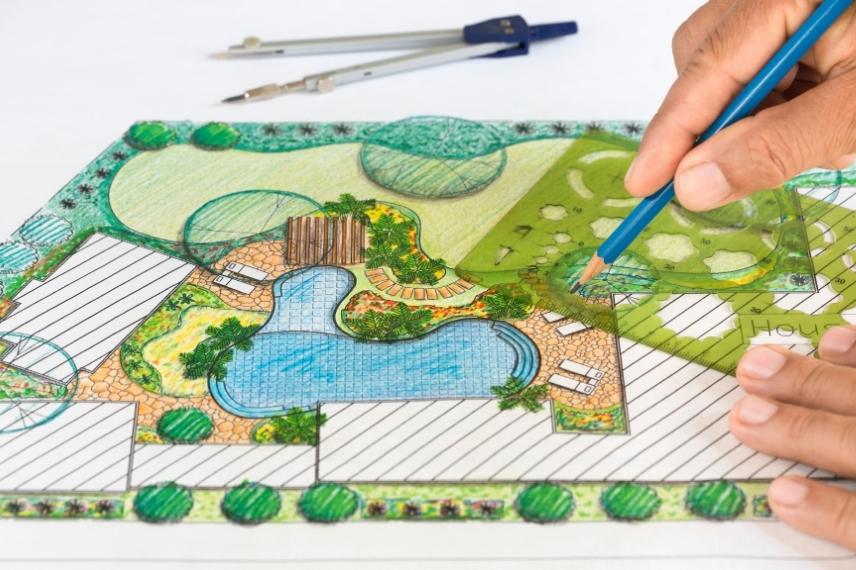
Pool is equipped with sunloungers. A scaled sketch helps visualise areas to be shaded and will help quantify shade cast by trees
- The root system : some spreading, running roots lift paving, pierce liners, destabilise coping stones or damage pipes. This quickly rules out plants such as bamboo (even clumping varieties), poplars, willows, robinias (black locust), many conifers, and you should favour taprooted or fasciculate root systems.
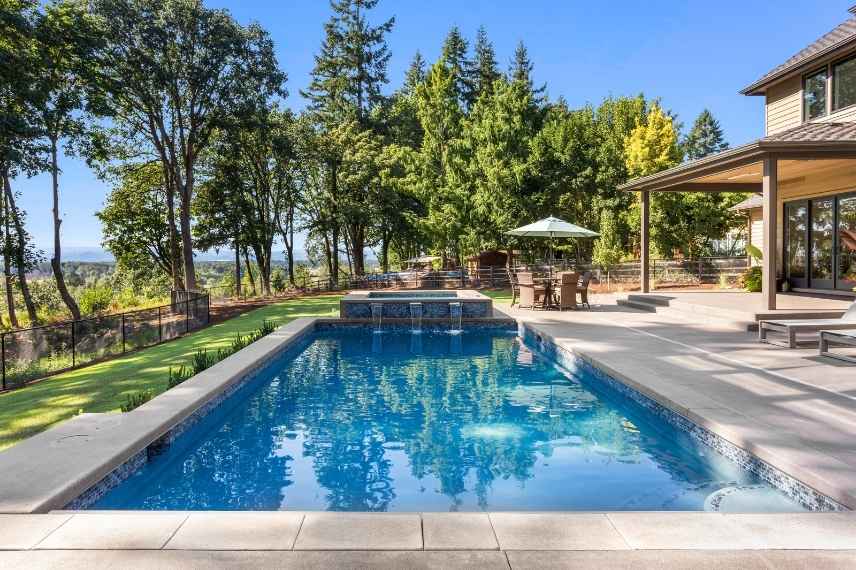
Some large trees must be planted at a minimum distance because of their spreading roots
- Trees that tolerate full sun, or scorching heat depending on region.
- Leaf fall : to avoid dirtying pool water and extra maintenance, evergreen plants are generally preferred. Trees with sticky leaves such as lime (Tilia) should be avoided.
- Importance of winds : identify prevailing wind to avoid leaves or debris falling towards pool.
- Estate rules : in some housing developments a maximum height or permitted species may be imposed for gardens with pools. Also respect planting distances from property boundaries.
- Finally, growth rate of a tree matters for pools on bare ground; remember evergreen trees tend to grow slowly.
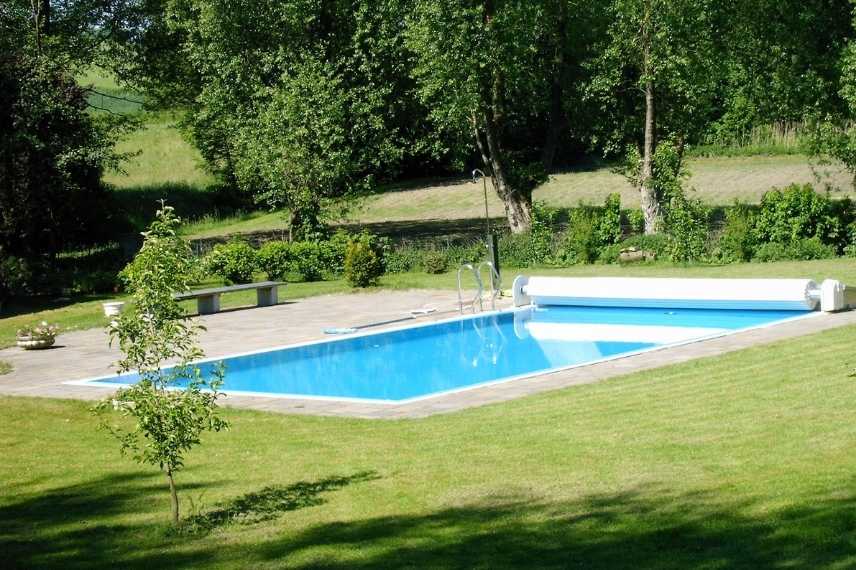
People want to benefit from shade fairly quickly when planting a tree nearby…
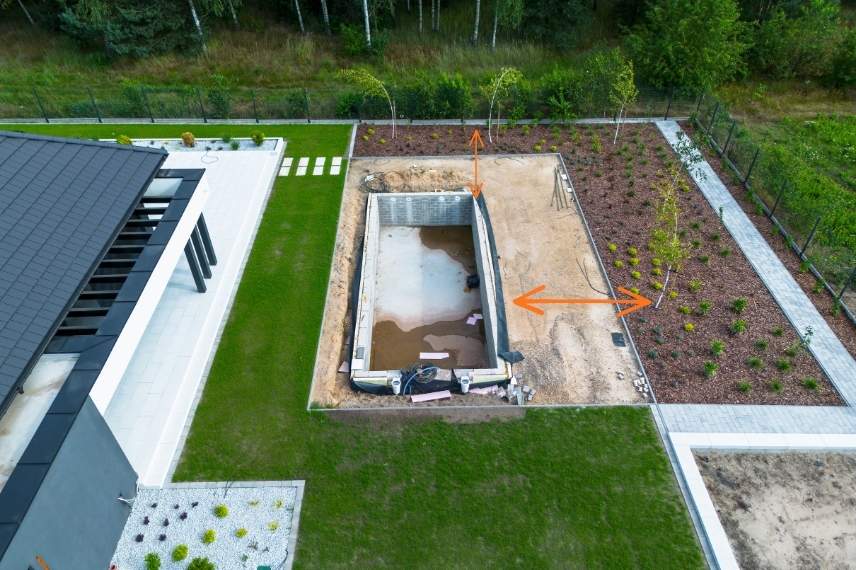
For all these reasons, keep trees at least 5–10 m away (depending on height), and shrubs between 3 and 5 m, or plant them downwind of prevailing wind.
If constraints are too severe, opt for pergolas or planted arbours.
Ideal shade plants for a pool to suit the desired ambience
For the reasons given above, choose plants around a pool that are tall enough… but not too tall, and, above all, evergreen so they do not dirty the water. The second priority is aesthetic: plant ornamental trees or shrubs that are in harmony with the style of the house and garden if already landscaped.
Here are different contexts and possible options :
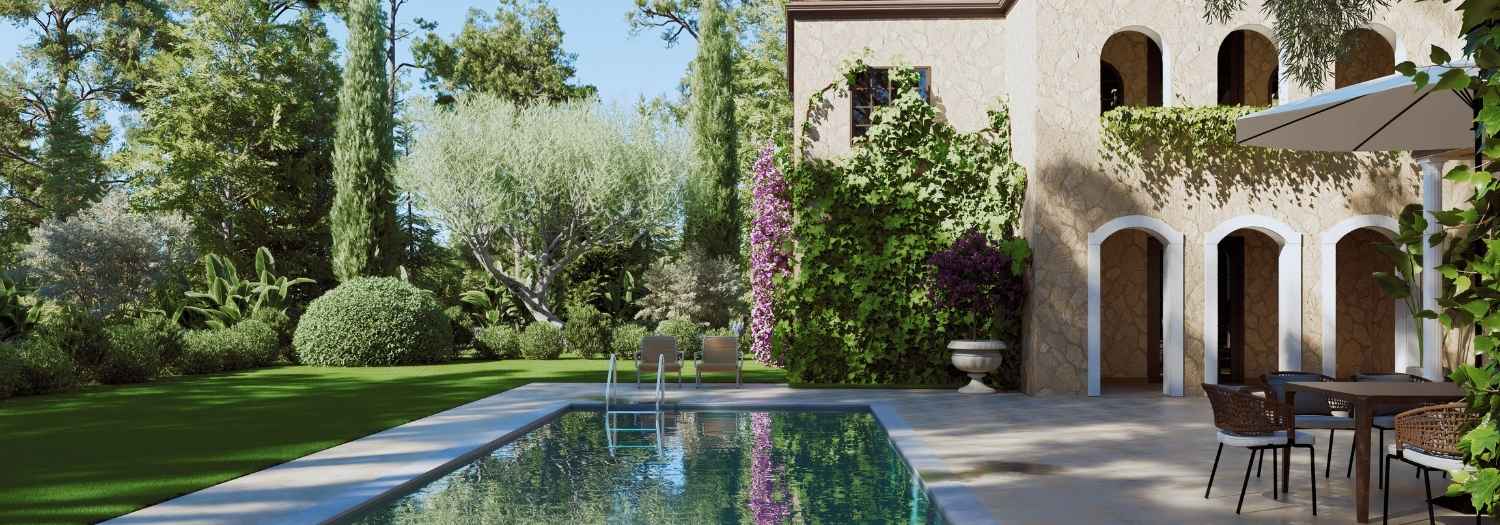
- In a Mediterranean region or a Mediterranean-style garden : vegetation that evokes Provence will greatly contribute to a holiday atmosphere. Bet on the chic, timeless winning trio: a pair or trio of cypresses with understated elegance, an olive tree for its habit and grey foliage, and a slightly lower oleander for seasonal blooms. Pines are often shown in magazines around dream pools, but even planted at a distance they are not ideal and can eventually damage the pool surround. To evoke Saint-Raphaël, consider at most Pinus nigra ssp. nigra (Austrian black pine), fast-growing with a tap-rooting system, together with some bougainvillea.
Also consider pomegranate, which, although deciduous, makes a handsome shrub branching from the base, provides shade, and whose late fruit does not cause problems.
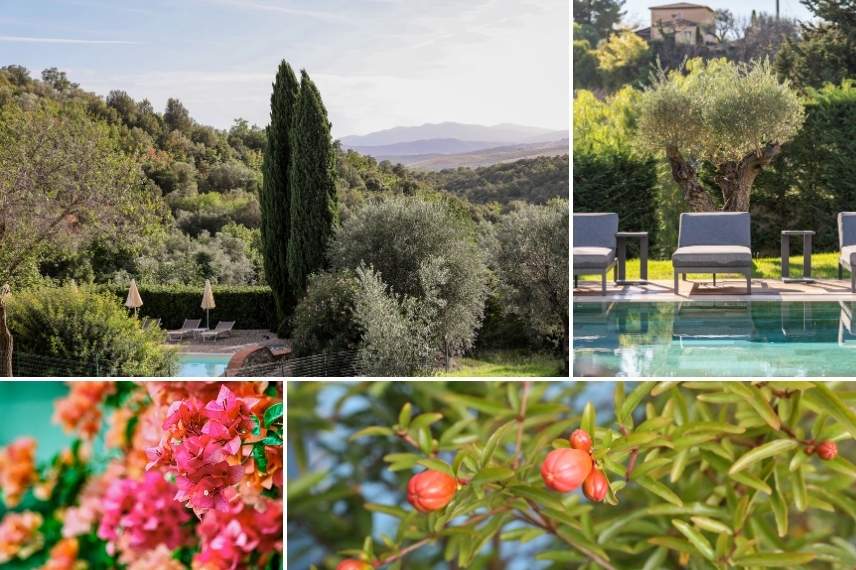
Cypresses and olive trees, bougainvillea and pomegranate
- In an exotic-style garden, favour a few evergreens with outstanding foliage such as palms, Feijoa, which is often overlooked, or some large hibiscus. Banana trees, planted in threes for example, are a great way to provide shade as they grow quickly (opt for the larger types, from Musa ‘Basjoo’ to Musa sikkimensis). Cordylines and Phormium also have their place. Lagerstroemia with its pink to red flowering is another option. In this context, do not hesitate to push planting to create a cocooning effect.
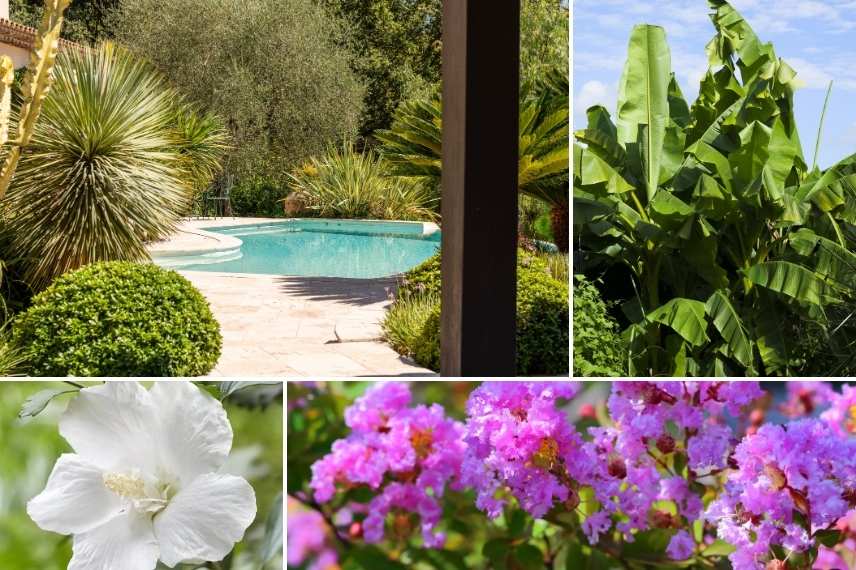
Banana tree, Hibiscus syriacus ‘Flower Tower White’ and Lagerstroemia indica
- In a seaside garden, choose hardy palms, Feijoa for its ornamental grey foliage year-round, or pomegranate, strawberry tree and magnolias and Michelia. Summer tamarisk is an attractive option, but control its suckers and keep it a distance to limit dropped flowers. You could also try loquat, provided you clear its often leathery fallen leaves regularly to maintain a tidy pool area.
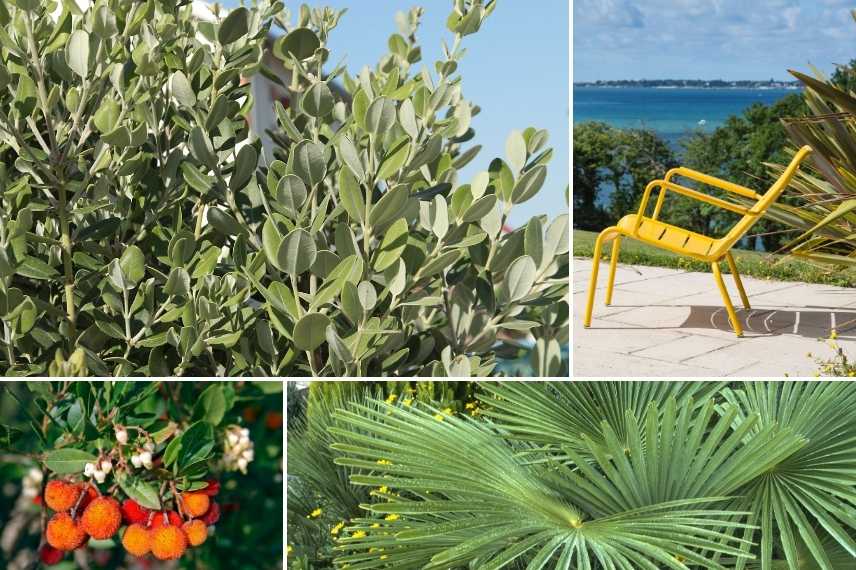
Feijoa, strawberry tree and windmill palm: three good ideas for pools in coastal gardens
- For a natural or country garden, invite a wide range of ornamental species that will help wrap the pool in a more or less wild setting, such as Portuguese laurel pruned to openness, photinias and Cotoneaster lacteus trained on stem. Coppiced shrubs offer broader shade because of their lower branching and are generally very attractive beside a pool (Judas tree and crape myrtle, although deciduous, look particularly beautiful here). Also consider larger Abelia such as Abelia grandiflora. Natural pools are generally little planted or unplanted so they blend into the landscape.
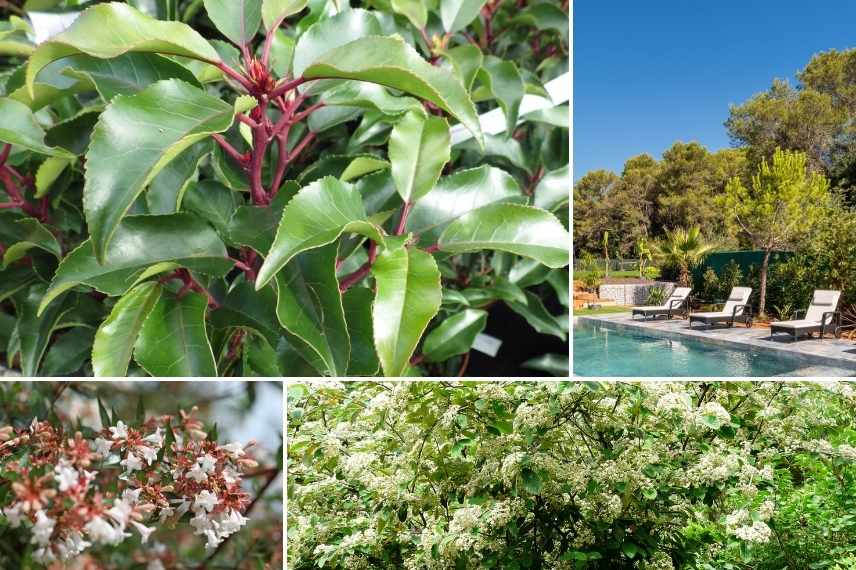
Prunus lusitanica, Abelia grandiflora and Cotoneaster lacteus
- For a pool in a modern setting : the trend still leans towards minimalism, even an absence of planting, despite climate change. If the house and garden are contemporary, look for architectural plants that also provide protection. They must combine a certain height with effective screening; stay minimalist with cypresses or yews, prostrate or sculptural conifers, large ornamental grasses, or an olive tree, which remains probably the finest option.
Pools already in place with large paved surrounds and little planting can, with work, be adapted by adding planting pits within that framework.
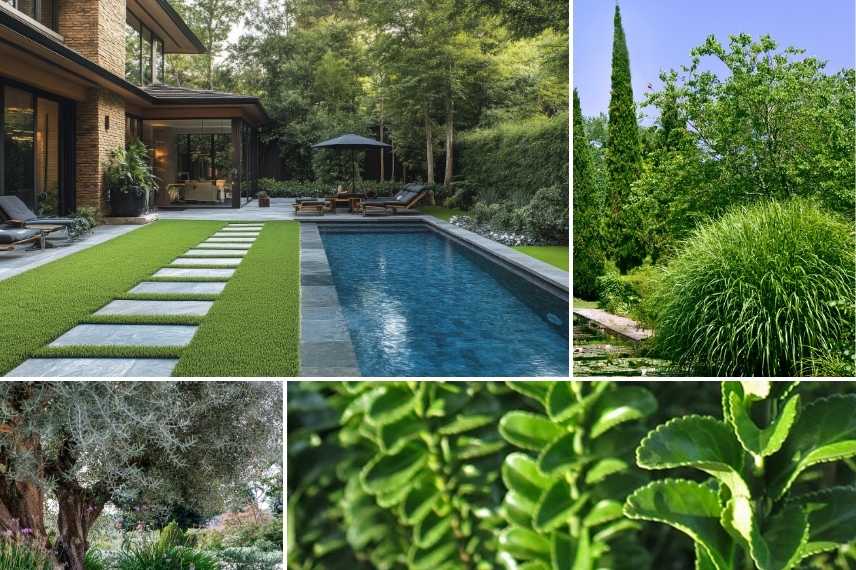
Cypresses and Miscanthus, olive tree and Euonymus ‘Benkomasaki’
Read also
Designing poolside areas in 5 stylesOutsiders
Some deciduous trees and shrubs pose no problem, as they will drop their leaves after the main pool-use season, when the pool is usually covered in autumn. For example, a sun-tolerant Japanese maple or a Samarian hop tree with the appearance of a giant lemon tree both have an attractive habit. Among evergreens, consider some unusual specimens such as Japanese spindle ‘Benkomasaki‘, 1.50 m high, very upright and architectural, and easy to care for. In mild climates and seaside gardens, also consider honey spurge, superb beside a pool.
Special cases: small space or low vegetated wall
Small spaces
When certain constraints prevent planting trees, option remains of a large planted pergola, dressed with climbing plants.
You can install a large bench-seat, resort-hotel style, or even a canopy bed, like hotels in far-flung places that make you dream in brochures. Just avoid trumpet vine, invasive and running.
→ Good options, tolerant of summer sun: evergreen honeysuckle, trumpet vine, star jasmine,
In case of pools in confined spaces, framed by a hedge that restricts planting, or where mineral surfacing is extensive, the solution is often to add large pots or jars in which to grow large perennials and grasses or small shrubs, or to choose standard-stem shrubs that take up less ground. Alocasias, large Miscanthus, a Magnolia grandiflora, a ceanothus, a Callistemon are practical and give an exotic feel to invite summer, etc.
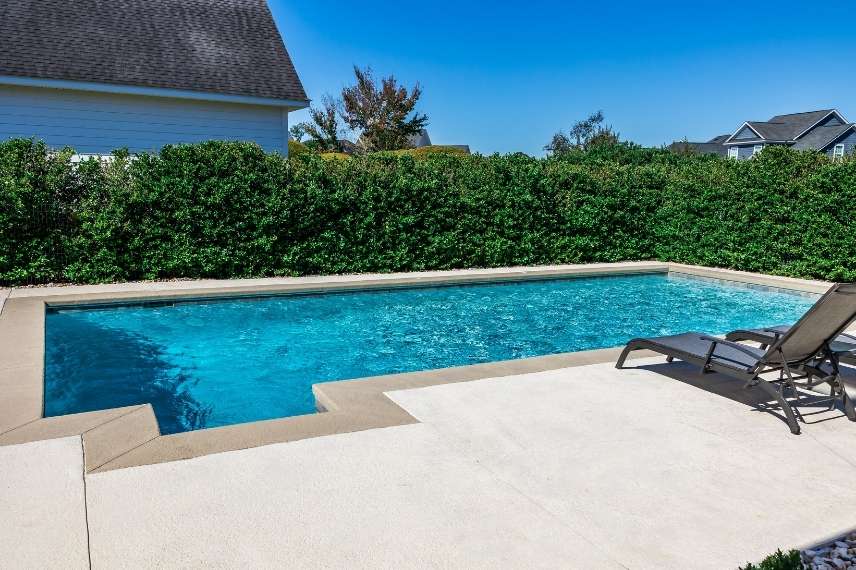
Sometimes there will be no choice but to add large pots on an overpowering surface
A low wall or plinth for raised planting around the pool
Framing pool with a low wall that can host cascading planting such as prostrate rosemary, or small globe-shaped shrubs well adapted to sun, is a lovely idea that will create suitable shade. Plant, according to dimensions, in groups of 1 or 3 fast-growing phormiums which, elevated in this way, will provide enough shade without causing problems from their tips.
- Subscribe!
- Contents
This form is protected by reCAPTCHA - the Google Privacy Policy and Terms of Service apply.

































Comments