Chaenomeles Double Delice Love - Japanese quince
Chaenomeles Double Delice Love - Japanese quince
Chaenomeles Double Delice Love - Japanese quince
Chaenomeles x speciosa ‘Minchadf13225’ Love
Japanese Quince, Flowering quince
Back-to-school special offer!
Get €10 off for every €50 you spend! And get up to €40 off on a single order.
How does it work?
1. Shop your favourites
Add your favourite plants to your basket. For every €50 you spend (excluding delivery charges, store credit and the plastic-free option), you’ll receive a €10 voucher.
€50 spent = €10 voucher
€100 spent = €20 voucher
€150 spent = €30 voucher
€200 spent = €40 voucher
2. Place your order
Once your basket reaches one of the spending thresholds, place your order. You can even choose your delivery date!
3. Receive your voucher
As soon as your order has been shipped, you’ll receive an email containing your personal voucher code and its value.
4. Use it on your next order
Your voucher is valid for 90 days from the date you receive it. It can be used once only, on a new order worth at least the value of the voucher, excluding delivery charges.
Please note: Vouchers can be combined with other offers, but cannot be split or refunded.
Home or relay delivery (depending on size and destination)
Important: You may be charged customs duties by your country’s customs authorities upon delivery.
Schedule delivery date,
and select date in basket
This plant carries a 24 months recovery warranty
More information
We guarantee the quality of our plants for a full growing cycle, and will replace at our expense any plant that fails to recover under normal climatic and planting conditions.
Would this plant suit my garden?
Set up your Plantfit profile →
Description
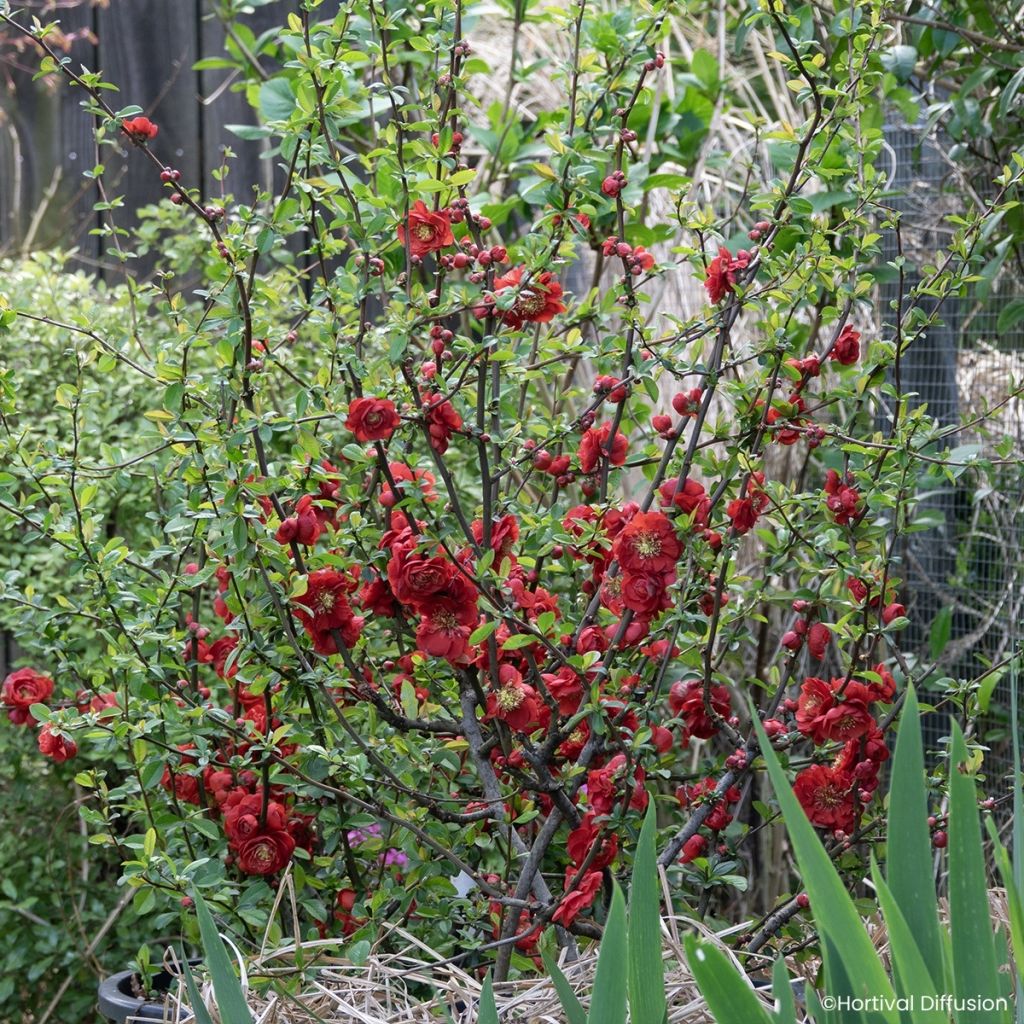
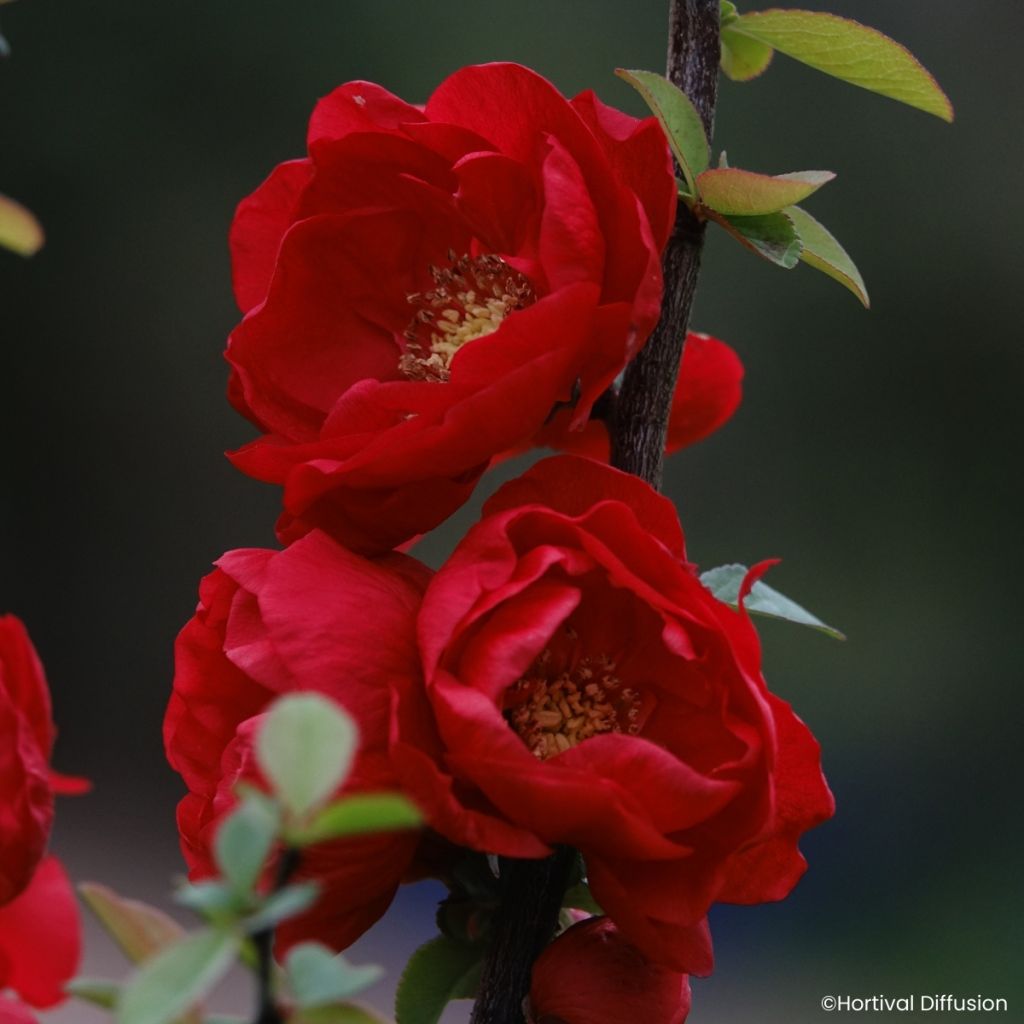
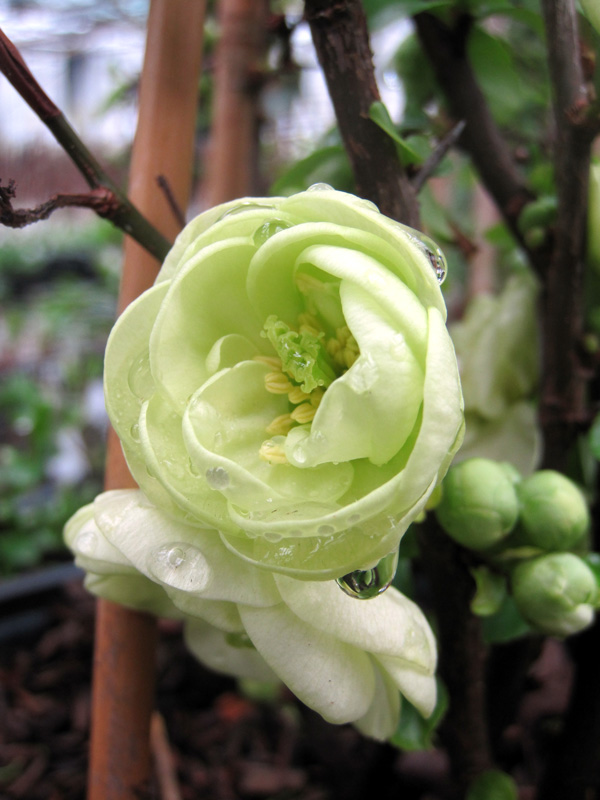
Chaenomeles speciosa ‘Minchadf13225’ Love is a recent variety of Japanese Quince with magnificent, brilliant, bright red double flowers. Of medium size, about 1.50m, the shrub flowers early in spring on bare wood still devoid of leaves, and then flowering repeats a month later, amid the young leaves, which are a beautiful, clear green. It is very floriferous and also has the great advantage of being thornless. Undemanding, adapting to most soils, it grows in full sun, also tolerating partial shade. Very interesting in the garden, due to its double flowering, it also makes superb cut flower arrangements for indoors.
Quince is a member of the vast Rosaceae family, which includes 5000 species and over a hundred genera, grouping wild plants from our countryside and forests, ornamental plants (Cotoneaster, Amelanchier, Hawthorn...) and most of our temperate climate fruit trees (Plum tree, Apple tree...), as well as soft fruits like Strawberry. Quince is divided between flowering species (Chaenomeles) and a fruit-bearing one (Cydonia oblonga). The Chaenomeles genus comprises only four species, very close to each other, and a hybrid obtained by cross-breeding between two of these species.
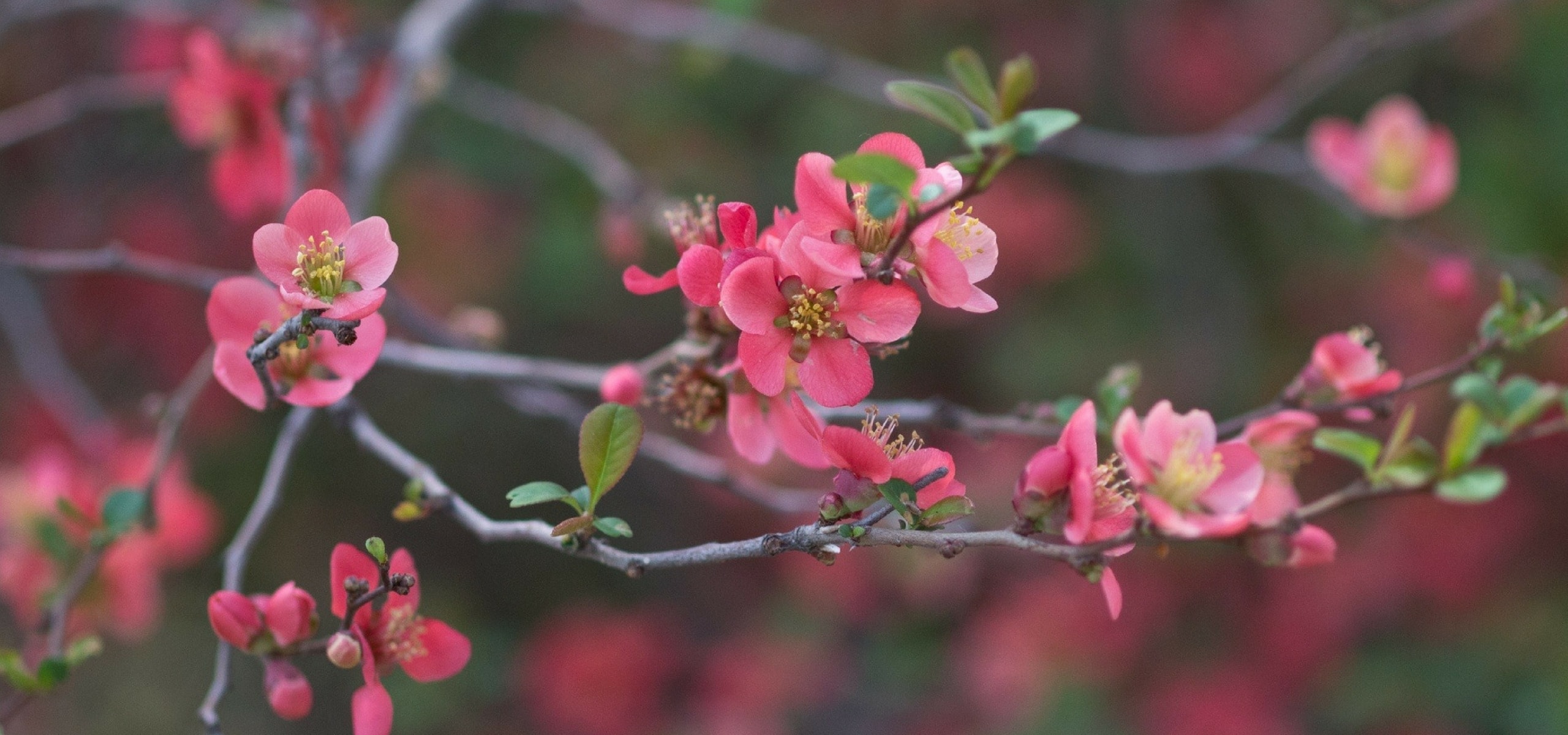
The Love Quince is part of the horticultural range Double Delice® series and appeared on the market in 2025, after 12 years of work. This cultivar is particularly attractive for its many ornamental qualities and also because it bears no thorns. This is a great advantage over classic varieties, whose rather stiff branches can scratch your forearms when gardening around them. After 10 years of cultivation, this variety reaches about 1.50m in all directions, and can easily be kept in more compact dimensions by pruning once a year after flowering. From the end of winter, Chaenomeles speciosa Double Delice Love is very ornamental with its red flower buds that stand out visually on the almost black bare wood. They then open into superb double, cup-shaped flowers, 4 to 5 cm in diameter, composed of concave, overlapping petals. Their brilliant red colour is further enhanced by the heart of yellow stamens, and their beauty is reminiscent of some Camellias. The spectacle of the flowers displayed on the leafless branches is worthy of a Japanese print. Blooming for three weeks in March, the scarlet flowering announces spring in the most beautiful way.
In the event of a mild spring, a second flowering develops again in May. The shrub is then in full vegetation, dressed in its small oval leaves of a clear green, which provide a setting for the bright red corollas, thus forming a very attractive contrast. It even sometimes has a small repeat flowering in early autumn, according to the climate. A few yellow quinces can also occasionally develop in autumn, adding a final decorative touch. These edible fruits can be used to make jams.
The Double Delice Love Quince amazes and delights with its unprecedented repeat flowering. It is one of those plants that celebrate the arrival of spring with a flourish. To create a bed dedicated to early flowering, near the house, to enjoy it to the full, accompany your Quince with a Stachyurus praecox. This unusual shrub with a flexible habit is covered with countless clusters of small pale yellow flowers aligned like strings of beads in February and March. Its deciduous foliage additionally takes on superb autumn colours. Even earlier, two winter glories offer their fragrant flowers until March. The first is Chimonanthus praecox, which produces a multitude of sulphur-yellow, bell-shaped flowers. The second is Viburnum bodnantense 'Charles Lamont', with light pink flowers, and whose foliage takes on brilliant autumn colours. To complete your bed, consider planting various Hellebores at the edge, to flower in winter and spring.
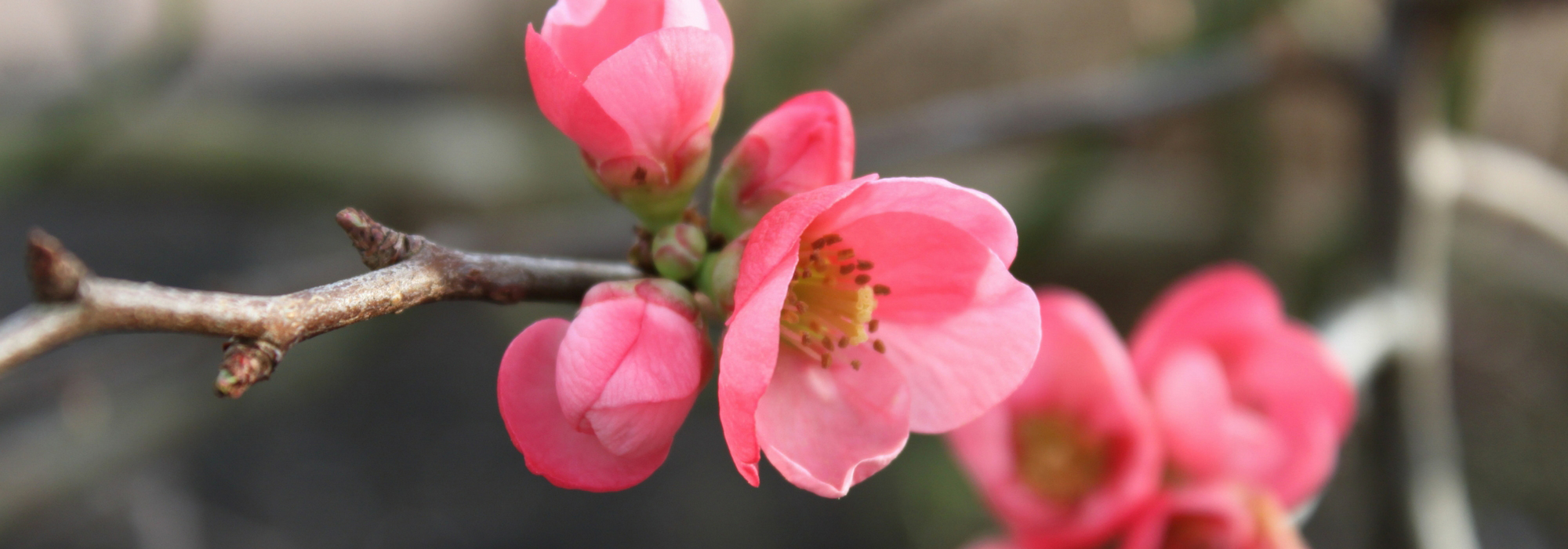
Chaenomeles Double Delice Love - Japanese quince in pictures
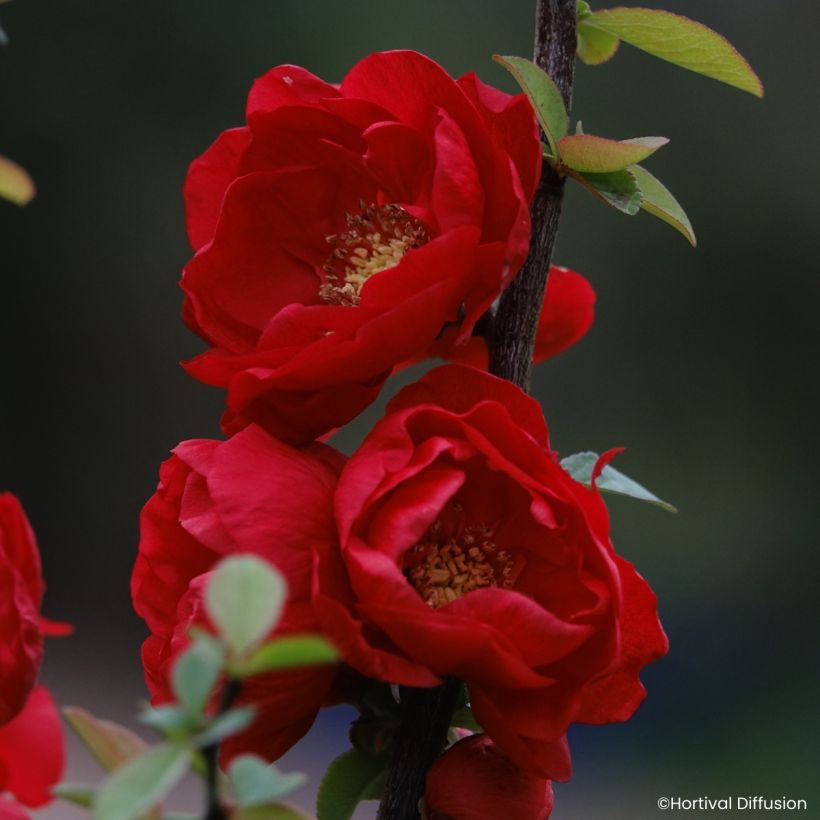
Plant habit
Flowering
Foliage
Botanical data
Chaenomeles
x speciosa
‘Minchadf13225’ Love
Rosaceae
Japanese Quince, Flowering quince
Chaenomeles × superba ‘Minchadf13225’, Chaenomeles Double Delice® Love
Cultivar or hybrid
Planting and care
Chaenomeles speciosa Double Delice® Love will thrive in full sun, where it is more floriferous. You can also grow it in partial shade in the sunniest regions. Plant it in ordinary, well-drained, rather moist soil, even though it tolerates drought well after three years of planting. It is a very easy plant to grow and also tolerates lime very well. When planting, mix your soil with compost. If grown as a hedge, space the plants 80 cm apart. In a border, space the plants 40 to 60 cm apart. This Japanese quince is resistant to pollution. It requires little maintenance, apart from occasionally shortening the longest shoots in spring, as they sometimes become less floriferous.
Planting period
Intended location
Care
Planting & care advice
-
-
-
-

-
-
-
-
This item has not been reviewed yet - be the first to leave a review about it.
Recently viewed products
Haven't found what you were looking for?
Hardiness is the lowest winter temperature a plant can endure without suffering serious damage or even dying. However, hardiness is affected by location (a sheltered area, such as a patio), protection (winter cover) and soil type (hardiness is improved by well-drained soil).

The flowering period indicated on our website applies to countries and regions located in USDA zone 8 (France, the United Kingdom, Ireland, the Netherlands, etc.)
It will vary according to where you live:- In zones 9 to 10 (Italy, Spain, Greece, etc.), flowering will occur about 2 to 4 weeks earlier.
- In zones 6 to 7 (Germany, Poland, Slovenia, and lower mountainous regions), flowering will be delayed by 2 to 3 weeks.
- In zone 5 (Central Europe, Scandinavia), blooming will be delayed by 3 to 5 weeks.
In temperate climates, pruning of spring-flowering shrubs (forsythia, spireas, etc.) should be done just after flowering.
Pruning of summer-flowering shrubs (Indian Lilac, Perovskia, etc.) can be done in winter or spring.
In cold regions as well as with frost-sensitive plants, avoid pruning too early when severe frosts may still occur.
The planting period indicated on our website applies to countries and regions located in USDA zone 8 (France, United Kingdom, Ireland, Netherlands).
It will vary according to where you live:
- In Mediterranean zones (Marseille, Madrid, Milan, etc.), autumn and winter are the best planting periods.
- In continental zones (Strasbourg, Munich, Vienna, etc.), delay planting by 2 to 3 weeks in spring and bring it forward by 2 to 4 weeks in autumn.
- In mountainous regions (the Alps, Pyrenees, Carpathians, etc.), it is best to plant in late spring (May-June) or late summer (August-September).
The harvesting period indicated on our website applies to countries and regions in USDA zone 8 (France, England, Ireland, the Netherlands).
In colder areas (Scandinavia, Poland, Austria...) fruit and vegetable harvests are likely to be delayed by 3-4 weeks.
In warmer areas (Italy, Spain, Greece, etc.), harvesting will probably take place earlier, depending on weather conditions.
The sowing periods indicated on our website apply to countries and regions within USDA Zone 8 (France, UK, Ireland, Netherlands).
In colder areas (Scandinavia, Poland, Austria...), delay any outdoor sowing by 3-4 weeks, or sow under glass.
In warmer climes (Italy, Spain, Greece, etc.), bring outdoor sowing forward by a few weeks.
Shipping country and language
Your country of residence may be:
Your country of residence is:
For a better user experience on our website, you can select:
Your shipping country:
-
 Austria
-
 Belgium
-
 Bosnia & Herzegovina
-
 Bulgaria
-
 Croatia
-
 Cyprus
-
 Czechia
-
 Denmark
-
 Estonia
-
 Finland
-
 France
-
 Germany
-
 Greece
-
 Hungary
-
 Iceland
-
 Ireland
-
 Italy
Italy
-
 Latvia
-
 Liechtenstein
-
 Lithuania
-
 Luxembourg
-
 Malta
Malta
-
 Netherlands
-
 Poland
-
 Portugal
-
 Romania
-
 Serbia
-
 Slovakia
-
 Slovenia
-
 Spain
Spain
-
 Sweden
-
 Switzerland
Language:
-
French
-
 English
-
Spanish
-
Italian
-
German
-
Portuguese
-
Dutch
-
Finnish
My Account
Hello
My wish lists
My cart
Log in / Register
Existing customer?
This form is protected by reCAPTCHA - the Google Privacy Policy and Terms of Service apply.
New customer?
Create an account to track your orders, access our customer service and, if you wish, make the most of our upcoming offers.