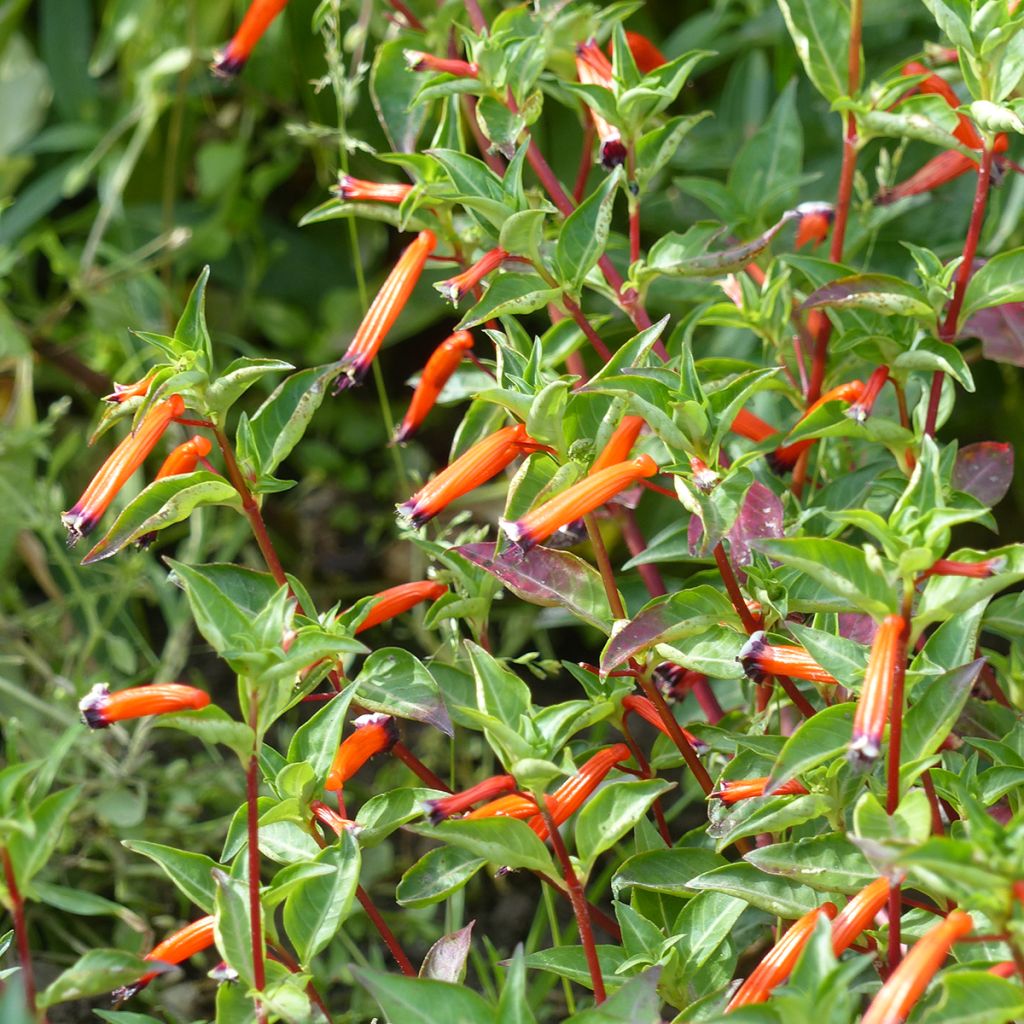
Cuphea ignea seeds - Cigar flower
Cuphea ignea seeds - Cigar flower
Cuphea ignea
Cigar flower
Back-to-school special offer!
Get €10 off for every €50 you spend! And get up to €40 off on a single order.
How does it work?
1. Shop your favourites
Add your favourite plants to your basket. For every €50 you spend (excluding delivery charges, store credit and the plastic-free option), you’ll receive a €10 voucher.
€50 spent = €10 voucher
€100 spent = €20 voucher
€150 spent = €30 voucher
€200 spent = €40 voucher
2. Place your order
Once your basket reaches one of the spending thresholds, place your order. You can even choose your delivery date!
3. Receive your voucher
As soon as your order has been shipped, you’ll receive an email containing your personal voucher code and its value.
4. Use it on your next order
Your voucher is valid for 90 days from the date you receive it. It can be used once only, on a new order worth at least the value of the voucher, excluding delivery charges.
Please note: Vouchers can be combined with other offers, but cannot be split or refunded.
Home or relay delivery (depending on size and destination)
Important: You may be charged customs duties by your country’s customs authorities upon delivery.
Schedule delivery date,
and select date in basket
This plant carries a 6 months recovery warranty
More information
We guarantee the quality of our plants for a full growing cycle, and will replace at our expense any plant that fails to recover under normal climatic and planting conditions.
Would this plant suit my garden?
Set up your Plantfit profile →
Description
Cuphea ignea, commonly called the cigar plant, is a small shrub native to Mexico, highly prized in frost-free regions. It forms a compact clump not exceeding 60cm in height and barely less in width. Its evergreen, dense, dark green foliage provides an ideal backdrop, creating a remarkable contrast with its dazzling flowering. From late spring to autumn, the plant is covered in a multitude of slender, elongated, intense red flowers. It can only be grown in the ground in the mildest areas; elsewhere, it must be planted in a pot to protect it from winter cold. It is otherwise undemanding; it enjoys a very sunny position and requires regular watering during the summer. Sowing has a high success rate, although the very fine seeds are somewhat tricky to handle.
The Cuphea genus, with over 250 species, belongs to the Lythraceae family, which includes both herbaceous plants and woody species suited to temperate to warm climates, such as Pomegranate, with its flowers or fruits, and crape myrtle (Lagerstroemia) with its magnificent summer blooms. Cuphea ignea (synonym Cuphea platycentra) is native to Mexico and the West Indies, where it flowers almost continuously throughout the year. Its many common names - Chinese match, cigar herb, or firecracker plant - stem from the distinctive morphology of its tubular, bright orange-red flowers. With its flared tip, marked with white and a purple edge, from which a few dark stamens emerge, the flower does indeed resemble a glowing cigar. Measuring approximately 3cm in length, the flowers begin to open in favourable climates from April to May and continue to renew until September-October. They appear in the axils of the leaves, whose deep to dark green colour particularly highlights them. The evergreen leaves are elliptical to lanceolate with a pointed tip and measure 3 to 7cm in length, while their surface is satiny to glossy. The plant branches easily and forms a dense, somewhat irregular clump, reaching about 60cm in height with an equivalent spread. A legacy of its tropical origin, it tolerates heat very well and, when grown in open ground, withstands periods of moderate drought. It prefers full sun or very light shade in southern climates and moist, well-drained, neutral to slightly acidic soil, not tolerating excess lime.
The cigar plant adapts equally well to outdoor or indoor cultivation. Indoors, it thrives in a very bright location, at a temperature between 18 and 24 °C. Water to keep the substrate slightly moist, allowing the surface to dry out between waterings, with standard ambient humidity. It must be brought indoors as soon as night-time temperatures drop below 5 to 7 °C. In sheltered areas, you can plant it in borders with other tender plants such as Streptosolen jamesonii with its striking orange flowers, or to create a strong colour contrast, with Cape Leadwort 'Dark Blue' with its astonishing blue blooms. Cuphea ignea is also an excellent choice for containers on a terrace or balcony. To create an exotic scene, grow it alongside citrus trees that can overwinter with it in a conservatory.
Report an error about the product description
Cuphea ignea seeds - Cigar flower in pictures
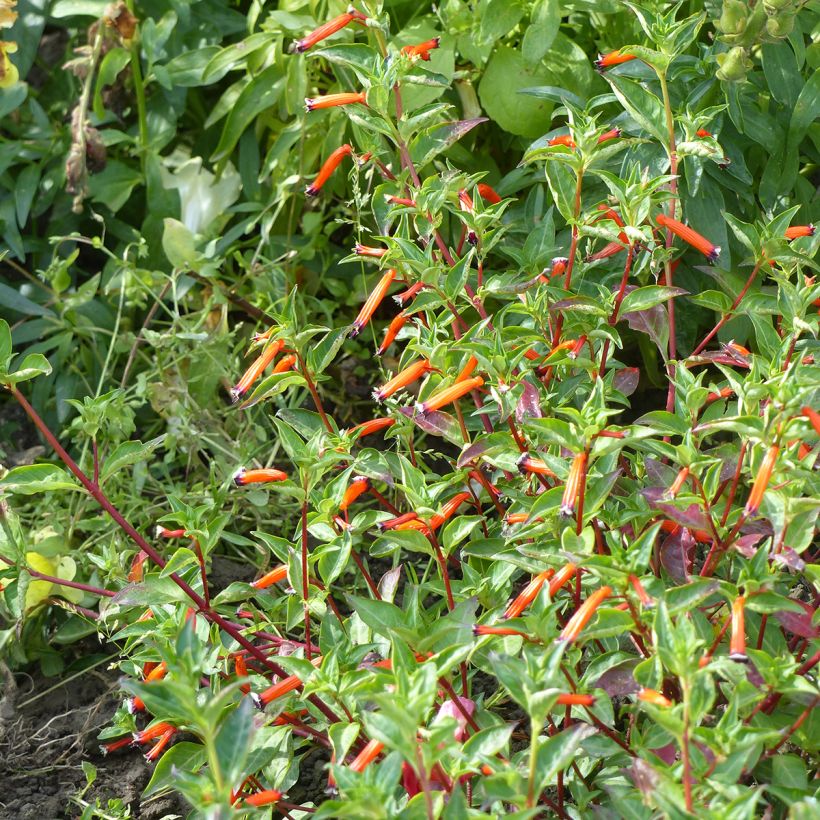
Flowering
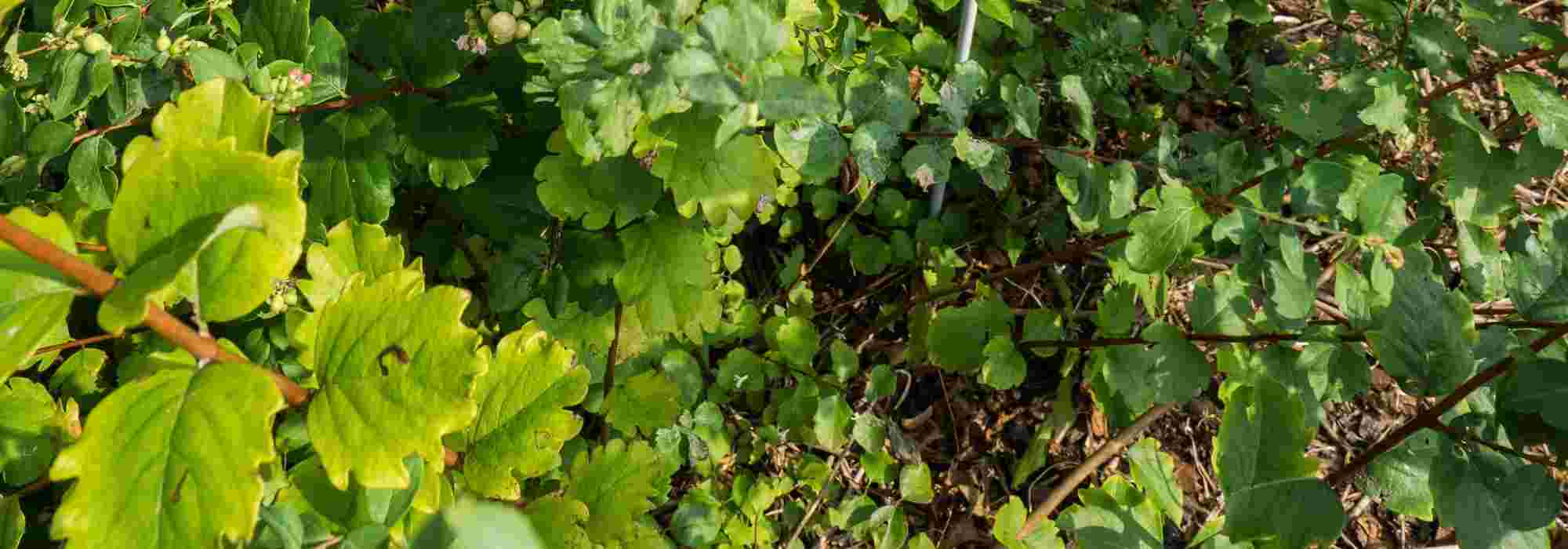
Foliage
Plant habit
Botanical data
Cuphea
ignea
Lythraceae
Cigar flower
Cuphea platycentra
Central America
Planting and care
Sow your Cuphea lanceolata from early February to April in seed compost (neutral to slightly acidic pH, around 6 to 6.5), barely covering the seeds with a very fine layer of compost or vermiculite, as light is necessary for germination. Germination takes 7 to 14 days at a temperature of 20°C to 25°C. Light encourages germination, and warmth is essential; otherwise, germination will take longer (21 days at 16-18°C). It can be helpful to enclose the sowing in a polythene bag or place the seed tray in a mini propagator. After four weeks, the seeds will no longer produce anything. The success rate with fresh seeds is high: from 60 to 80%. Flowering appears between 10 and 14 weeks after sowing.
Once they are sufficiently developed to handle, prick out the seedlings into 7.5cm pots and grow them on in a cooler environment, potting on if necessary. For planting outdoors, gradually acclimatise the young plants to outside conditions and transplant them at the end of spring, after the frosts. Space them 25cm apart. Choose a well-drained soil in a sheltered spot, in full sun or partial shade, but out of the scorching sun.
Cuphea lanceolata grows well in a greenhouse or conservatory, in pots 18 to 20cm in diameter. The temperature should not drop below 5 to 7°C in winter.
Sowing period
Intended location
Planting & care advice
-

-
-
-

-
-
-

-

This item has not been reviewed yet - be the first to leave a review about it.
Recently viewed products
Haven't found what you were looking for?
Hardiness is the lowest winter temperature a plant can endure without suffering serious damage or even dying. However, hardiness is affected by location (a sheltered area, such as a patio), protection (winter cover) and soil type (hardiness is improved by well-drained soil).

The flowering period indicated on our website applies to countries and regions located in USDA zone 8 (France, the United Kingdom, Ireland, the Netherlands, etc.)
It will vary according to where you live:- In zones 9 to 10 (Italy, Spain, Greece, etc.), flowering will occur about 2 to 4 weeks earlier.
- In zones 6 to 7 (Germany, Poland, Slovenia, and lower mountainous regions), flowering will be delayed by 2 to 3 weeks.
- In zone 5 (Central Europe, Scandinavia), blooming will be delayed by 3 to 5 weeks.
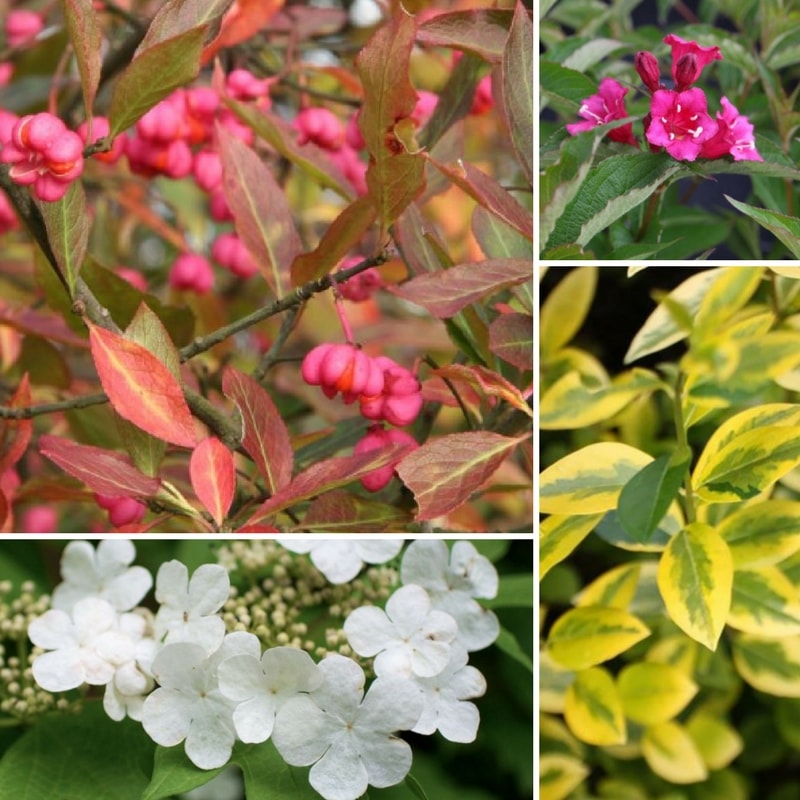
In temperate climates, pruning of spring-flowering shrubs (forsythia, spireas, etc.) should be done just after flowering.
Pruning of summer-flowering shrubs (Indian Lilac, Perovskia, etc.) can be done in winter or spring.
In cold regions as well as with frost-sensitive plants, avoid pruning too early when severe frosts may still occur.
The planting period indicated on our website applies to countries and regions located in USDA zone 8 (France, United Kingdom, Ireland, Netherlands).
It will vary according to where you live:
- In Mediterranean zones (Marseille, Madrid, Milan, etc.), autumn and winter are the best planting periods.
- In continental zones (Strasbourg, Munich, Vienna, etc.), delay planting by 2 to 3 weeks in spring and bring it forward by 2 to 4 weeks in autumn.
- In mountainous regions (the Alps, Pyrenees, Carpathians, etc.), it is best to plant in late spring (May-June) or late summer (August-September).
The harvesting period indicated on our website applies to countries and regions in USDA zone 8 (France, England, Ireland, the Netherlands).
In colder areas (Scandinavia, Poland, Austria...) fruit and vegetable harvests are likely to be delayed by 3-4 weeks.
In warmer areas (Italy, Spain, Greece, etc.), harvesting will probably take place earlier, depending on weather conditions.
The sowing periods indicated on our website apply to countries and regions within USDA Zone 8 (France, UK, Ireland, Netherlands).
In colder areas (Scandinavia, Poland, Austria...), delay any outdoor sowing by 3-4 weeks, or sow under glass.
In warmer climes (Italy, Spain, Greece, etc.), bring outdoor sowing forward by a few weeks.
Shipping country and language
Your country of residence may be:
Your country of residence is:
For a better user experience on our website, you can select:
Your shipping country:
-
 Austria
-
 Belgium
-
 Bosnia & Herzegovina
-
 Bulgaria
-
 Croatia
-
 Cyprus
-
 Czechia
-
 Denmark
-
 Estonia
-
 Finland
-
 France
-
 Germany
-
 Greece
-
 Hungary
-
 Iceland
-
 Ireland
-
 Italy
Italy
-
 Latvia
-
 Liechtenstein
-
 Lithuania
-
 Luxembourg
-
 Malta
Malta
-
 Netherlands
-
 Poland
-
 Portugal
-
 Romania
-
 Serbia
-
 Slovakia
-
 Slovenia
-
 Spain
Spain
-
 Sweden
-
 Switzerland
Language:
-
French
-
 English
-
Spanish
-
Italian
-
German
-
Portuguese
-
Dutch
-
Finnish
My Account
Hello
My wish lists
My cart
Log in / Register
Existing customer?
This form is protected by reCAPTCHA - the Google Privacy Policy and Terms of Service apply.
New customer?
Create an account to track your orders, access our customer service and, if you wish, make the most of our upcoming offers.