Fraxinus excelsior Foliis Aureis - Ash
Fraxinus excelsior Foliis Aureis - Ash
Fraxinus excelsior Foliis Aureis
European Ash, Common Ash
Back-to-school special offer!
Get €10 off for every €50 you spend! And get up to €40 off on a single order.
How does it work?
1. Shop your favourites
Add your favourite plants to your basket. For every €50 you spend (excluding delivery charges, store credit and the plastic-free option), you’ll receive a €10 voucher.
€50 spent = €10 voucher
€100 spent = €20 voucher
€150 spent = €30 voucher
€200 spent = €40 voucher
2. Place your order
Once your basket reaches one of the spending thresholds, place your order. You can even choose your delivery date!
3. Receive your voucher
As soon as your order has been shipped, you’ll receive an email containing your personal voucher code and its value.
4. Use it on your next order
Your voucher is valid for 90 days from the date you receive it. It can be used once only, on a new order worth at least the value of the voucher, excluding delivery charges.
Please note: Vouchers can be combined with other offers, but cannot be split or refunded.
Why not try an alternative variety in stock?
View all →
Available in 1 sizes
Available in 1 sizes
Available in 2 sizes
Available in 1 sizes
Available in 1 sizes
Available in 1 sizes
Available in 1 sizes
Available in 1 sizes
Available in 1 sizes
Available in 1 sizes
This plant carries a 24 months recovery warranty
More information
We guarantee the quality of our plants for a full growing cycle, and will replace at our expense any plant that fails to recover under normal climatic and planting conditions.
Would this plant suit my garden?
Set up your Plantfit profile →
Description
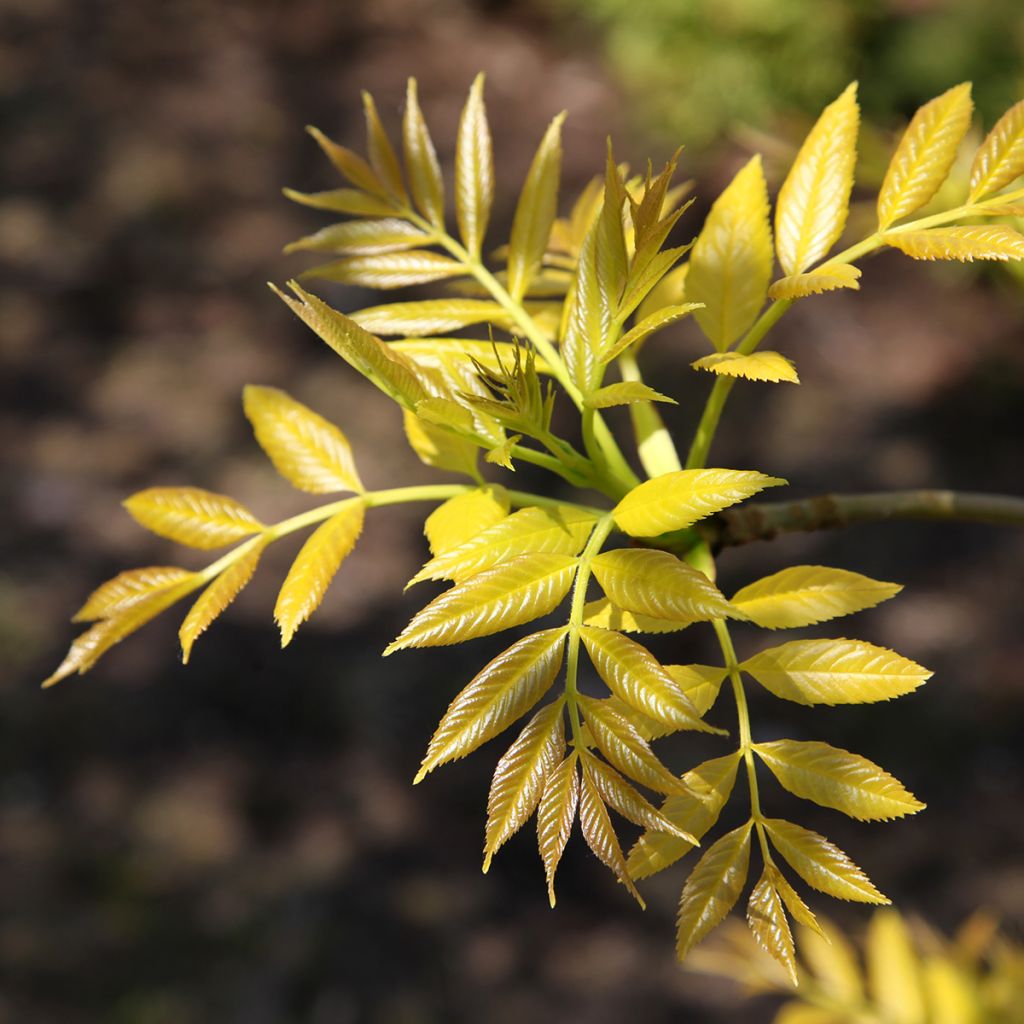
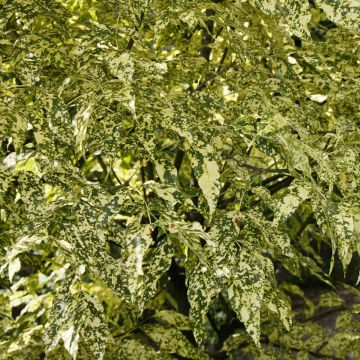
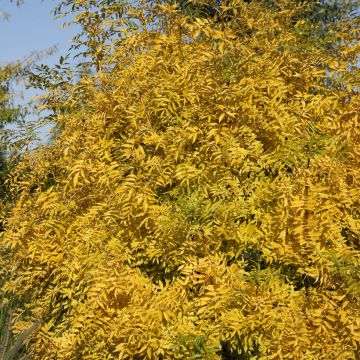
Fraxinus excelsior 'Foliis Aureis', also known as the Golden Common Ash, forms a beautiful tree reaching a height of 6 to 8 m, appreciated for the decorative value of its foliage and graceful silhouette. In spring, it displays intense lemon yellow foliage, then in summer the young light green leaves stand out against the darker background of the older leaves. In autumn, the leaves light up with warm shades of yellow, but sometimes they do not change colour until the first frost. All these colour changes create life throughout the seasons, to delight the eyes. it is slow-growing, choose a suitable location to plant it in the garden where it can provide a beautiful specimen, low-maintenance and attractive all year round.
Fraxinus excelsior, commonly known as the common ash or tall ash, is a tree of the olive family, just like the olive tree, jasmine, privet or lilac. It is mainly found in Europe, Scandinavia and Russia, where it is common on the banks of rivers and in forests. It can reach a height of 20 to 30 metres and live up to 150 to 200 years. Its trunk is usually straight and its crown elongated.
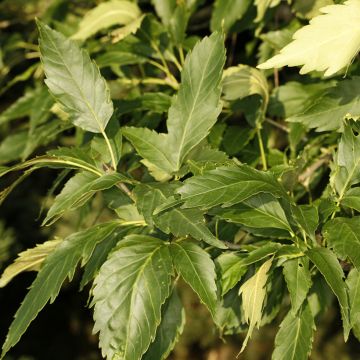
The 'Foliis Aureis' variety, whose origin is unknown, is characterised by a confusing nomenclature. The name "Foliis Aureis" was first used in nursery catalogues in the late 1880s. However, the synonym 'Aurea' was mentioned as early as 1807, but it was used to refer to the yellow-leaved variety and also to the one called 'Jaspidea', which has yellow shoots and green leaves. Fraxinus excelsior 'Foliis Aureis' forms a tree with a compact and regular crown, rounded when young and more spreading as it ages. It is slow-growing and reaches at maturity (15 to 20 years), a height of 6 to 8 m with a spread of about 5 to 7 m. The branches are greenish-grey and rigid and the leaves are large and pinnate, composed of 7 to 13 leaflets, elliptical, 3 to 5 cm long and pointed at the end. In spring, the leaves emerge a beautiful intense lemon yellow, then turn green as the season progresses. In summer, its young light green leaves stand out from the bright green of the older ones. Autumn is characterised by a colour change to warm shades of yellow, but sometimes the leaves do not change and remain green until the first frost. Occasionally, this creates a mix of spectacular colours. This tree does not produce flowers or fruits.
The Golden Common Ash is a medium-sized tree, which grows in a free form, making it an excellent choice for nature lovers. Its elegant silhouette and colourful foliage bring a touch of originality to your landscape. It is robust and resistant to winter cold (down to -30C°). It tolerates slightly acidic to alkaline soils and requires deep, rich, and moist soils with good drainage. A sunny exposure is preferable, but it can tolerate a slightly shaded location. It is sensitive to stagnant water and drought conditions, with leaves burning in high heat. Plant alone or in groups for filtered shade or to add colour and light to the garden. It is recommended for gardens, parks, streets, squares, and large lawns.
Report an error about the product description
Plant habit
Foliage
Safety measures
Botanical data
Fraxinus
excelsior
Foliis Aureis
Oleaceae
European Ash, Common Ash
Fraxinus excelsior 'Aurea'
Cultivar or hybrid
atteinterespiratoire
Cette plante peut entraîner des symptômes allergiques.
Evitez de la planter si vous ou vos proches souffrez de rhinite saisonnière ("rhume des foins").
Davantage d'informations sur https://plantes-risque.info
Planting and care
Plant your Fraxinus excelsior Foliis Aureis in autumn or spring, choose a clear location, in non-scorching sunlight, where the soil is deep and keep in mind the space it will take up in the long term. If necessary, create a drainage pit with stones if your soil is suffocating. If your soil is poor, adding leaf compost will be beneficial. Water regularly during the summer following planting and make sure to protect it from prolonged droughts for another year, mulching can help keep the base moist and space out watering. It is important to keep in mind that this tree needs consistently moist soil, at least in depth. It is perfectly frost-resistant. Pruning involves balancing the tree's habit every 3 years or so by aerating the centre of the canopy.
Planting period
Intended location
Care
Planting & care advice
-

-
-
-
-
-
-

-
This item has not been reviewed yet - be the first to leave a review about it.
Recently viewed products
Haven't found what you were looking for?
Hardiness is the lowest winter temperature a plant can endure without suffering serious damage or even dying. However, hardiness is affected by location (a sheltered area, such as a patio), protection (winter cover) and soil type (hardiness is improved by well-drained soil).

The flowering period indicated on our website applies to countries and regions located in USDA zone 8 (France, the United Kingdom, Ireland, the Netherlands, etc.)
It will vary according to where you live:- In zones 9 to 10 (Italy, Spain, Greece, etc.), flowering will occur about 2 to 4 weeks earlier.
- In zones 6 to 7 (Germany, Poland, Slovenia, and lower mountainous regions), flowering will be delayed by 2 to 3 weeks.
- In zone 5 (Central Europe, Scandinavia), blooming will be delayed by 3 to 5 weeks.
In temperate climates, pruning of spring-flowering shrubs (forsythia, spireas, etc.) should be done just after flowering.
Pruning of summer-flowering shrubs (Indian Lilac, Perovskia, etc.) can be done in winter or spring.
In cold regions as well as with frost-sensitive plants, avoid pruning too early when severe frosts may still occur.
The planting period indicated on our website applies to countries and regions located in USDA zone 8 (France, United Kingdom, Ireland, Netherlands).
It will vary according to where you live:
- In Mediterranean zones (Marseille, Madrid, Milan, etc.), autumn and winter are the best planting periods.
- In continental zones (Strasbourg, Munich, Vienna, etc.), delay planting by 2 to 3 weeks in spring and bring it forward by 2 to 4 weeks in autumn.
- In mountainous regions (the Alps, Pyrenees, Carpathians, etc.), it is best to plant in late spring (May-June) or late summer (August-September).
The harvesting period indicated on our website applies to countries and regions in USDA zone 8 (France, England, Ireland, the Netherlands).
In colder areas (Scandinavia, Poland, Austria...) fruit and vegetable harvests are likely to be delayed by 3-4 weeks.
In warmer areas (Italy, Spain, Greece, etc.), harvesting will probably take place earlier, depending on weather conditions.
The sowing periods indicated on our website apply to countries and regions within USDA Zone 8 (France, UK, Ireland, Netherlands).
In colder areas (Scandinavia, Poland, Austria...), delay any outdoor sowing by 3-4 weeks, or sow under glass.
In warmer climes (Italy, Spain, Greece, etc.), bring outdoor sowing forward by a few weeks.
Shipping country and language
Your country of residence may be:
Your country of residence is:
For a better user experience on our website, you can select:
Your shipping country:
-
 Austria
-
 Belgium
-
 Bosnia & Herzegovina
-
 Bulgaria
-
 Croatia
-
 Cyprus
-
 Czechia
-
 Denmark
-
 Estonia
-
 Finland
-
 France
-
 Germany
-
 Greece
-
 Hungary
-
 Iceland
-
 Ireland
-
 Italy
Italy
-
 Latvia
-
 Liechtenstein
-
 Lithuania
-
 Luxembourg
-
 Malta
Malta
-
 Netherlands
-
 Poland
-
 Portugal
-
 Romania
-
 Serbia
-
 Slovakia
-
 Slovenia
-
 Spain
Spain
-
 Sweden
-
 Switzerland
Language:
-
French
-
 English
-
Spanish
-
Italian
-
German
-
Portuguese
-
Dutch
-
Finnish
My Account
Hello
My wish lists
My cart
Log in / Register
Existing customer?
This form is protected by reCAPTCHA - the Google Privacy Policy and Terms of Service apply.
New customer?
Create an account to track your orders, access our customer service and, if you wish, make the most of our upcoming offers.