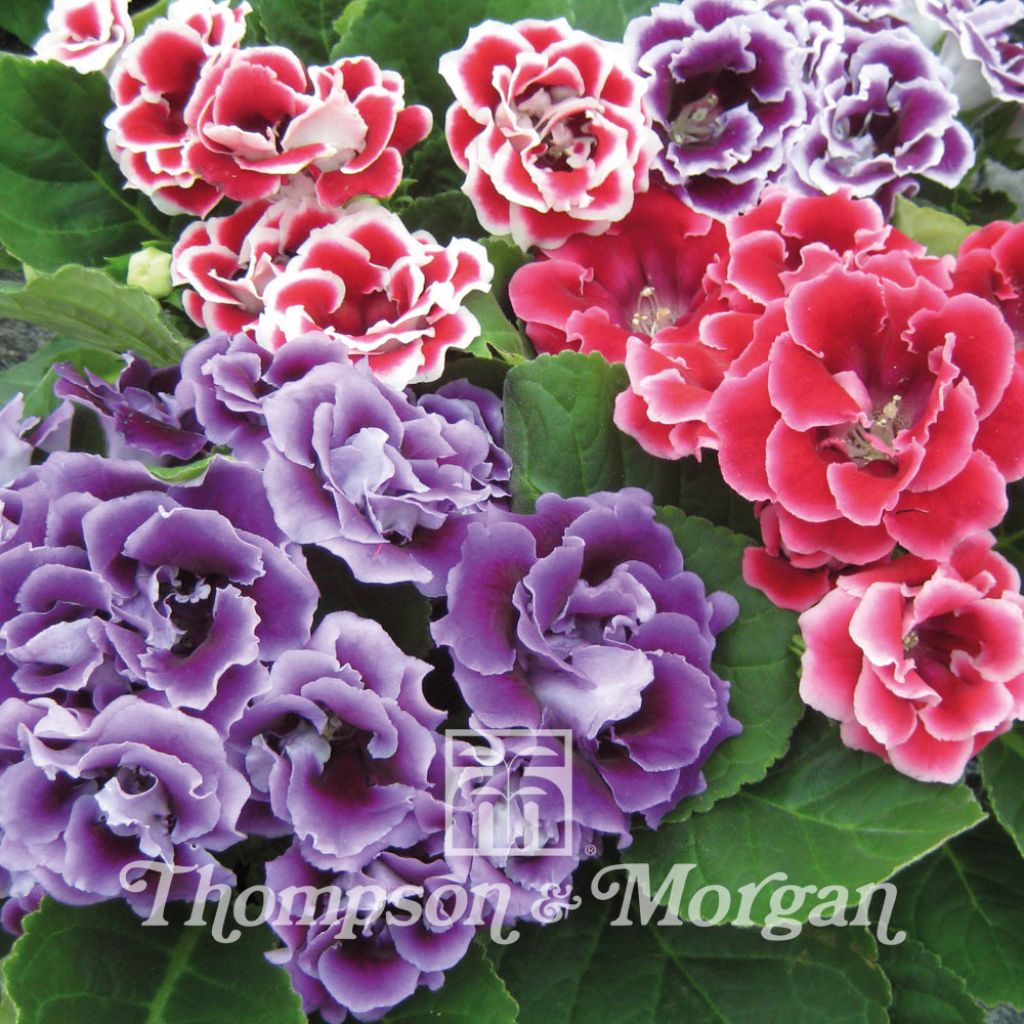
Gloxinia Brocade Double Mixed seeds
Gloxinia Brocade Double Mixed seeds
Gloxinia speciosa Brocade Double Mixed F1 Hybrid
Florist's Gloxinia, Gloxinia, Brazilian Gloxinia
Back-to-school special offer!
Get €10 off for every €50 you spend! And get up to €40 off on a single order.
How does it work?
1. Shop your favourites
Add your favourite plants to your basket. For every €50 you spend (excluding delivery charges, store credit and the plastic-free option), you’ll receive a €10 voucher.
€50 spent = €10 voucher
€100 spent = €20 voucher
€150 spent = €30 voucher
€200 spent = €40 voucher
2. Place your order
Once your basket reaches one of the spending thresholds, place your order. You can even choose your delivery date!
3. Receive your voucher
As soon as your order has been shipped, you’ll receive an email containing your personal voucher code and its value.
4. Use it on your next order
Your voucher is valid for 90 days from the date you receive it. It can be used once only, on a new order worth at least the value of the voucher, excluding delivery charges.
Please note: Vouchers can be combined with other offers, but cannot be split or refunded.
Why not try an alternative variety in stock?
View all →
Available in 1 sizes
Available in 1 sizes
Available in 1 sizes
Available in 1 sizes
Available in 2 sizes
Available in 1 sizes
Available in 1 sizes
Available in 1 sizes
Available in 2 sizes
Available in 2 sizes
This plant carries a 6 months recovery warranty
More information
We guarantee the quality of our plants for a full growing cycle, and will replace at our expense any plant that fails to recover under normal climatic and planting conditions.
Would this plant suit my garden?
Set up your Plantfit profile →
Description
The Elegant Gloxinia excels in this beautiful selection of Gloxinias Brocade Double Mixed F1 Hybrid, with double flowers in 5 solid or bicolour shades of violet, red, pink, violet/white, and red/white, on dwarf and compact plants. The large double bell-shaped flowers are nestled in a velvety, dark green foliage throughout the season. These sumptuous and dramatic perennials are spectacular indoors or on window sills, in partial shade.
Gloxinia speciosa, or Elegant Gloxinia, belongs to the gesneriad family and is native to Brazil. This tuberous and frost-tender perennial has given rise to numerous cultivars since the 19th century, that have quickly become exceptional indoor plants. The 'Brocade Double Mixed F1 Hybrid' mixture produces dwarf plants, not exceeding 20 cm (8in) in all directions. The flowers resemble large velvety bells appearing in spring and throughout summer, in the axils of the leaves. They can reach 8 cm (3in) in diameter and are borne on short peduncles, displaying intense solid colours or wide margins of white, depending on the individual plant. Crimson red, vibrant pink, violet, or mauve hues paint their open corollas around a speckled throat. From the base to the petal edges, each shade gradually lightens towards white, sometimes reduced to an imperceptible border. These flowers open against a cluster of broad, fleshy, and velvety dark green leaves. Their veins and margins are visible. The leaves are oval to oblong and they wither in autumn and disappear with the arrival of cool temperatures. Only the round and flattened tubers persist in the soil, which should be kept dry until the start of growth in spring.
Gloxinias are stunning plants, robust and easy to overwinter, even indoors. Few plants can boast such a theatrical appearance, and it is sometimes difficult, if not impossible, to combine them with other plants. They will look great in planters and on window sills, protected from direct sunlight. They are perfect for replacing geraniums in areas with limited sunlight.
Report an error about the product description
Flowering
Foliage
Plant habit
Botanical data
Gloxinia
speciosa
Brocade Double Mixed F1 Hybrid
Gesneriaceae
Florist's Gloxinia, Gloxinia, Brazilian Gloxinia
Cultivar or hybrid
Planting and care
Sowing:
Sow gloxinia seeds from December to February.
Sow the seeds on the surface of good moist soil, in pots or trays. Do not cover the seeds. Place them in a propagator or enclose them in a polythene bag, maintaining a temperature of around 24-27°C (75.2-80.6°F). After sowing, do not exclude light as it promotes germination. Keep the surface of the compost moist but not waterlogged; germination will generally take between 15 and 60 days.
WARNING: The seeds are as fine as dust. To open your packet without losing any seeds, hold it over a sheet of white paper, cut along the three sides of the inner envelope and carefully open it flat. Tap the packet to dislodge the seeds.
When the young plants are large enough to handle, transplant them into 7.5 cm (3in) pots or trays. Then pot them on to 13 cm (5in) pots and grow them in a greenhouse or on a windowsill.
Cultivation:
Florist's gloxinia is a frost-sensitive plant, but it can tolerate temperatures around 21°C (69.8°F) in summer. This same temperature should be provided in spring for growth to resume. That's why it's easy to grow indoors.
It is possible to take it outside as soon as it is warm enough. Gloxinia is sensitive to high temperatures that dry out the air, but it needs some light to thrive, without being exposed to direct sunlight, especially in summer. This plant likes humid atmospheres and partial shade. If you grow this plant indoors, it is a good idea to spray water on the leaves (not on the flowers, as they would be damaged) or to place it on a bed of clay pebbles or stones in a tray filled with water.
Water twice a week or more during flowering, then gradually reduce and completely stop when the foliage disappears and the rhizome enters dormancy. A weekly feed during summer is beneficial to support flowering.
When the above-ground parts of the florist's gloxinia have withered, store the pot in a dry and warm place (15°C (59°F)) until the following spring, when you can repot it in rich and light soil.
Sowing period
Intended location
Planting & care advice
-
-
-
-
-
-

-
-
This item has not been reviewed yet - be the first to leave a review about it.
Recently viewed products
Haven't found what you were looking for?
Hardiness is the lowest winter temperature a plant can endure without suffering serious damage or even dying. However, hardiness is affected by location (a sheltered area, such as a patio), protection (winter cover) and soil type (hardiness is improved by well-drained soil).

The flowering period indicated on our website applies to countries and regions located in USDA zone 8 (France, the United Kingdom, Ireland, the Netherlands, etc.)
It will vary according to where you live:- In zones 9 to 10 (Italy, Spain, Greece, etc.), flowering will occur about 2 to 4 weeks earlier.
- In zones 6 to 7 (Germany, Poland, Slovenia, and lower mountainous regions), flowering will be delayed by 2 to 3 weeks.
- In zone 5 (Central Europe, Scandinavia), blooming will be delayed by 3 to 5 weeks.
In temperate climates, pruning of spring-flowering shrubs (forsythia, spireas, etc.) should be done just after flowering.
Pruning of summer-flowering shrubs (Indian Lilac, Perovskia, etc.) can be done in winter or spring.
In cold regions as well as with frost-sensitive plants, avoid pruning too early when severe frosts may still occur.
The planting period indicated on our website applies to countries and regions located in USDA zone 8 (France, United Kingdom, Ireland, Netherlands).
It will vary according to where you live:
- In Mediterranean zones (Marseille, Madrid, Milan, etc.), autumn and winter are the best planting periods.
- In continental zones (Strasbourg, Munich, Vienna, etc.), delay planting by 2 to 3 weeks in spring and bring it forward by 2 to 4 weeks in autumn.
- In mountainous regions (the Alps, Pyrenees, Carpathians, etc.), it is best to plant in late spring (May-June) or late summer (August-September).
The harvesting period indicated on our website applies to countries and regions in USDA zone 8 (France, England, Ireland, the Netherlands).
In colder areas (Scandinavia, Poland, Austria...) fruit and vegetable harvests are likely to be delayed by 3-4 weeks.
In warmer areas (Italy, Spain, Greece, etc.), harvesting will probably take place earlier, depending on weather conditions.
The sowing periods indicated on our website apply to countries and regions within USDA Zone 8 (France, UK, Ireland, Netherlands).
In colder areas (Scandinavia, Poland, Austria...), delay any outdoor sowing by 3-4 weeks, or sow under glass.
In warmer climes (Italy, Spain, Greece, etc.), bring outdoor sowing forward by a few weeks.
Shipping country and language
Your country of residence may be:
Your country of residence is:
For a better user experience on our website, you can select:
Your shipping country:
-
 Austria
-
 Belgium
-
 Bosnia & Herzegovina
-
 Bulgaria
-
 Croatia
-
 Cyprus
-
 Czechia
-
 Denmark
-
 Estonia
-
 Finland
-
 France
-
 Germany
-
 Greece
-
 Hungary
-
 Iceland
-
 Ireland
-
 Italy
Italy
-
 Latvia
-
 Liechtenstein
-
 Lithuania
-
 Luxembourg
-
 Malta
Malta
-
 Netherlands
-
 Poland
-
 Portugal
-
 Romania
-
 Serbia
-
 Slovakia
-
 Slovenia
-
 Spain
Spain
-
 Sweden
-
 Switzerland
Language:
-
French
-
 English
-
Spanish
-
Italian
-
German
-
Portuguese
-
Dutch
-
Finnish
My Account
Hello
My wish lists
My cart
Log in / Register
Existing customer?
This form is protected by reCAPTCHA - the Google Privacy Policy and Terms of Service apply.
New customer?
Create an account to track your orders, access our customer service and, if you wish, make the most of our upcoming offers.