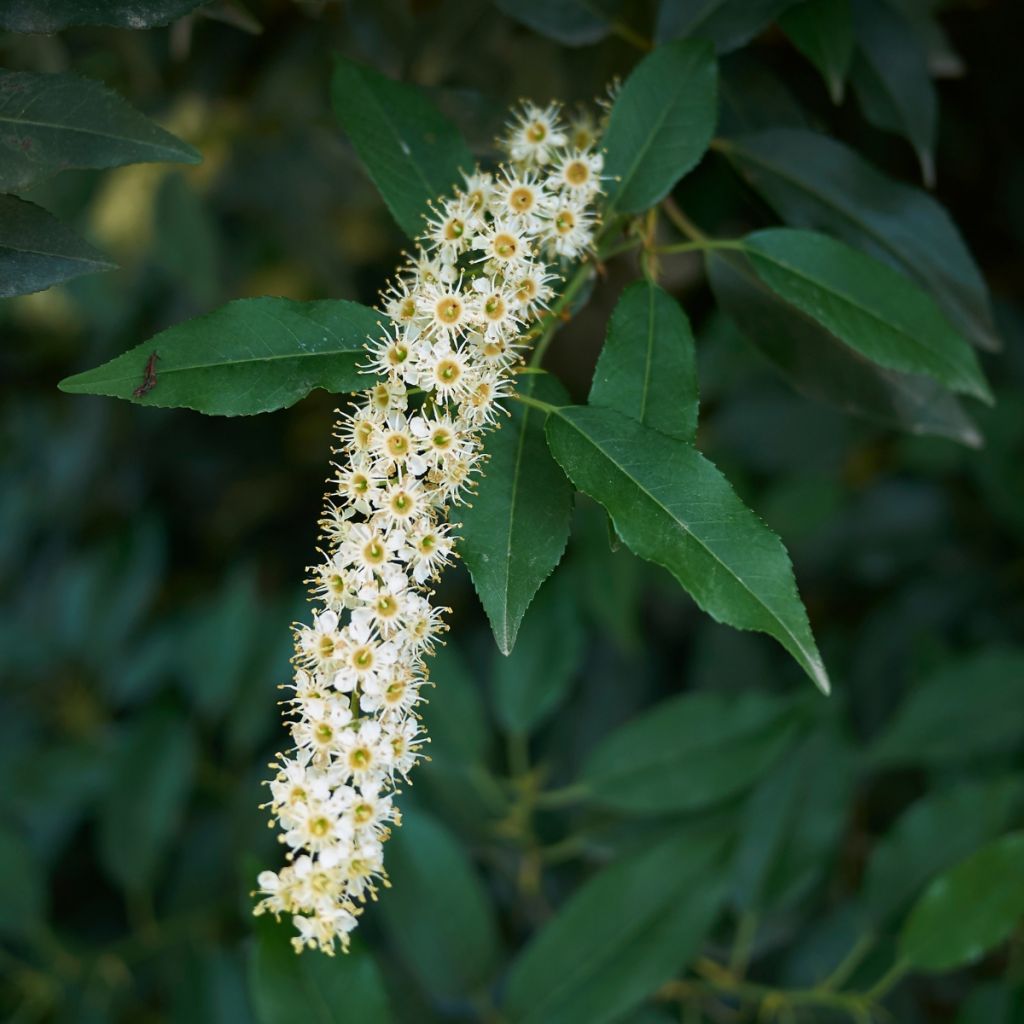
Prunus lusitanica subsp. lusitanica seeds - Portugal laurel
Prunus lusitanica subsp. lusitanica seeds - Portugal laurel
Prunus lusitanica subsp. lusitanica
Portugal Laurel, Azores Laurel
Back-to-school special offer!
Get €10 off for every €50 you spend! And get up to €40 off on a single order.
How does it work?
1. Shop your favourites
Add your favourite plants to your basket. For every €50 you spend (excluding delivery charges, store credit and the plastic-free option), you’ll receive a €10 voucher.
€50 spent = €10 voucher
€100 spent = €20 voucher
€150 spent = €30 voucher
€200 spent = €40 voucher
2. Place your order
Once your basket reaches one of the spending thresholds, place your order. You can even choose your delivery date!
3. Receive your voucher
As soon as your order has been shipped, you’ll receive an email containing your personal voucher code and its value.
4. Use it on your next order
Your voucher is valid for 90 days from the date you receive it. It can be used once only, on a new order worth at least the value of the voucher, excluding delivery charges.
Please note: Vouchers can be combined with other offers, but cannot be split or refunded.
Why not try an alternative variety in stock?
View all →
Available in 1 sizes

Available in 1 sizes

Available in 1 sizes

Available in 1 sizes

Available in 1 sizes

Available in 1 sizes

Available in 1 sizes

Available in 1 sizes

Available in 1 sizes

Available in 1 sizes
This plant carries a 6 months recovery warranty
More information
We guarantee the quality of our plants for a full growing cycle, and will replace at our expense any plant that fails to recover under normal climatic and planting conditions.
Would this plant suit my garden?
Set up your Plantfit profile →
Description
Prunus lusitanica, Portuguese Laurel, is a large evergreen shrub, ideal for creating dense, elegant hedges in gardens with a mild climate. With its glossy, dark green foliage, reddish young shoots, and clusters of fragrant white flowers, it is perfect for shielding a garden from prying eyes and wind while remaining decorative all year round. Sowing seed is a good idea for gardeners with patience who wish to propagate a reliable and robust shrub at low cost.
Botanically, the Portugal Laurel belongs to the Rosaceae family. The type species is Prunus lusitanica subsp. lusitanica. Among its official botanical synonyms are Cerasus lusitanica, Lauro-cerasus lusitanica, and Padus lusitanica. It is commonly called the Portugal Laurel, and more rarely the Portuguese Plum. It is native to south-western Europe (Portugal, Spain, south-western France, particularly the Basque Country) and north-western Africa (Morocco), as well as the Atlantic islands of Macaronesia. In the wild, it thrives in laurisilva forests and cool ravines, often along mountain streams, on well-drained rocky slopes.
It is an evergreen shrub or small tree, with a habit that is initially bushy and then conical, reaching 4m in height within about ten years in deep soil, and capable of exceeding 6 to 8m in height and spread if left to develop freely. Its growth is moderate, around 20 to 40cm per year under good conditions. The leathery, oval to lanceolate leaves are 6 to 12cm long, finely toothed, glossy dark green on top and lighter beneath. In May-June, it bears long, slender clusters of small fragrant, nectar-rich white flowers. These give way to ovoid berries, 8 mm long, initially green then red, turning almost black when ripe; they are decorative but toxic to humans. Its root system is fibrous, rather superficial but well anchored, allowing it to withstand wind adequately without being invasive to buildings.
The Portugal Laurel takes a little longer to grow from seed than buying ready-formed young plants, but sowing offers real advantages. One packet yields several young shrubs. Each plant gradually adapts to your soil, whether clay-loam, stony, or chalky, provided it is deep and well-drained. Allow 2 to 3 years to obtain young laurels of 30 to 60cm in pots, ready for planting in a hedge, then 6 to 8 years to achieve a screen 2 to 3m tall. Prunus lusitanica tolerates pruning well and can live for many years. Its hardiness is rated at -15°C at its peak.
The Portugal Laurel can be planted in the countryside or in town, on the coast or inland. You can train it as a fairly formal clipped hedge, or let it take on a freer appearance, pruning only every two or three years. To create a varied hedge, combine it, for example, with Photinia serratifolia, Elaeagnus ebbingei, Viburnum tinus ‘Giganteum’ and Pittosporum tobira.
Report an error about the product description
Flowering
Foliage
Plant habit
Botanical data
Prunus
lusitanica subsp. lusitanica
Rosaceae
Portugal Laurel, Azores Laurel
Prunus lusitanica var. hixa, Laurocerasus lusitanica, Cerasus lusitanica, Lauro-cerasus lusitanica, Padus lusitanica
Southern Europe, Mediterranean, Macaronesia, North Africa
Planting and care
Sowing Portuguese Laurel (Prunus lusitanica)
You can sow your seeds either outdoors in autumn or in spring after stratification.
For spring sowing, first soak the seeds for 24 hours in water at room temperature, then place them in the refrigerator for 3 to 4 months, in a small box or sealed bag with slightly damp sand or potting compost. This prolonged cold period helps to break dormancy. In early spring, sow in seed trays or pots, in a fine, well-drained compost (seed compost mixed with a little sand or perlite). Cover the seeds with a thin layer of substrate, 5 to 10mm at most, firm down gently, then water with a fine spray. Place your sowings in a bright, cool spot, sheltered from heavy rain, keeping the mix just moist, never waterlogged. Germination is often slow and staggered, sometimes over several months: do not discard your trays too soon.
As soon as the young plants are large enough to handle, prick them out into individual small pots, keeping as many roots as possible, then continue growing them outdoors in a sheltered position.
Planting and care
Wait until your young Portuguese laurels have filled their pots with roots, usually after 1 to 2 years. Plant them in spring or autumn, outside periods of frost. Choose a spot in sun or partial shade, in deep, loose, well-drained soil, even slightly lime-bearing. Dig a wide hole, loosen the soil well, add a little well-rotted compost if needed, position the root ball without burying the collar, backfill, then water generously. For the first two or three years, water occasionally in summer, especially in light soil, to encourage good rooting; afterwards, the Portuguese Laurel generally copes with rainfall alone, except during prolonged drought. A mulch around the base retains moisture and suppresses competing weeds.
Sowing period
Intended location
Planting & care advice
-

-

-

-

-

-

-

-

This item has not been reviewed yet - be the first to leave a review about it.
Recently viewed products
Haven't found what you were looking for?
Hardiness is the lowest winter temperature a plant can endure without suffering serious damage or even dying. However, hardiness is affected by location (a sheltered area, such as a patio), protection (winter cover) and soil type (hardiness is improved by well-drained soil).

The flowering period indicated on our website applies to countries and regions located in USDA zone 8 (France, the United Kingdom, Ireland, the Netherlands, etc.)
It will vary according to where you live:- In zones 9 to 10 (Italy, Spain, Greece, etc.), flowering will occur about 2 to 4 weeks earlier.
- In zones 6 to 7 (Germany, Poland, Slovenia, and lower mountainous regions), flowering will be delayed by 2 to 3 weeks.
- In zone 5 (Central Europe, Scandinavia), blooming will be delayed by 3 to 5 weeks.
In temperate climates, pruning of spring-flowering shrubs (forsythia, spireas, etc.) should be done just after flowering.
Pruning of summer-flowering shrubs (Indian Lilac, Perovskia, etc.) can be done in winter or spring.
In cold regions as well as with frost-sensitive plants, avoid pruning too early when severe frosts may still occur.
The planting period indicated on our website applies to countries and regions located in USDA zone 8 (France, United Kingdom, Ireland, Netherlands).
It will vary according to where you live:
- In Mediterranean zones (Marseille, Madrid, Milan, etc.), autumn and winter are the best planting periods.
- In continental zones (Strasbourg, Munich, Vienna, etc.), delay planting by 2 to 3 weeks in spring and bring it forward by 2 to 4 weeks in autumn.
- In mountainous regions (the Alps, Pyrenees, Carpathians, etc.), it is best to plant in late spring (May-June) or late summer (August-September).
The harvesting period indicated on our website applies to countries and regions in USDA zone 8 (France, England, Ireland, the Netherlands).
In colder areas (Scandinavia, Poland, Austria...) fruit and vegetable harvests are likely to be delayed by 3-4 weeks.
In warmer areas (Italy, Spain, Greece, etc.), harvesting will probably take place earlier, depending on weather conditions.
The sowing periods indicated on our website apply to countries and regions within USDA Zone 8 (France, UK, Ireland, Netherlands).
In colder areas (Scandinavia, Poland, Austria...), delay any outdoor sowing by 3-4 weeks, or sow under glass.
In warmer climes (Italy, Spain, Greece, etc.), bring outdoor sowing forward by a few weeks.
Shipping country and language
Your country of residence may be:
Your country of residence is:
For a better user experience on our website, you can select:
Your shipping country:
-
 Austria
-
 Belgium
-
 Bosnia & Herzegovina
-
 Bulgaria
-
 Croatia
-
 Cyprus
-
 Czechia
-
 Denmark
-
 Estonia
-
 Finland
-
 France
-
 Germany
-
 Greece
-
 Hungary
-
 Iceland
-
 Ireland
-
 Italy
Italy
-
 Latvia
-
 Liechtenstein
-
 Lithuania
-
 Luxembourg
-
 Malta
Malta
-
 Netherlands
-
 Poland
-
 Portugal
-
 Romania
-
 Serbia
-
 Slovakia
-
 Slovenia
-
 Spain
Spain
-
 Sweden
-
 Switzerland
Language:
-
French
-
 English
-
Spanish
-
Italian
-
German
-
Portuguese
-
Dutch
-
Finnish
My Account
Hello
My wish lists
My cart
Log in / Register
Existing customer?
This form is protected by reCAPTCHA - the Google Privacy Policy and Terms of Service apply.
New customer?
Create an account to track your orders, access our customer service and, if you wish, make the most of our upcoming offers.