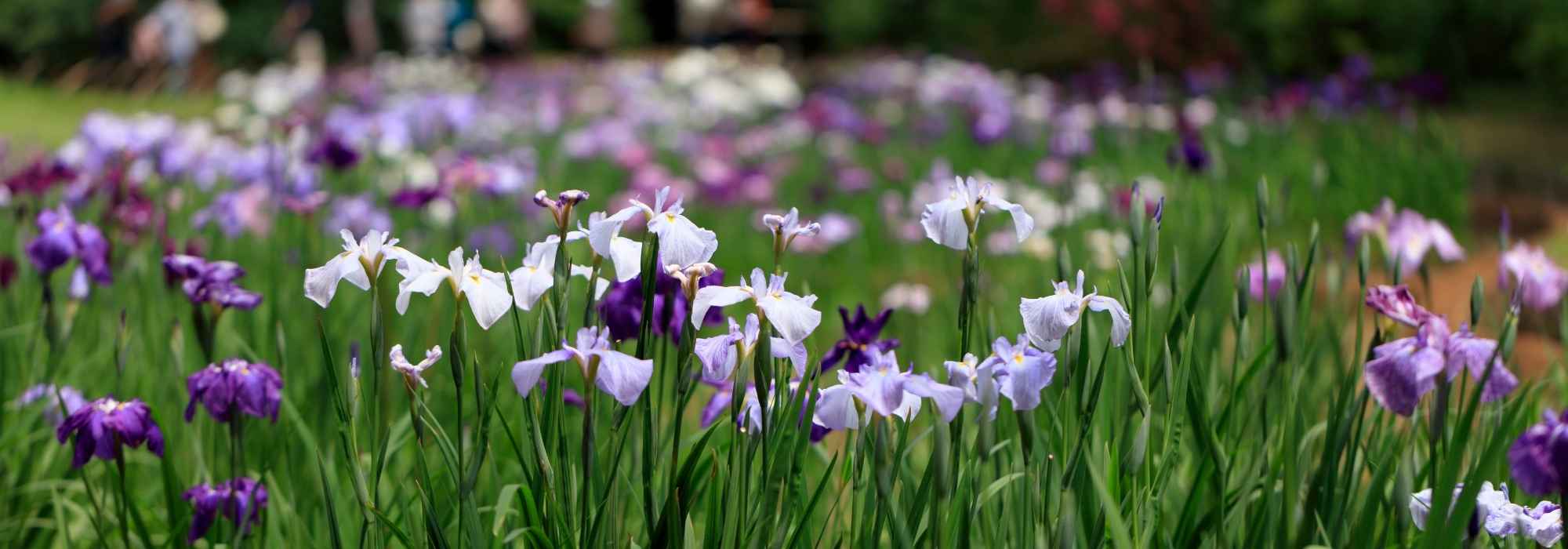
Iris for borders, pond edges, shade… The ultimate guide
Irises for every garden
Contents
Talking about iris means referring to a very large botanical genus comprising more than 300 different species. One immediately pictures large garden irises, the bearded irises, undoubtedly among spring’s most beautiful flowers. But there are more compact types, some bulbous, others rhizomatous, each with a preferred site: dry garden, rock garden, pond edge, perennial bed, low border, natural garden…
What they have in common? All are hardy and often enter dormancy in summer, making them ideal for gardens resilient to increasingly frequent droughts. Here are the ones you absolutely must have in your garden, classified by bed or site type.
For mixed borders and perennial beds: garden irises
Iris germanica is the bearded iris, more commonly called garden iris. It is the best-known and tallest of irises, charming us with its enormous flowers. They are classified into several “families” according to size, with the largest (the Barbata-eliator, often listed as “be”), the intermediates (the Barbata-media, “bm”) and the “bn” or Barbata-nana which make up the dwarf varieties, which I discuss below. They have been extensively hybridised and form a very rich range.
Garden iris has its place in large gardens or medium-sized gardens, depending on variety chosen. They are perfect as cut flowers and also have their place in cut-flower gardens.
Flowering generally takes place in spring, between May and June, depending on climate. Flowers, often large and generous, come in a wide palette of colours: blue, violet, yellow, white, pink, purple, bicolour, and even shades that are almost black or coppery. Some irises are repeat flowering, offering a second flowering in autumn, such as Iris germanica ‘English Cottage’ or Iris ‘Invitation’.
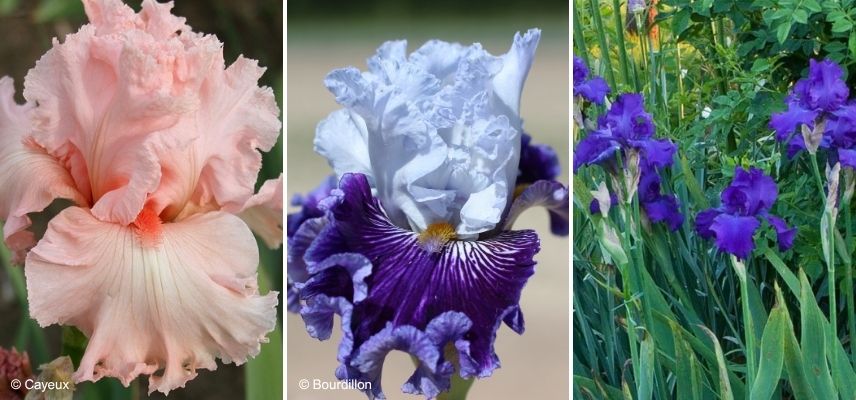
Iris germanica ‘Happenstance’, Iris germanica ‘Polar Shift’, and Iris germanica ‘Mer du Sud’
→ Further reading: our guide Garden iris, bearded iris: planting and care, and Iris germanica, 6 successful pairing ideas.
For low borders, rockeries and planters: dwarf irises
For this purpose, all Iris germanica Barbata-media are suitable, measuring between 40 and 60 cm tall, perfect for creating attractive borders. Their medium size is also ideal for planting on slopes. The smaller ones, the Barbata-nana and Iris reticulata, are mainly used in rockeries or planters.
Intermediate irises
The intermediate irises, the famed Barbata-media, are ideal for beds in small gardens or for low borders. A wide choice again, with colours ranging from orange to blue via purple and white. They grow to 40–60 cm tall.
Lilliput irises
Even smaller, yet worthy cousins of the larger irises thanks to their sublime colours, bicoloured or not, the lilliput irises are dwarf irises. There are many of them and they give plenty of options for integrating them into rockeries or planters. They do not exceed 40 cm in height.
Les Iris reticulata
Perfect for dressing rockeries thanks to their small size (approx. 15 cm), Iris reticulata are among spring’s delights when planted in planters. They prefer a partly shaded position, ideally on calcareous, very free-draining soil. Very early-flowering, they are nectariferous at a time when pollinators are returning to the garden — a boon! They tolerate summer heat as well as winter frosts. Dark blue streaked with white, cultivars are now also available in yellow-and-white or pale blue.
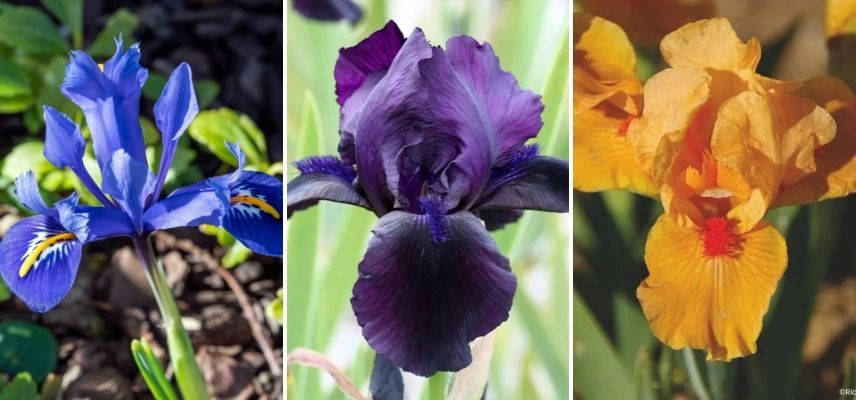
Iris reticulata ‘Harmony’, Iris germanica ‘Black Watch’ and Iris lilliput ‘Allumez le Feu’
→ Read our feature Iris reticulata: the most beautiful varieties.
For dry gardens: bulbous irises and garrigue irises
These irises live up to their name, since their storage organ is a bulb that enters dormancy in summer. They are therefore perfect for dry gardens, rock gardens, troughs, even green roofs in climates that are very dry and hot in summer
Dutch irises
Les Iris hollandica are the most widespread of the bulbous irises, readily available for sale in autumn, as they are planted from September to flower in spring. They prefer full sun, and some naturalise very well. Do not plant in overly clayey soil, which they dislike. Find out more in our feature on Dutch irises: planting, growing.
Iris pumila
Very low, the dwarf garden iris or garrigue iris (Iris pumila in Latin) is the ideal iris for a sunny or semi-shaded rockery. Not exceeding 15 cm tall, this rootstock iris, like other garden irises, has beards on the lower sepals.
Cultivated varieties often grow a little taller, though not exceeding 35 cm in height. All flower early in spring and are sometimes repeat-flowering in late summer. From the pure white of ‘Crispy‘ to the salmon of ‘La Ballet‘, the choice is irresistible!
Iris unguicularis
Of medium size (about 50 cm tall), this mauve to lilac iris, also called Iris stylosa or Algerian iris, suits dry rock gardens and stony soils. It should be placed in a very sunny, warm spot. It is one of the very first to flower, from December. Also one of the most drought-resistant!
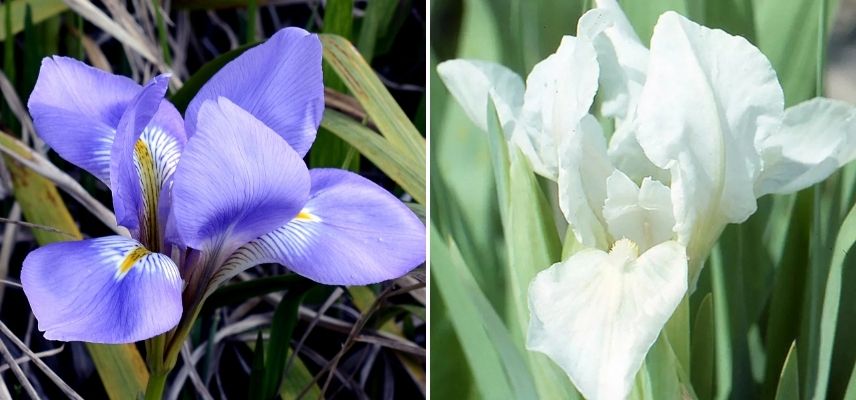
Left: Algerian iris; right: Iris pumila ‘Crispy’
Read also
Drought-resistant irisesFor fresh soils, water gardens, pond margins or banks: water irises
Choice here remains extremely wide, with species growing specifically in very cool, wet soils. These are either irises classified as marginal plants or submerged plants. Commonly known as water irises, they include many charming species. Many in this category can adorn garden water features:
Les Iris ensata or Japanese iris
From pink to violet, they are simply delightful. A few varieties flower bicoloured or yellow, but most are intense blue to violet. They are recognised by their drooping petals. Among favourites are the variegated-leaved species (Iris ensata ‘Variegata’), Iris ensata ‘Rose Queen’), a reliable choice with large pink flowers, and Iris ensata ‘Caprician Butterfly‘, a beautifully veined cultivar. As for Japanese iris ‘Crystal Halo’, violet with a white edge.
These irises are very hardy, allowing them to be planted in all regions, from north to south including mountainous areas. Plant in cool to moist soil, in sun or partial shade. They tolerate partial immersion in summer.
N.B.: they are also found under name Iris kaempferi. Learn more in Japanese iris: grow and care for.
Marsh iris (Iris pseudacorus)
Waterlogged ground and banks are their preferred domain! The species is appreciated for its sunny yellow blooms, from May or June, and for its ease of care. The marsh iris is superb planted en masse at edges of ponds or water features in large natural areas. It reaches 1 m in height when in flower. Its roots are valued for their filtering action year-round.
This splendid iris also exists, among others, in a cream version, a very fresh cultivar flowering from late spring to early summer, and with variegated foliage, striped with broad cream bands, in variety Iris versicolor ‘Variegata‘.
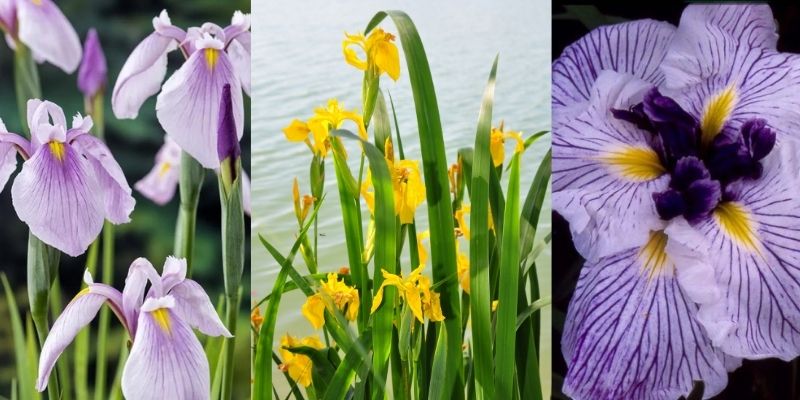
Iris ensata ‘Rose Queen’, Iris pseudoacorus, and Iris ensata ‘Caprician Butterfly’
Iris versicolor
Slightly shorter (about 80 cm when in flower), Iris versicolor are another option for planting marshy areas and waterlogged zones. They are deciduous. These are so-called marginal plants, which thrive in very cool, moist soil, banks being their preferred habitat.
The species is truly beautiful in its elegant simplicity with fine sepals spotted and a throat veined and coloured in cream and yellow. Plant on banks or even in a container converted into a mini-pond. It has also been developed into a few interesting versions for collectors: ‘Berlin Versilaev‘ in a deeper, almost purplish shade, ‘Dark Aura’ with evolving purple foliage, Iris versicolor ‘Variegata‘ with white-striped foliage, and many others…
Plant them submerged under water, or in waterlogged to very wet soil.
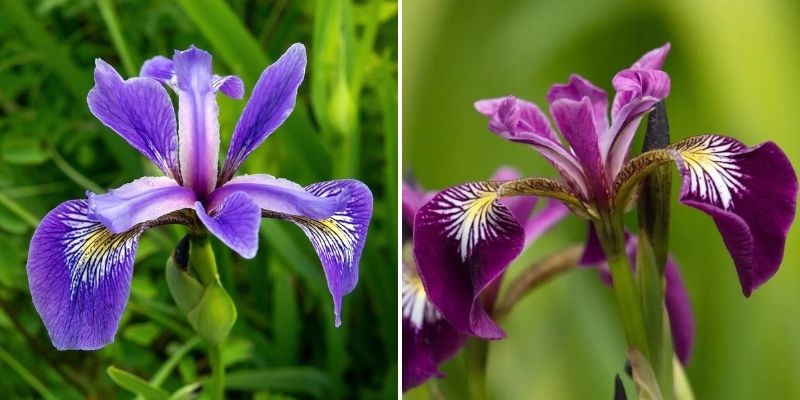
Iris versicolor and Iris versicolor ‘Berlin Versilaev’
Siberian irises
Iris sibirica, or Siberian iris, produces flowers in blue tones, though some cultivars are violet like Iris sibirica ‘Bundle of Joy‘ or bicoloured like ‘Ballerina Dance‘. It forms deciduous clumps, losing leaves in autumn. Species and various cultivars reach around 1 metre in height in flower, also flowering in May–June. ‘Blue King’ with pure blue, ‘Snow Crest‘ white with a yellow throat, are among those whose colours blend wonderfully into the garden in spring. In partial shade, blue varieties show their full brilliance.
All these water irises are very hardy, allowing them to be planted in all regions, from north to south including mountainous areas (where Algerian iris, only moderately hardy, should be avoided). Plant in cool to moist soil, in sun or partial shade.
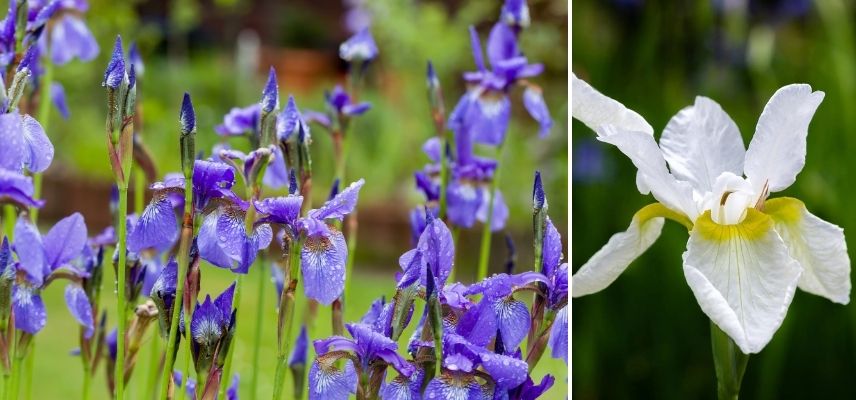
Species and Iris sibirica ‘Snow Crest’
For a scented garden: the most fragrant irises
Iris has been used in perfumery since Antiquity, and it is its rootstock that provides the powdery, woody fragrance prized by perfumers (notably Iris of Florence or Iris pallida). Yet some of them produce a delicately scented flower (although this is always subjective, and garden irises all smell to varying degrees). This is true only of bearded irises and of Iris pallida.
Among those interesting olfactorily: ‘Red Pike’ giving a spicy scent, ‘English Cottage‘ white, also well scented and repeat flowering, ‘Autumn Explosion’, ‘Color Carnival’, ‘Fragrance des sables’, ‘Dutch Chocolate’, a large garden iris with solid very coppery flowers, and a dwarf iris with an apt name, Iris pumila ‘Smell the Roses’ with a rose-like scent…
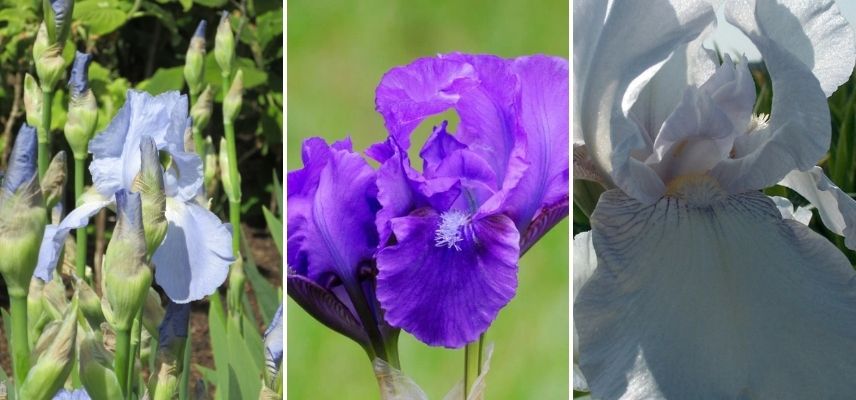
Iris pallida whose flower is also scented, Iris pumila ‘Smell The Roses’, and variety ‘English Cottage’
For shade garden: Iris gigot
Although they develop better in partial shade and tolerate non-scorching sun, the stinking irises (Iris foetidissima) can grow and flower in shade when the soil stays cool. This European iris takes its time to establish and produces discreet flowers and red fruiting with vivid seeds that persist until autumn, which is its main appeal.
There is a yellow-flowered variety, Iris foetidissima ‘Citrina’, and another with variegated foliage, Iris foetidissima ‘Variegata’. All stinking irises have evergreen foliage, providing year-round presence in partially shaded borders. They are among plants to use in dry shade.
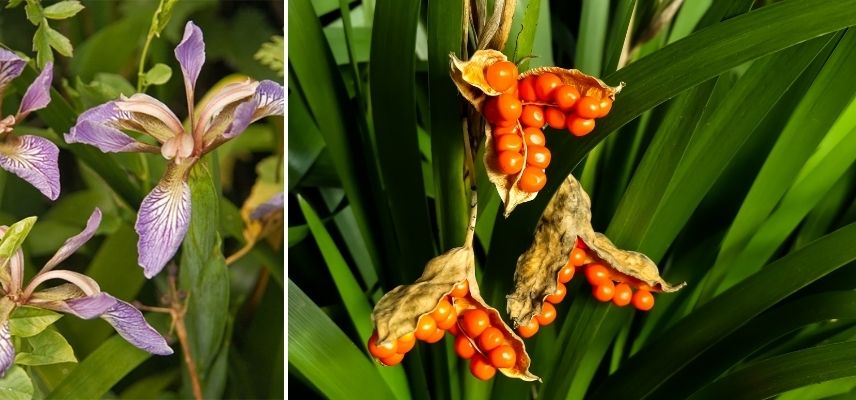
Flowering and fruiting of the stinking iris
For a monochrome garden: impressive diversity
Colour palette, developed over time by passionate American and European horticulturists, is such that you can find irises for a white garden, a yellow garden, a blue garden, a pink garden, an orange garden… Possibilities are truly many, either with single‑coloured irises or bicoloured ones, although hybridisers worldwide have not yet found a ‘true’ red for this plant.
Opt for ‘Natchez Trace’, a magnificent orange iris for hot borders, ‘Hysteria’, whose purple veins and orange beard enhance soft whiteness in a white garden, the more classic cobalt blue of the Dutch iris for any blue garden… Anything goes!
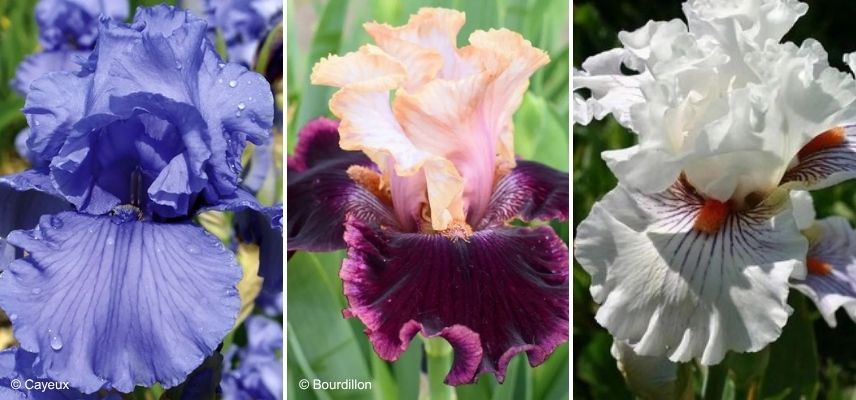
Iris germanica, from left to right: ‘Friendly Seas’, ‘Vanilla Berry’ and ‘Hysteria’
- Subscribe!
- Contents
This form is protected by reCAPTCHA - the Google Privacy Policy and Terms of Service apply.

































Comments