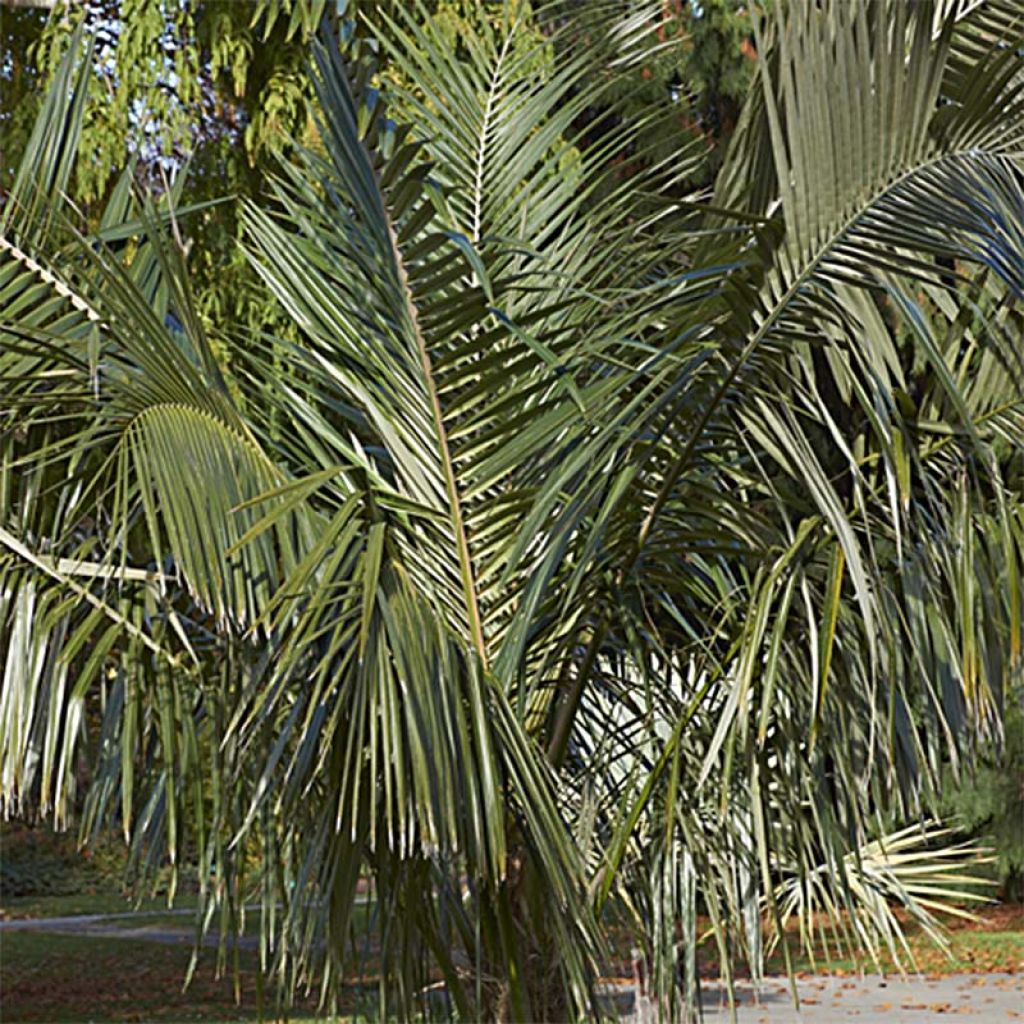
Parajubaea torallyi - Palm

Parajubaea torallyi - Palm

Parajubaea torallyi - Palm

Parajubaea torallyi - Palm
Parajubaea torallyi - Palm
Parajubaea torallyi
Back-to-school special offer!
Get €10 off for every €50 you spend! And get up to €40 off on a single order.
How does it work?
1. Shop your favourites
Add your favourite plants to your basket. For every €50 you spend (excluding delivery charges, store credit and the plastic-free option), you’ll receive a €10 voucher.
€50 spent = €10 voucher
€100 spent = €20 voucher
€150 spent = €30 voucher
€200 spent = €40 voucher
2. Place your order
Once your basket reaches one of the spending thresholds, place your order. You can even choose your delivery date!
3. Receive your voucher
As soon as your order has been shipped, you’ll receive an email containing your personal voucher code and its value.
4. Use it on your next order
Your voucher is valid for 90 days from the date you receive it. It can be used once only, on a new order worth at least the value of the voucher, excluding delivery charges.
Please note: Vouchers can be combined with other offers, but cannot be split or refunded.
Why not try an alternative variety in stock?
View all →
Available in 1 sizes
Available in 1 sizes

Available in 1 sizes
Available in 1 sizes
Available in 1 sizes
Available in 1 sizes
Available in 1 sizes
Available in 1 sizes

Available in 1 sizes
Available in 1 sizes
This plant carries a 24 months recovery warranty
More information
We guarantee the quality of our plants for a full growing cycle, and will replace at our expense any plant that fails to recover under normal climatic and planting conditions.
Would this plant suit my garden?
Set up your Plantfit profile →
Description
The Parajubaea torallyi is an elegant Bolivian palm tree, fast-growing and adapted to difficult conditions. Its only flaw is its relative hardiness, especially in heavy and humid soil. Native to dry and dusty Andean valleys where it grows between 2700 and 3400 m (8858 and 11155ft) altitude, subjected to frequent frosts, it is already abundantly planted in Portugal and Spain where its slender silhouette crowned with large finely cut green to grey-green leaves is appreciated along avenues. Becoming rare in its original lands due to human greed, this palm tree with edible fruits may find refuge in your garden. It tolerates limestone, withstands drought and cold down to -7°C (19.4°F)!
A fast-growing shrubby plant of the arecaceae family, highly appreciated as an ornamental plant, the Parajubaea torallyi thrives at high altitudes in dry habitats, receiving only 550 mm (22in) of water per year, on rocky soil of steep slopes, in dry forests, experiencing dry summers but also relatively cold temperatures in winter. It is now endangered in its very restricted natural habitat.
The plant, referred to as unicaule, produces only one trunk called a stipe, reaching up to 10 m (33ft) in height and 20 cm (8in) in diameter at an advanced age. It carries at its top a dense crown, at least 5m (16ft) wide. The stipe is covered with a thick layer of fibers and leaves, it has a tapering appearance during the first 10 to 15 years, then becomes columnar. The crown can have up to 20 pinnate leaves, 3 to 5m (10 to 16ft) long, rigid, leathery, erect to slightly pendulous at the periphery, dark green and striated on the upper side, slightly silver on the underside of young leaves. This cluster of leaves hides in its center the unique meristem responsible for the growth of this palm tree. The growth rate is directly related to the more or less favorable conditions of the environment; faster in deep, fertile and moist soil, a little slower in the opposite case. Flowering only occurs after many years. Large inflorescences, over 1m (3ft) long, covered with brown velvet, appear among the lower leaves. They are composed of numerous unisexual flowers, male or female. After fertilization, the fruits resemble small coconuts, 5 to 10 cm (2 to 4in) in diameter, gathered in clusters weighing up to 15 kg. The fruits will ripen in favorable climates.
This elegant palm tree, which has recently appeared in southwestern Europe and California, seems to have a promising future. It is not demanding in terms of water and heat, accommodating in terms of soil if it is well-drained, and quickly makes a strong impression in a mild climate garden. In the ground, it can be placed in isolation, not far from a swimming pool for example, in the company of banana trees or yuccas, in an exotic-inspired setting. But this species, very drought-resistant, will express its full potential in a Mediterranean-style garden, accompanied by Cycas or the Duprez Cypress (Cupressus dupreziana), a true Saharan relic almost extinct in its native Tassili des Ajjers. A bit difficult to associate due to its strong personality, it can nevertheless be planted in groups of 3 subjects and surrounded by a carpet of thyme, a sowing of California Poppies, or a bench of Felicia. A contemporary garden will adopt it above a tide of white pebbles.
Report an error about the product description
Parajubaea torallyi - Palm in pictures


Plant habit
Flowering
Foliage
Botanical data
Parajubaea
torallyi
Arecaceae
South America
Planting and care
Plant the parajubaea torallyi in a light, perfectly drained soil, even poor, sandy, rocky and dry in summer. It tolerates limestone well, but does not disdain a humus-rich soil. It will also appreciate a cooler, deeper and fertile soil, as long as water does not stagnate in it during winter. The ideal is to plant it in a mixture of coarse sand, gravel, leaf compost and garden soil, which will effectively drain winter moisture. Install it in a sheltered position from cold and dry winds, protect young plants during the first 3 years. At temperatures around -7/-8°C (19.4/17.6°F), a well-established specimen, a few years old, will probably lose its leaves, but the crown will reform in spring. Protect the stem with a winter cover, and even a thick mulch. Easy to grow, it requires little maintenance, with its leaves often falling off naturally when they reach the end of their life.
Planting period
Intended location
Care
Planting & care advice
-
-
-
-
-
-
-

-
This item has not been reviewed yet - be the first to leave a review about it.
Recently viewed products
Haven't found what you were looking for?
Hardiness is the lowest winter temperature a plant can endure without suffering serious damage or even dying. However, hardiness is affected by location (a sheltered area, such as a patio), protection (winter cover) and soil type (hardiness is improved by well-drained soil).

The flowering period indicated on our website applies to countries and regions located in USDA zone 8 (France, the United Kingdom, Ireland, the Netherlands, etc.)
It will vary according to where you live:- In zones 9 to 10 (Italy, Spain, Greece, etc.), flowering will occur about 2 to 4 weeks earlier.
- In zones 6 to 7 (Germany, Poland, Slovenia, and lower mountainous regions), flowering will be delayed by 2 to 3 weeks.
- In zone 5 (Central Europe, Scandinavia), blooming will be delayed by 3 to 5 weeks.
In temperate climates, pruning of spring-flowering shrubs (forsythia, spireas, etc.) should be done just after flowering.
Pruning of summer-flowering shrubs (Indian Lilac, Perovskia, etc.) can be done in winter or spring.
In cold regions as well as with frost-sensitive plants, avoid pruning too early when severe frosts may still occur.
The planting period indicated on our website applies to countries and regions located in USDA zone 8 (France, United Kingdom, Ireland, Netherlands).
It will vary according to where you live:
- In Mediterranean zones (Marseille, Madrid, Milan, etc.), autumn and winter are the best planting periods.
- In continental zones (Strasbourg, Munich, Vienna, etc.), delay planting by 2 to 3 weeks in spring and bring it forward by 2 to 4 weeks in autumn.
- In mountainous regions (the Alps, Pyrenees, Carpathians, etc.), it is best to plant in late spring (May-June) or late summer (August-September).
The harvesting period indicated on our website applies to countries and regions in USDA zone 8 (France, England, Ireland, the Netherlands).
In colder areas (Scandinavia, Poland, Austria...) fruit and vegetable harvests are likely to be delayed by 3-4 weeks.
In warmer areas (Italy, Spain, Greece, etc.), harvesting will probably take place earlier, depending on weather conditions.
The sowing periods indicated on our website apply to countries and regions within USDA Zone 8 (France, UK, Ireland, Netherlands).
In colder areas (Scandinavia, Poland, Austria...), delay any outdoor sowing by 3-4 weeks, or sow under glass.
In warmer climes (Italy, Spain, Greece, etc.), bring outdoor sowing forward by a few weeks.
Shipping country and language
Your country of residence may be:
Your country of residence is:
For a better user experience on our website, you can select:
Your shipping country:
-
 Austria
-
 Belgium
-
 Bosnia & Herzegovina
-
 Bulgaria
-
 Croatia
-
 Cyprus
-
 Czechia
-
 Denmark
-
 Estonia
-
 Finland
-
 France
-
 Germany
-
 Greece
-
 Hungary
-
 Iceland
-
 Ireland
-
 Italy
Italy
-
 Latvia
-
 Liechtenstein
-
 Lithuania
-
 Luxembourg
-
 Malta
Malta
-
 Netherlands
-
 Poland
-
 Portugal
-
 Romania
-
 Serbia
-
 Slovakia
-
 Slovenia
-
 Spain
Spain
-
 Sweden
-
 Switzerland
Language:
-
French
-
 English
-
Spanish
-
Italian
-
German
-
Portuguese
-
Dutch
-
Finnish
My Account
Hello
My wish lists
My cart
Log in / Register
Existing customer?
This form is protected by reCAPTCHA - the Google Privacy Policy and Terms of Service apply.
New customer?
Create an account to track your orders, access our customer service and, if you wish, make the most of our upcoming offers.